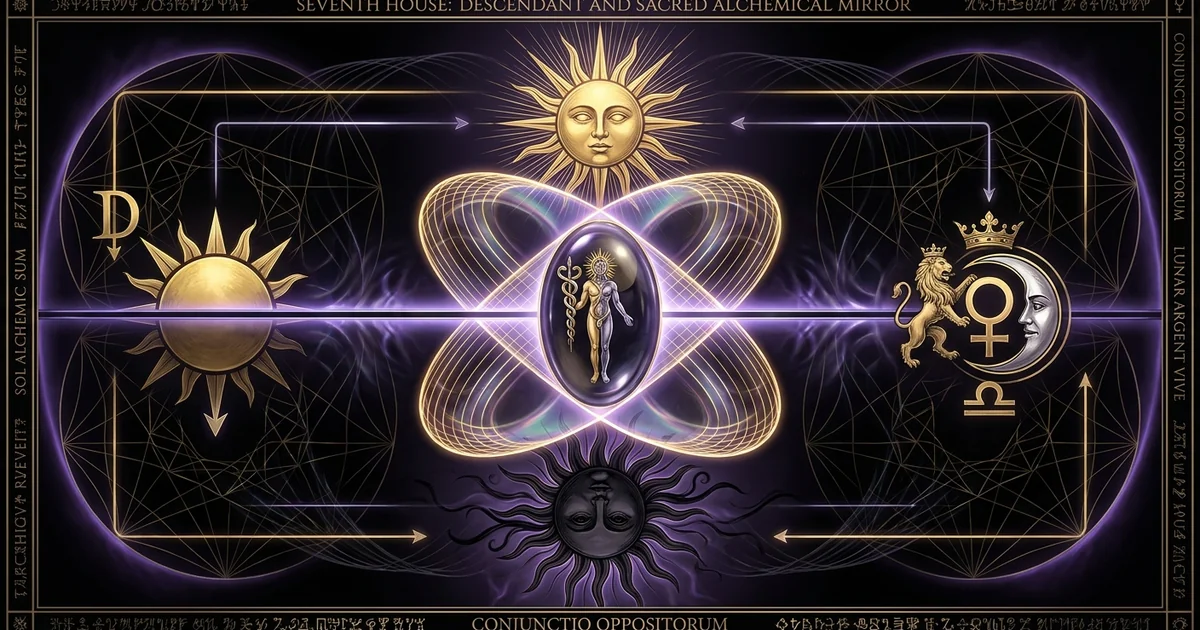
Seventh House: Descendant and Sacred Alchemical Mirror
Archetypal Thesis & Systemic Paradigm: The Horizon of the Transpersonal Mirror
The Descendant as the Thermodynamic Boundary of Ego-Identity
In the celestial architecture of the twelve natal chart houses, the Seventh House, anchored by the Western angle known as the Descendant (Dysis), marks the definitive boundary where the subjective ego terminates and objective reality commences. While the primary angle of the Orient—the Ascendant—governs the dawn of the somatic vehicle, primordial vitality, and the unmediated assertion of consciousness explored in /astrology/first-house-ascendant-individuation, the Occident demarcates the exact astronomical and psychological threshold where the solar diurnal arc plunges beneath the earth into darkness. Thermodynamically, if the First House represents an open system expending radiant metabolic energy to forge an idiosyncratic personal identity, the Seventh House serves as the dissipative structure’s environmental boundary. It is here that self-generated consciousness collides with the friction, entropy, and sovereign agency of the external collective.
The seventh house astrological meaning cannot be reduced to exogamous legal contracts or superficial partnership indicators. It functions as an ontological horizon. When an individual casts an archetypal projection across this 180-degree meridian, the celestial mechanics demand an immediate reckoning with alterity. In cosmological physics, every action demands an equal and opposite reaction; similarly, in archetypal mechanics, the unilateral emergence of the subjective self (ego) inevitably produces a polar counterpart in the collective field (alter). The Descendant represents that precise coordinate where psychic energy undergoes phase-transition from intrapsychic impulse to interpersonal phenomenon. It is the crucible where individual agency recognizes that its autonomy is radically conditioned by the existence of a non-ego possessing equivalent ontological validity.
Enantiomorphic Inversion: The Shadow Cast Across the Western Horizon
The psychological dynamics of the Seventh House operate by the law of enantiomorphic projection—a structural inversion wherein disowned, unassimilated intrapsychic material is mirrored across the horizontal axis of consciousness. As consciousness crystallizes around the Ascendant’s sign and planetary disposition, it systematically represses qualities incompatible with its cultivated persona. These rejected contents do not evaporate into psychic void; instead, obeying the conservation of psychic energy, they migrate directly across the diameter of the wheel to crystallize at the Occident. The Descendant becomes the cosmic screen upon which the native’s repressed, compensatory shadow is projected.
Because the human ego operates under the illusion of internal cohesion, it remains blind to its unconscious bifurcations. When confronted with planetary energies tenanting or ruling the Seventh House, the unindividuated consciousness experiences them not as self-generated impulses, but as alien intrusions arriving from without. The external partner, the contractual co-signatory, or the litigious adversary is invariably perceived as the sole repository of these archetypal dynamics. Through this enantiomorphic inversion, a native with an aggressive, martial Seventh House may experience themselves as entirely peace-loving and diplomatic, while perpetually navigating a reality populated by antagonistic, domineering figures. The Western horizon acts as a metaphysical mirror that forces the native to confront externally what they refuse to integrate internally.
The Dialectical Dyad: Transcendence of the Solipsistic First House
To mature beyond the solipsistic confinement of the First House, consciousness must undergo the systemic shock of the dyad. In archetypal psychology, the transition from the monad to the dyad represents the inaugural movement of ethical awareness. Without the oppositional tension generated by the Seventh House, the psyche remains arrested in infantile narcissism, operating as if the macrocosm were merely an extension of subjective somatic appetite. The Descendant introduces the necessity of negotiation, compromise, and relational alchemy. It is the operational theater of the Syzygy—the pairing of polar archetypes—demanding that consciousness hold two contradictory truths simultaneously: the integrity of the autonomous Self and the autonomous sovereignty of the Other.
Through this relational tension, the Seventh House breaks the pristine, non-reflective isolation of the native. Analytical psychology, contextualized alongside esoteric cartography in /divination/jungian-archetypes-tarot-alchemy, reveals that genuine transformation occurs only when the psyche encounters an intractable obstacle that cannot be assimilated by the conscious will. The Seventh House delivers precisely this obstacle in the form of the beloved or the enemy. By engaging with the Other as an externalized component of the total psyche, the individual is drawn into a transformative dialogue that systematically dismantles persona identification, initiating the preliminary stages of the conjunctio oppositorum—the sacred union of opposites.
Ascendant / First House (Orient)
- Astronomical Metric: Point of diurnal ascension; solar emergence above the horizon.
- Psychological Function: Subjective ego-crystallization; persona deployment; somatic vitality (prana).
- Directional Force: Centrifugal; expressive outward projection of personal will into the world.
- Archetypal Dynamic: The Heroic Monad; unmediated self-assertion; the Aries/Mars primordial impulse.
- Systemic Stance: The primary observer looking outward; identification with the immediate conscious field.
Descendant / Seventh House (Occident)
- Astronomical Metric: Point of diurnal occultation; solar descent beneath the horizon into darkness.
- Psychological Function: Transpersonal confrontation; Shadow/Anima encounter; alterity integration.
- Directional Force: Centripetal; inward reflection via relational feedback mechanisms.
- Archetypal Dynamic: The Sacred Syzygy; dialectical reconciliation; the Libra/Venusian relational field.
- Systemic Stance: The reflective mirror; recognition of autonomous external agencies conditioning the self.
Classical Provenance & Textual Lineage: From Hellenistic Dysis to the Uxor House
Hellenistic Dysis: The ‘Place of Sinking’ and Bodily Decline in Valens and Ptolemy
In Hellenistic astrology, the Seventh House was designated as the Dysis (Δύσις), meaning the Setting Place or the Western Pivot (kentrōn dytikon). Far from being viewed strictly through the lens of modern romantic affiliation, the ancient authors approached the Seventh House with profound ambivalence, rooted in its astronomical function as the place of stellar death, disappearance, and descent into the chthonic realms. In Book III of the Tetrabiblos, Claudius Ptolemy classifies the Descendant as an angular pivot (kentron), yet one intrinsically associated with bodily weakness, termination, and the transition into decrepitude, because it is at this precise coordinate that planets lose their light and are subsumed by the darkness of the lower hemisphere.
Vettius Valens, writing in Book II of the Anthologies, contextualizes the Dysis not merely as the locus of conjugal alliances, but as an operative signifier of mortality, legal contestation, and foreign wanderings. Because the Descendant opposes the Horoskopos (Ascendant), which bestows life (vitalis), the Seventh House was understood by Hellenistic practitioners to extract vital energy. It was seen as the quadrant through which fate intervenes via external agencies, often stripping the native of subjective control. Relationships were understood as fated entanglements (moira) that bound the native to societal duties, debt structures, and potential liabilities, demonstrating that the Hellenistic mind perceived partnership not as an escape into romantic fantasy, but as an existential confrontation with destiny and vulnerability.
“The Setting Place [Dysis] is the pivot of the occultation of the light, indicating the twilight of life, old age, and the completion of enterprises. It holds dominion over matters concerning alliances, the quality of marriages, and the presence of legal disputes. When malefics transit or hold domicile herein without the mitigation of benefics, they bring violent separations, bodily infirmities, and reveal the hidden machinations of those who oppose the native in public contention.”
The Medieval Reconceptualization: Legal Contracts, Open Enmities, and the Uxor House
As astrological technique was translated into Syriac, Arabic, and subsequently Latin during the early medieval period, the conceptualization of the Seventh House crystallized into rigid functional classifications. Arabic scholars such as Abu Ma’shar (848 CE) in The Great Introduction to the Science of the Astrology systematized the houses into distinct topical categories. In this framework, astrological house 7 was explicitly designated as the house of marriage, open enemies (inimici manifesti), partnerships, treaties, and lawsuits. Western Latin authors translated this topical assignment under the rubric of the uxor house (the house of the wife/spouse).
The apparent paradox of allocating both matrimonial devotion and ferocious open enmity to the exact same house reveals an underlying systemic brilliance. Medieval astrology recognized that both a spouse and a sworn adversary share identical structural characteristics: they are autonomous entities operating outside the subjective boundary of the native, possessing parity of standing. Unlike the hidden enemies of the Twelfth House, who strike invisibly via sabotage and deceit, the enemies of the Seventh House fight in broad daylight across a delineated field of battle or within a court of law. In the jurisprudence of medieval astrology, the marriage pact and the formal declaration of war were derived from the same legal architecture—a public, bilateral agreement between two distinct wills governed by mutual obligation and contested terrain.
William Lilly and Renaissance Horary: Delineating Marriage and Contestation
By the seventeenth century, William Lilly brought the delineation of the Seventh House to its highest technical synthesis in his masterwork, Christian Astrology (1647). Operating within the precise parameters of the horary and natal tradition, Lilly established absolute rules for evaluating whether the Seventh House yielded marital concord or ruinous conflict. In Book II, Lilly states that the Seventh House provides judgment:
“Of Marriage, and of all manner of Love-questions; of publick Enemies, of Factions in War, of the Person with whom the native contendeth in lawsuits; of all Bargains and Contracts, whether they shall be advantageous or not; and in Horary questions, it signifies the Physician, if the question be of Sickness; the Thief, if the question be of Theft.”
Lilly recognized that the planetary lord of the Seventh House, along with any planets tenanting the house, revealed the exact nature, temper, and moral disposition of the person with whom the querent was fated to engage. If the ruler of the First and the ruler of the Seventh applied to each other by friendly aspect (trine or sextile) with mutual reception, peace and reciprocal synthesis were assured. If, conversely, the rulers approached via a square or opposition without reception, the engagement resulted in protracted discord, infidelity, or legal destruction. Lilly’s operational methodology underscored a profound metaphysical principle: the Seventh House reveals the exact quality of the counter-force summoned by the native’s actions, demonstrating that conflict and union are twin branches of a single relational root.
Structural Mechanics & Symbolic Geometry: Planetary Rulers, Accidental Dignities, and Oppositional Vectors
Geometric Opposition: The 180-Degree Aspect as Alchemical Tension
The structural integrity of the Seventh House is governed by the 180-degree aspect, the diameter that bisects the celestial sphere into two equal hemispheres. In the language of sacred geometry explored in /sacred-geometry/oppositional-geometry-harmonics, the opposition is the most acute, polarizing geometric relationship possible between two points. It is not an aspect of passive resonance like the trine, nor of latent opportunity like the sextile; it is an aspect of pure, kinetic, Heraclitean tension. Heraclitus observed that “war is the father of all things,” positing that harmony is achieved only through the continuous equilibrium of opposing forces pulling against one another, much like the tension of the bow and the lyre.
ASC (0°) <==================== 180° ====================> DSC (180°)
[Subjective Ego]           [Tension Vector]           [Objective Mirror]
This 180-degree oppositional vector creates an irreducible dialectic. When a planet occupies the Seventh House, it does not exist in isolation; it establishes an inescapable dynamic vector toward the First House and the Ascendant. If an individual fails to actively integrate the planetary archetypes residing within the Seventh House, those planetary forces pull violently against the Ascendant, destabilizing the native’s physical vitality and psychological equilibrium. The structural mandate of the opposition requires the native neither to eliminate the polar opposite nor to collapse into enmeshment, but to sustain the tension of the opposites until a third, higher perspective emerges that transcends the binary division.
The Planetary Ruler of the Delineated Cusp: Tracking the Alchemical Agent
To decipher the specific psychological and material morphology through which the Seventh House operates, the astrologer must track the planetary ruler of the sign residing on the Descendant cusp. This planetary lord serves as the operational psychopomp—the alchemical agent charged with mediating between the native’s ego and the exterior collective. The sign on the Descendant establishes the baseline atmospheric conditions and expectations governing partnership, while the condition, placement, and aspects of its domicile ruler illustrate where and how this relational alchemy will physically manifest.
If the cusp of the Seventh House falls in Capricorn, the Descendant demands that relationships be governed by Saturnian principles: structural endurance, sobriety, boundary definition, and temporal maturation. The native will habitually reject superficial or volatile affiliations, seeking instead partners who act as ballast, paternal figures, or austere taskmasters.
However, the final destiny of this configuration depends entirely upon the position of Saturn in the natal chart. If Saturn is situated in the Tenth House in Libra (in exaltation), the partner functions as a prestigious, stabilizing pillar that elevates the native’s societal standing. If Saturn is situated in the Fourth House in Aries (in fall and accidental debility), the partner may reflect the native’s internalized feelings of familial abandonment, manifesting as coldness, domestic tyranny, or burdensome isolation. Tracking the planetary lord unmasks the exact physical vessel through which the unconscious projection is staged in the theater of the world.
Intersecting Lots: The Lot of Marriage (Kleros Gamou) and Venusian Dignity
In classical and Hellenistic methodology, delineation of the Seventh House is incomplete without calculating the mathematical Lots (kleroi), most notably the Lot of Marriage (Kleros Gamou). Synthesizing the precise angular distance between personal planets and projecting it from the Ascendant, the Lot of Marriage isolates the specific energetic signature governing formal unions.
For diurnal charts, the classical calculation of the Lot of Marriage traditionally projects the distance from Saturn to Venus from the Ascendant; for nocturnal charts, the order is inverted, measuring from Venus to Saturn.
$$\text{Lot of Marriage (Diurnal)} = \text{Ascendant} + \text{Venus} - \text{Saturn}$$ $$\text{Lot of Marriage (Nocturnal)} = \text{Ascendant} + \text{Saturn} - \text{Venus}$$
This specific planetary pair—Venus, the archetype of erotic attraction and relational cohesion, and Saturn, the archetype of binding oaths, institutional containment, and temporal consequence—reveals the rigorous classical understanding of matrimonial alliances. Marriage was not viewed as an unmoored Venusian pleasure cruise, but as a binding Saturnian covenant.
When evaluating the Seventh House, the astrologer must determine the accidental dignity of Venus—its angularity, house placement, speed, and freedom from the rays of the Sun (combustion). A Venus possessing high accidental dignity, placed in an angular house and unmolested by malefic aspects, can salvage a difficult Seventh House cusp. Conversely, a retrograde Venus combust the Sun and placed in the cadent Twelfth House can render the realization of harmonious Seventh House dynamics exceptionally arduous, indicating that the native must work through complex karmic knots and psychological blind spots before the mirror of the Descendant clears of distorting illusions.
Psychological Dynamics & Operational Praxis: The Shadow, Anima/Animus, and the Conjunctio Oppositorum
Projective Identification: The Partner as the Living Shadow
In the praxis of analytical psychology, the natal chart houses provide a detailed structural map of intrapsychic geography. Within this framework, the Seventh House serves as the premier domain of projective identification. Planets occupying the Seventh House are frequently dissociated from early conscious ego-development. Because the child must adapt to the constraints of familial and cultural expectations, archetypal energies that threaten the persona are systematically disowned. A child with Mars tenanting the Seventh House, raised within an environment that penalizes aggression, self-assertion, or anger, will bury their own martial drive deep within the unconscious.
Subjective Core [Ascendant]
       | (Disowns Aggression/Mars)
       v
Unconscious Repression
       |
       +---> Projective Arc ---> External Partner [Descendant]
                                        | (Acts out unintegrated Rage/Assertion)
                                        v
                            Ego perceives Partner as "Hostile"
In adulthood, this repressed planetary energy exerts an irresistible magnetic pull. The native does not cease to be a martial being; rather, their disowned Mars operates through the centripetal pull of the Descendant, attracting partners, employers, or open adversaries who embody extreme, raw, or even toxic expressions of Mars.
The native then adopts the stance of the innocent victim, complaining that they are perpetually surrounded by volatile, domineering individuals, utterly oblivious to the fact that their own unconscious engineered the encounter. The partner is drafted into service as the living Shadow, compelled by subtle psychological cues to play out the unintegrated planetary drama that the native refuses to consciously enact.
The Syzygy at the Threshold: Anima/Animus Entanglement across the 7th Cusp
The Seventh House is the primary threshold across which the Syzygy—the contrasexual archetypal complex of the Anima (the unconscious feminine within the man) and the Animus (the unconscious masculine within the woman)—is externalized. When an individual falls into state of romantic infatuation, they are rarely engaging with the empirical reality of the human being sitting across from them. Instead, they are struck by the numinous radiance of their own projected Anima or Animus, mapped precisely to the contours of the Seventh House cusp and its planetary denizens.
“Projection is never made; it happens, it is simply there. In the darkness of anything external to me I find, without recognizing it as such, an interior or psychic life that is my own… The projection-making factor is the Anima, or rather the Animus, which through their fascinating, compelling, and emotional power cast an enchantment over the conscious mind, weaving an illusion that makes the external world appear in the colors of the unconscious.”
When a man possesses Neptune in the Seventh House, his Anima wears the mantle of the mystical sea-nymph, the ethereal poetess, or the tragic, helpless victim requiring divine salvation. He will consistently overlook pragmatic, self-sufficient women, falling instead under the spell of individuals who embody an elusive, deceptive, or psychologically fragmented nature.
The tragic arc of such relationships occurs when the empirical human partner inevitably fails to sustain the weight of the divine archetype. The illusion collapses, yielding bitterness, disillusionment, and claims of betrayal. Operational psychological praxis requires recognizing that the transpersonal, numinous qualities perceived in the partner belong fundamentally to the native’s own inner Syzygy, demanding intrapsychic integration rather than interpersonal possession.
Alchemical Conjunctio: Transmuting Relational Strife into Individuation
The ultimate esoteric goal of the Seventh House is the realization of the conjunctio oppositorum—the alchemical sacred marriage wherein base psychological conflict is transmuted into spiritual gold (aurum non vulgi). In classical alchemy, the work cannot proceed without the vessel remaining hermetically sealed. The Seventh House, through the institution of marriage, solemn contracts, and long-term commitments, provides this exact alchemical athanor. The friction generated within an enduring relationship creates the thermodynamic heat (calcinatio) required to break down the rigid, calcified defenses of the individual ego.
To utilize the Seventh House as a dynamic vehicle for individuation, the native must transition from reactive projection to operational synastric analysis, a discipline examined extensively in /astrology/synastry-composite-chart-mechanics. When relational strife arises, instead of pathologizing the partner, the practitioner treats the friction as an epistemological diagnostic.
If the partner’s behaviors trigger acute indignation or emotional turbulence, the native interrogates what specific planetary dignity or repressed complex on the Descendant is being ignited. By identifying the partner as an ontological mirror, the individual systematically reclaims the disowned psychic faculties previously outsourced to the other. In this consecrated paradigm, relational conflict is no longer a justification for termination or warfare, but a direct summons to psychic wholeness.
Philosophical Synthesis & Macrocosmic Correspondence: Hermetic Polarity and Systems Dynamics
The Axiom of Polarity: The Descendant within the Kybalion Framework
The structural architecture of the Seventh House validates the fourth Hermetic axiom detailed in the Kybalion—the Principle of Polarity: “Everything is Dual; everything has poles; everything has its pair of opposites; like and unlike are the same; opposites are identical in nature, but different in degree; the extremes meet; all truths are but half-truths; all paradoxes may be reconciled.” Within this cosmological framework, the First House and the Seventh House are not two disparate entities colliding across a void; they are the two polar terminals of a single unbroken continuum of consciousness.
The enemy and the spouse, love and hate, identity and alterity inhabit identical cosmological territory. They are differentiated only by the degree of vibrational resonance and conscious awareness brought to bear upon the axis. When an astrologer studies the Seventh House, they are looking directly at the Ascendant turned inside out. The qualities that an individual violently denounces in their open adversary are the precise inverse manifestations of the qualities they cling to within their own egoic self-conception.
The Descendant proves that in the grand mechanics of fate, one cannot possess light without generating shadow, nor can one declare “I am” at the Eastern horizon without simultaneously summoning “Thou art” at the Western gate.
The relational dynamic of the Seventh House finds precise macrocosmic correspondence across multiple sacred diagnostic systems:
- The Qabalistic Tree of Life: The Descendant axis reflects the dynamic balance between the Sephirah Geburah (Severity/Judgment, ruling the boundary separation of the First House ego) and Chesed (Mercy/Expansion), synthesizing at the vertical threshold between Tiphereth (the integrated solar Self) and Netzach (Venusian relational desire and reciprocal harmony).
- I Ching (Book of Changes): The Seventh House corresponds directly to Hexagram 31 (咸 - Xian / Influence / Mutual Attraction). The hexagram comprises Lake (Dui) above Mountain (Gen); the rigid, solitary mountain yields inward to contain the receptive waters of the lake, establishing the metaphysical imperative that true partnership requires the voluntary yielding of the firm ego to receive the impression of the Other.
Relational Cybernetics: Autopoiesis, Mutual Causality, and Dynamic Equilibrium
Interpreted through modern systems dynamics and cybernetics, the First House–Seventh House axis operates as an autopoietic feedback loop. In the terminology of cognitive biologists Humberto Maturana and Francisco Varela, living systems are self-generating networks that continuously maintain their identity through interactions with an environment that perturbs them. The Seventh House is the operational locus of these perturbations. The native cannot be modeled as an isolated, linear agent exercising free will across an indifferent landscape; rather, the native is an emergent node within an interconnected, systemic web.
In cybernetic theory, linear causality ($A \to B$) is recognized as an epistemological illusion. Within the relational architecture of the Seventh House, causality is strictly circular ($A \leftrightarrow B$). The behavior of the native (First House) conditions the behavior of the partner (Seventh House), which in turn feeds back into and alters the initial state of the native.
When this feedback loop remains unconscious, it manifests as homeostatic stagnation: a couple perpetually locked in repetitive, exhausting conflict cycles, each blaming the other for initiating the sequence. When conscious cybernetic principles are applied to the Seventh House, both participants recognize that they are co-generating the relational field. A perturbation introduced at the Descendant is simultaneously an adjustment to the Ascendant, revealing that self-transformation and relational transformation are structurally identical.
The Macrocosmic Marriage: From Microcosmic Union to Universal Harmony
Beyond its psychological and interpersonal operations, the Seventh House serves an exalted cosmological function: it is the earthly gateway to the macrocosmic unio mystica. The descent of the Sun beneath the Seventh House cusp every evening is the daily cosmological enactement of the soul’s incarnation into matter, the plunging of spirit into form, and the divine willingness to undergo limitation for the sake of communion.
In Sufi metaphysics, particularly the visionary cosmology of Ibn Arabi, the universe was brought into manifestation through the “Sigh of the Compassionate” (Nafas al-Rahman) because the Divine desired to be known. The absolute, unmanifest Godhead stood in the position of the First House: infinite, unified, yet unmirrored. To achieve self-knowledge, the Divine projected the entire macrocosm in all its multiplicity, establishing the universe as a vast Seventh House mirror. Every creature, every star, and every human encounter is an operational aperture through which the cosmos views, challenges, and knows itself.
When an individual consciously steps into the Seventh House, shedding the defensive armaments of the isolated ego to truly meet the Other in profound parity and truth, they are not merely negotiating an earthly partnership. They are participating in the cosmic rite through which the universe reconciles its self-imposed estrangement, transmuting the illusion of division back into radiant, non-dual awareness.
Frequently Asked Questions
Deciphering Empty Seventh Houses vs. Multiple Planet Occupancies
An unoccupied Seventh House is one of the most frequently misunderstood signatures in natal chart interpretation, often erroneously thought to indicate an absence of relational destiny, an inability to marry, or an ascetic existence. In astrological mechanics, a house without planets is not a vacuum; it merely indicates that the relational domain is not a theater of primary archetypal turbulence or karmic fixation. The operative mechanics of an empty Seventh House are decoded entirely by locating its domicile lord—the planetary ruler of the sign residing on the Descendant cusp. The house position, sign placement, aspects, and essential and accidental dignities of this ruler will dictate the narrative arc, quality, and manifestation timeline of partnerships. If a chart possesses an empty Seventh House with Taurus on the cusp, and Venus is exquisitely placed in the Tenth House in Libra forming a trine to Jupiter, the individual will experience deeply harmonious, socially elevating, and stabilizing partnerships despite the absence of resident planets on the Descendant.
Conversely, multiple planets tenanting the Seventh House transform the relational horizon into a high-voltage, crowded alchemical vessel. A native with a stellium comprising Mars, Saturn, and Mercury in the Seventh House will not experience relationships as a tranquil refuge; instead, partnership becomes the central arena of their existential individuation. Such configurations indicate competing archetypal demands mapped onto the external partner. The native may alternately demand intellectual agility (Mercury), disciplined structure (Saturn), and passionate combat (Mars) from their companions, frequently leading to relational volatility until each distinct planetary energy is consciously recognized, integrated, and afforded balanced expression within the native’s own psychic constitution.
Resolving Open Enemies vs. Marital Partners in Seventh House Delineation
The classical convergence of both beloved spouses and fierce open enemies (inimici manifesti) within the Seventh House represents a profound psychological and technical truth that modern delineations often obscure. Historically and mechanically, both figures occupy the exact same topological space: they are autonomous entities standing directly opposite the native on equal footing, bound by formal rules of engagement. The bifurcation between whether a Seventh House planet manifests as an intimate ally or a sworn adversary is determined by the psychological mechanism of projection, the planetary aspects involved, and the presence or absence of mutual reception between the rulers of the First and Seventh Houses.
When the ruler of the First House and the ruler of the Seventh House form challenging aspects (such as an uncompromising 180-degree opposition or a 90-degree square) without the mitigation of harmonious essential dignities or mutual reception, the relational energy defaults to contestation. The native projects their unintegrated shadow onto the other, perceiving their presence as an existential threat to personal sovereignty, thereby summoning an open enemy. If, however, there is mutual reception—where the planetary lord of the First resides in the dignity of the Seventh, and the lord of the Seventh resides in the dignity of the First—the encounter resolves into marital union and deep cooperative harmony. The house demonstrates that love and warfare are identical systemic energies operating under different communicative vectors; the adversary is simply the spouse whose alterity the native has refused to love, while the spouse is the enemy with whom the native has negotiated an alchemical truce.
The Descendant’s Impact on Business Partnerships and Legal Contracts
Because the Seventh House governs all formal, bilateral peer agreements executed within the public eye, its mechanics govern corporate mergers, commercial partnerships, legal litigation, and binding treaties just as rigorously as matrimonial oaths. In classical jurisprudence, a business contract mirrors a marriage: two independent parties voluntarily relinquish a portion of their unilateral autonomy to construct a shared third entity possessing legal and financial reality. When an astrologer delineates the Seventh House for professional concerns, the condition of the Descendant cusp and its planetary ruler reveals the fiduciary reliability, ethical alignment, and ultimate profitability of any prospective business associate.
A Seventh House afflicted by the presence of a debilitated Neptune warns of catastrophic boundary dissolution, financial embezzlement, hidden deficits, or deceptive misrepresentations within business contracts; the prospective partner will appear as a financial savior but manifest as a dissolution engine.
Conversely, a Seventh House tenanted by a dignified Mercury or Jupiter with positive receptions to the Midheaven (Tenth House) or the Second House of liquid assets indicates exceptionally lucrative corporate alliances, ethical co-signatories, and triumph in contractual negotiations. In the courtroom, the Seventh House signifies the opposing counsel and adversary; if the native’s First House ruler is stronger by accidental dignity (angular, swift in motion, free from combustion) than the Seventh House ruler, the native will prevail in litigation. If the Seventh House ruler is dominant, the adversary will win the judgment, validating the ancient horary axiom that the Descendant rules all who dare to contest our will in the open forum of the world.