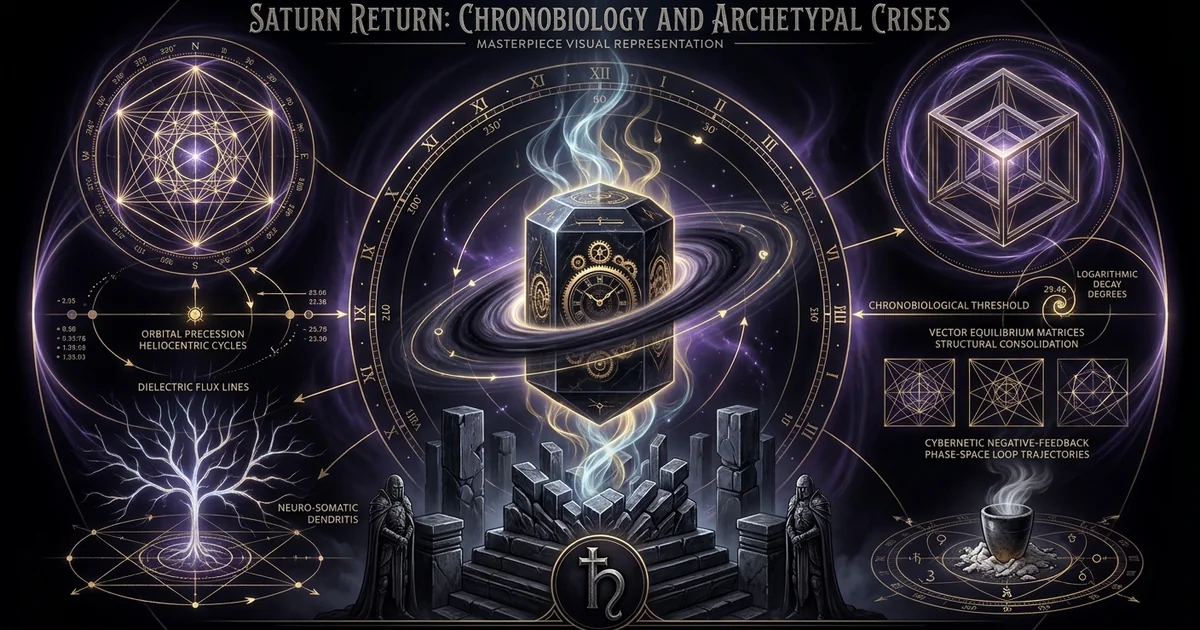
Saturn Return: Chronobiology and Archetypal Crises
Archetypal Thesis & Systemic Paradigm: The 29.5-Year Threshold
The Saturn return constitutes an objective developmental threshold operating at the intersection of astronomical periodicity and depth psychology, demarcating the close of initial somatic and neural consolidation at approximately 29.46 solar years. Far from a superstitious omen of misfortune, this transit functions as an archetypal homeostatic crisis wherein the psyche’s unintegrated puer aeternus projections are forcibly subordinated to the reality principle and the structural necessity of the senex archetype. By formalizing this planetary return within the framework of astrological chronobiology and analytical individuation, the phenomenon reveals itself as a cybernetic feedback mechanism calibrated for psychic maturation, structural calcination, and existential realignment.
Astrological Chronobiology and Cellular Epigenetics
The structural correspondence between macrocosmic periodicity and human ontogeny suggests that celestial cycles operate as chronological scaffolding for biological and psychological development. In astrological chronobiology, the 29.5 year orbit developmental threshold directly mirrors critical biomarkers of human maturation. Neurobiologically, the human brain does not complete its structural insulation until late in the third decade of life. The prefrontal cortex, which governs executive function, long-range risk assessment, impulse inhibition, and somatic boundary regulation, undergoes extensive terminal myelination through ages twenty-six to twenty-nine. This neural scaffolding terminates precisely as transiting Saturn returns to its natal coordinate.
Concurrently, cellular regeneration dynamics experience their first decisive systemic deceleration during this chronological window. The telomeric reserve, having sustained the explosive expansion of early development and biological adolescence, encounters an epigenetic plateau. The organism transitions from an open thermodynamic state characterized by limitless somatic expansion into a closed, conservative metabolic paradigm. The illusion of somatic immortality dissolves as tissue elasticity diminishes, metabolic latency increases, and the energetic cost of biological recovery elevates.
This biological reckoning is not a separate somatic process occurring alongside an esoteric transit; rather, it constitutes the physiological substrate of the Saturn return. Macrocosmic cycles and cellular processes are isomorphic expressions of physical limitation. The physical reality of the 29.46-year astronomical orbit of Saturn around the Sun tracks the exact phase space wherein human cellular biology forfeits its juvenile plasticity in exchange for terminal structural calcification.
The Puer-to-Senex Dialectic as Homeostatic Crisis
Within analytical psychology, this somatic deceleration instigates an acute psychic polarization: the compensatory struggle between the puer aeternus (the eternal youth) and the senex (the aged master or father). The puer represents limitless potential, unanchored ambition, mobility, and the refusal to commit to concrete form—a state of flight from mortality and constraint. Prior to the first Saturn return, the ego-consciousness predominantly shelters within the puer complex, treating life as a provisional rehearsal wherein failures are non-binding and decisions are infinitely reversible.
The advent of the Saturn return initiates a homeostatic crisis that shatters this psychological buoyancy. Transiting Saturn forces the emergence of the latent senex archetype from the collective unconscious, dragging the puer into confrontation with gravity, history, consequence, and decay. This confrontation is not negotiated gently; it is an archetypal demand for structural accountability. If the ego has over-identified with puerile mobility, the senex manifests somatically and environmentally as depression, systemic blockage, institutional obstruction, and existential exhaustion.
The senex imposes containment upon psychic energy that was previously dispersed in boundless, ungrounded ideation. Through this archetypal friction, the psyche must undergo what alchemical psychology denotes as calcinatio—the burning away of watery, unstable, and puerile projections through the dry heat of reality-testing. The senex archetype demands that the individual forfeit the infinite possibilities of who they might become in order to actualize the singular, bounded reality of who they are.
“The puer aeternus suffers from an inability to accept temporal boundary conditions; he prefers provisional states where no path chosen ever wholly eliminates alternative potentials. It is only when the senex archetype erupts from the unconscious—often experienced as an external catastrophe, chronic depression, or structural paralysis—that the individual is compelled to abandon the sky-realm of the mother and accept the heavy, leaden reality of terrestrial incarnation. The tension between these archetypes is not a pathology to be cured, but the primary crucible through which sovereign consciousness is distilled.” — Carl Gustav Jung, The Archetypes and the Collective Unconscious (Collected Works Vol. 9, Part 1); with reference to Marie-Louise von Franz, The Problem of the Puer Aeternus.
Reality Testing and the Dissolution of Provisional Existence
The primary operational vector of the saturn return chronobiology archetypal crises lies in the total dissolution of the provisional life (la vie provisoire). Prior to the late twenties, an individual’s developmental trajectory is sustained by external parental, educational, and institutional scaffolding. Even acts of rebellion during this phase remain anchored to these external institutions. The individual remains within a prolonged developmental latency where choices are treated as exploratory hypotheses rather than permanent architectures.
Upon entering the orb of the Saturn return, this provisional status collapses under the weight of ontological necessity. The reality testing imposed by Saturn operates as an audit of the psyche’s structural integrity. Relationships, career trajectories, academic pursuits, and psychological defenses founded upon neurotic fantasy or external approval begin to fail. The external environment ceases to absorb the friction of the individual’s disorganization; systemic feedback loops become immediate, unyielding, and exacting.
This collapse exposes the fundamental bad faith of living hypothetically. If the ego has constructed an identity around uncommitted genius, Saturnian friction manifests as professional marginalization. If relational dynamics have been sustained through codependency or parental projection, the boundary mechanics of the return rupture the bond. This stage of the transit acts as an ontological filter: non-resilient structures undergo catabolic breakdown, leaving only the authenticated fragments of the self upon which genuine sovereign autonomy can be constructed.
Classical Provenance & Textual Lineage: From Chronos to the Chronocrators
To understand the modern psycho-developmental experience of the Saturn return, one must excavate its roots in classical astrological literature. Across Hellenistic, Renaissance, and Medieval Islamic traditions, Saturn (Kronos) was conceptualized as the outermost threshold of the cosmos, the boundary of the visible planetary spheres, and the celestial chronocrator of physical containment and structural accounting.
Hellenistic Time-Lords and Ptolemaic Ages of Man
In the Hellenistic cosmotheology formalized by Claudius Ptolemy in the second century CE, the planets were not dynamic psychological archetypes, but objective arbiters of fate and the cosmic governors of time (chronocrators). Ptolemy’s doctrine of the Seven Ages of Man, articulated in the Tetrabiblos, partitioned human lifespan into planetary domains corresponding to the ascending planetary spheres, from the Moon to Saturn.
“To Saturn, the last, falls the seventh and final age, that of old age, occupying the remainder of life. For the cooling and desiccating qualities peculiar to his nature now arrest the animal passions and calm the impetuous movements of youth; the physical powers decay, mind and body become sluggish, cold, and slow, while the soul turns inward toward prudence, counsel, and deep contemplation of mortal limits.” — Claudius Ptolemy, Tetrabiblos, translated by F.E. Robbins (Harvard University Press, 1940).
Within Ptolemy’s developmental schema, Saturn governs the terminal horizon of mortal existence—the cooling, drying, and calcification of form. While the full Saturnian age corresponds to decrepitude and senescence, Hellenistic techniques of planetary time-lords (such as general profections and the chronocrators of /astrology/hellenistic-time-lords-profections-zodiacal-releasing) conceptualize any recurrence of Saturn’s natal position as an awakening of this terminal boundary principle. When transiting Saturn reoccupies its natal degree, the native is forced into an anticipatory encounter with the Seventh Age of Man. The boundless humidity of youthful growth gives way to the dryness of form and boundary, signaling the transition into biological and social adulthood.
Ptolemaic Ages of Man (Ascending Planetary Order):
[ Moon: Infancy ] -> [ Mercury: Childhood ] -> [ Venus: Adolescence ] ->
[ Sun: Youth ] -> [ Mars: Prime ] -> [ Jupiter: Maturity ] -> [ Saturn: Old Age ]
The Melancholic Humour in Renaissance Hermetic Medicine
During the Renaissance, the understanding of Saturn underwent a critical revision through the Neoplatonic Hermeticism of Marsilio Ficino. In De Vita Triplici (Three Books on Life), Ficino reassessed the physiological and psychological humor ruled by Saturn: black bile (melancholia). Traditional medieval medicine pathologized melancholia as a cold, dry, toxic dross capable of inducing madness, catatonia, and spiritual despair (acedia).
Ficino, synthesizing the pseudo-Aristotelian Problemata XXX, 1 with Platonic theology, posited that the Saturnine melancholic humor was the physical vehicle for the contemplative genius. While it caused somatic sluggishness, somatic drying, and acute existential dread, it simultaneously withdrew the human soul from superficial external sensations, concentrating its perceptual faculties upon abstract geometries, metaphysics, and high statecraft. For Ficino, Saturn imposes an inward pull away from the ephemeral realm of physical generation (hyle) toward the immutable realm of the Forms (noēsis).
Navigating a Saturn return requires an operational appreciation of this Renaissance alchemy. The psychic heaviness, depressive withdrawal, and somatic inertia characteristic of the transit are recognized not as psychiatric aberrations, but as the mandatory physiological conditions for intellectual and spiritual individuation. The coldness and dryness of Saturn arrest the chaotic, distracting fires of youthful passion, clearing a space within consciousness for sustained contemplation, severe self-examination, and the crystallization of character.
Medieval Arabic Delineations of Karmic Reckoning
The transmission of Hellenistic astrology through the Islamic Golden Age brought an intensification of mathematical precision and structural delineation to planetary returns. Scholars such as Abu Ma’shar (Albumasar) and Al-Biruni formalized the theory of revolutions (tahāwīl), analyzing the return of a planet to its exact natal radical position as an operative cosmic audit.
In the Arabic tradition, Saturn was delineated as Zuhal—the planet of deep foundations, subterranean vaults, ancestral debts, severe labor, and systemic reckoning. An individual’s natal Saturn was assessed within the strict hierarchy of /astrology/planetary-dignities-essential-accidental. If Saturn occupied its essential dignity (domicile in Capricorn or Aquarius; exaltation in Libra), the return manifested as the formalization of enduring authority, land acquisition, legacy construction, and the elevation to institutional sovereignty. Conversely, if Saturn was afflicted or peregrine, the return arrived as an inexorable settling of structural debts, enforcing poverty, exile, somatic collapse, or public exposure of unearned pretensions.
The medieval Arabic astrologers emphasized that Saturn never grants unearned grace; it is a rigid, mathematical bookkeeper of systemic inputs and outputs. The return of Zuhal was calculated as a cosmic trial where every structural compromise, neglected duty, and ethical evasion executed during the preceding 29.5-year cycle was quantified and extracted in the currency of labor, time, and material limitation. This classical delineation underpins the modern understanding of the Saturn return as an exacting karmic maturation transit.
Structural Mechanics & Symbolic Geometry: The Orbital Architecture of Saturn
The transformative potency of the Saturn return does not emerge ex nihilo at age twenty-nine; rather, it is the culminating consolidation of an uninterrupted quaternary geometric cycle woven throughout the native’s entire lifespan. The 29.46-year orbital architecture is divided by its internal hard aspect-geometry into four distinct 7.36-year developmental phases.
The 29.46-Year Orbital Mechanics and Retrograde Loops
Saturn’s physical orbit around the Sun requires precisely 10,759.22 terrestrial days (approximately 29.457 solar years). From the geocentric perspective of natal astrology, this slow traversal through the 360 degrees of the zodiac is punctuated annually by apparent retrograde motion. Retrogradation occurs when the Earth, moving on its faster interior orbital path, overtakes Saturn, causing the planet to appear to halt, reverse its motion, halt again at a second station, and resume direct motion across the ecliptic.
Because of this retrograde looping mechanism, a Saturn return rarely consists of a single, instantaneous transiting contact. In most instances, the transit manifests as a tripartite passage spanning eight to eleven months:
- First Station (Direct Motion): The initial crossing of the natal degree introduces the structural disruption, systemic friction, or institutional failure. The problem space is revealed.
- Second Station (Retrograde Motion): Saturn reverses over the natal degree, forcing an interiorization of the crisis. External escapes are blocked; the native is compelled to dismantle outmoded cognitive mechanisms and review structural dependencies.
- Third Station (Final Direct Motion): Saturn moves direct across the degree for the final time, requiring definitive material execution, boundary formalization, and permanent psychological commitment.
This three-phase loop operates as a psychological calcination cycle: initial mechanical collision, retrospective interiorization, and decisive material integration.
The Quarter-Cycle Coordinate System: Ages 7, 14, 21, and 29.5
The 29.5-year cycle divides geometrically into four ninety-degree developmental quadrants, each testing a specific phase of somatic, social, and psychological containment:
1. The Waxing Square (~Age 7.4)
Occurring as transiting Saturn forms a 90° square to its natal degree, this phase coincides with the biological milestone of the eruption of permanent dentition and the emergence of the cognitive capacity for concrete operational logic (as described by Jean Piaget). The child establishes a firm somatic and psychological boundary between the subjective self and the objective world. The reality of rule-governed structures outside the family nexus emerges.
2. The Opposition (~Age 14.7)
As transiting Saturn forms a 180° opposition to its natal degree, the native enters the crest of puberty. The physical body undergoes secondary sexual differentiation, while the ego experiences its primary sociosexual crisis of individuation against parental and institutional authority. The external world acts as a hard reflective surface, triggering rebellion, acute somatic self-consciousness, and early identity crises.
3. The Waning Square (~Age 22.1)
The 270° (waning) square coincides with the formal cessation of institutionalized education, biological adolescence, and parental insulation. The native is cast into the economic and professional ecosystem, confronting the initial friction between youthful ideological hubris and the indifferent mechanics of material survival. This phase functions as an ontological dress rehearsal for the full return.
4. The Complete Return (~Age 29.5)
The closure of the circle occurs as transiting Saturn conjoins its natal radical position. The thematic threads initiated at the waxing square, tested at the opposition, and strained at the waning square coalesce into a definitive imperative: the native must establish sovereign self-governance, structural autonomy, and material accountability.
Hard-Aspect Dynamics: Squares and Oppositions as Preparatory Stress-Tests
The hard aspect-geometry governing the Saturn cycle—conjunctions, squares, and oppositions—acts as an ontological stress test. While soft aspects (trines and sextiles) allow psychic energy to circulate along pathways of least resistance, hard aspects generate friction, resistance, and material densification.
In systemic engineering, a structural stress test subjects a material to increasing vibrational loads until structural flaws, microfractures, and tensile failures are revealed. In human psychology, the quarter-cycle squares and oppositions of Saturn function identically. They apply compressive existential weight to the native’s psychological architecture:
- The Waxing Square stress-tests the psychic boundary separating the child’s interior ego from the collective demands of social reality.
- The Opposition stress-tests the tensile strength of the native’s developing identity against parental and societal archetypes.
- The Waning Square stress-tests the native’s operational capacity to sustain material autonomy independent of external systems.
If these preliminary stress-tests are met with evasive strategies, infantile regression, or reliance on parental scaffolds, the structural defects accumulate within the psyche. When the full 29.5 year orbit developmental threshold arrives, these unresolved tensions can trigger the collapse of ungrounded existential architectures.
Psychological Dynamics & Operational Praxis: Navigating the Threshold
The operational manifestation of the Saturn return within an individual’s life is neither generic nor arbitrary. It conforms to the precise geometric wiring of the natal chart, guided by the house placement of Saturn, its planetary dignities, and the planetary rulers of the natal angles.
Unintegrated Saturn Return (Pathological Inertia)
- Somatic Manifestation: Chronic fatigue, conversion disorders, profound psychomotor retardation, psychosomatic joint/bone ailments, sleep architecture fragmentation.
- Psychological Architecture: Identification with the victim complex, projection of tyranny onto external institutions, bitter resentment, pervasive nihilism, terror of aging and biological finitude.
- Behavioral Vectors: Desperate reversion to puerile escapism, addiction, impulsive career/relationship sabotage to evade accountability, frantic over-commitment masking structural impotence.
- Existential Stance: Life is perceived as an arbitrary punitive prison; authority remains an external oppressor to be resisted or placated.
Integrated Saturn Return (Sovereign Consolidation)
- Somatic Manifestation: Somatic groundedness, conscious acceptance of biological limits, deliberate lifestyle discipline, deceleration of baseline nervous system agitation.
- Psychological Architecture: Integration of the senex archetype, assumption of radical personal culpability, realistic self-assessment devoid of narcissistic inflation or self-flagellation.
- Behavioral Vectors: Deliberate pruning of unproductive professional/relational commitments, boundary-setting without hostility, patient investment in high-latency, enduring structural goals.
- Existential Stance: Limits are recognized as the canvas for actualization; authority is internalized as sovereign personal accountability and structural mastery.
House Placement Vectors and Sectoral Breakdown
The house occupied by natal Saturn delineates the primary existential arena where the crisis of limitation, reality testing, and structural restructuring occurs:
House Placement Vectors of the Saturn Return:

[ Quadrant I: Houses 1-3 ]   -> Physical identity, material resources, cognitive structures
[ Quadrant II: Houses 4-6 ]  -> Domestic foundations, creative output, somatic labor
[ Quadrant III: Houses 7-9 ] -> Interpersonal contracts, shadow/mergers, ideological frameworks
[ Quadrant IV: Houses 10-12] -> Vocation/authority, social collectivism, unconscious dissolution
- Angular Houses (1st, 4th, 7th, 10th): The return manifests as an overt, public restructuring of foundational pillars.
- 1st House: Somatic deceleration, radical transformation of physical appearance, collapse of personal persona.
- 4th House: Ruptures in domestic foundations, ancestral reckoning, breaking generational trauma loops, physical property restructuring.
- 7th House: The termination of immature relational contracts, crystallization of long-term legal and marital commitments, dissolution of non-viable partnerships.
- 10th House: The vocational reckoning; acute encounters with patriarchal authority, severe career transitions, assuming or forfeiting public leadership roles.
- Succedent Houses (2nd, 5th, 8th, 11th): The crisis concentrates on issues of resource sustainability, value systems, and energetic exchange.
- 2nd House: Financial insolvency or the construction of disciplined fiscal systems; restructuring self-worth detached from external approval.
- 5th House: Creative paralysis giving way to disciplined artistic mastery; confronting biological fertility, parenthood, or the death of juvenile hedonism.
- 8th House: Confrontation with shared liabilities, debt consolidation, existential encounters with mortality, psychological shadow integration.
- 11th House: Pruning social networks; eviction from peer groups that sustain puerile behavior; integration into professional guilds and communities of practice.
- Cadent Houses (3rd, 6th, 9th, 12th): The return operates within psychological processing networks, daily operational habits, and ideological paradigms.
- 3rd House: Restructuring intellectual mechanics, communication boundaries, sibling contracts; mental discipline over anxiety.
- 6th House: Somatic crisis enforcing health regimens, systemic adjustments to daily operational labor, service, and workplace dynamics.
- 9th House: The collapse of borrowed dogmas and unearned spiritual philosophies; constructing an empirical worldview through hard personal experience.
- 12th House: Ego-dissolution, voluntary or enforced solitude, institutional confinement, the confrontation with chronic self-undoing and karmic latency.
Somatic Deceleration, Depression, and Alchemical Calcinatio
The experience of the Saturn return frequently mimics the clinical symptoms of dysthymia or unipolar depression: psychomotor slowing, anhedonia, sleep architecture disruption, and persistent existential fatigue. In depth-psychological consulting, this condition must not be immediately dismissed as a purely pathological malfunction requiring chemical eradication. Rather, it represents an endogenous somatic braking mechanism designed to arrest the frantic, evasive flights of the puer complex.
In the alchemical tradition, calcinatio is the process of heating a substance in a dry crucible until all moisture, volatile oils, and combustible elements are burned away, leaving an inert, incorruptible white ash (calx). Water symbolizes unconscious emotionality, provisional fantasy, and sentimental inflation; dryness symbolizes the objective, uncompromising clarity of the reality principle.
The Saturn return operates as a psychological calcinatio. The depressive deceleration withdraws libido from external social distractions, provisional fantasies, and manic projects. The psychic moisture that sustained romantic delusions of boundless potential is boiled off. This existential dryness can feel brutal to the uninitiated ego; it strips away self-soothing rationalizations, leaving the native face-to-face with the bare, unadorned structural reality of their life. The lead of unconscious depression is the raw material from which the gold of conscious, consolidated character is refined.
Clinical Delineation Strategy for the Karmic Maturation Transit
In the consulting room, an astrologer or depth psychologist evaluating a client undergoing a Saturn return must adopt an empirical and structural posture, avoiding fatalistic predictions or superficial reassurances. The delineation strategy must operate as an archetypal architectural review:
- Systemic Audit: The practitioner must inspect the houses ruled by Saturn (Capricorn and Aquarius) alongside its natal house placement. The house containing Saturn is where the concrete trial occurs; the houses ruled by Saturn are the resource supply lines feeding the trial.
- Identification of Puerile Escapes: The consultant must trace where the client persists in living provisionally. What relationships, jobs, or habits are being maintained on the assumption that “real life hasn’t started yet”?
- Imposition of Boundary Architectures: The operational countermeasure to Saturnian affliction is not escapism or spiritual bypassing, but the immediate adoption of Saturnian virtues: discipline, limitation, boundary-setting, sobriety, and labor. The practitioner guides the client to consciously build the necessary structures before the environment imposes them through collapse.
- Reframing Crisis as Feedback: Every breakdown during the return is reframed as a valuable diagnostic reading. A career path that implodes was built on a fragile foundation; a relationship that shatters was structurally incapable of bearing authentic adulthood.
Philosophical Synthesis & Macrocosmic Correspondence: Binah and Systemic Entropy
To grasp the ultimate metaphysical necessity of the Saturn return, the phenomenon must be contextualized within the broader Western esoteric tradition and modern systemic physics. Saturn is not an isolated planetary body acting upon human behavior through unknown physical rays; it is a macrocosmic symbol for the universal cosmological principle of formal limitation, entropic resistance, and systemic containment.
The Third Sephirah: Binah as the Great Architect of Limitation
In the Hermetic Qabalah, the planetary sphere of Saturn (Shabbathai) is attributed to the third Sephirah on the Tree of Life: Binah (Understanding). Positioned at the summit of the Pillar of Severity, Binah sits opposite Chokmah (Wisdom/The Primordial Dynamic Force) across the Supernal Abyss. While Chokmah is the unbridled, undifferentiated, and infinite energetic outrush of the cosmos, Binah is the Great Mother (Ama), the cosmic vessel that captures, cools, restricts, and shapes this raw energy into defined form.
Without Binah, the energetic emission of Chokmah would disperse infinitely into void space, resulting in cosmic dissolution. Binah is the primordial limit—the cosmic womb that gives birth to concrete existence precisely by imposing form, boundary, and mortality. Creation requires contraction (tzimtzum); life requires a container.
The Saturn return is the experiential initiation of the individual psyche into the mystery of Binah. It is the moment where the formless potential of the human spirit is forced into the restrictive vessel of temporal reality. In this container, the individual understands that freedom is not the absence of boundaries, but the conscious mastery of necessity.
- Sephirah: Binah (Understanding), Third Sephirah, Supernal Triad.
- Divine Name: YHVH Elohim (The Lord God of Form and Law).
- Mundane Chakra: Shabbathai (The Sphere of Saturn).
- Alchemical Metal: Plumbum (Lead) — dense, heavy, preservative, absorbing, non-resonant.
- Tarot Key: The World / The Universe (Key 21), governing the 32nd Path of Tav on the Tree of Life, linking Malkuth (Physical Reality) to Yesod (The Astral Foundation).
- Physical Analogue: Gravitational Containment, Mass Density, Degeneracy Pressure, Terminal Entropy.
The structural journey down the Tree of Life concludes along the 32nd Path, governed by the letter Tav and associated with Saturn and the Tarot’s Major Arcanum: Key 21, detailed in /tarot/major-arcana-the-world-saturnian-closure. This path connects the material plane (Malkuth) with the foundational astral plane (Yesod), establishing the final perimeter of terrestrial manifestation.
Supernal Architecture of the Saturnian Principle:
      [ Kether: The Crown / Primordial Unity ]
                 /              \
[ Chokmah: Dynamic Force ] <---> [ Binah: Form & Limitation (Saturn) ]
                                            |
                                  [ The Supernal Abyss ]
                                            |
                                  [ Microprosopus / Form ]
                                            |
                                 [ Malkuth: Earthly Vessel ]
Thermodynamics, Entropy, and Negentropic Psychic Architecture
From the perspective of general systems theory and statistical thermodynamics, living organisms are open, non-equilibrium systems that preserve their internal organization only by importing energy from the environment and exporting entropy. Entropy is the universal tendency of organized matter toward decay, dissipation, and disorder.
An unconstrained psyche—one trapped permanently within the puer aeternus dynamic—mirrors high internal entropy. Energy disperses chaotically in all directions without doing thermodynamic work. Ideas, passions, projects, and relationships are continuously initiated, but because no structural containment or boundary condition is imposed, the energy dissipates into the psychological environment without systemic consolidation.
The saturn return chronobiology archetypal crises operates as a negentropic intervention. Negentropy is the active importation of order, constraint, and structural discipline to reverse entropic dispersion. Saturn acts as the cold, structural boundary condition that arrests energetic bleed. By imposing limitation, deadlines, material necessities, and psychological boundaries, the transit reduces internal psychological entropy. It forces the chaotic, dispersed energy of the personality to compress into a dense, coherent, and highly organized crystalline matrix capable of performing meaningful work within the material world.
The Master-Builder Archetype: Synthesis of Form and Essence
The completion of this negentropic process marks the emergence of the Master-Builder archetype. The Master-Builder represents the integrated synthesis of Chokmah and Binah, of the puer and the senex. The individual no longer perceives limitations, time, and physical mortality as arbitrary punishments inflicted by a hostile universe, but as the medium through which authentic sovereign art and legacy are created.
A sculptor cannot carve without a dense, resistant medium; a musician cannot compose without the mathematical constraints of time, rhythm, and silence; an architect cannot construct without the severe laws of gravity and materials science. The Master-Builder embraces the Saturnian boundary as the condition for artistic and existential actualization.
By submitting to the reality principle during the 29.5-year threshold, the human consciousness achieves ontological sovereignty. The native no longer blames parents, society, or the gods for their limitations. They recognize that their limits are their form, their discipline is their freedom, and their mortality is the metric that gives their choices absolute, unrepeatable significance.
Frequently Asked Questions Regarding the Saturn Return
The Phenomenon of Multi-Pass Retrograde Stations
Does a three-pass Saturn return indicate a significantly worse psychological crisis than a single-pass transit?
A three-pass Saturn return—caused by apparent retrograde stations occurring directly over the natal coordinate—does not indicate a tripled catastrophe; rather, it indicates a protracted, dialectical process of psychological restructuring. A single-pass return typically delivers an acute, immediate structural collision that forces swift adjustment. In contrast, a three-pass transit delineates an extended, tripartite pedagogical sequence:
- The Initial Ingress (First Direct Pass): Delivers the external catalyst—the collapse of a non-viable relationship, a career impasse, or the onset of physical exhaustion.
- The Retrograde Station (Second Pass): Withdraws the crisis into the interior architecture of the psyche. External solutions are systematically denied during this phase, forcing the native to audit the inner psychological dependencies and unintegrated shadow aspects that precipitated the external failure.
- The Final Direct Station (Third Pass): Provides the systemic integration. The native, having internalized the structural lesson, executes the definitive material and psychological adjustments required to anchor their sovereign maturity.
The multi-pass return ensures that the individual cannot bypass the inner work through rapid superficial maneuvers; it enforces deep, structural reorganization.
Comparative Anatomy of First, Second, and Third Returns
How do the qualitative demands of the Second (~Age 59) and Third (~Age 88.5) Saturn Returns differ from the First (~Age 29.5)?
While all Saturn returns share the common signature of ontological boundary auditing, reality testing, and structural reckoning, their archetypal mandates shift according to the biological and social phases of the human lifecycle:
Lifespan Trajectory of Saturn Return Initiations:
[ First Return: Age 29.5 ]  -> Sovereign Adulthood (Exit Puer / Build Base)
[ Second Return: Age 59.0 ] -> Elderhood & Mentorship (Exit Ambition / Assess Legacy)
[ Third Return: Age 88.5 ]  -> Transpersonal Completion (Exit Physicality / Transcend Form)
- The First Saturn Return (~Age 29.5): Focuses upon the formal exit from childhood, adolescence, and the provisional life. It demands the consolidation of ego-sovereignty, economic and professional self-sufficiency, relational clarity, and the integration of the senex archetype against the puer.
- The Second Saturn Return (~Age 58–60): Governs the exit from vocational dominance and reproductive ambition. The native confronts biological senescence, societal elderhood, and the structural legacy of what they have constructed over the preceding thirty years. It demands the transition from the “Master-Builder” of external edifices to the “Wise Elder” or mentor, transferring structural authority to the generation behind them while preparing the psyche for the ultimate reality of biological termination.
- The Third Saturn Return (~Age 87–89): Focuses upon transpersonal completion, physical decrepitude, and the dissolution of the ego-vessel. This return demands the conscious reconciliation of the soul with its historical life-arc, the final divestment of material entanglements, and the traversal of the 32nd Path toward physical and spiritual release.
Mitigating Natal Debilities and Malefic Dignities
How can an individual productively navigate their Saturn return if Saturn is natally debilitated (in Fall in Aries, or in Exile/Detriment in Cancer)?
When natal Saturn occupies a sign of essential debility—such as Aries (fall) or Cancer (detriment)—the archetypes of containment, boundaries, and systemic patience run counter to the basic elemental nature of the zodiacal environment. In Aries, Saturn’s cold, drying, and slow nature is agitated by cardinal fire, triggering impulsive, erratic over-assertion alternated with acute frustration. In Cancer, Saturn’s boundary-setting is submerged in cardinal water, resulting in defensive hyper-vigilance, emotional insulation, or vulnerability to emotional abandonment.
To navigate a return with a debilitated Saturn, the individual must avoid the instinctive overcompensation mechanisms typical of these placements:
- For Saturn in Aries: The native must consciously replace rash, aggressive declarations of autonomy with calculated, deliberate, and high-latency tactical execution. The impulse to tear down existing structures out of frustration must be tempered through rigorous somatic and martial discipline. Structural progress must be measured in sustained, cumulative labor rather than decisive outbursts of will.
- For Saturn in Cancer: The native must abandon the expectation that external environments or authority figures will provide an emotional safety net. They must establish internal, objective emotional boundaries, recognizing that genuine care requires the capacity to hold structural limits without regressing into emotional manipulation or infantile dependency.
In both instances, the native cannot rely upon the passive, instinctual expression of Saturnian grace found in domicile placements (/astrology/planetary-dignities-essential-accidental). Instead, they must cultivate artificial, conscious, and deliberate structural compensations, building the necessary boundaries through rigorous self-awareness and disciplined operational praxis. :::