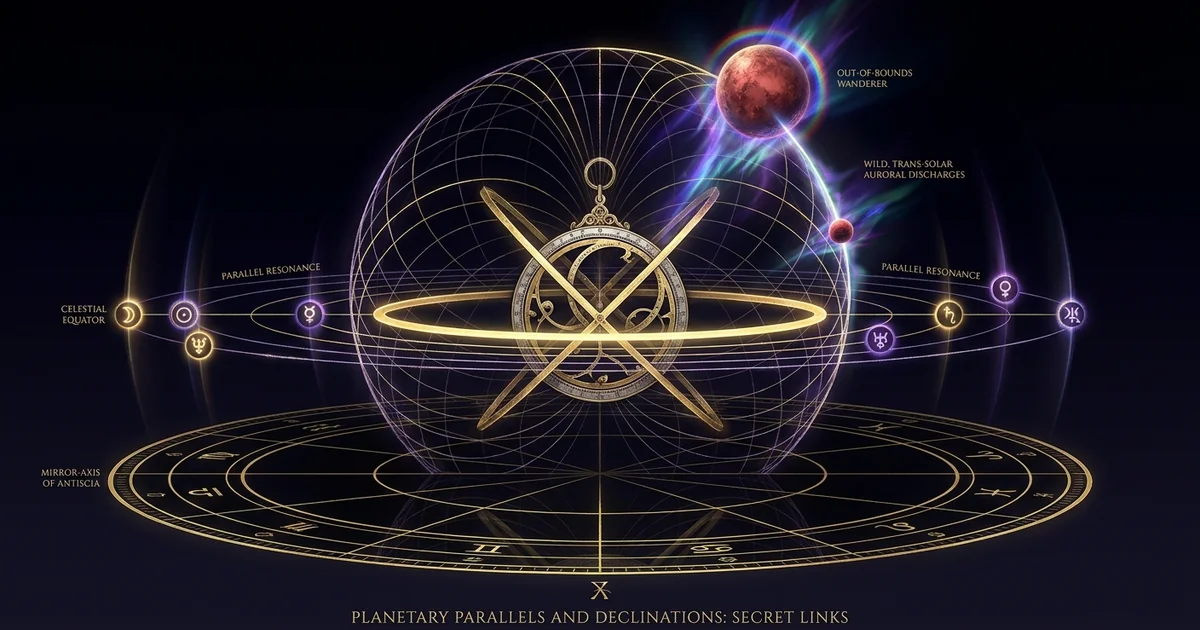
Planetary Parallels and Declinations: Secret Links
Archetypal Thesis & Systemic Paradigm: The Equatorial Dimension of Consciousness
Ecliptic Flatland vs. Equatorial Depth in Astrological Topology
Standard astrological praxis has long suffered from an epistemic reductionism, confining celestial cartography to the two-dimensional circumference of the ecliptic. By projecting three-dimensional orbital mechanics exclusively onto the 360-degree zodiacal wheel, practitioners collapse the spherical reality of the celestial sphere into an idealized planar circle. This flatland heuristic systematically ignores celestial latitude ($\beta$) and, more critically, equatorial declination ($\delta$)—the measurement of planetary positions north or south of the celestial equator. The ecliptic represents the apparent annual trajectory of the Sun from the terrestrial frame of reference, symbolizing the conscious ego-ideal, hero’s journey, and solar calendar of psychological realization. In contrast, the celestial equator represents the true projection of Earth’s diurnal rotation into cosmic space, anchoring the somatic, unconscious, and instinctual ground of terrestrial existence.
The mechanical interface between these two distinct planes is established by the obliquity of the ecliptic ($\varepsilon$), an axial tilt currently hovering near 23°26’22". This axial discrepancy causes the seasonal drama, dictating the rhythmic fluctuation of photoperiodism and solar irradiance across the northern and southern hemispheres. When an astrologer limits interpretation to ecliptic longitude ($\lambda$), they interpret the archetypal drives solely through the lens of solar filtration, blind to the orthogonal coordinate framework that governs diurnal reality. The equatorial coordinate system, measured via right ascension ($\alpha$) and declination ($\delta$), grounds celestial phenomena within the physical body of the Earth itself. Re-integrating declination into dynamic chart analysis transforms the birth chart from a static geometric blueprint into a multidimensional phase space of consciousness, revealing archetypal conduits that operate entirely beneath or beyond conscious zodiacal awareness.
Integrating the equatorial dimension rescues astrology from abstract geometric determinism. In standard longitude, two planets placed at 12° Aries and 18° Taurus are considered non-aspecting, separated by an inert thirty-six-degree angle with no major Ptolemaic engagement. Yet if both bodies share a declination of +14°32’ North, they occupy identical latitudinal distance from the celestial equator. They resonate at the exact same diurnal vibrational frequency, executing identical daily arcs across the local horizon. The failure to identify this equatorial alignment is the foundational blind spot of contemporary two-dimensional chart reading. Declination restores the vertical axis to astrology, reinstating depth to a flattened cosmological map.
Ecliptic Longitude (2D)
- Coordinate Axis: Measured along the ecliptic plane ($0^\circ$ Aries to $29^\circ59’$ Pisces) relative to the vernal equinox.
- Archetypal Domain: The solar ego, conscious identity processing, rationalized character traits, narrative life scripts.
- Aspect Geometry: Angular angularities across the 360° circle (conjunction, sextile, square, trine, opposition).
- Energetic Cadence: Linear, explicit, relational, unfolding dynamically through transiting solar-arc triggers.
- Cognitive Parallel: Conscious cognition, deliberate decision architectures, contextual awareness.
Equatorial Declination (3D)
- Coordinate Axis: Measured perpendicularly north ($+$) or south ($-$) from the celestial equator ($0^\circ$ to $90^\circ$).
- Archetypal Domain: Somatic grounding, archaic instinctual drives, subterranean complexes, autonomic reality.
- Aspect Geometry: Parallels (same declination and hemisphere) and Contraparallels (equal declination, opposite hemispheres).
- Energetic Cadence: Non-local, resonant, physiological, operating as subterranean conduits of pure force.
- Cognitive Parallel: Autonomic nervous system, archetypal shadow complexes, non-rational attractor states.
Parallels and Contraparallels as Non-Local Resonant Coupling
Within the declination matrix, aspects do not manifest as longitudinal divisions of the circle (such as the binary division of 180° or the ternary division of 120°), but as harmonic pairings based on shared altitude relative to the equatorial midline. A parallel of declination occurs when two celestial bodies occupy the identical degree of declination within the same celestial hemisphere (both North or both South). A contraparallel occurs when two bodies possess identical declinational degrees but occupy opposing hemispheres—one North, one South. In classical and modern energetic dynamics, the parallel operates identically to a high-potency conjunction, synthesizing the two archetypal drives into a fused psycho-dynamic engine. The contraparallel functions as an opposition, establishing an implicit polarity, an oscillating tension, or an axis of dynamic balancing between disparate somatic needs.
These equatorial linkages operate via non-local resonant coupling. In longitudinal aspects, planetary interactions are conditioned by the zodiacal signs housing the planets; a Mars-Saturn square between Aries and Cancer is inherently shaped by the cardinal, fiery assertiveness of the Ram colliding with the cardinal, protective water of the Crab. When planets form a parallel, their union is raw, visceral, and structural. Because they traverse identical daily circles of diurnal rotation, they share an identical temporal rhythm through Earth’s magnetic envelope. The parallel unites archetypal forces at a sub-symbolic, neurological stratum, operating beneath the native’s narrative cognition. The individual experiences this energetic bridge not as a thematic cognitive dilemma, but as an existential, instinctual reflex.
[ North Celestial Pole (+90°) ]
                     |
       +----------------------------+  Maximum North Declination (+23°26')
       |    Planet A (+18°20' N)    |  <==== PARALLEL RESONANCE ====> Planet B (+18°20' N)
       +----------------------------+
================================================= Celestial Equator (0°00')
       +----------------------------+
       |    Planet C (-18°20' S)    |  <== CONTRAPARALLEL POLARITY ==> Planet A / B
       +----------------------------+
                     |
       [ South Celestial Pole (-90°) ]
The contraparallel aspect, conversely, uncovers hidden dialectical systems within the psyche. Planets bound by contraparallel without an accompanying longitudinal opposition represent an implicit polarization that evades standard optical identification. An individual with the Sun at 4° Taurus and Mars at 27° Leo possesses an apparent, wide longitudinal square lacking exactitude; however, if both bodies share a declination of 16°15’ in opposite hemispheres, a profound contraparallel binds them. The solar life-force and the martial instinct are caught in an unending balance-recovery loop, compelling the individual to continuously modulate assertiveness against core identity. These subterranean aspect lines act as the foundational load-bearing beams of the natal chart, explaining severe behavioral compulsions and inexplicable physiological affinities that leave longitudinal chart interpretations at an interpretive impasse.
The Solar Perimeter: Ecliptic Boundaries and the Individuation Horizon
Because the Sun never crosses beyond the bounds of its own apparent path, the maximum declination it can attain is determined by the obliquity of the ecliptic. At the summer solstice, the Sun reaches its apex at approximately +23°26’22" North; at the winter solstice, it descends to its nadir at -23°26’22" South. This geographic and symbolic boundary constitutes the Solar Perimeter. Within the framework of depth psychology, the Sun symbolizes the archetypal ego-ideal, the organizing solar principle of consciousness, and the integrative gravitational center of the conscious self. The solar perimeter marks the jurisdictional boundary of the solar ego: the realm of normative social conventions, consensual reality, and predictable systemic socialization.
When planets possess high orbital inclinations relative to the ecliptic plane, their orbital mechanics allow them to migrate beyond this solar perimeter. When any celestial body surpasses the maximum solar declination of 23°26’22"—whether North or South—it transitions into the radical state designated as an out-of-bounds-planet. The archetypal implications of this migration are profound. By moving beyond the physical path of the Sun, the out-of-bounds planet operates outside the jurisdiction of the ego-consciousness. It evades normative super-ego constraints, civilizational habitus, and parental conditioning.
This dynamic marks out-of-bounds phenomena as critical indicators of the individuation horizon. A planet operating beyond the solar boundary breaks free from the homeostatic balance of the psyche, functioning as an untamed, semi-autonomous complex. It is neither inherently benevolent nor malevolent; rather, it possesses unchecked raw energy. In the vernacular of transpersonal cartography, the planet has broken the gravitational field of consensus reality, granting the native access to unprecedented artistic genius, sociological divergence, sociopathic detachment, or radical revolutionary drive. The declination matrix thereby maps not merely energetic affinities via parallels, but delineates the boundary between conventional socialization and unregulated individuation.
Classical Provenance & Textual Lineage: From Ptolemaic Antiscia to Placidean Directions
The Hellenistic Genesis: Antiscia and the Symmetrical Horizon
The historical recognition of declinational mechanics did not emerge ex nihilo in modern astrology, but is structurally rooted in the Hellenistic doctrine of antiscia ($\dot{\alpha}\nu\tau\acute{\iota}\sigma\kappa\iota\alpha$, “casting a shadow opposite”). In Book I of the Tetrabiblos, Claudius Ptolemy laid the conceptual groundwork for declinational symmetry by examining the relationship between zodiacal signs of equal daylight duration. Ptolemy observed that signs equidistant from the solstitial axis (the axis running from 0° Cancer to 0° Capricorn) shared an identical atmospheric and photoperiodic nature. While the early Hellenistic mechanics framed this dynamic as a relationship between signs of equal power or signs of “commanding” and “obeying” status, it was functionally an implicit calculation of declination.
                  Solstice Axis (0° Cancer / 0° Capricorn)
                                    |
          10° Gemini (Declination: +22°) <--- Antiscia ---> 20° Cancer (Declination: +22°)
                                    |
                               Equal Daylight
                            Equal Diurnal Shadows
Antiscia operate through the geometry of reflection across the solstitial axis. If a celestial body sits at 10° Gemini, its antiscion point is located at 20° Cancer. When another planet occupies that specific degree of Cancer, it occupies the same distance from the solstice, meaning it possesses the exact same declination and casts an identical noon shadow upon the terrestrial landscape. The Hellenistic astrologers recognized that these two points maintained an energetic union characterized by secret sympathy and shared agency. The contra-antiscion, projected symmetrically across the equinoctial axis (0° Aries to 0° Libra), yielded an equal declination in the opposite hemisphere, operating as an equatorial polarity. This classical methodology offered Hellenistic and early medieval astrologers an ecliptic-based workaround to quantify symmetrical declinational resonances without needing to compute complex spherical coordinate conversions for every point on the celestial sphere.
For further exploration of this classical symmetry and its seasonal implications, see the dedicated monograph on /astrology/antiscia-and-solstice-points.
The Arab and Renaissance Transition: Parallels in Mundo vs. In Zodiaco
During the Islamic Golden Age and the subsequent European Renaissance, the mathematical sophistication of astral science matured through the translation and expansion of spherical astronomy. Astrologers began to formally distinguish between two primary modes of aspects: aspects in zodiaco (measured along the ecliptic plane via longitudinal degrees) and aspects in mundo (measured within the sphere of the world, dependent upon diurnal arcs, meridian distance, and terrestrial rotation). Figures such as Albumasar and later Regiomontanus recognized that planets which lacked longitudinal aspect could nevertheless occupy proportional equatorial positions relative to the local horizon and meridian.
By the seventeenth century, English horary master William Lilly codified the functional use of parallels in his seminal 1647 work, Christian Astrology. Lilly did not treat parallels as minor secondary indicators. In Book II, when setting down the rules for resolving horary queries regarding marriage, business contracts, and physical health, Lilly explicitly equated the parallel of declination with the longitudinal conjunction:
“The Parallel of Declination in the Zodiac is equivalent to a Conjunction in its nature and efficacy; and you must observe this in all judgments, whether natal, horary, or mundane: for it oft-times performs what the aspects fail to bring to pass.” — William Lilly, Christian Astrology (1647)
Lilly documented that a parallel could consummate a horary matter when no classical Ptolemaic aspect existed, affirming that historical astrological praxis maintained a dual-coordinate methodology. If the longitudinal matrix showed no connection, the equatorial coordinate system served as the hidden court of arbitration, validating that planetary parallels and declinations formed a secret, structural foundation of classical divination.
Placidus de Titis and the Mathematical Institutionalization of Equatorial Aspects
The formal mathematical institutionalization of declinational parallels achieved its zenith in the seventeenth century through the work of the Italian Olivetan monk and mathematician Placidus de Titis. In his foundational treatises, Primum Mobile (1657) and Physiomathematica (1675), Placidus attacked the purely geometric, ecliptic abstractions of his contemporaries, arguing that astrological efficacy was inextricably bound to celestial mechanics and diurnal motion. Placidus argued that the primary direction—the engine of astrological timing wherein the rotation of the Earth carries one celestial body to the position of another—operates strictly within the equatorial and semi-diurnal arc framework.
“The parallel of declination is nothing other than the proportional equality of the diurnal arcs and the nocturnal arcs: wherein the planets, having an identical motion from the rotation of the Primum Mobile, exercise an active and mutual influx upon the Earth, equal to and frequently stronger than that of a bodily conjunction in the zodiac.”
Placidus demonstrated that two planets possessing the same declination describe identical semi-diurnal arcs across the local sky, meaning they spend the exact same proportion of time above and below the horizon. They culminate at proportional altitudes and penetrate the terrestrial atmosphere at identical angles of incidence. Therefore, Placidus positioned the parallel of declination not as an alternative to the conjunction, but as its physical and energetic foundation. His system of /astrology/primary-directions-mundane-astrology placed declination at the absolute core of astrological forecasting. In doing so, he cemented the reality that primary motion—the rotation of the Earth on its axis, measured along the equator—is the prime mover of fate, superseding the secondary motion of the planets drifting along the ecliptic.
Structural Mechanics & Symbolic Geometry: Calculating the Declination Matrix
Coordinate Transformation: Deriving Declination from Right Ascension and Obliquity
To integrate the declination matrix into modern analytical frameworks, one must abandon flat projection and master the spherical trigonometry that links the ecliptic and equatorial frameworks. The celestial sphere requires two distinct spherical polar coordinate networks: the ecliptic system, which uses the center of the Sun as its primary plane and measures longitude ($\lambda$) and latitude ($\beta$); and the equatorial system, which uses the terrestrial center and Earth’s equator as its baseline, measuring right ascension ($\alpha$) and declination ($\delta$).
                Ecliptic Pole
                     |
                     |--- Obliquity (ε ≈ 23°26')
                     |
              Equatorial Pole
                    /
                   /
                  +-------------------- Celestial Equator (0° Dec)
                 /
                +---------------------- Ecliptic Plane (0° Lat)
The mathematical transformation from ecliptic coordinates ($\lambda, \beta$) to equatorial declination ($\delta$) is calculated via the spherical law of cosines:
$$\sin \delta = \sin \beta \cos \varepsilon + \cos \beta \sin \varepsilon \sin \lambda$$
Where:
- $\delta$ = Declination of the target celestial body
- $\beta$ = Ecliptic latitude of the celestial body (its divergence north or south of the Sun’s plane)
- $\lambda$ = Ecliptic longitude of the celestial body (measured from 0° Aries)
- $\varepsilon$ = True obliquity of the ecliptic at the given epoch (approx. 23.439° or 23°26’22")
For bodies with negligible celestial latitude, such as the Sun itself ($\beta = 0$), the formula simplifies to the classical solar declination equation:
$$\sin \delta = \sin \varepsilon \sin \lambda$$
This trigonometric reality illuminates why planetary declination does not change at a steady, linear rate across the zodiac. At the equinoctial points ($\lambda = 0^\circ$ or $180^\circ$), $\sin \lambda$ is zero; the rate of declinational shift relative to longitude is at its maximum, causing planets near Aries and Libra to rapidly traverse degrees of declination. Conversely, at the solstitial points ($\lambda = 90^\circ$ or $270^\circ$), $\sin \lambda$ is $\pm 1$; the rate of declinational shift slows to an apparent halt as the body reaches its maximum declination, a phenomenon known as declinational stationing.
To map these planetary movements in three dimensions, especially as planets weave through their nodal intersections, see the analysis on /astrology/planetary-nodes-and-orbital-planes.
The Orb Conundrum: Mathematical Precision, Tight Tolerances, and Dynamic Harmonics
In conventional longitudinal astrology, aspect orbs are granted generous latitude. Astrologers routinely allow orbs of 6° to 10° for major longitudinal aspects involving the luminaries, and 4° to 7° for planetary interactions. Applying such liberal tolerances to the declination matrix completely compromises its diagnostic value. Because the entirety of normal declinational territory spans only 47 degrees—from -23°26’ South to +23°26’ North—an orb of 5° would encompass more than ten percent of the entire functional cosmos, generating statistical noise and false-positive resonances.
The mathematical nature of declination mandates strict, compressed orbs. The historical consensus among rigorous practitioners—from Placidus de Titis and William Lilly to twentieth-century equatorial pioneer L. Edward Johndro—demands that parallels and contraparallels be restricted to an absolute maximum orb of 1°00’ (one degree of arc), with peak archetypal resonance manifesting within 0°30’ (thirty minutes of arc).
[ Extreme Tightness ] < 0°15' : Somatic fusion / Unconscious reflex
[ Standard Operative ] 0°15' - 0°45' : Potent archetypal conduit
[ Outer Threshold ]   0°45' - 1°00' : Fading harmonic resonance
[ Null Threshold ]    > 1°00' : Ineffective / Background noise
The necessity for tight orbs is further amplified by the non-linear velocity of declination. When a planet stations in declination near its maximum solstitial turn, it may linger within the same single degree of declination for weeks or even months (in the case of slow-moving outer planets). An orb wider than 1° would fuse disparate planetary cycles into an undifferentiated state, distorting natal synthesis. Operating with an orb of $\le 1^\circ00’$ ensures that a parallel represents a genuine energetic lock, a laser-focused conduit of intent rather than a vague thematic drift.
Constructing and Deciphering the Declination Matrix
To operationalize these parameters, the investigator must construct a formal Declination Matrix alongside the traditional longitudinal aspectarian. The Declination Matrix is a dual-tier analytical grid that plots every celestial body and sensitive angle across two parameters: absolute declination value and hemisphere allocation. The diagnostic workflow moves through a systematic algorithmic progression from raw coordinate inputs to transpersonal dynamic synthesis.
When deciphering this matrix, the astrologer systematically analyzes three distinct categories of declinational phenomena:
- Direct Parallels ($P$): Planetary pairs occupying identical declination degrees within the same hemisphere ($+/+$ or $-/-$). These represent uninterrupted operational mergers where planetary functions lose their psychological autonomy and act in permanent concert.
- Contraparallels ($CP$): Planetary pairs occupying identical declination values across opposite hemispheres ($+/-$). These represent subterranean see-saws, polarity tensions, and projective psychological dynamics that compel the native to seek equilibrium through compensatory behavioral loops.
- Out-of-Bounds Anomalies ($OOB$): Planetary bodies whose absolute declination exceeds the solar threshold ($|\delta| > 23^\circ 26’22"$). These planets operate as rogue archetypal agents outside the matrix of consensus solar consciousness.
Psychological Dynamics & Operational Praxis: The Archetypal Extremes of Out-of-Bounds Planets
Breaching the Solstice Threshold: The Metaphysics of Declination Exceeding 23°27’
When a celestial body breaches the solstitial perimeter of 23°26’22", it enters an astrological state analogous to what depth psychology calls an autonomous complex. In standard psychology, the conscious ego exercises a regulatory, gatekeeping function over instinctual impulses, prioritizing social conformity and personal preservation. The Sun is the celestial sovereign of this psychological architecture. The physical limits of its declination trace the perimeter of the conscious ego’s domain. When a planet’s orbital geometry elevates it beyond this perimeter, the archetypal drive associated with that planet is unmoored from the solar organizing principle.
“Autonomous complexes are psychic fragments that have split off from the control of the conscious ego. They lead an independent existence in the unconscious, operating outside the laws of the ego and frequently exerting an obsessive, compelling influence over the individual. They behave like independent beings, following their own dynamic laws and resisting conscious integration until their specific instinctual demands are recognized and assimilated.” — C.G. Jung, The Structure and Dynamics of the Psyche (CW 8)
The out-of-bounds planet operates as an autonomous, instinctual agent within the psyche. It refuses to speak the language of normative behavioral convention. It is unbound by peer-group pressure, ancestral expectations, and cultural taboos. Marie-Louise von Franz, in her investigations into synchronicity and divination systems, observed that when an archetype is activated outside the normative spatial-temporal matrix of consensus consciousness, it exhibits erratic, acausal, and reality-bending characteristics. The out-of-bounds planet behaves precisely as an archetypal outlier: it produces geniuses, visionaries, sociopaths, iconoclasts, and eccentrics—individuals whose operational baseline refuses integration into consensual paradigms.
Planetary Expressions in the Wild: Moon, Mercury, Venus, and Mars Out-of-Bounds
Because of their orbital configurations and inclinations relative to the ecliptic, only a select group of celestial bodies can achieve out-of-bounds status. The Sun, by definition, can never go out-of-bounds. Saturn and Neptune possess low inclinations and their longitudinal relationship to the solstice keeps them within bounds throughout human history. The bodies that regularly breach the solar frontier are the Moon, Mercury, Venus, and Mars, alongside the occasional long-cycle migrations of Uranus and Pluto.
+-----------------------------------------------------------------------------------+
|               MAXIMUM OBSERVED PLANETARY DECLINATIONS                             |
+------------------+-----------------------+----------------------------------------+
| Planet           | Maximum Declination   | Frequency & Duration of OOB Cycles     |
+------------------+-----------------------+----------------------------------------+
| Moon             | ~ 28°44' N / S        | Every 18.6 years (Major Lunar Standstill) |
| Mercury          | ~ 27°00' N / S        | Multiple times per year (Brief spikes) |
| Venus            | ~ 28°00' N / S        | Periodic cycles (Every 8 years)        |
| Mars             | ~ 28°30' N / S        | Every 2 years (During solstitial pass) |
| Uranus           | ~ 23°40' N / S        | Generational (Centuries apart)         |
| Pluto            | ~ 23°50' N / S        | Generational (Extended multi-year span)|
+------------------+-----------------------+----------------------------------------+
An Out-of-Bounds Moon represents one of the most psychologically intense signatures in natal cartography. The Moon governs the affective matrix, instinctual safety reflexes, somatic conditioning, and the mother archetype. When the Moon crosses beyond 23°26’—reaching altitudes as extreme as 28°44’ during the Major Lunar Standstill cycle—the native’s emotional landscape detaches from the collective social baseline. These individuals experience emotions with untamed intensity, often coupled with an inability to rationalize their somatic reactions within social environments.
This placement generates radical emotional autonomy, hyper-sensory perception, or severe domestic and psychological alienation. The native feels like an alien in their familial line, displaying either profound nurturing genius or complete detachment from standard domestic roles.
An Out-of-Bounds Mercury disrupts the consensual grammar of communication. The mind operates outside normative cognitive structures, thinking in non-linear, hyper-dimensional, or idiosyncratic vectors. This manifests as linguistic brilliance, inventive technological intellect, or an inability to communicate via normative social registers, often bordering on erratic neurodivergence.
An Out-of-Bounds Venus unbinds the social contract regarding aesthetics, ethics, relationship protocols, and value hierarchies. These natives construct moral paradigms that openly defy cultural orthodoxy. Their relationship dynamics often bypass conventional gender roles and monogamous strictures, pursuing non-traditional romantic expression, taboo artistic forms, and financial models that disrupt consensual economic expectations.
An Out-of-Bounds Mars unleashes the assertiveness, vitality, and martial drives of the individual into unchecked territory. When Mars crosses the solar perimeter, its capacity for physical courage, strategic conquest, and disruptive action is amplified exponentially. This configuration is widely observed in pioneers, radical warriors, groundbreaking athletes, and individuals who single-handedly alter industries. Conversely, devoid of solar integration, this placement can manifest as explosive sociopathy, criminal disregard for life and property, destructive megalomania, and unprecedented volatility. The energy refuses subordination; it will either dominate its operational field or implode the surrounding structural baseline.
In contemporary cartographic models such as Human Design, these planetary activations map directly to gate infrastructure. To understand how these extreme activations ground themselves into explicit bodygraph definitions, see /human-design/planetary-activations-and-gates.
Operational Chart Praxis: Synthesizing Declination Anomalies with Longitudinal Structure
Clinical astrology demands that declinational phenomena never be evaluated in an analytical vacuum. The declination matrix does not replace the longitudinal birth chart; it acts as its structural modifier, energetic amplifier, and depth-dimension activator. When interpreting a chart featuring parallels, contraparallels, or out-of-bounds planets, the practitioner must synthesize the two frameworks using a layered diagnostic model:
+-------------------------------------------------------------------+
|               THREE-TIER SYNTHESIS METHODOLOGY                     |
+-------------------------------------------------------------------+
| 1. The Longitudinal Map: House & Sign (Operational Field)          |
|    --> Defines the costume, script, and psychological setting.    |
|                                                                   |
| 2. The Declination Matrix: Parallels & Contraparallels (Resonance)|
|    --> Uncovers subterranean energetic couplings and locks.       |
|                                                                   |
| 3. The Solstice Perimeter: In-Bounds vs. Out-of-Bounds (Status)   |
|    --> Determines if the archetype is socialized or autonomous.   |
+-------------------------------------------------------------------+
If an individual possesses Mars in Libra in the second house, traditional longitudinal analysis flags a planetary placement in detriment, suggesting passive-aggressive negotiations, compromised assertiveness, and difficulty in financial combativeness. If Mars sits at -24°12’ South, it is simultaneously out-of-bounds. The psychological reality changes completely: the apparent polite exterior of Libra is an instrument wielded by an unsanctioned, feral martial engine operating entirely outside societal boundaries. The native will pursue material autonomy with unorthodox, relentless audacity, shocking those who read only the polite zodiacal sign. The zodiacal sign supplies the behavioral vocabulary, but the declination governs the voltage, operational autonomy, and ultimate trajectory of the drive.
Philosophical Synthesis & Macrocosmic Correspondence: Declination as Holographic Harmonic Order
The Hermetic Neutral Axis: Equatorial Zero and Archetypal Equilibrium
In the sacred geometry of the celestial sphere, the celestial equator represents the axis of pure balance: the Hermetic Zero Point. At zero degrees declination ($0^\circ00’$), celestial bodies intersect the equatorial plane, marking the moments of equinoctial equilibrium. When a planet crosses the equator, its declination transitions from North to South or South to North, an astronomical event known as the planetary equinoctial node.
       (+) Northern Declination: Solar, Externalizing, Diurnal Expression
~~~~~~~~~~~~~~~~~~~~~~~~~~~~~~~~~~~~~~~~~~~~~~~~~~~~~~~~~~~~~~~~~~~~~~~~~~~~~
       (0°) CELESTIAL EQUATOR: THE HERMETIC NEUTRAL AXIS (Equilibrium Node)
~~~~~~~~~~~~~~~~~~~~~~~~~~~~~~~~~~~~~~~~~~~~~~~~~~~~~~~~~~~~~~~~~~~~~~~~~~~~~
       (-) Southern Declination: Telluric, Internalizing, Nocturnal Expression
Within the Hermetic philosophy of polarity, the celestial equator serves as the cosmological mirror, dividing the northern (active, exteriorizing, diurnal) and southern (receptive, interiorizing, nocturnal) realms of archetypal incarnation. A planet transiting or natally positioned at zero degrees declination exists in an undifferentiated state of absolute potentiality. It belongs to neither hemisphere. It is anchored to the prime baseline of Earth’s rotational center.
Planets at this zero-point interface act as universal translators between the unconscious, instinctual foundations of the human experience and its external, solar manifestations. They mark operational junctures where the native can transmute archetypal drives from subjective psychological pathology into objective collective service, embodying the true Hermetic alchemical axiom of balance through neutrality.
Cybernetic Feedback Loops: Declination Waves and Chronobiological Rhythms
Beyond static natal analysis, the systemic fluctuation of declinations functions as a cosmic cybernetic feedback loop. The motion of celestial bodies north and south of the equator resembles a perpetual wave function:
$$\delta(t) = \arcsin(\sin \varepsilon \sin(\omega t + \phi))$$
This wave motion drives the chronobiological systems of Earth. The lunar declinational cycle—which oscillates from its maximum northern limits to its maximum southern limits every 27.3 days (the tropical month)—governs tidal rhythms, ionospheric electron density, and systemic geomagnetic fluctuations. When the Moon crosses the celestial equator, tidal pressures shift across the terrestrial crust, triggering dynamic changes in oceanic currents and terrestrial weather patterns.
Declination Wave
      +23.5° |        /\                /\
             |       /  \              /  \
        0.0° |------/----\------------/----\------ Equatorial Baseline
             |            \  /              \  /
      -23.5° |             \/                \/
             +-------------------------------------> Time
At the macro-historical level, the extended declination wave of the lunar nodal cycle (the 18.6-year nutation rhythm) alternates between years of compressed lunar declination (maximum $\pm 18^\circ$) and years of extended out-of-bounds standstills (maximum $\pm 28^\circ44’$). Human history confirms that epochs corresponding to the Major Lunar Standstill—when the Moon ventures furthest from the solar perimeter—are characterized by sociopolitical volatility, revolutionary ruptures, artistic experimentation, and mass migrations. The physical bio-sphere and human unconscious respond in tandem to these declinational waves, operating as a biological resonator that translates equatorial celestial mechanics into collective historical evolutions.
Integration with Evolutionary Individuation and Transpersonal Cartography
When fully synthesized, the integration of ecliptic longitude and equatorial declination completes the Great Work of astrological mapping: the alchemical coniunctio of the Solar and Terrestrial paths. Longitudinal astrology tracks the sequential, evolutionary development of the soul through the zodiacal belt—a narrative journey through signs, elements, and developmental houses. Equatorial declination supplies the structural matrix: the deep-rooted neurological conduits, shadow polarities, and autonomous archetypal complexes that shape how destiny acts through the somatic instrument.
The declination matrix exposes the secret architecture of human fate. Parallels provide unexpected systemic alliances between disparate drives, contraparallels anchor dialectical polarities that demand psychic integration, and out-of-bounds anomalies identify the pioneering pathways where the soul rejects collective socialization to forge new territories of consciousness. By expanding interpretive practice from a two-dimensional wheel into a three-dimensional sphere, the practitioner transcends predictive fortune-telling, reclaiming astrology as an analytical coordinate system capable of mapping the full depth of human individuation.
When evaluating a contraparallel that lacks a longitudinal aspect (such as a Moon at 12° Gemini at +21°15’ North and Saturn at 4° Scorpio at -21°15’ South), delineate the dynamic using the following operational sequence:
- Identify the Polarity: Moon (emotional vulnerability, instinctual safety) is bound to Saturn (boundary, restraint, temporal realism).
- Eliminate Sign Antipathy: Do not read this as an airy Gemini vs. watery Scorpio friction; read it as a direct somatic and psychological equilibrium puzzle.
- Recognize the Subconscious Channel: The native will not experience this dynamic as externalized projection (e.g., encountering cold, restrictive partners), which is the standard manifestation of a longitudinal opposition. Instead, it operates as an internalized, somatic feedback loop: whenever emotional vulnerability (Moon) rises, a somatic chilling and structural contraction (Saturn) triggers automatically within the nervous system.
- Integration Protocol: The individual must consciously construct a behavioral framework that honors the emotional need for safety while providing Saturnian structure, achieving through conscious realization what the two-dimensional chart obscured.
Frequently Asked Questions: Navigating Declination and Parallel Aspects
What is the operational distinction between a longitudinal conjunction and an equatorial parallel?
While both aspects function archetypally to synthesize two planetary energies into a unified behavioral unit, their operational textures, levels of psychological visibility, and somatic manifestations are distinct. A longitudinal conjunction occurs when two bodies occupy the same zodiacal degree along the ecliptic plane. This aspect is explicit, narrative-driven, and operating primarily within the field of conscious awareness and cognitive intentionality. The individual recognizes these two archetypes as inextricably intertwined within their personality, behavioral style, and life narrative.
An equatorial parallel, conversely, occurs when two planets share an identical declination degree and hemisphere relative to the celestial equator, irrespective of their zodiacal positions. The parallel functions as an invisible, subterranean conduit of raw energy. It operates beneath the cognitive narrative, anchored in the autonomic nervous system, physiological reflexes, and structural behavioral patterns. Two planets in parallel share an identical diurnal arc through Earth’s atmosphere and magnetic envelope; their partnership is a mechanical, instinctual reality.
When a chart features a longitudinal conjunction reinforced by an equatorial parallel—a condition historical astrologers designated as a parallel in zodiaco et in mundo—the energetic integration is absolute. When a parallel exists without a longitudinal aspect, it acts as a silent partnership: the two archetypal drives cooperate effortlessly behind the scenes, catching both the native and external observers unaware with their coordinated, instinctual manifestations.
How do contraparallels differ psychologically from traditional zodiacal oppositions?
A traditional zodiacal opposition takes place across a 180-degree division of the ecliptic circle, inherently pairing opposing signs that share polarity (Masculine/Feminine) and quadruplicity (Cardinal, Fixed, or Mutable), while conflicting in element (Fire vs. Air, or Earth vs. Water). Psychologically, the longitudinal opposition is deeply prone to psychological projection. The individual typically identifies consciously with the planet positioned closer to the Ascendant, Midheaven, or Sun, and subsequently projects the opposite planet onto the external world—encountering it as adversarial individuals, systemic blockages, or conflicting environmental circumstances.
A contraparallel aspect operates through mirror symmetry across the celestial equator (+ and - declination), totally independent of zodiacal signage. A contraparallel can bridge signs that possess zero classical geometric relationship, such as an alignment between an Earth sign and a Fire sign. Because it lacks the externalized framework of zodiacal polarities, the contraparallel rarely manifests as outward, adversarial projection.
Instead, it operates as an internalized balance-recovery puzzle within the subjective core of the native. The individual experiences an internal see-saw, a psychological oscillation where activating drive A instantly creates a somatic demand for drive B. The dialectical tension is contained within the psychosomatic vessel of the individual, demanding sophisticated psychological integration and conscious equilibrium rather than the resolution of interpersonal conflict.
Can outer planets (Uranus, Neptune, Pluto) go Out-of-Bounds, and what is their macro-historical significance?
Because their orbital planes lie close to the ecliptic, the outer planets rarely cross beyond the solar perimeter of 23°26’22", but when they do, their historical impact is generational and systemic. Neptune’s low orbital inclination of 1°46’ permanently prevents it from achieving out-of-bounds status during our current historical epoch. Uranus (orbital inclination of 0°46’) and Pluto (extreme orbital inclination of 17°10’), however, possess orbital geometries that allow them to periodically breach the solar perimeter during specific historical windows.
       Pluto's High Orbital Inclination (17°10')
            \
             \               Ecliptic Plane (Solar Path)
==============\======================================= Solstice Bound (+23°26')
               \
                \----> Pluto breaches into Out-of-Bounds territory (Extreme Macro-Shifts)
Pluto goes out-of-bounds during historical intervals when its high orbital inclination coincides with its transit through signs flanking the solstices (Gemini/Cancer or Sagittarius/Capricorn). In the late 1930s through the mid-1940s, Pluto reached extreme northern declinations beyond +23°26’, mirroring the discovery and weaponization of nuclear energy, the industrial-scale atrocities of World War II, and the absolute geopolitical restructuring of the global order. When Pluto operates out-of-bounds, the underworld archetype breaks the containment of consensus reality; catastrophic, transformative, and evolutionary energies flood the terrestrial landscape unchecked.
Uranus breaches the out-of-bounds threshold during rare, long-wave cyclic alignments. In the late 1960s and early 1970s, Uranus crossed into high declination, a transit that coincided precisely with global youth revolutions, the detonation of civil rights struggles, unprecedented scientific disruptions (including the genesis of the internet and microprocessor computing), and the collapse of traditional socio-sexual frameworks. When an outer transpersonal planet leaves the bounds of the solar perimeter, the collective unconscious sheds its structural homeostasis, prompting historical epochs that permanently fracture and reconstitute human civilization. :::