Planetary Dignities in Hellenistic Astrological Arts
Archetypal Thesis & Systemic Paradigm: The Algebra of Ontological Agency
Planetary Dignity as an Epistemic Coordinate Framework
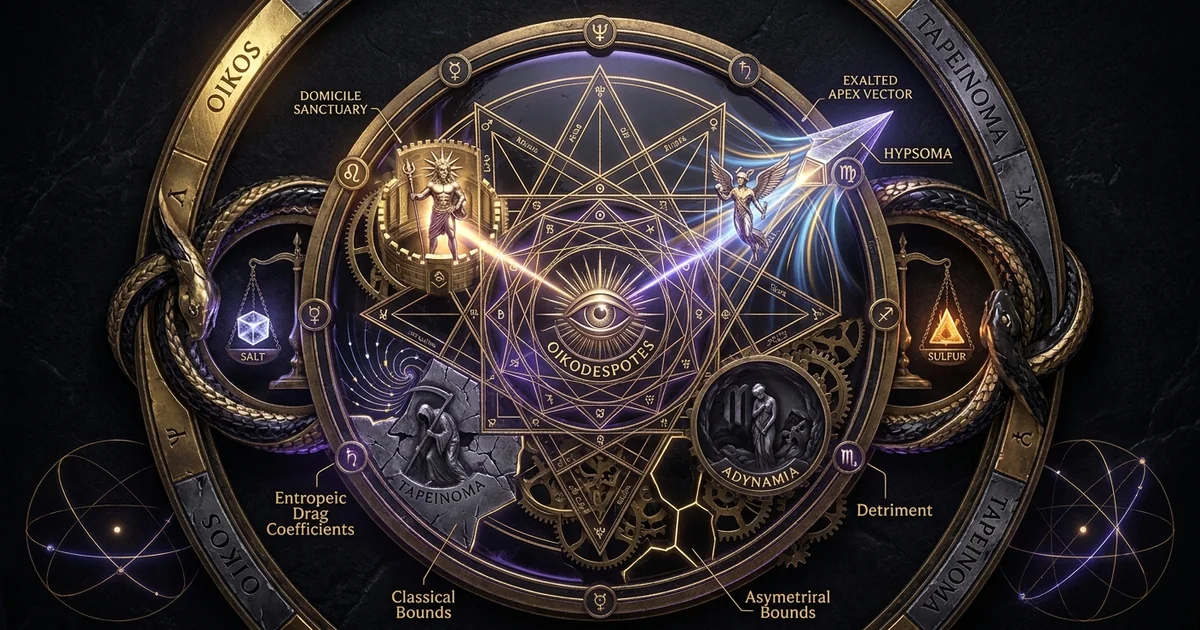
The matrix of planetary dignities in early Mediterranean astrological practice is not an arbitrary moral taxonomy or a catalog of fatalistic verdicts. It operates as a coordinate framework designed to quantify archetypal agency (oikodespoteia) within the structural fabric of the zodiac. Rather than defining whether an operative celestial body is inherently “favorable” or “unfavorable” in the vernacular sense, the hellenistic astrological calculus establishes an exact topological mapping of systemic jurisdiction. Through this geometry, the seven classical wandering stars (planētes) interface with the twelve archetypal arenas of the celestial sphere, determining how raw psychic and metaphysical forces manifest in the phenomenal world.
In this psycho-cosmological system, the zodiacal degrees serve as an ontological state-space. A planet’s placement within this space establishes its degree of systemic integration, resource availability, and programmatic competence. The essential dignities—domicile (oikos), exaltation (hypsoma), triplicity (trigonon), and bound (horion)—function as nested registers of structural resonance. They measure how effectively an archetypal drive can articulate its teleological impulse within a given psychosomatic vessel. When viewed through the lens of analytical psychology, dignity is the structural coherence of an autonomous psychic complex, governing its ability to integrate into conscious ego-structures rather than erupting as an unintegrated, compensatory neurosis.
[Absolute Principle / Archetype]
       │
       ▼
[Zodiacal State-Space (Topological Grid)]
       │
       ├─► Domicile (Oikos): Sovereign resource ownership
       ├─► Exaltation (Hypsoma): Zenithal systemic inflation
       ├─► Triplicity (Trigonon): Environmental/sect support
       └─► Bound (Horion): Operative behavioral perimeter
The Functional Distinction Between Essential Authority and Accidental Power
Hellenistic practitioners such as Antiochus of Athens and Porphyry of Tyre distinguished sharply between the essential condition of a planet and its accidental, contextual deployment. Essential dignity quantifies the intrinsic authority, legitimacy, and structural capacity of the planetary archetype. It answers the fundamental systemic question: Does this planet possess the intrinsic resources, legal standing, and systemic license to execute its natural agenda within the psychic economy? A planet endowed with essential dignity possesses an ontological home, a stable ground of operations, and immediate access to the psycho-material supplies required to manifest its significations.
Accidental dignity, conversely, governs the immediate kinetic capability, ocular visibility, and temporal urgency of that planet within the nativity’s concrete horizon. A planet positioned on an angle (kentron), progressing direct in motion, swift in speed, and free from the scorching rays of the Sun (hypo augas) possesses accidental power (dynamis). It can command immediate psychic attention and manifest concrete external events.
However, accidental power without essential dignity produces an acute systemic paradox. A planet angular but essentially destitute acts with forceful velocity, yet lacks systemic authority or coherent resources. It operates like a magistrate endowed with executive power but stripped of ethical integrity, civic mandate, or operational infrastructure. Conversely, a planet possessing maximum essential dignity while buried in an operational house of avoidance (apoklima), such as the twelfth or sixth house, remains an archetypal sovereign operating in exile: possessing immense systemic wisdom and legitimate jurisdiction, yet structurally impeded from executing immediate phenomenological interventions.
Reconceptualizing Debility: State-Space Deprivation vs. Moralistic Malignity
The structural decline of astrological mechanics in late medieval and Victorian reception stemmed largely from moralizing classical terms. Greek astrological texts employed the designations enantiosis (contrariety or opposition, later termed detriment) and tapeinoma (depression or dejection, later translated as fall) not to signify intrinsic corruption, but to identify states of acute environmental deprivation and structural dislocation.
When evaluating planetary dignities, essential debilities in Hellenistic astrology must be understood as structural alienations. A planet residing in the sign diametrically opposed to its domicile (enantiosis) or to its exaltation (tapeinoma) is denied access to its native semiotic pathways. The archetypal function finds no sympathetic resonance in the host environment. The psychological drive must operate within a landscape whose fundamental elemental, seasonal, and temperamental qualities directly oppose its own instinctual vectors.
“The autonomous complex, when forced to operate in an environment structurally antithetical to its native disposition, does not cease to function; rather, it turns inward, polarizing the conscious field and developing highly unconventional compensatory pathways to achieve structural equilibrium.” — Carl Gustav Jung, Collected Works, Volume 8: The Structure and Dynamics of the Psyche (Princeton University Press, 1969, p. 121)
Consequently, a planet in essential debility is structurally dislocated rather than intrinsically corrupted. The psyche experiences this dislocation not as innate villainy, but as a chronic crisis of resource management. A Mars placed in Taurus—a nocturnal, moist, melancholic, feminine earth environment ruled by Venus—cannot deploy its martial imperative through swift, direct, penetrating kinetic action. Instead, its drive must filter through a heavy, fixed, visceral substrate dedicated to homeostasis, sensual preservation, and stability.
The planetary drive is forced to innovate unconventional, often hyper-conscious compensatory strategies to navigate its environmental disenfranchisement. Rather than signaling categorical doom, essential debility indicates an archetypal complex compelled to labor against structural inertia, frequently generating profound technical nuance, psychological depth, and idiosyncratic mastery through the sheer necessity of overcoming systemic alienation.
Classical Provenance & Textual Lineage: Transmission of the Hellenistic Oikodespotes
The Mesopotamian Origins of Hypsomata and Egyptian Bound Distributions
The architecture of Hellenistic planetary dignities constitutes a syncretic fusion of Mesopotamian astral divination and Egyptian astronomical frameworks, synthesized through the unifying paradigm of Greek geometrical and philosophical mechanics. The concept of exaltation (hypsoma) preserves direct lineage from the Babylonian bīt nisirti (“house of the secret” or “cleft of mystery”). In cuneiform tablets dating from the Neo-Babylonian and Achaemenid periods, specific ecliptic regions were marked as zones where distinct planetary divinities attained anomalous power and sacred efficacy.
The Hellenistic synthesis inherited these specific Babylonian degrees—such as the 19th degree of Aries for the Sun, the 3rd degree of Taurus for the Moon, and the 27th degree of Pisces for Venus—and embedded them into an overarching Greek mathematical geometry. Rather than merely retaining them as detached mythic points, Greek astrologers structured the zodiac so that exaltations formed symmetrical, coherent chords of aspectual resonance across the seasonal year.
Simultaneously, the distribution of the bounds (horia), commonly known by their Latin appellation termini or “terms,” reveals an authentic Egyptian provenance. As noted by Claudius Ptolemy in the Tetrabiblos and preserved in the practical fragments of Vettius Valens, the so-called “Egyptian bounds” divided each of the twelve signs into five distinct, unequal segments, each ruled by one of the five non-luminary planets: Saturn, Jupiter, Mars, Venus, and Mercury.
Unlike Ptolemy’s later rationalized, mathematically smoothed term system, the Egyptian distribution exhibits an empirical, field-tested asymmetry. These boundaries served as micro-zodiacal borders where the macrocosmic sovereignty of the domicile ruler (oikodespotes) was modulated, challenged, or fine-tuned by the local planetary magistrate.
“For the triplicity rulers of the luminaries, if they are situated well in their own houses or exaltations, or are in the operational angles (chrematistikoi kentron), render the nativities distinguished, authoritative, and wealthy. But if they are alienated in unfavorable places, unassisted by benefic witness, they produce wanderers, paupers, and men subjected to the sudden blows of fortune, unable to secure life’s fundamental provisions.” — Vettius Valens, Anthologies, Book II.1–2 (trans. Mark T. Riley, 2010, p. 28)
The Dorothean Triplicity Paradigm vs. Ptolemy’s Rationalist Re-engineering
A central divergence in the textual tradition of planetary dignities centers on the triplicity (trigonon) system. The older Hellenistic methodology, crystallizing in the verse treatise Carmen Astrologicum by Dorotheus of Sidon (c. 75 CE), structured the triplicity rulers upon a tripartite temporal schema directly governed by the doctrine of temporal sect (hellenistic-sect-light-and-darkness). Dorotheus allocated three planetary rulers to each of the four elemental triangles: a primary diurnal ruler, a secondary nocturnal ruler, and a tertiary participating ruler that provided systemic continuity across both day and night:
- Fire Triplicity (Aries, Leo, Sagittarius): Sun (day), Jupiter (night), Saturn (participating).
- Earth Triplicity (Taurus, Virgo, Capricorn): Venus (day), Moon (night), Mars (participating).
- Air Triplicity (Gemini, Libra, Aquarius): Saturn (day), Mercury (night), Jupiter (participating).
- Water Triplicity (Cancer, Scorpio, Pisces): Venus (day), Mars (night), Moon (participating).
In the Dorothean schema, these three rulers functioned as an architectural continuum of chronocratorship, mapping the early, middle, and late phases of human lifespan and foundational material security.
When Claudius Ptolemy composed his Tetrabiblos in Alexandria during the second century CE, he sought to reconcile astrological praxis with Aristotelian natural philosophy, specifically seasonal physics and the four elementary qualities (heat, cold, dryness, moisture). Ptolemy eliminated the third participating triplicity ruler entirely, reducing the triplicities to binary pairs and replacing the Dorothean environmental framework with seasonal rationalizations. In doing so, Ptolemy prioritized the primary seasonal qualities over the structural sect dynamic of the astrological tradition.
Subsequent textual lineages diverged along this fault line. Valens, Antiochus, Porphyry, and later the Perso-Arabic masters retained the Dorothean triplicity doctrine for operative delineations, while the Latin West, inheriting a heavily Ptolemaic bias through Renaissance translations, truncated the triplicity framework and obscured its original temporal function.
The Transmission Vector: From Alexandrian Papyri to the Islamic Golden Age and Latin West
The operational nomenclature of essential dignity underwent systematic semantic shifts across its cross-cultural transmission. In classical Hellenistic Greek, the lord of a sign was designated the oikodespotes—a term denoting the master of a household, a patriarch, or a hospitable steward bound by the sacred laws of xenia (guest-host reciprocity). The sign itself was an oikos (estate, home, or physical dwelling).
When these doctrines were translated into Pahlavi, Syriac, and ultimately Arabic during the Abbasid translation movement of the eighth and ninth centuries, scholars such as Masha’allah ibn Athari, Abu Ma’shar, and al-Biruni rendered oikodespotes through the lens of legalistic Islamic governance. The oikos became the bayt (house), and the sovereign steward was transformed into the sahib (lord) or mubtazz (he who prevails, Latinized as Almuten).
As these Arabic texts were rendered into Medieval Latin by translators like Gerard of Cremona and John of Seville during the twelfth century, the living ontological metaphor of the Hellenistic household underwent further distortion. The oikos became the domicilium, and the oikodespotes was recast as the dominus or “ruler” holding feudal dominion over a territorial fiefdom.
The subtle Greek concepts of hospitality, planetary reception (hypodoche), and environmental custodianship were subordinated to a feudal paradigm of imperial ownership, punitive debility, and contractual property rights. Consequently, the original Hellenistic vision of a participatory, living cosmos was flattened into an abstract hierarchy of mechanical rulership, obscuring the psycho-somatic relational dynamics inherent in the foundational Alexandrian papyri.
Structural Mechanics & Symbolic Geometry: The Hierarchy of Essential Dignities and Debilities
   DOMICILE (Oikos)        EXALTATION (Hypsoma)      TRIPLICITY (Trigonon)         BOUND (Horion)
 ┌───────────────────┐    ┌─────────────────────┐    ┌─────────────────────┐    ┌─────────────────┐
 │ Sovereign Master  │    │   Honored Guest     │    │ Social & Clan Base  │    │ Border Guard    │
 │ Inherent Autonomy │    │ Peak Performance    │    │ Resource Logistics  │    │ Behavioral Code │
 │ Direct Access to  │    │ Hyper-Visible,      │    │ Environmental       │    │ Constrained     │
 │ Material Substrate│    │ Aristocratic Stature│    │ Sustenance          │    │ Operative Modus │
 └───────────────────┘    └─────────────────────┘    └─────────────────────┘    └─────────────────┘
Domicile (Oikos) and Exaltation (Hypsoma): Sovereign Stewardship and Zenithal Authority
At the summit of the dignity hierarchy stand the complementary registers of domicile (oikos) and exaltation (hypsoma). A planet positioned within its domicile operates with full structural autonomy, drawing upon the archetypal ground formalized in the cosmic blueprint of the Thema Mundi. Within its own domicile, a celestial body acts as the master of its estate. It possesses immediate access to the psycho-material substrate of that sign, commands its indigenous resources, and remains immune to the systemic demands or distortions imposed by an external planetary host.
Psychologically, a planet in its domicile represents an integrated, sovereign function of the self. A Venus in Libra or Taurus, or a Saturn in Capricorn or Aquarius, requires no foreign translation layer to deploy its archetype; its teleology is supported by its immediate energetic environment.
Exaltation, conversely, manifests a completely different geometric and phenomenological authority. While domicile represents structural property ownership, exaltation operates as an honorary elevation, akin to an aristocrat or an esteemed ambassador invited into a high office of state. The planet in its hypsoma does not own the territory; rather, it is elevated upon a pedestal, showered with systemic honors, and granted hyper-visible socio-cosmic authority.
However, this zenithal position imposes profound performance pressure. As Firmicus Maternus observes in Matheseos Libri VIII, an exalted planet is magnified beyond its customary proportion, functioning at peak archetypal capacity. Yet, because it does not own the underlying real estate, its position is subject to dramatic sudden reversals if its host fails to provide continuous material backing. Domicile is sustainable endurance; exaltation is peak performance and aristocratic glory.
Domicile & Exaltation (Oikos / Hypsoma)
- Systemic Standing: Absolute sovereign possession (Domicile) or elevated zenithal honor (Exaltation).
- Operational Access: Immediate, unmediated deployment of native archetypal resources.
- Psychic Manifestation: Stable ego-syntonic integration; transparent teleological purpose.
- Hermetic Function: The celestial agent commands the material field, dictating operational terms to its occupants.
Detriment & Fall (Enantiosis / Tapeinoma)
- Systemic Standing: Territorial alienation (Detriment) or deep dejection and marginalization (Fall).
- Operational Access: Severe resource starvation; host provides antithetical, uncooperative supplies.
- Psychic Manifestation: Compensatory, hyper-conscious complex; forced reliance on idiosyncratic strategies.
- Hermetic Function: The celestial agent is captive to hostile ambient physics, forced to transmute base conditions through struggle.
Triplicity (Trigonon) and Temporal Sect (Hairesis): Environmental Viability and Communal Support
The triplicity (trigonon) level of essential dignity acts as the ambient socio-environmental infrastructure supporting the celestial body. Governed strictly by the mechanics of temporal sect (hellenistic-sect-light-and-darkness), triplicity rulers do not represent the absolute ruler of a sign, but rather its elemental fellowship, its clan, and its social allies.
A planet placed within its triplicity moves among its cohort; it possesses a communal life-support system. Even in the absence of domicile or exaltation rulership, a planet operating in its own triplicity avoids destitution. It retains allies who speak its elemental language and share its fundamental thermal and moisture parameters.
In operational chart analysis, triplicity integrity provides vital information regarding the sustained continuity of a life trajectory. According to Dorotheus and Valens, the condition of the triplicity rulers of the sect light (the Sun by day, the Moon by night) determines the underlying structural security of the entire nativity. If the primary and secondary triplicity rulers are essentially dignified and angular, the individual experiences enduring communal backing, consistent economic viability, and systemic protection from structural collapse. If the triplicity rulers are in aversion (asyndeton) or placed in cadent debility, the native, regardless of momentary achievements, operates without a systemic safety net, perpetually exposed to sudden environmental dislocations.
Micro-Architectures: Egyptian Bounds (Horia) and Decans (Prosopa) as Vector Modifiers
Beneath the macro-dignities of domicile, exaltation, and triplicity lies the micro-architecture of the zodiac: the bounds (horia) and the decans (prosopa). The bounds, detailed extensively in bounds-and-decans-micro-zodiac, segment each 30-degree zodiacal sign into five irregular partitions. These partitions act as operational checkpoints or behavioral filters. When a planet enters a sign, it must reside within the horion of a specific planet. That bound lord establishes the specific rules of engagement, ethical parameters, and functional boundaries through which the occupying planet must operate.
Zodiacal Sign (30° Domicile of Host Planet)
├── Horion 1 (0°–6°): Saturnian Boundary (Crystalline Restriction / Form)
├── Horion 2 (6°–12°): Cytherean Boundary (Venusian Conciliation / Harmony)
├── Horion 3 (12°–19°): Mercurial Boundary (Dialectical Processing / Vectoring)
├── Horion 4 (19°–25°): Jovian Boundary (Expansion / Systemic Coherence)
└── Horion 5 (25°–30°): Martial Boundary (Severing / Kinetic Friction)
If an essentially dignified Jupiter enters the sign of Cancer (its exaltation), it possesses immense systemic capacity. Yet, if it occupies the bounds of Mars within Cancer, its expansive, philosophical benevolence is forced to express itself through the tactical, severing, and confrontational parameters established by Mars. The bound lord acts as the local magistrate, setting the terms of behavior.
Below the bounds sit the decans or prosopa (faces), which segment the signs into ten-degree increments. Derived from the ancient Egyptian decanal stellar clocks, the prosopa represent the sensory presentation, the archetypal mask, and the visible dramatic dress adopted by a planet. As preserved in the iconological lineages of the astrological-decans-minor-arcana, the decans introduce subtle psychological undertones and existential imagery, modifying how the planetary complex is perceived by external observers without fundamentally granting structural resources.
Psychological Dynamics & Operational Praxis: The Archetypal Calculus of Functional Agency
Algorithmic Chart Synthesis: Scoring the Master of the Nativity (Kyrios) and Chart Ruler (Oikodespotes)
The synthesis of a nativity within Hellenistic astrology is an algorithmic calculation of systemic agency, avoiding modern tendencies toward isolated psychological profiling. The practitioner seeks to identify the macro-organizers of the psychic architecture: specifically the Oikodespotes (the Overall Ruler or Predominator of the chart) and the Kyrios (the Master or Director of Action). Determining chart governance requires systematically tracing the lines of planetary authority across the vital sensitive points of the nativity:
- Delineation of the Predominator (Epikratētōr): The astrologer first evaluates the primary luminous life-centers (the Sun, the Moon, and the Ascendant) to establish which sensitive point holds the vital, foundational thread of the nativity.
- Identification of the Oikodespotes: The astrologer determines which planet holds the highest essential authority over that predominating degree—systematically cross-referencing domicile, exaltation, triplicity, bound, and decan rulership. This planet becomes the custodian of the physical and psychological vessel, embodying the baseline operational integrity of the life.
- Discovery of the Kyrios: The Master of the Nativity is sought among the planets that possess direct operational capacity (praxis). This planet must be angular, advancing, free from solar combustion, and possessed of sufficient bound and domicile dignity to enact real-world vocational, creative, and intellectual agency.
If the Oikodespotes (the foundational custodian) and the Kyrios (the active executive agent) hold mutually supportive geometric aspects, the conscious ego and the unconscious structural foundation operate in profound harmony. If they reside in aversion (asyndeton)—bearing no whole-sign aspectual witness—the native experiences a persistent psychodynamic fracture: their internal existential requirements perpetually conflict with their external vocational pursuits.
The Shadow Protocol: Functional Compensation of Planets in Enantiosis (Detriment) and Tapeinoma (Fall)
When a planet occupies its sign of detriment (enantiosis) or fall (tapeinoma), Hellenistic mechanics do not view it as an irrevocable defect, but rather as an activated shadow complex requiring intentional remediation. Because the planet cannot draw upon the native supplies of its host, it must compensate. It develops hyper-vigilance, unique operational workarounds, and intellectual specializations to secure the expression of its archetypal drive.
Consider Mercury in Sagittarius, its detriment and fall. In this Jupiter-ruled, broad-spectrum, expansive fire environment, the native Mercurial drive—dedicated to granular categorization, micro-analysis, dialectical critique, and precise taxonomy—is overwhelmed by broad, sweeping theological intuitions and unverified philosophical visions. The planet cannot simply categorize data points; it drowns in macro-cosmic scale.
Psychodynamically, the individual cannot rely on an effortless, intuitive linguistic fluency. They must construct conscious, highly intentional, and often complex cognitive systems to bridge the gap between their micro-analytical duty and their macro-mythic terrain. This structural friction often produces profound philosophical architects, satirists, and holistic synthesizers whose intellectual contributions emerge directly from the struggle to master a hostile operational environment.
Accidental Interventions: Phasis, Helical Rising, and Reception (Hypodoche) as Mitigation Vectors
Essential debility is neither fatal nor static; it is subject to immediate mitigation through kinetic and relational factors. The Hellenistic operational toolkit utilizes several vital mechanisms that can fundamentally rescue, reroute, or elevate an essentially compromised celestial body:
- Planetary Phase (Phasis) and Helical Rising: A planet emerging from the beams of the Sun, making its helical rising within seven days of the nativity, is considered to be speaking directly to the native consciousness. It holds the mantle of an active herald. Even if placed in essential debility, its emergence into optical visibility grants it an urgent, kinetic accidental dignity that commands phenomenological expression.
- Reception (Hypodoche): When a planet occupies the domicile or exaltation of another planet, and the host planet regards its guest through an aspectual configuration (aspect-doctrine-witness-and-aversion), the condition of hypodoche (hospitable reception) occurs. The host planet acknowledges its guest, receives it into the estate, and provides systemic resources, canceling the acute effects of environmental isolation.
- Mutual Reception: If two planets reside in each other’s domiciles or exaltations while maintaining aspectual contact, an unbroken dialectical circuit is forged. Even if both planets reside in signs of their mutual detriment (such as Mars in Libra and Venus in Aries), the reciprocal reception generates an unorthodox, hyper-active alliance. They exchange resources across the structural void, transforming systemic alienation into an engine of high-stakes, innovative agency.
Philosophical Synthesis & Macrocosmic Correspondence: Hermetic Sympathy and Cybernetic Autopoiesis
The Stoic Sympatheia ton Holon and Hermetic Resonant State-Spaces
The Hellenistic dignity matrix rests upon the metaphysical foundation of universal sympathy: the Stoic doctrine of sympatheia ton holon (the interconnected resonance of the whole). As articulated in the Corpus Hermeticum and epitomized in the Emerald Tablet, the cosmos is a singular, living, autopoietic organism wherein every micro-level process mirrors, informs, and responds to macro-cosmic architectures. Planetary dignities are the symbolic vocabulary of this universal sympathy.
Under this Hermetic paradigm, the zodiac is not a physical ring of material stars exerting direct gravitational or mechanistic pressure upon earthly biology. It is an archetypal resonator, a qualitative coordinate grid through which the nous (universal mind) differentiates itself into physical manifestation (physis). The essential dignities establish the degree of tuning between a local planetary node and the universal resonator. A planet in its domicile is in perfect phase-lock with the cosmic current; its harmonic output is coherent, undistorted, and stable. A planet in essential debility operates in phase-dissonance, generating cognitive and physical interference patterns that demand intentional, conscious tuning by the incarnate individual.
Dignity Matrices as Cybernetic Autopoietic Feedback Systems
Viewed through contemporary complex-systems theory and cybernetics, the Hellenistic system of planetary dignities constitutes an autopoietic state-space representation. An autopoietic system is one capable of reproducing, maintaining, and regulating itself through continuous feedback loops with its environment. The celestial chart, calculated via the Hellenistic dignity matrix, maps precisely how the human psyche functions as such a cybernetic system.
┌────────────────────────────────────────────────────────┐
       │                 ENVIRONMENTAL INPUT                    │
       │    Macrocosmic Field / Transits / Chronocrators        │
       └──────────────────────────┬─────────────────────────────┘
                                  │
                                  ▼
 ┌────────────────────────────────────────────────────────────────────────────┐
 │                     PSYCHIC CYBERNETIC ENGINE                              │
 │                                                                            │
 │   Domicile / Exaltation Nodes               Debilitated Nodes              │
 │   [High Systemic Coherence]                 [Systemic Structural Tension] │
 │   • Direct resource routing                 • Compensatory workarounds    │
 │   • Steady equilibrium state                • High informational entropy  │
 │                                                                            │
 │                       RECEPTIVE FEEDBACK LOOPS                             │
 │             Bounds (Local Filtering) ◄---► Aspects (Witnessing)             │
 └────────────────────────────────┬───────────────────────────────────────────┘
                                  │
                                  ▼
       ┌────────────────────────────────────────────────────────┐
       │                PHENOMENOLOGICAL OUTPUT                 │
       │       Individuated Action / Somatic Manifestation      │
       └────────────────────────────────────────────────────────┘
The planets serve as dynamic operational nodes; their sign placements establish their initial parameter constraints; their bound lords modulate their operational protocols; and their aspectual relationships form the communication buses through which energy, information, and semiotic resources are transferred.
Essential dignities reveal the baseline informational entropy of each node. A planet with high dignity operates with low entropy: its inputs and outputs are clean, predictable, and structurally supported. A planet in debility operates with high entropy: it introduces tension, friction, and novel permutations into the systemic network. The psyche, seeking homeostasis, must deploy cognitive and somatic energy to regulate these high-entropy nodes, transforming the initial structural debility into an engine of psychodynamic evolution.
The archetypal chart of the cosmos, the Thema Mundi, directly anchors the distribution of domiciles to the mathematical acoustics of Pythagorean music theory. Projecting outward from the solar and lunar thrones in Leo and Cancer:
- The planetary aspects to the luminaries replicate the foundational musical consonances: the sextile (60°, 5:6 minor third or 3:5 major sixth), the square (90°, 3:4 diatessaron or fourth), the trine (120°, 2:3 diapente or fifth), and the opposition (180°, 1:2 diapason or octave).
- Saturn’s domiciles in Capricorn and Aquarius form the lethal, structural opposition (the octave) to the luminaries, marking the boundary of the perceptible cosmos. Mars in Scorpio and Aries forms the tense square (the fourth); Jupiter in Sagittarius and Pisces establishes the resonant trine (the fifth); and Venus in Libra and Taurus casts the harmonious sextile.
- Planetary dignity is an acoustic physics of the celestial sphere: placing a planet in its domicile restores the fundamental resonant frequency of the original Pythagorean harmony.
The Evolution of Archetypal Agency: From Astrological Fate to Individuated Self-Mastery
The ultimate trajectory of Hellenistic astrological arts, particularly within its Hermetic and Gnostic contexts, is not passive subjugation to cosmic fate (heimarmene), but the intentional cultivation of archetypal self-mastery. The ancient student did not map the essential dignities simply to forecast doom or material windfall. They surveyed the chart as an anatomical blueprint of the soul’s terrestrial entrapment and its potential liberation.
By identifying which archetypal functions operate from positions of systemic sovereignty (domicile and exaltation) and which function within states of structural starvation (detriment and fall), the practitioner steps outside the unconscious machinery of psychological projection. The individual ceases to experience the debilitated planet as an external catastrophe, an antagonistic boss, an unfaithful partner, or a chronic physical symptom.
Instead, the condition is recognized as an internal archetype operating in environmental isolation, demanding deliberate, conscious integration. In this manner, the Hellenistic algebra of planetary dignities serves as a rigorous engine of Jungian individuation. By conscious engagement with the structural parameters of the nativity, the soul shifts from passive subjugation to the blind mechanics of fate into an active, co-creative participant in the realization of its own teleological potential.
Frequently Asked Questions: Resolving Classical and Contemporary Anomalies
How Does Hellenistic Essential Debility Diverge from Medieval and Modern ‘Affliction’?
The divergence between classical Hellenistic debility and later medieval or modern concepts of “affliction” is fundamentally ontological. Medieval astrology, influenced by moralistic and fatalistic reinterpretations, often conflated essential debility with inherent malevolence, depicting a planet in detriment or fall as corrupt, evil, or utterly ruined. Modern psychological astrology reacted against this fatalism by largely abandoning essential dignity altogether, viewing all planetary placements through a lens of neutral potential.
In contrast, Hellenistic mechanics preserves an objective, non-moralizing, structural paradigm. Hellenistic astrology distinguishes between a planet’s essential condition (its structural resource access within the zodiac) and its accidental afflictions (such as being overcome by a superior square from a malefic, being combust the Sun, or being situated in aversion to the Ascendant).
A planet in its detriment (enantiosis) is not “afflicted”; it simply lacks systemic resources and sympathetic host support. An “affliction” in the classical sense requires active, dynamic interference from an antagonistic celestial agent. Conflating essential structural deprivation with accidental malevolent attack obscures the precise mechanical nuance of Hellenistic chart synthesis.
Why Are Egyptian Bounds Prioritized over Ptolemaic Terms in Functional Delineation?
While Claudius Ptolemy attempted to reform the bounds system by applying Aristotelian principles and mathematical symmetries based on triplicities and seasonal qualities, practicing Hellenistic astrologers—including Vettius Valens and subsequent practitioners in the Perso-Arabic lineage—consistently favored the traditional Egyptian bounds.
       EGYPTIAN BOUNDS (Empirical Praxis)   vs.   PTOLEMAIC TERMS (Theoretical Schema)
       ┌────────────────────────────────┐         ┌─────────────────────────────────┐
       │ Derived from ancient temple    │         │ Rationalized academic revision  │
       │ records and operational charts │         │ based on Aristotelian physics   │
       │                                │         │                                 │
       │ Preserves complex asymmetries  │         │ Imposes artificial symmetry     │
       │ that match empirical field     │         │ that disrupts original          │
       │ observation                    │         │ planetary boundaries            │
       └────────────────────────────────┘         └─────────────────────────────────┘
The Egyptian bounds are prioritized because they preserve an ancient, empirical distribution optimized for operative chart delineation and chronocratorship systems (such as circumambulations or distributions through the bounds for determining critical life climacterics).
Ptolemy’s rationalized terms represent an academic reform that flattened the structural irregularities of the Egyptian system. Practitioners discovered that Ptolemy’s theoretical revisions failed to yield the same diagnostic precision when predicting the precise timing of physical crises, psychological shifts, and somatic events. As a result, both ancient manuscripts and modern reconstructions of Hellenistic praxis preserve the Egyptian bounds as the gold standard for delineating operational agency.
Can an Essentially Debilitated Planet Yield Constructive Material or Psychological Outcomes?
An essentially debilitated planet can produce extraordinary material achievements and profound psychological gifts. Hellenistic literature contains numerous examples of individuals with debilitated planets who attained exceptional social, creative, or intellectual distinction. The mechanisms through which an essentially debilitated planet yields constructive manifestations include:
- Mitigation through Reception and Angularity: If a planet in its fall occupies a powerful angle (the 1st, 10th, 7th, or 4th house) and receives an aspect from its domicile lord, its structural deprivation is provided with executive agency and life-support. The planet achieves tangible, public real-world success, often driven by a compulsive urge to overcome its early disadvantages.
- The Imperative of Specialization: In psychological dynamics, ease rarely breeds innovation. A planet blessed with effortless domicile dignity can remain dormant or complacent; its archetypal functions operate so naturally that the ego feels little need to scrutinize or develop them consciously. A planet in essential debility, perpetually frustrated by its environment, forces the native to cultivate profound technical skill, acute self-awareness, and relentless discipline to accomplish what others achieve intuitively.
- Empathy for the Disenfranchised: Debilitated planets attune the psyche to systemic dysfunction, suffering, and non-linear perspectives. A debilitated Venus or Moon often generates remarkable artistic, therapeutic, and counseling abilities. The individual intimately understands emotional alienation and the mechanics of structural fracture, transmuting their subjective existential wound into an objective cultural gift.