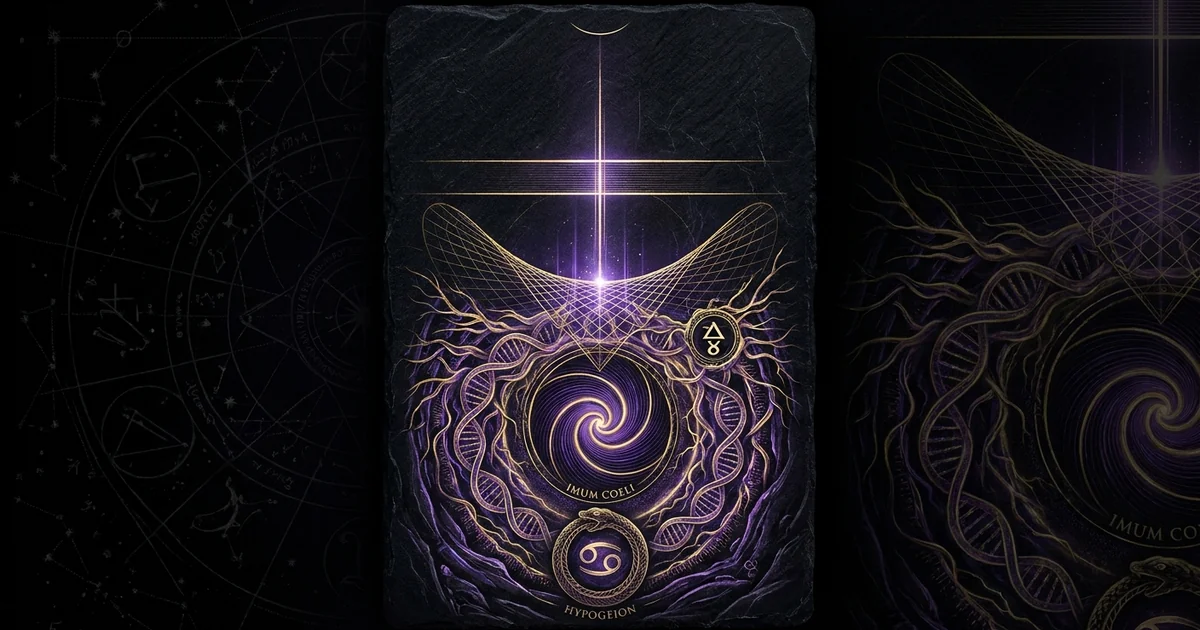
Fourth House: Imum Coeli and Ancestral Soul Roots Base
Archetypal Thesis & Systemic Paradigm: The Hypogeion and the Subterranean Psychic Bedrock
The Nadir as the Gravitational Well of Individuation
The fourth house of the natal chart occupies the exact spatial and symbolic nadir of the celestial sphere. Geometrically generated by the intersection of the celestial meridian with the lower horizon, this point—the Imum Coeli (IC) or “Lowest Heaven”—marks the deepest subterranean coordinate of the geocentric cosmos. In the mechanics of natal chart houses, while the Ascendant delineates the dawn of conscious embodiment and the initial interface of selfhood, the fourth house represents the dark, unilluminated bedrock from which that selfhood is extracted. Popular modern astrological discourse often collapses this sector into the trivialities of residential real estate, domestic decoration, or superficial domesticity. Such an exoteric reduction catastrophically obscures the actual psycho-cosmological function of this angle.
The fourth house astrological meaning operates fundamentally as an ontological gravitational well. In psychological terms, it corresponds not to the conscious ego’s private domicile, but to the archaic, pre-verbal foundations of the psyche: the subterranean pool of the collective and familial unconscious. As Dane Rudhyar formulated in The Astrology of Personality (1936), the Imum Coeli is the point of integration through rootage—the point where the isolated individual experience taps into the universal matrix of biological, cultural, and spiritual ancestry. Without structural integrity at the nadir, the psyche possesses no ballast against the shearing winds of social actualization.
The psychic architecture anchored at the nadir is inherently inertial and gravitational. It pulls the native downward into the historical depths of their lineage, functioning as an operative coordinate for the transgenerational unconscious. Here, the soul’s vertical axis finds its origin point. Individuation cannot occur as an unmoored flight toward the zenith; rather, as Carl Gustav Jung observed, the tree that reaches toward heaven must embed its roots within the underworld itself. The fourth house is this systemic underworld. It is the repository of primary psychic conditioning, containing the undifferentiated oceanic state of early infancy, somatic affect-complexes, and inherited lineage pathologies that operate far beneath the native’s waking cognitive architecture.
‘The collective unconscious contains the whole spiritual heritage of mankind’s evolution, born anew in the brain structure of every individual. His conscious mind is an ephemeral phenomenon that accomplishes all provisional adaptations and orientations, for which reason its functioning can best be compared to orientation in space. The unconscious, on the other hand, is the source of the instinctual forces of the psyche and of the forms or categories that regulate them, namely the archetypes.’
The Genitor Axis and Epigenetic Architecture
Within the classical canon, this sector was formally classified as the genitor-house (the house of the parents, lineage, and physical origins). Rather than displaying the subjective, performative persona that the native constructs across development, the fourth house codifies what was systemically received prior to the genesis of conscious will. Contemporary cellular biology and psychoneuroimmunology confirm what ancient astrological hermeneutics codified symbolically: transgenerational epigenetic inheritance dictates that trauma, behavioral adaptations, and biological stress responses are encoded within cellular memory across multiple generations. The fourth house represents this exact psycho-epigenetic coordinate.
When the native confronts the planetary occupants and rulership networks of the fourth house, they are not examining an isolated psychological complex. They are interrogating the ancestral matrix—an intricate psychic web linking parental figures, dead forebears, and discarded bloodline debts. It is the seat of what depth psychology terms the “ancestral ghost.” These inherited patterns are non-verbal and pre-rational. They manifest as unchosen physiological predispositions, spontaneous somatic collapses, visceral reactions to the concept of belonging, and deeply internalized taboos that dictate what is permissible for the lineage to achieve or endure.
Through this lens, the genitor axis is revealed not as an external record of parental biography, but as an internalized archetypal landscape. The parent signified by the fourth house is not merely the empirical mother or father who provided biological nourishment; it is the parental archetype as experienced through the prism of the native’s deepest unconscious vulnerabilities. This subterranean coordinate registers the structural conditions under which the child was welcomed into physical incarnation. It determines whether the psychological bedrock of the life is composed of granite security or subterranean quicksand.
The Subterranean Cardo in Natal Chart Houses
As the subterranean cardo (pivot or hinge), the fourth house occupies an angular station of supreme structural significance. The four angles of the chart—Ascendant, Medium Coeli, Descendant, and Imum Coeli—form the crux interpretum upon which the entirety of astrological interpretation balances. In this structural quadrivium, the fourth house provides the vertical counter-weight to the public, teleological zenith of the tenth house. The relationship between these two points is systemic and inescapable: no structure can rise higher than its foundation is deep.
                  [ Medium Coeli (MC) ]
                     Zenith: Teleology
                            |
                            |  Axis Mundi
  [ Ascendant (ASC) ]-------+-------[ Descendant (DSC) ]
  Dawn: Individuation       |       Twilight: Otherness
                            |
                     Nadir: Arche
                   [ Imum Coeli (IC) ]
When situated alongside the trajectory of the first house and Ascendant individuation, the fourth house represents the unformed clay from which the persona is chiseled. The Ascendant acts as the operational vehicle of the incarnation, yet the fuel that drives this vehicle, alongside the latent mechanical design of its chassis, originates entirely within the dark reservoirs of the fourth house. To neglect this angle in chart synthesis is akin to analyzing the architecture of a cathedral while ignoring the bedrock, soil composition, and foundational footings that prevent its collapse into the earth.
The fourth house functions as an alchemical crucible where the raw, undifferentiated materials of the lineage are either continuously replicated through unconscious repetition compulsion or transmuted into conscious agency. It is the systemic anchor of the natal chart houses, stabilizing the psyche against the externalizing demands of the world. In the developmental trajectory of the individual, any attempt to bypass this foundational space results in profound psychological fragility—a brittle persona that shatters when subjected to archetypal crises, because it possesses no interior ballast, no roots embedded within the deep earth of the soul.
Classical Provenance & Textual Lineage: From Hypogeion to the Genitor House
Hellenistic Formulations: Valens, Ptolemy, and the Subterranean Pivot
In the foundational texts of Hellenistic astrology, the fourth house was universally designated as the Hypogeion (literally, “Under the Earth”) or the Kato Mesouranema (the Lower Midheaven). Classical practitioners approached this place with deep solemnity, recognizing it as the domain of chthonic forces, hidden treasures, ancestral vaults, and the fundamental roots of physical existence. Vettius Valens, writing in the second century CE, categorized the fourth place as an angular pivot of extreme kinetic consequence, inextricably bound to the patrimony, the structural estate, and the final resolution of the mortal sequence.
Claudius Ptolemy, in Book III of his Tetrabiblos, delineates the parents through an intricate integration of house mechanics and planetary rulers, establishing the fourth house as the primary site of paternal inheritance in diurnal charts, while simultaneously linking it to the ground, land, and ancestral estate. Ptolemy’s treatment emphasizes the absolute, non-negotiable nature of the fourth place: while the diurnal movement of the heavens carries planets from the subterranean darkness through the Ascendant into the supernal hemisphere, the fourth house remains the ultimate subterranean repository, the place of entry and exit from the earthly plane.
‘The fourth place from the Ascendant, the subterranean cardo, deals with parents, the foundation of estate, hidden matters, life in old age, the burial of the dead, and the final end of all actions. It shows the conditions of the father, the roots of the lineage, and whatever lies hidden in the earth or beneath the consciousness of men.’
The Hellenistic masters did not regard the Hypogeion as a place of light emotional comfort. It was understood as a dark, silent chamber where ancient fates were determined. Firmicus Maternus, in his fourth-century treatise Mathesis, designates this angle as the Cardo Infimus (the Lowest Hinge), assigning to it the delineation of family origins, paternal wealth, hidden treasures, and the condition of the native’s body after death. The ancients perceived a profound, symmetrical elegance in this assignment: the place that witnessed the genesis of the biological lineage was also destined to govern the physical decomposition of the body and the ultimate enclosure of the soul within the tomb.
The Medieval Arab Syntheses: Al-Qabisi and Abu Ma’shar on Patrimony
As Hellenistic astrology was translated, refined, and systematized by the scholars of the Islamic Golden Age—including Abu Ma’shar, Al-Qabisi (Alchabitius), and Masha’allah—the fourth house underwent an analytical formalization. These medieval Arab astrologers expanded the Hellenistic doctrine of the finis rerum (“the end of all matters”), establishing the fourth house as the definitive arbiter of how any undertaking, life journey, or historical lineage concludes.
In the Introduction to the Craft of Astrology by Al-Qabisi, the fourth house is rigorously mapped to landed properties, real estate, subterranean mineral wealth, mines, hidden caches, and the ancestral patrimony (patrimonium). The Arabic astrologers introduced a hyper-refined system of lots (kleroi) calculated from this house, most notably the Lot of the Father and the Lot of Ancestral Lands, which were cross-referenced with the condition of Saturn (the diurnal chronocrator of fathers) and the Sun to determine the exact degree of honor, poverty, or devastation that the native inherited from their forebears.
Abu Ma’shar’s monumental Great Introduction systematized the fourth house as the cosmic axis governing continuity. If the native sought to comprehend the stability of their reign, the permanence of a dynasty, or the final outcome of an imperial enterprise, the fourth house and its celestial condition provided the singular, non-negotiable metric. To the medieval mind, the fourth house was the anchor of fate: it revealed whether the soul was born into a flourishing stream of divine favor or burdened with a decayed lineage whose ancestral sins demanded structural expiation.
The Latin Tradition: Cardo Infimus and the Shifting Assignation of Parents
When these Greek and Arabic compendiums were translated into Latin during the high and late Middle Ages, the fourth house became universally standardized as the Cardo Infimus. However, a major doctrinal ambiguity emerged concerning the exact assignation of the parents between the fourth and tenth houses. While modern astrology broadly assigns the fourth house to the mother (or the primary nurturing parent) and the tenth to the father, the classical and Latin traditions maintained a profoundly different structural calculus.
In classical doctrine, house assignations were strictly governed by sect (diurnal versus nocturnal charts) and cosmological polarity. According to Dorotheus of Sidon and Ptolemy:
- In a day chart, the Sun and the fourth house signify the father, while Venus and the tenth signify the mother.
- In a night chart, Saturn and the fourth house signify the father, while the Moon and the tenth signify the mother.
Other traditions, including elements of the Hellenistic lineage preserved by Antiochus of Athens, viewed the fourth house as the biological and genetic origin point (the physical matrix of the mother, the womb, and the earth), while the tenth house signified the social standing, lineage name, and outward authority of the father. This historical ambiguity persists because the fourth house does not operate as a single empirical human being; it operates as the primordial psychic ground from which both parents emerge within the child’s pre-verbal perception. The Latin tradition ultimately solidified the fourth house as the house of ancestral descent, paternal lineage, and the physical sepulcher, ensuring that throughout the Renaissance, the finis rerum remained the definitive locus for assessing the concluding chapter of human life.
Structural Mechanics & Symbolic Geometry: The Polar Meridian Axis and Spatial Coordinates
Vector Dynamics of the IC-MC Polarity
The Imum Coeli cannot be understood as an isolated astrological coordinate; it exists in a state of absolute, perpetual polar tension with the Medium Coeli (MC), forming the vertical axis of the cosmos: the Axis Mundi. In the geometric architecture of the natal sphere, the meridian circle intersects the horizon at right angles, establishing an unbroken teleological circuit. The IC is the archetypal origin; the MC is the teleological destination. Every psychological drive, professional aspiration, and public monument delineated by the tenth house and Midheaven career teleology is mechanically dependent upon the energetic pressure generated at the Imum Coeli.
Imum Coeli (Nadir / Fourth House)
- Internal, subterranean psychic matrix
- Ancestral conditioning & epigenetic roots
- Nocturnal, pre-verbal subjectivity
- The foundation of private psychological safety
- Alchemical nigredo and primary dissolution
- The ancestral past and biological heritage
Medium Coeli (Zenith / Tenth House)
- External, supernal projection
- Public teleology & societal destiny
- Diurnal, explicit self-actualization
- The apex of professional culmination
- Alchemical rubedo and solar realization
- The visible future and historical legacy
This meridian polarity represents a classic energetic feedback loop. When an individual attempts to pour all their psychic libido into the Midheaven—striving for public recognition, career dominance, or political power—without having consciously excavated and stabilized the Imum Coeli, the axis becomes top-heavy. The systemic structural consequence is catastrophic psychic or physiological collapse. The subterranean roots cannot sustain the supernal canopy. Conversely, when the native remains fixated purely on the fourth house, trapped in historical grievances, childhood trauma, or regressive family obligations, the axis suffers from energetic stagnation; the life force suffocates within the chthonic vault, unable to climb the meridian toward solar actualization.
Quadrant Versus Whole Sign Mechanics at the Nadir
A critical technical divergence in celestial mechanics occurs when comparing unequal quadrant house systems (such as Placidus, Regiomontanus, or Koch) with the ancient system of whole-sign-houses. In quadrant systems, the Imum Coeli is, by definition, the exact cusp of the fourth house. The celestial meridian directly demarcates the boundary where the third house terminates and the fourth house begins, binding the spatial angle to the house system itself.
In the Whole Sign house system, however, the degree of the Imum Coeli floats dynamically. The entire sign containing the degree of the Ascendant becomes the first house, and the entire sign four places removed becomes the fourth house. Consequently, depending on the geographic latitude of the birth location and the obliquity of the ecliptic, the mathematical degree of the Imum Coeli can fall within the third house, the fourth house, or the fifth house.
Whole Sign House Framework (Example: IC Floating into 3rd House)
================================================================
[ 2nd House: Pisces   ]  --> Resources & Material Sustenance
[ 3rd House: Aries    ]  --> Kinship, Local Mind, & [ IC ANGLE ]
[ 4th House: Taurus   ]  --> The Ground of Estate & Ancestral Land
[ 5th House: Gemini   ]  --> Progeny, Pleasure, & Libidinal Flow
This structural separation provides immense interpretive nuance. When the IC degree falls in the Whole Sign third house, the native’s ancestral roots, transgenerational trauma, and core psychic anchor are filtered through the mechanisms of local environment, siblings, communication, and cognitive displacement. When the IC falls in the fourth house proper, the systemic power of the nadir is hyper-concentrated within the domestic and genealogical bedrock. The spatial angle (IC) functions as the dynamic, sensitive energetic vortex, while the topical house (the fourth place) delineates the mundane circumstances, material assets, and biological progenitors of the native’s earthly incarnation.
Angular Kinetic Force and the Subterranean Quadrivium
In the classical taxonomy of house categorizations, the fourth house is an angle (Greek: kentron; Sanskrit: kendra). The angular houses—the first, fourth, seventh, and tenth—are the seats of kinetic energy within the natal chart. While succedent houses stabilize and cadent houses disperse, angular houses actively execute. Despite its subterranean, dark, and receptive nature, the fourth house must not be misinterpreted as a passive or inert space. Its kinetic force is immense; it exerts a continuous, inexorable pressure that pushes events, neuroses, and biological imperatives up from the deep unconscious into manifest reality.
This subterranean kineticism operates like tectonic plates grinding beneath the earth’s crust. It is silent, invisible to the conscious eye, and completely unconcerned with the social persona’s ego-ideals. Yet, when the structural tension at the nadir reaches critical mass, the resulting eruption reshapes the entire landscape of the chart. An afflicted fourth house does not simply create quiet, internal sadness; it systematically undermines the native’s physical health, shatters relationships (seventh house, via square aspect), destabilizes mental equilibrium (first house, via square aspect), and topples public standing (tenth house, via direct opposition). The fourth house is the kinetic bedrock upon which the sanity of the native rests.
Psychological Dynamics & Operational Praxis: Delineating Transgenerational Matrices
Planetary Inhabitation: Malefics, Benefics, and the Ancestral Ghost
When analyzing the planets inhabiting the fourth house, the archetypal psychologist and esoteric astrologer must read these celestial bodies as active components of the inherited family crypt. A planet situated at the nadir is rarely a personal possession of the native; rather, it is an ancestral complex that has taken up residence within the subject’s somatic foundation. It indicates how the lineage processed specific archetypal energies—and whether those energies were integrated into conscious living or violently repressed into the lineage shadow.
The classical malefics, when occupying this angle, signify heavy ancestral burdens and systemic debts:
- Saturn in the Fourth House: Represents an ancestral crypt sealed in lead. The native inherits a transgenerational legacy of emotional coldness, structural poverty, severe religious dogmatism, or crushing parental obligation. The home of childhood is experienced as an institutional space dominated by duty, unspoken grief, or the heavy weight of an absent or tyrannical progenitor. Somatically, it induces chronic tension in the skeletal system and an absolute terror of vulnerability.
- Mars in the Fourth House: Inscribes the ancestral inheritance with iron, blood, and unresolved fury. The native is the recipient of intergenerational violence, displacement, structural warfare, or intense domestic discord. The subterranean bedrock is volcanic. The native harbors an instinctual, somatic expectation of sudden attack, resulting in hypervigilance that frequently erupts as unconscious rage within the adult domestic sphere.
Conversely, the classical benefics in this position indicate inherited systemic protection:
- Jupiter in the Fourth House: Confers an ancestral blessing—a psychological or material buffer derived from forebears who possessed ethical standing, philosophical broadness, or substantial physical property. The root system is nourished by an enduring, unconscious faith in the cosmic order, granting the native an unshakeable sense of interior belonging and psychological resilience.
- Venus in the Fourth House: Softens the subterranean matrix, embedding the soul within an ancestral lineage that valued aesthetic harmony, material security, and relational diplomacy. The native experiences the domestic sanctuary as an essential therapeutic retreat, using the private sphere to repair the somatic damage incurred within the public sphere.
The Ruler of the Fourth: Tracing the Genetic and Psychic Heredity Line
While planets occupying the fourth house describe the immediate psychological climate of the ancestral vault, the planetary ruler of the sign on the fourth house cusp (the Lord of the Hypogeion) serves as the psychopomp—the guide that traces the ultimate trajectory and operational mechanics of the lineage. The condition, placement, and relational aspects of this ruler reveal how the ancestral debt is paid and where the soul’s roots derive their sustenance.
If the ruler of the fourth house is deposited in the eighth house, the family inheritance is intrinsically bound to hidden crises, taboo ancestral secrets, financial entanglements with the dead, and the imperative to psychically compost lineage trauma. If the ruler of the fourth resides in the tenth house, the lineage demands public visibility; the native is compelled to carry the private ancestral name onto the public stage, transforming hidden familial imperatives into collective monuments.
To delineate the ruler of the fourth is to diagnose the structural health of the family tree. A debilitated ruler—such as Mars in Cancer or Venus in Virgo governing the nadir—suggests a fractured foundation, indicating that the native has been tasked by the lineage to resolve a structural pathology that prior generations were unable to integrate. The native ceases to be an isolated individual; they become the designated alchemical vessel for transgenerational systemic repair, operating within the territory of archetypal transgenerational inheritance.
Chronocrators, Profections, and the Activation of the Root Matrix
The ancestral matrix encoded within the fourth house does not remain static throughout the native’s lifespan. It is activated chronobiologically according to precise mathematical time-lord systems. In the Hellenistic system of Annual Profections, the fourth house is formally activated during the fourth year of life, and recursively every twelve years thereafter—specifically at ages 3, 15, 27, 39, 51, 63, 75, and 87.
Annual Profection Cycle of the Fourth House
=============================================================
Profection Year: 4th House (Root, Lineage, Domestic Foundation)
-------------------------------------------------------------
- Age 03: Primary somatic rooting; early parental conditioning
- Age 15: Pubescent individuation; rebellion against the family vessel
- Age 27: The pre-Saturn Return crisis; initial renegotiation of roots
- Age 39: Midlife restructuring; confronting the parental mortality
- Age 51: Ancestral maturation; becoming the generational elder
- Age 63: The second Saturn completion; consolidation of estate
- Age 75: Preparation for the finis rerum; structural detachment
=============================================================
During a fourth-house profection year, the planet that rules the sign of the fourth becomes the chronocrator (time-lord) for that twelve-month period. During these temporal windows, the subterranean vault unseals. The events of these years routinely bypass conscious ego-control, manifesting as:
- The literal physical death or systemic restructuring of a parental figure.
- Radical disruptions in geographical domicile, including forced migration, ancestral repatriation, or the purchase and liquidation of land.
- The sudden, uninvited surfacing of transgenerational psychic crypts—repressed family secrets, genetic medical conditions, or ancient legal disputes concerning the estate.
- Intense somatic crises that compel the native to withdraw from public social performance (tenth house) and descend into the psychological underworld to repair their broken foundations.
Philosophical Synthesis & Macrocosmic Correspondence: Hermetic Root Systems and Alchemical Nigredo
The Alchemical Nigredo as the Primordial Base
In operative psychological alchemy, the fourth house is the astrological vessel for the stage of Nigredo (the blackness, or putrefactio). Before any psychic substance can be purified through the Albedo (whitening) or integrated into the solar consciousness of the Rubedo (reddening), it must undergo primary decomposition. The fourth house represents this exact alchemical vessel. It is the moist, dark, warm earth where the seed of the persona decays, sloughing off its superficial cultural adaptations so that the true Prima Materia (first matter) can be exposed.
The Imum Coeli corresponds directly to the midnight hour of the diurnal cycle—the moment of complete solar absence. It is the cosmological womb and the cosmological sepulcher. In the alchemical tradition, this is the subterranean laboratory where the adept discovers that the stone which the builders rejected has become the head of the corner. By descending into the fourth house, the native encounters the putrefying remnants of their childhood illusions, the broken idols of their parents, and the heavy lead of their lineage karma. This descent is not a pathology; it is an absolute technical requirement of Hermetic initiation. To refuse the Nigredo of the fourth house is to condemn oneself to an artificial, hollow existence—an ego-construct that possesses height without depth.
Qabalistic Bridges: Yesod and the Malkuthian Underworld
Within the structural framework of the Qabalistic Tree of Life, the fourth house functions as the systemic interface between Malkuth (the Kingdom, the physical world of manifest form) and Yesod (the Foundation, the astral reservoir of formative images, instincts, and ancestral memories). Yesod is the lunar sphere that collects, purifies, and projects the spiritual energies of the upper Sephiroth into the material reality of Malkuth.
[ TIPHARETH ] (Solar Consciousness / MC Apex)
              |
              |  The Central Pillar of Balance
              v
         [ YESOD ]   (The Astral Foundation / 4th House Matrix)
              |
              |  Threshold of Incarnation
              v
        [ MALKUTH ]  (Physical Manifestation / Earthly Body)
The fourth house represents the invisible energetic roots of Malkuth dipping directly into the subterranean waters of Yesod. It is the astral foundation of the physical body. Just as Yesod is associated with the reproductive organs, the nocturnal dream-state, and the automatic functions of the autonomic nervous system, the fourth house governs the automatic, somatic habits of the human organism. It is the bridge through which the ancestral ghosts (the lingering astral forms of dead lineages in Yesod) transmit their patterns directly into the physical biology of the living native (Malkuth).
Without conscious mastery of this threshold, the native remains an unconscious puppet of Yesodic astral automation, perpetually enacting the instinctual patterns, neuroses, and biological scripts that were written into the lineage long before their physical birth.
- Astrological Element: Primordial Water (Cardinal / Archetypal Cancerian Root)
- Celestial Coordinates: Intersection of the Meridian Circle with the Northern Horizon (Nadir)
- Qabalistic Node: Yesod / Interface with the Subterranean Vaults of Malkuth
- Alchemical Operation: Putrefactio / Nigredo (Decomposition to isolate the Prima Materia)
- Chronobiological Axis: Solar Midnight / The Nocturnal Pivot of the Diurnal Arc
- Hellenistic Categorization: Hypogeion / Cardo Infimus / Angular Pivot
- Teleological Function: Finis Rerum (The End of Matters / Return to the Source)
Cyclical Closure: The End of Matters as the Chrysalis of the Self
The ancient designation of the fourth house as the finis rerum—the end of all matters—reveals its philosophical profoundness. In a linear paradigm of time, the beginning and the end are separated by an unbridgeable chronological gulf. In the circular, spherical geometry of Hermetic psycho-cosmology, however, the beginning and the end occupy the exact same spatial coordinate. The womb is the tomb; the grave is the chrysalis.
The fourth house signifies the final chapter of human life not as a macabre fixation on mortality, but as the teleological return to the source. It delineates how an individual extracts the ultimate meaning from their earthly incarnation when all social status (tenth house), interpersonal alliances (seventh house), and egoic projections (first house) are stripped away. It shows the conditions of the soul’s interior retirement, the quality of its late-life contemplation, and the psychological atmosphere surrounding its departure from the physical vessel.
By recognizing the fourth house as the eternal finis rerum, the metaphysical investigator discovers the ultimate purpose of this subterranean space: it is the chrysalis of the authentic Self. When the native courageously descends into the nadir, excavates the family crypt, releases the ancestral ghosts through conscious awareness, and purifies the soil of their psychological bedrock, the fourth house ceases to be a site of generational trauma. It transforms into an unshakeable inner citadel—a private, sacred center of psychic gravity that grounds the individual so deeply within the cosmos that no worldly catastrophe can overturn them.
Frequently Asked Questions: Navigating the Imum Coeli and Ancestral Matrices
Assigning the Parents: Tenth House versus Fourth House Debate
The structural assignment of parents between the fourth house and the tenth house remains one of the most contentious technical debates in both traditional and modern astrological practice. To resolve this doctrinal tension, the practitioner must distinguish between historical mechanics and modern psychological projections.
In classical Hellenistic astrology, parental assignation was derived primarily through sect and planetary natural significators rather than an arbitrary gender division of the houses:
- The Diurnal Calculus: In a day chart, the Sun represents the natural archetype of the father, and the fourth house delineates the father’s biological lineage, estate, and physical foundation. The tenth house, standing in opposition, delineates the mother and her ancestral status, naturalized through the placement of Venus.
- The Nocturnal Calculus: In a night chart, Saturn becomes the operational significator of the father, while the Moon becomes the direct ruler of the mother. Here, the fourth house often describes the mother’s physical womb and lineage base, while the tenth describes the father’s worldly authority and public patrimony.
Modern psychological astrology, pioneered by figures such as Dane Rudhyar and Liz Greene, altered this assignation by mapping the houses to the child’s subjective psychological experience. Modern practice frequently assigns the fourth house to the mother (or the parent who provided the initial domestic holding environment and primary psychological conditioning) and the tenth house to the father (the parent who represented social authority, worldly ambition, and the bridge into the external culture).
The optimal diagnostic method requires synthesizing both traditions: the fourth house must be interpreted as the parent who provided the psychological, somatic, and transgenerational foundation—the parent who was internalized as the child’s subterranean emotional bedrock—regardless of their biological gender.
The Phenomenon of Interceptions and Disjunct Angles at the IC
When using unequal quadrant house systems at extreme geographical latitudes, the Imum Coeli can decouple from the fourth house cusp, or the fourth house itself can become intercepted (containing an entire zodiacal sign that does not hold a cusp). These mechanical distortions reveal critical psychological configurations within the native’s ancestral roots.
Quadrant Latitudinal Distortion (Intercepted 4th House)
==============================================================
[ 3rd House Cusp: 28° Leo ] ---------------------------------
     [ Subterranean Vault: Virgo Entirely Intercepted ]
     [ IC Dynamic Angle: 14° Virgo (Subterranean Focus) ]
[ 4th House Cusp: 02° Libra ] -------------------------------
==============================================================
When an interception occurs within the fourth house, the ancestral complex is structurally occluded or “locked away.” The archetypal qualities of the intercepted sign were not permitted natural, open expression within the ancestral lineage. For example, if Scorpio is intercepted in the fourth house, the family history contains deep, unmentionable vaults of trauma, sexual taboos, financial betrayals, or unresolved grief that were deliberately buried beneath an exterior facade of mundane domestic normality. The native cannot easily access their emotional roots; they must perform extensive, intentional psycho-spiritual excavation to uncover the primary matter of their psychological foundation.
Furthermore, in high-latitude quadrant charts where the IC degree falls into the third or fifth house, a structural disjunction occurs between the spatial angle of the nadir and the topical house of domesticity. In such instances, the Imum Coeli acts as the internal, psychic gravitational well, while the fourth house cusp describes the physical domestic environment. The native’s deepest transgenerational identity may operate through third-house intellectualization or fifth-house creative projection, while their mundane domestic life follows the systemic demands of the fourth house sign.
Remediating Malefic Inhabitation in the Genitor House
The placement of classical malefics (Saturn, Mars) or outer planetary forces (Uranus, Neptune, Pluto) within the fourth house frequently correlates with profound ancestral fracturing, early domestic disruption, or deep somatic vulnerabilities. Remediating these placements requires moving beyond fatalistic resignation into active psychological and ritual architecture.
Operative remediation of an afflicted fourth house involves three distinct phases:
- Ancestral Archaeology and Crypt Excavation: The native must consciously investigate the historical realities of their lineage. Malefics at the nadir thrive on denial, silence, and repressed family secrets. By researching the literal history of their forebears—identifying ancestral patterns of bankruptcy, military trauma, emotional abandonment, or systemic oppression—the native extracts the historical facts from the psychological unconscious, preventing those facts from operating as autonomous somatic complexes.
- Spatial and Domestic Cleansing: The physical dwelling space must be treated as an externalized mandala of the fourth-house psyche. For Mars afflictions, the native must deliberately provide a constructive physical outlet for fire and martial energy within the home (such as a forge, an intense physical training area, or explicit energetic boundary demarcations) to prevent domestic violence or systemic accidents. For Saturn afflictions, the native must consciously introduce light, warmth, and structural order, transforming the home from an emotional prison into a deliberate, secure sanctuary of contemplative discipline.
- The Creation of an Interior Anchor: The native must recognize that when the external biological roots are compromised, the soul is being initiated into constructing its own foundation. The true purpose of a difficult fourth house is to sever unconscious, regressive dependencies on the biological lineage. By acting as the conscious alchemical vessel—the elder of the self—the native reparents their own infantile psyche, grounding their soul not in the fragile, wounded history of their ancestors, but in the indestructible, transcendent bedrock of the cosmos itself.