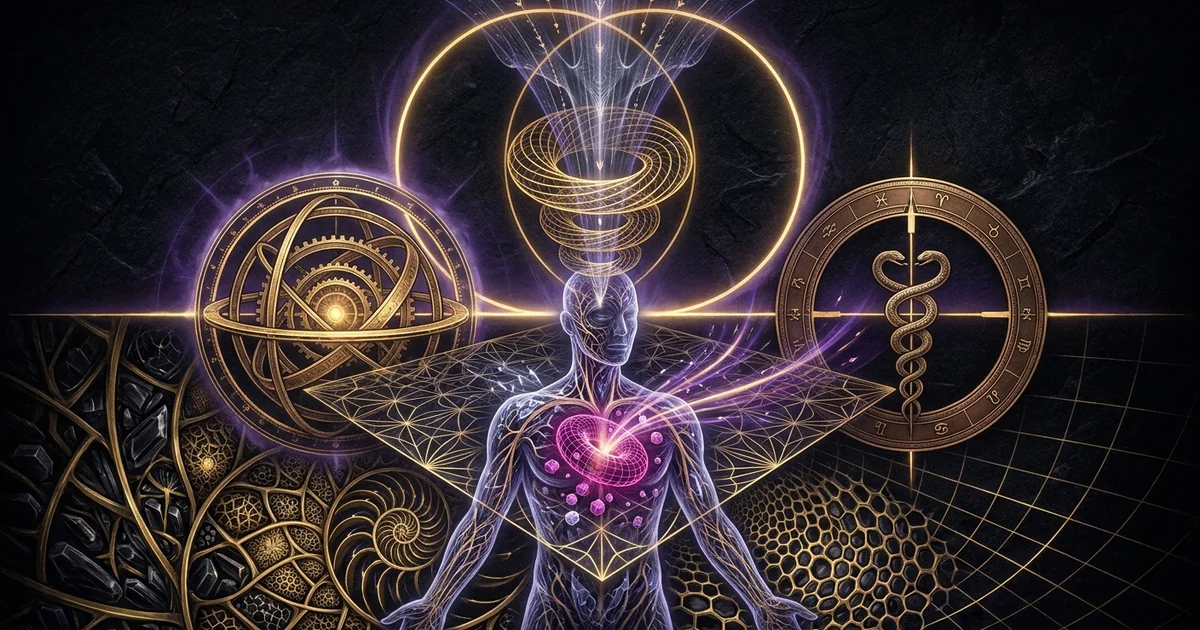
First House: The Ascendant and Incarnate Soul Vessel
Archetypal Thesis & Systemic Paradigm: The Eastern Horizon as the Incarnate Boundary Layer
The ontological genesis of the natal chart occurs neither at the zenith of social visibility nor in the subterranean depths of ancestral memory, but at the exact liminal juncture where the eastern horizon bifurcates the cosmos into the seen and the unseen. In archetypal astrology and psycho-cosmological mechanics, this threshold is formalized as the Ascendant, or the cusp of the First House. Rather than functioning as a mere stylistic flourish or cosmetic social mask, the First House demarcates the structural membrane of the waking ego. It is the primary somatic interface, the thermodynamic boundary condition through which transpersonal cosmic fields collapse into localized, spatiotemporal biological matter. At this intersection of time and space, the unmanifest archetypal continuum is transduced into phenomenological embodiment, setting into motion the finite organism’s mortal trajectory.
The Horoskopos as the Primary Ontological Cusp
The designation of this orienting point derives from the Hellenistic Greek horoskopos (ὡροσκόπος), literally translated as the “hour-watcher” or “marker of the hour.” Far from the vernacular debasement that reduced the term “horoscope” to generic sun-sign forecasts, the classical horoskopos represented the precise degree of the ecliptic rising above the rational horizon at the exact moment an infant severed physical unity with the maternal organism and drew its first independent breath. This respiration marks the initial thermodynamic exchange between the microcosm and the macrocosmic atmospheric field. In Hellenistic cosmology, the Ascendant degree was the master coordinate from which the entire architecture of the nativity was derived; without the calculation of this primary axis, the remaining heavens remained an unanchored, floating sphere.
The horoskopos anchors the subjective observer in terrestrial reality. By establishing the eastern edge of the local horizon, it institutes a distinct coordinate grid that dictates how the soul interfaces with the planetary spheres. The First House does not passively observe the cosmos; it actively anchors it, acting as the prime orienting axis that configures the native’s subjective experience of reality. To understand the structural deployment of the other eleven houses, one must examine the systemic foundation mapped in natal chart houses, where the First House functions as the primary operational coordinate for all subsequent experiential developments.
Deconstructing the First House Astrological Meaning Beyond Superficial Persona
Twentieth-century psychological astrology frequently degraded the first house astrological meaning, conflating the rising degree with a superficial “mask” or an insincere adaptation mechanism designed to court social approval. This reductive interpretation arose from a partial and flattened reading of Jungian archetypal psychology, erroneously equating the Ascendant exclusively with the socio-psychic persona. In classical, medieval, and authentic analytical paradigms, however, the First House encompasses far more than social presentation: it represents the native’s instinctual physical vitality, constitution, somatic predispositions, and the structural integrity of the biological organism itself.
+-------------------------------------------------------------------------+
|                  PSYCHO-COSMOLOGICAL TRANSLATION MATRIX                 |
+=========================================================================+
| Macrocosmic Radiance | Archetypal Potential / Unmanifest Planetary Rays |
|          ↓           |                                                  |
| Ecliptic Intersection| The Ascendant Degree (Rational Horizon Vector)   |
|          ↓           |                                                  |
| Psychophysical Cusp  | First House / Vita: The Biological Boundary      |
|          ↓           |                                                  |
| Somatosensory Output | Visceral Phenotype, Sensorium, Behavioral Stance |
+-------------------------------------------------------------------------+
When reduced to a mere social facade, the profound psychosomatic reality of the rising sign is severed from its physiological moorings. The first house astrological meaning denotes the biological vessel: the nervous system’s hardwired sensitivity, baseline cellular resilience, somatic temperament, and autonomic stress-response architecture. The psychological traits traditionally assigned to the rising sign are in fact secondary psychological adaptations to an underlying somatic condition. A native with an Aries Ascendant, for instance, does not merely project a bold outward persona; their central nervous system is chemically and biophysically configured for sympathetic arousal, rapid motor recruitment, and direct environmental confrontation. Conversely, a native with a Saturn-governed Capricorn Ascendant experiences reality through a heightened baseline of sensory restraint, somatic density, and cautious metabolic expenditures.
The Transduction of Noumenon into Phenomenological Soma
The structural mechanics governing this operational boundary illustrate how archetypal forms condense into concrete bio-physical reality. The First House operates as an open thermodynamic system, continually processing matter-energy exchange across its biological threshold. In the lexicon of process philosophy and esoteric embryology, the physical form is the sedimentation of the subtle energetic field. The ecliptic coordinate rising at the nativity provides the structural parameters for this sedimentation, converting raw astral potential into cellular morphology, glandular configuration, and neural topography.
Through this somatic lens, the sensory apparatus is calibrated. The native does not perceive objective reality in vacuo; instead, sensory stimuli are processed through the archetypal filter of the Ascendant sign and its planetary governors. The Ascendant determines which spectrum of sensory data is privileged, which inputs are registered as systemic threats, and which vectors are disregarded. The First House functions as the organism’s primary sensory filter, organizing environmental inputs to generate a coherent phenomenological reality for the waking ego.
The First House possesses precise structural parallels across major esoteric cartographies of consciousness:
- Qabalah (Malkuth): The First House corresponds to the final Sephirah on the Tree of Life—Malkuth, the Kingdom. Malkuth represents the ultimate crystallization of divine emanations into the world of Assiah (physical action and concrete form). Just as Malkuth serves as the somatic crucible through which the upper nine Sephiroth become tangible, the First House anchors the celestial potential of the upper houses into the corporeal flesh of the native.
- Hermeticism & Neoplatonism (Ochema-Pneuma): It represents the material envelope that coats the ethereal ochema-pneuma (the subtle “vehicle of the soul”), transforming immaterial planetary rays into blood, bone, and visceral instincts.
- Human Design (The G-Center / Personality Crystal Interface): The Ascendant operates analogously to the magnetic monopolar orientation and the G-Center’s capacity to locate the physical vehicle in space and time, anchoring the transcendent Personality Crystal into the biological geometry of the Design vehicle.
Classical Provenance & Textual Lineage: The Hellenistic Horoskopos and the Vita House
The rigorous lineage of astrological doctrine establishes the First House as the preeminent pillar of the natal scheme. In classical antiquity, early astrologers did not interpret the chart as an abstract psychological mandala; they approached it as an inquiry into physical fate, biological longevity, systemic health, and the corporeal embodiment of the daimon. Through the Hellenistic era, into Roman judicial astrology, through the Islamic Golden Age, and finally into the Renaissance, the First House retained its primacy as the fundamental signifier of physical vitality.
Anatole, the Rising Cusp, and the Coining of the Horoskopos
The classical Greeks designated the eastern horizon by the term Anatole (ἀνατολή), signifying the rising, the dawn, and the emergence from the darkness of the underworld. In the foundational Hellenistic treatises of Antiochus of Athens, Dorotheus of Sidon, and Claudius Ptolemy, the horoskopos served as the absolute zero-point of the chart’s structural geometry. Under the whole-sign house system—the ubiquitous paradigm of classical Hellenistic practice—the zodiacal sign containing the rising degree became the First Place (topos), designating every planet within that entire thirty-degree sign as an inhabitant of the First House.
Ptolemy, in Book III of his Tetrabiblos, delineates the methodology for determining the physical constitution and somatic vulnerabilities of the native. He explicitly links the Ascendant with the physical form, asserting that bodily defects, temperament, and constitutional strengths originate from the celestial configurations presiding over the horoskopos. Ptolemy treats the First House not as an ephemeral cognitive trait, but as the concrete determinant of physical longevity and biological inheritance. To examine the operational mechanics of this rising cusp in detail, one must consult the mathematical and symbolic formulations detailed in ascendant sign mechanics.
The Roman Vita House: Life Force, Bodily Constitution, and Helm of the Soul
As Hellenistic astrology was systematized by Roman practitioners—most notably Firmicus Maternus in his Matheseos Libri VIII and Marcus Manilius in the Astronomica—the First House received its definitive Latin nomenclature: the Vita, or the House of Life. Manilius designated the First House as the place of the newborn infant, the dawn of mortal existence, and the point where the soul first encounters the terrestrial elements.
“The Horoskopos is the foundation of bodily life, the vital spirit, and the breath of the native. It signifies the physical constitution, the helm of the ship of life, and the early years of upbringing. While the Midheaven determines action, social rank, and the mental helm, the Horoskopos governs the somatic ship itself. If the Lord of the Horoskopos is afflicted, badly placed, or aspected by malefics, the vessel itself is compromised, regardless of the heights the native’s career might attain.” — Vettius Valens, Anthologies (c. 175 CE), translated by Mark Riley
Valens’ nautical metaphor of the chart as a sailing vessel provides essential theoretical clarity: the Midheaven (Medium Coeli) serves as the strategic rudder, determining the course of social destiny, profession, and conscious action; but the Ascendant is the physical hull. If the hull is constructed of fragile timbers or breached by malevolent aspects, the ship founder will occur in turbulent waters, irrespective of the helmsman’s skill. In this classical framework, the vita house governs the native’s baseline vitality, physical form, constitutional temperament (the balance of hot, cold, wet, and dry humors), and the ultimate duration of the physical incarnation.
+--------------------------------------------------------------------------+
|          CLASSICAL NAUTICAL CARTOGRAPHY OF THE NATAL VEHICLE             |
+==========================================================================+
| Ascendant (Horoskopos)  | The Physical Hull: Somatic Integrity & Vitality|
| Midheaven (MC)          | The Helmsman / Navigational Course: Social Aim |
| Descendant (Dysis)      | The Encountered Waters: The Other & Exterior   |
| Imum Coeli (IC)         | The Deep Ocean Bed: Roots, Ancestry, Crypt     |
+--------------------------------------------------------------------------+
The Transmission from Medieval Arabian Astrology to the Renaissance Magus
Following the collapse of the Western Roman Empire, this cosmological framework was preserved and refined by medieval Islamic astrologers, including Abu Ma’shar, Al-Kindi, and Al-Biruni. These scholars synthesized Hellenistic methods with Persian and Indian techniques, formalizing the concept of the Hayyiz and expanding the system of Arabian Parts—most critically the Part of Fortune (Pars Fortunae), which is calculated directly from the longitudinal distance between the Sun and Moon projected from the Ascendant degree.
During the Italian Renaissance, Marsilio Ficino integrated this mathematical corpus into the Hermetic-Platonic revival. In his medical-magical treatise De Vita Libri Tres (Three Books on Life, 1489), Ficino synthesized astrology with medicine, positing that the Ascendant and its planetary ruler (kyrios) dictate the native’s physical spirit (spiritus). For Ficino, the physical spirit was a subtle, vaporous fluid running through the nervous system, functioning as an intermediary between the rational soul and the gross biological flesh. Ficino argued that to maintain physical health and spiritual potency, the native must align their dietary, environmental, and intellectual habits with the planetary ruler of the First House, thereby maintaining the stability of the mortal envelope against the disruptive forces of the environment.
Structural Mechanics & Symbolic Geometry: Spatial Topology and House Division Dynamics
To comprehend the First House, one must examine its structural topology. The Ascendant is not an astronomical body; it is a mathematical intersection, an energetic vector generated by the convergence of celestial coordinate systems with the local terrestrial sphere.
The Intersection of the Ecliptic and the Rational Horizon
Mathematically, the Ascendant is defined as the exact degree and minute of the ecliptic that intersects the eastern horizon of the observer’s rational horizon at a specific geographical latitude, longitude, and moment in Universal Time. The rational horizon is the plane passing through the center of the Earth, parallel to the sensible horizon of the observer on the surface.
       Zenith (Directly Overhead)
             \       |       /
              \   Midheaven /
               \     |     /
                \    |    /
  Ecliptic Arc   \   |   /   Celestial Sphere
  ════════════════\══╪══/═════════════════════
                   \ | /
  ──────────────────X──────────────────────── Rational Horizon
                 /  |  \
       ASCENDANT /  |   \
 (Ecliptic-Horizon  |    \
   Intersection)    |     \
                    |      \
                    |       \
                   Nadir
The ecliptic, the apparent annual path of the Sun through the constellations, is tilted relative to the celestial equator by an obliquity of approximately 23.44 degrees. Because of this obliquity, the signs of the zodiac do not rise over the eastern horizon at equal speeds. In the Northern Hemisphere, signs of “short ascension” (from Capricorn through Gemini) rise quickly, often crossing the horizon in under an hour and a half, while signs of “long ascension” (from Cancer through Sagittarius) require up to three hours to clear the horizon. This astronomical asymmetry directly influences natal chart house calculations, altering the temporal frequency and structural dimensions of the First House depending on geographical latitude.
Whole Sign versus Quadrant Systems: Topological Discrepancies in the First House
The architectural delineation of the First House varies significantly depending on the mathematical house division system applied. This divergence reveals distinct ontological premises concerning whether astrological house 1 measures celestial longitude, temporal ascension, or spatial quadrant division:
- Whole Sign House System (Archaic / Hellenistic): The Ascendant degree establishes the entire 30-degree zodiacal sign as the First House. The Ascendant degree itself functions as an internal sensitive point—the anchor of vitality—within the sign, but does not define the house cusp. Under this system, any planet residing anywhere in that sign acts upon the native’s somatic core.
- Equal House System: The precise degree of the Ascendant serves as the structural beginning of the First House, which extends exactly 30 degrees of celestial longitude forward, regardless of zodiacal sign boundaries.
- Quadrant House Systems (Placidus, Regiomontanus, Porphyry): These systems define the First House cusp as the Ascendant degree, but determine the size of the house by dividing the diurnal/nocturnal semi-arcs of the celestial sphere. In the Placidus system, which divides the time required for degrees to traverse the horizon-to-meridian quadrants, the First House can be severely compressed or expanded at extreme northern or southern latitudes, sometimes leading to intercepted signs—signs that fall entirely within a house without appearing on either cusp.
+--------------------------------------------------------------------------+
|            TOPOLOGICAL COMPARISON: FIRST HOUSE ARCHITECTURES             |
+==========================================================================+
| System     | House Boundary Basis      | Core Ontological Premise        |
+------------+---------------------------+---------------------------------+
| Whole Sign | Entire Zodiacal Sign      | House as pure thematic place    |
| Equal      | 30° Ecliptic Arc from ASC | Longitude-based somatic sphere  |
| Placidus   | Time-proportional semi-arc| Temporal dynamics of incarnation|
+--------------------------------------------------------------------------+
These spatial discrepancies require theoretical precision. In quadrant systems, an intercepted sign within the First House implies that a secondary archetypal frequency is encapsulated within the physical constitution, struggling for direct somatic expression because it lacks a conduit to the rational horizon.
Diurnal Motion, Primary Motion, and the Genesis of the First House Vector
A critical paradox of astrological mechanics lies in the opposing motions governing the natal chart. The planets travel along the ecliptic in secondary motion from west to east (counter-clockwise in conventional chart representations). However, the Earth’s diurnal rotation—the primary motion—drives the entire celestial sphere from east to west (clockwise).
The Ascendant degree is the crucible of manifestation because it marks the point where planets, carried by primary motion, cross from the invisible underworld of the nocturnal hemisphere (houses 1 through 6) into the visible, illuminated world of the diurnal hemisphere (houses 7 through 12).
When a celestial body approaches the Ascendant from below the horizon, it undergoes a transformation from unconscious potential to waking, physiological manifestation. It emerges from darkness into light. Astrological house 1 functions as the cosmic gateway through which raw planetary potentials are transformed into visceral physical realities, embodied reflexes, and immediate psychological drives.
Psychological Dynamics & Operational Praxis: The Ascendant as Persona, Sensorium, and Cybernetic Filter
From the standpoint of analytical psychology and cybernetic systems theory, the First House functions as the primary regulatory threshold of the individual psyche. It is the operating system through which the waking ego translates internal archetypal pressures into adaptive external responses.
Modern Superficial Persona Paradigm
- Ontological Status: An artificial, externalized facade or insincere social mask.
- Locus of Operation: Purely cognitive, intentional, and performative presentation.
- Physical Integration: Neglects the body; views somatic reality as separate from the mask.
- Ego Relation: A defense mechanism adopted to hide the “authentic” solar self.
- Systemic Role: A cosmetic veneer layered atop the underlying natal architecture.
Classical-Analytical Sensorium Paradigm
- Ontological Status: Somatosensory interface and psycho-physical transducer (vita).
- Locus of Operation: Autonomic, physiological, instinctual, and behavioral baseline.
- Physical Integration: Deeply rooted in humors, somatic morphology, and nervous system wiring.
- Ego Relation: The structural gateway and baseline orientation through which the Self meets the world.
- Systemic Role: The master coordinate filter governing how all other house dynamics are experienced.
Jungian Persona versus the Ascendant Somatic Matrix
Carl Gustav Jung, in Aion and Two Essays on Analytical Psychology, characterized the persona as “a complicated system of relations between individual consciousness and society, fittingly a kind of mask, designed on the one hand to make a definite impression upon others, and, on the other, to conceal the true nature of the individual.” When shallowly integrated into astrology, this definition led practitioners to dismiss the Ascendant as an artificial construct that must be stripped away to access the “true” Sun sign.
This perspective misinterprets both Jung and astrological mechanics. A detailed reading of the Jungian persona archetype reveals that the persona is not an unnecessary illusion; it is an indispensable psychological organ. Without a functional, adaptive persona, the ego experiences psychic fragmentation, overwhelmed by the collective unconscious or paralyzed by social friction.
The First House represents the natural, embodied emergence of this organ. It is the biological foundation of the persona: the voice timbre, postural habits, instinctual reactions, and gaze characteristics that instinctively emerge whenever an individual encounters new environments. The Ascendant is the instinctual ego-skin, providing the necessary psychological boundary condition that makes autonomous conscious thought possible.
       ENVIRONMENTAL INPUT (Chaotic Macrocosm)
                        │
                        ▼
      [ FIRST HOUSE: Somatic Filter & Persona ]
      ┌───────────────────────────────────────┐
      │ - Autonomic Nervous System Regulation  │
      │ - Somatotype & Humoral Homeostasis     │
      │ - Behavioral Strategy of First Contact │
      └───────────────────────────────────────┘
                        │
                        ▼
         EGO INTEGRATION & INTERIOR PSYCHE
The Ascendant Ruler (Kyrios) and Co-Rulers as Operative Software Drivers
In classical astrology, the degree of the Ascendant points directly to its ruling planet—the Lord of the Ascendant, known in Hellenistic theory as the oikodespotes (domicile master) or the kyrios (lord/ruler). If the First House is the incarnate vehicle, the kyrios is the driver of that vehicle. The condition of the First House cannot be evaluated without a thorough assessment of this ruling planet: its sign, house placement, aspectual geometry, and essential dignity.
The kyrios shows where and how the native directs their primary vital energy:
- A native with a Taurus Ascendant governed by a exalted Venus in Pisces in the Eleventh House will direct their physical presence and vital instinct toward social connectivity, artistic collaboration, and ideological communities; their physical vitality relies heavily on emotional harmony and creative outlets.
- The same Taurus Ascendant with Venus fallen in Virgo in the Fifth House directs their vital energy through analytical scrutiny, critical discernment, and controlled somatic expressions; their physical vitality is closely bound to digestive health and routine management.
Furthermore, Hellenistic and medieval systems evaluate the co-rulers of the First House: the bound ruler (the planet governing the specific term or dodekatemorion of the Ascendant degree) and the triplicity rulers of the Ascendant. These secondary rulers provide nuance, highlighting the biological sub-layers, subtle instinctual shifts across different stages of life, and the underlying constitutional strengths of the native’s vitality.
Delineating First House Planetary Occupants as Somatosensory Filters
Planets residing within the First House introduce their energetic frequencies directly into the native’s physiological matrix. Such planets act as structural modifications to the primary Ascendant lens:
- Mars in the First House: Injects an excess of metabolic heat, physical drive, and autonomic reactivity. The native possesses an assertive physical presence, prone to inflammatory conditions, rapid motor responses, and a low tolerance for systemic stagnation.
- Saturn in the First House: Imposes somatic density, structural caution, and cold, dry humoral qualities. The physical constitution may lean toward joint stiffness, skeletal vulnerabilities, or calcification, but frequently exhibits enduring resilience, personal reserve, and disciplined somatic boundaries.
- Neptune in the First House: Dissolves the clarity of the ego-skin, creating high sensory permeability, porous energetic boundaries, and psychosomatic vulnerabilities to the immediate environment, alongside strong empathic receptivity.
- Jupiter in the First House: Expands the physical frame and humoral warmth, providing broad biological resilience and an open demeanor, though it can create a vulnerability to physiological excess or metabolic imbalance.
These planetary occupants modify the individual’s baseline sensorium. They function as persistent somatic lenses that govern how raw environmental stimuli are received, physically experienced, and expressed in the native’s immediate bearing.
Philosophical Synthesis & Macrocosmic Correspondence: Hermetic Embodiment and the Vehicle of the Soul
The First House represents the ultimate philosophical paradox of spiritual incarnation: how the boundless, non-local, eternal consciousness of the Unus Mundus constricts itself to inhabit a mortal, local, biological form.
The Ochema-Pneuma: Neoplatonic Astral Vehicles and the First House
In the late antique Neoplatonism of Plotinus, Porphyry, and Proclus, as well as the theurgic texts of Iamblichus, the soul’s descent into matter requires a mediating vehicle. The pure, immaterial nous cannot touch the heavy material elements directly without undergoing ontological disruption.
“The soul possesses a luminous, ethereal body—the ochema-pneuma—which it gathers during its descent through the planetary spheres. As it traverses the heavenly zones, it takes on layers of astral qualities, acquiring the specific faculties it requires for mortal life. This subtle vehicle is the bridge between incorporeal reason and animal flesh, and its condition is imprinted at the moment the mortal boundary is fixed.” — Iamblichus, On the Mysteries, Book V, translated by Clarke, Dillon, and Hershbell
This Neoplatonic subtle vehicle—the ochema-pneuma—is the direct philosophical precursor to the First House. To explore this dynamic in its philosophical context, review Hermetic ochema-pneuma doctrine. The Ascendant degree marks the exact astrological coordinates where this astral sheath is sealed into biological tissue. It is the celestial signature of the ochema, the geometric blueprint through which the immaterial soul takes on a temporal, mortal skin. The physical senses are the outer organs of this inner ethereal vehicle, and their structural tuning is governed by the astrological condition of the vita house.
   NOUS / UNMANIFEST SPIRIT (Eternal Transpersonal Consciousness)
                          │
                          ▼  Descends through the Planetary Spheres
       OCHEMA-PNEUMA (Subtle Astral Sheath / Fluid Vehicle)
                          │
                          ▼  Sealed at the Eastern Horizon (Horoskopos)
         BIOLOGICAL SOMA (First House / Corporeal Enclosure)
                          │
                          ▼
           PHENOMENOLOGICAL INCARNATE EXISTENCE
The Microcosmic Boundary: Individuation as Physical Enclosure
Without the First House, individuation is impossible. In both the psychological formulations of C.G. Jung and the esoteric mechanics of the Western esoteric tradition, consciousness requires a vessel (vas hermeticum) to achieve self-reflection. An uncontained soul remains diffused throughout the collective unconscious, trapped in archaic participation with the surrounding field.
The First House provides this essential containment. By circumscribing an interior space that is “not the world,” the rising cusp generates the subject-object divide. It creates the experiential boundary of the skin, separating internal sensations from external reality. This separation is the necessary precondition for the emergence of the conscious ego. The First House is the primal act of demarcation: it draws the boundary lines of the incarnated self, protecting the fragile spark of individual awareness from dissolution into the undifferentiated unconscious.
The Alchemical Coagulation of the Soul into Biological Matter
In the stages of the Magnum Opus, the First House corresponds to coagulatio—the alchemical operation that fixes that which is volatile, turning the vaporous, intangible spirit into concrete, dense matter. If the non-physical psyche is volatile, airy, and diffuse, the First House is the alchemical vessel that solidifies it into biological reality.
“The moment of birth represents a sudden, irrevocable synchronistic solidification. The qualitative field of the cosmos at that specific second is fixed into the biological organism. The Ascendant degree is the psychoid needle pinning the vast archetypal network of the collective unconscious to a physical coordinate point on Earth, establishing an indissoluble, lifelong psychophysical unity.” — Marie-Louise von Franz, On Divination and Synchronicity: The Psychology of Meaningful Chance (1980)
Coagulatio is an inherently demanding operation: it involves wrapping the infinite soul in the physical constraints of mortality, genetic history, and biological vulnerability. Yet it is the indispensable prerequisite for real spiritual work. The First House does not trap consciousness in flesh as a form of punishment; it provides the corporeal alembic within which consciousness can be tested, refined, and awakened. Through the structural resistance offered by the physical vehicle, the transpersonal self achieves distinct self-awareness.
Structural Dynamics of the First House: A Reference Matrix
The mechanical and archetypal realities of the First House can be synthesized into an operational matrix, illustrating how each Ascendant sign structures the somatic vehicle, constitutional tendencies, and core behavioral instincts:
| Ascendant Sign | Classical Element | Constitutional Humoral Bias | Somatic & Nervous System Matrix | Baseline Behavioral Instinct | Primary Operative Need |
|---|---|---|---|---|---|
| Aries | Fire | Choleric (Hot & Dry) | High sympathetic tone; rapid motor recruitment; cranial/ocular sensitivity. | Direct confrontation; immediate physical mobilization. | Autonomy through kinetic impact. |
| Taurus | Earth | Melancholic/Phlegmatic (Cold & Dry) | Metabolic endurance; high sensory thresholds; thyroid and cervical vulnerability. | Deliberate resistance; steady conservation of somatic output. | Material and somatic stability. |
| Gemini | Air | Sanguine (Hot & Moist) | Neurological sensitivity; high synaptic transmission; respiratory/pulmonary focus. | Constant information sampling; somatic restlessness. | Environmental mapping via communication. |
| Cancer | Water | Phlegmatic (Cold & Moist) | Visceral gastrointestinal responsiveness; fluid retention; high autonomic permeability. | Protective self-containment; defensive retreat; instinctual shielding. | Emotional and bodily sanctuary. |
| Leo | Fire | Choleric (Hot & Dry) | Cardiovascular focus; high vitality and stamina; postural and spinal emphasis. | Central self-expression; visible physical presence. | Radiance and systemic authority. |
| Virgo | Earth | Melancholic (Cold & Dry) | Neuro-digestive axis sensitivity; high sensory discrimination; somatic anxiety. | Critical filtering; somatic optimization; systemic purification. | Somatosensory calibration and functional order. |
| Libra | Air | Sanguine (Hot & Moist) | Renal equilibrium focus; sensitivity to environmental aesthetic and structural balance. | Social balancing; adaptive equilibrium; non-combative posturing. | Dialectical integration with the Other. |
| Scorpio | Water | Phlegmatic/Choleric (Cold & Wet) | Intense parasympathetic-sympathetic oscillation; reproductive and immunological focus. | Strategic concealment; energetic scanning; deep vigilance. | Psychological and energetic boundary control. |
| Sagittarius | Fire | Choleric/Sanguine (Hot & Dry) | Large muscle recruitment; hepatic focus; high metabolic turnover; physical mobility. | Expansive locomotion; forward propulsion; bodily exploration. | Unconstrained spatial and intellectual movement. |
| Capricorn | Earth | Melancholic (Cold & Dry) | Skeletal, connective-tissue, and joint density; slow metabolic rate; constitutional endurance. | Somatic containment; calculated defense; energetic economy. | Structural endurance and self-sufficiency. |
| Aquarius | Air | Sanguine/Melancholic (Hot & Moist) | Bio-electric and circulatory focus; erratic nervous system patterns; low muscular tension. | Detached systemic observation; idiosyncratic motor patterns. | Mental autonomy within structural systems. |
| Pisces | Water | Phlegmatic (Cold & Moist) | Lymphatic system sensitivity; porous energetic boundaries; high psychosomatic resonance. | Permeable adaptation; diffuse boundary containment. | Transcendence of rigid corporeal boundaries. |
Frequently Asked Questions: Structural Clarifications on the First House
How does the Ascendant differ functionally from the Sun sign and Moon sign?
In traditional psycho-cosmology, the Sun, Moon, and Ascendant form an indivisible operational triad that sustains the incarnation. The Sun represents the central telos, the conscious solar will, and the intentional path of individuation. The Moon governs the instinctual soul, memory, emotional equilibrium, and the subconscious habits inherited from ancestral lineages.
The Ascendant, by contrast, is the physical instrument through which both the Sun and Moon must operate in the concrete world. A native may possess a deeply analytical Virgo Sun and an emotionally intuitive Scorpio Moon, but if they have a Sagittarius Ascendant, that analytical will and emotional intuition are mediated through an expansive, outward-reaching, risk-tolerant somatic vessel.
+--------------------------------------------------------------------------+
|                     THE LUMINARY-ASCENDANT TRIAD                         |
+==========================================================================+
| Sun (Solar Will)       | The Conscious Purpose, Core Telos & Vital Fire  |
| Moon (Lunar Vessel)    | The Instinctual Soul, Cellular Memory & Habits  |
| Ascendant (The Vessel) | The Somatic Hull, Sensory Interface & Horizon   |
+--------------------------------------------------------------------------+
The Ascendant provides the physical senses, the metabolic style, and the primary behavioral orientation that define how solar objectives and lunar reactions manifest in tangible environments.
What occurs when the Ascendant degree falls in late or critical degrees (anaretic degrees)?
When the Ascendant degree falls at an anaretic degree—specifically the 29th degree (29°00’00" to 29°59’59") of any zodiacal sign—the structural dynamics of the First House change:
- Liminal Somatic Condition: The native embodies a transitional somatic state, functioning on the boundary between two disparate archetypal sensoriums. The physical constitution carries the mature, often exhausted qualities of the closing sign while actively registering the emerging frequencies of the subsequent sign.
- Somatic Exhaustion and Urgency: Classical astrologers often viewed the 29th degree as volatile or structurally stressed. Somatically, this placement frequently corresponds to an individual who experiences a persistent sense of developmental urgency, feeling that physical mastery within that sign’s archetype must be quickly stabilized to prevent systemic destabilization.
- Refined Discernment: Far from signifying an inherent defect, a late-degree Ascendant demands sophisticated psychological and physiological discernment. The native is compelled to resolve unresolved systemic tensions related to the rising sign, learning to ground its expression without resorting to unconscious, compensatory behaviors.
How should an astrologer interpret an empty First House versus an intercepted First House sign?
The absence of planetary occupants within the First House is a common condition that in no way implies a deficient personality, weak vitality, or lack of somatic presence.
When the First House is empty:
- The condition of the house is governed by its kyrios (the ruling planet of the Ascendant sign).
- The sign on the cusp retains its full authority over the native’s physical constitution, demeanor, and sensory orientation.
- The planetary ruler’s house placement, sign dignities, and aspectual matrix reveal where and how the native’s core physical vitality is deployed. If an Aries Ascendant has an empty First House, but Mars is dignified in Capricorn in the Tenth House, the native possesses strong physical discipline, focused vitality, and a drive toward social and vocational achievement.
When the First House contains an intercepted sign (a phenomenon occurring in quadrant house systems at higher latitudes):
- A complete zodiacal sign is entirely enclosed within the First House, possessing neither the Ascendant cusp nor the Second House cusp.
- This indicates an encapsulated archetypal frequency within the individual’s somatic matrix.
- The native often finds it challenging to express the qualities of this intercepted sign during their early years, as it lacks a direct outlet to the eastern rational horizon.
- Integrating an intercepted sign requires conscious, disciplined effort to unlock its hidden traits, ensuring that its vital forces support the native’s physical vitality and psychological cohesion. :::