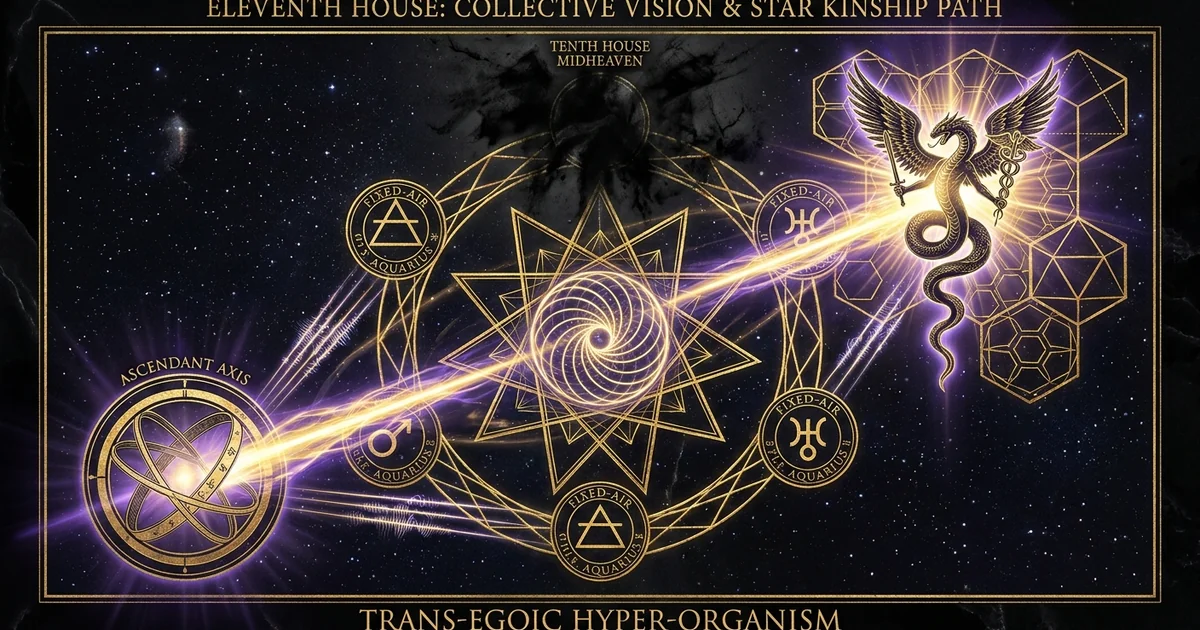
Eleventh House: Collective Vision and Star Kinship Path
Archetypal Thesis & Systemic Paradigm: The Transpersonal Coordinate of Collective Will
From Monadic Ego to Distributed Consciousness
The eleventh house astrological meaning denotes the structural threshold where the monadic ego relinquishes its claims to sovereign isolation, integrating into a distributed, polycentric network of collective intentionality. Within the architecture of natal chart houses, the movement across the upper hemisphere reaches a definitive ontological crisis at the transition from the tenth house to the eleventh. Whereas the tenth house establishes vertical authority, individual career culmination, and the crystallization of personal reputation through hierarchical structures (as explored in the context of /astrology/tenth-house-midheaven-praxis), the eleventh house distributes this concentrated power laterally. It operates not as an amorphous registry of casual acquaintances or superficial social clubs, but as a psycho-cosmic state-space wherein the isolated self integrates into a trans-generational ideological and spiritual lineage.
This transition marks an evolutionary imperative within psychic cartography. In archetypal psychology, the monadic ego must inevitably confront the limits of its own autonomy. If the native remains arrested within tenth-house culmination, the psychic apparatus succumbs to structural petrification—what analytical psychology identifies as ego-inflation resulting from identification with the social persona or cultural monarch archetype. Astrological house 11 resolves this entropic stagnation by introducing the principle of non-coercive affiliation. Here, consciousness encounters other individuated nodes capable of mutual recognition, producing an ideological fabric that sustains individual purpose through collective resonance. The eleventh house is therefore the structural prerequisite for genuine self-transcendence within the mundane sphere.
The Cybernetics of Hope: Teleology as a Vector Field
Far from a repository of passive wish-fulfillment, hope within the eleventh house functions as a cybernetic feedback mechanism. In systemic terms, hope is an operational vector field: an intentional orientation toward a prospective state-space that continuously alters current behavioral parameters. Drawing from the frameworks of Norbert Wiener and Ludwig von Bertalanffy, the eleventh house acts as an anticipatory negative feedback loop that moderates individual hubris by continuously recalibrating personal ambition against macro-systemic stability. Teleology within this locus ceases to be a linear drive toward personal conquest; instead, it becomes a systemic negotiation between the individual’s projective capacity and the historical demands of the collective psyche.
The aspirations traditionally designated by classical astromancers as spes (hope) represent the psychic projections of an integrated future. When the native articulates a vision within this coordinate, they participate in an iterative cybernetic loop: the prospective future pulls the current psychological state toward higher complexity, while the structural limitations of the present reframe what is collectively possible. The eleventh house records this exact dynamic. Its structural integrity indicates whether an individual’s long-range objectives will harmonize with systemic evolutionary pressures or collapse under the friction of collective inertia. Through this lens, hopes and wishes are operational instruments of systemic evolution rather than naive psychological sentiments.
The Star Kinship Archetype: The Noosphere Made Flesh
The concept of “star kinship” (astrophilia in esoteric Hermetic lineages) addresses an ontological category that biological determinism cannot accommodate. Star kinship posits that conscious entities assemble not merely through genetic inheritance (the province of the fourth house) or economic contract (the province of the seventh house), but through harmonic resonance within an ideological and spiritual frequency spectrum. Synthesizing Carl Gustav Jung’s delineation of the transpersonal Self with Pierre Teilhard de Chardin’s formulation of the noosphere, the eleventh house constitutes the physical and symbolic anchor where the mental sheath of the Earth crystallizes into local networks.
The eleventh house operates as the terminal, fixed-air station of the relational Air Triplicity (Houses 3, 7, and 11), establishing a clear progression across individual, interpersonal, and transpersonal registers:
- Third House (Mutable Air / Gemini resonance): Epistemological scaffolding; local, sibling, and immediate lateral communication; rudimentary linguistic categorization.
- Seventh House (Cardinal Air / Libra resonance): Interpersonal polarity; the dyadic encounter with the Shadow and the externalized Alter-Ego; legal, contractual, and romantic integration.
- Eleventh House (Fixed Air / Aquarius resonance): Transpersonal collectivity; ideological networks; teleological assembly oriented toward systemic transformation; the planetary joy of Jupiter. Within this triplicity, House 11 represents the consolidation (fixitas) of ideological communion, where communication serves the realization of collective destiny.
Star kinship functions as an ontological attractor. Disparate psychological nodes, alienated from their biological origins or conventional social environments, gravitate toward ideological networks that reflect their internal archetypal configurations. This dynamic is mediated through the symbolic mechanics of the eleventh locus. When activated by transit, progression, or natal emphasis, this coordinate compels the individual to seek their philosophical cohort—those who share a common orientation toward the unmanifest future. Star kinship is therefore the social manifestation of the noosphere, transforming abstract philosophical consensus into coordinated historical praxis.
Classical Provenance & Textual Lineage: The Agathos Daimon and the Benefacta Legacy
Hellenistic Roots: Agathe Tyche vs. Agathos Daimon
In the foundational Hellenistic schema of the Dodekatropos, the eleventh house was termed the Agathos Daimon (Ἀγαθὸς Δαίμων), translated as the “Good Spirit” or “Good Divinity.” This attribution directly mirrors its opposite across the horizontal axis: the fifth house, known as the Agathe Tyche (Ἀγαθὴ Τύχη) or “Good Fortune.” This structural duality reveals the metaphysical architecture of classical astromancy. While the fifth house governs fortune as embodied, biological, and material bounty (associated with Venus and the instinctual joy of physical creation, as detailed in /astrology/fifth-house-creative-daimon), the eleventh locus governs the spiritualized intellect, providence, and divine assistance operating through human agency.
Hellenistic practitioners, including Antiochus of Athens and Critodemus, classified the eleventh as the preeminent benefacta house. The Agathos Daimon was regarded as an explicitly fortunate locus because it sits in an operative, harmonious aspect to the Horoskopos (Ascendant). Unlike the subterranean houses or the cadent declines, the eleventh house possesses both direct visual contact with the rising degree and superior celestial elevation over the eastern horizon. The “Good Spirit” signifies that psychic and metaphysical intelligence which intervenes benevolently on behalf of the native, manifesting concretely through loyal patrons, powerful advocates, and fortunate associations that preserve the physical and social integrity of the life path.
“The eleventh locus, which is called the Agathos Daimon, is an operative and fruitful place. It is productive of good things, indicating gifts, alliances, the acquisition of goods, and the realization of hopes. When benefics are found in this place or aspect it with superiority, they make the native prominent, elevated through friendships, and favored by great men. Even malefics, when situated here in favorable sect, temper their destructive nature, turning their severity into vigorous action and defensive alliances.” — Vettius Valens, Anthologiae, Book II (Transl. Mark T. Riley, 2010)
Arabic Adaptations: Bait al-Raja (The House of Hope) and the Benefacta House
During the translation movements of the Abbasid era, Islamic astromancers received the Hellenistic concept of the Agathos Daimon and transmuted it into Bait al-Raja wa al-Amal (The House of Hope and Expectations). Scholars such as Abu Ma’shar (Albumasar) and al-Biruni maintained the beneficent valuation of the locus while elaborating its socio-political mechanics within an imperial administration. In Abu Ma’shar’s The Abbreviation of the Introduction to Astrology, the eleventh house is established as the primary signifier of the sovereign’s court, specifically the ministers, counselors, and benefactors whose mediation is necessary to convert royal favor into lasting material prosperity.
Abu Ma’shar emphasized that while the tenth house determines the status of the ruler (al-Sultan), the eleventh indicates the durability of that status through the fidelity of the ruler’s companions (al-Ashaab). The Arabic astrologers conceptualized this locus as the structural buffer preventing the collapse of sovereign will. If the eleventh house was compromised by the presence of contrary-to-sect malefics or afflicted by harsh aspects, the native—regardless of personal competence—would find their ambitions subverted by betrayals among their ideological vanguard or the sudden withdrawal of patronage. The concept of the “benefacta house” was thus sharpened: it represents the externalized goodwill of the socio-political cosmos without which individual agency remains impotent.
Medieval Transmission to Renaissance Astromancy
The Latin transmission of the Arabic corpus, conducted by translators such as John of Seville and Gerard of Cremona, solidified the designation of the eleventh as the Domus Benefactorum and Domus Spei. Medieval practitioners like Guido Bonatti codified strict delineation rules concerning this house, establishing that the realization of any astrological judgment regarding career (House 10) or wealth (House 2) depended upon the strength of House 11. Bonatti asserted that no promise in the chart could come to fruition without the implicit consent of the eleventh house, as it signifies the network of human facilitators through whom Providence executes its decrees.
By the Renaissance, the Hermetic revival spearheaded by Marsilio Ficino and later systematized in William Lilly’s Christian Astrology (1647) preserved this classic lineage. Lilly concisely attributes to the eleventh house: “It naturally representeth Friendship, and Amity of Men, Friends, Companions, Hope, Faith, the Confidence of a Man, the Counsel of Friends; and as to Kings and Princes, it represents their Favorites, their Treasures, and their Ammunition.” Across two millennia of continuous textual lineage, the eleventh house retained its designation as an uncompromised structural good—a celestial haven where social resonance overrides mechanical determinism, converting individual vulnerability into collective strength.
Structural Mechanics & Symbolic Geometry: Aspects, Joys, and Spatial Dynamics
The Dexter Sextile to the Ascendant and Trine to the Descendant
The foundational potency of the eleventh house derives from its non-combative geometric relationship to the primary angles of the celestial sphere. In classical aspect doctrine, aspects are categorized by their nature, orientation, and efficacy. The eleventh house forms a dexter sextile to the Horoskopos (Ascendant). In traditional optics and spherical trigonometry, a dexter aspect moves backward against the natural order of the signs, carrying an energetic imprint akin to the diurnal motion of the heavens. It possesses an active, authorizing, and affirmative character.
The sextile (a 60-degree configuration) belongs fundamentally to the nature of Venus: temperate, conciliatory, and constructive. Because the eleventh house observes the Ascendant through a dexter sextile, its condition directly fortifies the somatic and psychological integrity of the native. The ideological aspirations and community alliances located here do not subvert or oppress the self (as occurs with the aversion of the twelfth house or the disruptive square from the tenth); rather, they provide scaffolding that validates personal identity. Simultaneously, the eleventh house casts a sinister trine (a 120-degree configuration, of the nature of Jupiter) to the Descendant (the seventh house angle). It harmonizes one-to-one partnerships and external alliances, embedding private contracts into a broader, protective ideological collective.
The Planetary Joy of Jupiter: Expansion within the Ideological Matrix
In the system of planetary joys (gaudia), an essential doctrine preserved in the Hellenistic lineage through Hellenistic authors and later summarized in modern scholarship (see /astrology/planetary-joys-classical-delineation), each traditional planet finds its natural operational joy in a specific house. The eleventh house is universally assigned as the joy of Jupiter (Iuppiter in undecima domo laetatur). The mechanics underlying this assignment demonstrate profound psycho-cosmological coherence.
Jupiter is the greater benefic of the diurnal sect: hot, moist, generative, expansive, and teleologically oriented toward unity and ethical coherence. The diurnal sect demands celestial spaces that reside above the horizon, bathed in solar light. The eleventh house provides Jupiter with an optimal staging ground: an elevated, diurnal locus that possesses an unobstructed aspect to the Ascendant without carrying the crisis-laden burdens of supreme angularity found in the tenth house. In the eleventh, Jupiter’s impulse toward philosophical synthesis, magnanimity, and ideological expansion is unencumbered by the administrative accountability or potential tyranny of raw institutional control. It allows the principle of faith (fides) and shared vision to operate purely as an attractive, cohesive force, binding diverse individuals into unified ideological matrices.
Succedent Energetics: The Sustained Engine of Midheaven Mandates
Within the triplicity of house dynamics—Angular (kentra), Succedent (epanaphorai), and Cadent (apoklimata)—the eleventh house operates as the preeminent succedent house. The celestial sphere moves perpetually via diurnal motion: the stars rise at the Ascendant, culminate at the Midheaven (MC), set at the Descendant, and achieve anti-culmination at the Imum Coeli (IC). In this diurnal mechanics, a succedent house is one that literally “follows” or ascends toward an angle. However, the eleventh house occupies a unique, post-culminating position: it is the sign or space into which planets pass after they cross the zenith of the Midheaven.
This structural dynamic reveals the metabolic function of the eleventh house. The tenth house represents the momentary, intense culmination of the will—the realization of authority, the public performance, the achievement of sovereignty. Yet no political or psychic regime can survive on apex culmination alone; the energetic expenditure required to sustain raw power at the tenth angle inevitably exhausts the system. The eleventh house receives the post-culmination flow, serving as the sustained kinetic engine that captures, stabilizes, and resources what was achieved at the zenith. It transforms the solitary crown of the Midheaven into the enduring infrastructure of the guild, the senate, the party, or the school of thought. The succedent status of House 11 guarantees structural longevity, resourcing the executive mandates of the tenth house through decentralized institutional loyalty.
Divergent House Polarities: The Axis of Individual Radiance and Collective Synthesis
Fifth House Creation vs. Eleventh House Distribution
The relational mechanics of natal chart houses operate across diametrically opposed axes. The 5th/11th house polarity maps the psychological and ontological dialectic between monadic generative spark and distributive collective architecture. The fifth house, the Joy of Venus, governs the raw, unmediated eruption of the individual soul into form: artistic creation, biological procreation, erotic play, and the autocentric externalization of personal libido. It is the locus where the individual declares: I create because it is the intrinsic nature of my sovereign essence to radiate.
In contrast, the eleventh house demands the systemic distribution of that creative output. Creation generated in the fifth house remains solipsistic, infantile, or sterile if it fails to cross the threshold into the eleventh house for distribution, ideological critique, and societal integration. Conversely, an eleventh house divorced from the creative vitality of its opposing pole degenerates into dry, bureaucratic scholasticism—ideological structures empty of original artistic or spiritual fire. The polarity axis requires an unbroken energetic circulation: the individual soul generates the spark (House 5), which is then received, refined, and distributed by the network (House 11) to nourish the civilizational commons.
Fifth House: Individual Radiance (Agathe Tyche)
- Psychic Focus: Autocentric externalization; the solar, childlike impulse toward uninhibited play, self-expression, and creative vitality.
- Structural Geometry: Inferior hemisphere; succedent to the 4th house of ancestral roots; looking up toward the Midheaven through a trine.
- Classical Allotment: Agathe Tyche (Good Fortune); the joy of Venus; sensual pleasure, personal offspring, direct artistic procreation.
- Pathological Deviation: Narcissistic solipsism, histrionic grandiosity, creative volatility divorced from ethical accountability to the community.
Eleventh House: Collective Synthesis (Agathos Daimon)
- Psychic Focus: Transpersonal integration; the Saturnian/Uranian architecture of collective ideals, teleological networks, and distributed intentionality.
- Structural Geometry: Superior hemisphere; succedent to the 10th house of institutional power; sustaining social structures via a dexter sextile to the Ascendant.
- Classical Allotment: Agathos Daimon (Good Spirit); the joy of Jupiter; ideological cohorts, benefactors, decentralized networks.
- Pathological Deviation: De-individuated groupthink, ideological fanaticism, the total dissolution of personal conscience into mass movements.
The King and the Guild: Sovereign Ego vs. Polycentric Network
This axis materializes sociologically as the structural tension between the King and the Guild, or the Sovereign Ego and the Polycentric Network. In the fifth house, consciousness operates under a monarchical model. The solar ego reigns supreme over its internal psychic landscape, much like a Renaissance prince commanding a court. This is the coordinate of personal celebrity, individual virtuosity, and the singular hero journey. The creative act is experienced as an intensely private triumph.
The eleventh house deconstructs this centralized monarchy in favor of the guild, the cooperative, or the open-source network. It introduces horizontal peer review, shared ownership of intellectual capital, and the subordination of individual vanity to the longevity of the collective enterprise. When this axis is healthily integrated, the King does not rule through authoritarian dictate; rather, the sovereign functions as the executive servant of the Guild’s vision. If an individual over-identifies with fifth-house radiance, they risk social exile or personal hubris. Conversely, if an individual capitulates entirely to eleventh-house collectivism without establishing fifth-house sovereignty, they become a replaceable functionary within an anonymous apparatus. Individuation requires sustaining the creative tension between unique personal expression and systemic participation.
Solar Self-Expression Balanced by Uranian/Saturnian Coordination
The governance of this polarity reflects its deep planetary archetypes. While the fifth house finds natural resonance with the Sun and the joy of Venus, the eleventh house holds historical and modern associations with both Saturn (its traditional Hellenistic domicile ruler via Aquarius) and Uranus (its modern archetypal correlation). This dual planetary tension underscores the complexity of collective vision. Saturn provides the architectural discipline, boundary parameters, and institutional continuity required to build durable alliances; Uranus introduces the disruptive, evolutionary spark that shatters ossified social paradigms to establish radical egalitarian networks.
When the solar radiance of the fifth house encounters the combined Saturnian-Uranian mechanics of the eleventh, personal creative output undergoes rigorous transmutational pressure. The individual must reconcile their personal artistic or existential gestures with systemic necessity. This reconciliation prevents the creative ego from retreating into an ivory tower. It forces the creative spark to engage with the sociological, political, and philosophical currents of its historical epoch. The eleventh house demands that the light kindled in the fifth does not simply burn for its own aesthetic enjoyment, but illuminates the dark path ahead for the native’s star kin.
Psychological Dynamics & Operational Praxis: Delineation of the Collective Coordinate
Deciphering Planetary Occupants in House 11
The specific planets inhabiting the eleventh house reveal the psychological mechanisms through which an individual negotiates their covenant with the collective. Rather than delivering simple moralistic outcomes, these placements indicate the archetypal tone of the native’s peer group, the structural challenges they will confront within organizations, and the nature of their prospective hope.
When benefics occupy this locus, the interface between ego and group consciousness is naturally fluid. Jupiter in the eleventh house—operating in its planetary joy—bestows an intuitive grasp of macro-systemic trends, bringing expansive patrons, access to influential philosophical networks, and an abiding sense of existential optimism. Venus in this house smooths group mechanics through aesthetic affinities, diplomatic tact, and pleasant, mutually beneficial social circles. Under benefic governance, the collective is experienced as an affirming sanctuary that elevates personal dignity.
Conversely, the presence of malefics in the Agathos Daimon introduces psychological friction that tests the native’s social discernment:
- Saturn in the Eleventh House: Conveys an initial sense of intense isolation or rejection by early peer groups. The native frequently harbors a profound distrust of crowds, cliques, and superficial networks. There is an acute awareness of the hypocrisy often embedded in social movements. However, once matured through Saturnian discipline, this placement produces the peerless institutional architect: the individual capable of founding durable, highly structured organizations that endure across generations through rigorous loyalty and pragmatic realism.
- Mars in the Eleventh House: Electrifies the collective coordinate with combative, kinetic energy. The individual does not quietly join a movement; they mobilize it, radicalize it, or fracture it through intense ideological competition. Alliances are formed through shared struggle, shared enemies, or pioneering social crusades. The danger lies in perpetual ideological schism, where the native repeatedly burns bridges with their allies over factional dogma. In high integration, Mars becomes the tireless champion of structural reform, driving collective projects past systemic resistance.
- The Sun in the Eleventh House: The native seeks self-actualization by projecting their core identity into collective causes, often rising to positions of symbolic leadership within guilds, associations, or forward-looking political platforms.
- The Moon in the Eleventh House: The individual’s emotional equilibrium fluctuates with the mood of their collective network; they seek tribal belonging as a substitute for domestic security, creating surrogate families within ideological cohorts.
- Mercury in the Eleventh House: Disposes toward intellectual networks, scientific societies, and technical exchanges, conceptualizing friendships primarily as ideological communication channels.
The Shadow of the Collective: Groupthink, Projection, and Ideological Zealotry
The shadow of the eleventh house is profound, insidious, and historically catastrophic when enacted at scale. When the individual ego fails to maintain its anchor within the opposite pole (the self-reflective consciousness of the fifth house), the psychic vacuum is instantly colonized by the collective unconscious. This results in the complete surrender of moral agency to the ideology of the collective—the psychological mechanism underlying totalitarian contagion, tribal polarization, and moral panic.
“In order to free the individual from the oppressive power of the mass, it is not enough to appeal to his reason, for the mass psyche acts through unconscious suggestion. The mass crushes out the insight and reflection that are still possible with the individual, and this necessarily introduces a tyrannical, irresponsible, and completely unprincipled group-will into his life. He is swept along on the wave of collective enthusiasm, losing all moral responsibility for his actions.” — Carl Gustav Jung, The Undiscovered Self, Collected Works Vol. 10, §516
Within astrological house 11, the shadow manifests as the uncritical absorption of group dogmas, where the individual mistakes the consensus of their selected peer group for universal truth. The native projects their personal Shadow onto rival ideological factions, converting structural debates into apocalyptic crusades. Star kinship degrades into an insular cult of belonging characterized by ideological gatekeeping, cancelation mechanics, and the pathologizing of independent dissent. In this degraded state, the “Good Spirit” (Agathos Daimon) reverses its polarity, mutating into an intellectual prison where the fear of excommunication by the ideological tribe paralyzes the individual’s capacity to perceive reality.
Consultative Methodology: Translating Transpersonal Transits into Daily Praxis
In professional delineation, assessing the eleventh house requires a rigorous, multi-tiered protocol that steps beyond the superficial identification of friendship circles. The practitioner must analyze this coordinate as a complex dynamic engine of systemic integration:
- Audit the Domicile Ruler: Delineate the condition of the planet ruling the sign on the eleventh house cusp. A well-placed eleventh house ruler (configured by essential dignity, fortunate sect, and pleasant aspects to benefics) guarantees that even if the house itself is unoccupied or subject to challenging transits, the native will ultimately locate functional allies and systemic support during existential crises. Conversely, if the ruler of the eleventh is compromised in the cadent sixth or twelfth houses, or severely debilitated, the native will repeatedly encounter instability through bad counsel or fair-weather patrons.
- Examine the Sector Condition (Sect and Planetary Joys): Evaluate whether diurnal or nocturnal planets occupy the space. Day charts favor the rational, systematizing alliances of Jupiter and Saturn, whereas night charts navigate the collective more successfully through Venusian resonance and subjective emotional affinity.
- Trace Outer Planet Transits: The passage of transpersonal planets through the eleventh house fundamentally rewires the native’s social and ideological matrix:
- Uranus Transits: Induce sudden disruptions in the network. The native abruptly breaks with long-standing ideological associations, experiencing a radical clearing of their peer circle to accommodate unconventional, avant-garde collectives.
- Neptune Transits: Dissolve ideological boundaries. The native may fall victim to spiritualized group projections, charismatic gurus, or deceptive social movements, requiring subsequent disenchantment to discover authentic trans-egoic communion.
- Pluto Transits: Precipitate profound power struggles within organizations. The native experiences betrayal, systemic exclusion, or structural metamorphosis within their professional guilds, forcing them to reclaim their sovereign creative authority from corrupt collective mandates.
Through methodical synthesis of these steps, the practitioner translates abstract archetypal configurations into actionable daily guidance, empowering the native to align with collective forces without forfeiting individual discernment.
Philosophical Synthesis & Macrocosmic Correspondence: The Noospheric Awakening
Teilhard de Chardin’s Noosphere and Hermetic Unity
The macrocosmic dimension of the eleventh house is best illuminated by bridging classical Hermeticism with contemporary evolutionary philosophy. In the Hermetic worldview, the cosmos is an unbroken, living continuum (The All is Mind; the Universe is Mental). This doctrine anticipates the visionary evolutionary theology of Pierre Teilhard de Chardin. Teilhard posited that evolution proceeds through successive stages of complexification and consciousness: first the geosphere (inanimate matter), then the biosphere (biological life), and ultimately the noosphere—a luminous, planet-spanning layer of thought, collective reflection, and interlinked psychic systems.
Astrological house 11 operates as the individual chart’s dedicated interface with this noospheric layer. It is the anatomical coordinate where personal consciousness ceases to be a merely biological phenomenon (Houses 1 through 6) or an interpersonal encounter (Houses 7 through 10), and instead becomes a functioning cell within the emerging planetary mind. The aspirations nurtured within the eleventh house are the threads through which the noosphere weaves its historical tapestry. When an individual engages with systemic social reform, ecological restoration, or trans-cultural intellectual exchange, they are not acting in solipsistic isolation; they are executing the developmental imperatives of the planetary organism itself.
The Bodhisattva Vow and the Circuit of Cosmic Kinship
In the Mahayana Buddhist tradition, the Bodhisattva vows not to enter the final peace of Nirvana until every sentient blade of grass has attained liberation. This sublime ethical gesture represents the absolute spiritual zenith of the eleventh house. In contrast to the vertical ascendance of the ninth house (which pursues personal enlightenment and transcendental wisdom in an individualistic arc), the eleventh house recognizes that isolated liberation is a systemic impossibility. The monadic self is inextricably woven into the systemic matrix of the total collective.
This understanding underpins the true Hermetic reality of “star kinship.” The star kin are not an exclusive, elite sect of spiritual adepts who reject the world; they are the incarnate agents of the Bodhisattva principle. They recognize their fellow travelers across cultural, generational, and ideological chasms through a mutual commitment to systemic elevation. This kinship transcends physical proximity. Two individuals sharing an eleventh-house harmonic may reside on opposite sides of the planet, separated by divergent languages and backgrounds, yet when their paths intersect, they synchronize instantly around a shared teleological mission. The eleventh house is the celestial circuit board through which these trans-historical, cosmic alliances are coordinated.
Evolutionary Teleology: The 11th House as the Eschaton Gateway
In the final analysis, the eleventh house stands as the Astrological Eschaton Gateway. It represents consciousness leaning forward into the yet-unmanifest, drawn by what post-modern philosophy and complexity theory term an “evolutionary attractor.” Linear time posits the past as the deterministic engine pushing the present into the future. Esoteric astrology, through the structural reality of the eleventh house, reverses this vector: the future—as an archetypal design of integrated wholeness—exerts a magnetic gravitational pull upon the present.
The eleventh house is the space where this future makes its presence felt as vision, hope, and systemic inspiration. It demands that the human individual evolve beyond the adolescent fixations of personal dominance, territorial defense, and isolated self-indulgence. By anchoring our intentionality within the Agathos Daimon, we align our subjective will with the broader cosmic movement toward integration, complexity, and universal empathy. The path of star kinship is ultimately the path of civilizational renewal: an invitation to step out of the blinding glare of the solitary ego and walk together into the dawn of collective awakening.
Frequently Asked Questions: Analytical Clarifications on the Eleventh House
Ontological Status of Empty Eleventh Houses
A prevalent misapprehension in pop-astrological discourse asserts that an unoccupied eleventh house signifies an absence of meaningful friendships, an impoverished social life, or an inability to articulate collective vision. In classical astromancy and rigorous archetypal psychology, this assertion is mathematically and ontologically invalid. A house without planetary occupants simply indicates that the life-themes associated with that coordinate do not constitute a zone of chronic, crisis-driven psychological fixation or direct, recurring energetic intervention.
To delineate an empty eleventh house, the practitioner must immediately trace the condition of its domicile ruler (the planetary lord governing the sign residing on the house cusp). For instance, if an individual possesses an empty eleventh house in Sagittarius, the operational mechanics of their friendships, patronage, and long-range hopes are entirely governed by the sign, house placement, sect, and aspectual matrix of Jupiter. If that Jupiter is dignified in Cancer in the sixth house, the native’s star kinship networks will crystallize through shared environments of service, healing, technical labor, or crisis management. The absence of occupants simply suggests that this coordinate operates as a stable, open pathway through which the domicile lord directs systemic traffic without the competing, contradictory archetypal voices of multiple planetary residents.
Differentiating the 11th House (Allies) from the 7th House (Partners)
The structural distinction between the seventh house and the eleventh house is fundamental to charting human relationality. The seventh house, configured as an angle directly opposing the Ascendant, governs the dyadic encounter. This is the realm of the contractual, the intimate other, the legal spouse, the distinct business partner, and the openly declared adversary. The psychology of the seventh house is rooted in the mirror: the native projects their own disowned unconscious qualities (the Shadow, the Anima/Animus) onto a singular other to achieve self-integration through relational friction and mutual devotion. It is characterized by personal vulnerability, contractual duty, and intense emotional investment.
In contrast, the eleventh house governs the polycentric network. It is trans-egoic and non-dyadic. Within the eleventh house, interactions are not based on personal emotional entanglement or formal contractual polarity, but on shared philosophical alignment, collective teleology, and mutual loyalty to an overarching ideal. One does not marry the eleventh house; one marches with it. In this coordinate, the question is never “Do I love you?” but rather “Do you see the same horizon that I see?” The eleventh house facilitates camaraderie, ideological companionship, and non-possessive collaboration toward a systemic objective that dwarfs the personal biographies of the individual participants.
The Role of Outer Planets (Uranus, Neptune, Pluto) Transiting House 11
Transits of the transpersonal outer planets through the eleventh house fundamentally dismantle and reconstruct the native’s socio-ideological matrix, acting as systemic evolutionary initiations:
- Uranus Transiting the 11th: Functions as a radical destabilizer of existing networks. The individual frequently experiences sudden, irreconcilable ideological rifts with organizations or peer groups to which they were previously devoted. The transit demands that the native liberate themselves from conformist group dynamics and discover an avant-garde cohort that accommodates their untethered individuality. It brings sudden access to unconventional communities, futuristic ideologies, and radical humanitarian networks.
- Neptune Transiting the 11th: Dissolves the rigid boundaries of the native’s ideological convictions. The challenge here is the potential for profound projection: the native may become enmeshed in utopian collectives, deceptive political sects, or spiritual communities presided over by charismatic, unreliable figures. Psychologically, this transit initiates a process of disenchantment that strips away naive collective fantasies, ultimately revealing a genuine, boundary-less compassion and deep spiritual solidarity that transcends dogmatic affiliations.
- Pluto Transiting the 11th: Orchestrates an intense psychological purge within the realm of alliances and societal participation. The native inevitably confronts power dynamics, manipulation, betrayal, or institutional corruption within their chosen guild, party, or collective movement. Often, the individual is forced out of a network through painful social ostracism or political coup. This existential confrontation compels the native to inspect their own complicity in collective shadow mechanics, stripping away false tribal security until they learn to forge alliances based solely on deep structural integrity, sovereign truth, and transformative cultural impact. :::