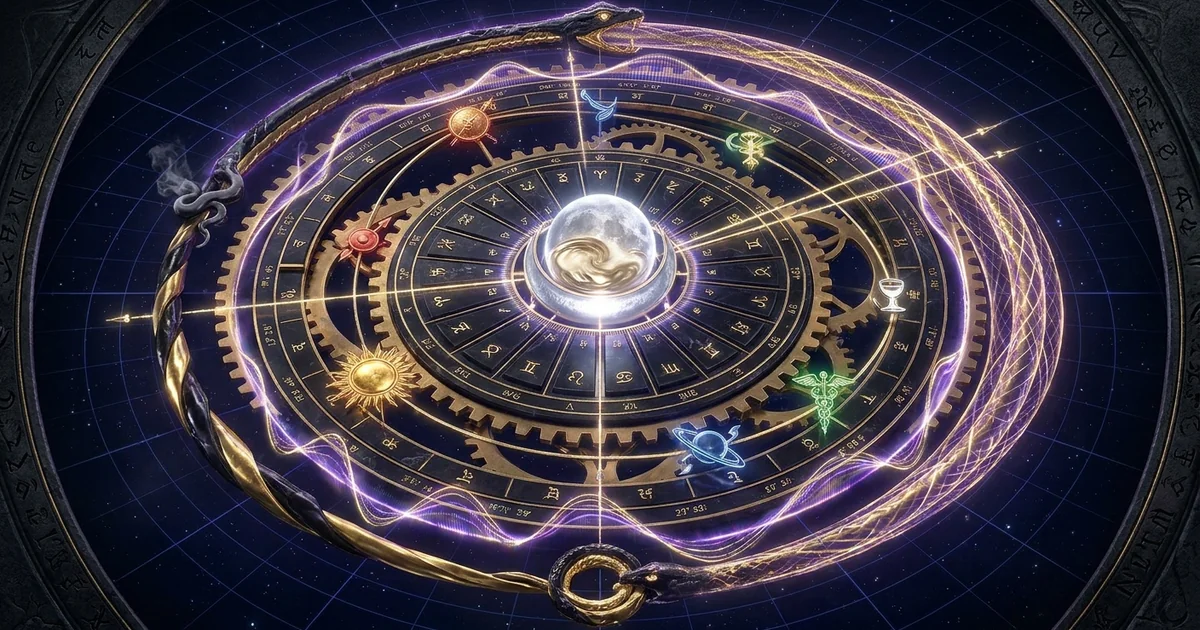
Vimshottari Dasha System: Unfolding 120-Year Lifecycles
Archetypal Thesis & Systemic Paradigm: The 120-Year Cybernetic Horizon
Chronos as Archetypal State-Space
Vedic predictive timing does not merely catalog chronological duration; it establishes an operative coordinate map of psycho-spiritual evolution wherein planetary cycles unlock sequential latencies native to the natal matrix. In the framework of classical Jyotish, time is treated not as an empty, homogeneous background against which accidents happen, but as an active, qualifying dimensional field. The static geometry of the birth chart—the Rashi Chakra—delineates an individual’s unmanifest potential, representing the totality of latent impressions (samskaras) brought across karmic thresholds. The activation of this latent geometry demands an internal motor, a chronometric engine that unfolds these potentials across experiential reality.
This chronometric engine is the Vimshottari Dasha system. Rather than operating via simple Newtonian causality, where an external planet casts a mechanical ray upon terrestrial biology, Vimshottari functions as a state-space representation of consciousness. The system operates on the premise that an incarnation is a structured sequence of psycho-archetypal regimes. Each planetary ruler constitutes a primary filter of perception, attuning the nervous system, cognitive faculties, and instinctual drives toward specific bands of existential experience. Under the administration of a given planetary period, the native does not merely encounter specific external events; rather, the native’s perceptual apparatus undergoes systemic realignment, rendering them selective to environments, relationships, and neurochemical states corresponding to that governing archetype.
This systemic temporal unfolding aligns precisely with the principles of depth psychology. The archetypes latent within the collective unconscious remain abstract until activated by teleological temporal processes. When an individual transitions from one planetary epoch to the next, the psyche reconfigures its conscious posture, drawing forth hitherto dormant complexes. The predictive mechanics of nakshatra archetypes and planetary periods reveal the teleological trajectory of the self, delineating the exact structural coordinates where the ego is forced to confront, assimilate, and transcend its unconscious material.
The Vimshottari 120-Year Parametric Baseline
The parameter of 120 solar or lunar years, designated in classical Sanskrit texts as Paramayush (the ideal human lifespan), reflects an astronomical and harmonic architecture embedded within sacred geometry and celestial periodicity. Far from an arbitrary span, the 120-year cycle directly correlates human longevity with fundamental planetary harmonics. Within this system, human life is calibrated to three complete revolutions of the lunar nodal axis (Rahu and Ketu), which possess an approximate 18.6-year orbital nodal period, yielding roughly 55.8 years per double cycle and harmonizing with broader planetary synchronization intervals, notably the Jupiter-Saturn grand conjunctions and the overarching geometry explored within platonic solids and time cycles.
The number 120 forms a superior highly composite mathematical foundation. Within the hexagesimal base-60 mechanics that underpin ancient cosmological measurements, 120 serves as the double-base ($60 \times 2$), allowing for precise, whole-number harmonic divisions across a multitude of factors (1, 2, 3, 4, 5, 6, 8, 10, 12, 15, 20, 24, 30, 40, and 60). This mathematical fluidity enables the fractal nesting of sub-periods without fractional degradation. The 120-year continuum establishes an energetic spectrum upon which the nine governing archetypes (Navagrahas) apportion their distinct spans: Ketu (7), Venus (20), Sun (6), Moon (10), Mars (7), Rahu (18), Jupiter (16), Saturn (19), and Mercury (17).
Summed together, these spans form the complete 120-year Paramayush. This baseline presupposes that for a human system to achieve full psycho-spiritual individuation—experiencing the entire qualitative gamut of the archetypes from primal solar vitality to the deep calcification of Saturn and the transcendent dissociation of Ketu—a century and a fifth of conscious biological continuity is structurally required.
“Time, far from being an abstraction, is a qualitative medium. It is not an empty container, but an energetic continuum filled with archetypal contents… What is born or done at this particular moment has the qualities of this moment of time. Synchronicity does not denote a mechanical causality, but an acausal connection through meaning, wherein the temporal coordinate is the formal expression of psychic individuation.” — Carl Gustav Jung, Synchronicity: An Acausal Connecting Principle (1952, Collected Works Vol. 8)
Deterministic Momentum Versus Psycho-Cosmological Feedback
A pervasive misapprehension of Vedic predictive astrology is the assumption of rigid fatalism. In the cybernetic language of modern systems theory, the Vimshottari Dasha system operates as a recursive feedback mechanism rather than an inviolable, closed-loop determinism. The natal positions of the planets and the structural integrity of the janma-nakshatra establish initial boundary conditions and deterministic momentum (prarabdha karma). This momentum manifests as somatic predispositions, socioeconomic entry points, and acute relational encounters that are largely non-negotiable at the level of gross physical manifestation.
Yet, consciousness acts as an active operator within this field. The Dasha system models the environment and internal cognitive climate, but the native’s behavioral and psychic response initiates a cybernetic loop. When an individual operates with zero self-awareness, the Dasha plays out with mechanical, almost computational predictability; their reactionary instincts track precisely with the base tendencies of the operating planetary lord. As consciousness becomes aware of its own systemic conditioning, the feedback loop transitions from positive (deviation-amplifying crisis) to negative (stabilizing, homeostatic integration).
The Dasha cycles, therefore, represent shifts in environmental entrainment and psychological affordance. A native entering a Mars period is not predestined to suffer an inflammatory injury or provoke violent confrontation; rather, the neurobiology experiences an influx of aggressive, metabolically intense drive. If this state-space is channeled without self-regulation, the exterior world responds antagonistically, producing the textbook classical event of conflict or physical trauma. Conversely, if integrated through strategic action and somatic discipline, the identical Dasha potential manifests as decisive leadership, pioneering enterprise, and surgical precision.
Classical Provenance & Textual Lineage: The Parashari Canon
Parashara’s Prescription in the Brihat Parashara Hora Shastra
The primary authority and foundational codification of the Vimshottari Dasha resides within the monumental Brihat Parashara Hora Shastra (BPHS), attributed to Sage Parashara. Within this foundational text of the Parashari canon, temporal analysis (Kala Jnana) is elevated above all other interpretive modalities. While hundreds of Dasha variations exist within the broader spectrum of Jyotish lore, Parashara explicitly singles out the Vimshottari system as the supreme, all-encompassing temporal measure (Sarva-Sreshtha) calibrated specifically for the current cosmic epoch, the Kali Yuga.
“दशा बहुविधास्तासु मुख्या विंशोत्तरी मता । कलियुगे नराणां च विंशोत्तरी दशा शुभा ॥ नक्षत्राणां च सर्वेषां चन्द्रे यद् यत् प्रवर्तते । तस्माद् दशा परिज्ञेया शास्त्रोक्तेन विधानेन ॥” “Among the various Dashas described by the learned, the Vimshottari Dasha is the foremost. In the Kali Yuga, for the longevity and welfare of mankind, the Vimshottari Dasha is auspicious and definitive. From whichever Nakshatra the Moon is situated in at birth, from that Nakshatra the order of Dashas must be ascertained in accordance with the rules laid down by the Shastras.” — Maharishi Parashara, Brihat Parashara Hora Shastra (trans. R. Santhanam, 1984)
Parashara’s canonical elevation of Vimshottari rests upon an essential esoteric premise: that in an age characterized by accelerated physical entropy, spiritual obscuration, and cognitive fragmentation, the human vehicle requires a temporal reference point anchored directly to lunar consciousness. The text details that while systems such as Chara Dasha rely upon the structural signs (Rashis), Vimshottari derives its power directly from the asterisms (Nakshatras), accessing an ontological layer of reality that precedes the gross crystallization of the zodiacal signs.
Later classical texts rigorously reinforced Parashara’s decree. Mantreswara, in his sixteenth-century masterpiece Phaladeepika, asserts that the Vimshottari Dasha reigns supreme over other planetary period methods because it reliably tracks both psychological transformation and tangible event manifestation. Vaidyanatha Dikshita, author of the Jataka Parijata, similarly designates Vimshottari as the foundational ephemeris of the soul, asserting that any prediction divorced from the Moon’s initial asterism balance is structurally unmoored.
Comparative Longevity Systems: Ashtottari, Shodashottari, and Kalachakra
The Jyotish canon preserves an array of conditional and unconditional Dasha systems designed to account for alternative existential variations. Among these, the Ashtottari Dasha (a 108-year cycle) and the Shodashottari Dasha (a 116-year cycle) are the most widely cited alternatives. Ashtottari omits Ketu entirely from its planetary sequence, utilizing an eight-planet framework that starts conditionally based on the placement of Rahu in a quadrant (Kendra) or trine (Trikona) from the Ascendant lord. Its temporal span—108 years—carries immense sacred-geometric significance, aligning with the 108 Padas (quarters) of the 27 Nakshatras.
Similarly, systems like Dvisaptati Sama Dasha (72 years), Shashtihayani Dasha (60 years), and the formidable Kalachakra Dasha (a complex cycle based on the Moon’s movement through the wheels of time) serve targeted diagnostic functions. Kalachakra Dasha, in particular, tracks the spatial leaps (gatis) of consciousness, requiring extreme computational precision regarding the Moon’s Navamsha quarter.
Yet, as emphasized throughout classical commentaries, these alternative systems are conditional (visheshika); they activate only when distinct, highly specific planetary configurations emerge in the natal matrix (such as Rahu occupying the 5th, 9th, or 10th houses while the Lagna lord is in the daytime hemisphere). The Vimshottari Dasha remains the sole unconditional (samanya) temporal system. It holds universality because its operational substrate—the 27 Nakshatras and their immutable planetary rulerships—constitutes the foundational bedrock of the sidereal sky, independent of conditional planetary contingencies.
The Primacy of the Moon (Chandra Lagna) as the Cosmic Ephemeris
The calibration of the Vimshottari engine initiates not from the physical body (represented by the Ascendant or Janma Lagna) nor from the core spiritual essence (the Sun, or Surya Lagna), but unequivocally from the natal longitudinal placement of the Moon (Chandra). This foundational rule establishes that within the manifest world, subjective consciousness is the primary filter through which time unfolds. In Vedic epistemological models, the Moon governs Manas—the sensory mind, perceptual apparatus, cognitive responsiveness, and somatic memory.
The physical brain and sensory organs construct the subjective experience of duration. Because karma is registered and processed through internal psychological responses rather than inert external events, the Moon serves as the cosmic ephemeris. An event devoid of emotional or perceptual impact possesses zero psychological mass; it leaves no imprint on the chitta (mind-stuff). Conversely, a purely internal psychological realization can completely redirect the outward trajectory of a life.
By anchoring the Vimshottari Dasha directly to the Moon’s natal degree, the Parashari canon guarantees that the planetary periods model the subjective perceptual framework of the native. The Dasha does not simply dictate when an asset is acquired, a disease is contracted, or a partnership is formed; it maps the psychological readiness of the native to inhabit these specific modalities of awareness, demonstrating that external destiny is the somatic crystallization of inward cognitive evolution.
Structural Mechanics & Symbolic Geometry: The Nakshatra-Planetary Matrix
The 27 Lunar Mansions and the Triad of Nine Lords
The celestial architecture of the Vimshottari Dasha relies upon the division of the 360-degree sidereal ecliptic into 27 Nakshatras (lunar mansions), each measuring exactly $13^\circ 20’$ of arc ($360^\circ / 27 = 13^\circ 20’$ or 800 arcminutes). Each Nakshatra is further subdivided into four Padas of $3^\circ 20’$ each, yielding 108 Padas across the complete zodiac, directly unifying the sidereal framework with the harmonic navamsha D9 esoteric matrix.
The 27 Nakshatras are distributed among nine planetary rulers through a triadic recurrence. The nine planets govern sequential triplets of Nakshatras positioned exactly $120^\circ$ apart in the zodiac, forming an equilateral trine within the elemental triangles (fire, earth, air, water):
1. Ketu:    Ashwini (01),      Magha (10),          Mula (19)
2. Venus:   Bharani (02),      Purva Phalguni (11), Purva Ashadha (20)
3. Sun:     Krittika (03),     Uttara Phalguni (12),Uttara Ashadha (21)
4. Moon:    Rohini (04),       Hasta (13),          Shravana (22)
5. Mars:    Mrigashira (05),   Chitra (14),         Dhanishta (23)
6. Rahu:    Ardra (06),        Svati (15),          Shatabhisha (24)
7. Jupiter: Punarvasu (07),    Vishakha (16),       Purva Bhadrapada (25)
8. Saturn:  Pushya (08),       Anuradha (17),       Uttara Bhadrapada (26)
9. Mercury: Ashlesha (09),     Jyeshtha (18),       Revati (27)
This sequence is invariant. It reflects a specific cosmic order of psychological individuation, commencing with the void-like, past-life severance of Ketu, progressing through the sensual fertilization of Venus, the structural illumination of the Sun, the nurturing assimilation of the Moon, the kinetic enterprise of Mars, the disruptive material hunger of Rahu, the integrative wisdom of Jupiter, the material calcification and boundaries of Saturn, and concluding with the refined intellectual synthesis of Mercury.
Calculating the Balance of Dasha at Birth (Bhukti Sphuta)
The entry point of an individual into this 120-year cycle is mathematically determined by the precise longitudinal placement of the Moon within its natal asterism (Janma Nakshatra). A single Nakshatra spans $13^\circ 20’$, equivalent to 800 minutes of arc ($800’$). The Moon’s position within this 800-minute span indicates how much of that Nakshatra’s energetic regime has already elapsed (Bhukta) and how much remains to be traversed (Bhogya).
To calculate the initial balance of Dasha at birth (Janma Dasha Shesha):
- Identify the longitude of the natal Moon.
- Determine the starting point of the occupied Nakshatra.
- Compute the traversed arc: $$\text{Traversed Arc} = \text{Moon Longitude} - \text{Nakshatra Start}$$
- Calculate the remaining arc: $$\text{Remaining Arc} = 800’ - \text{Traversed Arc}$$
- The unelapsed balance of the planetary period is proportional to this remaining arc: $$\text{Dasha Balance} = \left(\frac{\text{Remaining Arc in Minutes}}{800’}\right) \times \text{Total Period of the Planetary Lord}$$
If a native is born with the Moon at $06^\circ 40’$ of Rohini, the Moon has traversed exactly half ($400’$) of the total $800’$ span. Rohini is governed by the Moon, whose total Mahadasha is 10 years. Therefore, the balance of the Moon Mahadasha remaining at the precise moment of birth is:
$$\left(\frac{400’}{800’}\right) \times 10 \text{ years} = 5 \text{ years}$$
The native will inhabit this lunar regime for exactly 5 years before naturally transitioning into the 7-year Mahadasha of Mars, followed sequentially by Rahu (18 years), Jupiter (16 years), and continuing through the invariant cycle.
The Asymmetrical Durations: From Sun’s 6 Years to Venus’s 20 Years
A central structural feature of the Vimshottari system is the radical asymmetry of its planetary durations. The spans are not evenly distributed around the 120-year circle; instead, they range from a concise 6 years for the Sun to an expansive 20 years for Venus. Classical Jyotish attributes this asymmetry to the distinct energetic density and functional velocity of the planetary archetypes within human incarnation.
The luminaries represent rapid, concentrated energetic actualization. The Sun, functioning as the Atmakaraka (significator of the soul) and source of biological prana, operates with high energetic density; its period is brief (6 years) because prolonged exposure to unattenuated solar radiation would theoretically incinerate psychological and physical equilibrium. The Moon, governing somatic fluid dynamics and rapid emotional processing, similarly operates within an energetic frame of 10 years.
Conversely, the heavy karmic integrators and social mediators demand extensive terrestrial calibration. Venus encompasses 20 years—the longest single tenure—because the integration of desire, sensory aesthetics, biological reproduction, and relational balance requires deep, gradual psychological sedimentation. Saturn requires 19 years to execute its structural reorganization, structural pruning, and karmic accounting through slow, irreversible physical processes. Rahu requires 18 years to induce the deep material obsessions, systemic over-extensions, and foreign assimilations necessary to expand the native’s evolutionary boundary before Jupiter arrives for 16 years to synthesize and canonize those raw experiences into philosophical wisdom.
Fractal Sub-Divisions: Mahadasha, Antardasha, and the Nested Architecture
The Recursive Descent: From Mahadasha to Pratyantardasha and Sookshma
The 120-year master loop does not unfold as a blunt, undifferentiated epoch. Instead, it mirrors holographic and fractal structures found throughout cosmic architecture. The overarching major cycle—the Mahadasha—contains within itself the entire 120-year archetypal spectrum scaled proportionally downward into sub-periods known as Antardashas (or Bhuktis). Each Antardasha, in turn, undergoes an identical mathematical condensation into Pratyantardashas (sub-sub-periods), which further descend into Sookshma Dashas (sub-sub-sub-periods), and finally into Prana Dashas, resolving into windows of a few hours or minutes.
This recursive descent allows the Jyotishi to observe how macroscopic archetypal regimes crystallize into specific physical events. The Mahadasha outlines the general ontological landscape, setting the psychological boundaries, primary motivations, and systemic focus of a life epoch. The Antardasha introduces a secondary, qualifying archetypal lens that modifies the operational environment. The Pratyantardasha establishes the precise psychological impulse, while the Sookshma and Prana levels coordinate the psychosomatic triggers that precipitate tangible worldly encounters.
Predictive failure often stems from analyzing a Mahadasha as an isolated monolithic state. A native residing within the expansive, optimistic tenure of a Jupiter Mahadasha will still experience periods of severe structural contraction, isolation, and material reckoning during the Saturn Antardasha. The nested architecture guarantees that throughout an entire lifetime, every planetary archetype continues to be sampled, integrated, and metabolized at varying levels of magnification.
Algorithmic Derivation of Proportional Sub-Periods
The mathematical derivation of the Antardasha relies upon a self-similar proportion: the ratio of the sub-period lord’s total years relative to the 120-year master baseline is projected directly against the duration of the operating Mahadasha.
To calculate the duration of an Antardasha (Lord B) within a Mahadasha (Lord A):
$$\text{Duration (Years)} = \frac{\text{Years of Lord A} \times \text{Years of Lord B}}{120}$$
To translate this decimal result into months and days:
- The integer portion represents full solar years.
- Multiply the remaining decimal by 12 to extract the full months.
- Multiply the remaining fractional month by 30 to extract the precise days.
Operational Example: Determining the exact duration of the Rahu Antardasha within a Saturn Mahadasha:
- Saturn Mahadasha = 19 Years
- Rahu Antardasha = 18 Years
$$\text{Duration} = \frac{19 \times 18}{120} = \frac{342}{120} = 2.85 \text{ Years}$$
Deconstructing the 2.85-year value:
- Integer component: 2 Years
- Decimal component: $0.85 \times 12 \text{ months} = 10.2 \text{ months}$ (10 Months)
- Fractional month: $0.2 \times 30 \text{ days} = 6 \text{ days}$ (6 Days)
Total Duration: 2 Years, 10 Months, and 6 Days. During this temporal window, the calcifying, boundary-enforcing reality of Saturn is directly destabilized and electrified by the foreign, disruptive hunger of Rahu.
The operative consequence of this proportional derivation is structural precision. The energetic outcome is not decided purely by the sub-lord’s generic nature, but by the complex geometric and functional relationship (Sambandha) between the Mahadasha lord (Dasha pati) and the Antardasha lord (Bhukti pati).
The predictive analysis requires evaluating the relationship between these two planetary rulers across multiple vectors:
- Their mutual house placement from one another in the natal Rashi chart (e.g., mutually harmonious Trikona alignments of 5/9, stabilizing Kendra alignments of 4/10, or volatile, conflict-generating Shadashtaka alignments of 6/8).
- Their comparative status in the planetary-dignities-functional-malefics matrix.
- Their precise placement and dignity within the harmonic D9 Navamsha chart, which determines whether the fruits of the Antardasha will structurally crystallize or deteriorate over time.
Cross-Referencing the Dasha Lord with Transit Intersections (Gochara)
A fundamental axiom of the Parashari methodology dictates that transits (Gochara) cannot generate manifest events independently; their function is strictly limited to triggering that which has been authorized and mobilized by the operating Dasha lords. The Dasha constitutes the internal biological and psychological clock, dictating systemic receptivity. The transit represents the macroscopic, external atmospheric trigger. If the internal state-space (the Dasha) does not activate a specific house potential, an external planetary transit sweeping through that identical sector will pass without leaving a permanent material footprint.
Accurate predictive synthesis demands tracking the transit movements of both the Mahadasha and Antardasha lords relative to their natal coordinates, as well as observing the transits of the major outer regulators—Saturn and Jupiter—relative to the positions occupied by the Dasha rulers.
For instance, if a native is running a Jupiter Mahadasha and a Mars Antardasha, the external precipitation of a major event (such as an acquisition of property, a career elevation, or a physical intervention) typically aligns with the exact moment when transiting Mars casts an aspect upon natal Jupiter, or when transiting Saturn simultaneously applies pressure to the house owned by the Antardasha lord. This cross-referencing synthesizes internal temporal maturation with external planetary mechanics, resolving the apparent contradiction between subjective psychological emergence and objective material phenomena.
Psychological Dynamics & Operational Praxis: The Archetypal Navigation of Crises
Rahu and Ketu: The Evolutionary Thresholds of Obsession and Renunciation
The intersection points of the solar and lunar orbital planes—the lunar nodes, Rahu and Ketu—govern the most volatile and psychologically challenging terrain within the Vimshottari cycle. As mathematical vectors devoid of physical mass, their periods operate via radical psychic projection, biological disequilibrium, and sudden ontological destabilization.
Rahu Mahadasha spans 18 years of intense centrifugal acceleration. In psychological terms, Rahu represents the unassimilated evolutionary edge, the taboo, the foreign, and the insatiable material impulse. Entering a Rahu period thrusts the ego into acute material hunger and societal ambition. The psyche becomes fixated on achievements, boundary expansions, and the ingestion of novel sensory experiences. It is a phase of radical individuation wherein the soul is driven to inhabit unfamiliar cultural, intellectual, or socioeconomic landscapes.
Because Rahu acts through illusion (Maya) and amplification, this epoch frequently engenders severe psychological crisis: feelings of impending imposter syndrome, somatic anxiety, obsessive states, and the eventual disillusionment that occurs when intense material realization fails to deliver spiritual integration.
Conversely, the 7-year Ketu Mahadasha represents centripetal withdrawal, hyper-rational detachment, and somatic severance. Where Rahu ingests, Ketu evacuates. Ketu operates as the psychic guillotine, systematically dismantling the native’s attachments to whichever house it occupies or influences. Under Ketu’s tenure, external achievements often lose their subjective meaning, inducing states of existential vertigo, psychic dissociation, and profound isolation. This period compels the native to turn inward, forcing a rigorous confrontation with the transience of the material matrix. If resisted, Ketu manifests as chronic, hard-to-diagnose physical ailments, systemic exhaustion, and irrational anxieties. If surrendered to, it functions as a gateway to spiritual liberation (Moksha), clearing historical psychic debris to prepare for the subsequent 20-year creative consolidation under Venus.
Rahu Mahadasha (18 Years)
- Psychic Orientation: Centrifugal expansion; fixation on evolutionary edge; obsessive desire to ingest unmastered material experiences.
- Cognitive Stance: Radical unorthodoxy; affinity for the taboo, foreign, and disruptive; systemic dissatisfaction with existing boundaries.
- Somatic Signatures: Heightened nervous sensitivity; hyper-reactivity; erratic neurochemical surges; susceptibility to toxic accumulation and phantom symptoms.
- Archetypal Objective: Pushing consciousness across historical familial, cultural, and personal limits through direct material immersion.
Jupiter Mahadasha (16 Years)
- Psychic Orientation: Centripetal consolidation; seeking wisdom, moral coherence, and existential integration through sacred order.
- Cognitive Stance: Philosophical, expansive, and pedagogical; trust in providence, natural law (Dharma), and ethical alignment.
- Somatic Signatures: Systemic tissue expansion (metabolic, liver, arterial); stabilization of nervous vitality; generalized somatic equilibrium.
- Archetypal Objective: Synthesizing raw, disparate worldly experience into coherent moral, philosophical, and systemic structures of meaning.
Shani Mahadasha: Saturnian Calcification and Ego-Mortification
The 19-year tenure of Saturn (Shani) is the ultimate crucible of psychological maturation within the Vimshottari framework. In the psychological architecture of the self, Saturn represents the reality principle, structural limits, somatic calcification, and the settling of unresolved ancestral debts. Its movement does not permit psychological evasion; it brings the native into contact with systemic friction, delay, institutional responsibility, and personal mortality.
During Shani Mahadasha, the expansive projections and inflated ego-identifications constructed during earlier periods are systematically subjected to structural stress-testing. The native is stripped of superficial psychological scaffolding. If an individual has constructed their self-worth on transitory beauty, unearned status, or speculative delusions, Saturn orchestrates scenarios that dismantle these brittle architectures. The experience is often registered subjectively as prolonged depressive heaviness, relentless professional or domestic labor, and acute experiences of solitude.
Yet, this process is teleological. Saturn’s ultimate operational purpose is ego-mortification and structural consolidation. By systematically pruning non-essential, energy-draining pursuits, Saturn concentrates the native’s focus onto what is fundamentally durable. The virtues cultivated under this 19-year regime are endurance (Titiksha), methodical discipline, humility, and somatic sobriety. By the conclusion of a well-navigated Saturn Mahadasha, the individual emerges structurally reorganized, possessing an unshakeable psychological core anchored in objective reality rather than narcissistic projection.
Sandhi Transitions: The Psychological Turbulence of Planetary Shifts
The transition points between major planetary epochs, known as Dasha Sandhi, represent the most volatile, liminal zones within the entire 120-year lifecycle. A Dasha Sandhi occurs during the final months of an expiring Mahadasha and the initial months of the incoming one—particularly when the shift involves radical archetypal polarities, such as the transition from Saturn to Mercury, from Mercury to Ketu, or from Mars to Rahu.
During a Dasha Sandhi, the structural integrity of the outgoing planetary archetype begins to dissolve, yet the incoming planetary ruler has not yet fully crystallized its operational reality. The native finds themselves suspended between two distinct psychic architectures. The coping mechanisms, professional strategies, and relational dynamics that functioned effectively for years suddenly collapse or lose their potency, inducing profound disorientation and anxiety.
[ Expiring Mahadasha ] ──> [ Dasha Sandhi: Psychic Dissolution ] ──> [ Incoming Mahadasha ]
   Operating Archetype           Liminal Unstable Void             New Archetypal Field
The most psychologically severe of these transitions is the Rahu-Jupiter Sandhi (the shift from intense, chaotic material expansion to ethical, philosophical consolidation) and the Ketu-Venus Sandhi (the violent lurch from monastic renunciation to sensory, aesthetic, and relational engagement). Practitioners of clinical Jyotish recognize that during these transitional thresholds, making irrevocable life choices—such as high-risk investments, structural career leaps, or hasty divorces—is inherently perilous. The consciousness is navigating an unstable void, requiring stabilizing rituals, patience, and non-reactive psychic containment until the incoming planetary archetype fully establishes its structural grip on the native’s nervous system.
Philosophical Synthesis & Macrocosmic Correspondence: Hermetic Cycles and Biological Time
The Hermetic Principle of Correspondence in Jyotish Temporal Mechanics
The systemic elegance of the Vimshottari Dasha system provides an immaculate empirical and metaphysical verification of the ancient Hermetic axiom: As above, so below; as within, so without. In the Hermetic worldview, humanity is the microcosm (Microprosopus) mirroring the cosmic macrocosm (Macroprosopus). The celestial spheres do not generate fate via mechanical strings; they act as a grand macroscopic clockwork reflecting the unfolding internal chambers of the human soul.
Jyotish temporal mechanics reveal that the outer movements of the planets through the sidereal backdrop are synchronized with the internal unfoldment of our neurobiology, unconscious complexes, and karmic inheritances. The external transit is the external clock face, while the Vimshottari Dasha represents the internal escapement mechanism of the timekeeper. When internal time (the Dasha) and external time (the transit) align, the potential energy of a karmic seed (Bijakshara) crosses the threshold of the unmanifest to collapse into the physical event horizon.
This perspective elevates divination from superstitious fatalism into an advanced branch of esoteric physics and cybernetics. The chart is not a sentencing document; it is a cosmological schematic of the soul’s self-chosen journey through the dense experiential learning fields of time and matter.
Cellular Chronobiology and Planetary Resonance
This metaphysical alignment finds contemporary resonance within the emerging fields of chronobiology and biological epigenetics. Science increasingly recognizes that biological life is not an isolated mechanical phenomenon, but an open, oscillator-driven system entrained to macroscopic rhythmic oscillations. From the circadian rhythms governed by the solar cycle to the infradian rhythms governed by the lunar months, the human organism is fundamentally constructed of nested biological clocks.
The Vimshottari Dasha models an ultra-long-frequency infradian biological clock. The planetary periods track qualitative shifts in our cellular epigenetic expression. During specific Dashas, specific genetic instructions—predispositions to metabolic vitality, inflammatory responses, neurochemical shifts, or structural degenerations—are unlocked in response to internal chronobiological timelines.
B.V. Raman, one of the foremost modern intellectual champions of the Jyotish tradition, consistently argued in his foundational work Planetary Influences on Human Affairs that planetary configurations represent complex electromagnetic and gravitational field variations that resonate with our central nervous system and endocrine glands. The 120-year cycle acts as a master epigenetic schedule, governing the sequential activation of biological and psychological programs designed to optimize experiential learning throughout a complete human life.
Transcending Predictive Determinism through Conscious Alignment
The realization that the Vimshottari Dasha models an archetypal state-space shifts the ultimate objective of Vedic astrology from passive fortune-telling to conscious, archetypal navigation. If time were an inescapable, deterministic prison, the study of Jyotish would serve no constructive purpose; it would merely induce fatalistic despair or anxious anticipation. The classical texts, however, emphasize that the knowledge of the stars (Jyotirvidya) is designed to illuminate the path toward spiritual liberation (Moksha).
The Parashari tradition incorporates practical interventions known as Upaya (remedial measures), which include the application of specific sacred mantras, geometric yantras, conscious behavioral modifications, ethical disciplines (Dāna), and Ayurvedic lifestyle alignments. The philosophical mechanics of Upaya do not involve bribing an angry planetary deity to cancel a karmic debt; rather, they involve actively attuning conscious awareness to the higher frequency of the operating archetype.
Incoming Planetary Archetype (Raw Karmic Force)
                │
                ▼
      [ Consciousness Filter ]
       ├── Unconscious/Reactive ──> Gross Material Friction (Trauma, Chaos)
       └── Conscious/Integrated  ──> Transmuted Expression (Mastery, Wisdom)
If an individual undergoing an acute Mars Mahadasha remains unconscious, the influx of raw kinetic and aggressive energy manifests externally as physical confrontations, accidents, and somatic inflammation. If that same individual engages with conscious intentionality—initiating rigorous physical discipline, practicing radical honesty, mastering emotional reactivity, and utilizing appropriate mantras to harmonize their nervous system—the raw energy is transmuted. The Dasha still produces its necessary intensity, but its expression shifts from unconscious tragedy to heroic mastery. This is the ultimate goal of the Vimshottari Dasha: to convert blind, deterministic fate (Adrishta) into illuminated, conscious evolution.
Frequently Asked Questions: Structural Clarifications and Predictive Misconceptions
FAQ 1: Resolving Discrepancies Between 360-Day Savana and 365-Day Solar Calendars
A long-standing debate within classical Jyotish scholarship concerns the precise calendar year standard utilized to compute Dasha durations. The tradition provides several year measures: the Saura mana (solar year, approximately 365.25 days), the Chandra mana (lunar year of 354 days), and the Savana mana (a standard civil year of 360 days, composed of twelve 30-day months).
The Parashari consensus, supported by classical commentators including Mantreswara in Phaladeepika, indicates that the 360-day Savana year is the foundational mathematical measure for the generic division of the 120-year cycle, as it correlates with the 360 degrees of the zodiac ($1^\circ$ per civil day). However, modern computing and contemporary empirical predictive practice have demonstrated that calibrating the 120-year cycle against the precise sidereal solar year of 365.2422 days (Saura mana) yields vastly superior timing precision when tracking sub-period transitions down to the day. Utilizing a pure 360-day year across an 80-year lifespan introduces a cumulative computational drift of over 400 days, fundamentally desynchronizing the Antardasha and Pratyantardasha triggers from actual life events. The rigorous predictive practitioner must calibrate the 120-year baseline to absolute solar duration while maintaining the hexagesimal structural proportions of the sub-period divisions.
FAQ 2: The Fallacy of Uniformly ‘Benefic’ or ‘Malefic’ Dasha Outcomes
One of the most persistent and destructive misconceptions in popular astrology is the simplistic categorization of Dashas as inherently “good” or “bad” based entirely on the natural status of the planetary lord (Naisargika Karaka). Under this flawed premise, periods governed by Jupiter and Venus are blindly assumed to produce unmitigated wealth, health, and joy, while periods of Saturn, Mars, and the Nodes are feared as harbingers of destruction.
Vedic astrology completely dismantles this binary via the doctrine of Functional Nature (Tatkalika Sambandha and house rulership). A natural benefic can become a functional malefic capable of inflicting catastrophic psychological and somatic damage if it presides over harmful houses (Trik Bhavas: the 6th, 8th, or 12th) or acts as a death-inflicting agent (Maraka: governing the 2nd or 7th houses without redeeming trinal associations). For instance, for a Taurus Ascendant, Jupiter governs the 8th and 11th houses; during a Jupiter Mahadasha, the native frequently encounters acute systemic friction, financial volatility, health issues, and deep crises of faith.
Conversely, for a Libra Ascendant, Saturn is a Yogakaraka—a planet of supreme functional benevolence—simultaneously governing a quadrant (the 4th house) and a trine (the 5th house). Under Saturn Mahadasha, a Libra native frequently experiences massive professional stabilization, intellectual focus, real estate expansion, and profound personal integration. The predictive outcome of any Dasha depends upon:
- The planet’s functional rulership relative to the Ascendant.
- Its foundational dignity (exaltation, debilitation, Moolatrikona).
- Its placement in the primary divisional charts, most notably the Navamsha (D9).
FAQ 3: Natal Promises Versus Dasha Triggers: Can an Event Occur Without Dasha Authorization?
In Jyotish predictive mechanics, the hierarchy of causality is absolute: The Natal Promise (Janma Lagna) dictates what can happen; the Dasha dictates when it can happen; the Transit (Gochara) dictates the precise trigger point.
An event cannot occur if it is not structurally promised within the static geometry of the birth chart. If the natal chart lacks the fundamental potential for exceptional worldly fame, wealth, or chronic somatic affliction, no Dasha period—regardless of how exalted its planetary ruler may be—can manifest that reality out of nothing. The Dasha lord can only unpack and distribute the specific karmic cargo assigned to it by its house ownership, physical placement, associations, and dignity within the natal architecture.
Similarly, an event cannot precipitate simply because an extraordinary transit is taking place in the heavens. A spectacular conjunction of Jupiter and Venus occurring directly over a native’s 10th house of career will pass as an ordinary, mildly pleasant day unless the operating Mahadasha and Antardasha lords are actively authorizing a professional breakthrough. The Dasha system functions as the absolute gatekeeper of manifestation. Transits merely supply the final sparks of ignition to the fuel that the operating planetary Dasha has brought to the fore. Without Dasha authorization, the transit lacks a receptive psychological and somatic substrate, dissipating its energy harmlessly into the macrocosm.