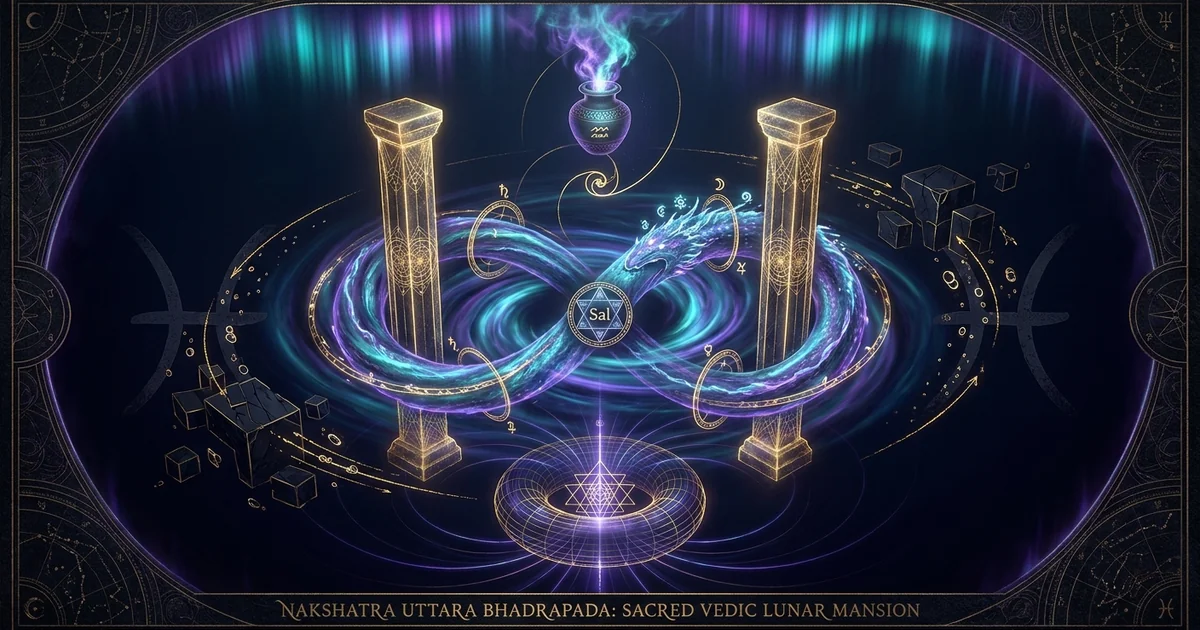
Nakshatra Uttara Bhadrapada: Sacred Vedic Lunar Mansion
Archetypal Thesis & Systemic Paradigm: The Threshold of Dissolution
Uttara Bhadrapada occupies an indispensable, highly stabilized position within the psycho-cosmological matrix of the 27 nakshatras jyotish system. Spanning from 03°20’ to 16°40’ of the sidereal sign Meena (Pisces), this twenty-sixth asterism functions as the architectural floor of the celestial waters. In the systemic evolution of consciousness, the zodiacal journey represents a gradual densification, individuation, and ultimate deconstruction of the psychic apparatus. Where earlier mansions chart the expansion of egoic agency and the subsequent existential crises of material entanglement, Uttara Bhadrapada operates as the systemic phase transition where individualized consciousness ceases its horizontal propulsion across the plane of manifest reality and yields to vertical, abyssal stabilization. The teleological imperative of this asterism is neither the ecstatic ascent of the mystic nor the combustive catharsis of spiritual warfare, but the voluntary immobilization of the psychic vehicle within the primordial sea of undifferentiated consciousness.
Understanding the uttara bhadrapada nakshatra vedic astrology meaning necessitates viewing it as a state-space representation of psychic cooling, equilibrium, and structural preservation at the edge of cosmic dissolution. It is the systemic counterweight to violent entropic fragmentation. When a complex dynamic system reaches maximum experiential saturation, it encounters two alternatives: chaotic collapse into systemic noise or an organized phase transition into a coherent ground state. Uttara Bhadrapada constitutes this ground state. It provides the archetypal geometry through which the soul survives the terrifying liquidation of its localized identities, solidifying its transpersonal core before passing into the ultimate, unitive exit-node of the zodiac.
Thermodynamic Entropy and the Coagulation of Consciousness
In the vocabulary of non-equilibrium thermodynamics and esoteric cartography, the movement of consciousness across the final quadrant of the zodiac traces an entropic crescendo. The fiery, apocalyptic rupture initiated in the preceding asterism of Purva Bhadrapada destabilizes the structural boundaries of the ego through a high-voltage influx of tapas (cosmic heat and spiritual austerity). This volatility mirrors the thermodynamic breakdown of an overdetermined system. Uttara Bhadrapada intervenes precisely at the point of thermal catastrophe, enacting an alchemical phase change reminiscent of /hermeticism/alchemical-mortificatio-coagulatio. It extracts the heat from the psychospiritual substance, causing the volatilized components of the psyche to precipitate into an enduring, crystalline substrate.
This coagulation (coagulatio) ensures that dissolution does not culminate in absolute psychic annihilation (nihilism), but rather in the sedimented crystallization of pure structural wisdom (sophia). The energetic substrate of this lunar mansion decelerates the micro-oscillations of the mind (chitta-vritti), compelling the cognitive apparatus to settle like heavy silt upon an oceanic basin. Within this silent benthic medium, consciousness undergoes a profound restructuring. The raw, unfiltered contents of the unconscious are no longer experienced as invasive, disorienting complexes; instead, they are integrated through a cool, non-reactive awareness that anchors the soul amidst the total withdrawal of sensory scaffolding.
The Oceanic Serpent: Ahirbudhnya as the Unconscious Axis
The metaphysical core of Uttara Bhadrapada is governed by the ahirbudhnya (serpent of the ocean depths) deity. Unlike terrestrial serpents that evoke instinctual dread, Ahirbudhnya represents the subterranean root of the cosmological tree—the unmanifest, coiled intelligence that anchors the world-pillar (axis mundi) within the unfathomable depths of the celestial ocean (Apah). This chthonic divinity is the macrocosmic homologue to kundalini-shakti sleeping at the base of the energetic spine in the Muladhara chakra. In Ahirbudhnya, the reptilian archetype is stripped of its predatory agility and rendered architectural, contemplative, and primordial.
Purva Bhadrapada (The Atmospheric Fire)
- Presiding Divinity: Aja Ekapada (The One-Footed Unborn Goat / Cosmic Lightning Bolt)
- Symbolic Glyphs: Front legs of the funeral cot; the two-faced man; dynamic electrical discharge
- Thermodynamic State: Volatilization, intense tapas, entropic rupture, sudden psychospiritual catharsis
- Operational Vector: Piercing the veil through violent ascendant sublimation; the fire that consumes the vessel
Uttara Bhadrapada (The Abyssal Deep)
- Presiding Divinity: Ahirbudhnya (The Serpentine Dragon of the Oceanic Foundation)
- Symbolic Glyphs: Back legs of the funeral cot; the coiled serpent in deep stasis; water depths
- Thermodynamic State: Coagulatio, deep stasis, entropic stabilization, profound structural crystallization
- Operational Vector: Anchoring consciousness at the oceanic floor; the abyssal stillness that preserves wisdom
Ahirbudhnya holds the systemic boundaries of the manifest universe together from below. If the sky is sustained by the solar principle and the middle atmosphere is agitated by the storm gods, it is Ahirbudhnya who prevents the floor of creation from collapsing into the void. This serpentine consciousness operates without light, without movement, and without externalized intent. It is pure, latent potentiality—the psycho-cosmological equivalent of dark energy or the uroboric matrix wherein all archetypal representations remain in cold storage. By aligning the human vessel with Ahirbudhnya, Uttara Bhadrapada imparts the capacity to inhabit the collective unconscious without succumbing to vertigo or ego-death.
The Dialectic Between Purva and Uttara Bhadrapada
The twin mansions of Bhadrapada constitute a dialectical engine that drives the terminal phase of the sidereal journey. Purva Bhadrapada represents the sacrificial pyre, the disruptive strike of celestial lightning (Aja Ekapada), and the unbearable existential friction generated when finite forms are forced to channel infinite energies. It is the active, Rajasic-Tamasic phase of mortification, wherein the illusions of permanence are incinerated. The soul in Purva Bhadrapada experiences the agony of separation from the transcendent, driving it toward radical acts of penance, psychological extremity, and systemic deconstruction.
Conversely, Uttara Bhadrapada is the quiescent aftermath of the blaze: the cooling ashes that reveal the indestructible diamond body (vajra-deha). The relationship between the two is strictly causal and developmental. Without the incinerating lightning of Purva Bhadrapada, the profound benthic immobility of Uttara Bhadrapada cannot be accessed; consciousness would remain trapped in superficial psychic equilibrium. Yet, without the serpentine oceanic bedrock of Uttara Bhadrapada, the lightning of Purva Bhadrapada would simply vaporize the soul, leaving no systemic container capable of crossing into the final reintegration of Revati. Uttara Bhadrapada provides the post-sacrificial bed, stabilizing the transubstantiated substance of consciousness within the cool womb of the primeval waters.
Classical Provenance & Textual Lineage: The Rigvedic Serpentine Chthonos
The textual lineage of Uttara Bhadrapada traces a continuous arc from the archaic strata of the Rigveda Samhita through the sacrificial liturgies of the Brahmanas, culminating in the analytical syntheses of classical Jyotish shastras. Throughout this transmission, the core attributes of the asterism remain remarkably preserved: it is consistently invoked as the domain of quietude, rain-bringing atmospheric reserves, oceanic foundations, and immutable interior restraint. While later medieval astrologers occasionally overemphasized its somber, Saturnine exterior, early Vedic hymnology recognized Ahirbudhnya not as an agent of malefic constriction, but as a primary cosmic benefactor who guarantees structural integrity against systemic dissolution.
In the liturgical hierarchies of ancient India, the invocation of the Nakshatras was not an exercise in predictive horoscopy, but a deliberate tuning of the microcosmic sacrifice (yajna) to the macrocosmic operational cycles of the cosmos (Rta). Uttara Bhadrapada occupied a sanctified niche within these rituals as the mansion that secures the perimeter. It is the firm ground upon which the celestial fire (Agni) rests, ensuring that the transformative blaze of ritual action does not consume the priests or unravel the fabric of the temporal order.
Ahirbudhnya in Vedic Hymnology: The Atmospheric-Abyssal Continuum
In the Rigveda, Ahirbudhnya is invoked approximately twelve times, almost exclusively in the company of the Vishvedevas (the All-Gods), and repeatedly paired with Aja Ekapada, the waters (Apah), and the mountains (Parvatas). The rishis of Mandala VII characterize Ahirbudhnya not as a monstrous adversary to be slain like Vritra, but as a luminous, primordial guardian of the deep. In Rigveda VII.34.16, the seer implores the serpentine divinity not to abandon the worshiper, recognizing that the foundation of the world is maintained through the subterranean grace of this abyssal deity.
Rigveda Samhita (Mandala VII, Sukta 34, Rik 16): ā́ no 'hir budhníyo mahé rāyé dā́t, śr̥ṇotú parvátāso no ábhi ṣyur | ā́paḥ samudríyā ví muñcantu no hiraṇyavarṇā́ḥ śucayaḥ pāvakā́ḥ ||
“May the Serpent of the Deep, Ahirbudhnya, grant us profound, unshakeable riches; may the enduring mountains hear our call; may the pristine, purifying, golden-hued waters flowing from the celestial ocean release us from all limitation.”
Taittiriya Brahmana (Ashtaka 3, Prapathaka 1, Anuvaka 2): ahirbudhniyo vā uttara-proṣṭhapadāḥ | varṣodyamā ca shaktiḥ | meghapravardhanī | yad varṣati tena jagat sthāpayati | tāmetām kāmāya vishvedevā upāsate ||
“Ahirbudhnya rules the posterior auspicious feet (Uttara Bhadrapada). His inherent potency is Varshodyama Shakti—the dynamic capacity to generate and precipitate spiritual and material rainfall, nourishing the cloud matrices. That which pours down establishes and sustains the manifest universe; for the fulfillment of this sacred desire do the All-Gods attend upon this mansion.”
The atmospheric-abyssal continuum described in these hymns resolves what might otherwise seem a geographical contradiction. Ahirbudhnya is simultaneously described as being born of the atmospheric waters (nabhas) and dwelling in the unfathomable depths of the subterranean ocean (budhna). In the esoteric epistemology of the Vedic seers, the upper celestial waters (parastat) and the lower terrestrial waters (avastat) are symmetric reflections of a single metaphysical fluid. Ahirbudhnya is the topological circuit that mediates between these states: he draws the dispersed moisture of the cosmos into coherent clouds, stores it in the deep sky, and releases it as fertilizing rain that stabilizes the terrestrial ecology.
Parasharic and Varahamihiric Classifications: Graha and Guna Mechanics
In the systematization of horoscopy articulated in the Brihat Parasara Hora Sastra, Uttara Bhadrapada is assigned to the lordship of the graha Shani (Saturn). Parashara emphasizes that while the sign Meena is governed entirely by the expansive, benevolent, and philosophical grace of Guru (Jupiter), the specific tenure of Uttara Bhadrapada operates under the austere, decelerative governance of Saturn. This establishes a structural juxtaposition: Saturn’s cold, dry, binding mechanics are deployed directly inside Jupiter’s warm, wet, and boundless matrix.
Varahamihira, writing in the Brihat Samhita, delineates the psychological and phenomenological consequences of this configuration. In his analysis of the lunar transits and natal configurations (Nakshatravyuha), he notes that individuals born with the Moon or significant lagna placements in Uttara Bhadrapada are characterized by profound eloquence, disciplined asceticism, an innate capacity for broad-spectrum endurance (kshama), and a disposition inherently detached from the frantic pursuits of the populace. Varahamihira classifies this nakshatra as Dhruva (fixed, enduring, stable), making it the ideal celestial coordinate for architectural foundations, perpetual vows, deep meditative transmission, and the construction of edifices intended to outlast generational cycles.
From the standpoint of the Guna taxonomy, Uttara Bhadrapada exhibits a complex internal geometry. As an integral component of the third, terminal tier of the zodiac, its overarching macro-guna is Sattva (truth, lucidity, spiritual refinement). However, its secondary and tertiary sub-gunas demonstrate how Saturnian mechanics operate within this field: it channels Sattva through the medium of structural discipline, utilizing the cooling, binding inertia of Tamas to anchor consciousness, while eliminating the chaotic, destabilizing surges of Rajas.
Esoteric Transmission: From Taittiriya Brahmana to Medieval Jyotish Shastras
The Taittiriya Brahmana attributes to Uttara Bhadrapada the specific operational power known as Varshodyama Shakti—the power to bring forth rain and fertilizing spiritual waters. In the ritual context of early Vedic civilization, this shakti was invoked to secure the seasonal monsoons necessary for agrarian survival. However, within the interiorized esoteric lineages of the Upanishads and medieval Tantric Jyotish, this power was re-read as the release of the divine nectar (amrita) descending from the Sahasrara chakra to saturate the energetic body.
As these doctrines passed into medieval manuals such as the Jataka Parijata, Saravali, and Phaladeepika, the archaic, serpentine majesty of Ahirbudhnya began to refract through the prism of medieval social conventions. These texts describe the native of Uttara Bhadrapada as one who conquers enemies through non-resistance, possesses enduring wealth that is never ostentatiously displayed, exhibits unwavering fidelity to duty (dharma), and harbors a persistent affinity for solitude and the contemplation of death. The medieval astrologers recognized that the planetary and archetypal energies converging here yield a personality capable of enduring extraordinary psychological pressure without suffering catastrophic internal collapse.
Structural Mechanics & Symbolic Geometry: Coordinate Space of the Deep Waters
The coordinate space occupied by Uttara Bhadrapada represents one of the most mathematically sophisticated and psychologically dense sectors of the sidereal zodiac. Located entirely within the watery sign of Meena, between 03°20’ and 16°40’, it represents the exact midpoint of cosmic re-absorption. Here, the boundaries that define physical matter, individual psychology, and social role are subjected to an unremitting oceanic solvent. Yet, unlike an amorphous void, this sector possesses a rigorous internal structural cartography delineated by its sub-zodiacal divisions (navamshas) and archetypal glyphs.
Sidereal Meena (Pisces)
00°00'           03°20'                         16°40'           30°00'
|-------------------|------------------------------|-------------------|
   Purva Bhadrapada        Uttara Bhadrapada                Revati
     (Final Pada)          (Complete 4 Padas)          (Complete 4 Padas)
The primary spatial glyph of the mansion—the back legs of funeral bed symbol (the posterior two posts of the bier)—demarcates the transition from dynamic animation to systemic rest. In Vedic iconography, the cot or bed (mancha) possesses four legs: the front two belong to Purva Bhadrapada, representing the active, feverish dissolution of life, the delirium of transition, and the preparation for departure. The rear two legs belong to Uttara Bhadrapada, symbolizing the final stabilization of the corpse, the cessation of all motor impulse, and the horizontal alignment of the entity with the earth and ocean. It is the absolute resting posture of the soul post-dissolution, marking the boundary where physical animation ceases and metaphysical crystallization initiates.
Sidereal Topography: 03°20’ to 16°40’ Meena (Pisces)
The astronomical boundaries of Uttara Bhadrapada align primarily with the stars Gamma Pegasi (Algenib) and Alpha Andromedae (Alpheratz). Alpheratz, historically linked to both the constellation Andromeda and Pegasus, sits at the boundary of celestial waters and the flying steed, radiating a quiet, immobile radiance that ancient observers linked to contemplative wisdom and foundational stability.
Within the 360-degree circuit of the zodiac, this specific arc of 13°20’ represents the transition from the preliminary breakdown of forms into the sedimented depths of pure memory. In Jyotish mechanics, the sign of Pisces is governed by Guru (Jupiter), the planet of spiritual expansion, cosmic law, and ideological synthesis. However, because Uttara Bhadrapada is governed internally by Shani (Saturn), this asterism forces the Jupiterian expansion inward rather than outward. The typical jovian traits—optimism, social generosity, philosophical proselytization—are subdued by the Saturnian reality principle. The unbounded Piscean ocean is bounded by the ring of Saturn; infinity is compelled to construct a vessel capable of holding its own immense weight.
The Tetradic Pada Cartography: Navamsha Breakdown and Elemental Flow
The macro-arc of Uttara Bhadrapada is subdivided into four distinct quarters (padas), each measuring precisely 03°20’ of celestial longitude. These padas correspond to the ninth harmonic division (navamsha or D9 chart), which maps the evolutionary trajectory of the soul’s inner consciousness (sukshma sharira). The journey across these four padas moves systematically through the subtle elements (tattvas) and the classical goals of human life (purusharthas), revealing an internal structural ascent that counters the apparent passivity of the outer Pisces field.
Pada 1: 03°20’ to 06°40’ Meena (Pisces)
- Navamsha: Simha (Leo) / Lord: Surya (Sun)
- Tattva: Agni (Fire) | Purushartha: Dharma
- Psychological Vector: Internalized Sovereign Authority. The oceanic depth absorbs the solar flame, producing an individual whose identity is anchored in quiet, indestructible dignity. Consciousness achieves immunity from the external gaze, deriving its orientation from an inner spiritual monarchy.
Pada 2: 06°40’ to 10°00’ Meena (Pisces)
- Navamsha: Kanya (Virgo) / Lord: Budha (Mercury)
- Tattva: Prithvi (Earth) | Purushartha: Artha
- Psychological Vector: Analytical Mysticism and Ascetic Pragmatism. This is the operational engine of the asterism. Mercury’s influence introduces discrimination into the oceanic abyss. The native possesses the capacity to systematize chaotic unconscious material, manage resources within high-stress environments, and maintain precise physical and psychic hygiene.
Pada 3: 10°00’ to 13°20’ Meena (Pisces)
- Navamsha: Tula (Libra) / Lord: Shukra (Venus)
- Tattva: Vayu (Air) | Purushartha: Kama
- Psychological Vector: Harmonized Equilibrium and Transpersonal Grace. Here, the solitary asceticism of the nakshatra softens into profound interpersonal receptivity. The soul seeks to balance opposing dualities—light and shadow, life and death, self and other. Relationships are approached not through passionate attachment, but through cosmic partnership and structural equanimity.
Pada 4: 13°20’ to 16°40’ Meena (Pisces)
- Navamsha: Vrishchika (Scorpio) / Lord: Mangala (Mars) [Pushkara Navamsha]
- Tattva: Jala (Water) | Purushartha: Moksha
- Psychological Vector: The Alchemical Crucible and Occult Depths. Situated at the very edge of the Piscean abyss, this pada represents maximum transformative pressure. Martian drive is submerged in the oceanic trench, awakening latent kundalini-shakti. As a Pushkara Navamsha, this quarter possesses extraordinary regenerative potential; it heals the psychic damage sustained across lifetimes through the radical surrender of the localized self.
The trajectory through the four padas demonstrates that Uttara Bhadrapada is far from a homogeneous expanse of oceanic silence. The soul awakens its dormant solar will (Pada 1), subjects its experience to rigorous structural analysis (Pada 2), harmonizes its internal relationships with the objective universe (Pada 3), and finally undergoes the ultimate transmutative death and transfiguration within the alchemical waters of Scorpio (Pada 4).
Planetary Dualities: Saturnine Lordship in a Jovian Field
The functional alchemy of Uttara Bhadrapada is governed by the structural tension between its planetary ruler, Saturn (Shani), and its sign ruler, Jupiter (Guru). In the traditional psycho-cosmology of Jyotish, Saturn and Jupiter represent the structural dialectic of the cosmos: contraction versus expansion, limitation versus grace, crystallization versus dissolution, time (Kala) versus space (Akasha). In Uttara Bhadrapada, these two planetary forces are not engaged in destructive conflict; rather, they form an archetypal synthesis wherein each graha provides the systemic counterbalance required by the other.
Saturn within this lunar mansion prevents the Piscean ocean from degenerating into amorphous sentimentality, psychic inflation, or dissociative escapism. Saturn acts as the hydrostatic pressure of the deep sea, crystallizing the insights of the jovian mind into indestructible structural principles. Conversely, the vastness of the Jovian Piscean field softens the brutal, bone-dry malice typically associated with unmitigated Saturnian transits. Under the influence of Jupiter, Saturn’s sickle ceases to be a weapon of arbitrary mortality and transforms into the tool of the benevolent cosmic surgeon, systematically pruning the vestigial attachments of the ego to prepare the consciousness for the total liberation promised in Revati. This dynamic embodies the Hermetic principle of coagulatio: the divine water is given form, boundaries, and endurance through the cooling architecture of structural law.
Psychological Dynamics & Operational Praxis: The Archetypal Shadow and Kundalini Coherence
From the perspective of depth psychology and analytical psychopathology, Uttara Bhadrapada represents the psychic capacity to maintain an integrated ego-Self axis while traversing the most terrifying landscapes of the personal and collective unconscious. In the clinical taxonomy of archetypal psychologist Carl Gustav Jung, the descent into the deep waters of the psyche—the nekyia—is fraught with the peril of catastrophic ego-dissolution. When the defensive structures of the conscious personality are lowered, the overwhelming contents of the uroboric unconscious can flood the mental vessel, precipitating psychosis, borderline states, or chronic spiritual bypass.
Uttara Bhadrapada is the psycho-structural apparatus that prevents this catastrophic flooding. It embodies the clinical concept of psychic containment. The native with strong Uttara Bhadrapada activations possesses an inherent interior bulkhead that permits the descent into abyssal trauma, repressed complexes, and oceanic archetypal realities without capitulating to the structural integrity of the conscious vessel. It is the archetype of the seasoned deep-sea diver: pressurized, deliberate, non-reactive, and fully conscious within regions where light cannot penetrate.
“The sea is the symbol of the collective unconscious, because unfathomed depths lie concealed beneath its reflecting surface… Those who go down into the deep sea find themselves confronted with the primordial dragon of the deep, Ahirbudhnya, who represents the terrifying yet stabilizing power of the unconscious matrix. If the ego can withstand the immense hydrostatic pressure of this realm through ascetic composure and structural grounding, the dragon does not devour the voyager; it transforms into the foundation of an unshakeable, transpersonal Self.” — Carl Gustav Jung, Collected Works, Vol. 9, Part I: The Archetypes and the Collective Unconscious (paraphrased integration of the chthonic uroboric motif).
Jungian Abyss: Navigating the Collective Unconscious and Uroboric Depths
The primary psychological obstacle encountered in Uttara Bhadrapada is the gravitational pull of the oceanic /archetypes/ouroboros-primordial-waters. The uroboros—the serpent biting its own tail—represents both the maternal womb of undifferentiated potential and the devouring abyss that seeks to reclaim the differentiated ego. In its lower, regressive manifestation, an afflicted Uttara Bhadrapada produces an overwhelming psychic inertia, manifesting clinically as chronic clinical depression, catastrophic lethargy, pervasive existential nihilism, and the pathological withdrawal of libido from the social world. The individual senses the vastness of the cosmic ocean and concludes that all human endeavor is merely an absurd, transient ripple upon a dark and indifferent sea.
Transmuting this psychological shadow requires recognizing that this benthic inertia is not an invitation to passive surrender, but the raw material for transpersonal stabilization. The Ahirbudhnya archetype demands that the individual become comfortable with darkness, solitude, and silence. When the conscious mind relinquishes its frantic pursuit of external validation and aligns itself with the cool, serpentine rhythm of its unconscious depths, the devouring aspect of the uroboros recedes. In its place emerges an unshakeable emotional resilience—a capacity to absorb the psychic turbulence of others without reacting, absorbing toxicity and neutralizing it within the benthic floor of the transpersonal heart.
The Thanatos Impulse: Reconceptualizing the Funeral Cot Archetype
The persistent association of Uttara Bhadrapada with the back legs of funeral bed symbol has frequently led vulgar astrological traditions to associate this mansion with physical death, tragedy, and funerary architecture. In the framework of advanced psychospiritual analysis, this attribution points to a profound interior reality: the mastery of the Thanatos impulse. In Freudian and post-Freudian theory, Thanatos represents the instinctual drive toward quiescence, inorganic stillness, and the cessation of existential tension. It is the desire of the differentiated form to return to the peace of the unmanifest ground.
Uttara Bhadrapada elevates Thanatos into the alchemical art of mortificatio. It is the conscious, voluntary surrender of obsolete egoic structures. The funeral cot here is not the site of arbitrary physical demise, but the sacred bier of the initiatory temple. Upon this cot, the adept lies in simulated death—a state recognized in Indian yogic traditions as Shavasana or Samadhi. The rear two legs of the cot represent the posterior pillars of the mind, upon which the burden of temporal identity is laid to rest. This nakshatra teaches that the fear of death is entirely a byproduct of peripheral consciousness clinging to kinetic motion. By identifying with the immovable Ahirbudhnya at the center of the deep waters, the soul discovers that its fundamental identity was never born, has never moved, and cannot die.
Clinical and Meditative Integration: Cultivating Ahirbudhnya Consciousness
The practical, meditative operationalization of Uttara Bhadrapada consciousness requires a disciplined ascetic methodology. Given its Saturnine lordship within a Jupiterian sign, passive, unstructured meditation often proves counterproductive for natives dominated by this energy, as it tends to exacerbate oceanic depression or mental stagnation. Instead, praxis must emphasize structural containment, precise postural alignment, and rigorous breath control (pranayama).
The cultivation of Ahirbudhnya consciousness involves the conscious activation of the Muladhara-to-Sahasrara axis through Kevala Kumbhaka (the spontaneous, effortless cessation of the breath). In this state, the respiratory cycle decelerates until it reaches absolute stillness, mimicking the benthic stasis of the serpentine deity beneath the celestial ocean. The practitioner anchors attention at the energetic base of the spine, visualizing the luminous, coiled body of Ahirbudhnya resting in the dark, warm waters of the pelvic floor. As the mind stabilizes upon this chthonic foundation, the erratic thermal fluctuations of mental anxiety are absorbed into the oceanic serpent. The result is the emergence of shanti (deep, immovable peace)—a crystalline equilibrium that remains entirely unaffected by external disruptions, market fluctuations, relational catastrophes, or the shifting tides of historical circumstance.
Philosophical Synthesis & Macrocosmic Correspondence: The Hermetic Waters
When examined through the lens of comparative macrocosmic metaphysics, Uttara Bhadrapada serves as the Vedic articulation of an archetypal paradigm recognized across all classical high civilizations. The confrontation with, and stabilization within, the primordial abyss is the central mystery of the ancient mystery cults. From the Egyptian waters of Nun to the Babylonian Tiamat, the cosmos is consistently depicted as emerging from, and eventually returning to, a primeval oceanic medium governed by an abyssal dragon or serpent.
In the Vedic context, these waters are the Apah—the maternal, unformed substance of the universe. Uttara Bhadrapada is the architectural keystone that prevents the Apah from behaving as a destructive deluge. It is the cosmic dyke, the divine sovereign will that commands the oceanic chaos to maintain its proper boundaries. Without the serpentine intelligence of Ahirbudhnya coiled at the root of the celestial sea, creation would instantly collapse into undifferentiated soup.
The Primordial Waters: Nun, Tiamat, and the Vedic Apah
In the Hermetic cosmological traditions, the creation of the cosmos is initiated when the primordial mind (Nous) projects a ray of luminous logos into the dark, moist nature—the Prima Materia. This moist nature, chaotic and undulating, closely mirrors the benthic environment of Uttara Bhadrapada. In the Corpus Hermeticum, this primordial fluid is neither purely material nor purely spiritual; it is the ontological continuum between matter and spirit, awaiting the imposition of divine law to crystallize into distinct forms.
Ahirbudhnya is the Vedic homologue to the Hermetic Agathodaimon—the beneficent serpentine daemon who moves through the primordial waters, impregnating them with cosmic intelligence and systemic order. Where Tiamat in Mesopotamian myth is slain and bifurcated by Marduk to construct the heaven and earth, Vedic metaphysics avoids this violent cosmogonic dualism. Ahirbudhnya is not slain; he is honored, propitiated, and integrated. The primordial dragon of the deep is recognized as an aspect of the Supreme divinity itself. In this non-dual architecture, chaos is not evil; it is merely uncoordinated potential awaiting the stabilizing consciousness of the benthic watcher.
Cybernetic Restability: Equilibrium at the Edge of Chaos
In the language of contemporary systems theory and cybernetics, Uttara Bhadrapada functions as an ultra-stable homeostatic attractor. Every complex adaptive system—whether a living organism, an economy, or a localized psyche—generates entropy as a byproduct of its internal operations. As the system navigates through environmental challenges, it accumulates systemic noise, structural fatigue, and metabolic waste. If the system possesses only positive feedback loops, it will inevitably drive itself into runaway excitation, resulting in systemic burnout and catastrophic structural failure.
Uttara Bhadrapada is the celestial manifestation of negative feedback taken to its absolute mathematical perfection. It dampens systemic oscillations. When the psychological or spiritual vehicle is whipped into a frenzy of spiritual aspiration, existential panic, or creative manic fervor in Purva Bhadrapada, Uttara Bhadrapada introduces an insurmountable damping coefficient. It arrests the runaway positive feedback loops of the psyche. It acts as the ultimate heat sink of the zodiac, absorbing vast amounts of operational stress and grounding it into the zero-point baseline of the oceanic floor.
The Teleological Culmination of the Lunar Mansions
The trajectory of the twenty-seven nakshatras is an evolutionary spiral. Beginning at the vernal ignition point of Ashwini—where the primal, kinetic spark of consciousness breaks out of the void into material exploration—the soul traverses twenty-five consecutive stages of differentiation, conflict, consolidation, mastery, and disintegration. By the time it reaches Uttara Bhadrapada, the individual evolutionary experiment has fulfilled its structural requirements.
The transition from Uttara Bhadrapada into Revati represents the final movement of the sidereal drama. Uttara Bhadrapada provides the safe harbor, the deep stabilization, and the alchemical preservation of the soul’s essential harvest. It holds consciousness completely motionless so that the gentle shepherd divinity of Revati (Pushan) can lead the transfigured entity across the final threshold of the cosmic horizon, returning it to the unmanifest Absolute without losing the hard-won structural fruits of its evolutionary descent. Uttara Bhadrapada is the indispensable bridge between time and eternity, form and formlessness, the world of the living and the realm of the immortal.
Frequently Asked Questions: Analytical Clarifications on Uttara Bhadrapada
De-Mystifying the Funerary Attribution
A frequent point of confusion among contemporary students of the uttara bhadrapada nakshatra vedic astrology meaning is the terrifying attribution of the back legs of funeral bed symbol. In literalist, deterministic frameworks of astrology, this glyph has often been translated as an omen of premature mortality, morbid obsessions, or inherited sorrow. Such an exegesis represents an unsophisticated, superficial reading of classical symbolic language.
The funeral bed in traditional Vedic culture is not an emblem of existential horror; it is the sacred altar of completion. In the cycle of the sixteen classical sacraments (samskaras), the final rite—the Antyeshti (the last sacrifice)—is the holy ceremony wherein the individual drops the worn-out physical garment and returns the five elemental components of the body to their cosmic repositories. The posterior legs of the funeral bed signify structural finality and absolute, holy rest. They represent the point where the labor of existence is complete, the debt of karma has been reconciled, and the psychic apparatus is permitted to achieve absolute horizontal stillness. Within the horoscopic chart, this attribution confers not physical doom, but an extraordinary capacity for radical acceptance, peaceful endings, deep restorative sleep, and the ability to midwife others through life’s most challenging transitions.
Resolving the Saturn-Jupiter Planetary Friction
From a structural standpoint, the convergence of Saturnian lordship within a Jovian sign presents what appears to be an irreconcilable planetary contradiction. Saturn is cold, dry, restrictive, and associated with Tamas and separation; Jupiter is warm, moist, expansive, and associated with Sattva and spiritual coherence. How can these two antagonistic cosmic forces operate harmoniously within the 13°20’ coordinate space of Uttara Bhadrapada?
The answer lies in understanding the difference between unmitigated planetary conflict and structured planetary synergy. When Saturn operates within its own signs (Capricorn and Aquarius), its restriction often manifests as hard social labor or ideological rigidity. However, when Saturn is placed in the home of Jupiter (Pisces), its operational mandate is transformed: it is ordered to construct an architecture for Jupiterian grace. This planetary friction generates what classical philosophers termed sophia—wisdom that possesses both the visionary warmth of Jupiter and the structural discipline of Saturn. Saturn prevents Jupiter from dissipating into ineffective mysticism; Jupiter prevents Saturn from collapsing into bitter cynicism. In psychological praxis, this produces the true philosopher-sage: one who understands the boundless, infinite nature of reality, yet respects and observes the inviolable laws of time, consequence, and manifest form.
Differentiating Cosmic Serpentine Archetypes
The Vedic pantheon features several prominent serpentine divinities, and precision demands that Ahirbudhnya not be conflated with the Sarpas of Ashlesha or the shadowy dragon nodes of Rahu and Ketu. Each represents an entirely distinct state-space of the serpentine consciousness across the cosmic spectrum.
Ashlesha (The Sarpas)
- Zodiacal Domain: 16°40’ to 30°00’ Karka (Cancer)
- Archetypal Nature: Visceral, reactive, terrestrial serpents; instinctual mammalian defense
- Psychological Function: Sharp sensory intellect, emotional manipulation, psychic enmeshment, defensive survival mechanisms, acute hyper-vigilance
- Operational Energy: Highly kinetic, volatile, toxic, and bound to the personal unconscious
Uttara Bhadrapada (Ahirbudhnya)
- Zodiacal Domain: 03°20’ to 16°40’ Meena (Pisces)
- Archetypal Nature: Primordial, abyssal oceanic dragon; the foundation of cosmic order
- Psychological Function: Transpersonal stillness, deep spiritual containment, radical equanimity, stabilization of the collective unconscious
- Operational Energy: Static, cool, protective, nectarous (amrita), and anchored to the cosmic foundation
Where Ashlesha represents the serpent as biological instinct and psychic entanglement, and the nodal axis of Rahu and Ketu represents the serpent as the evolutionary engine of karmic desire and sudden severance, Ahirbudhnya in Uttara Bhadrapada represents the serpent as pure, unmoving, foundational wisdom. Ahirbudhnya does not strike, defend, or manipulate; it rests at the bottom of the cosmic ocean, upholding the weight of the universe through the silent, eternal grace of its immutable presence.