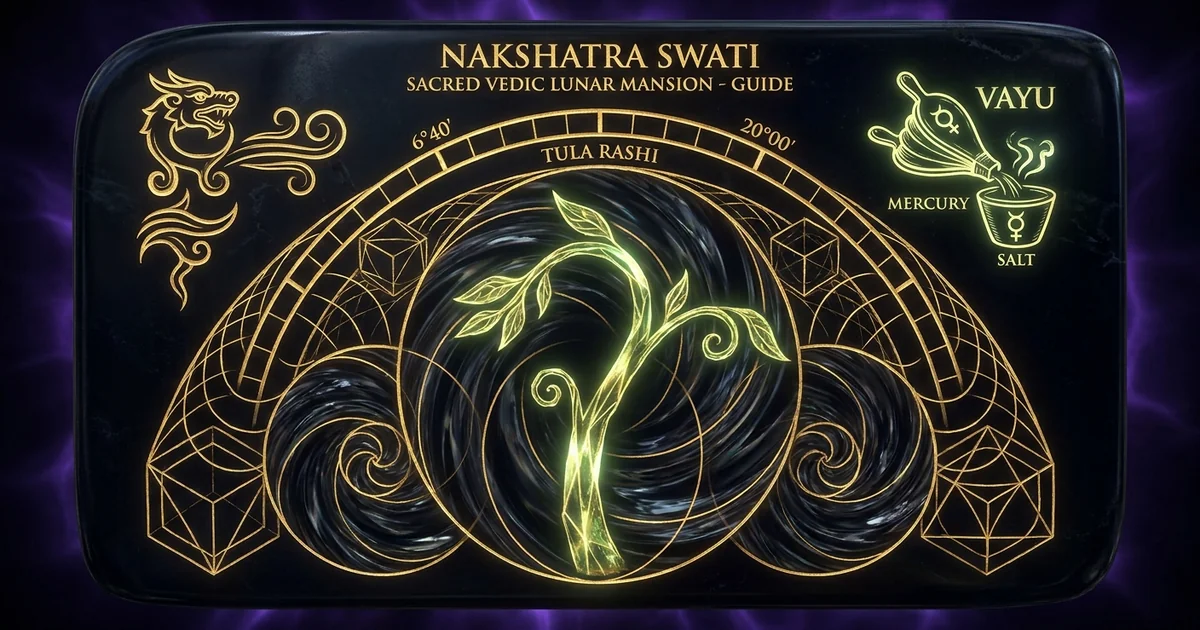
Nakshatra Swati: Sacred Vedic Lunar Mansion - Guide
Archetypal Thesis & Systemic Paradigm: The Aerodynamics of Consciousness
Occupying 6°40’ to 20°00’ of the sidereal sign of Tula (Libra)—spanning precisely from 186°40’ to 200°00’ of the tropical-independent sidereal zodiac—Nakshatra Swati constitutes the cosmic pivot where individual consciousness undergoes structural individuation through aerodynamic adaptation. Rather than an arbitrary celestial station of passive fortune, Swati operates as an archetypal feedback mechanism embodying the biological and cybernetic principle of autopoiesis. Modeled classical-symbolically by a young, green plant shoot swaying yet unbroken amid violent gales, this lunar mansion demonstrates how thermodynamic turbulence and psychodynamic conflict are transmuted into structural resilience, kinetic intelligence, and sociological mobility.
Vectorial Dynamics of Vayu and the Pranic Continuum
The presiding deity of Swati is Vayu, the cosmic wind god and the personification of the universal life-force or prana. In Vedic cosmogony, Vayu is neither mere physical atmosphere nor poetic breeze; he is the primordial kinetic principle, the dynamic vector of the universe that facilitates all structural transformation, respiratory exchange, and neuromuscular communication. Within the human subtle body, Vayu presides over the five distinct vital currents—Prana, Apana, Samana, Vyana, and Udana—serving as the energetic substrate through which ideation condenses into physical reality.
When consciousness enters Swati’s domain, it encounters the uncontainable power of this aerial deity. Vayu acts as an entropic solvent, methodically dismantling rigid, ossified psychic defenses. Rigid behavioral paradigms and crystallized character armors cannot withstand the persistent shearing forces of high-velocity airflow; they must either shatter into pathology or cultivate aerodynamic compliance. Thus, Swati governs the psycho-cosmic dissipative structure: an open thermodynamic system that sustains its internal order only by continuously metabolizing the kinetic energy of its turbulent environment. The native or transit under Swati’s sway learns that survival is fundamentally a function of velocity, breath regulation, and structural non-attachment.
┌──────────────────────────────┐
                  │   External Turbulent Field   │
                  │ (Sociological / Cosmic Wind) │
                  └──────────────┬───────────────┘
                                 │ Shearing Forces
                                 ▼
┌─────────────────────────────────────────────────────────────────┐
│               SWATI PSYCHO-COSMIC EQUILIBRIUM                  │
│                                                                 │
│  [ Dissipative Core ] ──(Metabolizes Tension)──► Dynamic Homeostasis
│         ▲                                               │       │
│         │                                               │       │
│  Elastic Modulus                               Adaptability     │
│   (Hooke's Law)                                 (Flexibility)   │
│         │                                               │       │
│         └───────────────────────────────────────────────┘       │
│                                                                 │
└────────────────────────────────┬────────────────────────────────┘
                                 │
                                 ▼
                  ┌──────────────────────────────┐
                  │   Individuated Resilience    │
                  │   (Unbroken Consciousness)   │
                  └──────────────────────────────┘
The Young Plant Shoot: Elastic Modulus as Spiritual Metaphor
The primary visual emblem of Swati is an emerald shoot of plant life, flexing gracefully under the violent pressure of atmospheric currents. This image establishes a profound bio-mechanical doctrine: absolute surrender of static rigidity is the only path to indestructible permanence. In structural engineering, Hooke’s Law determines the elastic deformation of a material subjected to tensile or compressive stress. If a material exceeds its yield strength without exhibiting elasticity, it suffers brittle catastrophic failure; conversely, materials engineered with an optimal elastic modulus absorb kinetic shock, temporarily deform, and effortlessly return to their baseline equilibrium once the dynamic load dissipates.
Applied to transpersonal psychology, the sprout in the wind symbolizes the soul’s capacity for psychological plasticity. The ego-structure operating within Swati does not seek to dominate its surroundings through blunt, martial resistance, nor does it collapse into nihilistic capitulation. Instead, it oscillates in precise harmonic phase with the prevailing cultural, philosophical, and relational winds. It absorbs ideological shocks, economic upheavals, and existential crises by momentarily bending along the vector of the incoming force. This is not passive weakness, but an advanced expression of dynamic equilibrium, where consciousness remains anchored in the fertile substrate of being while its conscious manifestation retains total kinetic freedom.
Rahu’s Vector in Cardinal Air: The Drive for Autonomy
The esoteric governance of Swati introduces a dialectical friction of high technical complexity. While the mansion resides entirely within the cardinal air sign of Tula (Libra)—governed by the unifying, aesthetic, and balance-seeking authority of Venus (Shukra)—its planetary ruler within the Vimshottari Dasha system is Rahu, the north node of the Moon. This brings the voracious, taboo-breaking, individualistic, and futuristic frequency of the shadow planet into direct confrontation with Venus’s impulse toward harmonious social contracts.
Rahu in cardinal air acts as an evolutionary catalyst. Venus seeks symmetry, diplomatic consensus, and the preservation of shared societal values; Rahu demands radical individuation, unprecedented expansion, and the subversion of conventional lineage boundaries. The resultant vector of this intersection is an intense impulse toward autonomy. Swati natives do not borrow authority; they invent it. Rahu’s presence prevents the airy Venusian balance from stagnating into superficial politeness or decorative complacency. It injects a sharp, restless intellect, a visionary appetite for global trade and unorthodox philosophies, and a refusal to remain bound within the domestic, tribal perimeter. Swati thus becomes the celestial forge of the independent thinker, the cross-border merchant, and the self-made mediator of civilizational dialectics.
- Astronomical Marker: Arcturus (Alpha Boötis), a golden-red giant star situated high in the northern celestial hemisphere (Right Ascension ~14h 15m, Declination ~+19° 10’), notable for its exceptionally large proper motion across the interstellar background.
- Ecliptic Longitude: 186°40’ to 200°00’ (6°40’ to 20°00’ Sidereal Tula / Libra).
- Elemental Attribution: Air (Vayu Tattva); Cardinal / Movable (Chara).
- Triune Motivation (Purushartha): Artha (Material mastery, strategic resource acquisition, structural utility).
- Caste / Gana Integration: Deva (Divine / benevolent inclination toward systemic preservation and harmony).
- Animal Totem: Male Buffalo (Mahisha), signifying deep somatic endurance, steady carrying capacity, and stubborn underlying strength cloaked under an agile exterior.
- Biomechanical Vector: Structural elasticity governed by the formula $\sigma = E \cdot \varepsilon$ (Hooke’s Law of Elasticity), where psychodynamic stress ($\sigma$) is absorbed through dynamic psychic strain ($\varepsilon$) via a resilient spiritual modulus ($E$), preventing irreversible ego fracture.
Classical Provenance & Textual Lineage: Historical Epistemology of the 15th Mansion
The analytical history of Swati reveals an evolving epistemology across several millennia of Indian astronomical and cosmological literature. Across the canonical texts of 27 nakshatras in Jyotish, this 15th mansion marks a clear threshold: the structural departure from self-contained, personal evolution (manifested across the initial fire, earth, and water quadrants of the zodiac) into the complex fields of public life, commerce, and interpersonal equilibrium.
Vedic Cosmological Attribution in the Taittiriya Brahmana
In the Taittiriya Brahmana (specifically within the sections governing the Nakshatra Ishtis, the sacrificial rites allocated to each asterism), Swati is explicitly invoked alongside Vayu as an instrument of spatial purification and non-attached vital circulation. The Vedic seers recognized this asterism under the alternate phonetic appellation Nishtyā, which translates philologically as “the outcast,” “the independent,” or “she who stands entirely outside conventional lineage constraints.”
The sacrificial liturgies of the Taittiriya Brahmana emphasize Swati’s capacity to facilitate unrestricted transit across cosmological realms. Just as Vayu moves through both exalted palatial halls and impure burial grounds without contracting elemental contamination, the consciousness initiated under Swati’s fire retains an innate, unassailable purity. The ancient hymns plead for the favor of Vayu to bestow cattle, swift horses, and unimpeded respiratory power, explicitly codifying this celestial coordinates’ association with swift transportation, physical trade caravans, and the uninhibited movement of physical and psychic capital.
Taittiriya Brahmana (III.1.4.14):
“वायवे स्वाहा । निष्ट्यायै स्वाहा । तिष्ठते स्वाहा । प्रतिष्ठायै स्वाहा । वातो वा अयमन्तरेण पवते । स एतां निष्ट्यामपश्यत् ।” “Vāyave svāhā. Niṣṭyāyai svāhā. Tiṣṭhate svāhā. Pratiṣṭhāyai svāhā…” Translation: “Oblations unto Vayu; oblations unto Nishtya (Swati). Oblations unto the static; oblations unto the firm foundation. Verily, this Wind purifies in the intermediate space between Heaven and Earth; he beheld this celestial station Nishtya, the Independent One.”
Brihat Samhita of Varahamihira (Chapter XV, Sloka 14):
“स्वात्यां मृदुक्रुद्धर्मासक्ताः प्रियवाचो धनिनः ।” Translation: “Those born when the Moon occupies the mansion of Swati are exceptionally mild of demeanor, capable of subduing anger, profoundly dedicated to righteousness (Dharma), gifted with sweet, agreeable speech, and destined to attain vast wealth through independent commercial acumen.”
Parasarian and Varahamihiran Formulations
When the structural transition from Vedic liturgical sacrifice to horoscopic astrology solidified between the 1st and 6th centuries CE, the fundamental attributes of Swati were codified by the master authorities Parasara and Varahamihira. In the Brihat Parasara Hora Sastra, Parasara treats the placement of the Lagna or the Moon within Swati as an indicator of an agile, philanthropic, and commercially successful individual who masters the art of rhetoric and social diplomacy. Parasara notes that Rahu’s governance over this space endows the mind with a capacity for subtle stratagems, granting the native an intuitive understanding of the marketplace and bureaucratic mechanics.
Varahamihira, compiling centuries of observational astronomy and omen literature in the Brihat Samhita, reinforces these behavioral parameters. He observed that lunar transits through Swati cultivate a psychological climate marked by sweet speech (priyavak), ascetic self-restraint, business acumen, and merchant enterprise. Varahamihira explicitly links Swati with travelers, messengers, navigators, and purveyors of aromatic substances—all domains governed by the transmission of wind, circulation, and sensory attraction. His treatises illustrate that ancient astrology viewed Swati not as a generator of chaotic storms, but as the master of the beneficial, regulated breeze that propels trading vessels safely to port.
                      ┌──────────────────────────────┐
                      │    Ancient Vedic Roots       │
                      │ (Taittiriya Brahmana: Nishtya)│
                      │  - Non-attached movement      │
                      │  - Purification via Prana     │
                      └──────────────┬───────────────┘
                                     │
                                     ▼
                      ┌──────────────────────────────┐
                      │   Classical Horoscopy        │
                      │   (Parasara & Varahamihira)  │
                      │  - Sweet-spoken diplomat      │
                      │  - Merchant-navigator         │
                      │  - Subdued anger, high wealth │
                      └──────────────┬───────────────┘
                                     │
                                     ▼
                      ┌──────────────────────────────┐
                      │    Medieval / Modern Shift   │
                      │  - Single Pearl / Sword       │
                      │  - Volatility vs. Organic Law │
                      │  - Autopoietic Elasticity     │
                      └──────────────────────────────┘
The Sword and the Sprout: Medieval Hermeneutic Shifts
As astrological commentary developed through the medieval era via texts like the Jataka Parijata, the Saravali, and the commentaries of Bhattotpala, a subtle shift occurred in the symbolic geometry assigned to the 15th mansion. Certain lineages introduced the khadga (the double-edged sword) as an auxiliary symbol alongside the plant shoot and the single, luminous pearl (moti).
This dual symbolism encapsulates an organic system theory of balance. The pearl, formed layer by microscopically thin layer around an irritating foreign particle within the dark belly of an oyster, perfectly captures Rahu’s alchemical capacity to transform psychological suffering and foreign disruption into priceless material elegance. The sword, conversely, demonstrates the razor-sharp intellectual discrimination of cardinal air—the ability to sever dead wood, bifurcate conflicting arguments, and construct crisp legal or philosophical delineations.
Yet, medieval practitioners cautioned that when inverted or afflicted by malefic aspects, this sword becomes an instrument of internal severance, generating alienation and cognitive isolation. Thus, the plant shoot remained the preeminent glyph, continuously reminding the adept that the ultimate deployment of Swati’s sword is not to conquer external terrain, but to carve out psychic space wherein the tender shoot of consciousness can grow toward self-actualization.
Structural Mechanics & Symbolic Geometry: Anatomy of the Pada Quadrants
The complete architecture of Nakshatra Swati is delineated through its four quarters, or padas, each measuring precisely 3°20’ of the ecliptic. These padas function as micro-coordinate lenses, refracting the raw aerial Venus-Rahu matrix through four distinct ninth-harmonic (navamsha) environments. The progression of these quadrants traces the systematic descent and mastery of aerial consciousness, descending from philosophical ideation into structural application, collective networking, and ultimate spiritual transcendence.
The 13°20’ Matrix: Sub-Harmonics and Navamsha Partitioning
The full span of Swati (186°40’ to 200°00’ sidereal) occupies the mid-section of Tula, where the balancing act of the scales moves away from the martial friction of Chitra (governed by Mars) and steers clear of the intense devotional polarization of Vishakha (governed by Jupiter and Indra-Agni). Swati is pure, untarnished Air; it sits at the absolute core of the cardinal air triplicity. In the D9 Navamsha chart, which governs the internal soul trajectory and relational mechanics, the four padas traverse the final quadrant of the zodiac: Sagittarius, Capricorn, Aquarius, and Pisces.
This structural sequence is of supreme esoteric consequence. It reveals that within Swati, the soul moves sequentially through Fire (Sagittarius), Earth (Capricorn), Air (Aquarius), and Water (Pisces). Air cannot exist as an isolated, self-sustaining vacuum; it must be fired by noble vision, grounded by pragmatic enterprise, circulated across collective human networks, and ultimately dissolved in the waters of transcendent compassion. This structural sequence ensures that the native who masters Swati’s internal harmonics moves through a comprehensive cycle of human experience.
Navamsha Analysis: Sagittarius, Capricorn, Aquarius, and Pisces Invasions
Pada 1: Sagittarius Navamsha (186°40’ to 190°00’ Sidereal Tula)
Governed by Jupiter (Guru), this pada acts as the Dharmic seed of Swati. It merges the kinetic volatility of Vayu with the expansiveness, ethical rectitude, and philosophical ambition of Sagittarius. The native functioning within this quadrant acts as an ideological voyager or an educational pioneer. The air is energized by flame; ideas are not merely debated, but weaponized in the pursuit of righteous reformation. The challenge here is the mitigation of fanatical self-righteousness, as Rahu’s appetite combined with Jupiter’s certitude can generate a crusader complex that forgets the Venusian need for relational diplomacy.
Pada 2: Capricorn Navamsha (190°00’ to 193°20’ Sidereal Tula)
Governed by Saturn (Shani), who is the ruler of Capricorn and also achieves his exaltation degree within this specific region of Tula (exalting at 20°00’ Tula, exactly at the terminus of Swati). This is the Artha pada of supreme materialization. Here, the wild, unpredictable wind is channeled through a cold, disciplined aerodynamic turbine. The native exhibits immense organizational intelligence, business acumen, and calculating patience. The instability of Rahu is contained by Saturn’s grim realism. This pada produces captains of commerce, legal architects, corporate strategists, and institutional leaders capable of constructing resilient structures that endure shifting social landscapes.
Pada 3: Aquarius Navamsha (193°20’ to 196°40’ Sidereal Tula)
Also governed by Saturn, but expressing his sign-quality of fixed air, this is the Kama pada of systemic circulation. Aquarius is the visionary collective grid; when merged with Swati’s aerial nature, it facilitates extraordinary technological, scientific, and sociological breakthroughs. The individual consciousness ceases to view the world through personal or dynastic lenses; it thinks in terms of algorithms, global logistics, civil rights, and complex societal ecosystems. Communication here is rapid, detached, and profoundly egalitarian, allowing the individual to interact with diverse social strata without succumbing to elitism or class bias.
Pada 4: Pisces Navamsha (196°40’ to 200°00’ Sidereal Tula)
Governed by Jupiter, this constitutes the Moksha pada and the emotional terminus of the mansion. The aerial vector completes its arc by descending into the oceanic depths of Pisces. Here, the sharp intellect of Rahu-Venus yields to mystic intuition, artistic transcendence, and universal compassion. The inherent restlessness of the wind calms into contemplative stillness. Natives operating in this zone often channel their commercial or social talents toward deep philanthropic causes, esoteric scholarship, music, or spiritual liberation. The hazard of this pada is psychological dispersion or escapism, requiring constant somatic grounding to prevent the dissolution of individual identity into emotional fantasy.
Planetary Intersections: Venusian Base vs. Rahuvian Teleology
To interpret Swati accurately, an astrologer must master the persistent counterpoint between Venus (the Rashi Swami, or ruler of the base sign) and Rahu (the Nakshatra Swami, or operational planetary director). Venus is the cosmic artisan, the diplomat, the preserver of bodily vitality (Shukra dhatu), and the architect of shared agreements. Rahu is the cosmic foreign agent, the hunger for expansion, the technological innovator, and the disruptor of societal consensus.
| Parameter | Sign Ruler: Venus (Shukra) | Nakshatra Ruler: Rahu (North Node) | Synthesized Swati Function |
|---|---|---|---|
| Elemental Core | Cardinal Air / Refined Earth (Watery Grace) | Shadowy Kinetic Air / Smoke | Highly refined, hyper-kinetic intellectual currents |
| Psychic Drive | Relational symmetry, beauty, social ease | Transgression of boundaries, worldly ascent | Strategic diplomacy utilized to infiltrate new spheres |
| Material Utility | Artistic harmony, trade, luxury | Technological networks, finance, mass media | Global commerce, financial engineering, international law |
| Shadow Trap | Shallow aestheticism, appeasement | Existential detachment, sociopathy, deceit | The charismatic chameleon without an authentic self |
When these two currents intersect, they yield a consciousness that uses charm, aesthetic refinement, and diplomacy (Venus) as the operational vehicle to achieve unprecedented, non-traditional heights of influence and autonomy (Rahu). The danger lies in an instrumentalization of human relationships: the native can become an archetype of transactional sociability, charming everyone while remaining internally detached from everything. Conversely, when integrated through rigorous spiritual practice, this planetary pair produces a formidable diplomat who can build bridges between violently divergent cultures, mediating peace where more rigid forces fail.
Psychological Dynamics & Operational Praxis: The Individuation Architecture
Examined through analytical psychology, Swati represents a crucible for Carl Gustav Jung’s process of individuation. Because its elemental matrix is Cardinal Air governed by an aerial deity and an insatiable shadow node, the ego-structure faces a unique developmental hazard: the total dissipation of the Self into cognitive abstraction, intellectual detachment, and chameleonic social masks.
The Vayu Complex: Restlessness, Dissociation, and Intellectual Adaptability
The psychological baseline of an individual with strong Swati activations (especially the Moon, Ascendant, or Ascendant Lord placed within its degrees) is characterized by high cognitive velocity. In Ayurvedic terms, this manifests as a chronic susceptibility to ayurvedic-vata imbalances: rapid ideation, variable energy states, dryness of physical tissues, and an intrinsic, nervous restlessness. The individual lives primarily within the mental sphere, perceiving external physical environments as secondary projections of conceptual frameworks.
Under conditions of trauma or chronic stress, this personality matrix readily retreats into the psychological defense of dissociation. Rather than feeling somatic grief, rage, or physical agony, the Swati individual transmutes raw emotional distress into abstract analysis. They analyze their suffering rather than embodying it. The Puer Aeternus (the Eternal Youth) archetype often emerges here: the flight away from dense, chthonic, earthly reality—represented by Saturnian domesticity and physical limitations—into the boundless sky of pure potentiality. The mind floats effortlessly, avoiding real-world commitments that threaten to anchor the dynamic shoot of the soul to a single physical location.
Unintegrated / Chaotic Vayu Expression
- Pathological Dissociation: Complete detachment from physical bodily signals, severe somatic amnesia, living entirely within conceptual illusions.
- Chameleonic Hypocrisy: Pathological adaptation to external expectations; adopting any moral code, philosophical stance, or accent to maintain superficial approval.
- Chronic Restlessness: Inability to complete cycles of work; perpetual flight from emotional intimacy into speculative professional or intellectual pivots.
- Exploitative Transactionalism: Reducing interpersonal relationships to calculated maneuvers for social, technological, or financial leverage.
Integrated / Transmuted Swati Gnosis
- Autopoietic Resilience: The capacity to absorb acute life disruptions and dynamic shocks without cracking the core personality structure.
- Systemic Diplomacy: Authentic, compassionate mediation; the capacity to understand multiple ideological matrices simultaneously without losing one’s own truth.
- Mastery of Vital Force: Conscious regulation of the breath (Pranayama), stabilizing internal bio-rhythms and directing focus into focused creation.
- Structural Autonomy: Cultivation of non-attached independence; operating within complex societal systems while remaining internally free.
Archetypal Shadow: The Dispersal of Will and Chameleonic Chameleonism
The primary shadow dynamic of Swati is the fragmentation of the individual will. Because the native can intuitively understand every perspective within a dispute, they risk losing the ability to take an unequivocal moral stand. The Venusian desire to appease combines with Rahu’s instinct for self-preservation, spawning a social chameleon. In this state, the personality constructs an array of functional personas, presenting one face to the orthodox establishment, another to the counter-cultural underground, and yet another to commercial associates.
Over time, this strategy generates an acute existential crisis. The native looks into the mirror and realizes that behind the dazzling array of masks, no central observer remains. The wind has scattered the soul across the four quarters of the earth. This psychological fracture often manifests in professional life as polymathic paralysis: the individual excels at twelve different disciplines, learns eight different software languages, drafts five incomplete manuscripts, yet struggles to consolidate their efforts into a single, cohesive, authoritative body of work.
                      ┌──────────────────────────────┐
                      │    The Swati Shadow Loop     │
                      │  (Air/Rahu Over-Adaptation)  │
                      └──────────────┬───────────────┘
                                     │
                                     ▼
        ┌──────────────────────────────────────────────────────────┐
        │  1. Hypersensitive Perception of Social/Ideological Wind │
        │  2. Chameleonic Masking: Submerging Core Identity        │
        │  3. Intellectual Dissociation: Severing Somatic Ties     │
        │  4. Entropic Will: Polymathic Paralysis & Exhaustion     │
        └────────────────────────────┬─────────────────────────────┘
                                     │
                                     ▼
                      ┌──────────────────────────────┐
                      │   Breaking the Shadow Loop   │
                      │   (Somatic Grounding Praxis) │
                      │  - Slow-cadence Pranayama    │
                      │  - Dense Saturnian Routines  │
                      │  - Ethical Invariants (Roots)│
                      └──────────────────────────────┘
Clinical Integration: Somatosensory Grounding for Rahu-Vayu Hyperactivation
The remediation of Swati pathology requires structural somatosensory grounding rather than speculative mental techniques. When a native experiences severe anxiety, insomnia, or emotional dissociation driven by a Rahu-Vayu transit or natal affliction, sending them to further cognitive or analytical therapies can exacerbate the condition by feeding their defensive intellectualization.
The classical and clinical remedy relies on anchoring the body within dense, physical reality:
- Slow-Cadence Pranic Regulation: Intentional, paced respiratory practices such as Nadi Shodhana (alternate nostril breathing) utilizing a 1:2 inhalation-to-exhalation ratio with gentle breath retention (Kumbhaka). This activates the parasympathetic branch of the autonomic nervous system, pulling kinetic energy down from the overactive brain to the belly.
- Somatic Contact and Heavy Resistance: Physical resistance training, barefoot contact with natural soil, and heavy sensory inputs. This recalibrates the vestibular system and forces the psychic locus out of the conceptual stratosphere and back into the musculoskeletal core.
- Firm Temporal Boundaries: The native must consciously accept Saturnian limitations. This requires imposing non-negotiable routines: fixed waking and sleeping times, structured eating intervals, and deliberate commitments that cannot be abandoned when dynamic friction inevitably emerges. The shoot must willingly accept deep soil; otherwise, the wind that was meant to strengthen it will tear it out by its fragile roots.
Philosophical Synthesis & Macrocosmic Correspondence: Arcturus and the Cosmic Respiratory Cycle
The macrocosmic anchor of Swati is the fixed star Arcturus (Alpha Boötis), a brilliant, orange-hued giant that sits like a solitary sentinel outside the main plane of the Milky Way’s disk. Positioned nearly thirty-seven light-years from our Sun, Arcturus does not share the common orbital trajectory of the stars forming our local solar neighborhood; it travels at an extreme, oblique angle across the galactic plane, accompanied by an entourage of ancient stars known as the Arcturus Stream.
Arcturus as the Psychopomp: Stellar Hermeneutics of Alpha Boötis
In the hermetic mapping of the cosmos, Arcturus functions as an energetic gatekeeper, a psychopomp facilitating the entry and exit of trans-dimensional currents into our local sector of the galaxy. Its high proper motion mirrors the restless, boundary-crossing nature of Vayu and the alien, out-of-bounds trajectory of Rahu. Classical western and eastern astrometric treatises recognized that this solitary star imparts an intense, piercing intelligence, an affinity for navigation, law, and high governmental or spiritual responsibility, tempered by a continuous undercurrent of existential isolation.
The solitary nature of Arcturus informs the deeper spiritual condition of Swati: the soul must ultimately realize its fundamental independence (Svatantrya). Just as Arcturus moves through the stellar firmament on its own unique orbital trajectory, unentangled with the rotational drift of the local galactic stellar herd, the individuated Swati consciousness must eventually realize that its ultimate security lies not in social networks, commercial contracts, or worldly diplomacy, but in its own self-generated, indestructible divine core.
Hermetic Resonance: The Principle of Polarity in Cardinal Air
Within the Hermetic tradition, the fourth principle of the Kybalion—the Principle of Polarity—states: “Everything is Dual; everything has poles; everything has its pair of opposites; like and unlike are the same; opposites are identical in nature, but different in degree.”
Swati is the ultimate celestial theater for the mastery of this Hermetic law. Residing in the sign of the Scales (Tula), its structural function is not the eradication of tension, but the dynamic balancing of opposing polarities. True equilibrium is never a static, frozen state; such rigidity is death. True equilibrium is kinetic, continuous, and dynamic, identical to the microscopic adjustments a high-wire artist makes to maintain balance, or the rapid, microscopic shifts an aircraft’s flight-control computer executes to navigate atmospheric turbulence.
The adept working with Swati’s energy embraces dualities: poverty and wealth, radical individuality and social integration, ascetic solitude and commercial mastery. They do not fear the shifting of worldly winds, recognizing that each pole of life contains the hidden seed of its absolute opposite. By refusing to latch onto either extreme with grasping desire or fearful aversion, the Swati consciousness hovers directly over the cosmic pivot, moving freely between polarities without becoming enslaved to any single ideological or emotional extreme.
“The organism is not a static blueprint, but an open system maintained in a dynamic steady state by the continuous intake and outflow of energy. What we term ‘stability’ is precisely this capacity to remain functional within a zone of continuous thermodynamic turbulence through homeostatic feedback loops.” — Norbert Wiener, Cybernetics: Or Control and Communication in the Animal and the Machine (1948, MIT Press)
“Synchronicity reveals the meaningful connection between the subjective psychodynamic state and the objective, external cosmological configuration. It assumes that there is an underlying, unconditioned unity of all existence—the unus mundus—wherein physical movement and psychic individuation are two aspects of an identical, self-regulating teleological reality.” — Carl Gustav Jung, Synchronicity: An Acausal Connecting Principle, CW Vol. 8 (1960, Princeton University Press)
Cybernetic Feedback: The Self-Correcting Trajectory of the Soul
Modern cybernetics defines a system’s intelligence by its capacity to ingest feedback from its external surroundings, compute the deviation from its intended vector, and execute corrective commands to preserve its teleological trajectory. This process precisely maps the esoteric functioning of Swati within the zodiac. Swati operates as the universal error-correcting algorithm of the 27 lunar mansions.
In the preceding mansions, personal desires, domestic security, and martial conquests dominate consciousness. When the soul crosses the threshold of Swati, personal ambition (Rahu) must be calibrated against the objective structural reality of interpersonal justice and social harmony (Tula). If a human civilization or an individual ego becomes too rigid, oppressive, and unbalanced, Swati unleashes the winds of Vayu: economic collapses, ideological disruptions, and migratory crises sweep through the system, shattering artificial monuments of pride and leveling the field.
The plant shoot reminds us that only the soft, the green, and the deeply rooted survive these structural corrections. By accepting Swati’s aerodynamic law, the soul learns to self-correct in real time. It yields where it must yield, asserts its trajectory where it must assert, and navigates through the storms of space and time with serene, unshakable sovereignty.
Frequently Asked Questions: Advanced Esoteric Clarifications
How does Jyotish reconcile Rahu’s chaotic nature with the refined, diplomatic harmony of Venus in Swati?
The synthesis of Rahu and Venus within Swati is not a collision of incompatible forces, but an alchemical calibration. Rahu is an elemental disruptor; it craves expansion, seeks unconventional territory, and refuses to conform to hereditary norms. However, because it resides within the cardinal air sign of Tula, its disruptive impulse is filtered through the harmonic, aesthetic, and intellectual matrix of Venus. Venus provides the refined aesthetic language, the understanding of social architecture, and the diplomatic poise; Rahu provides the kinetic velocity, strategic ambition, and technical innovation.
Rather than producing coarse violence or crude destruction, Rahu in this mansion manifests as an exceptionally high-order, strategic mind. It creates an individual who can navigate polite society effortlessly while executing non-linear commercial or philosophical maneuvers behind the scenes. The friction between the two planets transforms raw, base desire into sophisticated socio-political power, turning the outsider into an indispensable global mediator.
What distinguishes Swati’s air element from other air-dominated nakshatras like Ardra and Shatabhisha?
While all three of these asterisms—Ardra (Gemini), Swati (Libra), and Shatabhisha (Aquarius)—are ruled by Rahu and share the Air element (Vayu Tattva), their mechanics and cosmic functions diverge sharply:
- Ardra (Mutable Air / Gemini): Governed by Rudra (the god of storms and destruction), Ardra’s air is electric, tempestuous, and localized. It represents the psychological storm: acute cognitive friction, sudden emotional lightning, weeping, and the destruction of mental ignorance through visceral, traumatic insight. Its symbol is the teardrop.
- Swati (Cardinal Air / Libra): Governed by Vayu (the cosmic wind), Swati’s air is kinetic, aerodynamic, and circulatory. It represents the global atmospheric current: long-range trade, social movement, linguistic translation, and adaptive survival. It does not destroy the ego via trauma like Ardra; instead, it shapes the ego via continuous, gentle, shaping pressure, fostering the resilience of the bending shoot.
- Shatabhisha (Fixed Air / Aquarius): Governed by Varuna (the god of cosmic waters and the celestial ocean), Shatabhisha’s air is ambient, cosmic, and clinical. It represents the atmospheric void: deep, silent, transpersonal space, dealing with esoteric healing, the medicine of isolation, and the metaphysical networks that sustain universal order.
Why do Swati nativities excel in international law, merchant banking, and cross-cultural mediation?
Swati occupies the precise coordinate intersection where human communication (air) becomes codified into structural contracts (Libra) and extended across foreign borders (Rahu). Classical treatises identify this mansion with the Mahisha (male buffalo) totem and the Deva gana, indicating a combination of relentless, disciplined endurance paired with an innate, civilized preference for order and fairness.
Because Rahu breaks down insular, tribal prejudices, the Swati native possesses a natural global consciousness. They can step outside their native cultural assumptions, adopt foreign languages, and grasp the nuances of alien legal and financial frameworks without cognitive friction. Furthermore, the governing deity Vayu ensures that they approach negotiation not as a zero-sum siege, but as a dynamic flow of mutual interests. They design agreements with the necessary structural elasticity (Hooke’s Law) to accommodate future real-world fluctuations, making them incomparable international lawyers, currency traders, and diplomatic emissaries in a rapidly globalizing world. :::