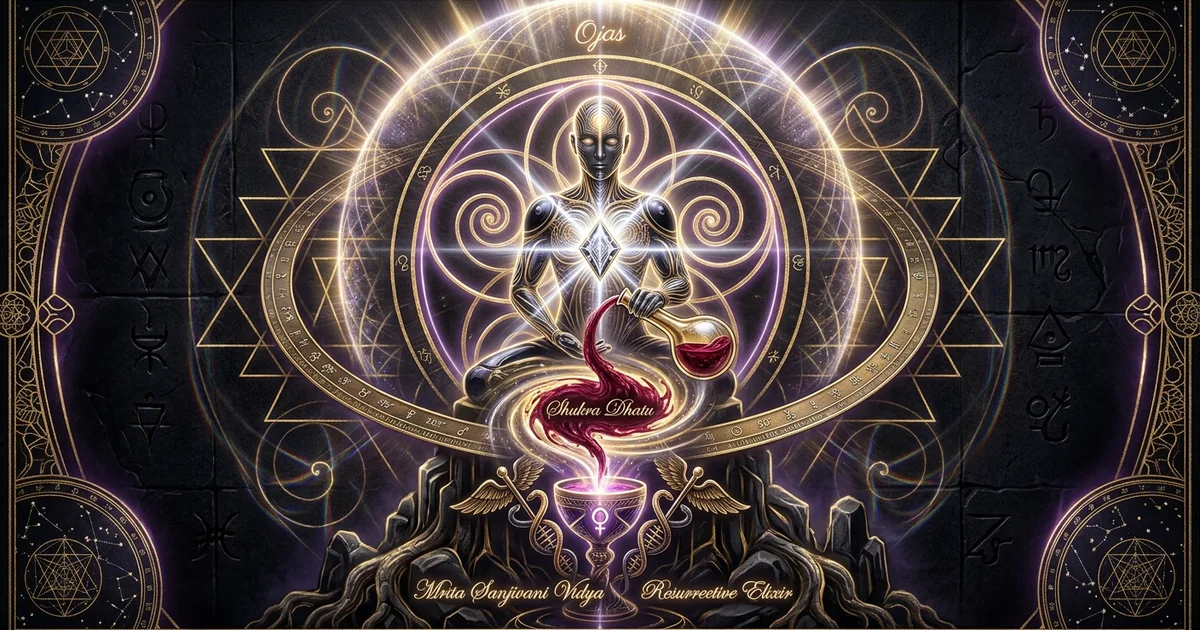
Shukra: Sacred Devotion, Art and Shukra Neeti Lore
Archetypal Thesis & Systemic Paradigm: The Asura Guru and the Embodied Divine
In the classical cosmological cartography of Vedic astrology (Jyotish), the planetary archetype of Shukra (Venus) is routinely flattened by exoteric interpretations that reduce its operational sphere to hedonic pursuit, romantic sentimentalism, and surface aesthetics. Within the non-dual ontological architecture established by the Rishi lineages, Shukra occupies a far more formidable, sovereign, and esoteric station: that of the Asura Guru, the preceptor to the titans of material manifestation. While Brihaspati (Jupiter) presides over disembodied cosmic law, intellectual orthopraxy, and the celestial hierarchy of the Devas, Shukra descends directly into the labyrinth of dense, recalcitrant matter. His pedagogic mandate is the spiritualization of the flesh and the reclamation of immanence.
Rather than viewing the material universe (Prakriti) as an illusory trap to be dissolved through ascetic flight, Shukra demonstrates that the sensory architecture of the human organism is an alchemical laboratory designed for divine realization. Investigating planetary archetypes in Vedic astrology reveals that Shukra is the strategic architect who equips consciousness to navigate the dense frictions of worldly sovereignty without suffering systemic dissolution.
The Transmutation of Kama into Devotional Teleology
The primary systemic vector through which Shukra operates is Kama—the cosmic principle of desire, affinity, cohesion, and erotic pull. In the early stages of individuation, Kama manifests as localized sensual craving and instinctual grasping, driving the biological organism toward territorial acquisition, reproductive conjugation, and ephemeral comfort. Through the refined lens of Shukra, Kama is systematically liberated from its reactive, lower-frequency feedback loops and sublimated into Bhakti—non-dual devotional immersion. This transition is not achieved through moralistic suppression or the puritanical mortification of the senses; rather, it occurs through the radical deepening of aesthetic perception.
When sensory immersion is pursued to its qualitative limit, the boundaries of the experiencing ego dissolve into the radiance of the perceived object. Shukra instructs that the longing embedded within physical touch, the resonance of a musical scale, or the geometric proportions of visual art are merely refracted rays of a singular metaphysical longing: the desire of the fragmented self to experience total integration with the Divine Mother (Para Shakti). Thus, Kama is not an impediment to liberation (Moksha), but its energetic propellant.
Sensory Impulse (Kama) ──> Aesthetic Refining (Kala) ──> Devotional Immersion (Bhakti) ──> Non-Dual Dissolution (Moksha)
Through this evolutionary progression, artistic mastery becomes an authentic liturgy. The practitioner of Shukran arts does not decorate reality, but systematically constructs sensory conduits through which the transcendent becomes sensorially palpable.
The Asuric Bridge: Material Sovereignty and Esoteric Preservation
The denomination of Shukra as the Asura Guru underscores an imperative metaphysical paradox: the spiritualization of the manifest order requires the preservation and refinement of those forces that build and sustain physical structures. The Asuras, often mischaracterized as purely demonic entities, represent the primordial drive toward materialization, technological manipulation, state-building, and biological preservation. Left unguided, Asuric consciousness devolves into tyrannical pride, consumerist depletion, and entropic warfare.
Shukra functions as the indispensable regulative intelligence for these forces. He does not demand that the Asuras renounce their material nature; instead, he instructs them in the arts of political jurisprudence (Neeti), refined architecture, physical hygiene, sensory equilibrium, and systemic preservation. By guiding the forces of materialization, Shukra ensures that the physical world does not collapse under its own inertial gravity.
Central to this dynamic is Shukra’s possession of the ultimate esoteric secret: Mrita Sanjivani Vidya, the primordial science of revivification. Mythologically bestowed upon Shukra through severe somatic tapasya, this science allows the Asura Guru to restore fallen warriors to life. Within the theatre of consciousness, Mrita Sanjivani Vidya signifies the specific psychological and alchemical capacity to resurrect deadened, traumatized, or purely materialistic states of mind, restoring them to radiant awareness. Where rigid intellectual orthodoxy (Brihaspati) excommunicates or abandons that which has fallen into decay, Shukra descends into the necrotic realms of psychic ruin to regenerate life from within the depths of matter itself.
“Aesthetics is not a branch of philosophy that deals with the beautiful in art; it is a manner of being in the world, the heart’s response to the world’s breath… The restoration of the world’s soul (Anima Mundi) depends upon the restoration of our capacity to sense the world, to perceive its immediate aesthetic presentation as an inherent divine intelligence.” — James Hillman, The Thought of the Heart and the Soul of the World (1992)
Somatic Epistemology: Aesthetic Perception as Direct Gnosis
Western dualism has long maintained an adversarial divide between the somatic apparatus and intellectual cognition, branding sensory knowledge as inherently subjective and metaphysically untrustworthy. In contrast, the epistemology of Shukra in Jyotish asserts that aesthetic perception is a form of direct, non-propositional gnosis. The five senses are calibrated instruments of consciousness; when cleansed of projective grasping, they register the subtle mathematical symmetries that structure the cosmos. Beauty is understood not as a subjective sentiment, but as the direct perception of harmonious structural integration.
In this somatic epistemology, to experience aesthetic ecstasy (Rasa) is to experience the cosmic order directly within the nervous system. The endocrine cascade, the rhythmic harmonization of cardiovascular pulses during the contemplation of sublime art, and the cellular receptivity to sacred sound are not biological accidents; they are somatic confirmations of cosmic alignment. Shukra demonstrates that the body is not an obstacle to spirit, but the crystallized manifest expression of consciousness itself, possessing an innate capacity to comprehend metaphysical truths through aesthetic resonance long before the discursive intellect can formulate them into conceptual systems.
Classical Provenance & Textual Lineage: Shukracharya, the Puranic Canon, and the Shukra Neeti
The classical literature of the Vedic and Puranic canons establishes Shukra (also known as Ushanas, Kavi, or Bhrigunandana) as an intellectual and operational titan whose stature challenges the hegemony of the solar and lunar aristocracies. As the son of Maharishi Bhrigu—the primordial sage who penned the ultimate treatises on biological destiny and cosmic cycles—Shukra inherits a lineage deeply anchored in the mastery of time, genealogical inheritance, and the manipulation of physical reality.
In the Brihat Parashara Hora Shastra, Sage Parashara characterizes Shukra as a planet of joyful countenance, endowed with splendor, exquisite poetic vision, high political intellect, and an abundance of biological essence (Kapha and Vata constitution). Varahamihira, writing in the Brihat Jataka, confirms this multidimensionality, delineating Shukra not merely as the giver of physical pleasures, but as the supreme indicator of refined counsel, literary brilliance, ministerial authority, and the alchemical fluids of life.
       Maharishi Bhrigu (Primordial Lineage)
                 │
                 ▼
         Kavi / Shukracharya
  ┌──────────────┴──────────────┐
  │                             │
Tapas over Smoke       The Asura Guruship
(Mrita Sanjivani)      (Shukra Neeti & Statecraft)
The Penance of Bhrigu’s Son: Smoked Tapas and Shiva’s Boon
The foundational mythos explaining the genesis of Shukra’s supreme authority concerns his unprecedented penance (Tapas) to acquire the Mrita Sanjivani Vidya from Lord Shiva. Recognizing that the Deva preceptor, Brihaspati, held an entrenched institutional advantage over the Asuras, Shukracharya subjected himself to a radical somatic ordeal: he suspended himself upside down from the branch of an ancient tree, with his face positioned directly above a sacrificial fire of burning husks and damp leaves, for a duration of one thousand solar years. Throughout this epoch of self-imposed constraint, Shukra inhaled only the thick, suffocating smoke, completely denying himself physical food, water, or sensory light.
This severe constraint reveals the operational mechanics of the Venusian archetype. True aesthetic refinement, alchemical mastery, and the power of revivification are not products of self-indulgent ease; they are forged through radical interior pressure and the voluntary containment of life force. By hanging upside down, Shukra inverted the typical gravitational and pranic vectors of the human vessel, forcing the ascending currents (Udana and Prana) to fuse with the descending, reproductive currents (Apana). The smoke he inhaled symbolized the dense, obscure, and suffocating aspects of material life—the very toxicity of embodied existence.
Having digested the smoke without succumbing to biological or psychological disintegration, Shukracharya emerged before Mahadeva (Shiva) as an alchemical adept capable of transmuting poison into life-restoring nectar. Shiva swallowed Shukracharya whole, incorporating the sage into his divine belly, before expelling him through his seminal conduit. Re-emerging from the body of Shiva as pure reproductive and spiritual essence, the sage was bestowed with the name Shukra (the luminous, the pristine, the seminal) and given sovereign dominion over the art of defeating death itself.
“Neither the pure practice of Dharma without Artha (material capability), nor the accumulation of Artha without Dharma, leads to the preservation of the social organism. The preceptor who counsels the abandonment of material sovereignty out of an excessive desire for disembodied virtue abandons his people to subjugation. Wisdom consists in the continuous, artful synthesis of moral equilibrium with practical administrative dominion.” — Shukra Niti, Chapter I, verses 42–46 (Trans. Benoy Kumar Sarkar, 1914)
The Shukra Neeti: Realpolitik, Administrative Architecture, and Secular Ethics
Far from being an ethereal or otherworldly recluse, Shukracharya authored one of the most comprehensive, sophisticated, and pragmatic systems of political philosophy and statecraft in ancient Indian civilization: the Shukra Neeti. While the Manu Smriti privileges an idealized, orthodox, and caste-stratified vision of society, and Kautilya’s Arthashastra focuses on centralized imperial intelligence and resource mobilization, the Shukra Neeti approaches governance as a multidimensional aesthetic, diplomatic, and socioeconomic science.
The text outlines granular operational protocols:
- The design of fortified cities with optimal acoustic and aesthetic symmetry to preserve civil peace.
- The precise calibration of state taxation (advocating against the predatory extraction of merchant wealth).
- The legal codification of labor rights, medical provisions, and pensions for state artisans, sculptors, and soldiers.
- The systematic deployment of the four diplomatic strategies (Upayas): Sama (conciliation/aesthetic resonance), Dana (resource alliance), Bheda (systemic differentiation), and Danda (calibrated force).
To Shukracharya, good governance is fundamentally an aesthetic art. An ugly, discordant, impoverished, and culturally sterile state is an unstable state, inevitably marked for political collapse and revolutionary overthrow. The preservation of social harmony demands the generous funding of the sixty-four traditional arts (Kalas), the protection of poets and engineers alike, and the calculated deployment of beauty as a psychological stabilizer for the populace. Through this lens, diplomacy is not merely the transactional exchange of treaties, but the sophisticated orchestration of systemic relationships, mirroring the complex harmonizations found in classical music and architectural design.
Transmission through Brihat Parashara Hora Shastra and Brihat Jataka
In technical Jyotish, as codified by Parashara and Varahamihira, Shukra is recognized as a natural benefic (Naisargika Shubha Graha) of the highest magnitude, rivaled only by Jupiter. However, the classical texts consistently encode an adversarial, subversive current within Shukra’s beneficent nature. In the Brihat Parashara Hora Shastra, while Shukra rules over vehicles (Vahana), fine garments (Vastra), conjugal happiness (Kalatra Sukha), and exquisite scents, his lordship over the 6th or 8th house matrices for specific rising signs (such as Sagittarius or Aries) endows him with the capacity to unleash immense systemic disruption.
Varahamihira notes in the Brihat Jataka that Shukra’s vision is directed horizontal-oblique, perceiving that which is hidden, marginalized, or excluded by orthodox structures. Parashara systematically designates Shukra as the planetary Karaka (significator) of the seminal essence, sight, and the capacity for artistic synthesis. Where Jupiter instructs through spoken dogma, conceptual scripture, and paternal authority, Shukra instructs through direct participatory immersion, intuitive aesthetic synthesis, and relational mirror-dynamics. The classical texts thus demand that the astrological practitioner treat Shukra not merely as a symbol of trivial delights, but as a primary index of an individual’s capacity to achieve coherence between their material desires and their ultimate spiritual realization.
Structural Mechanics & Symbolic Geometry: Zodiacal Dignities, Nakshatra Triad, and Dhatu Alchemy
To decode the structural operations of Shukra within the psychic apparatus, one must examine the precise geometric coordinates of his zodiacal dignities and his rulership across the 27 lunar mansions (Nakshatras). The energetic signatures of exaltation, debilitation, and nakshatric rulership outline an exact psycho-spiritual map of consciousness navigating the terrain of embodiment, relational reciprocity, and biological alchemical transmutation.
       EXALTATION: 27° Meena (Pisces)
       [Surrender, Oceanic Dissolution, Transcendent Grace]
                          ▲
                          │
                          │   Dynamic Polarity
                          │
                          ▼
       DEBILITATION: 27° Kanya (Virgo)
       [Atomization, Transactional Anxiety, Hyper-Critical Grid]
The Polarity of Exaltation and Fall: 27° Pisces versus 27° Virgo
Shukra reaches his highest point of exaltation (Uccha) at precisely 27 degrees of the mutable water sign, Meena (Pisces), and falls into maximum debilitation (Neecha) at 27 degrees of the mutable earth sign, Kanya (Virgo). This structural axis captures the fundamental tension between the unconditional, devotional dissolution of the ego and the fragmented, hyper-rational atomization of experience.
In Pisces—a sign ruled by Jupiter and co-inhabited by the deep water realm of Ahirbudhnya—Shukra operates without conditions. The oceanic environment of Pisces allows the Venusian current to expand beyond personal boundaries, financial calculations, and contractual obligations. At 27 degrees Pisces, in the final decan governed by the revolutionary nakshatra Revati, love ceases to be an exchange; it becomes a state of being. The individual ego completely surrenders its claim to personal ownership over beauty and affection, recognizing that the Beloved is omnipresent. Here, art transcends mere craft and becomes a transparent portal into transcendental grace.
Conversely, Shukra’s fall at 27 degrees Virgo illuminates the fundamental pathology of love when filtered through unrestrained analytical critique. Virgo is the mercurial laboratory of categorization, precision, utilitarian utility, and biological hygiene. While indispensable for empirical analysis and clinical execution, when the Venusian current is forced into this hyper-rational grid, the aesthetic and relational field is compromised. At 27 degrees Virgo—the exact nakshatra padas of Chitra or Hasta—love is reduced to a commercial ledger, an efficiency metric, or an exhaustive list of human imperfections.
The debilitated Venusian consciousness cannot surrender to the imperfect beauty of the manifest world because it is obsessed with dissecting the mechanics of the flower rather than breathing its perfume. It doubts grace, calculates affection, and seeks to protect itself from the vulnerability of devotion through intellectual defense mechanisms and demanding transactional agreements.
The Nakshatras of Shukra: Bharani, Purva Phalguni, and Purva Ashadha
The three Nakshatras assigned to Shukra’s systemic rulership in the Vimshottari Dasha system—Bharani, Purva Phalguni, and Purva Ashadha—form an evolutionary triad spanning the elemental thresholds of fire signs (Aries, Leo, and Sagittarius). This nakshatric architecture details the descent, cultivation, and ultimate transfiguration of the creative fire within matter. For an extensive mapping of these lunar portals, consult the study of nakshatras and cosmic anatomy.
1. Bharani (13°20’ – 26°40’ Aries)
Governed by Yama, the lord of death, cosmic balance, and ancestral judgment. The symbol of Bharani is the Yoni, the divine female portal of birth, blood, and primal emergence. Under Shukra’s rulership, Bharani illustrates that all creation is inherently linked with mortality; to enter into physical form is to step into the domain of time and decay. Bharani holds the raw, untamed potency of creative desire, demanding intense restraint and ethical containment lest it burn the vessel through uncontrolled passion. It is the crucible of biological incarnation.
2. Purva Phalguni (13°20’ – 26°40’ Leo)
Governed by Bhaga, the solar deity of fortunate distribution, conjugal bliss, and the delight of shared abundance. The symbols of Purva Phalguni are the front legs of a couch or a hammock, signifying profound biological rest, sovereign celebration, and the fruitful union of polarities. Here, the creative energy of Bharani is stabilized into culture, theater, royal courtliness, romantic courtship, and artistic mastery. Purva Phalguni represents the flowering of civilization, where the raw vitality of the biological organism is elevated into conscious aesthetic enjoyment and refined leisure.
3. Purva Ashadha (13°20’ – 26°40’ Sagittarius)
Governed by Apas, the primordial cosmic waters of absolute purification and cosmic regeneration. The symbol is a winnowing basket (used to separate the essential grain from the disposable chaff) or an elephant’s tusk. Within Purva Ashadha, Shukra’s energy transforms into an unconquerable, purifying spiritual will. The waters of Apas cleanse the creative impulse of personal egoic vanity. This mansion represents the alchemical warrior-artist who cannot be defeated, because their creative output is aligned with the cosmic currents of life itself. It is the final purification of desire into spiritual illumination.
Biological and Energetic Transmutation: Shukra Dhatu to Ojas
In the psycho-somatic taxonomy of Ayurveda and esoteric Jyotish, Shukra is the direct biological ruler of the seventh and most refined tissue layer (Sapta Dhatus): the Shukra Dhatu. As codified in the Charaka Samhita (Chikitsa Sthana), the physical body processes nutrition through a progressive metabolic sequence:
$$\text{Rasa (plasma)} \longrightarrow \text{Rakta (blood)} \longrightarrow \text{Mamsa (muscle)} \longrightarrow \text{Meda (adipose)} \longrightarrow \text{Asthi (bone)} \longrightarrow \text{Majja (marrow/nervous)} \longrightarrow \text{Shukra (reproductive essence)}$$
Shukra Dhatu is not merely the physical semen or ovum; it is the ultimate distillation of all physical nourishment, representing the body’s concentrated capacity for self-replication, cellular regeneration, structural cohesion, and artistic conception. It is the biological carrier of creative vitality.
When Shukra Dhatu is depleted through excessive dissipation, unrestrained sensory indulgence, continuous emotional turbulence, or physical exhaustion, the entire somatic matrix collapses toward premature aging and immunological failure. However, when Shukra Dhatu is preserved, concentrated, and subjected to the alchemical fire of Tejas (directed intentionality, yogic discipline, and creative focus), it undergoes an internal phase change.
It transmutes into Ojas—the primordial psycho-spiritual essence of vitality, radiant immunity, and spiritual illumination. For practical insights into these operational methods, examine the mechanics of Dhatu and Ojas transmutation.
Ojas is the biological substrate that enables the human nervous system to endure the high-voltage frequencies of divine realization (Samadhi) and unbridled artistic revelation. It manifests in the human form as an iridescent, magnetic glow in the eyes, skin, and voice—a phenomenon known in classical Sanskrit as Lavanya (transcendent aesthetic radiance). A damaged, afflicted, or poorly metabolized Shukra in the natal chart directly impairs the conversion of Shukra Dhatu into Ojas, yielding chronic fatigue, psychological dissatisfaction, dry skin, aesthetic blindness, and an inability to sustain devotional or creative absorption. Conversely, an exalted, well-aspected, and disciplined Shukra operates as a perpetual fountain of Ojas, converting basic sensory experience into the gold of spiritual presence.
Psychological Dynamics & Operational Praxis: The Aesthetic Path to Non-Dual Realization
From the vantage point of depth psychology and Jungian analytical theory, Shukra represents the operational architecture of the Anima—the archetypal bridge connecting the fragile conscious ego to the vast, numinous depths of the collective unconscious. When an individual lacks a conscious, disciplined relationship with the Venusian dimension of the psyche, the Anima remains unintegrated, projecting itself onto external romantic partners, unattainable commodities, or addictive hedonic loops.
Unintegrated Anima (Projection) ──> Sensory Fixation ──> Addiction & Depletion
                                         │
                   Alchemical Upasana    │   (Remedial Cultivation)
                                         ▼
Integrated Anima (Internalized) ──> Contemplative Witness ──> Transpersonal Realization
The Anima Integration: Refining Projection into Contemplation
When an individual falls into compulsive romantic obsession or erratic consumption, they are not suffering from an excess of Venusian energy, but from a profound starvation of its refined essence. The primitive ego projects its own unmanifested capacity for beauty, grace, and completion onto another fallible human vessel. When the inevitably flawed human vessel fails to embody this divine archetype, disillusionment, relational bitterness, and existential despair follow.
The psychological operation of Shukra consists of withdrawing this externalized projection and internalizing the divine Beloved within the subtle chambers of the heart (Hridaya). This psychological maturation demands the shift from being a consumer of beautiful objects to becoming a vessel for the aesthetic witness.
Through the contemplative cultivation of the arts, the individual learns to view external beauty not as a target for personal conquest, possession, or consumption, but as a mirror reflecting the inherent radiance of their own underlying consciousness. The beloved is recognized not as an external object, but as the supreme reality dwelling within all manifest forms.
Brihaspati (Deva Guru / Jupiter)
- Domain of Wisdom: Abstract Dharma, Vedic scripture, institutional orthopraxy, celestial hierarchies, disembodied metaphysical ethics.
- Epistemological Mode: Discursive intellectual reasoning, exegesis, paternal pedagogy, conceptual formulation.
- Approach to Matter: Transcendence over matter; treating Prakriti as a temporary staging ground or potential spiritual entrapment.
- Supreme Realization: Dissolution of the individual soul into the impersonal Nirguna Brahman through cognitive discrimination (Jnana).
Shukracharya (Asura Guru / Venus)
- Domain of Wisdom: Sovereign statecraft (Neeti), bodily alchemical resurrection (Mrita Sanjivani), artistic mastery, occult sciences, sensory transformation.
- Epistemological Mode: Direct aesthetic perception (Rasa), non-verbal somatic resonance, relational mirror dynamics, immersion.
- Approach to Matter: Immanent spiritualization of matter; transmuting the physical vessel and social order into divine architecture.
- Supreme Realization: Non-dual recognition of the divine within the sensory world through radical devotional union (Bhakti/Para-Shakti).
The Diagnostic of Addiction versus Devotion in Nativity Analysis
In the clinical assessment of a natal chart (Kundali), the structural health of Shukra serves as a primary diagnostic instrument for distinguishing between addictive consumption and authentic devotional capacity.
When Shukra is severely afflicted—such as through a tight, unmediated conjunction with Rahu in an unsupportive sign—the desire mechanisms of the individual become bottomless and volatile. Rahu acts as an insatiable amplifier, driving the Venusian impulse into pathological expressions: hyper-hedonism, compulsive sexual conquest, chemical dependency, luxury addiction, and the constant pursuit of sensory shock value.
In this state, the sensory receptors are perpetually burnt out by intensity, resulting in severe Ojas depletion and chronic psychic fragmentation. The native mistakes the escalating thrill of consumption for the profound delight of love.
Affliction (e.g., Shukra-Rahu Conjunction)
  └── Sensory Desensitization ──> Escalating Hedonism ──> Ojas Exhaustion

Dignified Configuration (e.g., Shukra in Taurus/Libra/Pisces with Ketu/Jupiter)
  └── Sensory Clarification ──> Devotional Interiority ──> Ojas Radiance
Conversely, when Shukra is well-dignified—positioned in his own signs of Vrishabha (Taurus) or Tula (Libra), exalted in Meena (Pisces), or receiving stabilizing aspects from a dignified Jupiter or Saturn—the dynamic shifts from consumption to contemplative devotion. The sensory apparatus is quieted, refined, and sensitized. The individual is fulfilled by simple, coherent, and highly structured aesthetic forms.
Furthermore, if Shukra is harmoniously aspected by Ketu (the significator of spiritual liberation and non-attachment), the native frequently demonstrates an organic capacity for Vairagya (dispassion). They enjoy the splendors of the sensory world without becoming psychologically bound to them, understanding material beauty as a temporary reflection of an eternal principle.
Remedial Upasana: Sound Geometry (Shukra Bija) and Sacred Craft
Remediation (Upasana) of a compromised or afflicted Shukra does not consist of puritanical self-denial, nor does it yield to the indiscriminate, vulgar consumption of material pleasures. True Jyotish remediation demands the conscious, intentional sublimation of the Venusian frequency through sound geometry, sacred architecture, and dedicated craft.
The primary sonic key to the Venusian frequency is the Shukra Bija Mantra:
$$\text{Aum Drām Drīm Draum Sah Shukrāya Namah}$$
or the esoteric seminal syllable:
$$\text{Shūm (शुं)}$$
The systematic repetition (Japa) of this acoustic frequency recalibrates the subtle nadis (particularly the Ida Nadi, which governs lunar, receptive, and cooling fluids), regulating the endocrine system and replenishing dried or agitated seminal-reproductive tissues.
At a higher level of the tantric arts, the remediation of Shukra is addressed to the supreme archetypes of the Divine Feminine: Sri Maha Lakshmi, the goddess of golden material and spiritual abundance, and Lalita Tripurasundari, the cosmic empress of the three worlds whose very form is the blueprint of divine desire and sacred geometry.
Maha Lakshmi / Lalita Tripurasundari
                             │
            ┌────────────────┴────────────────┐
            ▼                                 ▼
   Sound Geometry (Bija)             Sacred Craft (Kalas)
[Recalibration of Ida Nadi]       [Geometric & Aesthetic Order]
            │                                 │
            └────────────────┬────────────────┘
                             ▼
         Sublimation of Afflicted Venusian Current
Alongside mantra recitation, the operational practice of a sacred craft (Kala) serves as a reliable corrective technology. Engaging in classical painting, sculpturing according to proportional canons, performing classical music based on the raga system, or mastering the architectural geometry of Vastu Shastra forces the undisciplined, wandering Venusian current into rigorous structural alignment. By training the hands, eyes, and ears to recreate cosmic proportions, the practitioner transmutes personal neurosis into transpersonal harmony.
Philosophical Synthesis & Macrocosmic Correspondence: Hermetic Venus, Neeti, and Statecraft
A cross-cultural examination reveals striking structural parallels between the Vedic Shukra and the Western Hermetic archetype of Venus, while simultaneously exposing the unique political and strategic gravity possessed by the Indian preceptor. For a detailed cross-cultural analysis, explore the Hermetic Venus and Aphrodite correspondences.
In the Western esoteric traditions—from the Orphic hymns to the Renaissance Florentine Platonism of Marsilio Ficino—Venus is venerated as the Aphrodite Urania (the celestial intelligence that harmonizes the macrocosmic spheres) and Aphrodite Pandemos (the generative force circulating through physical nature). Hermeticism recognizes Venus as the principle of universal attraction, magnetic sympathy, and the unitive bond of love (Amor) that prevents the cosmos from disintegrating into chaotic atomization.
       Hermetic Aphrodite                          Vedic Shukracharya
  ┌─────────────────────────┐                 ┌─────────────────────────┐
  │   Cosmic Sympathy       │                 │   Aesthetic Mastery     │
  │   Universal Attraction  │   CONVERGENCE   │   Diplomatic Neeti      │
  │   Anima Mundi           │                 │   Mrita Sanjivani Vidya │
  │   Artistic Harmony      │                 │   Asura Guruship        │
  └─────────────────────────┘                 └─────────────────────────┘
Yet, where the Western Hermetic tradition often depoliticized Venus—relegating her primarily to the domain of erotic romance, artistic production, and private interior alchemy—the Vedic lineage expands Shukra into an authoritative master of statecraft and strategic jurisprudence. Shukracharya is not merely Aphrodite; he is a synthesis of Aphrodite’s aesthetic brilliance, Thoth’s linguistic-alchemical intellect, and Machiavelli’s strategic clarity.
Aesthetic Sovereignty in Governance: The Diplomatic Calculus of Shukra Neeti
In the Shukra Neeti, aesthetic sovereignty is treated as an indispensable requirement for lasting administrative power. Shukracharya establishes that political authority cannot endure through brute force (Danda) alone. The tyrant who relies exclusively on martial dominance creates an ambient pressure that inevitably crystallizes counter-hegemonic rebellion. Sustainable imperium requires the cultivation of the subtle, binding ties of culture, beauty, and mutual affinity (Sama and Dana).
The successful ruler must be an adept in the deployment of aesthetic resonance:
- Public works must be designed with proportional beauty to inspire civic devotion.
- Ceremonial protocols must be executed with dramatic magnificence to reinforce structural order.
- The treasury must actively subsidize musicians, dramatists, and architects, integrating them directly into the apparatus of statecraft.
In this diplomatic calculus, the cultivation of refinement is weaponized against internal decay and foreign conquest alike. A society that honors beauty, cultivates refined social discourse, and guarantees the material welfare of its citizens develops an immense structural immunity to ideological disruption. The Shukra Neeti argues that a citizenry surrounded by architectural harmony, dignified labor, and celebratory culture becomes profoundly invested in the preservation of the state. Thus, beauty is not an ornamental luxury to be pursued after political stability has been secured; it is the primary instrument through which social coherence and political power are forged.
In the foundational Parashari predictive framework, Shukra functions as the primary Naisargika Sthira Karaka (natural fixed significator) for:
- Conjugal union (Vivaha) and the physical partner.
- The capacity to perceive sensory beauty (Rupa).
- Vehicles, luxury conveyances, and mechanical adornments (Vahana).
- The vitality of the seminal fluid and reproductive longevity (Virya).
In the Jaimini system of astrology, the planet holding the lowest longitudinal degree in any nativity is designated as the Dara Karaka (the planetary significator of the spouse, partnership, and worldly transactions). When Shukra simultaneously occupies the status of Dara Karaka or interacts directly with the Upapada Lagna (the secondary ascendant calculated from the 12th house of sacrifice and bed pleasures), its structural health dictates the physical manifestation, spiritual quality, and karmic longevity of all contractual, romantic, and diplomatic treaties entered into by the native.
The Cybernetic Equilibrium of Wisdom: The Interplay of Jupiter and Venus
The overarching architecture of the cosmos is maintained not by the total victory of the Devas over the Asuras, but by the dynamic equilibrium between their respective preceptors: Brihaspati (Jupiter) and Shukracharya (Venus). This dialectic is a cosmic cybernetic system.
Brihaspati represents the regulatory feedback mechanism: he establishes structural boundaries, moral absolutes, ideological orthodoxies, and disembodied philosophical ideals. Left to operate in isolation, this Jovian current ossifies into rigid ascetic fundamentalism, hypocritical dogma, and an impractical rejection of physical embodiment.
       Brihaspati (Deva Guru)                     Shukracharya (Asura Guru)
      [Transcendent / Orthodoxy]                 [Immanent / Pragmatic Art]
                 │                                           │
                 ▼                                           ▼
            Thesis: Order                               Antithesis: Form
                 │                                           │
                 └─────────────────────┬─────────────────────┘
                                       │
                                       ▼
                       Synthesis: Cybernetic Equilibrium
                        [Cosmic Preservation & Vitality]
Shukracharya operates as the adaptive, regenerative feedback mechanism: he introduces somatic vitality, practical negotiation, aesthetic innovation, and biological endurance. He ensures that philosophy remains livable, that spirit embraces its material incarnation, and that those who have fallen into moral or physical ruin are granted the grace of revivification (Mrita Sanjivani).
However, if the Venusian current is left entirely to its own devices without Jovian ethical boundaries, it risks sliding into hedonic consumption, transactional cynicism, and the decay of transcendent principles.
Cosmic equilibrium, both in the macrocosm of the state and the microcosm of the individual psyche, requires the simultaneous presence and mutual respect of both teachers. The true sage is one who carries the celestial righteousness of Brihaspati in their heart, while navigating the turbulent currents of the world with the practical diplomacy, artistic mastery, and embodied resilience of Shukracharya.
Frequently Asked Questions: Technical and Hermeneutic Inquiries
Why is Shukra Classified as an Asura Guru if Venus is a Natural Benefic?
The paradox of Shukra being simultaneously a prime natural benefic (Naisargika Shubha Graha) and the supreme teacher of the Asuras stems from an exoteric misunderstanding of Vedic metaphysics. The term Asura in the archaic Rigvedic context is derived from Asu, meaning breath, vitality, and primal life force. The Asuras are not intrinsically evil entities; they are the necessary forces of materialization, condensation, and systemic structure within the physical universe.
Shukra is designated as their preceptor precisely because these forces of materialization require the highest level of wisdom, beauty, and systemic order to prevent them from devolving into chaotic entropy and destructive pride.
Shukra is a benefic because his ultimate teleology is compassionate, redemptive, and elevating. While Jupiter acts as the guru to those who are already attuned to celestial order (the Devas), Shukra takes on the far more difficult, sacrificial assignment: descending into the darkest, most material, and most fragmented layers of creation to teach the secrets of resurrection, aesthetic harmony, and sovereign preservation. His beneficent nature is expressed through his ability to transmute the raw, turbulent instincts of embodied beings into the gold of devotional realization and artistic mastery.
What Distinguishes Exalted Shukra in Pisces from Debilitated Shukra in Virgo?
The distinction between Shukra’s exaltation in Meena (Pisces) and debilitation in Kanya (Virgo) lies in the fundamental cognitive and emotional approach to the manifest world:
| Feature | Exalted Shukra in Pisces (Meena) | Debilitated Shukra in Virgo (Kanya) |
|---|---|---|
| Cognitive Framework | Holistic, oceanic, unconditional | Analytical, atomized, critical |
| Aesthetic Paradigm | Beauty as a transparent divine portal | Beauty as formal perfection & technique |
| Relational Stance | Radical surrender of egoic demands | Transactional accounting & fault-finding |
| Psychological Shadow | Dissolution of boundaries, martyrdom | Chronic discontent, relational cynicism |
| Transmutation Path | Cultivation of clear discernment | Surrender of perfectionistic control |
In Pisces, Shukra operates through oceanic, holistic, and unconditional surrender. The native perceives the underlying divine unity beneath all fragmented forms. Love is experienced as a self-sustaining state of consciousness that does not demand transactional reciprocity. Beauty is understood not as the absence of flaws, but as the radiance of the divine shining through all existence. The primary vulnerability here is a lack of healthy energetic boundaries, occasionally leading to codependency or indiscriminate martyrdom.
In Virgo, Shukra operates through an analytical, atomized, and critical grid. The native processes sensory and relational information through the intellect rather than the spiritual heart. Affection is often contingent upon the other person meeting precise, demanding standards of behavior, hygiene, and utility. The mind continuously catalogues human imperfections, which prevents total devotional absorption.
However, this placement is not an absolute spiritual dead-end; when consciously integrated, a debilitated Shukra can produce extraordinary technical craftspeople, medical practitioners, and analytical critics who express love through dedicated, practical service (Seva) and structural precision.
How Does Shukra Influence Biological Vitality (Ojas) in Medical Astrology?
In Ayurvedic medical astrology, Shukra is the primary cosmic significator of the reproductive system, the endocrine balance, the visual faculty, and the seventh somatic tissue layer, Shukra Dhatu. The production of Ojas—the subtle biological essence responsible for immune vitality, physical radiance, and psycho-spiritual endurance—is entirely dependent upon the healthy metabolic digestion of this seventh tissue.
When Shukra is structurally compromised in the nativity (such as through debility, combustion by the Sun within narrow degrees, or hard aspects from natural malefics like Mars or Saturn without benefic intervention), the metabolic transition from Majja Dhatu (bone marrow and nervous tissue) into Shukra Dhatu becomes dysregulated.
This dysregulation manifests physically as:
- Endocrine imbalances, seminal or ovarian depletion, and reproductive pathologies.
- A systemic deficiency in Ojas, leaving the physical body vulnerable to autoimmune disorders and infectious pathogens.
- Psychological exhaustion, emotional hypersensitivity, and a pervasive incapacity to experience aesthetic or sensory joy (Anhedonia).
To evaluate vitality accurately, the medical astrologer must analyze Shukra’s placement in both the primary natal chart (Rashi) and the harmonic division dedicated to physical health and fortune (Navamsha and Shashtiamsha). Remediation in this context relies on preserving sexual and creative essence, adopting a diet rich in life-building substances (such as pure ghee, soaked almonds, and specific rejuvenative herbs like Shatavari and Ashwagandha), and consciously directing creative energy into higher intellectual and artistic pursuits. This discipline prevents the wasteful expenditure of Shukra Dhatu, allowing it to undergo complete transmutation into luminous, protective Ojas.