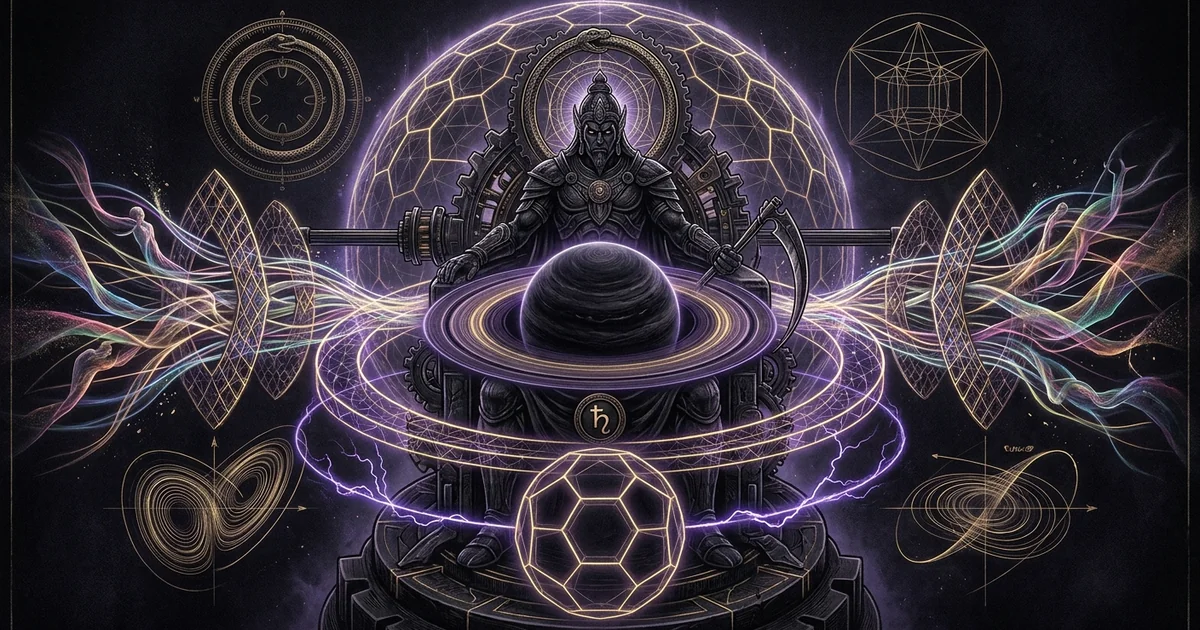
Shani: The Great Cosmic Karmic Disciplinarian Guide
Archetypal Thesis & Systemic Paradigm: Shani as the Cybernetic Regulator of Karma
In the algorithmic architecture of Vedic psycho-cosmology, Shani (Saturn) operates not as a malicious entity dealing out arbitrary cruelty, but as the supreme cybernetic regulator of the manifest cosmos. Where subjective human consciousness tends toward energetic dissipation, psychological inflation, and the illusion of unconstrained agency, Shani introduces structural friction, systemic inertia, and thermodynamic cooling. Within this framework, planetary configurations are deciphered as psycho-cosmological coordinate frameworks and state-space representations of consciousness.
The planet functions as a cosmic governor, stabilizing individual volition within the immutable boundaries of universal law. Understanding shani saturn vedic astrology karma discipline requires stripping the archetype of medieval superstitious fatalism and grasping its teleological function: the systemic calibration of the individual soul (Jiva) through the inescapable mechanics of structural reality.
The Thermodynamics of Planetary Influence: Cold, Dry, and Entropic Vectors
In classical Jyotish, Shani is classified as inherently cold (Shita) and dry (Ruksha), embodying the ultimate expression of the Vayu (air/wind) tattva in its desiccating, non-nourishing modality. This thermodynamic classification is precise in its psychological and metaphysical implications. Heat, governed by Surya (the Sun) and Mangala (Mars), corresponds to metabolic expansion, subjective will, vital narcissism, and radiant teleology.
Shani operates as the thermodynamic counter-vector: absolute zero, the withdrawal of kinetic excitation, and the imposition of entropic drag. By dampening vitality, Shani forces complex biological and psychological systems to confront their baseline efficiency. Under Shani’s influence, whatever is structurally redundant, energetically unsustainable, or psychically inflated collapses under its own weight.
This entropic vector enforces the conservation of energy across the trans-incarnational matrix. Just as the second law of thermodynamics dictates that isolated systems tend toward maximum disorder unless work is applied, Shani reveals that psychospiritual coherence cannot survive on aspirational fantasy alone. The cold, dry pressure of the Great Karmic Disciplinarian leaches out ungrounded optimism, compelling the conscious agent to expend rigorous, deliberate, and sustained spiritual labor (Tapas) to maintain organizational integrity against universal decay.
From Fate to Feedback: The Senex Principle in Jungian Transpersonal Psychology
Interpreted through analytical psychology, Shani represents the definitive celestial manifestation of the Jungian senex-archetype: the primordial Elder, the Hermit, the Architect, and the Keeper of the Threshold. The senex stands in permanent, necessary dialectic with the puer aeternus—the eternal youth who dreams of flight, infinite potential, and immunity from time. Left unchecked, the puer devolves into manic grandiosity, manic defense mechanisms, and spiritual bypassing. Shani, as senex, supplies the heavy ballast of reality, pulling the soaring psyche back down to earth.
“The Senex archetype is inherently bound to the experience of time, limit, and cosmic law. When unintegrated, it manifests psychically as paralyzing melancholy, calcified dogma, and absolute dread of mortality. Yet, when assimilated through conscious suffering, the Senex transforms into the foundation of wisdom—the inner master that recognizes limitation not as imprisonment, but as the necessary vessel for true individuation.” — Carl Gustav Jung, Collected Works, Vol. 8: Synchronicity: An Acausal Connecting Principle (with reference to Marie-Louise von Franz, Puer Aeternus)
When examined through the cybernetics of karmic law, Shani’s operational mechanics shift from punitive moralism to an impersonal negative feedback loop. In cybernetic systems, negative feedback arrests runaway deviation, returning an errant subsystem to homeostatic equilibrium.
Human consciousness, driven by Raga (attachment) and Dvesha (aversion), constantly overreaches, generating destabilizing oscillations in the cosmic web. Shani registers this deviation and applies compensatory resistance. The individual experiences this restorative friction subjectively as obstacle, delay, depression, or material scarcity. Objectively, however, it is nothing more than systemic homeostasis reasserting itself. The karmic reaper does not seek to crush the ego, but to force its maturation, trading fragile persona constructs for structural integrity.
The Dialectic of Solar Hubris (Surya) and Structural Grounding (Chhaya-putra)
The deep mythological lineage of Shani reflects this profound psycho-structural dynamic. As Chhaya-putra—the son of Surya (the solar deity) and Chhaya (the goddess of shadow)—Shani represents the structural counterweight to solar consciousness. Surya is the unmediated, blinding radiance of the transcendent Self, the divine spark of Ahankara (ego-identity), and the archetype of supreme sovereignty. Yet raw solar radiance without shadow produces psychological blindness, solipsistic hubris, and scorched earth.
Shani emerges from the shadow cast by the Sun’s own light. He is the sobering consequence of illumination, the physical body that light reveals, and the heavy, cooling earth that absorbs blinding heat. Surya represents the ideal; Shani represents the execution. Surya is the king; Shani is the peasant, the ascetic, and the magistrate.
The perpetual tension between Surya and Shani within a natal chart represents the existential dialectic between will and fate, vision and endurance, radiant self-expression and the hard, unyielding limits of social and physical reality. Mastery of this internal axis marks the transition from infantile spiritual claims to grounded psychological maturity. For an analysis of this structural tension, consult the Saturn Return and Archetypal Psychology framework.
Classical Provenance & Textual Lineage: The Shadow Son in Vedic Cosmogony
The position of Shani in the Vedic pantheon is distinguished by its judicial solemnity. Unlike planetary energies that offer divine grace (Kripa) or kinetic vitality (Virya), Shani occupies the throne of the Cosmic Magistrate (Nyayadheesha). This role was assigned to him within classical puranic cosmogony to deliver the precise fruits of past actions (Karmaphala), devoid of personal sentiment, mitigation, or prejudice.
The Mythological Vector: The Birth of Shani from Surya and Chhaya
Classical narratives preserved in the Skanda Purana and Saurapurana document that Sanjna, the daughter of the celestial architect Vishwakarma and consort of Surya, found the blazing brilliance of the Sun unbearable. To survive his proximity, she withdrew into the forest to perform austerities, leaving behind her living shadow double, Chhaya. From the union of the blinding Sun and this cool, dark shadow, Shani was conceived.
While carrying him, Chhaya engaged in intense devotional penance to Shiva, scorning the blistering sun, fasting, and absorbing profound meditative austerity. Consequently, Shani was born dark, cold, skeletal, and possessing a gaze so potent with concentrated ascetic heat (Tapas) that upon his birth, his single glance cast a eclipse over his father Surya, vitrified his chariot horses, and caused the sun god’s skin to break into lesions.
This allegorical narrative crystallizes the metaphysical mechanics of the planet. Born of asceticism and shadow, Shani possesses inherent mastery over Surya’s pride. He carries no illusions regarding material glory, for his very substance was forged in renunciation. He does not fear power; he measures it against eternity. The mythological rupture between Surya and Shani establishes that in the court of cosmic law, spiritual radiance and temporal rank grant no immunity from structural reality.
Canonical Scriptural Exegesis in Brihat Parashara Hora Shastra and Brihat Jataka
In canonical Jyotish literature, Shani’s structural and diagnostic significations (Karakatvas) are rigorously detailed. Rather than portraying a demonic caricature, classical masters isolated Shani’s qualitative nature as the deliverer of evolutionary friction, essential for preserving the cosmic web.
“अथ शनिस्वरूपम्: कृशदीर्घतनुः श्यामो मन्दाक्षः वातलोऽलसः। स्नायुप्रधानो धीमांश्च कुत्सितः खररोमवान्॥ शनिर्मन्दगतिः कृष्णः पृथुदन्तोऽतिदारुणः। वातात्मा पिशुनश्चैव मन्दबुद्धिः प्रवर्तते॥”
Translation: “Shani has an emaciated and tall body, dark complexion, honey-colored eyes, is of Vata (airy) constitution, possesses prominent veins and sinews, is slow-moving, has coarse hair, large teeth, and is severe and disciplined. He is indolent, sharp in systemic intellect, and governs the deep architecture of the bodily framework and the processes of systemic deceleration.”
Sage Parashara identifies Shani as the primary significator (Karaka) of:
- Ayus (lifespan, longevity)
- Dukkha (suffering, grief, systemic adversity)
- Mrityu (mortality, physical death)
- Jada (inertia, matter, calcification)
- Bhritya (servants, labor, the disenfranchised)
- Vairagya (non-attachment, renunciation, the ascetic impulse)
Varahamihira, writing in the foundational Brihat Jataka (Chapter 2), echoes this structural assessment, designating Shani as Manda (the slow one). He notes that when Shani’s planetary rays (Rashmis) are evaluated within the Shadbala framework, a dignified Saturn indicates an individual capable of enduring monumental deprivations to achieve unyielding structural, spiritual, or political mastery. The classical literature never treats Dukkha as an end in itself; it recognizes it as the essential friction through which raw consciousness (Citta) burns away residual karma, developing genuine Vairagya.
The Judicial Mandate: Shani’s Appointment as the Cosmic Magistrate (Dharmaraja / Nyayadheesha)
In the administrative distribution of cosmic portfolios, Surya is the King, Mangala the Commander, Brihaspati (Jupiter) the Minister and Priest, and Shani is the Magistrate and Enforcer of Justice in Jyotish (Nyayadheesha). This judicial mandate elevates Shani above standard moral judgments of “good” or “bad.”
Where Yama operates as the terminal judge of death who weighs the soul after life departs, Shani acts as the living judge of physical existence. He executes the disbursement of prarabdha-karma—that specific quantum of accumulated past-life debt (Sanchita Karma) that has ripened to precipitate into physical form in the current incarnation. Shani does not author karma; he merely measures it with cold, incorruptible precision. He functions as a mirror reflecting the unvarnished systemic consequences of every thought, word, and deed, ensuring the macrocosmic order balances its energetic books across centuries and lifetimes.
Structural Mechanics & Symbolic Geometry: Planetary Rays, Dignities, and Drishti
The operational execution of Shani within the horoscope relies on an intricate geometric architecture of positional dignities and planetary aspects (Drishti). Unlike other planets whose gaze is often interpreted through mutual resonance, Shani’s gaze is asymmetric, exacting, and structurally transformative.
Astronomical and Astrological Positional Mechanics: Exaltation in Thula, Debilitation in Mesha
Shani rules two adjacent signs of the natural zodiac (Kalapurusha):
- Makara (Capricorn): the 10th sign, representing the structural scaffolding of society, hierarchical authority, duty, and public legacy.
- Kumbha (Aquarius): the 11th sign, his Moolatrikona sign, representing collective networks, systemic systems architecture, universal ideals, and structural equanimity.
The nature of Shani’s justice is revealed in his points of exaltation and debilitation:
Exaltation in Thula (Libra - 20°)
- Cosmic Principle: Balanced Equilibrium and Systemic Harmony.
- Psychological Manifestation: Objective detachment, social equilibrium, structural consensus, and dispassionate justice.
- Operational Mechanics: Here, Shani’s cold, deliberate nature is elevated by Venusian diplomacy and balance. Justice ceases to be raw, punitive force; it becomes equitable distribution, legal exactitude, and non-narcissistic service.
Debilitation in Mesha (Aries - 20°)
- Cosmic Principle: Frustrated Impulsivity and Unregulated Will.
- Psychological Manifestation: Impatience, reactive tyranny, structural instability, and chronic frustration.
- Operational Mechanics: In the Martian sign of Aries, the fiery urge toward immediate, self-assertive kinetic action directly wars against Shani’s imperative for slow, deliberate, and delayed labor. The individual feels chronically hindered, erupting into bitter, counterproductive resistance.
This dichotomy confirms that supreme justice in Jyotish is not brute force, but calculated equilibrium, objective arbitration, and systemic balance, as detailed in our guide to planetary dignities in Vedic astrology.
The Geometry of Asymmetrical Gaze: The Special 3rd, 7th, and 10th Drishtis
While all Grahas cast a full aspect (Purna Drishti) upon the 7th house from their location, Shani exercises two unique, asymmetrical aspects: the 3rd house aspect and the 10th house aspect. These aspects operate as specialized functional vectors:
-
The 7th Drishti (The Mirror of Direct Confrontation):
Cast directly opposite his placement, this aspect subjects the opposing house, and any Grahas inhabiting it, to cold reality checks. It introduces delays, tests foundational resilience, and demands unyielding sobriety in whatever field of life it touches. -
The 3rd Drishti (The Vector of Labor and Friction):
The 3rd house represents manual effort, courage, sibling relationships, and kinetic output (Parakrama). When Shani casts his gaze three houses away, he imposes relentless manual effort, demanding grueling labor and exhausting iterations before yielding success. He denies sudden inspiration, demanding blood, sweat, and endurance. -
The 10th Drishti (The Vector of Structural Karma and Responsibility):
The 10th house represents career, public accountability, social legacy, and systemic impact. Shani’s 10th aspect places a heavy burden of responsibility upon the targeted house, forcing the native to bear heavy public or familial duties, undergo occupational trials, and submit their personal ambitions to systemic necessity.
Shani Placement (Base Engine)
   ├── [3rd Drishti]  ──> Enforces Kinetic Friction & Relentless Labor (Tapas)
   ├── [7th Drishti]  ──> Enforces Sober Confrontation & Foundational Testing
   └── [10th Drishti] ──> Enforces Structural Accountability & Heavy Duty
Through this tripartite gaze, a single placement of Shani simultaneously constrains and conditions four distinct houses in the natal chart, constructing a web of systemic tension designed to prevent psychic inflation across multiple domains.
The Epicycles of Sade Sati: The 7.5-Year Lunar Transit Matrix
Among Shani’s transit dynamics (Gochara), none occupies a more revered and feared place than sade-sati. This phenomenon occurs when transiting Shani moves through the 12th house from the natal Moon (Chandra), the house containing the natal Moon, and the 2nd house following it. Spanning roughly seven and a half years (approximately 2.5 years per house), Sade Sati is a psychospiritual initiation designed to recalibrate the native’s emotional core (Manas).
The Moon represents subjective perception, emotional security, biological comfort, and the maternal matrix. When Shani enters this proximity, he cools and condenses the mind’s emotional waters. For deep survival strategies on this transit, see the Sade Sati Survival Guide. The three phases unfold systematically:
- Phase 1 (The 12th House Ingress): Dissolves ungrounded illusions, forces subconscious confrontations, prompts isolation, and strips away external emotional supports.
- Phase 2 (The Conjunction): The psychological epicenter. Ahankara is compressed under raw existential weight. The native confronts mortality, identity crises, and emotional vulnerability directly.
- Phase 3 (The 2nd House Departure): Forces the stabilization of practical resources, financial realism, and restructured lineage values, cementing the hard-won lessons into permanent character armor.
Psychological Dynamics & Operational Praxis: Navigating Transits and Dashas
The lived experience of Saturnine periods—whether during a 19-year Shani mahadasha, a critical planetary sub-period (Antardasha), or a major transit—demands the systematic deconstruction of unintegrated ego structures.
The Deconstruction of Ahankara: Psychological Dissolution during Shani Mahadasha
During a Shani Mahadasha, the individual is systematically divested of whatever identity markers were built on ungrounded psychological projections. If one’s self-concept is founded on youth, physical vitality, unearned status, superficial charm, or material extravagance, Shani directly targets these brittle scaffolds.
This deconstruction manifests psychologically as an alchemical Nigredo—the dark, slow, putrefactive stage of the Great Work. The native experiences subjective anhedonia, intellectual lethargy, professional plateaus, and an overwhelming sense of cosmic inertia. Projects that once flourished through charismatic momentum ground to a halt; networking networks run cold; shortcuts collapse into dead ends.
This is the deliberate signature of the Great Karmic Disciplinarian. Shani arrests momentum to force internal introspection. By blocking outward expansion, he turns psychic libido inward, initiating the slow, agonizing calcification of genuine personal authority. What survives a Shani Mahadasha is structurally indestructible.
Sade Sati as Initiatory Crucible: Chronobiological Calibration and Somatic Symptoms
The friction of Sade Sati and Shani Dashas is not merely psychological; it writes itself directly into somatic and chronobiological structures. Because Shani governs the Asthi Dhatu (skeletal framework, teeth, and mineral structure) and exerts prime dominion over Vata Dosha within Ayurvedic physiology, Saturnine activations often manifest physically:
- Accelerated degradation of mineralized structures (joint pains, arthritis, dental issues).
- Chronic Vata aggravation (dryness of the skin, systemic dehydration, insomnia, nervous exhaustion).
- Somatized depressive states arising from diminished serotonin and dopamine response curves.
- Intense sensations of chronobiological acceleration—a somatic anxiety that time is slipping away, accompanied by acute grief over lost opportunities.
These somatic symptoms are somatopsychic catalysts: biological reminders of physical mortality. They shatter the unconscious illusion of physical permanence, forcing the individual into embodied responsibility, clean lifestyle architecture, and sober self-preservation.
- Biological Tissue (Dhatu): Asthi (Bones, skeletal system, joints, teeth) & Majja (Nervous system matrix via Vata).
- Physiological Vector: Vata Dosha (Cold, dry, light, rough, moving principle; chronic depletion).
- Metal: Iron / Black Iron (Dense, magnetic, base, structurally load-bearing).
- Planetary Day: Saturday (Shanivar).
- Direction: West (Pashchima - the place of sunset, darkness, and completion).
- Gemstone: Neelam (Blue Sapphire - intense, unyielding light; tests purity of psychic intention).
- Sacred Tree / Flora: Shami (Prosopis cineraria), Sesame (Tila), Mustard (Sarshapa).
- Color Resonance: Deep Black, Charcoal, Indigo, Midnight Blue.
Remedial Architecture: Upayas, Tapasya, and the Ethics of Conscious Renunciation
True classical remediation (Upayas) in Jyotish is not magical placation or cosmic bribery; it is cognitive-behavioral realignment, voluntary asceticism (Tapasya), and conscious debt settlement. Attempting to “bribe” Shani through ostentatious rituals while maintaining ethical blindness only invites deeper judicial retribution.
Effective remediation operates through sympathetic resonance and behavioral alignment:
-
Voluntary Austerity (Tapasya):
Voluntarily embracing discomfort—fasting on Saturdays, cultivating solitary silence, establishing disciplined routines, and eliminating sensory overindulgence. By voluntarily embracing containment, one preempts the systemic necessity for Shani to impose it externally. -
Seva to the Marginalized:
Shani rules the disenfranchised, the aged, the destitute, physical laborers, and the outcasts of society. Direct, unglamorous physical service to these populations balances the karmic ledger. This requires practical assistance: feeding the hungry, tending to the sick, and cleaning dirty, ignored spaces. -
The Cultivation of Vairagya (Non-Attachment):
Intellectual non-attachment is a defense mechanism; true Vairagya is emotional and behavioral sovereignty. It is the capacity to remain steady amid gain and loss, praise and blame, realizing that all forms in the material world are subject to time, decay, and dissolution.
Comparative Cosmologies: Shani and the Western Hermetic Saturn
Juxtaposing Vedic Shani with the Western Hermetic and Hellenistic traditions reveals deep archetypal convergence alongside vital philosophical divergence.
Vedic Shani versus Classical Kronos/Saturn: Retributive Fate versus Systemic Duty
In Hellenistic and Greco-Roman mythology, Kronos/Saturn is fundamentally tragic, paranoid, and devouring. Driven by the prophecy that his own offspring would overthrow him, Kronos devours his children—an archetype of devouring time, parental jealousy, and blind material tyranny. In classical Western astrology, Saturn was historically designated as the Infortuna Major (The Greater Malefic), an agent of scarcity, freezing cold, poverty, and mortality that crushes human aspiration without clear philosophical purpose.
Vedic Jyotish reframes this archetype entirely. Shani does not devour his children out of fear; he disciplines them out of systemic necessity. Shani is not blind retributive fate (Ananke), but Dharma in its structural mode. He operates under the doctrine of Samsara and Moksha, where material limitation is the essential schoolhouse for evolutionary liberation. In the Vedic framework, Shani’s discipline is inherently compassionate, though his methods are severe: he destroys only what is illusory, unsustainable, or corrupt, so that the indestructible Self (Atman) may emerge unencumbered.
Binah in the Qabalistic Tree of Life: Form, Severity, and the Womb of Cosmic Law
Within the Hermetic Qabalah, Saturn is attributed to the 3rd Sephirah on the Tree of Life: Binah (Understanding). Positioned at the apex of the Pillar of Severity (Boaz), above the Abyss, Binah is known as the Great Mother (Ama), the cosmic loom that weaves form out of the undifferentiated force of Chokmah (Wisdom).
This structural correspondence reveals a foundational Hermetic axiom: Form is limitation. Raw, infinite light cannot be comprehended, experienced, or differentiated without a boundary. Binah/Saturn provides that boundary. It is the womb that gives birth to concrete manifestation, but that very act of limitation is also the introduction of time, aging, mortality, and death. Binah is the primordial matrix of cosmic law, establishing the exact rules of weight, measure, and number through which the universe exists.
Shani occupies precisely this position in the Vedic schema: he is the dark, structural womb that condenses solar intention into tangible, physical, and time-bound consequence.
The Alchemy of Melancholia: Converting Lead into the Gold of Individuation
In the Hermetic alchemical tradition, Saturn is intimately correlated with the base metal Lead (Plumbum), the melancholic humor (Melancholia), and the initial stage of the Opus Magnum: the Nigredo (the blackening).
Lead is dense, heavy, poisonous, and structurally protective; it absorbs radiation and resists corrosion, yet lacks light. The core axiom of spiritual alchemy—Aurum Nostrum Non Est Aurum Vulgi (“Our gold is not the common gold”)—proclaims that the gold of spiritual realization is not found in untroubled happiness, but must be laboriously extracted from the black, heavy lead of Saturnian suffering.
The profound introspective melancholy brought by Saturnine pressure turns the soul’s gaze inward. The leaden weight of depression and despair forces the seeker to abandon superficial social diversions and construct an inner philosophical center. Individuation demands that one pass through this leaden crucible; no soul attains alchemical gold without first drinking the melancholic medicine of Shani.
Philosophical Synthesis & Macrocosmic Correspondence: The Metaphysics of Limitation
Moving beyond psychological and astrological operations brings us to the metaphysical foundation of the Saturnine archetype: the absolute structural necessity of ontological limitation.
The Conservation of Karmic Momentum in Transpersonal State-Space
Within transpersonal cosmology, the universe can be mapped as an infinite-dimensional state-space where consciousness interacts with material reality. Every conscious or unconscious act (Kriyamana Karma) injects a vector of force into this field. If these forces operated without a systemic balancing mechanism, the fabric of manifest reality would disintegrate into entropic noise.
Shani embodies the Law of Conservation of Karmic Momentum. No energetic action is lost; no unresolved psychological projection dissipates into thin air. Every volitional output generates an equivalent structural debt that must be resolved within the coordinates of time (Kala) and space (Desha).
The Karmic Disciplinarian operates as the universal ledger, holding this momentum across multiple trans-incarnational loops. When an individual meets an inexplicable obstacle or structural failure in this life, it is not bad luck; it is an ungrounded past-life momentum meeting its equal and opposite balancing force in Shani’s cosmic ledger.
Limitation as the Crucible of Form: Hermetic Axioms of Weight and Measure
Cosmic design relies on containment. A poem requires the constraints of meter and syntax to achieve aesthetic resonance; a river requires hard granite banks to build hydrodynamic power, without which it degenerates into a directionless swamp; a biological cell requires a semi-permeable membrane to sustain life against external entropy.
Limitation is not an ontological failure of the universe; it is the fundamental condition for manifest existence. Shani represents these structural boundary conditions. By setting bounds on human lifespan, physical endurance, material resources, and emotional indulgences, Shani forces consciousness to concentrate its intentions. Limitation generates pressure; pressure creates density; density, under prolonged heat, transforms carbon into diamond. Without Shani’s containment, consciousness remains a diffuse, unintegrated mist.
The Transmutation of Suffering into Spiritual Resilience (Moksha-Marga)
In the final reckoning of the four classical human pursuits (Purusharthas):
- Dharma (duty/righteousness)
- Artha (wealth/security)
- Kama (pleasure/desire)
- Moksha (spiritual liberation)
Shani serves as the bridge between Dharma and Moksha. He begins by systematically crushing Kama (hedonistic indulgence), demonstrating the transience of all sensual pleasure. He proceeds to test Artha (material accumulation), proving that worldly wealth cannot stay the hand of time. Having exhausted these two realms, Shani leaves the individual with only two functional options: strict adherence to Dharma (duty for its own sake, without attachment to fruits) or the pursuit of Moksha (transcendental liberation from the Wheel of Samsara).
This structural dynamic redefines suffering (Dukkha). Suffering is not an end; it is an initiatory solvent. It burns away trivial identifications, breaks open the hardened shell of the ego, and awakens an unyielding thirst for transcendental truth. In this capacity, Shani stands revealed as the profound friend of the spiritual aspirant—the master who closes every false exit until only the path of real liberation remains.
Frequently Asked Questions: Demystifying Shani and Karmic Transits
Is Sade Sati Invariably Catastrophic for Natal Chart Realization?
No. The assumption that Sade Sati brings universal destruction is an ungrounded astrological myth. Sade Sati is a period of intense structural reckoning and psychic auditing, not indiscriminate ruin.
For individuals running favorable Dashas, with a well-placed natal Moon and a dignified Saturn (such as Shani in Libra, Capricorn, or Aquarius), Sade Sati frequently marks the period of their greatest career elevations, professional stabilization, and lasting societal achievements. What Sade Sati consistently destroys are ungrounded ventures, fraudulent claims, unintegrated ego structures, and lifestyle patterns detached from structural reality. If an individual aligns with discipline, humility, and relentless hard work, Sade Sati can serve as the unshakeable foundation of lifelong authority.
How Does Shani Function in Positive Dignity (Tula and Makara/Kumbha)?
When Shani occupies his signs of dignity—exalted in Tula (Libra), or in his own signs of Makara (Capricorn) and Kumbha (Aquarius)—he forms the revered Sasa Yoga, one of the five Mahapurusha Yogas (planetary combinations of greatness).
In these placements, Shani’s energy expresses its highest structural architecture:
- Deep, unyielding patience, stoic endurance, and unmatched organizational competence.
- The capacity to direct large scale social, political, or material infrastructures with dispassionate equity.
- An objective, crystalline intellect free from narcissistic bias, capable of managing heavy public responsibilities.
- The development of mature, authentic non-attachment (Vairagya), wherein the individual works tirelessly for collective welfare without clinging to personal praise.
Can Ritual Upayas Alter Immutable Karma (Prarabdha Karma)?
Classical Vedic philosophy categorizes karma into distinct operational degrees of fixity:
- Dridha Karma (fixed, immutable debt): virtually impossible to modify through human intervention; it must be directly experienced and exhausted through physical reality.
- Dridha-Adridha Karma (semi-fixed debt): can be mitigated or altered through extraordinary spiritual effort, intense penance (Tapas), and targeted remediation.
- Adridha Karma (non-fixed debt): easily resolved through awareness, conscious behavioral shifts, and devotional remedies.
Ritual Upayas (such as mantra recitation, charitable service, and fasting) rarely erase Dridha Prarabdha Karma. What Upayas accomplish is a fundamental transformation of the observer’s psychological state. By voluntarily aligning consciousness with the frequency of Shani (through humility, silence, and service), the native ceases their reactive internal war against external circumstance.
The heavy, punishing blow that would have cracked a brittle, resistant ego is transformed into a clean, conscious clearing of karmic debt. The event may still unfold materially, but its capacity to inflict psychic suffering is transmuted into stoic wisdom.
What Distinguishes Shani’s Karmic Lessons from Rahu and Ketu’s Nodal Axials?
While Shani, Rahu, and Ketu constitute the great karmic triumvirate in Jyotish, their operational mechanics are fundamentally distinct:
- Shani works through linear time, matter, systemic delay, and physical consequence. He is the architect of classical cause and effect. His lessons are slow, tangible, pedagogical, and embodied. He demands work, duty, and compliance with reality.
- Rahu (the North Node) operates through amplification, obsession, psychic illusion (Maya), and unconventional disruption. Rahu is explosive, accelerated, and insatiable, thrusting the soul into foreign territories and high-stakes karmic experiments to rapidly exhaust worldly desire.
- Ketu (the South Node) operates through subtraction, sudden severing, dissolution, and psychic vacuum. Ketu does not delay like Saturn; he amputates. He forces detachment by abruptly removing material anchors, pulling the soul toward unmediated spiritual transcendence.
Where Rahu inflates desire and Ketu dissolves attachment, Shani stabilizes the balance sheet: testing every step through the cold, unyielding reality of space, time, and physical consequence.