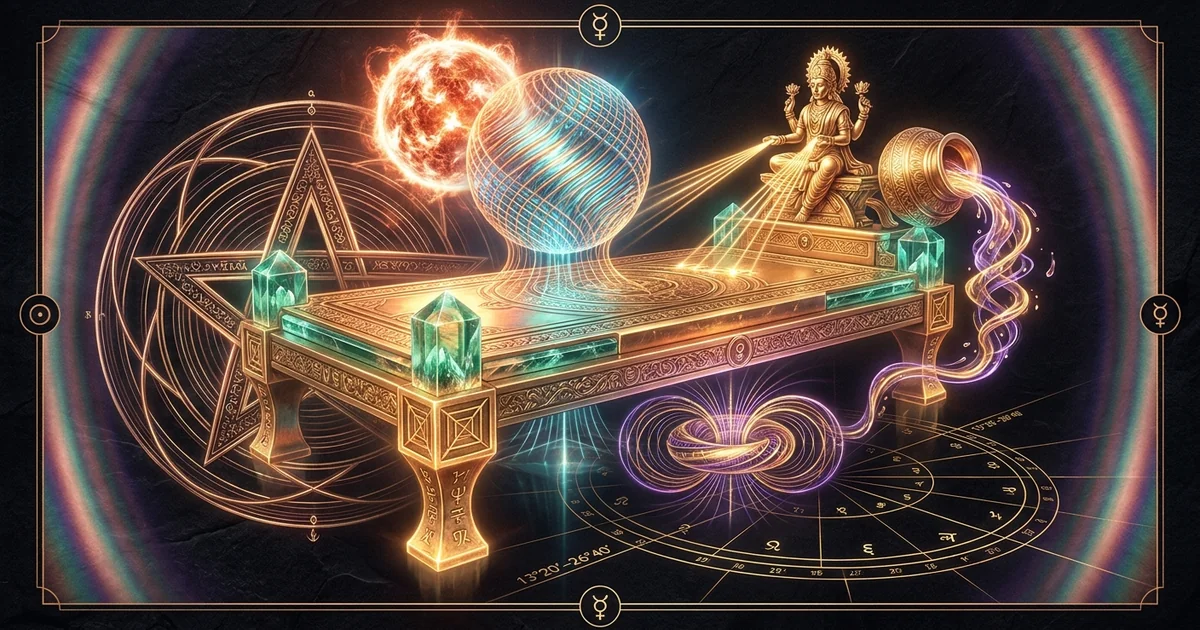
Nakshatra Purva Phalguni: Sacred Vedic Lunar Mansion
Archetypal Thesis & Systemic Paradigm: The Metaphysics of Bhaga and Creative Rest
Within the architectural geometry of the sidereal zodiac, the lunar mansion of Purva Phalguni occupies an essential nexus between individual sovereignty and collective communion. Spanning from 13°20’ to 26°40’ Simha (Leo), this asterism represents an evolutionary threshold where the raw, autocratic self-assertion of solar consciousness undergoes an aesthetic and relational refinement. While exoteric astrological manuals frequently reduce this sector to an uncritical signifier of pleasure, carnal indulgence, and domestic relaxation, a rigorous psycho-cosmological deconstruction reveals a far more complex dynamic. Purva Phalguni is the archetypal state-space of primordial creative incubation, aesthetic fruition, and redistributive fortune. It operates not as a site of passive, undisciplined hedonism, but as a deliberate thermodynamic pause within consciousness—a space wherein the friction of individuation resolves into the cohesive harmony of shared experience.
+-------------------------------------------------------------------------+
|                        PURVA PHALGUNI NAKSHATRA                         |
|               "The Front Red One" / "The Former Auspicious"             |
+------------------------------------+------------------------------------+
| Astronomical Span                  | 13°20' to 26°40' Simha (Leo)       |
| Presiding Deity                    | Bhaga (Aditya of Fortune & Delight)|
| Nakshatra Ruler (Vimshottari)      | Shukra (Venus)                     |
| Sign Lord (Rashi)                  | Surya (The Sun)                    |
| Primary Symbol                     | Hammock / Couch Legs (Khatva)      |
| Operative Shakti                   | Prajanana Shakti (Power of Union)  |
| Guna & Tattva Matrix               | Rajas-Rajas-Tamas / Fire & Water   |
+------------------------------------+------------------------------------+
The Dialectic of Solar Will and Venusian Receptivity in the Leo Vector
The core mechanical tension governing Purva Phalguni arises from the structural convergence of its overarching rashi ruler, Surya (the Sun), with its specific nakshatra lord, Shukra (Venus). In standard planetary taxonomy, these two grahas maintain a relationship of mutual ideological friction: Surya represents the undifferentiated, radiant Atman, the monarchical ego, centralizing authority, and austere masculine Tejas (fiery brilliance), whereas Shukra represents Kama (desire), aesthetic discrimination, somatic immersion, and the receptive, cohesive Jala (water) of the feminine unconscious. Purva Phalguni forces this divergent pair into an intimate synthesis.
Within this sidereal sector, the Leo impulse—which in its initial emergence through the preceding asterism of Nakshatra Magha was anchored in ancestral authority, royal lineage, and vertical patriarchal hierarchy—encounters a horizontal imperative. The monad recognizes that unshared sovereignty inevitably calcifies into isolation. To fulfill its evolutionary purpose, solar power must manifest beauty; it must descend from the lonely heights of the throne and enter the salon, the bedchamber, and the communal sanctuary. The solar will (Surya) willingly yields its absolute self-referentiality to the Venusian principle of relational resonance. This produces a psychological temperament that does not command respect through raw coercion, but seduces reality through magnanimity, charm, and theatrical generosity.
Bhaga as the Archetype of Equitable Distribution and Hedonic Equilibrium
The theological and psycho-spiritual engine of Purva Phalguni is its presiding divinity, Bhaga, one of the twelve Vedic Adityas (solar deities sprung from the cosmic mother, Aditi). In traditional Vedic exegesis, Bhaga is fundamentally distinct from the solar forces of blazing light (Savitar) or sovereign order (Varuna). Bhaga signifies the “lawful share,” the rightful portion of inherited wealth, agricultural bounty, and divine grace apportioned to every sentient entity within the cosmic order. The Sanskrit root bhaj- signifies to distribute, allocate, enjoy, or share; from this root emerges both Bhaga (the distributor of fortune) and Bhagavan (the possessor of auspicious attributes).
[ ADITI ]
                                    |
                           (Cosmic Matrix)
                                    |
           +------------------------+------------------------+
           |                                                 |
       [ SURYA ]                                         [ BHAGA ]
  Absolute Radiance /                               Allocated Share /
  Centralizing Monad                                Divine Inheritance
           |                                                 |
           +------------------------+------------------------+
                                    |
                        [ PURVA PHALGUNI FIELD ]
                   Solar Splendor Modulated by the
                     Distribution of Auspiciousness
In the context of the purva phalguni nakshatra vedic astrology meaning, the presence of Bhaga prevents the pursuit of delight from deteriorating into nihilistic gluttony. Bhaga represents the principle of cosmic fairness in the dispensation of earthly joy. He guarantees that sensory pleasure, romantic alliance, and material comfort are not moral sins to be castigated, but the legitimate karmic inheritance (bhagya) earned by the soul across cycles of embodiment. Bhaga governs the sanctified distribution of soma, marital harmony, and the celebration of life’s abundance. He demands an equanimous relationship with pleasure: delight must be experienced without neurotic clinging, and prosperity must circulate organically through social networks rather than be hoarded behind the ramparts of an insecure ego. When consciousness attunes to Bhaga, anxiety regarding scarcity dissolves, permitting a state of authentic hedonic equilibrium.
The Thermodynamic Meaning of the Hammock / Couch Symbol
The primary hieroglyphic representation of Purva Phalguni is the khatva, specifically visualized as a swinging hammock, a resting couch, or the two front legs of a marriage bed. Superficial delineations interpret this iconography as an endorsement of sloth, sexual preoccupation, or mundane luxury. However, viewed through the lens of esoteric thermodynamics and archetypal depth psychology, the hammock or couch symbol models a profound phase shift in psychic energy. The couch denotes Nidra—not the unconscious stupor of ignorance (Ajnana), but the deliberate, restorative suspension of externalized kinetic effort.
“Bhāgo ha havir a-bhūd yajñasya prathamaḥ purogāḥ | pūrve phālgunī upa yātu devī | svasti no yajamānāya dhātu || Bhaga has become the oblation, the primal leader of the sacrifice. May the divine Purva Phalguni approach us favorably; may she confer auspicious well-being and fortune upon the celebrant of the ritual.”
Thermodynamically, an open system cannot maintain perpetual caloric expenditure without experiencing systemic collapse through entropy. The martial and ancestral striving of the preceding asterisms requires a stage of metabolic consolidation. The hammock is suspended above the earthly ground, detached from immediate gravitational exertion, swaying in rhythmic resonance with the subtle currents of the atmospheric element (Vayu). It represents the gestation of the creative seed. Just as physical sleep facilitates biological cellular repair and unconscious cognitive integration, the resting couch of Purva Phalguni provides the ego with an entropic sanctuary. Here, the creative unconscious incubates ideas, visions, and artistic masterpieces away from the glaring demands of pragmatic utility. It signifies an intentional phase of receptivity, affirming that non-action (wu wei) is the necessary structural precursor to enduring manifestation.
Classical Provenance & Textual Lineage: From Rigvedic Solar Hymns to Jyotish Canons
The structural integrity of Purva Phalguni is rooted in foundational Vedic literature, developing through canonical astronomical and predictive treatises into the classical Jyotish system. To grasp the mechanics of this lunar mansion, one must trace its conceptual emergence from the liturgical invocations of the Rigveda down to the rigorous mathematical and delineative treatises of Maharishi Parashara and Varahamihira.
       [ Rigveda VII.41 ]
       (The Bhagasukta: Invocations of the Dispenser of Grace)
               │
               ▼
   [ Taittiriya Brahmana III.1.1 ]
   (Astrological Cosmography: Prajanana Shakti Assigned)
               │
               ▼
 [ Brihat Samhita & BPHS (6th c. CE) ]
 (Codification of Physical, Psychological, & Natal Mechanics)
The Vedic Aditya Lineage: Bhaga’s Solar Emergence in the Rigveda and Taittiriya Texts
In the ancient hymns of the Rigveda, specifically within the celebrated Bhagasūkta (RV VII.41), the divinity Bhaga is repeatedly implored alongside Mitra, Varuna, and Aryaman as the cosmic bringer of morning prosperity and sovereign vitality. The Vedic rishis recognized that the dawn does not simply cast light; it distributes opportunity, biological nourishment, and the immediate impetus for social engagement:
Prātara jitāṃ bhagamugraṃ huvema vayaṃ putra maditer yo vidhartā
“In the early morning we invoke the conqueror, the fierce Bhaga, the son of Aditi, who is the sustainer of the world, upon whom the destitute, the grandee, and even the king call, saying: ‘May I obtain Bhaga.’” (RV VII.41.2)
The Taittiriya Brahmana directly links this luminous distributor to the Purva Phalguni asterism, defining its cosmic function as the awakening of shared abundance and the formalization of generative unions. It is within these archaic liturgical boundaries that the asterism is first formally recognized as a planetary coordinate where the gods apportion divine favor to humanity. The text assigns to Purva Phalguni the unique power to attract communal grace, establishing that any enterprise initiated under this celestial mansion participates in the sacred duty of mutual celebration and collective harmony.
Codifications in Parashara’s Brihat Parasara Hora Sastra and Varahamihira’s Brihat Samhita
As the observational and liturgical cosmography of the Vedas crystallized into the predictive framework of classical Jyotish, the masters of the classical era integrated these archetypal concepts into practical natal analysis. In the Brihat Parasara Hora Sastra (BPHS), Maharishi Parashara explicitly categorizes Purva Phalguni under the divine rulership of Bhaga and the planetary stewardship of Shukra (Venus). Parashara emphasizes that this nakshatra partakes fundamentally of the rajoguna (the quality of dynamism, passionate attachment, and creative generation) across all three systemic tiers of its internal constitution: primary, secondary, and tertiary. This pure, unmitigated triplicity of Rajas renders the asterism uniquely volatile, extraordinarily creative, and deeply enmeshed in the sensory fabric of material reality.
+-------------------------------------------------------------+
|               PURVA PHALGUNI GUNA STRATIFICATION            |
+----------------------+--------------------------------------+
| Primary Guna Level   | Rajas (Dynamic Activation / Desire)  |
| Secondary Guna Level | Rajas (Somatic & Aesthetic Output)   |
| Tertiary Guna Level  | Tamas (Material Fixation / Form)     |
+----------------------+--------------------------------------+
In Chapter 15 of the Brihat Samhita, the polymath Varahamihira delineates the sociological and somatic manifestations of this nakshatra. He records that souls born with the Moon or the Ascendant in Purva Phalguni are characterized by priyamvada (sweetness of speech), an inherent generosity of spirit, an inclination toward restless mobility or wandering (atana), and an irresistible attraction to the fine arts, performance, and the courts of political or aristocratic authority. Varahamihira categorizes Purva Phalguni as an Ugra (fierce, aggressive, or severe) asterism. This functional classification often perplexes modern practitioners who expect a Venus-ruled mansion to be gentle (Mridu). The classical assignment of Ugra highlights the unapologetic intensity of desire. The procreative and artistic drives governed by Purva Phalguni are not passive; they act as compelling forces that rupture complacency, initiate sexual pairing, dissolve celibate restraint, and boldly conquer the material plane through the exercise of aesthetic charisma.
The Paired Asterisms: Purva and Uttara Phalguni as the Two Halves of Cosmic Maturity
Purva Phalguni does not exist in isolation; it forms the introductory phase of an integrated dual asterism known historically as the Phalgunis. The two Phalguni mansions constitute a contiguous cosmological arc spanning from 13°20’ Leo to 10°00’ Virgo, collectively depicted as the four legs of a grand couch or bed.
Purva Phalguni (The Former Auspicious)
- Presiding Deity: Bhaga (Aditya of Fortune & Delight)
- Planetary Lord: Shukra (Venus)
- Symbolic Component: The two front legs of the couch / The swinging hammock
- Cosmic Mandate: Individual sensory experience, creative germination, romance, and the spontaneous subjective consumption of fortune.
- Orientation: Inward and interpersonal; represents the creative spark, dynamic attraction, and the initial bliss of romantic or artistic conception.
Uttara Phalguni (The Latter Auspicious)
- Presiding Deity: Aryaman (Aditya of Chivalry & Compacts)
- Planetary Lord: Surya (The Sun)
- Symbolic Component: The two rear legs of the couch / The enduring bedstead
- Cosmic Mandate: Social contracts, systemic philanthropy, institutionalized marriage, and the objective structural governance of fortune.
- Orientation: Outward and societal; represents societal stabilization, contractual longevity, and the ethical integration of the individual into the macrocosm.
Purva Phalguni generates the kinetic, romantic, and aesthetic vitality that makes life worth living; Nakshatra Uttara Phalguni then builds the structural, ethical, and civic institutions required to preserve that vitality across generational time. The former is the ecstatic feast; the latter is the enduring legal covenant that protects the banquet hall. Understanding this architectural dichotomy is essential for diagnosing systemic blockages in the 27 nakshatras jyotish paradigm. Without Purva’s sensory enthusiasm, Uttara’s institutional structures remain sterile and cold; without Uttara’s sober responsibility, Purva’s revelry collapses into hedonic exhaustion.
Structural Mechanics & Symbolic Geometry: Padas, Planetary Dignities, and Navamsha Sub-States
To map Purva Phalguni with technical accuracy, the metaphysical investigator must dismantle its overarching zodiacal field into its component mathematical sub-states. Astrological mechanics operates through nested dimensional fractal frameworks, where the macro-rashi sign is systematically modulated by the micro-navamsha divisions.
13°20' Leo                                                     26°40' Leo
[------------------------------ PURVA PHALGUNI -----------------------------]
|      Pada 1      |      Pada 2      |      Pada 3      |      Pada 4      |
|  13°20' - 16°40' |  16°40' - 20°00' |  20°00' - 23°20' |  23°20' - 26°40' |
|   Leo Navamsha   |  Virgo Navamsha  |  Libra Navamsha  | Scorpio Navamsha |
|    Vargottama    |  Discrimination  | Pushkara Navamsha| Occult Intensity |
|   (Solar-Solar)  |  (Solar-Mercury) |   (Solar-Venus)  |   (Solar-Mars)   |
+------------------+------------------+------------------+------------------+
Zodiacal Architecture: The 13°20’ to 26°40’ Simha Ingress and Decan Intersections
Occupying the central core of the fixed fire sign of Simha (Leo), Purva Phalguni bridges the second and third decanates (drekkana) of the solar domain. The initial portion of the asterism (up to 20°00’ Simha) resides in the second decanate, classically co-ruled by Jupiter (representing the Sagittarius decan), infusing this segment with philosophical optimism, dramatic pageantry, and expansive generosity. The final segment (from 20°00’ to 26°40’ Simha) falls into the third decanate, governed by Mars (representing the Aries decan), which injects an underlying current of kinetic urgency, competitive pride, and fierce passions into the naturally refined Venusian environment.
The elements of fire (Tejas) and water (Jala) are held in constant, dynamic interaction throughout this span. Leo’s raw, dry, radiating heat is continually cooled, softened, and challenged by the humid, fertilizing, cohesive waters of Venusian desire. This dual-elemental friction generates a psycho-cosmic mist—an atmospheric condition optimal for the flourishing of drama, expressive art, theatrical vulnerability, and sexual tension.
Micro-Dimensional Decomposition: The Four Padas (Leo, Virgo, Libra, Scorpio)
The four padas (quarters) of Purva Phalguni represent a ninety-degree journey through four distinct navamsha realities, dictating the evolutionary maturation of the soul’s desires:
-
Pada 1 (13°20’ to 16°40’ Simha – Leo Navamsha): The Monarchical Artist. Falling into its own sign, this pada is Vargottama, imbuing any occupying graha with exceptional stability, structural dignity, and concentrated willpower. Here, the solar-Venusian friction leans heavily toward the solar matrix. The native possesses an unshakeable sense of destiny, immense self-respect, and regal charisma. The creative output is dramatic, bold, and unapologetically self-expressive. If afflicted, however, this pada can manifest as an insufferable narcissism that demands adoration without reciprocating affection.
-
Pada 2 (16°40’ to 20°00’ Simha – Virgo Navamsha): The Critical Craftsman. Governed by Budha (Mercury), this pada forces the radiant indulgence of the nakshatra through the analytical prism of the sixth sign. The expansive, pleasure-seeking impulse is here constrained by an acute awareness of technique, utility, and somatic health. This creates the quintessential perfectionist in the arts: the musician who practices scales with relentless discipline, or the designer obsessed with geometric precision. The shadow of this pada manifests as somatic hypochondria, nervous digestion, or a cynical critique of the very romantic ideals the native longs to embrace.
-
Pada 3 (20°00’ to 23°20’ Simha – Libra Navamsha): The Sublime Diplomat. Governed by Shukra (Venus) in its own sign of rulership, this pada marks a critical energetic crescendo: it is a Pushkara Navamsha, an exceptionally auspicious micro-segment capable of healing, elevating, and harmonizing the most troubled planetary energies. Here, the Venusian element reigns supreme, effortlessly softening the severe pride of the Leo rashi. Natives with placements in this pada embody pure social grace, diplomatic genius, refined aesthetic perception, and an intuitive capacity for romantic connection. It facilitates the highest manifestations of relational wealth, harmonious partnerships, and sublime artistic creation.
-
Pada 4 (23°20’ to 26°40’ Simha – Scorpio Navamsha): The Tantric Alchemist. Governed by Mangala (Mars), this pada exposes the raw, volcanic undercurrent beneath Purva Phalguni’s polished surface. The pursuit of pleasure descends into the psychological depths of taboo, emotional intensity, sexual possession, and transformative crisis. The superficial enjoyment of Bhaga transforms into an uncompromising confrontation with mortality, intimacy, and the shadow side of desire. Placements here grant deep psychological insight, occult acumen, and profound healing power, but may exact a heavy emotional toll through turbulent attachments and jealousy before the self attains inner peace.
- Longitudinal Range: 133°20’ to 146°40’ of the absolute sidereal zodiac.
- Padas & Navamshas: Pada 1 (Leo/Vargottama), Pada 2 (Virgo), Pada 3 (Libra/Pushkara Navamsha), Pada 4 (Scorpio).
- Core Shakti: Prajanana Shakti (The generative power of union, conception, and social reproduction).
- Tattva Matrix: The overarching structural Tattva is Tejas (Fire), animated internally by the circulating moisture of Jala (Water) and the expanding breadth of Vayu (Air).
- Animal Totem: The Female Rat (Mushika), denoting persistence, hidden resourcefulness, nocturnal intelligence, and an instinct for material security.
+-----------------------------------------------------------------------------------------+
|                              PURVA PHALGUNI PADA BREAKDOWN                              |
+------+-----------------+------------------+---------+-------------------+---------------+
| Pada | Sidereal Span   | Navamsha Sign    | Ruler   | Dimensional Theme | Class         |
+------+-----------------+------------------+---------+-------------------+---------------+
| 1    | 13°20' - 16°40' | Simha (Leo)      | Surya   | Royal Magnificence| Vargottama    |
| 2    | 16°40' - 20°00' | Kanya (Virgo)    | Budha   | Somatic Precision | Technical     |
| 3    | 20°00' - 23°20' | Tula (Libra)     | Shukra  | Harmonic Balance  | Pushkara Nav. |
| 4    | 23°20' - 26°40' | Vrischika (Scorp)| Mangala | Tantric Intensity | Transformative|
+------+-----------------+------------------+---------+-------------------+---------------+
Planetary Rulership Matrices: Shukra as Vimshottari Lord within Surya’s Solar Citadel
The developmental architecture of Purva Phalguni within the 120-year Vimshottari dasha framework requires careful diagnostic attention. As an asterism ruled by Shukra, an individual born with the Moon positioned within this mansion commences physical existence under the direct governance of the Venusian cycle. This early-life immersion in the energetic field of Shukra establishes a core psychological baseline anchored in the search for aesthetic resonance, validation, affection, and comfort.
However, because this Venusian cycle unfolds entirely within the boundaries of Surya’s citadel (Simha), the emerging consciousness is prevented from existing in uncritical passivity. The external environment repeatedly demands that the child prove their worth, demonstrate personal sovereignty, and command attention.
When an individual subsequently encounters the Vimshottari Dasha or Antardasha of a planet placed in Purva Phalguni later in life, an identical dynamic activates: the native is summoned to resolve the apparent contradiction between self-absorbed pride (Surya) and surrender to the beloved (Shukra).
Planets positioned here are subjected to the Prajanana Shakti—the procreative, fruit-bearing power of the asterism. Beneficial planets (Shubha Grahas) such as Jupiter or Mercury flourish here, generating literary elegance, high social capital, and generous financial windfalls.
Conversely, malefic planets (Krura Grahas) like Saturn or Rahu struggle against the pleasure-seeking, luxurious atmosphere of the mansion. Saturn here can feel like a grim ascetic forced into a glittering ballroom, producing profound social anxiety, defensive arrogance, or an inability to access genuine joy; Rahu amplifies insatiable desires for luxury, theatrical fame, and compulsive romantic entanglements.
Psychological Dynamics & Operational Praxis: The Individuation of Eros and Hedonic Shadows
Approached through the framework of depth psychology and operational clinical practice, Purva Phalguni acts as a psycho-cosmological coordinate for the integration of the personal Eros. In a cultural paradigm often poisoned by Puritanical guilt on one side and predatory consumerist hedonism on the other, this lunar mansion preserves an ancient, integrated psychology of sanctified delight.
Jungian Archetypal Dynamics: Eros, the Anima/Animus Projection, and Narcissistic Inflation
In Jungian psychology, the maturation of the human personality hinges on the conscious differentiation and integration of the contra-sexual archetypes: the Anima in man and the Animus in woman. Purva Phalguni, occupying the heart of the solar-individualized fifth house of the natural zodiac (Kalapurusha), represents the dynamic arena where these inner images are intensely projected onto the outer world through the medium of romantic enchantment.
[ THE EGO ]
                               (Solar Center)
                                     │
                          Projected Dynamic Arc
                                     ▼
                              [ ANIMA/ANIMUS ]
                         (Venusian Counter-Pole)
                                     │
           ┌─────────────────────────┴─────────────────────────┐
           ▼                                                   ▼
    [ LIGHT ASPECT ]                                    [ SHADOW ASPECT ]
  Conscious Coniunctio:                               Narcissistic Enmeshment:
  Creative Sublimation,                               Demands for Adoration,
  Eros as Sacred Bridge                               Hedonic Entitlement
The solar nature of the sign Leo causes the ego to view itself as the radiant center of the psychic universe. When the Venusian rulership of Purva Phalguni activates, this central ego demands a mirror that reflects its splendor back to itself. Consequently, individuals with prominent placements in this mansion are uniquely susceptible to the intoxicating mechanics of romantic projection. They do not merely fall in love with a human partner; they project the archetype of the Divine Lover, the Muse, or the Archetypal Royalty onto the beloved.
“The transformation of the unconscious libido into conscious creative achievement is profoundly connected to the aesthetic function. The psychic energy which previously lay bound in the instinctual matrix of biological drive (Kama) requires an imaginative, relational bridge to elevate it into spiritualized culture and lasting symbolic form. Without the intercession of the aesthetic Eros, the solar will remains trapped in a sterile cycle of crude self-assertion.” — Carl Gustav Jung, Psychological Types (Collected Works Vol. 6), §194.
When integrated, this dynamic enables profound empathetic connection and the capacity to elevate the partner into a genuine creative equal, facilitating the psychological coniunctio. When unintegrated, however, it degenerates into intense narcissistic inflation. The native uses the partner as a psychological prop to bolster a fragile self-image, alternating between theatrical devotion and cold contempt when the fallible human partner inevitably fails to embody the projected godhead.
The Operational Trap of Indolence: Distinguishing Restorative Khatva from Lethargic Dissolution
The primary operational pathology of Purva Phalguni lies in the corruption of its primary symbol, the khatva. There is a vast thermodynamic difference between active, conscious rest and unconscious, lethargic dissolution.
In its functional state, the resting couch serves as an incubator for physical restoration, nervous system regulation, and creative synthesis. It is the necessary silence between musical movements, the fertile fallow period of the soil that enables subsequent agricultural yields.
In its shadow expression, the rajoguna that characterizes the higher octaves of the nakshatra collapses under the weight of excessive indulgence, allowing tamas (inertia, decay, and obscurity) to corrupt the vessel:
[ Conscious Khatva ]   ──(Loss of Discernment)──>   [ Unconscious Dissolution ]
  - Intentional creative gestation                    - Indolent avoidance of friction
  - Nervous system regulation                         - Chronic anhedonia and numbness
  - Restoration of somatic vitality                   - Parasitic reliance on external labor
When this decline occurs, the native uses the pursuit of comfort as an avoidance strategy to evade the existential friction necessary for growth. The hammock becomes a psychological prison of complacency. The individual displays an intense sense of entitlement, expecting life to yield wealth, adulation, and satisfaction without personal effort. This dynamic frequently manifests clinically as chronic procrastination masked as “waiting for inspiration,” emotional parasitism where the native exploits the labor of others to sustain their leisure, or severe addictions to sensory stimulation, food, luxury goods, and sexual conquest. The capacity to extract meaning from simplicity is extinguished, leaving an insatiable, restless void that perpetually hungers for dramatic stimulation.
Consultation & Dasha Synthesis: Navigating Venus-Sun Planetary Cycles and Remedial Protocols
In practical predictive consultations, when a client enters a planetary period (Dasha or Bhukti) linked directly to Purva Phalguni, the practitioner must prepare the individual for significant shifts in relational dynamics, social visibility, and aesthetic identity. The overarching directive during these cycles is the harmonious reconciliation of personal sovereignty with compassionate partnership.
+--------------------------------------------------------------------------------+
|                   PURVA PHALGUNI DIAGNOSTIC & REMEDIAL MATRIX                  |
+------------------------+-------------------------------------------------------+
| Core Diagnostic Focus  | Anhedonia, Creative Paralysis, Narcissistic Inflation |
| Primary Element Tension| Fire (Simha/Solar Pride) vs. Water (Shukra/Sensory)   |
| Somatic Correspondence | The Heart (*Hridaya*), Spine, Reproductive Matrices   |
| Primary Vedic Upaya    | Invocations of Shiva-Shakti or Lalita Tripurasundari  |
| Shukra Beeja Mantra    | *Oṃ Drāṃ Drīṃ Draum Saḥ Śukrāya Namaḥ*                |
| Operational Antidote   | Disciplined Craftmanship, Anonymous Philanthropy      |
+------------------------+-------------------------------------------------------+
When navigating an afflicted Purva Phalguni configuration—such as the Sun or Mars placed here in combative tension, or the Moon suppressed by Saturn’s cold gaze—specific remedial protocols (upayas) are required to purify the channel:
-
Sublimation of Sensory Drive (Kama into Ojas): The client must redirect purely consumption-oriented appetites into structured creative disciplines. Engaging in classical dance, expressive painting, sacred theater, or instrumental music transforms raw emotional energy into lasting aesthetic and spiritual strength.
-
The Cultivation of Anonymous Beneficence: Because Purva Phalguni is vulnerable to theatrical displays of generosity designed purely to harvest public acclaim, the practice of Gupta Dana (anonymous charity) serves as a potent psychic corrective. Distributing material resources to the vulnerable without receiving social recognition cleanses the archetype of Bhaga, realigning the soul with authentic divine fortune.
-
Tantric and Devotional Invocations: Classical lineages prescribe the propitiation of the divine feminine in Her most beautiful yet sovereign manifestations. Meditations upon Lalita Tripurasundari (the playful Empress of the three worlds) or the recitation of the Shri Suktam realigns the native’s energetic field. These practices tune consciousness to the highest octave of Venus: universal, transcendent love free from the toxic anxieties of possession and fear of loss.
Philosophical Synthesis & Macrocosmic Correspondence: Prajanana Shakti and the Universal Weave
Beyond its applications in personal psychological analysis and predictive astrological consultations, Purva Phalguni occupies a profound functional position within the wider macrocosmic order. It is an indispensable gear within the universal machine of becoming, driving the descent of spirit into matter and fueling the evolutionary return of matter to spirit.
Prajanana Shakti: The Teleology of Creation, Fertility, and Manifest Density
The specific divine potency assigned to Purva Phalguni in classical texts is Prajanana Shakti—the capacity to unite polar opposites to produce offspring, creative artifacts, and cultural continuity. This power extends far beyond literal biological conception, though it certainly governs that domain. Within the metaphysical economy of the cosmos, Prajanana Shakti is the cosmic imperative that prevents the universe from remaining a sterile expanse of unmanifest light.
UNMANIFEST ABSOLUTE
          (Parashiva)
               │
               ▼
      [ SOLAR MONAD (Magha) ]
  (Ancestral Blueprint / Pure Will)
               │
               ▼  <--- PRAJANANA SHAKTI INTERVENTION
 [ PURVA PHALGUNI INTERSECTION ]
(Venusian Condensation / Manifest Form)
               │
               ▼
     CONCRETE EMBODIMENT
         (The Cosmos)
The universe desires to look upon its own beauty; it hungers to taste its own sweetness. Purva Phalguni provides the sensory instruments through which cosmic consciousness experiences somatic delight. It is the cosmic loom upon which the formless vibrations of the divine will are woven into the textured, fragrant, tangible fabric of physical embodiment. It affirms that material form is not a fallen, corrupted state to be abandoned through ascetic renunciation, but a sacred sanctuary created specifically for the divine play (Lila). Without the operation of this generative energy, the macrocosm would collapse into uniform stillness; Purva Phalguni supplies the gravitational pull of beauty that sustains the cosmic dance.
Cross-Systemic Resonances: The Empress (Tarot), Human Design Gate 29/59, and Hexagram 54
When examined through the comparative lens of global esoteric cartography, the structural architecture of Purva Phalguni reveals remarkable structural parallels across diverse sacred systems.
In the Western Hermetic Tarot tradition, this asterism resonates deeply with the third Major Arcanum, The Empress. The Empress, seated in luxurious comfort surrounded by fertile fields and flowing waters, crowned with twelve stars and bearing the shield of Venus, is the precise Western mirror of Purva Phalguni’s khatva and Prajanana Shakti. Both archetypes preside over biological and artistic gestation, sensual delight, maternal abundance, and the radiant celebration of embodied consciousness. Both operate as a counterweight to the severe, detached authority of the masculine monarch, infusing the material realm with warmth, beauty, and creative fecundity.
+-----------------------------------------------------------------------------------+
|                     ESOTERIC CROSS-SYSTEMIC CORRESPONDENCES                       |
+-------------------+--------------------+--------------------+---------------------+
| System            | Symbolic Anchor    | Functional Node    | Shared Meaning      |
+-------------------+--------------------+--------------------+---------------------+
| Western Hermetic  | The Empress (III)  | Venusian Realm     | Fertile Gestation   |
| Human Design      | Gates 29 & 59      | Sacral Center      | Commitment & Intimacy|
| I Ching (Yijing)  | Hexagram 54 (Gui)  | Lake over Thunder  | The Marrying Maiden |
| Alchemical Matrix | Venus (Copper)     | The Coniunctio     | Harmonious Crucible |
+-------------------+--------------------+--------------------+---------------------+
In the Human Design matrix, this sidereal territory corresponds closely to the themes of Gate 59 (The Gate of Intimacy / Sexuality) and Gate 29 (The Gate of Saying Yes / Commitment). Gate 59, situated in the Sacral Center, breaks down barriers to establish profound interpersonal union, governing the genetic imperative to reproduce and bond deeply. This directly mirrors the relational drive of Bhaga.
Similarly, in the I Ching (The Book of Changes), this sector corresponds structurally to Hexagram 54, Gui Mei (The Marrying Maiden), which delineates the delicate dynamics of entering into emotional unions, navigating desire, and accepting the natural laws governing relationships without losing one’s inner integrity.
The Alchemical Union: Sol and Venus as the Harmonized Coniunctio Oppositorum
In the Western alchemical tradition, the ultimate goal of the Great Work (Magnum Opus) is the Coniunctio Oppositorum—the sacred wedding of the Red King (Sol/Sulphur) and the White Queen (Luna or Venus/Salt). This union reconciles polar opposites into the incorruptible Philosopher’s Stone. Purva Phalguni is an astrological vessel specifically configured to accomplish this internal alchemical transfiguration.
The solar gold of the Leo sign provides an enduring, incorruptible foundation of pure consciousness. The Venusian green of Purva Phalguni’s planetary ruler provides the quickening, biological sap that animates this structural framework with living beauty. When this internal marriage is completed within the initiate, the split between spirit and matter is definitively healed. The practitioner no longer experiences the spiritual life as an agonizing choice between transcendent detachment and earthly love. Instead, the individual lives out a unified reality: walking the earth with a sovereign, immovable center of consciousness (Surya), while simultaneously moving through the world with an open, compassionate, and creatively receptive heart (Shukra).
Frequently Asked Questions: Technical Inquiries on Purva Phalguni
How does the mutual enmity between the Sun (sign ruler) and Venus (nakshatra ruler) manifest in natal interpretations without causing functional combustion?
The dynamic between Surya as the lord of Simha and Shukra as the lord of Purva Phalguni should not be analyzed through the simplistic lens of physical combustion (Asta), unless Venus is physically conjunct the Sun within close orb. Rather, this is a profound conceptual dialectic.
The Sun perceives Venus as an enemy because Venus draws the sovereign soul downward into sensory attachment and emotional vulnerability. Venus views the Sun as an enemy because the Sun’s blazing heat threatens to scorch the delicate flowers of empathy, artistic nuance, and intimate connection.
When a planet resides in Purva Phalguni, this friction generates high creative tension. If the native possesses sufficient psychological maturity, this tension produces charismatic individuals who project both magnetic authority and gentle approachability.
The individual does not sacrifice their sovereignty to relate to others; rather, they use their relational charm to expand their influence. Combustion only occurs if the physical Sun sits within a few degrees of a planet in this sector, which can scorch the healthy expression of the nakshatra and turn the pursuit of love into an anxious, ego-dominated demand for validation.
[ SUN (Surya) ]                      [ VENUS (Shukra) ]
     Sovereign Monad /                      Aesthetic Bridge /
      Imperial Tejas                         Cohesive Water
            \                                      /
             \                                    /
              ▼                                  ▼
      +--------------------------------------------------+
      |        PURVA PHALGUNI CREATIVE DIALECTIC         |
      |   Creative Tension: Transforming Arrogance into  |
      |       Approachable Charisma and Generosity       |
      +--------------------------------------------------+
Why is an asterism associated with rest, romance, and Venusian pleasure classified classically as an Ugra (fierce/severe) Nakshatra in electional astrology (Muhurtha)?
This paradoxical classification reveals the clinical depth of classical Jyotish. In Muhurtha, asterisms are categorized based on their operative nature and the psychological force they release into the material plane. Purva Phalguni is classified as Ugra (fierce, sharp, aggressive) because the manifestation of desire, romantic passion, and artistic conception is not passive.
Prajanana Shakti requires an assertive, disruptive expenditure of energy. The romantic act involves the surrender of personal boundaries, an aggressive confrontation with the unknown, and the dissolution of celibate containment.
Furthermore, the deity Bhaga is an Aditya—a radiant, blazing solar entity who commands the rightful distribution of worldly fortune. Consequently, electionally, Purva Phalguni is not suitable for mundane, gentle administrative tasks or passive domestic maintenance. It is exceptionally potent for actions that require bold, assertive charisma: initiating intense artistic masterworks, performing on stage before large audiences, entering into calculated romantic or marital alliances, pursuing sensual conquest, and waging cultural campaigns that captivate human attention.
What are the precise clinical and remedial indicators for addressing chronic anhedonia or creative blockages tied to an afflicted Purva Phalguni?
When Purva Phalguni is severely afflicted in a birth chart—such as when it hosts an afflicted Saturn, a debilitated planet, or when its ruler Shukra is starved of light (Kshina) in the sixth or eighth houses—the native often suffers from chronic anhedonia. This manifests as a profound inability to experience joy, persistent feelings of unworthiness, creative paralysis, and a defensive, cynical detachment from life’s pleasures.
To structurally repair this damaged link, a systematic remedial strategy is required:
-
Somatic Restructuring: The physical body must be liberated from chronic tension stored in the chest, thoracic spine, and heart center (Anahata Chakra). Yoga practices involving heart-opening postures (Ustrasana, Bhujangasana) coupled with systematic restorative rest restore the flow of Prana through the body.
-
Mantra and Sound Therapy: Chanting the Shukra Beeja Mantra (Oṃ Drāṃ Drīṃ Draum Saḥ Śukrāya Namaḥ) during the Friday dawn hour helps re-tune the energetic field to the frequency of receptive harmony.
-
Artistic Engagement: The client must be guided to pursue artistic creation completely detached from financial or commercial outcomes. This breaks the toxic cycle of demanding that every creative impulse justify itself economically, re-establishing creative work as a joyful, healing end in itself.
How does Purva Phalguni function in synastry when key personal planets between two charts intersect this asterism?
When two charts establish synastric connections within Purva Phalguni—such as one individual’s Moon or Ascendant falling upon the other’s Sun, Venus, or Jupiter in this mansion—the relationship activates an intense, immediate romantic and aesthetic magnetism.
The archetype of the khatva becomes the psychological theater for the partnership. The couple shares a profound instinctual need to curate a shared sanctuary of comfort, elegance, and beauty away from the harsh demands of the outside world. They become generous social hosts, thriving within shared social networks, artistic circles, and creative collaborations.
However, because this asterism sits in the heart of Leo, both partners must be vigilant against the covert emergence of competitive vanity. If either native begins to treat the relationship as a competition for social attention, the generous, warm influence of Bhaga curtails into icy entitlement.
To maintain lifelong harmony, the couple must channel their shared solar-Venusian energy into collective projects—such as building a home, raising a family, or launching creative endeavors—ensuring that the Prajanana Shakti flows outward into tangible, shared manifestations of beauty rather than turning inward into narcissistic conflict.