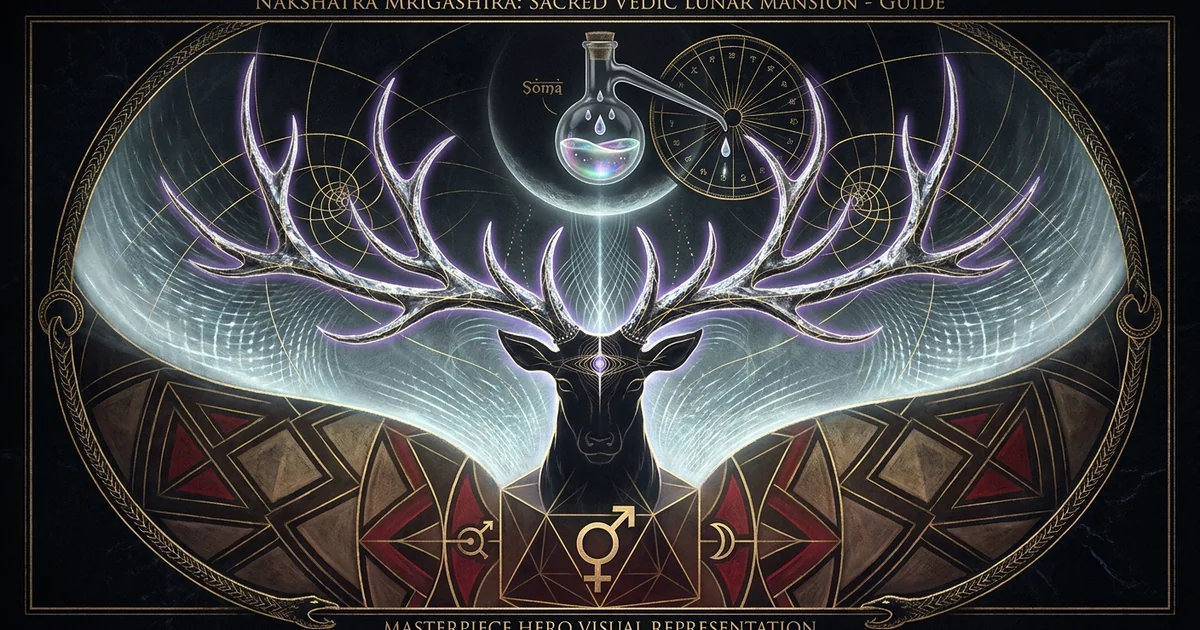
Nakshatra Mrigashira: Sacred Vedic Lunar Mansion - Guide
Archetypal Thesis & Systemic Paradigm: The Epistemic Quest of the Wandering Consciousness
Within the coordinate architecture of the sidereal zodiac, Mrigashira Nakshatra represents an evolutionary pivot in human consciousness. Extending from 23°20’ Vrishabha (Taurus) to 06°40’ Mithuna (Gemini), this lunar mansion occupies the threshold between fixed, vegetative earth and mutable, dialectical air. Rather than serving as an arbitrary prognostic container, Mrigashira operates within the foundations of Vedic astrology as a cybernetic feedback system of cognitive migratory patterns. It captures the exact psycho-cosmic juncture where sensory satiation yields to epistemic hunger, converting the metabolic inertia of physical form into an acute, wandering perceptual apparatus.
The Totemic Deer Head: Metaphor of Perpetual Vigilance and Foraging
The primary symbol of this mansion—the deer’s head (Mrigashirsha)—encodes an evolutionary state of hyper-attunement and environmental scanning. The cervine consciousness does not dominate its ecological terrain through predatory brute force; instead, it navigates via sensory delicacy, perpetual vigilance, and an intuitive appraisal of acoustic and kinetic shifts. In the lexicon of archetypal psychology, the deer embodies the soul’s foraging impulse. This totemic animal continually samples new theoretical and perceptual pastures without permanently settling, reflecting the mrigashira nakshatra vedic astrology meaning of dynamic pursuit.
This ceaseless browsing is not merely a metaphor for physical wandering, but a systemic description of the mind’s quest for epistemic nutrients. The deer’s sensory orientation signifies consciousness liberated from the dense inertia of tamas, yet vulnerable to hyper-arousal and acute anxiety. Because its psychological survival depends on scanning the environment for predators, the Mrigashira mind develops an agile, non-dogmatic mode of information processing. This perceptual vigilance preserves cognitive plasticity at the cost of chronic internal tension, driving the psyche forward through an unending terrain of inquiry.
The Cusp of Transmutation: Bridging Vrishabha (Fixed Earth) and Mithuna (Mutable Air)
The structural significance of Mrigashira hinges on its spatial bridge across the zodiacal boundary. The first half of the nakshatra (Padas 1 and 2) remains grounded in Venusian Taurus, where the sensory apparatus is anchored in material beauty, somatic stability, and terrestrial cultivation. Here, the foraging impulse explores tangible resources, artistic forms, and the rhythmic cadence of the natural world, consolidating the biological vitality established in Rohini Nakshatra.
As consciousness crosses into the third and fourth Padas, it enters Mercurial Gemini, transmuting the physical senses into linguistic abstractions, semiotic systems, and theoretical cartographies. The grazing deer transitions from physical pasture to noetic space. The systemic drive shifts from cultivating tangible resources to dissecting ideological constructs. Mrigashira thus serves as a transmutational bridge within the 27 Nakshatras of Jyotish: it dislodges consciousness from somatic complacency and compels it toward the cognitive fragmentation and structural reconstruction that culminates in Ardra Nakshatra.
“The Puer Aeternus remains in a state of eternal wandering, never wholly planting his feet in the terrestrial soil of the present. He pursues an elusive spiritual maternal substrate—a horizon of pure potentiality that flees the moment it is approached. In this state, restlessness is an ontological condition: the psyche flees the mundane containment of fixed form to preserve its relationship with the sacred source of renewal.” — Marie-Louise von Franz, The Problem of the Puer Aeternus (1970)
The Soma-Mars Dialectic: Kinetic Desire Catalyzing Contemplative Illumination
The internal engine of Mrigashira is powered by an operational dialectic between its ruling planetary graha, Mars (Mangala), and its presiding deity, Soma (the divine lunar nectar). At first appraisal, this union presents an esoteric paradox: Mars represents kinetic heat, penetrative will, muscular initiative, and the combustive fire of tejas. Conversely, Soma denotes the cooling, unctuous, reflective, and psychically integrative nectar of consciousness, typified by ojas.
[ Mars / Mangala ]                   [ Soma / Chandra ]
 (Combustive Drive / Tejas)         (Refined Ambrosia / Ojas)
             \                                 /
              \                               /
               v                             v
      +-----------------------------------------------+
      |             MRIGASHIRA ALCHEMY                |
      |   Kinetic drive converted into epistemic      |
      |   foraging; the hunt for illuminated gnosis   |
      +-----------------------------------------------+
Within this lunar mansion, Mars is stripped of its crudely militaristic functions. Instead of conquering physical territories, the martial drive is redirected inward to track, unearth, and distill the mysterious spiritual substrate symbolized by Soma. Mars supplies the directional vector, courage, and epistemic stamina necessary to sustain the pursuit; Soma provides the elusive prize—an inner ambrosia of intuitive clarity and spiritual nourishment. Consequently, the native operating under this influence experiences desire not merely as biological craving, but as a kinetic catalyst intended to awaken contemplative illumination.
Classical Provenance & Textual Lineage: The Vedic Primacy of Soma and the Celestial Hunter
To comprehend Mrigashira outside the scope of contemporary psychological projections, one must analyze its classical lineage across Vedic, Puranic, and Samhita literature. In the Vedic canonical order, lunar mansions served as temporal coordinates for sacrificial rituals (yajnas) and metaphysical states of cosmic order (rita).
“सोमो वा एतस्य राज्यमभ्यजयत् । यः सोमं वशीकृत्य नक्षत्रं मृगशीर्षमुपतिष्ठते । तस्य सौम्यो भवति राज्यं वै सोमोऽभिजयेत् ॥” Translation: “Verily, Soma conquered the sovereignty through this mansion. Whosoever, mastering the inward flow of Soma, approaches the constellation of Mrigashirsha, unto him Soma becomes benevolent; through Soma indeed does he attain spiritual sovereignty.” — Taittiriya Brahmana, Nakshatra Ishti Section
Vedic Foundations: The Taittiriya Brahmana and Nakshatra Sukta Invocations
In the Taittiriya Brahmana (1.5.1), the foundational mapping of the Nakshatra Ishtis indexes Mrigashira directly to Soma, designating this celestial coordinate as the sacred reservoir of amrita. Within the Vedic liturgical framework, Soma is both an entheogenic botanical sacrament and the cosmic, sovereign principle of delight (ananda) that sustains the gods. The Rigveda Samhita (Mandala IX, Pavamana hymns) repeatedly extols Soma as the clarifier of intelligence, the fluid of poetic insight (kavi), and the mystical antidote to mortality.
When the Taittiriya Brahmana instructs the sacrificer to propitiate Soma under the asterism of Mrigashirsha, it establishes this nakshatra as an inner alchemical laboratory. The Vedic seers recognized that the mind (chandra-manas) cannot find enduring peace through worldly pursuits. True cognitive equilibrium requires distilling the scattered prana of the senses into a coherent flow of contemplative fluid. The asterism does not merely represent a cervine form in the night sky; it denotes the sacred precinct where divine nourishment is cultivated, preserved, and defended from profanation.
The Mythologem of Prajapati, Rohini, and Rudra’s Transfixing Arrow
The astronomical and mythic core of Mrigashira is situated in the primordial Vedic drama of Prajapati, the demiurgic creator. Driven by unbridled generative desire (kama), Prajapati pursued his own daughter, Rohini—the red star Aldebaran, representing primordial material manifestation and aesthetic allure. To evade this cosmic pursuit, Rohini transformed into a female deer (rohit). Prajapati promptly assumed the form of a stag (mriga) to chase her across the celestial expanse.
[ Rohini / Aldebaran ]  <--- Fled as a Doe (Material Form)
                 ^
                 | (Incestuous Kama / Creative Drive)
                 |
      [ Prajapati / Mrigashirsha ]  <--- Pursued as a Stag (Intellect/Kama)
                 ^
                 | (Transfixing Arrow of Dharma / Cosmic Order)
                 |
       [ Rudra / Ardra ]  <--- Pierced the Stag (Shattering of Ego)
Witnessing this breach of cosmic order (dharma), the devas gathered their most terrifying essences to forge Rudra, the unconditioned force of absolute destruction. Rudra released his three-pronged arrow (Isus Trikanda, corresponding to the belt of Orion), piercing the stag in mid-stride. The severed, transfixed head of the stag became the asterism Mrigashirsha, suspended in the heavens immediately before the dread asterism of Ardra (Betelgeuse, the celestial incarnation of Rudra).
This myth positions Mrigashira at the apex of generative creative tension. It symbolizes consciousness driven to the absolute frontier of experiential longing, frozen right before its inevitable ego-dissolution in the storms of Ardra.
Puranic Codification: Jyotish Lineages and the Lunar Architecture of Varahamihira
In his masterwork Brihat Samhita (Chapter XIV, the Kurma Chakra and Nakshatra Phala), the 6th-century polymath Varahamihira outlines the sociological and psychological manifestations of Mrigashirsha:
“Those born in the lunar mansion of Mrigashira are typically enthusiastic, mercurial in their pursuits, gifted with practical wit, eloquent in council, fearful of physical confrontations, wealthy through intellectual transactions, and engaged in deep study of sacred and secular treatises.”
Varahamihira’s characterization preserves the core paradox of the asterism: the combination of radiant intellectual capacity (soma) with cautious physical reactivity (the deer).
This lineage was systematically developed by Sage Parashara in the Brihat Parasara Hora Sastra. Parashara assigns the twenty-year Vimshottari planetary cycle to Mars as the nakshatra lord. Here, the graha Mars acts not as an engine of military slaughter, but as pitta-karaka—the fiery metabolic agency that transmutes raw experiential input into refined mental capacity.
Classical commentaries repeatedly return to this distinction: Mrigashira natives excel as ambassadors, research scholars, forest-dwellers, and poets. They operate as continuous investigators, using sharp observational abilities to navigate complex societal terrains without getting ensnared by them.
Structural Mechanics & Symbolic Geometry: Zodiacal Degrees, Padas, and Navamsha Sub-Divisions
Analyzing Mrigashira requires precise mathematical attention to its cartography across the sidereal zodiac. The mansion spans precisely 13°20’ of celestial arc, bisected by the fundamental boundary between the signs of Taurus (Vrishabha) and Gemini (Mithuna).
Degree Allocation and the Rashi Boundary Split (23°20’ Taurus to 6°40’ Gemini)
The structural split across the 30-degree boundary line shapes the nakshatra’s dual nature:
- Padas 1 and 2 (23°20’ to 30°00’ Taurus): Disposed by Venus (Shukra). The investigative impulse of the deer is anchored in the somatic, tangible realm of physical matter, finance, earth stewardship, and artistic composition. The martial ruler (Mars) must collaborate with the sensuous, harmonizing protocols of Venus.
- Padas 3 and 4 (00°00’ to 06°40’ Gemini): Disposed by Mercury (Budha). The investigative impulse breaks free into the linguistic, symbolic, and conceptual realm of abstract thought, information synthesis, and psychological inquiry. The martial ruler (Mars) must interface with the mercurial intellect, producing rapid cognitive cycles, verbal agility, and analytical restlessness.
The Four Padas: Navamsha Analysis from Leo to Scorpio
The internal evolutionary trajectory of Mrigashira is revealed through its four nine-fold divisional divisions (navamshas), which transition through consecutive signs from Leo to Scorpio in the Navamsha D9 interpretation:
+------+-------------------+------------+---------------+------------------------+
| Pada | Sidereal Range    | Navamsha   | Sub-Lord      | Evolutionary Directive |
+------+-------------------+------------+---------------+------------------------+
|  1   | 23°20'-26°40' Tau | Leo        | Sun (Surya)   | Sovereign Creative Act |
|  2   | 26°40'-30°00' Tau | Virgo      | Mercury (Bud) | Tactical Discrimination|
|  3   | 00°00'-03°20' Gem | Libra      | Venus (Shuk)  | Relational Exploration |
|  4   | 03°20'-06°40' Gem | Scorpio    | Mars (Mangal) | Occult Gnostic Insight |
+------+-------------------+------------+---------------+------------------------+
Pada 1 (23°20’ – 26°40’ Taurus)
Falling into the Leo Navamsha, ruled by the Sun (Surya), this pada unifies the grounded earth of Taurus with solar majesty and creative radiance. Mars and the Sun share a naturally friendly dynamic (Mitra sambandha), bestowing an assertive, dignified, and expressive temperament. This pada anchors the wandering cervine energy into stable forms of self-expression, artistic creation, or physical mastery. The foraging impulse seeks structural excellence and noble environments, minimizing sensory panic.
Pada 2 (26°40’ – 30°00’ Taurus)
Falling into the Virgo Navamsha, ruled by Mercury (Budha), this pada represents the absolute terminal degrees of fixed earth. It synthesizes the sensual endurance of Venus with the hyper-discriminating, categorizing power of Mercury. The mind possesses extraordinary tactical precision, diagnostic acumen, and forensic curiosity. Here, the deer forages for practical methodologies, health sciences, calculations, and structured data, producing meticulous craftspeople and analytical scholars.
Pada 3 (00°00’ – 03°20’ Gemini)
Falling into the Libra Navamsha, ruled by Venus (Shukra), this pada marks the leap across the rashi threshold into mutable air. Here, consciousness encounters relational dialectics, intellectual debate, sociological dynamics, and linguistic balance. The mind is fascinated by philosophical exchanges, design, poetry, and interpersonal dynamics. The deer now scans the social landscape, seeking cognitive connection and conceptual resonance through cooperative dialogue.
Pada 4 (03°20’ – 06°40’ Gemini)
Falling into the Scorpio Navamsha, ruled by Mars (Mangala), this pada is the most volatile and spiritually potent quarter of the asterism. As Mars is both the Nakshatra lord and the Navamsha dispositor, its martial potency becomes concentrated. Operating within the mental air of Gemini, this pada bypasses superficial socializing to probe hidden motives, occult mysteries, psychology, and complex research. The gentle deer transforms into an investigative bloodhound, stalking esoteric gnosis through the labyrinth of the subconscious.
Planetary Rulership Architecture: Mars (Graha), Chandra (Natural Significator), and Mercury (Sign Lord)
The navigational output of Mrigashira depends on an interconnected triad of planetary energies:
- Mars (Nakshatra Graha Ruler): Provides the foundational drive, decisive thrust, and energetic stamina. It prevents the lunar mind from degenerating into passive daydreams.
- Chandra (Natural Significator of Consciousness): As the cosmological repository of Soma and ruler of the mind (manas), Chandra dictates whether the search produces internal peace or obsessive rumination.
- Venus / Mercury (Rashi Lords): Determine the medium through which the search unfolds—translating the impulse into material forms in Taurus, or conceptual frameworks in Gemini.
The chart interpreter must rigorously calculate the planetary dignity (bala) of Mars, Venus, and Mercury to determine the ultimate trajectory of this nakshatra. If Mars is dignified in Capricorn or Aries while Mercury is elevated, the native channels this restless seeking into breakthrough scientific discoveries or linguistic mastery. Conversely, if Mars is debilitated in Cancer or combust the Sun without benefic aspects, the energy degenerates into erratic physical restlessness, escapist impulses, and chronic focus deficits.
Psychological Dynamics & Operational Praxis: The Archetype of Seeking, Restlessness, and Sublimation
When transposed into clinical depth psychology and behavioral dynamics, Mrigashira manifests as a psyche organized around exploration, investigative mobility, and the dread of cognitive confinement.
Mrigashira in Vrishabha (Padas 1 & 2)
- Psychic Vector: Sensory, tangible, aesthetic, material-formative.
- Investigative Focus: Forages for architectural, agricultural, financial, or artistic stability.
- Shadow Expression: Possessive clinging disguised as discernment; material over-accumulation.
- Linguistic Output: Measured, deliberate, grounded in empirical reality.
- Somatic Tension: Concentrated in the vocal cords, neck, cervical spine, and thyroid.
Mrigashira in Mithuna (Padas 3 & 4)
- Psychic Vector: Ideational, linguistic, semiotic, conceptual-synthetic.
- Investigative Focus: Forages for structural models, occult secrets, linguistic nuances, and data flows.
- Shadow Expression: Hyper-fragmentation, perpetual doubt, intellectual promiscuity, and sensory burn-out.
- Linguistic Output: Rapid, dialectical, ironic, intensely conversational.
- Somatic Tension: Concentrated in the nervous system, respiratory pathways, shoulders, and hands.
Cognitive Restlessness and the Pathology of Perpetual Unfulfillment
The primary psychological shadow of Mrigashira is the conflation of the process of seeking with the ultimate value of the realization. The archetypal deer survives through continuous locomotion; to remain stationary is to risk capture and death. At the level of the individual psyche, this instinct can metastasize into chronic dissatisfaction. The native may abandon projects, relationships, and spiritual traditions the moment the initial rush of discovery gives way to mundane maintenance.
       [ Initial Inquiry ] ────> Captures Novel Intellectual Terrain
              │
              v
       [ Habituation ] ────> Satiation Dies; Dread of Inaction Arises
              │
              v
       [ Restless Flight ] ───> Abandons Pasture to Evade Fixity
              │
              v
       [ Perpetual Foraging ] ──> Infinite Loop: The Seeker Never Settles
This pattern mirrors the classic neurosis of the Puer Aeternus: the dread of terrestrial enclosure, binding commitments, and irreversible life choices. The Mrigashira psyche constantly surveys alternative horizons, believing that the true nectar (soma) lies just over the next intellectual ridge. If left unintegrated, this dynamic produces cognitive nomadism—an intellectual grazing that consumes vast quantities of eclectic information while failing to metabolize any of it into mature wisdom.
Comparative Anatomy of the Padas: Grounded Cultivation vs. Gnostic Dispersion
The clinical divide between the Taurean and Geminian padas manifests conspicuously in therapeutic observation:
- Padas 1 and 2 (Taurus) exhibit a slower, more deliberate cadence. Psychological distress here manifests as somatic anxiety—tension held in the vocal cords, neck, and shoulders—or as stubborn resistance to changing behavioral loops once established. The investigative engine targets tangible skills: ceramics, real estate acquisition, culinary arts, acoustic production, or natural sciences.
- Padas 3 and 4 (Gemini) operate with a high-velocity nervous system. These natives manifest neuro-vegetative exhaustion, sleeplessness (insomnia), and rapid speech patterns. The deer runs through noetic fields, jumping from one theoretical framework to another. The shadow in Pada 3 is social fickleness and conversational superficiality, whereas the shadow in Pada 4 involves conspiratorial paranoia, obsessive research, and emotional isolation.
Sadhana and Remedial Protocols: Grounding the Martian Mind in Somatic Presence
To balance the hyper-kinetic Mars-Soma friction, the native requires precise remedial and meditative protocols:
[ Active Martial Heat / Prana ] ──> Sitali / Nadi Shodhana Pranayama ──> [ Cooling Integration / Soma ]
[ Fragmented Senses / Manas ]   ──> Trataka / Dharana Concentration  ──> [ Grounded Awareness / Ojas ]
- Somatic Dharana (Concentration Practice): The deer mind cannot be coerced into stillness through blunt force; attempting to repress the mental fluctuations (vrittis) only triggers its flight mechanism. The optimal meditative approach employs structured concentration (dharana), such as Trataka (fixed gazing upon a single ghee lamp flame) or systematic scanning of bodily sensations (kayanupassana). This channels the scanning impulse inward, systematically anchoring awareness within the physical body.
- Pranayama Protocols for Lunar-Solar Equilibrium: To regulate the fire of Mars (tejas) with the cooling nectar of Soma (ojas), classical texts prescribe Nadi Shodhana (alternate nostril breathing) followed by Sitali or Sitkari pranayama. This practice cools the neuro-vegetative circuits, lowering systemic inflammation and quieting hyper-vigilance.
- Remedial Astrological Therapeutics: Classical remedial traditions prescribe the ritual recitation of the Soma Gayatri or the Chandra Bija Mantra during the lunar transit through Mrigashirsha. Incorporating natural cooling substances—such as silver vessels, pure sandalwood (chandana), and raw pearl or moonstone—counterbalances an afflicted Mars dispositor. The fundamental operational mandate for Mrigashira is simple: transform the wandering instinct from an evasive flight into an intentional, focused pilgrimage toward inner stability.
Philosophical Synthesis & Macrocosmic Correspondence: The Alchemical Extraction of Amrita
At its highest esoteric octave, Mrigashira Nakshatra maps the central mystery of the Vedic-Hermetic interface: the alchemical extraction of the immortal elixir (amrita) from the dense, oceanic baseline of prima materia.
The Churning of the Ocean (Samudra Manthan) and the Extraction of Elixir
In the cosmic mythologem of the Samudra Manthan, the devas (solar-lunar principles of higher consciousness) and the asuras (primordial subterranean drives) tether the great serpent Vasuki to Mount Mandara to churn the primordial ocean of milk. This cosmic churning is an exact macrocosmic blueprint of Mrigashira’s internal alchemy.
[ Mount Mandara ] <── Axis Mundi / The Cerebrospinal Core
              │
    ┌─────────┴─────────┐
    │                   │
[ Devas ]           [ Asuras ]
 (Solar/Martial)     (Lunar/Somatic)
    │                   │
    └─────────┬─────────┘
              │
  (Rhythmic Churning Action)
              │
              v
     [ EXTRACTION OF SOMA ]
  Immortal Nectar of Unconditioned
         Transcendental Insight
The mountain represents the spinal column (meru-danda), while the serpent represents the rhythmic breathing cycle of life (prana-kundalini). The relentless, back-and-forth friction between the solar-fire forces (Mars) and the lunar-water forces (Soma) churns the psychological baseline of the individual. Out of this friction, the hidden ambrosial essence of reality—the fourteenth and ultimate jewel, Amrita—is crystallized and brought to the surface.
Mrigashira native experiences this mythic churning as chronic existential friction. Their seeking is an instinctive biological attempt to churn the mundane experiences of everyday life until they yield the nourishing nectar of unconditioned wisdom.
Within esoteric Ayurveda and internal yogic physiology, Mrigashira represents the precise functional synthesis of the three vital essences: $$\text{Ojas (Lunar Substrate)} \underset{\text{Tejas (Martial Agni)}}{\overset{\text{Sublimated by}}{\rightleftharpoons}} \text{Prana (Vata / Active Cognition)}$$ When Mars operates at a lower octave, excessive Tejas burns through Ojas, inducing mental burnout, chronic irritability, and neurochemical exhaustion. Conversely, when guided by the contemplative oversight of Soma, Tejas transforms into a clean, smokeless metabolic fire that transmutes physical Ojas into Prana, generating sustained intellectual clarity and profound spiritual awareness.
Microcosmic-Macrocosmic Hermetic Isomorphism: Soma as the Pineal Secretion
This macrocosmic churning reflects an exact biological counterpart within internal human physiology. In the esoteric anatomy of Hatha Yoga and Hermetic traditions, Soma corresponds to the subtle cooling fluid secreted within the third ventricle of the brain—the region of the pineal and pituitary interface known as the Brahmarandhra or the thousand-petaled lotus (Sahasrara).
This lunar secretion continuously descends toward the digestive fire (jatharagni) located in the solar plexus (Manipura Chakra), where it is ordinarily consumed by the fire of metabolic time and biological desire.
The advanced yogic practices associated with Mrigashira—such as Khechari Mudra and Jalandhara Bandha—aim to arrest this downward dissipation. The wandering cervine consciousness learns to turn its perceptual gaze upward back toward the crown of the head. By capturing the descending lunar nectar before it is burned away by terrestrial ambition, the adept transforms temporal mortality into sustained contemplative illumination.
                     [ SAHASRARA CHAKRA ]
                 (Secretes Subtle Soma / Fluid)
                            │
                            │ (Downward Descent / Consumed by Time)
                            v
                     [ MANIPURA CHAKRA ]
                 (Metabolic Fire / Jatharagni)
                            │
        ═════════════════════════════════════════════
          YOGIC INVERSION: KHECHARI & JALANDHARA
        ═════════════════════════════════════════════
                            │
                            ^ (Ascent of Kundalini / Reversal)
                            │
               Transmutation of Ojas into Tejas;
           The Mind Drinks the Internal Ambrosia
Teleology of the 27 Nakshatras: Mrigashira as the Inception of Intellectual Individuation
Within the evolutionary cycle of the 27 Nakshatras of Jyotish, Mrigashira fulfills an irreplaceable architectural function:
[ ASHWINI - BHARANI - KRITTIKA ]  ──>  Biological Genesis, Primal Emergence
               │
               v
          [ ROHINI ]             ──>  Sensory Satiation, Aesthetic Earth
               │
               v
        [ MRIGASHIRA ]           ──>  Intellectual Individuation, Dialectical Search
               │
               v
           [ ARDRA ]             ──>  Destruction of Egoic Illusions, The Storm
- Ashwini, Bharani, and Krittika establish the primordial forces of life: divine genesis, incarnation into flesh, and purification by fire.
- Rohini grounds consciousness within the fertile fields of nature, sensory enjoyment, and the stable consolidation of biological life.
- Mrigashira disrupts this comfortable biological equilibrium. It is the first lunar mansion driven by self-conscious, intellectual curiosity. The mind looks beyond the lush comforts of Rohini and asks: What lies beyond this physical horizon? What is the divine reality that sustains this world?
- By asking these foundational questions, Mrigashira initiates intellectual individuation. It separates the questioning self from the unreflective rhythms of the collective unconscious, deliberately leading consciousness toward the transformative storms of Ardra. It is the noble, inquisitive scout of the zodiac, willing to walk away from biological safety to track down the enduring light of truth.
Frequently Asked Questions: Analytical Clarifications on Mrigashira Nakshatra
Epistemological Vulnerability: Why is Mrigashira symbolized by a gentle deer rather than an aggressive predator?
The assignment of the deer (mriga) rather than an aggressive apex predator to a Mars-ruled nakshatra is one of the most deliberate, profound choices in Vedic symbology. An aggressive predator approaches its environment through territorial domination, violence, and the subjugation of external forces. This mode of engagement destroys the delicate nuances of subtle phenomena; the predator sees the world solely as competitive prey to be mastered.
Predatory Vector:   [Consciousness] ───( Domination / Destruction )───> [Object of Focus]
Cervine Vector:     [Consciousness] ───( Vulnerability / Attunement )──> [Nuanced Reality]
In contrast, authentic spiritual and philosophical inquiry demands radical epistemological vulnerability. The deer moves through the wild with an open, completely undefended sensory apparatus. It cannot rely on heavy armor, claws, or crushing jaws; its safety depends entirely on accurate perception, attunement to subtle changes in its environment, and swift responsiveness.
By employing the deer as the totemic animal for Mrigashira, the Vedic rishis established that the ultimate mysteries of consciousness (Soma) cannot be conquered through forceful intellectual aggression. They reveal themselves only to an agile, deeply receptive mind that approaches the sacred landscape with gentle curiosity, quiet steps, and refined awareness.
Navamsha Delineations: How does the chart interpretation change when Mrigashira falls in Taurus versus Gemini?
The chart delineation changes fundamentally based on whether the planetary placement occupies the Taurus or Gemini sector of the nakshatra:
- Taurus Placement (Padas 1 & 2 / 23°20’ to 30°00’ Taurus): Disposed by Venus. Here, the energetic drive is somatic, artistic, and empirical. The search focuses on mastering concrete, terrestrial forms: natural architecture, financial systems, acoustic arts, and environmental resources. The individual seeks grounded security and evaluates ideas by their real-world value. The mind moves with measured, stable steps, resisting sudden disruptions in thought or lifestyle.
- Gemini Placement (Padas 3 & 4 / 00°00’ to 06°40’ Gemini): Disposed by Mercury. Here, the drive detaches completely from physical inertia and enters the conceptual, linguistic, and theoretical realms. The search focuses on abstract patterns, semiotic systems, philosophical literature, journalism, or occult mysteries. The mind processes information rapidly, thriving on intellectual debate and cross-disciplinary studies. However, it is also far more susceptible to neuro-vegetative exhaustion, nervous agitation, and cognitive fragmentation.
+--------------------------+-------------------------------------+-------------------------------------+
| Dimensional Parameter   | Taurus Arc (Padas 1 & 2)            | Gemini Arc (Padas 3 & 4)            |
+--------------------------+-------------------------------------+-------------------------------------+
| Dispositor Nexus         | Venus (Shukra)                      | Mercury (Budha)                     |
| Core Element             | Fixed Earth (Sthira Bhumi)          | Mutable Air (Dwisvabhava Vayu)      |
| Perceptual Channel       | Somatic, Tactile, Aesthetic         | Linguistic, Dialectical, Abstract   |
| Primary Vulnerability    | Stagnant Comfort, Possessiveness    | Analysis Paralysis, Mental Burnout  |
| Practical Manifestation  | Material Arts, Ecology, Finance     | Literature, Coding, Esoteric Studies|
+--------------------------+-------------------------------------+-------------------------------------+
Deity Mechanics: How does Soma differ from Chandra in Vedic symbolic cosmology?
While popular astrology often treats Soma and Chandra as interchangeable names for the Moon, Vedic cosmological mechanics draws a vital functional distinction between them:
Chandra represents the manifested, planetary archetype of the Moon. He embodies the general, personal emotional mind (manas), fluctuating moods, public sentiment, social consciousness, and the cyclic tides of earthly time. Chandra waxes and wanes, reflecting both vulnerability to external influences and subjective, psychological reactivity.
    [ CHANDRA ]                                       [ SOMA ]
The Phenomenological Moon                         The Essential Nectar
       │                                                 │
       v                                                 v
* Personal Mind (Manas)                           * Pure Delight (Ananda)
* Moods & Subjective Reactivity                   * Unconditioned Consciousness
* Temporal Cycles & Waning                        * The Sustaining Cosmological Elixir
* Psychological Reflection                        * Transpersonal Gnosis & Immortality
Soma, conversely, is the divine, unconditioned essence that sustains the cosmos. Soma is the ambrosial nectar of immortality (amrita), the principle of spiritual delight (ananda), and the nourishing fuel that empowers the gods to uphold cosmic order (rita).
Chandra is merely the celestial chalice; Soma is the luminous, life-giving wine resting within that chalice.
In Mrigashira Nakshatra, propitiating Soma does not simply mean attending to one’s transient emotional feelings (Chandra). It means reaching through the fluctuating mind to taste the transcendent, unconditioned nectar of spiritual awareness that remains uncorrupted by temporal experience. Mrigashira does not merely track the shifting movements of the reflective mind; it hunts for the divine nectar of pure consciousness itself.