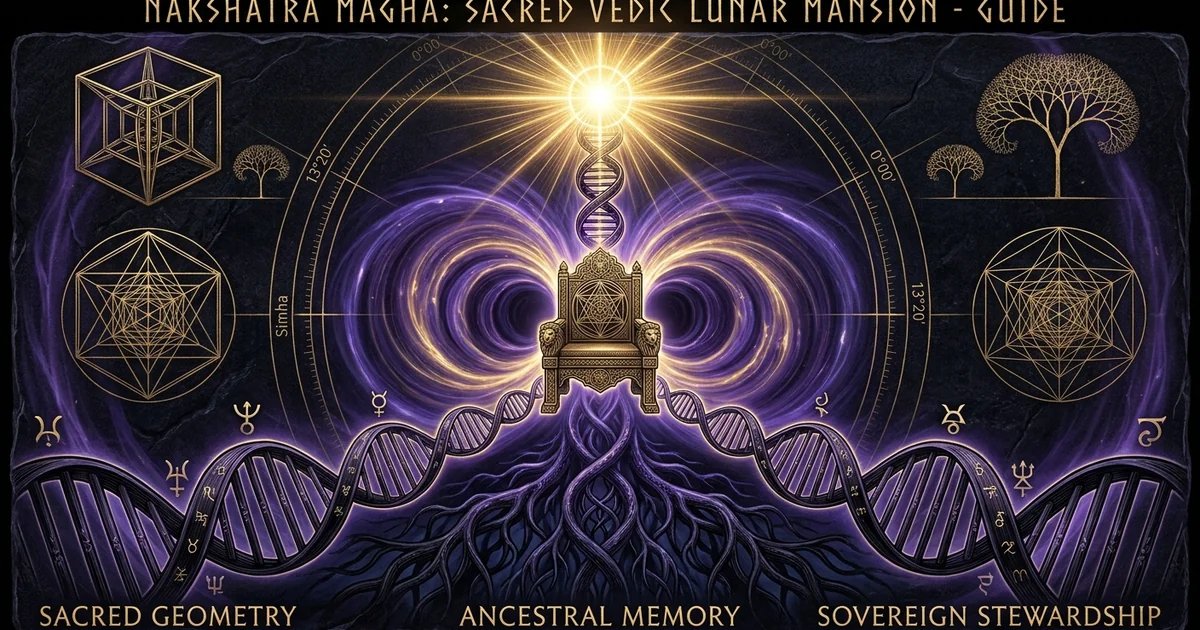
Nakshatra Magha: Sacred Vedic Lunar Mansion - Guide
Archetypal Thesis & Systemic Paradigm: The Threshold of Ancestral Sovereignty
The Morphogenetic Axis: Ketu’s Dissolution and Solar Crystallization
Occupying 0°00’ to 13°20’ of the sidereal sign Simha (Leo), Magha nakshatra represents the foundational evolutionary rupture where consciousness shifts from instinctual, biologically bound awareness to self-authorizing solar individuation. Governed planetary-wise by the South Lunar Node (Ketu) and presided over by the Pitris (ancestral progenitors), this lunar mansion operates as an intricate psycho-cosmological bridge. In the broader system of the 27 nakshatras in jyotish, Magha establishes a thermodynamic paradox: the cold, vacuum-like dissolution of Ketu intersects directly with the radiant, outward-emanating fire of Surya (the Sun). Rather than negating solar potency, this nodal influence purges personal egoism so that an archetypal, transpersonal majesty can manifest.
The core of the magha nakshatra vedic astrology meaning lies within this morphogenetic axis. Ketu acts as the cosmic archivist of accumulated karmic debt and spiritual insight, stripping away transient identity markers. When stationed in the solar sanctuary of Simha, Ketu does not merely deny worldly recognition; instead, it demands that any exercise of authority be cleansed of solipsism. The native whose chart is anchored here discovers that sovereignty is an inherited custodial duty rather than an arbitrary egoic acquisition. True leadership within the Magha frequency requires the individual to serve as a conduit for the lineage, transforming biological inheritance into conscious spiritual stewardship.
::: diagram The Gandanta Threshold and Ancestral Emergence


    Ashlesha: Subconscious Bind
    Gandanta Threshold: 29°59' Cancer / 0°00' Leo
    Magha: Pitri Awakening
    Purva Phalguni: Solar Creative Fruit


:::
Transgenerational Individuation: From Familial Debt to Self-Sovereignty
The traversal from the preceding lunar mansion, Ashlesha, into Magha requires crossing the profound metaphysical boundary known as the gandanta—the karmic void bridging water and fire signs. Where Ashlesha represents the peak of psycho-emotional entanglement within the maternal matrix and the serpentine underworld of the Nagas, Magha emerges as the upward-surging flame of ancestral reckoning. The soul, having confronted its instinctual dependencies, is thrust into the ancestral court. In this domain, the ancestral complex analyzed by Jungian psychology ceases to be merely a psychological theory; it functions as an active metaphysical reality demanding reconciliation.
This psychological evolution requires the native to resolve unconscious epigenetic inheritances. The individual cannot simply step onto the royal dais without first settling accounts with the lineage that brought them to the threshold. Unresolved family traumas, unrealized ancestral aspirations, and lingering ethical transgressions (rinic bonds) condense within Magha as behavioral compulsions. Sovereignty is achieved only through conscious individuation: separating the authentic Self from ancestral conditioning while reverently integrating the hard-won wisdom of the progenitors.
Magha within the Macrocosm of the 27 Nakshatras
Within the structural architecture of the lunar zodiac, Magha initiates the second great developmental cycle (Paryaya). The first nine mansions, from Ashvini to Ashlesha, govern the establishment of individual incarnation, biological survival, emotional crystallization, and early cognitive mastery. Magha breaks through this primary enclosure. It stands as the tenth mansion, echoing the tenth house of the natal chart (Karma Bhava), and therefore inherently governs duty, public station, systemic status, and societal governance.
Here, the soul steps into historical time. It is no longer preoccupied solely with private survival; it is tasked with the maintenance, protection, and evolution of civilization itself. Magha serves as the gateway through which cosmic intelligence organizes societies, legitimizes royal dynasties, and demands adherence to ancestral Dharma. By mediating the forces between Ashlesha’s subterranean depths and Purva Phalguni’s creative, cultured revelry, Magha functions as the pillar upon which cultural continuity rests.
Classical Provenance & Textual Lineage: The Pitris and Vedic Epigraphy
The Taittiriya Brahmana and Rigvedic Pitṛyajña Canon
The Vedic canon places Magha at the center of its sacerdotal liturgies concerning the continuity of cosmic order (Rta). In the Taittiriya Brahmana (III.1.1), the mansion is expressly dedicated to the Pitris (ancestors) deity. These entities are not merely familial ghosts or psychological projections of dead relatives; they are the primordial architects of form, the conscious memory banks of cosmic evolution who hold the structural blueprints of human existence across the yugas.
‘pitaraḥ pūrve pitaraḥ pare… maghāsu pitṝn yajante.’ Translating the Vedic hymn assigning the primordial ancestors as custodians of the soul’s lineage-consciousness under the stars of Magha.
The performance of Pitṛyajña (ancestral sacrifice) delineated in the Rigveda and supplementary liturgical manuals was intentionally synchronized with the Moon’s transit through Magha. The text makes clear that when the Moon occupies this sector of the sky, the celestial membrane separating the realm of the living (Bhur Loka) from the realm of the fathers (Pitri Loka) becomes exceptionally thin. Through precise ritual offerings of water, sesame seeds, and sacred chants, the living feed the ancestral collective, which in turn radiates blessings of vitality, progeny, and institutional stability down to the terrestrial realm.
Parashara’s Exposition: Brihat Parashara Hora Shastra
In the classical astrological canon, Maharishi Parashara’s Brihat Parashara Hora Shastra provides foundational technical and symbolic parameters for assessing Magha. In Chapter 3, Parashara attributes the lordship of Magha to the Pitris, defining its disposition as Ugra (fierce or formidable), an assessment rooted in the severe responsibility required of those who wield executive authority. Parashara states that planets posited in this nakshatra undergo an ancestral trial; they become heavily burdened with transgenerational karma that must be consciously processed before the native can actualize their benign potentials.
Furthermore, in Chapter 43, when elucidating the remedies for inauspicious planetary placements (arishthas) and birth at border states, Parashara highlights the critical nature of the initial degree of Magha. As the starting point of the Fire trine, it represents a state of structural vulnerability. The soul enters Magha shorn of the protective waters of Cancer, standing naked before the fiery expectations of its ancestral line. Parashara instructs that specific purifications, including ancestral libations and gifts of land or gold, must be offered to appease the ancestral collective and avert structural ruin.
Varāhamihira’s Taxonomy of Regulus and Regal Omina
The master polymath Varāhamihira, writing in the 6th century CE, consolidates both predictive and mundane traditions in his seminal Brihat Samhita. In Chapter 15, within the section detailing the stellar divisions (Nakshatra Kurma Vibhaga), he categorizes Magha as presiding over individuals of great wealth, traditionalists, lineage keepers, deep ritualists, and sovereign rulers. He notes that Magha governs the elite echelons of society—ministers, potentates, and custodians of ancestral treasuries:
“In Magha are stationed the possessors of great wealth, persons devoted to their ancestors, kings, commanders of armies, and those who preserve the ancient lineages and hereditary sciences.” — Varāhamihira, Brihat Samhita (XV.8)
Varāhamihira’s focus centers on the chief astronomical marker of Magha: the bright fixed star Alpha Leonis, classical Latin Regulus, known in Sanskrit epigraphy as Magha proper or Maha. In the mundane astrological frameworks of the Brihat Samhita, the behavior of wandering planets relative to Regulus portended the rise and fall of whole dynasties. If benefics like Jupiter or Venus graced this star, righteous monarchs ascended the throne and preserved civil peace; conversely, if afflicted by transiting Mars or Saturn, dynastic heads were assassinated, thrones usurped, and ancestral sanctuaries desecrated.
Structural Mechanics & Symbolic Geometry: Regulus, Padas, and the Throne
The Astronomical Anchor: Cor Leonis (Regulus) at 0°00’–13°20’ Simha
The spatial manifestation of Magha within the tropical and sidereal sky centers upon the stellar powerhouse Alpha Leonis, historically revered across cultures as Regulus, the royal fixed star. Anchored astronomically near the ecliptic, Regulus is often designated Cor Leonis (the Heart of the Lion). In the sidereal zodiac used in Jyotish, Regulus sits precisely within the structural heart of Magha, projecting its immense energetic signature across the entire 13°20’ span.
From an astrophysical standpoint, Regulus is a multi-star system dominated by an oblate, rapidly rotating blue-white main sequence star. Its blinding luminescence and axial velocity mirror its symbolic astrological signature: hyper-concentrated solar radiance, imperious dynamic drive, and an acute vulnerability to rapid collapse if balance is lost. The proximity of Regulus to the ecliptic plane makes it a primary junction point where planetary deities encounter the archetypal current of ancient kingship.
- Zodiacal Span: 0°00’ – 13°20’ Simha (Leo)
- Primary Celestial Body: Alpha Leonis (Regulus)
- Planetary Lord: Ketu (South Lunar Node)
- Presiding Deity: Pitris (The Deified Progenitors)
- Primary Symbol: The Simhasana (Royal Throne Room) / Palanquin (Doli)
- Gana (Temperament): Rakshasa (Demonic/Pragmatic/Formidable)
- Yoni (Animal Totem): Male Rat (Mushika)
- Nadi (Pulse/Constitution): Antya (Kapha / Transformational Termination)
- Tattva (Element): Jala (Water/Memory subtle sub-current within Fire)
- Primary Motivation (Purushartha): Artha (Material & Social Security)
Symbolic Geometry: The Royal Throne Room Symbol and Palanquin
The geometric and physical iconography of Magha is twofold: the royal throne room symbol (Simhasana) and the palanquin (Doli). These icons are not mere historical accoutrements; they serve as operational mandalas encoding the systemic paradox of inherited status and spiritual autonomy.
                  ┌──────────────────────┐
                  │    THE SIMHASANA     │
                  │ (Royal Throne Room)  │
                  └──────────┬───────────┘
                             │
            Lineage Mandate  │  Transgenerational
             Carried Down    │  Responsibility
                             ▼
                  ┌──────────────────────┐
                  │   THE PALANQUIN      │
                  │   (Doli / Vehicle)   │
                  └──────────────────────┘
The Simhasana—literally the seat of the lion—embodies the stabilized seat of divine authority. The throne is a stationary cosmic center; it exists independently of the transient mortal who sits upon it. The throne room is a boundary space where the invisible ancestral lineage elevates the individual into high visibility. Concurrently, the Doli (palanquin) introduces mobility and dependence. A palanquin moves only when carried on the shoulders of others. It serves as a visual metaphor: the native elevated by Magha is carried entirely by the labor, sacrifices, and karmic momentum of their ancestors and subordinates. To sit within the palanquin without acknowledging the carriers below breeds severe hubris, invariably inviting a violent fall from grace.
The Four Navamsha Trajectories: Mesha to Karka
The unfolding of Magha’s 13°20’ arc occurs through four distinct Navamshas (ninth-divisional harmonics), moving progressively from Aries to Cancer. This trajectory reveals the precise alchemical path the soul must navigate to actualize its lineage mandate:
-
Pada 1: 0°00’ to 3°20’ Simha (Aries Navamsha / Mars Governed)
Falling within the dynamic fire of Mesha, this pada directly borders the Gandanta abyss. It is characterized by raw pioneering willpower, martial ambition, and imperial drive. The individual here acts as an assertive founder of dynasties, often compelled by ancestral anger or an existential drive to lift their lineage out of obscurity. The primary vulnerability is tyrannical overreach, where the Mars-Sun-Ketu nexus creates reckless authoritarianism. -
Pada 2: 3°20’ to 6°40’ Simha (Taurus Navamsha / Venus Governed)
Transitioning into the fixed earth of Vrishabha, this quadrant grounds Magha’s imperial impulse into durable form. The focus centers on institutional consolidation, the accumulation of ancestral wealth, the collection of classical art, and the maintenance of material dynasties. The native displays deep pride in family traditions and lineage assets, functioning as an aristocratic conservator of cultural legacy. -
Pada 3: 6°40’ to 10°00’ Simha (Gemini Navamsha / Mercury Governed)
Stepping into the dual air of Mithuna, the royal archetype takes an intellectual turn. This pada disseminates the lineage’s accumulated wisdom through statesmanship, literature, history, and institutional administration. Here, the royal court is filled with scribes, diplomats, and scholars. The challenge lies in avoiding superficial intellectual vanity, where the mental agility of Mercury dilutes the solemnity of Ketu’s karmic imperative. -
Pada 4: 10°00’ to 13°20’ Simha (Cancer Navamsha / Moon Governed)
Terminating in the cardinal waters of Karka, the final quarter returns the fiery regal impulse back to the maternal, ancestral ocean. This pada bridges the conscious king back to the subconscious roots of the Pitris. It is intensely psychic, ritualistic, and emotionally sensitive. The sovereign authority realized in the earlier padas must now surrender its outward crown, recognizing that all worldly power ultimately dissolves into the ancestral waters of Moksha.
Psychological Dynamics & Operational Praxis: Transmuting Ancestral Karma
The Pitri Dosha Complex: Epigenetic Inheritances in the Natal Matrix
When Magha is afflicted by severe malefics—or when its ruler Ketu is structurally compromised—the natal chart manifests the psychological complex known in Jyotish as Pitri Dosha (ancestral debt or curse). In psychoanalytic terms, this corresponds to transgenerational trauma: unresolved behavioral, emotional, and relational wounds transmitted across the morphogenetic field of a family system.
Transgenerational Trauma (Unresolved Debt)
                 │
                 ▼
        Afflicted Magha Matrix
                 │
  ┌──────────────┴──────────────┐
  ▼                             ▼
Psychological:                Material/Relational:
- Imposter Syndrome           - Abrupt Disenfranchisement
- Authoritarian Overreach     - Patriarchal Friction
- Lineage Alienation          - Institutional Stagnation
In psychological profiling, individuals grappling with an afflicted Magha often express an agonizing paradox. They experience a profound internal expectation to achieve distinction, accompanied by an equally intense imposter syndrome or fear of sudden exposure and public ruin. The individual frequently feels haunted by an invisible standard set by the lineage, manifesting either as slavish conformity to dead family traditions or as reactive self-sabotage designed to punish the ancestral line. The psychological task requires bringing these inherited dynamics into conscious awareness, paying the psychological debt without sacrificing one’s personal identity.
Integrated Magha (The Anointed Sovereign)
- Exercises power as lineage stewardship
- Acknowledges ancestral transmissions
- Sustains magnanimity and dharmic duty
- Channels transpersonal solar authority
- Anchors decisions in historical context
- Relinquishes power gracefully when the cycle concludes
Shadow Magha (The Entitled Despot)
- Demands unearned deference and praise
- Subjugates subordinates to compensate for lineage shame
- Vulnerable to abrupt fall from grace and public deposition
- Trapped in unconscious repetition of ancestral trauma
- Equates personal ego with divine right
- Suppresses dissent to protect an inherited, fragile status
The Archetype of Deposition: Hubris, Usurpation, and Fall
The shadow architecture of Magha is intimately linked to the mythic motif of the Fallen King. Because Magha sits under the rulership of the South Lunar Node, Ketu’s metaphysical function is fundamentally subtractive, apophatic, and disillusioning. When a native uses the radiant platform of Simha and Regulus to aggrandize their personal ego—proclaiming, “I am the sole author of this greatness”—the subterranean hand of Ketu activates to destabilize the throne.
This dynamic explains why Magha is historically linked to dramatic downfalls, public deposition, and the sudden stripping of rank. The usurper mistakes the borrowed light of the Pitris for their own intrinsic luminescence. The classic tragic trajectory unfolds: initial elevation by lineage favor, intoxication with absolute authority, refusal to honor the carriers of the palanquin, and a final, humiliating expulsion from the royal court. This cycle demonstrates that under Magha, pride is not merely a moral flaw; it is a structural failure to honor the cosmic ecosystem of lineage authority.
Integrative Ritual: Shraddha, Ancestral Constellation, and Solar Calibration
To remediate an afflicted Magha and stabilize its sovereign potential, Jyotish prescribes rigorous ceremonial and psychological interventions. The primary classical remedy is the systematic performance of Shraddha—the traditional Vedic rite of feeding the ancestors, executed with raw rice, black sesame seeds, and water, particularly during the lunar dark fortnight of Pitru Paksha or on the Amavasya (New Moon) aligning with Magha.
                    SHRADDHA (LITURGICAL OFFERING)
                                  │
                                  ▼
           Clearing of Epigenetic Static & Lineage Debts
                                  │
                                  ▼
                SYSTEMIC FAMILY CONSTELLATION PRAXIS
                                  │
                                  ▼
                 Conscious Reclamation of Authority
                                  │
                                  ▼
                       THE ANOINTED SOVEREIGN
In modern operational practice, this ritual work correlates directly with systemic Family Constellation work as pioneered by Bert Hellinger. The practitioner maps the family matrix, giving voice to forgotten, ostracized, or dishonored ancestors whose energetic exclusion creates structural instability in the family field. Concurrently, solar calibration rituals—such as reciting the Aditya Hridaya Stotram at dawn—align the native’s heart center with the cosmic Sun, shifting their leadership style from defensive entitlement to warm, self-authorizing magnanimity.
Philosophical Synthesis & Macrocosmic Correspondence: Morphic Fields and Sacred Kingship
The Hermetic Principle of Correspondence: Microcosmic Monarchs
The deeper esoteric architecture of Magha manifests the fundamental Hermetic axiom: Quod est superius est sicut quod est inferius (“That which is above is like that which is below”). Within Hermetic philosophy, the terrestrial monarch is a localized, biological mirror of the macrocosmic Sun. The Sun rules the planetary court, dispersing life, light, and order unconditionally across the system; the human monarch must govern their realm with identical cosmic detachment and unconditional generosity.
Magha serves as the stellar gateway through which this Hermetic ideal descends into human politics. Yet this ideal cannot be actualized through human ego alone. The presence of Ketu acts as the Great Alchemical Hermetic Fire, purifying personal vanity to transform the terrestrial leader into an empty vessel through which Divine Providence can flow. Sacred kingship requires the king to “die” to their personal desires, ensuring that the royal decrees emerging from the throne room reflect universal law rather than individual whim.
“The conscious mind is based upon, and results from, an unconscious psyche which is prior to consciousness and very much more archaic… our personal unconscious rests upon a deeper layer, which does not derive from personal experience and acquisition, but is inborn.” — Carl Gustav Jung, The Structure and Dynamics of the Psyche, CW 8, p. 152.
“Morphic resonance involves the transmission of formative causal influences from past organisms to subsequent similar organisms… memory is inherent in nature. The morphic fields of the past act directly on current systems across space and time.” — Rupert Sheldrake, The Presence of the Past: Morphic Resonance and the Memory of Nature, 1988.
Morphic Resonance and the Pitris: Biological Memory Fields
Magha’s ancestral deity canon can be understood through the lens of modern theoretical biology via Rupert Sheldrake’s hypothesis of morphic resonance. Within this paradigm, the Pitris represent the conscious, self-organizing morphic field of the human lineage. Species memory, ancestral traits, survival adaptations, and cultural rituals are conserved not merely within physical DNA sequences, but within non-local, nested morphic fields that surround biological organisms across evolutionary time.
When the Moon or ascendant occupies Magha, the individual’s biological receiver is attuned directly to these transgenerational morphic fields. The ancestral past is not dead history; it is a field of active information exerting formative causation upon the native’s present reality. Magha provides the psycho-cosmic coordinates where this non-local memory crystallizes into biological form, shaping an individual’s psychological tendencies, health predispositions, and instinctive social behaviors.
The Role of Magha in the Cycle of Reincarnation
Within the grand cycle of the soul’s transmigration (Samsara), Magha occupies a critical pivot point between personal karmic accumulation and spiritual transcendence. In the 27 nakshatras in jyotish, it represents the moment where the soul, having completed its personal growth through the first nine mansions, is summoned by the cosmic administration to answer for its lineage lineage. It is the chamber where the soul recognizes that it does not incarnate in a vacuum; it deliberately chooses its biological and cultural vessel to resolve specific collective karmas.
Magha demands that the reincarnating soul pay its ancestral debts (Pitri Rina) before claiming spiritual freedom. The soul cannot ascend to the transpersonal heights of the final nakshatras (such as Uttara Bhadrapada or Revati) while leaving its biological lineage dishonored or fractured. Through Magha, the wheel of reincarnation enforces systemic integrity: each individual must lift their ancestral line higher, converting the biological dross of the past into the refined, spiritual gold of the future.
Frequently Asked Questions Regarding Magha Nakshatra
Resolving Classical Ambiguities in Planetary Placement
The interpretation of planetary placements in Magha requires careful differentiation between worldly status and inner peace. Because Magha is characterized as an Ugra (fierce) nakshatra focused on Artha (material structure and status), material significators often yield impressive outward success coupled with intense internal pressure:
- Surya (The Sun) in Magha: Highly dignified by sign (Simha), the Sun experiences amplified radiance and natural authority here. The native can command large organizations, state structures, or dynasties. However, the influence of Ketu can manifest as a deep, subterranean identity crisis, requiring the native to lead through humble duty rather than personal pride.
- Chandra (The Moon) in Magha: Grants regal carriage, deep reverence for classical culture, and access to ancestral assets. The psychological shadow involves sudden bouts of isolation, lineage-related anxiety, and deep-seated fears of inadequacy in the face of ancestral expectations.
- Shani (Saturn) in Magha: An uneasy, challenging position. Saturn, the karaka of the laborer and servant, feels deeply conflicted within the royal throne room of Magha. This placement frequently indicates ancestral debts linked to the exploitation of subordinates or painful separations from the father figure, requiring lifelong reparations through selfless public service.
- Guru (Jupiter) in Magha: A profoundly favorable placement for institutional leadership, philosophical scholarship, and priestly authority. The native synthesizes classical ancestral wisdom with moral magnanimity, often acting as a teacher or judge who restores integrity to degraded traditions.
Ketu’s Rulership Paradox over a Solar Mansion
A frequent point of confusion among students of Jyotish is why the South Lunar Node (Ketu)—the significator of renunciation, asceticism, and worldly detachment (Moksha-karaka)—presides over the most overtly regal, ambitious, and status-conscious sector of the zodiac: early Simha.
This planetary-zodiacal paradox resolves when authority is understood as an act of egoic surrender. If Simha were governed exclusively by a worldly or expansive planet like Venus or Mercury, the native would easily become intoxicated with personal power, transforming leadership into personal tyranny. The divine architecture installs Ketu at the gates of the solar court to function as an unyielding reality check. Ketu ensures that those who sit upon the royal throne remain acutely aware of the transient nature of mortal fame. The throne room is transformed into an altar of sacrifice: the king is not the master, but the chief servant of the cosmic order.
Navigating the Gandanta Void between Cancer and Leo
The initial segment of Magha encompasses the formidable Abhukta Mula or Nakshatra Gandanta—specifically the volatile zone bridging the final 48 minutes (or one Pada) of Ashlesha (29°12’ to 30°00’ Cancer) and the initial 48 minutes of Magha (0°00’ to 0°48’ Simha). This boundary marks the transition between the oceanic, instinctual end of the water trine and the fiery, self-conscious beginning of the fire trine.
CANCER                                         LEO
   (Jala Tattva)                                 (Agni Tattva)
┌──────────────────┐                           ┌──────────────────┐
│     Ashlesha     │    ═══════════════════    │      Magha       │
│ 29°12' - 30°00'  │ ──► [ GANDANTA VOID ] ──► │  0°00' - 0°48'   │
│ (Subconscious)   │    ═══════════════════    │ (Conscious Fire) │
└──────────────────┘                           └──────────────────┘
Planets stationed precisely within this structural gap experience an elemental crisis. The cooling waters of Cancer evaporate instantly against the roaring fires of Leo, creating a psychological vortex where past-life habits dissolve before the new identity can stabilize. Classical texts warn that a natal Moon situated in the Magha Gandanta can bring structural upheaval to the parents or early physical vulnerabilities to the child. However, if navigated consciously through proper ancestral propitiation and psychological grounding, this void serves as an initiation chamber. It frees the soul from past emotional entanglements, allowing it to ignite the pure, sovereign flame of conscious individuation under the enduring canopy of the ancestors.