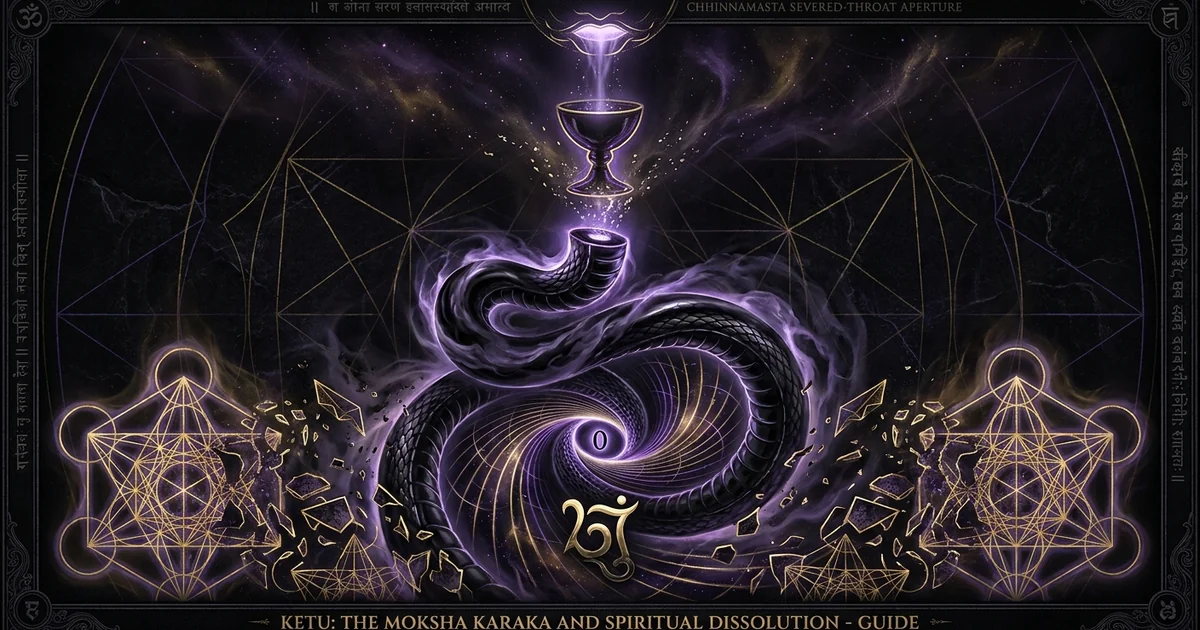
Ketu: The Moksha Karaka and Spiritual Dissolution - Guide
Archetypal Thesis & Systemic Paradigm: The Apophatic Singularity of Ketu
The Vacuum State of Consciousness: Decoupling from the Ahamkara
Within the computational geometry of Jyotish, Ketu occupies an ontological position distinct from the seven embodied planetary bodies (sapta grahas). Possessing neither physical mass nor perceptible surface, Ketu functions as a chhaya-graha—a shadow planet derived from the southern intersection of the lunar orbital path and the solar ecliptic. Where conventional planetary archetypes broadcast specific energetic frequencies that build, sustain, and organize sensory reality, Ketu behaves as a localized collapse operator. It introduces a structural vacuum into the psychic topography of the native.
This vacuum state does not signify simple non-existence; rather, it represents the ontological baseline prior to the emergence of forms. In classical Indian epistemology, the psychic apparatus (antahkarana) constructs an operative simulation of individual existence through the agency of the ahamkara (the “I-maker”). The ahamkara binds sensory inputs, emotional valences, and memory traces into a continuous, reified ego. Ketu severs these binding agents. By introducing an entropic tear into the fabric of localized identity, this nodal point dismantles the sensory matrices generated by Maya.
Through the mechanism of apophatic negation—formalized in Advaita Vedanta as neti, neti (“not this, not that”) and mirrored in Western apophatic theology—Ketu denies the ultimate reality of any transient phenomenon to which consciousness attaches. When interacting with personal planets, Ketu strips away their narrative signifiers. A Sun-Ketu conjunction burns away the self-aggrandizing persona; a Venus-Ketu contact systematically exposes the insufficiency of romantic projection. This process is rarely an act of punitive deprivation. Instead, it constitutes a radical psycho-cosmological deconditioning, compelling consciousness to withdraw from exteriorized projections and recognize its fundamental substrate as unconditioned awareness.
THE SENSORY MATRIX (MAYA)
                             │
            [ Ahamkara / Egoic Construction ]
                             │
       ┌─────────────────────┴─────────────────────┐
       ▼                                           ▼
 Centrifugal Vector                         Centripetal Void
  Rahu (North Node)                         Ketu (South Node)
  Desire & Materialization                  Negation & Dissolution
  Sensory Proliferation                     Apophatic Reduction
       │                                           │
       ▼                                           ▼
[ Cosmic Entanglement ]                     [ Spiritual Emancipation ]
(Moksha)Astronomical Coordinate: The descending or South Lunar Node, defined by the orbital plane of the Moon intersecting the ecliptic southward at $\Omega - 180^\circ$.
Physical Dimension: Non-luminous, immaterial mathematical singularity (chhaya-graha); possesses no physical mass, exercising gravitational and psychotropic influence entirely through the modulation of solar-lunar light matrices.
Subtle Element (Tattva): Transmuted elemental Fire (Agni) operating through the medium of the transcendent Void (Akasha).
Dignities: Exalted (uccha) in Sagittarius (Dhanu) or Scorpio (Vrischika) depending on canonical lineage; moolatrikona in Pisces (Meena); debilitated (neecha) in Gemini (Mithuna) or Taurus (Vrishabha).
Primary Archetypal Function: Moksha Karaka (significator of spiritual liberation, final release, non-dual realization, and somatic transcendence).
The Thermodynamic Inversion: Dissolution Versus Accumulation
From an energetic and cybernetic standpoint, the planetary pantheon of Jyotish operates primarily as an accumulative economy. Benefics such as Jupiter (Guru) and Venus (Shukra) increase social capital, conceptual wisdom, and somatic pleasure, while malefics like Saturn (Shani) and Mars (Mangala) apply structural pressure through energetic consolidation, stress testing, and boundary enforcement. Ketu executes a thermodynamic inversion of these principles. It introduces negative entropy to psychic systems, functioning not by adding complexity, but through systematic substraction.
Where modern consumerist paradigms and Western esoteric adaptations frequently conceptualize spiritual evolution as an additive process—the acquisition of virtues, higher dimensions, or astral perceptions—Ketu enforces an inverse trajectory. Liberation (moksha) requires the systematic liquidation of sanchita karma (accumulated actions) and the cooling of trishna (thirst or craving). In the psychological domain, this dynamic manifests as acute alienation from the domains governed by Ketu’s natal house and planetary associations. The native finds that conventional strategies of acquisition yield diminishing psychological returns within these specific sectors.
This structural dynamic explains why modern psychological astrology often struggles with the South Node. Inheriting evolutionary models that privilege progressive accretion, Western methodologies frequently relegate the South Node to passive “ancestral comfort zones” or “outgrown past-life habits” that must be abandoned in favor of the North Node’s evolutionary novelty. In contrast, authentic Vedic hermeneutics frames the /astrology/rahu-north-node-material-desire-maya axis as an interdependent metabolic system. Rahu ingests the phenomenal world to generate raw experiential data, while Ketu digests, burns, and excretes the narrative remnants, extracting only the non-dual essence of liberation. Ketu is not a passive residue; it is an active, incisive scalpel that severs temporal attachments to initiate spiritual enlightenment.
The Headless Torso (Kabandha) as Pre-Reflective Awareness
The primary zoomorphic and anthropomorphic representation of Ketu across classical iconographical treatises is that of Kabandha—the headless torso, often terminating in the tail of a serpent. This iconography carries profound epistemological implications. The head is the locus of dualistic processing: it houses the ocular organs of visual distinction, the linguistic mechanisms of semantic categorization, and the sensory apparatus through which subject-object division is constructed. To be headless is to be deprived of dualistic vision.
Consequently, Ketu operates outside the domain of discursive intellect (manas and buddhi). While a native under strong Mercurial influence interprets reality through taxonomy, logic, and semiotic relationships, a prominent Ketu configuration enforces non-discursive, pre-reflective awareness. Ketu does not “think” reality; it apprehends existence through an unmediated somatic and suprarational gnosis. This state corresponds closely to what phenomenology identifies as pure intentionality prior to thematic reflection, or what early Buddhist metaphysics terms nirvikalpa—awareness devoid of conceptual construction.
This headless nature renders Ketu unpredictable within social hierarchies that require discursive defense, rationalization, and narrative cohesion. Under Ketu’s influence, actions are taken without discursive calculation; they emerge from deep unconscious currents, ancestral memory banks, or supra-individual spiritual directives. For an individual entrenched in egoic control, this lack of conceptual oversight feels like blindness, chaos, or madness. For the initiated practitioner, it manifests as total detachment in Jyotish: an immediate, instinctual alignment with cosmic mechanics that bypasses the friction of conceptual deliberation entirely.
Classical Provenance & Textual Lineage: The Samudra Manthan and Purana Epistemology
The Mythologem of Svarbhanu: Decapitation and Dual Manifestation
The canonical genesis of Rahu and Ketu is preserved within the Puranic corpus, most prominently in the Vishnu Purana, the Mahabharata (Adi Parva), and the Bhagavata Purana. The narrative of the Samudra Manthan—the churning of the cosmic milk ocean—delineates the polarization of raw cosmic energy into manifest dualities. The Devas (suras of order and solar radiance) and the Asuras (titans of chaotic potential and chthonic power) employed the serpent Vasuki coiled around Mount Mandara to extract the ultimate nectar of immortality, Amrita.
THE PRIMORDIAL CHURNING (SAMUDRA MANTHAN)
                                │
               [ Serpent Vasuki / Cosmic Axis ]
                                │
       ┌────────────────────────┴────────────────────────┐
       ▼                                                 ▼
 The Solar Devas                                   The Asuras
 Cosmic Maintenance                               Primordial Will
       │                                                 │
       └────────────────────────┬────────────────────────┘
                                │
                    [ Emergence of Amrita ]
                                │
                 [ Infiltration by Svarbhanu ]
                                │
                  [ Sudarshana Chakra Strike ]
                                │
       ┌────────────────────────┴────────────────────────┐
       ▼                                                 ▼
Rahu (Head / Caput Draconis)               Ketu (Body / Cauda Draconis)
Ocular Vision, Insatiable Hunger           Sensory Deprivation, Pure Void
Pranayama of Ingestion                     Pranayama of Apana / Release
During the distribution of the Amrita, the Asura Svarbhanu disguised himself as a Deva, positioning himself strategically between the luminaries Surya (the Sun) and Chandra (the Moon). As Svarbhanu ingested the nectar, the luminaries detected the subterfuge and alerted Mohini, the female avatar of Vishnu. Mohini instantly severed Svarbhanu’s neck with the Sudarshana Chakra—the rotating solar disc representing inexorable cosmic order (Rta) and temporal division.
Because the nectar had passed the Asura’s throat, both severed parts attained immortal status. The head was christened Rahu; the severed, tail-bearing torso became Ketu. Far from an arbitrary mythological punishment, this cosmogony represents the ontological birth of linear time and psychological cleavage. The unified Asuric force was polarized into:
- Rahu: Optical perception, conceptual hunger, sensory craving, forward temporal projection, and centrifugal amplification of material forms.
- Ketu: Headless intuition, sensory cessation, vacuum processing, ancestral withdrawal, and the centripetal return to the unmanifest absolute.
Sanskrit Formulation:
धूम्राकारो नीलकण्ठः शिखी ज्ञेयो महाबलः।
केतुः शून्यमयो नित्यं मोक्षदः क्रूरचेष्टितः॥
Translation and Academic Commentary:
“Ketu has a smoky (Dhumra) appearance, possesses a dark or blue-hued throat, bears the crest of hair (Shikhi), is endowed with immense subtle potency, is inherently composed of the void (Shunyamaya), eternally bestows spiritual liberation (Mokshada), and acts with ruthless, incisive behavior.”
Parashara’s attribution of Dhumra (smokiness) signifies the perceptual occlusion of physical phenomena coincident with the unveiling of the subtle light. The descriptor Shunyamaya cements Ketu’s primary ontological status as an instantiation of the ultimate Void (Shunyata). By qualifying its actions as krura-cheshtita (cruel or fierce in operation), Parashara clarifies that spiritual emancipation is rarely gentle to the ego; it requires the ruthless excoriation of transient identifications.
Canonical Inscriptions in Brihat Parasara Hora Sastra and Phaladeepika
In foundational astrology treatises, Ketu’s mechanical operations are framed with analytical precision. Sage Parashara, in the Brihat Parasara Hora Sastra (BPHS), treats Ketu not as an incidental anomaly, but as a pivotal karmic vector. Parashara assigns Ketu the status of Kulik and Shikhi (the crested one, or the flagbearer), noting that its gaze (drishti) does not operate through the conventional planetary aspects, but rather through diffuse, destabilizing projections that negate the material security of houses it influences.
Significantly, Parashara accords Ketu the supreme karakatva over spiritual liberation: Ketu-moksha-karaka. While Jupiter acts as the karaka for Dharma (cosmic order, ethics, and philosophical systems), Ketu governs the actual exit velocity from the cycle of rebirth (Samsara). This differentiation is critical: Jupiter sanctifies and elevates the world of forms, whereas Ketu dissolves it entirely.
In the 16th-century treatise Phaladeepika, Mantreswara elaborates upon these dynamics, establishing structural rules for predicting nodal outcomes. Mantreswara states:
Yad-bhava-gatau va yadvad-ishetau…
(Nodes deliver the results of the houses they occupy and the rulers of those houses with enhanced, catalytic volatility.)
When Ketu occupies the moksha-trikona (Houses 4, 8, and 12), it strips the respective life-spheres of mundane utility. In the 4th house, it dissolves domestic and psychological security, directing the native toward internal refuge. In the 8th house, it triggers acute occult perceptions, structural kundalini eruptions, and catastrophic encounters with the chthonic realms. In the 12th house—its classical position of highest spiritual efficacy—it unlocks total unbinding, monastic isolation, and the dissolution of identity into the unmanifest ocean of pure consciousness.
The Transmission from Tantric Codices to Medieval Jyotish Commentaries
Outside the mainstream legalistic and prognostic traditions, the Tantric lineages preserved a parallel, esoteric reading of Ketu. In texts such as the Siva Svarodaya and the commentaries on the Lalita Sahasranama, Ketu is intrinsically associated with the dissolution of the prana vayu into the central spinal channel, the Sushumna Nadi. In these manuals of subtle physiology, Rahu governs the left channel (Ida Nadi, lunar, ingestive, materializing), while Mars and Ketu rule the transformative and upwardly transmuting fires of the right and central channels (Pingala and Sushumna).
Medieval astrological commentators such as Vaidyanatha Dikshita (Jataka Parijata) and Balabhadra (Hora Ratnam) codified this Tantric undercurrent, recognizing that Ketu’s combustion does not destroy consciousness, but liberates it from the koshic sheaths (the bodily layers). They noted that while a malefic aspect on Ketu produces psychological alienation, paranoia, and physical ailments related to the nervous system, deep tissues, and cryptic diseases, its well-aspected deployment precipitates spontaneous mystical illumination. In these lineages, Ketu is viewed as the internal flag (Ketu meaning “comet,” “meteor,” or “ensign”) that marks the ultimate battlefield where the individual soul (Jiva) confronts and dissolves its illusion of separation from the supreme reality (Brahman).
Structural Mechanics & Symbolic Geometry: The Nodal Axis and the Moksha Trikona
The Polar Complementarity: The Rahu-Ketu Dipole Axis
The lunar nodes cannot be understood as discrete planetary entities; they operate as a single, polarized electromagnetic and psycho-spiritual axis. By immutable astronomical definition, Ketu resides exactly 180 degrees opposite Rahu. This spatial polarity represents a continuous energetic circuit:
                           THE NODAL DIPOLE

        CENTRIFUGAL                                 CENTRIPETAL
        [ RAHU ] ◄───────────────────────────────► [ KETU ]
        North Node                                  South Node
        Amplification                               Subduction
        Hunger (Graha)                              Release (Moksha)
        Future Projections                          Ancestral Resolution
        Psychic Inflation                           Psychic Evacuation
Where Rahu generates an intense centrifugal force that flings the native into unprecedented karmic territory, experiential hunger, and novel sociopolitical frontiers, Ketu produces an equal and opposite centripetal pull toward the core. Rahu creates moha (delusion) through identification with newly acquired forms; Ketu creates vairagya (dispassion) through visceral recognition of the transience of those very forms.
This dipole operates as an existential gyroscope within the natal chart. If an individual attempts to pursue the ambitions of Rahu without integrating the releases demanded by Ketu, the psychological system destabilizes. The house occupied by Ketu marks the structural leak in the native’s psychic vessel—a realm where material energy inevitably drains away to prevent the absolute calcification of the ego.
Attempting to dam this drain inevitably induces neurotic pathology. The native who strives to accumulate wealth in the 2nd house with Ketu positioned there experiences constant financial volatility, linguistic paralysis, or family alienation until they accept that the 2nd house must become an instrument of detachment, speech devoid of manipulation, and unattached stewardship.
Rahu: The Centrifugal Vector of Maya
- Physiological Representation: Head without a body (Sira); eyes, mouth, discursive sensory instruments.
- Direction of Force: Centrifugal; outwards into evolutionary novelty, ambition, and proliferation.
- Psychological Signature: Obsession, insatiable appetite, imposter syndrome, sensory overstimulation, forward projection.
- Epistemological Mode: Empirical-rational, exploratory, boundary-violating, dependent on external validation.
- Karmic Velocity: Generation of new karmic momentum (Kriyamana Karma); building systemic complexity.
Ketu: The Centripetal Vector of Moksha
- Physiological Representation: Body without a head (Kabandha); heart, visceral gut, spine, the tail of serpent.
- Direction of Force: Centripetal; inwards toward systemic collapse, dissolution, and primordial zero.
- Psychological Signature: Apathy, profound dispassion (Vairagya), alienation, sudden severance, hyper-intuition.
- Epistemological Mode: Somatic-suprarational, apophatic, neti-neti reduction, unconditioned gnosis.
- Karmic Velocity: Liquidation of past residual imprints (Sanchita Karma); radical systemic simplification.
Mapping the Moksha Trikona: Houses 4, 8, and 12
The deployment of Ketu within the moksha-trikona—the three houses constituting the water triplicity dedicated to emotional integration, psychic transformation, and spiritual emancipation—yields its most potent psycho-cosmological dynamics.
THE MOKSHA TRIKONA OF KETU
                                 │
     ┌───────────────────────────┼───────────────────────────┐
     ▼                           ▼                           ▼
[ 4th House ]               [ 8th House ]              [ 12th House ]
Psychological Emptiness     Chthonic Transmutation     Total Unbinding
Loss of External Refuge     Piercing of the Kundalini  Parama-Moksha
Discovery of Atman          Catastrophic Insight       Solitude as Liberation
The 4th House (Bandhu Bhava / Sukha Bhava)
Positioned in the realm of the psychological foundation, maternal nourishment, and domestic peace, Ketu acts as a solvent upon conventional emotional security. The individual frequently experiences an emotional disconnect from the mother figure or a pervasive, groundless sense of homelessness, even when situated within physical affluence.
The structural teleology of this placement is the forced realization that domestic architecture and ancestral lineage cannot provide existential sanctuary. Denied an external psychological resting place, the consciousness is driven inward to construct an unshakeable inner citadel, grounding its sense of safety in the unmoving Atman rather than emotional feedback loops.
The 8th House (Randhra Bhava)
The 8th house governs systemic destruction, secret dimensions, involuntary crises, and the transmutation of primal energetic forces. Here, Ketu acts as an incisive scalpel slicing through the veil of mortal fear. This configuration often precipitates sudden psychophysical emergencies, involuntary awakenings of the kundalini-shakti, and intense encounters with the collective unconscious.
The native possesses an instinctual, non-intellectual comprehension of metaphysical systems, ancestral hexes, and the mechanics of death. When integrated, Ketu in the 8th house strips the ego of its illusions of physical and psychological immortality, transforming the native into a potent psychopomp, healer, or occult initiate who has traversed the alchemical underworld.
The 12th House (Vyaya Bhava)
Widely celebrated across classical commentaries as the optimal astrological placement for Ketu, the 12th house represents ultimate dissolution, loss, institutional confinement, dreams, and exit routes from cyclic existence. Ketu residing in this house functions as the literal key to moksha. Because the 12th house naturally signifies the liquidation of assets, egoic boundaries, and physical coherence, Ketu feels instantly native to this environment.
The individual experiences an intrinsic gravitational pull toward solitary contemplation, ashram environments, or foreign shores where their native identity is thoroughly deconstructed. The capacity for lucid dreaming, conscious ego-death, and meditative absorption (Samadhi) is dramatically elevated. The 12th-house Ketu demands the voluntary sacrifice of personal sovereignty in exchange for oceanic absorption into the transcendent absolute.
Ketu’s Nakshatra Triad: Ashwini, Magha, and Mula
Ketu’s cosmological mandate is further revealed through its exclusive rulership over the initial Nakshatras of the three Fire signs of the zodiac: Aries, Leo, and Sagittarius. These Nakshatras demarcate the critical thresholds of evolutionary development where consciousness transitions from one elemental triad to the next:
- Ashwini ($0^\circ00’ - 13^\circ20’$ Aries): Positioned at the absolute beginning of the zodiacal wheel, Ashwini holds the creative primordial spark. Under Ketu’s rulership, Ashwini channels the swift, miraculous healing power of the Ashwini Kumaras (the celestial physicians). It represents the miraculous somatic leap—the sudden infusion of life-force (prana) out of the non-manifest void into somatic reality. Ketu here acts as the psychic surgeon, operating with electric rapidity to excise energetic blockages.
- Magha ($0^\circ00’ - 13^\circ20’$ Leo): Located at the seat of solar authority and personal sovereignty, Magha governs the ancestral throne (Pitris). Ketu’s dominion over this lunar mansion reveals a structural paradox: to truly assume sovereignty, the ego must step out of personal vanity and become an empty vessel for transpersonal, ancestral currents. Magha demands the sacrificial purification of lineage patterns; Ketu strips the royal crown of its personal hubris, transmuting worldly authority into spiritual stewardship.
- /astrology/nakshatra-mula-annihilation-root ($0^\circ00’ - 13^\circ20’$ Sagittarius): Presided over by Nirriti, the dark goddess of destruction, dissolution, and cosmic realignment, Mula represents Ketu’s most uncompromising planetary expression. Situated directly over the supermassive black hole at the Galactic Center, Mula literally signifies the “root.” Ketu in Mula executes absolute botanical and structural devastation, tearing down systems, institutions, and psychological structures that are built on false foundations. It exposes the bare, unvarnished existential root, demonstrating that total annihilation of phenomenal illusions is the absolute prerequisite for spiritual rebirth.
Psychological Dynamics & Operational Praxis: Archetypal Nigredo and Somatic Intuition
Ketu as the Jungian Shadow: Encountering the Void and Nigredo
Through the analytical prism of Carl Gustav Jung’s depth psychology, Ketu emerges as an astrological signifier of the encounter with the archetypal Shadow and the subsequent initiation into the Nigredo—the blackening, mortification, and radical dissolution foundational to the alchemical Magnum Opus. While Western astrology often associates the Shadow predominantly with Saturn or Pluto, Ketu embodies an even deeper stratum: the terrifying, un-representable void of the unconscious that threatens the total annihilation of the ego-complex itself.
Source: Carl Gustav Jung, Mysterium Coniunctionis (Collected Works Vol. 14, §§ 67–72) & The Archetypes and the Collective Unconscious (CW 9/1).
Synthesis: In his exploration of the alchemical solutio and mortificatio, Jung underscores that before any authentic self-realization (Individuation) can occur, the psychic structures that maintain the conscious persona must be degraded and pulled down into the prime matter (prima materia).
Jung notes: “The nigredo is that state of despair, emptiness, and disorientation wherein the conscious mind realizes its total impotence to direct the psyche… It is the indispensable dismemberment (dismembratio) of the old king so that a new consciousness, no longer identical with the localized ego, may emerge.”
This structural dismemberment corresponds cleanly with Ketu’s headless iconography (Kabandha). The dissolution initiated by Ketu is not an encounter with simple personal neurosis, but a collision with the autonomous, numinous Void that forces the human vessel into absolute, unresisted surrender.
During Ketu-dominated psychological intervals—most acutely observed in transits over sensitive natal points or during the execution of its planetary period—an individual enters an authentic alchemical-nigredo. The standard apparatus of emotional projection and psychological compensation collapses. The native experiences a distinct variety of depression that resists typical therapeutic remediation: an “existential apathy” born of the sudden transparency of worldly pursuits.
Career triumphs, financial security, and romantic validations feel like empty shells devoid of psychological sustenance. This is the surgical operation of Ketu: stripping the psychological projections of their numinous charge so that the individual can no longer seek the divine within finite containers.
                    THE ALCHEMICAL CYCLE OF KETU
                                 │
             [ Identification with Persona / Maya ]
                                 │
     ┌───────────────────────────┴───────────────────────────┐
     ▼                                                       ▼
  Rahu Inflation                                     Ketu Intervention
(Craving, Expansion)                                (Sudden Severance)
     │                                                       │
     ▼                                                       ▼
Karmic Entanglement                                 Alchemical Nigredo
                                                    (Egoic Mortification)
                                                             │
                                                             ▼
                                                    Non-Dual Awareness
                                                     (Somatic Gnosis)
Somatic Knowing and Headless Cognition: Beyond Conceptual Dialectics
Because Ketu lacks the ocular and linguistic instruments associated with the head, charts characterized by prominent Ketu placements display highly developed forms of somatic and post-rational intelligence. The individual does not deduce truth through classical syllogistic structures or empirical documentation; they “know” truth through visceral resonance within the body tissues, gut complexes, and autonomic nervous systems.
This somatic intelligence manifests as an instinctual polygraph. In interpersonal interactions, a native operating under refined Ketu dynamics bypasses the semantic content of an individual’s speech, tracking instead the subtle dissonances in their energetic presence. The native experiences profound, immediate revulsion or deep, non-rational comfort based entirely on subconscious structural frequencies. This capacity renders such individuals exceptional diagnosticians, intuitive researchers, software debuggers, and deep analysts. They perceive where an intricate systemic flow is broken not because they have traced every linear pathway, but because the systemic error registers as an immediate, unpleasant contraction within their own neuro-somatic framework.
This headless cognition carries significant clinical and psychological implications. When an individual attempts to force Ketu’s perceptions into traditional discursive language, they experience stammering, intense intellectual fatigue, or profound frustration. The insights of Ketu are holographic, non-linear, and instantaneous. They correspond precisely to the Hermetic concept of gnosis—direct, experiential illumination that dissolves the dialectical distance between the observer and the observed.
Remedial Praxis and Hermetic Integration: Meditation, Yantras, and Non-Attachment
The remediation (upaya) of Ketu in traditional Jyotish and Hermetic practice differs fundamentally from the remediation of embodied planets like Jupiter or Venus. One does not attempt to “propitiate” Ketu with transactional rituals aimed at material acquisition, nor can one appease it by feeding its desires, for Ketu desires nothing. Attempting to bribe Ketu into granting worldly success is an ontological impossibility; such efforts only provoke its fierce, disruptive nature.
The proper operational praxis for integrating Ketu involves total psycho-behavioral alignment with its intrinsic mechanics:
The Practice of Radical Non-Attachment (Vairagya)
The native must identify the specific house occupied by Ketu and systematically surrender egoic ownership over that domain. If Ketu occupies the 10th house, professional work must be conducted purely as an offering (seva), utterly detached from public reputation, institutional accolades, or career trajectory. The paradox of Ketu is structural: the moment the native genuinely abandons the desperate hunger for outcome in that house, Ketu ceases its disruptive excoriations, frequently leaving unexpected worldly success in its wake, since the native can no longer be corrupted by it.
Apophatic Meditation and Sensory Deprivation
Classical techniques such as Trataka (fixed gazing) on a point of darkness, prolonged silent retreats, sensory deprivation environments, and non-dual contemplation (Advaita self-inquiry, “Who am I?”) directly mirror Ketu’s operational frequency. In these practices, the conceptual mind is consciously suspended, providing a controlled environment for the ego-death that Ketu otherwise extracts through disruptive life circumstances.
Yantric and Deific Alignments
In the Vedic pantheon, Ketu’s presiding deity is Ganesha—specifically in his role as Vighnaharta (the remover and placer of obstacles)—and Matsya, the primordial Fish Avatar of Vishnu who navigates the chaotic waters of cosmic dissolution (Pralaya). Mantric engagement with the Ketu Bija Mantra:
$$\text{Om Kem Ketave Namah}$$
vibrates at a frequency that stills the turbulence of the lower mind. Similarly, the ritual deployment of the Ketu Yantra, constructed from dark smoky quartz, cat’s eye (Vaidurya), or engraved upon silver, provides a disciplined focal point to channel chaotic, ungrounded psychic intrusions into stable geometric structures of non-dual contemplation.
Philosophical Synthesis & Macrocosmic Correspondence: The Cybernetics of Liberation
Cybernetic Feedback: Ketu as the Systemic Garbage Collector
The operation of Ketu can be translated cleanly into the formal language of systems theory and computer architecture. In complex software ecosystems, memory allocation is dynamic: processes continuously spawn data structures, allocate resources, and generate operational caches to execute their designated subroutines. If an operating system possesses no automated mechanism to identify and purge memory allocations that are no longer referenced by active processes, the system inevitably experiences memory leaks. Unreferenced, obsolete data structures accumulate, consuming available RAM, until the entire operational environment undergoes catastrophic failure.
To avert this collapse, computational runtimes employ an autonomous, low-level process known as the garbage collector. The garbage collector operates continuously in the background, tracing the graph of object references. When it detects a data structure to which no active thread of execution holds a pointer, it immediately deallocates the memory, returning it to the unallocated, pristine pool of systemic potential.
THE KETU GARBAGE COLLECTION ENGINE
                                     │
           [ Continuous Karmic Computation (Samsara) ]
                                     │
    ┌────────────────────────────────┴────────────────────────────────┐
    ▼                                                                 ▼
Active Process Threads                                    Orphaned Karmic Memory
(Conscious Evolution)                                     (Obsolete Psychological Attachments)
    │                                                                 │
    │                                                     [ Ketu Scan & Deallocation ]
    │                                                                 │
    └────────────────────────────────┬────────────────────────────────┘
                                     ▼
                      [ Restored Systemic RAM ]
                     (Pure Pristine Awareness)
In the cybernetics of consciousness, Ketu is precisely this systemic garbage collector. The individual human mind (Jiva) relentlessly allocates emotional and narrative resources to transient phenomena: old trauma narratives, expired ancestral obligations, obsolete identities, and dead ideological systems. These unpurged mental loops constitute karmic debt (sanchita karma).
Without Ketu’s relentless intervention, the human psychic apparatus would suffer irreversible systemic crash through experiential bloat and informational entropy. Ketu scans the energetic system for patterns that have exhausted their evolutionary utility. It then strikes with surgical precision, terminating the process and deallocating the psychic energy bound within it. The ego cries out in agony, misinterpreting the deallocation of an obsolete mental construct as the destruction of its personal self; yet the larger systemic architecture is preserved, cleansed, and recalibrated toward equilibrium.
The Hermetic Mirror: Macrocosmic Void and Microcosmic Kundalini
The Hermetic axiom Quod est inferius est sicut quod est superius (“That which is below is like that which is above”) finds its most rigorous astrological verification in the correspondence between Ketu’s cosmic mechanics and the subtle physiology of the human bio-circuit. Macrocosmically, Ketu is the dark rift in the Milky Way, the cosmic void from which the stars are born and into which they collapse. Microcosmically, it represents the awakened ascent of the Kundalini Shakti through the Sushumna Nadi.
In traditional yogic anatomy, the subtle body is constricted by three primordial energetic knots (granthis) that prevent the ascent of awareness from the animalistic baseline to absolute transcendence:
- Brahma Granthi: The knot of physical identification, localized at the Muladhara and Svadhisthana chakras, binding the soul to material survival and sensory addiction.
- Vishnu Granthi: The knot of emotional and relational identification, localized at the Anahata and Vishuddha chakras, binding the soul to emotional dynamics, compassion, and conceptual prestige.
- Rudra Granthi: The knot of intellectual and spiritual identification, situated precisely at the Ajna chakra (the third eye), which binds the soul to the ultimate duality: the subtle distinction between the knower and the known, the mystic and the divine reality.
                   THE PIERCING OF THE THREE GRANTHIS
                                    │
           [ Sahasrara: Non-Dual Realization (Kaivalya) ]
                                    ▲
                                    │ ◄─── Rudra Granthi Pierced by Ketu
                       [ Ajna: Third Eye Vision ]
                                    │
                                    ▲
                                    │ ◄─── Vishnu Granthi
                     [ Anahata: Emotional Matrix ]
                                    │
                                    ▲
                                    │ ◄─── Brahma Granthi
                     [ Muladhara: Physical Ground ]
While Mars and Saturn can assist in wearing down the lower two knots through physical discipline and suffering, only Ketu possesses the acute, non-dual voltage necessary to rupture the Rudra Granthi. When Ketu pierces this final knot, the optical vision of the two physical eyes is completely superseded by the singular, non-dual aperture of the third eye.
The illusion of an individual observer residing “inside” the skull looking “out” at an external universe is permanently liquidated. The serpent Vasuki, whose severed body constitutes Ketu, completes its macrocosmic loop: the tail and the head re-fuse, not in cyclic reincarnation, but through the complete collapse of temporal sequence into the eternal Now.
The Final Exit: Parama-Moksha and the Complete Zero-Point State
The ultimate philosophical teleology of Ketu is the attainment of Parama-Moksha—supreme, irreversible liberation from cyclic existence. This state corresponds directly to what Mahayana Buddhist philosophy designates as Shunyata (absolute Emptiness or Openness) and what classical Samkhya-Yoga formulates as Kaivalya (absolute, isolated independence of pure consciousness from material nature).
A fundamental error in both Western occultism and degraded forms of exoteric religion is the presumption that liberation is an acquisitive, additive state. Practitioners routinely conceptualize enlightenment as an ascension into radiant, luminous realms where the individual enjoys eternal pleasure, infinite knowledge, and celestial companionship. Ketu refutes this childish theology. Ketu reveals that liberation is not the acquisition of any state, however elevated, celestial, or refined. Every state that can be acquired can also be lost; every energetic matrix that is composed must inevitably decompose.
Liberation, as mediated by the ultimate operation of Ketu, is the absolute, irrevocable subtraction of every contingent architecture. It is the realization of the Zero-Point State. When every false identification with the physical body, the emotional turbulence, the intellectual taxonomies, and even the sublime spiritual archetypes is systematically evacuated through neti, neti, what remains is not an empty, terrifying nothingness, but the luminous, unconditioned Ground of Being itself. Ketu does not illuminate the self; Ketu annihilates the false witness, leaving only that which cannot be destroyed because it was never born.
Frequently Asked Questions: Decoding the Mysteries of the South Node
Is Ketu Always Harmful for Material Prosperity and Career?
Ketu does not possess an inherent structural mandate to destroy material wealth, professional status, or commercial enterprise; its mandate is solely to sever psychological attachment to those constructs. When Ketu occupies houses associated with material prosperity—such as the 2nd house (accumulated wealth), the 10th house (career achievements and institutional authority), or the 11th house (social networks and collective gains)—it frequently precipitates a paradoxical psychological dynamic.
The native often achieves substantial mastery, high status, or exceptional wealth precisely because they possess zero grasping hunger for those outcomes. Unlike an individual dominated by Rahu, who acts with frenetic anxiety to preserve and expand their acquisitions, an individual operating through a mature Ketu functions with complete emotional dispassion. They can walk away from vast fortunes or elite corporate and political roles without psychological crisis, for their sense of self is not anchored in those external matrices.
However, if a native approaches these sectors with strong possessiveness, Ketu executes its classic surgical divestment. It will dismantle the commercial enterprise through sudden, cryptic disruptions, unforeseen tax interventions, structural re-organizations, or profound bureaucratic apathy until the individual realizes that they are merely an unattached steward, not the permanent owner, of those material assets.
How Does Ketu Function During Its 7-Year Vimshottari Dasha?
The planetary period (Dasha) of Ketu lasts precisely seven years within the 120-year /astrology/vimshottari-dasha-planetary-periods-guide scheme. Occurring immediately after the long, 17-year period of Mercury—which is characterized by rapid conceptual development, business networking, intellectual expansion, and communicative processing—the onset of the Ketu Dasha acts as an abrupt energetic brake.
The native is abruptly decoupled from the discursive, hyper-connected Mercurial reality. The first phase of this dasha often induces an intense sense of psychological vertigo, alienation, and confusion:
THE MERCURY-TO-KETU TRANSITION
                                 │
           [ Mercury Dasha: 17 Years of Accretion ]
           (Commerce, Intellect, Societal Integration)
                                 │
                                 ▼
              [ Sudden Nodal Shift / Structural Brake ]
                                 │
           [ Ketu Dasha: 7 Years of Liquidation ]
           (Ascesis, Neti-Neti, Systemic Recalibration)
                                 │
     ┌───────────────────────────┼───────────────────────────┐
     ▼                           ▼                           ▼
[ Years 1 - 2.5 ]           [ Years 2.5 - 5 ]          [ Years 5 - 7 ]
Identity Deconstruction     Internal Withdrawal         Emergence of Detached
Social Decoupling           Metaphysical Rebirth        Non-Dual Mastery
The standard strategies for social validation fail to produce results. Friends, professional networks, and even intimate partners may drift away without overt conflict, severed by an invisible current of mutual irrelevance.
During the mid-phase of the dasha (roughly years 2.5 through 5), the native is driven deeply inward. This is the classic window for monumental spiritual transformations, spontaneous kundalini activations, long periods of hermetic isolation, and intensive immersion in occult or computational disciplines.
The terminal phase of the dasha (the sub-periods of Mercury and Ketu closing the cycle) consolidates this deconstruction, stabilizing the individual as an intensely focused, egoically purged instrument. When the individual transitions into the subsequent 20-year Venus Dasha, they re-enter the worldly theater of relationships and beauty, but with a profound, structural invulnerability: they have touched the Void, and can never again be completely ensnared by the forms of Maya.
What Differentiates Ketu’s Spiritual Influence from Jupiter’s Wisdom?
While both Jupiter (Guru) and Ketu (Moksha Karaka) are spiritual signifiers within Jyotish, their philosophical epistemologies, cognitive mechanics, and structural manifestations are diametrically opposed:
               THE TWO EPISTEMOLOGIES OF LIBERATION
                                 │
       ┌─────────────────────────┴─────────────────────────┐
       ▼                                                   ▼
[ Jupiter / Guru ]                                 [ Ketu / Shikhi ]
Kata-phatic (Additive)                             Apophatic (Subtractive)
Dharmic Accretion                                  Mokshic Dissolution
The Ethical Sage                                   The Silent Ascetic
Expansion of Frameworks                            Incineration of Frameworks
Jupiter operates through kataphatic theology (the path of affirmation), while Ketu operates through apophatic theology (the path of negation).
Jupiter is the arch-priest, the supreme legal authority, the ethical philosopher, and the builder of comprehensive worldviews. Jupiterian spirituality proceeds by accretion: the native masters sacred scriptures, practices precise ethical disciplines, cultivates universal benevolence (karuna), and builds vast metaphysical cosmologies. Jupiter integrates the individual smoothly into the cosmic order (Dharma), harmonizing their existence with family, society, and the gods.
Ketu is the wandering, silent Avadhuta, the fierce Aghori residing in the cremation grounds, the radical Zen master who cuts through theoretical dialectics with a single strike. Ketu does not build cosmologies; it incinerates them. It does not teach ethics; it forces non-dual realization beyond the duality of virtue and sin.
Jupiter provides theoretical, conceptual wisdom (Jnana); Ketu produces the unmediated, non-conceptual experiential realization (Vijnana or Prajna). Jupiter guides the soul through the luminous heavens of the higher planetary realms; Ketu unplugs the soul from the cosmic game entirely, demanding total, absolute release from cyclic becoming.
Can Ketu Facilitate Genius or Scientific Breakthroughs?
While common, exoteric astrological lore typically attributes scientific and technological innovation strictly to Mercury (logic, programming), Rahu (unconventional, futuristic paradigms, synthetic intelligence), or Uranus (sudden breakthroughs), prominent classical commentators and modern analytical observation prove that exceptional genius is frequently mediated by a refined Ketu.
The genius facilitated by Ketu is fundamentally different from the iterative, experimental method of Mercury or the speculative boldness of Rahu. Ketu produces what can be characterized as algorithmic, non-local insight. It operates within the realms of extreme abstraction: pure mathematics, quantum mechanics, cryptic decryption, theoretical physics, and high-level software engineering.
Because Ketu represents the headless, singular point of awareness, it allows a researcher or theoretician to hold vast, complex multidimensional architectures in the mind simultaneously, perceiving the singular structural defect or systemic elegance without linear step-by-step computation.
MODES OF INTELLECTUAL COGNITION
                                 │
     ┌───────────────────────────┼───────────────────────────┐
     ▼                           ▼                           ▼
[ Mercury ]                 [ Rahu ]                    [ Ketu ]
Linear Iteration            Disruptive Innovation       Holographic Collapse
Taxonomy & Logic            Boundary Breaking           Algorithmic Compression
Step-by-Step Proof          Synthesized Matrices        Immediate Direct Gnosis
Many foundational physicists, mathematicians, and programming pioneers feature Ketu conjunct the Sun, Mercury, or residing in the 5th or 9th houses of higher cognition. Ketu provides the capacity for prolonged, hyper-concentrated mental absorption devoid of personal vanity.
It is the archetype of the absent-minded professor or the isolated programmer who forgets to eat, sleep, or maintain personal grooming because consciousness is entirely absorbed in an abstract zero-point matrix. This is the intellectual manifestation of the headless torso: discursive identity is completely vacated so that pure cosmic intelligence can compute through an uncluttered psychic channel. For deeper context on how planetary nodes interface with ancestral and unconscious psychological architecture, explore our analysis of /divination/archetypal-psychology-astrological-transits.