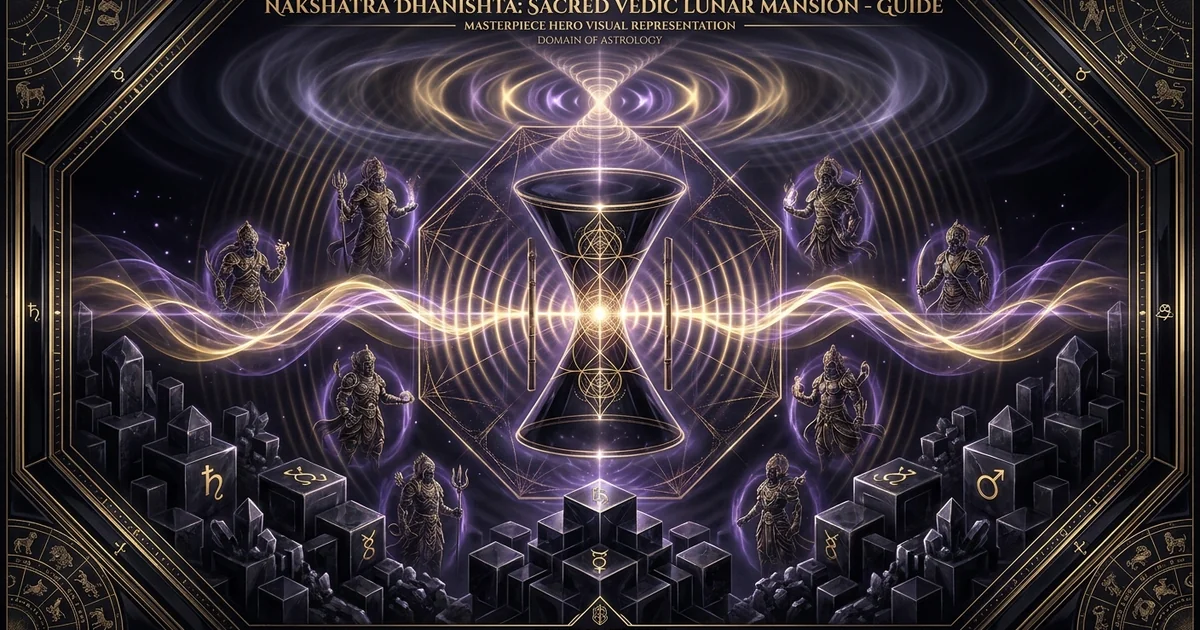
Nakshatra Dhanishta: Sacred Vedic Lunar Mansion - Guide
Archetypal Thesis & Systemic Paradigm: The Acoustic Architecture of Dhanishta
Dhanishta Nakshatra constitutes a critical psycho-cosmological interface within Vedic sidereal cartography, spanning the transitional threshold from Capricornian structural consolidation (23°20’ Makara) to Aquarian universalized dispersion (06°40’ Kumbha). Within the canonical roster of the 27 nakshatras jyotish coordinates, this twenty-third lunar mansion represents the stabilization of sonic vibration into manifest reality. Rather than serving as an index of crude material accumulation—a reductionist interpretation stemming from the colloquial translation of its name as “The Most Beneficent” or “The Wealthiest”—the true dhanishta nakshatra vedic astrology meaning lies in the dynamic regulation of temporal rhythms, acoustic geometry, and systemic entrainment. It marks the precise cosmological juncture where the internalized sonic reception cultivated in Shravana undergoes percussive externalization, converting unmanifest acoustic potential into physical form and societal infrastructure.
The Pulsed Continuum: Damaru, Nada Brahma, and Rhythmogenesis
The core operative mechanics of Dhanishta reside in the doctrine of Nada Brahma—the cosmos as acoustic resonance. While its preceding mansion, Shravana, governs the passive, receptive capacity to perceive the cosmic hum (shruti), Dhanishta embodies the active, kinetic stroke that sets the manifest continuum into motion. This rhythmogenesis is preserved in its primary glyphs: the drum (damaru) / flute symbol. The damaru, the hourglass drum wielded by Shiva Nataraja during the Tandava, generates the cosmic pulse through alternating impacts of its striking beads upon opposite drum skins. This bilateral percussion represents the primordial polarity of manifestation: expansion and contraction, involution and evolution, time (Kala) and space (Desha).
The alternating beat of the damaru functions as a cosmological clock, inaugurating systemic order out of entropic turbulence. The accompanying symbol, the hollow bamboo flute, introduces an inverse acoustic modality. Where the damaru operates through percussive, martial shock, the flute demands non-resistance, absolute evacuation of egoic density, and the controlled channeling of pneumatic pressure (Prana). Together, they articulate the bi-directional acoustic nature of Dhanishta: sound generated through sudden kinetic collision, and sound articulated through disciplined, resonant emptiness.
Spatial Boundary Crossing: From Makara’s Earth to Kumbha’s Aether
The spatial distribution of Dhanishta over the Makara-Kumbha boundary forces an evolutionary translation from individual terrestrial mastery to collective etheric dissemination. The first two padas of Dhanishta fall within Makara (Capricorn), ruled by Shani (Saturn) and characterized by dense, cardinal earth. Here, the Martian Vimshottari energy is concentrated within the physical matrix, crystallizing into tangible hierarchies, institutional authority, and tectonic permanence. In these initial segments, the drive to orchestrate rhythm serves the consolidation of material boundaries and the execution of pragmatic ambitions.
Upon crossing the threshold into Kumbha (Aquarius) at 00°00’, the final two padas inhabit fixed air, co-ruled by Saturn and Rahu. The dense acoustic wave is released from the constraints of structural mass, diffusing into the transpersonal commons. The acoustic pulse ceases to be merely an instrument of institutional control; it transforms into an electromagnetic carrier wave capable of organizing distributed networks, scientific syndicates, and revolutionary ideological frameworks. This transition from earth to air mirrors the sublimation of kinetic force into systemic resonance, transitioning the native from a ruler of physical terrain to a conductor of collective paradigms.
The Vasu Matrix: Material Crystallization through Elemental Gods
Presided over by the eight vasus (elemental gods) deity, Dhanishta serves as the energetic scaffold through which the elemental building blocks of physical manifestation coalesce. The Vasus are the radiant, foundational deities of the Vedic cosmogony, personifying the essential forces of the material plane. Through their collective oversight, Dhanishta acts as a cosmic capacitor that condenses scattered astral blueprints into durable thermodynamic architectures.
The wealth (Vasu) conferred by this lunar mansion is fundamentally the capacity to command matter by attuning to its underlying periodic laws. Matter is understood not as inert substance, but as frozen sound organized by rhythmic intervals. The native attuned to Dhanishta commands structural mastery because they comprehend the cadence of temporal cycles, knowing precisely when to withhold force and when to strike the percussive blow. This dynamic is reinforced by the underlying tension between the Nakshatra’s Vimshottari ruler, Mars (Mangala), and its sign ruler, Saturn (Shani). This planetary pairing sets up an intense thermodynamic engine where martial kinetic drive is relentlessly compressed, refined, and released through Saturn’s cold, structural matrices.
Sidereal Coordinates: 23°20’ Makara (Capricorn) to 06°40’ Kumbha (Aquarius)
Vimshottari Dasha Lord: Mars (Mangala) [7-year cycle]
Rashi Custodians: Saturn (Shani) for Padas 1–2; Saturn and Rahu for Padas 3–4
Primary Archetype: The Ashta Vasus (The Eight Elemental Custodians of Manifest Reality)
Esoteric Symbols: The Damaru (Percussive Hourglass Drum), The Bamboo Flute (Resonant Hollow Reed)
Elemental Shift: Prithvi (Earth) via Makara transmuting into Vayu/Akasha (Air/Ether) via Kumbha
Pada Alignments:
- Pada 1 (23°20’–26°40’ Makara): Simha Navamsha (Solar resonance; structural sovereignty, dynamic statecraft).
- Pada 2 (26°40’–30°00’ Makara): Kanya Navamsha (Mercurial resonance; extreme analytical precision, logistical mastery, rhythmic architecture).
- Pada 3 (00°00’–03°20’ Kumbha): Tula Navamsha (Venusian resonance; acoustic equilibrium, harmonic integration, socio-relational networks).
- Pada 4 (03°20’–06°40’ Kumbha): Vrischika Navamsha (Martian resonance; deep occult transmutation, esoteric timing, catalytic rhythmic release).
Classical Provenance & Textual Lineage: The Ashta Vasus in Vedic Liturgy
The textual history of Dhanishta traces back to the foundational layers of the Vedic canon, where it was originally recognized under the name Shravishtha. In the older liturgical texts, this name designated not merely an arbitrary point of observation, but an organ of celestial audit: the swiftest, most celebrated, or most acutely heard. The shift in nomenclature from Shravishtha to Dhanishta within classical Jyotish exegesis signifies an evolution in semantic emphasis, moving from the purely acoustic phenomenon of “audible fame” to the manifestation of the treasures (vasu) that follow when temporal laws are observed.
Vedic Codices: Taittiriya Brahmana and the Invocation of the Vasus
In the Taittiriya Brahmana (3.1.4), the Nakshatra Ishti mantras establish the metaphysical parameters of Shravishtha by binding its operational efficacy to the collective power of the Ashta Vasus. The liturgy outlines the cosmic assignment: the Vasus reside within Shravishtha to secure material stability, temporal continuity, and protection against systemic disintegration. The text emphasizes that those who offer the appropriate oblations to Shravishtha and its presiding devatas gain access to an unshakeable locus of sovereign authority (Agra) within their collective spheres.
Devanagari:
या गावो गोपतये दधाति । शृणोतु देवाः पृथिवीमुत द्याम् ।
अष्टौ देवा वसवः सोम्यासः । श्रविष्ठां मे यजमानाय दत्तः ॥
आ वसवः श्रविष्ठां हविषा वर्धयन्तः । शतमिन्द्रं सहस्रं वाचमाहुः ।
तन्नो देवा अनुजानन्तु कामाः ॥
Transliteration:
yā gāvo gopataye dadhāti | śṛṇotu devāḥ pṛthivīmuta dyām |
aṣṭau devā vasavaḥ somyāsaḥ | śraviṣṭhāṃ me yajamānāya dattaḥ ||
ā vasavaḥ śraviṣṭhāṃ haviṣā vardhayantaḥ | śatamindraṃ sahasraṃ vācamāhuḥ |
tanno devā anujānantu kāmāḥ ||
Exegetical Translation:
“May that which confers the nourishing herds upon their keeper be established. Let the radiant gods listen across the earth and the firmament. May the eight divine Vasus, delighted by the sacred Soma, bestow the power of Shravishtha upon me, the sacrificer. The Vasus, swelling Shravishtha through the sacred oblation, invoke Indra a hundredfold and the primordial speech a thousandfold. May the luminous ones grant our structural aspirations their absolute fruition.”
This liturgical passage articulates the intimate bond between Vak (primordial speech) and Shravishtha. By asserting that the Vasus invoke speech “a thousandfold,” the Taittiriya Brahmana affirms that Dhanishta is the structural scaffolding of Vak, translating transcendent semantic intentionality into dense, ordered materialization.
Puranic Cosmogony: The Curse of Vasishta and the Genesis of the Eight Spheres
The Puranic lineages—particularly the Mahabharata (Adi Parva) and the Vishnu Purana—delineate the nature of the Ashta Vasus through the narrative of their terrestrial incarnation. The eight deities are cataloged as:
- Dhara (Prithvi): The principle of terrestrial mass, stability, and support.
- Anila (Vayu): The dynamic principle of breath, wind, and kinetic momentum.
- Anala (Agni): The principle of biological and metabolic transformation, flame, and digestive combustion.
- Apas (Varuna/Jala): The cosmic waters, cohesive liquidity, and psychological memory.
- Pratyusha (Ushas/Surya): The pre-dawn illumination, mental clarity, and the awakening of localized consciousness.
- Prabhasa (Dyu): The radiant etheric light, supreme sky, and cosmological expansion.
- Soma (Chandra): The lunar nectar, biological cooling, and rhythmic vegetative regeneration.
- Dhruva (The Polar Axis): The unmoving, gravitational center around which temporal reality rotates.
The cosmogonic drama surrounding their curse by the Brahmarishi Vasishta illuminates the psychological shadow of Dhanishta. The Vasus, captivated by the wish-fulfilling cow Nandini (symbol of inexhaustible material plenitude), conspired to abduct her. The act was spearheaded by Prabhasa, the most radiant among them. Vasishta, perceiving their transgressive acquisitiveness through ascetic vision, condemned them to descend into mortal wombs.
Upon their plea for clemency, the curse was modified: seven would be liberated from mortal forms immediately upon birth, while Prabhasa, the architect of the theft, was condemned to a protracted, agonizing incarnation on earth. Prabhasa manifested as Devavrata—who later assumed the terrifying vow of celibacy and temporal duty as Bhishma.
This mythological architecture directly informs the esoteric currents of Dhanishta. The mansion carries the structural burden of Bhishma: unmatched institutional loyalty, mastery over warfare and statecraft, an unbending adherence to vows, and an agonizing relational detachment. This dynamic often manifests as domestic celibacy or deliberate marital postponement, the archetypal cost of wielding untamed Vasu energies.
Medieval Jyotish Exegesis: Parashara and Varahamihira on Shravishtha
In his seminal compendium Brihat Parasara Hora Sastra, Maharishi Parashara assigns the Vimshottari lordship of Dhanishta to Mars, establishing the energetic friction that defines this mansion. Parashara observes that individuals born with the Moon or Lagna in Dhanishta exhibit profound liberality (danasheela), extensive material capacity, yet an underlying restlessness derived from internal kinetic heat. He notes that the combination of Martian impulse with Saturnian temporal regulation requires the individual to navigate cycles of intense structural isolation before achieving genuine societal authority.
Varahamihira, writing in the Brihat Samhita (Chapter 15), provides an empirical assessment of Dhanishta’s socio-cultural and geographic correspondences:
“Dhanishta rules over men without pride, the quiet, the wealthy, persons of immense charitable disposition, lovers of music, and custodians of dynamic institutions. When afflicted by malefic transits, it damages the rhythmic functions of society, strikes musicians, disrupts temporal treasuries, and instigates martial disputes over shared physical borders.”
Furthermore, in the Brihat Jataka (Chapter 16, Sloka 21), Varahamihira succinctly isolates the natal indicators:
Dhanishthayam lubdho vibhavan kshama-sameto dhaneshvaro bhavati
(“In Dhanishta, the native is liberal in gift-giving yet materially acquisitive, endowed with tremendous endurance and valor, deeply wealthy, yet prone to profound self-absorption.”)
Both classical authorities emphasize that Dhanishta does not produce simple, passive luxury. Instead, it yields a pressurized material competence. Afflictions in this mansion do not correlate with a lack of resources, but rather with internal acoustic disharmony: emotional arrhythmia, severe marital discord, and an inability to adapt one’s subjective cadence to relational partners.
Structural Mechanics & Symbolic Geometry: The Quadripartite Padas and Mars-Saturn Dynamics
[ PRIMAL IMPULSE ]
             Martian Kinetic Drive (Mangala)
             Raw Acoustic Agitation (Nada)
                    │
                    ▼
       [ STRUCTURAL CONTAINMENT ]
             Saturnian Compression (Shani)
             Temporal Matrix & Rhythmic Law
                    │
                    ▼
       [ ACOUSTIC MODULATION ]
   ┌────────────────┴────────────────┐
   ▼                                 ▼
Percussive Strike            Resonant Void
 (Damaru / Pada 1-2)          (Flute / Pada 3-4)
   │                                 │
   └────────────────┬────────────────┘
                    ▼
        [ MANIFESTED MATRIX ]
     The Eightfold Elemental Assembly
             (Ashta Vasus)
The functional mechanics of Dhanishta operate through an intricate cybernetic loop established between Mars (its planetary ruler) and Saturn (its sign ruler). Mars represents raw catalytic propulsion, metabolic fire, and kinetic ambition. Saturn represents spatial boundary conditions, entropy, time (Kala), and absolute structural constraint. When the kinetic energy of Mars is forced to operate entirely within the tectonic architectures of Saturn, thermodynamic friction is inevitable.
This planetary polarity converts volatile volatility into focused hydraulic pressure. Rather than dispersing aimlessly, the Martian impulse is hammered by Saturnian discipline into rhythmic execution. The individual cannot simply act on impulse; they must wait for the exact chronological window to release their accumulated pressure, achieving strategic precision.
Pada Breakdown: The Navamsha Progression (Simha to Vrischika)
The internal subdivision of Dhanishta across the four padas reveals an evolutionary trajectory moving through four distinct internal elemental dynamics, transitioning the soul from royal solar consolidation to intense occult transformation.
Pada 1: Simha (Leo) Navamsha (23°20’ to 26°40’ Makara)
- Cosmological Mechanics: Ruled by Surya (Sun). This pada merges Saturn’s cardinal earth with the fixed fire of Leo. It represents the consolidation of individual sovereignty within administrative systems. The native utilizes percussive will to carve out institutional dominion.
- Psychological Architecture: Highly ambitious, authoritative, and acutely conscious of status. The Martian drive expresses as noble leadership, but runs the risk of hubristic isolation. The individual seeks to become the central solar conductor around which the social orchestra revolves.
- Physiological Axis: Governs the spinal alignment, cardiac rhythm, and the rhythmic pumping of arterial blood. Afflictions here induce hypertension or structural spinal rigidity.
Pada 2: Kanya (Virgo) Navamsha (26°40’ to 30°00’ Makara)
- Cosmological Mechanics: Ruled by Budha (Mercury). Here, cardinal earth interfaces with mutable earth. This is the ultimate matrix of material computation, logistical architecture, and precise musical timing.
- Psychological Architecture: Extremely analytical, discerning, and pragmatically gifted. The creative percussion of the damaru transforms into mathematical cadence, financial structuring, and structural engineering. The shadow here is hyper-criticism, neurosis, and somatic stiffness born from relentless behavioral micro-management.
- Physiological Axis: Corresponds to the intestinal peristalsis and the neurological regulation of muscular contractions.
Pada 3: Tula (Libra) Navamsha (00°00’ to 03°20’ Kumbha)
- Cosmological Mechanics: Ruled by Shukra (Venus). Crossing the threshold into Kumbha’s fixed air, this pada marries Saturn-Rahu’s collective field with the balance of Libra. The acoustic pulse shifts from percussion to melody, from structural enforcement to harmonic integration.
- Psychological Architecture: Deeply drawn to the fine arts, acoustic science, interpersonal diplomacy, and group coordination. The native excels at orchestrating diverse human elements into cohesive alliances. However, the profound inner detachment of Kumbha paired with Libra’s relational drive can create deep emotional ambiguity within intimate partnerships.
- Physiological Axis: Governs the renal systems and fluid balance, regulating internal hydrostatic equilibrium.
Pada 4: Vrischika (Scorpio) Navamsha (03°20’ to 06°40’ Kumbha)
- Cosmological Mechanics: Ruled by Mangala (Mars). This is the Vargottama-adjacent martial culmination where fixed air interfaces with fixed water. The fiery martial current plunges into the subterranean depths of Scorpio, generating psychological power, occult penetration, and deep catalytic resilience.
- Psychological Architecture: Intense, secretive, strategic, and uncompromising. The native possesses the capacity to sustain severe psychological pressure, utilizing rhythmic discipline for esoteric synthesis or radical socio-political reform. Its shadow manifests as vindictiveness, severe relational paranoia, and an authoritarian impulse to dominate the emotional dynamics of others.
- Physiological Axis: Oversees the excretory and reproductive systems, specifically the rhythmic contractions of the pelvic floor and elimination organs.
The Damaru vs. Flute Hermeneutic: Hollow Vessels and Sound Transduction
The dialectic between the damaru and the flute operates as an esoteric code for somatic and energetic cultivation. The damaru requires two opposing membranes connected by an empty, constricted center—the hourglass shape resembling the bindu point between material and astral realms. The percussive sound generated by its striking cords requires active physical force, representing kinetic engagement with the temporal world.
Conversely, the flute produces no sound through collision; its voice is born entirely from kenosis—radical self-emptying. A flute clogged with debris cannot produce tone; it can only manifest music when its interior core is cleared of obstruction, allowing the breath of the musician to pass through its nodes unobstructed.
This acoustic polarization demonstrates that to master the dhanishta nakshatra vedic astrology meaning, the native must cultivate both modes of consciousness. They must know when to strike the environment with martial decisiveness (damaru), and when to become an egoless conduit through which higher celestial harmonies can descend into society (flute).
Mars-Saturn Cybernetics: Thermodynamic Friction and Kinetic Mastery
The underlying cybernetics of Dhanishta represent an internal combustion engine. Mars acts as the fuel: volatile, reactive, expansive. Saturn functions as the heavy forged cylinder block. When fuel ignites within an unconstrained space, it generates a brief, chaotic flash of fire. But when compressed within Saturn’s rigid spatial cylinder, that detonation drives a mechanical piston, converting raw chemical energy into systematic torque.
Natives dominated by Dhanishta continually endure this internal thermodynamic compression. If they lack creative outlets, rhythmic discipline, or athletic rigor, this pressurized energetic dynamic turns inward, precipitating acute marital conflict, chronic vascular tension, or deep psychological frustration. When properly calibrated through yogic sadhana, martial arts, or high-level strategic management, it generates an individual capable of sustaining sustained work capacity over vast expanses of time, systematically achieving objectives that exhaust less pressurized temperaments.
Comparative Archetypal Paradigms: Dhanishta and Western Esoteric Systems
An examination of cross-cultural esoteric cartography demonstrates that Dhanishta’s unique thermodynamic and acoustic properties are an invariant human perception of this cosmological sector.
Dhanishta: Makara Sector (Padas 1–2)
- Vedic Mechanics: 23°20’–30°00’ Makara. Mars Vimshottari Lord under Saturn Rashi governance.
- Western Decan Match: Capricorn Decan III (20° to 30° Capricorn), ruled classically by the Sun (or Saturn by triplicity).
- Archetypal Image: The Throne of Stone. The convergence of absolute worldly power, administrative architecture, and dynastic duty. Mars reaches its degree of maximum exaltation (28° Capricorn) precisely within this sector.
- Psychic Polarity: Dynamic compression. Will bound by civic law; martial ambition consecrated to institutional immortality.
- Shadow Manifestation: Ruthless instrumentalization of others, unbending emotional rigidity, structural calcification, and complete sacrifice of the personal life to the institution.
Dhanishta: Kumbha Sector (Padas 3–4)
- Vedic Mechanics: 00°00’–06°40’ Kumbha. Mars Vimshottari Lord under Saturn/Rahu Rashi governance.
- Western Decan Match: Aquarius Decan I (00° to 10° Aquarius), ruled classically by Venus (or Saturn by triplicity).
- Archetypal Image: The Alchemical Conduit. The broadcast of radical ideation, universal brotherhood, and systematic societal engineering via etheric conduits.
- Psychic Polarity: Radiant transmission. Kinetic impulse diffused into ideological currents; individual will consecrated to collective evolution.
- Shadow Manifestation: Ideological fanaticism, profound emotional dissociation from living individuals in the name of “humanity,” cold utilitarianism, and cosmic alienation.
The Western Decan Correspondence: Mars in Capricorn and Saturn in Aquarius
The presence of Dhanishta’s first two padas within the final degrees of Capricorn is profoundly significant when cross-referenced with Western classical astrology. The absolute exaltation degree of Mars is traditionally fixed at 28° Capricorn—a spatial coordinate that falls inside Dhanishta’s second pada (Kanya Navamsha). Western astrological tradition holds that Mars achieves its most elevated, constructive expression here because its raw, chaotic aggression is tempered by the deliberate, cold architecture of Saturn’s sign.
This directly reflects the Indian exegesis of Dhanishta: kinetic drive disciplined into supreme mechanical execution. Conversely, when Dhanishta steps into Aquarius Decan I, it interfaces with the traditional rulership of Saturn alongside its modern resonance with Uranian lightning. This mirrors the dual rulership in Jyotish of Saturn and Rahu for Kumbha, marking the sudden, revolutionary dispersion of acoustic energy into ideological and technological vectors.
Human Design Parallel: Gate 41 (Contraction) to Gate 19/49 Dialectics
In the synthesized mechanics of the Human Design System (which maps the 64 Hexagrams of the I Ching directly onto the 360° zodiacal wheel), the space of Dhanishta intersects the Gate of Contraction (Gate 41) and transitions toward the programmatic interfaces of the solar plexus and emotional awareness. Gate 41, located within the Root Center, operates as the genetic start codon of the human experiential design. It provides the initial pressure—the rhythmic pulse—that initiates an entirely new emotional and historical cycle.
This mirrors the acoustic stroke of Shiva’s damaru. Gate 41 does not fulfill desire; it gathers fuel, focuses human hunger into a singular trajectory, and establishes temporal tension. Dhanishta operates with this same catalytic dynamic: it builds structural pressure at the base of the spine, preparing to fire it upward through the central axis of the subtle body.
Qabalistic Resonances: Peh (The Tower) to Binah’s Cosmic Framework
On the Hermetic Tree of Life, the energetic synthesis of Dhanishta can be mapped across the dynamic tension between the Sephirah Binah (Saturn, structural form, cosmic law, severe limitation) and the path of Peh (Mars, The Tower, kinetic discharge, the shattered boundary). Dhanishta is the structural crucible where Mars’ fiery path of Peh is completely internalized within the architecture of Binah.
Rather than allowing the explosive force of Mars to destabilize the vessel, Binah absorbs the percussion, transforming the destructive blast of the Tower into the periodic oscillation of a cosmic clock. It is the music of the spheres: dynamic energy confined within mathematical law, vibrating the seven planetary octaves across the cosmic matrix.
Psychological Dynamics & Operational Praxis: The Emptiness of the Resonant Chamber
The psychological terrain of Dhanishta is defined by a central paradox: the drive to manifest material wealth and societal recognition countered by an internal void that resists emotional integration. Because the symbol of this mansion is the flute, the psyche of the native is marked by an intuitive imperative toward internal evacuation. If the ego becomes overly dense, grasping, or emotionally possessive, the acoustic clarity of the channel is lost, resulting in neurosis, severe anxiety, and somatized tension.
The Jungian Shadow of Dhanishta: Marital Celibacy, Alienation, and Rigid Control
In depth psychology, Dhanishta presents a distinct persona-shadow architecture. The persona is typically polished, authoritative, rhythmic, and publicly generous—the archetypal benefactor or indispensable institutional executive. The shadow, however, harbors deep isolation, an acute fear of vulnerability, and an unconscious terror of emotional absorption by the feminine or the relational partner.
“The vas bene clausum (well-sealed vessel) is a primary prerequisite for the alchemical transmutation. But if the vessel becomes impenetrable out of defense against the unconscious, it ceases to be a transformative matrix and becomes a psychological tomb. The individual remains completely isolated within their self-created structural apparatus, deaf to the irrational rhythms of the anima.”
— Carl Gustav Jung, The Structure and Dynamics of the Psyche (CW Vol. 8), Princeton University Press.
This alchemical dynamic explains why Dhanishta is traditionally flagged in Jyotish chart analysis for marital delays, celibacy, or intense domestic discord (Kuja Dosha resonance). The native’s internal boundaries are so rigorously fortified that emotional intimacy feels like an entropic threat to their structural autonomy. Like Bhishma, who swore an irreversible oath that severed him from domestic lineage, Dhanishta natives frequently impose severe vows, hyper-rational criteria, or career demands upon themselves, unconsciously prioritizing systemic control over relational intimacy.
Somatic and Creative Entrainment: Music, Dance, and Circadian Precision
The therapeutic path for navigating Dhanishta pathology involves deliberate somatic and acoustic entrainment. When a native experiences cognitive congestion, psychological dissociation, or chronic physical rigidity, the medicine is found through rhythm:
- Percussive and Acoustic Therapy: Active engagement with drums (such as the mridangam, tabla, or West African djembe) or wind instruments allows the individual to safely channel their inner Mars-Saturn pressure. Percussion discharges somatic aggression, while the flute retrains pneumatic breath control.
- Rhythmic Movement and Dance: Classical dance forms that demand strict adherence to temporal cycles (tala) and spatial precision (such as Bharatanatyam or Kathak) bridge the gap between martial kinetic energy and structural Saturnian form.
- Circadian and Biological Entrainment: Because Dhanishta is deeply tied to the cosmic clock, disruptions in the native’s circadian rhythm (irregular sleep-wake cycles, chaotic eating habits) directly damage their psychological well-being. Restoring strict chronobiological routines acts as an immediate stabilizing force on their nervous system.
Therapeutic Chart Consultation: Navigating Wealth, Timing, and Relational Void
When counseling individuals with significant Dhanishta placements (such as the Moon, Ascendant, or Atmakaraka), the consulting astrologer must dismantle superficial associations with financial abundance. Clients often seek consultation during their seven-year Mars Vimshottari Dasha or significant Saturn returns, complaining of profound emotional isolation despite professional elevation.
The objective is to pivot their understanding of Vasu (wealth) away from external collection toward internal resonance. The practitioner should assess:
- The Status of the Resonant Chamber: Is the individual maintaining enough psychic emptiness to allow intuitive guidance to flow through them, or are they stuffing their schedule with excessive obligations to avoid feeling their internal loneliness?
- Timing Analysis: Are they trying to force an outcome out of season? Dhanishta demands that one wait for the downbeat. Action taken out of alignment with the cycle yields catastrophe; action taken precisely on the downbeat requires minimal effort to command maximal influence.
- The Relational Matrix: The astrologer must challenge the client’s defense mechanisms. They must be guided to recognize that relational intimacy requires the softening of their martial armor, accepting the vulnerability of being played upon like a delicate instrument rather than operating as an unyielding fortress.
Philosophical Synthesis & Macrocosmic Correspondence: The Pulsing World Soul
At its highest philosophical altitude, Dhanishta is the cosmic mechanism of Spanda—the divine dynamic pulsation articulated within Kashmir Shaivism. The universe is not an inert, mechanical arrangement of static objects; it is an ongoing vibration (Spandana) through which the supreme consciousness alternately closes its eyes (Nimesha) to manifest the cosmos, and opens its eyes (Unmesha) to dissolve the manifest order back into absolute transcendence.
       UNMANIFEST ABSOLUTE (Paramashiva)
                     │
         [ Spanda / Primordial Pulse ]
                     │
     ┌───────────────┴───────────────┐
     ▼                               ▼
  NIMESHA                         UNMESHA
(Cosmic Contraction)            (Cosmic Expansion)
 Capricorn / Makara               Aquarius / Kumbha
 Solidification of Form          Diffusion into Aether
 Structural Density              Universalized Networks
Spanda: The Primordial Vibration in Kashmir Shaivism
Within the framework of the Spandakarika, reality is perpetual, rhythmic kinetic motion. Dhanishta crystallizes this principle within the human energy field. The contraction phase of Spanda is experienced in the Makara sector of the mansion, where consciousness binds itself to density, stone, skeletal systems, and societal structures. The expansion phase is realized in the Kumbha sector, where the dense acoustic wave shatters the boundaries of localized form, dispersing as an etheric frequency that binds humanity into a singular energetic circuit.
To inhabit Dhanishta with conscious awareness is to recognize that one’s personal heart rate, breathing cadence, and life transitions are not isolated phenomena; they are microscopic iterations of the universal pulsation. The damaru of Shiva is not an external mythological prop—it beats within the sinoatrial node of the human heart, driving the circulation of blood and prana across the physical organism.
The Alchemical Lyre: Cosmic Harmony and the Music of the Spheres
This macrocosmic correspondence directly reflects the Pythagorean and Hermetic doctrine of the Musica Universalis—the Music of the Spheres. The planets, as they trace their orbital geometries across the heavens, emit mathematically precise frequencies whose interplay weaves the matrix of mortal life. Dhanishta is the alchemical lyre, the celestial instrument through which this cosmic music is transduced into physical and social frameworks.
When the ancient rishis designated this constellation as Shravishtha, they recognized that the fundamental requirement for participating in cosmic order is the purification of hearing. One must hear the cosmic cadence before one can dance in harmony with it. The tragedy of the fallen Vasus was their surrender to grasping desire, losing their attunement to this cosmic harmony; the redemption of the Vasus is the realization that true sovereignty is found not in ownership, but in serving as a conscious instrument for the cosmic symphony.
Integration: Dhanishta as the Metronome of the 27 Nakshatras
Within the expansive machinery of the 27 nakshatras jyotish, Dhanishta acts as the central metronome. Coming immediately after Shravana’s intense listening and directly preceding Shatabhisha’s deep ocean of a hundred healing physicians, Dhanishta marks the indispensable moment of action. It takes the silent gnosis heard in the void of Shravana and manifests it with rhythmic precision, clearing the ground for Shatabhisha’s transpersonal healing.
It is the engine room of the zodiac. Without its percussive clarity, cosmic wisdom remains an unmanifest abstraction, and physical manifestation degenerates into chaotic matter. To align with the current of Dhanishta is to surrender personal haste, master the arts of breath and timing, and step into the cosmic cycle as an instrument of divine law.
Frequently Asked Questions: Technical Inquiries on Dhanishta Nakshatra
How does Dhanishta Nakshatra induce marital delays, and how can Kuja Dosha be remediated here?
Dhanishta’s association with domestic discord and delayed marriage stems from its internal planetary and archetypal architecture. Because Mars rules the Nakshatra while Saturn and Rahu govern its overarching Rashis, a persistent thermodynamic tension exists between dynamic desire and structural containment. This setup naturally activates a specialized manifestation of Kuja Dosha (Mars affliction). Psychologically, the native develops high defensive walls, deep-seated emotional autonomy, and an intolerance for interpersonal messiness, echoing the archetypal celibacy of Bhishma.
Remediation requires shifting focus away from fatalistic superstitions toward practical psychological and energetic integration. The individual must deliberately cultivate vulnerability and dismantle their internal defenses. Somatically, engaging in partnered dance (such as tango) or shared musical practices retrains their nervous system to accept a shared tempo without needing to control the interaction. Spiritually, propitiation of Shiva and Parvati through the recitation of the Shiva Tandava Stotram or Lalita Sahasranama helps harmonize their internal masculine kinetic drive (Mars) with structural wisdom (Saturn).
What are the operational differences between Dhanishta in Makara versus Kumbha?
The operational divergence across the 00°00’ Kumbha boundary centers on the transition from cardinal earth to fixed air, fundamentally altering how the Martian acoustic pulse manifests:
- Makara (Padas 1 & 2): The energy is focused inward and downward into structural and institutional forms. Mars operates with intense, concentrated discipline, directing its focus toward administrative execution, executive authority, real estate, physical construction, and corporate dominance. The native works through established hierarchies, seeking to construct physical empires that endure over time.
- Kumbha (Padas 3 & 4): The energy expands outward and upward into etheric, intellectual, and systemic networks. Mars operates within the fixed air of Saturn and Rahu, driving technological innovation, socio-political reform, acoustic research, and mass ideological movements. The objective shifts from securing personal institutional authority to rewiring collective systems and conducting transpersonal resources for broad social utility.
How does Dhanishta interact with the adjacent Nakshatras, Shravana and Shatabhisha?
Dhanishta forms the crucial central phase of an evolutionary triad spanning late Capricorn and early Aquarius:
- Shravana (The Ear): Operates via passive reception, deep listening, contemplative silence, and the absorption of the unmanifest cosmic sound (Shruti). The consciousness receives higher wisdom, but takes no external action.
- Dhanishta (The Drum/Flute): Acts as the dynamic externalization of that reception. What was heard in Shravana is now actively played, struck, and constructed in Dhanishta through rhythm, architecture, and temporal mastery.
- Shatabhisha (The 100 Physicians/Veils): Operates via the containment of the manifested vibration within the vast, healing waters of the cosmic aether (Varuna). It turns inward to heal, synthesize, and dissolve the structural boundaries created by Dhanishta, preparing the soul for universal dissolution.
What are the classical vocations and mundane manifestations of Dhanishta?
Due to the convergence of Mars’ kinetic drive, the Ashta Vasus’ material mastery, and the acoustic symbols of the drum and flute, Dhanishta produces mastery across several fields:
- Acoustics, Music, and Performance: Professional percussionists, composers, conductors, choreographers, sound engineers, and performing artists who rely on precise rhythmic cadence.
- Structural Engineering and Architecture: Civil engineers, infrastructure planners, builders of material or digital systems, and urban landscape architects who work with concrete form and foundational materials.
- High-Level Administration and Strategy: Military planners, institutional executives, treasury custodians, and strategic managers who organize large human hierarchies with tactical efficiency.
- Chronobiology and Biometrics: Professionals working with biological clocks, neurological pathways, surgical cardiac rhythm intervention (such as electrophysiology), and kinesiology.
How should planetary transits through Dhanishta be utilized in practical electional astrology (Muhurta)?
Because Dhanishta is classified as a Chara (movable/dynamic) Nakshatra with a martial undertone, it is highly potent for activities that require rapid kinetic execution, structural foundation, and long-term rhythmic momentum:
- Favorable Undertakings: Breaking ground for major architectural projects; launching systemic corporate restructuring; acquiring dynamic assets, precious metals, or real estate; beginning musical, rhythmic, or athletic training; conducting surgeries that require manual precision; and implementing new temporal schedules or productivity protocols.
- Unfavorable Undertakings: Marriage and intimate partnership ceremonies should generally be avoided when the Moon transits Dhanishta—unless the broader synastry strongly mitigates it—due to the mansion’s archetypal links to celibacy, emotional isolation, and the unyielding vows of Bhishma. It is similarly unsuited for negotiations that require passive compliance or immediate emotional vulnerability.