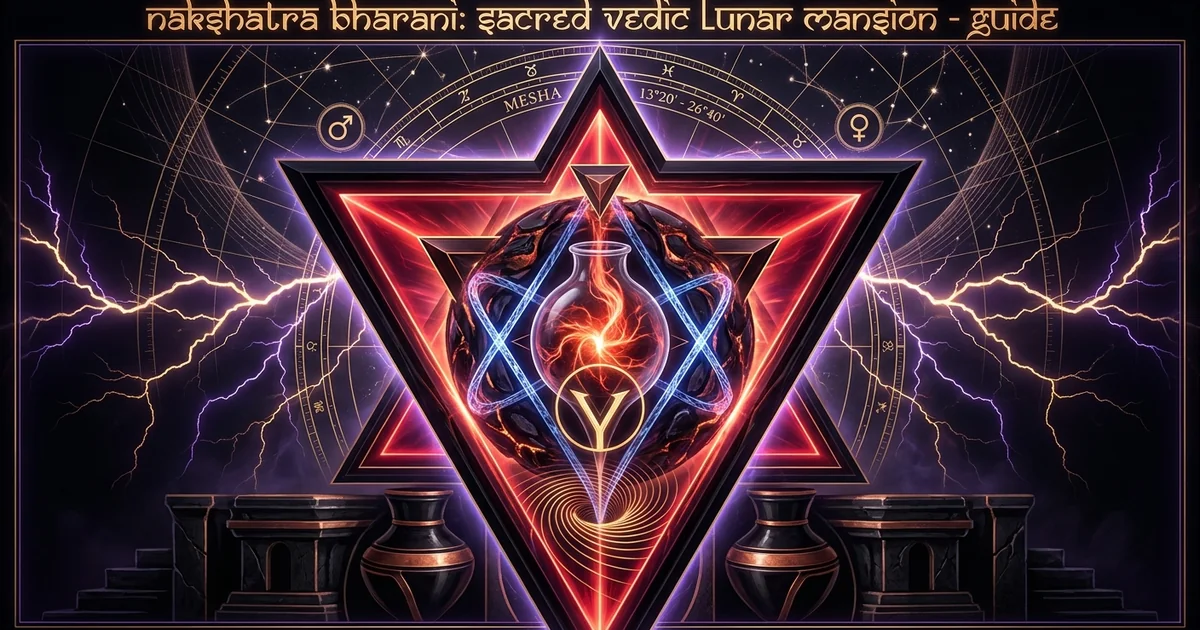
Nakshatra Bharani: Sacred Vedic Lunar Mansion - Guide
Archetypal Thesis & Systemic Paradigm: The Threshold of Incarnation and Dissolution
Operating as the second lunar mansion within the sidereal zodiac, Bharani spans precisely from 13°20’ to 26°40’ of Aries (Mesha). In the psycho-cosmological mechanics of the 27 nakshatras of Jyotish, Bharani functions as the threshold of radical gestation and bio-spiritual filtration. Where its predecessor, Ashwini, represents the instantaneous, uninhibited eruption of the life-spark, Bharani constitutes the immediate deceleration of that kinetic impulse into a restrictive physical vessel. This stellar station forces the primordial fire into the confines of an alchemical crucible. Here, absolute potential confronts absolute limitation. The native architecture of this mansion demonstrates that incarnation cannot occur in an unbounded state; life demands a vessel, and that vessel inevitably circumscribes, pressures, and ultimately consumes the energy it harbors.
13°20' Aries ---------------- [ BHARANI NAKSHATRA ] ---------------- 26°40' Aries
(Ashwini: Kinetic Spark)      (Crucible / Gestation)         (Krittika: Solar Flame)
The Apabharani Shakti: Dynamics of Cleansing and Removal
The functional operation of Bharani is governed by its primordial power, known in the Vedic canon as Apabharani Shakti—the capacity to carry away, cleanse, and transport the soul beyond structural decay. Classical Jyotish identifies this shakti as apavahana shakti (the power to take away what has reached culmination) and bharana shakti (the power to sustain, nurture, and bear burdens). This dual movement forms an energetic loop: before a new biological or psychological form can be nurtured, the residual detritus of previous incarnations and obsolete ego-structures must be violently or systematically cleared. Bharani extracts the essence while purging the husk, an operation that is frequently experienced by the waking ego as acute crisis, bereavement, or radical existential severance.
This dynamic of removal is neither punitive nor arbitrary; it is an inevitable law of thermodynamic conservation within the astral anatomy. The Apabharani Shakti operates at the juncture where cosmic substance (prakriti) thickens to its densest biological threshold within Aries. The Sanskrit root bhara conveys the bearing of weight, the carrying of a heavy load, and the maternal labor of pregnancy. Consequently, the cleansing performed by this lunar mansion is distinct from the cerebral detachment seen in later air or water signs. It is an excruciating, viscously physical purgation—an energetic evacuation that empties the psychic vessel so that conscious spiritual descent may occur without catastrophic contamination.
The Confinement of Fire: Martian Substratum Meets Venusian Synthesis
The underlying systemic tension of Bharani emerges from its planetary governance: situated entirely within the cardinal, rajasic fire sign of Aries—governed by Mars (Mangala)—Bharani is presided over by Venus (Shukra), the planet of refined harmony, sensory immersion, and cellular reproduction. This juxtaposition establishes an intense alchemical compression chamber. The unmediated, centrifugal aggression of Mars is forced to negotiate the centripetal, binding aesthetics of Venus. For an analytical breakdown of how these planetary archetypes negotiate their essential qualities, examine Planetary Dignities of Mars and Venus. In Bharani, this interaction prevents the raw impulse of Mars from dissipating into empty space; Venus traps the fire inside an enclosure of longing, form, and desire.
This synthesis generates an oscillating dialectic between creative fertility (shukra) and brutal severance (kuja). The Venusian governance over this sector of Aries does not manifest as passive peace; rather, it manifests as the urgent, pressurized desire to manifest form at all costs. It is the libido in its most visceral, creative state, forced to construct an enduring vehicle under the explosive pressure of Martian heat. When these planetary frequencies are integrated consciously, this tension produces unparalleled artistic stamina, unyielding resilience, and the capacity to mid-wife complex creative paradigms into historical reality. When dysregulated, it degenerates into catastrophic possessiveness, insatiable appetites, and dramatic cycles of somatic and relational self-immolation.
Perinatal Tension: The Yoni as the Alchemical Crucible
Archetypally, Bharani is symbolized by the yoni, the sacred female generative organ, representing the primordial birth canal, the matrix of material emergence, and the tomb-like confinement preceding liberation. In analytical and transpersonal psychology, this nakshatra correlates directly to what Stanislav Grof delineates as the Basic Perinatal Matrices (BPM), specifically the grueling transition from BPM II to BPM III. In BPM II (the closed cosmic system of the contracting womb prior to the opening of the cervix), consciousness experiences radical confinement, cosmic agony, and an absolute absence of exit. Bharani embodies this psychological state: the ego is locked within the uterine walls of its own karma, crushed by the muscular contractions of divine law.
As the archetypal pressure mounts, Bharani shifts into the mechanics of BPM III—the titanic struggle through the birth canal, characterized by the interpenetration of biological agony, explosive eroticism, aggressive friction, and the looming certainty of death. The yoni is not merely a doorway of delightful emergence; it is a mechanism of compression, a meat-grinder through which the spirit must pass to achieve individuated physical incarnation. The soul is subjected to profound asphyxiation as the price of admission into physical reality. Bharani stands as the celestial cartography of this agonizing compression, declaring that every act of genuine creation necessitates an experience of claustrophobic containment and egoic extinction.
“The second perinatal matrix (BPM II) represents the experience of being caught in an inescapable, agonizing trap: the uterine contractions compress the organism, yet the cervix is entirely closed. It is an existential vacuum characterized by severe physical suffering, overwhelming helplessness, and catastrophic despair. As this transitions into the third matrix (BPM III), the biological channel opens, transforming passive agony into an intense, dynamic struggle between life, death, and catastrophic mechanical pressure, where titanic demonic and erotic energies fuse.” — Stanislav Grof, Realms of the Human Unconscious: Observations from LSD Research (1975)
Classical Provenance & Textual Lineage: The Vedic Cadence of Yama and Shukra
The historical tracking of Bharani within primary Vedic literature establishes its identity as an indispensable checkpoint of universal morality, karmic settlement, and psychopompic transitions. To comprehend this mansion within the 27 nakshatras of Jyotish requires stepping outside the simplistic lens of contemporary astrological fortune-telling and grounding our inquiry within the shruti and smriti canons. In these ancient texts, stellar positions were measured as living psycho-spiritual dimensions governing both the physical universe and the human subtle body.
Vedic Hymnography: Yama’s Entrustment in the Taittiriya Brahmana
The Taittiriya Brahmana (specifically 3.1.1.2) provides one of the oldest systematic enumerations of the nakshatras, assigning deities to each asterism with surgical cosmological precision. Bharani is referred to archaically as the Apabharanis (in the plural), indicating a stellar collective of waters that carry away, and is directly linked to Yama, the god of dharma, cosmic justice, and physical mortality. Unlike late puranic degenerations that reduce Yama to a terrifying monarch of the underworld, the early Vedic hymnography honors Yama as the First Mortal—the primordial pioneer who walked the uncharted pathways of mortality, discovered the route to the ancestral realms (pitri-loka), and attained sovereign dominion over the conservation of divine law (Rta).
“yamasya apabharaṇīḥ / apa śoko bharaṇīr bharantu / yamo rājyānvavaitv enaḥ / yaśo mahyam apabharaṇīr dadhatu / yamasya rājño amṛtasya bhakṣaḥ / apabharanto apa pāpam etu.”
Translation: “The Apabharanis belong to Yama. May these bearing waters carry away grief! May King Yama wash away structural sins and transgression. May the Apabharanis confer profound glory and non-decay upon me. Of King Yama, this is the immortal portion; carrying away, may all corrupting evil depart.”
This invocation indicates that ancient seers viewed the stars of Bharani (comprising 35 Arietis, 39 Arietis, and 41 Arietis) as an astral filtration apparatus. The soul, laden with the dross of unfulfilled cravings and transgressive distortions (enas), requires an agency of spiritual hygiene. Yama is invoked not to destroy consciousness, but to apply the unbending yardstick of dharmic reality. The Apabharanis are the celestial conduits through which our delusions of permanence are systematically stripped away, ensuring that only that which has been reconciled with divine order is permitted to pass into the subsequent evolutionary mansions.
Varahamihira’s Delineations in the Brihat Samhita
By the classical period of the 6th century CE, the encyclopedic scholar Varahamihira solidified the observational consequences of Bharani in his masterwork, the Brihat Samhita. In the fourteenth and fifteenth chapters detailing stellar geography and the transits of the Moon, Varahamihira catalogs the material expressions aligned with this asterism. He explicitly designates Bharani as belonging to the Ugra (fierce, aggressive, terrifying) and Kruura (cruel, hard) classification of asterisms, prescribing that its periods of activation are ideal for acts involving:
- Strategic destruction, subterfuge, and combat operations.
- The excavation of tunnels, subterranean crypts, and foundational wells.
- The handling of poisons, toxic substances, and potent chemical cures.
- Purifications involving fire, surgical interventions, and radical amputations.
- Ritual acts aimed at exorcising malevolent psychological complexes.
Varahamihira observes that individuals born with an operative, prominent Moon in Bharani (Bharani-jata) are typically characterized by an unyielding spirit (sthiro), an uncompromising attachment to their declared commitments, a propensity toward sensory indulgence (sukhopapanna), and an uncanny attraction to forbidden, threshold zones of social, political, or spiritual life. Varahamihira cautions that should the Moon or the ascendant within this mansion be afflicted by harsh aspectual geometry—particularly from an unfavorably placed Saturn (Shani) or Rahu—the native risks falling victim to profound moral compromises, judicial censure, or sudden catastrophes originating in unrestrained physical appetites.
Mythological Substrata: The Parentage of Yama and the Solar Law
To unravel the psychological architecture of Bharani, one must trace the mythic genealogy of its presiding deity, Yama. Yama is the son of Surya (the Sun, representing unadulterated cosmic consciousness) and Saranyu (also known as Sanjna, the goddess of spiritual perception and celestial dawn). Unable to endure the blistering, incinerating radiance of her husband Surya, Saranyu retreated into seclusion, leaving in her place her animated shadow, Chhaya. From this shadow-womb was born Saturn (Shani), making Yama and Saturn step-brothers—both functioning as cosmic arbiters of limitation, structural retribution, and physical culmination.
Yama’s twin sister is Yami (who later became the sacred river Yamuna). In the profound dialogue recorded in the Rigveda (10.10), Yami experiences an overwhelming erotic obsession toward her twin brother, begging him to engage in an incestuous union to propagate the species. Yama, demonstrating absolute spiritual restraint (samyama), systematically declines her overtures, citing the unyielding laws of the cosmic guardians (Varuna and Mitra) who monitor the moral integrity of humanity. This mythic motif is the foundational subtext of Bharani: it represents the dynamic collision between the chaotic, primordial, incestuous pull of raw nature (symbolized by Yami and the Venusian instinct) and the unbending spiritual law of ethical restraint and self-mastery (embodied by Yama).
Structural Mechanics & Symbolic Geometry: The Yoni, Aries Span, and Pada Architecture
The astronomical and mathematical architecture of Bharani within the sidereal matrix defines how this nakshatra functions as a cosmic engine. Extending from precisely 13°20’ to 26°40’ of Aries, it occupies the middle segment of the initial cardinal fire sign. In this span, the direct, uninhibited dynamic of the Aries initiating spark encounters resistance, crystallizing the ethereal fire into dense, thermodynamic mass.
00°00' Aries ---------------- 13°20' Aries ---------------- 26°40' Aries ---------------- 30°00' Aries
[       Ashwini        ]      [       Bharani        ]      [      Krittika (Pada 1)      ]
(Ketu / Initiatory Fire)      (Venus / Gestation)           (Sun / Purifying Flame)
Degrees and Geometrical Divisions: 13°20’ to 26°40’ Mesha
The specific span of Bharani holds exceptional significance in the division of the Rashis (signs) and Amshas (harmonic subdivisions). At 13°20’ Aries, the raw kinetic trajectory established in Ashwini ceases its horizontal expansion and plunges downward. The astrological coordinate of 13°20’ represents an exact mathematical harmonic: it is four padas of 3°20’ each, bringing to completion the first full cycle of the soul’s primal burst through the cardinal fire.
As the Moon or any operative planet crosses the threshold of 13°20’, it enters an energetic dead-zone where external action must be traded for deep internal pressure. This sector of the sky coincides with the deep, dark interior of the alchemical vessel. Planetary bodies located here lose their superficial, outward agility; they are pulled into an inescapable gravity well where their significations are tested, weighed, and subjected to the laws of physical gestation. The native with critical planets in this span feels an instinctive need to hoard energy, develop impenetrable personal boundaries, and build a protective wall against external dilution until their creative, financial, or spiritual operations have fully ripened.
The Tetrad of Padas: Navamsha Trajectories from Simha to Vrischika
Every nakshatra is partitioned into four equal padas (quarters) of 3°20’, each corresponding to an underlying navamsha (the ninth-harmonic chart, revealing the internal psychological and karmic destiny of a placement). The four padas of Bharani chart a profound evolutionary passage through the zodiac’s most intense, challenging psychological terrain, tracing an arc from the royal, solar self-expression of Leo through the dark, transmutative underworld of Scorpio.
+---------------------------------------------------------------------------------------------------+
|                                 BHARANI PADA ARCHITECTURE                                         |
+--------+--------------------+-----------+------------+--------------------+----------------------+
| Pada   | Zodiacal Span      | Navamsha  | Sub-Ruler  | Elemental Nature   | Core Psychological   |
|        |                    |           |            |                    | Expression           |
+--------+--------------------+-----------+------------+--------------------+----------------------+
| 1      | 13°20'–16°40' Ari  | Simha     | Sun        | Fire (Cardinal-    | Sovereign Will,      |
|        |                    | (Leo)     | (Surya)    | Fixed Synthesis)   | Creative Radiance,   |
|        |                    |           |            |                    | Destined Ambition    |
+--------+--------------------+-----------+------------+--------------------+----------------------+
| 2      | 16°40'–20°00' Ari  | Kanya     | Mercury    | Earth (Cardinal-   | Tactical Austerity,  |
|        |                    | (Virgo)   | (Budha)    | Mutable Synthesis) | Rigorous Discipline, |
|        |                    |           |            |                    | Surgical Pruning     |
+--------+--------------------+-----------+------------+--------------------+----------------------+
| 3      | 20°00'–23°20' Ari  | Tula      | Venus      | Air (Cardinal-     | Harmonized Tension,  |
|        |                    | (Libra)   | (Shukra)   | Cardinal Polarity) | Relational Mirroring,|
|        |                    |           |            |                    | Sensory Mastery      |
+--------+--------------------+-----------+------------+--------------------+----------------------+
| 4      | 23°20'–26°40' Ari  | Vrischika | Mars       | Water (Cardinal-   | Alchemical Death,    |
|        |                    | (Scorpio) | (Mangala)  | Fixed Transmutation| Nigredo Purgation,   |
|        |                    |           |            |                    | Occult Sovereignty   |
+--------+--------------------+-----------+------------+--------------------+----------------------+
The first pada (13°20’ to 16°40’ Aries) projects its root essence into the Leo Navamsha, ruled by the Sun. This pada integrates the Martian kinetic drive with solar self-sovereignty. It is the most outwardly radiant and ambitious sector of Bharani, where the native utilizes confinement as a personal platform for commanding leadership. The generative spark is focused on establishing dominion, creative majesty, and personal legacy, though it carries an inherent shadow of blinding narcissism and an inability to brook any perceived defiance.
The second pada (16°40’ to 20°00’ Aries) descends into the Virgo Navamsha, ruled by Mercury. Here, the volcanic heat of the nakshatra is forced through a narrow aperture of analytical precision, service, and strategic restraint. This pada represents the functional labor of gestation: the meticulous cellular division of an embryo. Natives with placements here possess profound organizational acumen, surgical critical thinking, and the capacity to endure grueling conditions to actualize their ambitions. The danger here lies in self-destructive neuroses, hypochondria, and hyper-critical defensiveness.
The third pada (20°00’ to 23°20’ Aries) enters the Libra Navamsha, ruled by its primary overlord, Venus. As a Vargottama zone for Venusian resonance, this pada harmonizes the Martian sign with the pure, relational architecture of the seventh house principle. It balances individual passion with social impact, producing visionary artists, diplomatic negotiators, and individuals capable of mediating extreme polarities. This pada exposes the native to intense sexual tensions, sensory fascinations, and a lifelong challenge to maintain psychological balance amid emotional upheaval.
The fourth pada (23°20’ to 26°40’ Aries) culminates in the Scorpio Navamsha, ruled by Mars and co-ruled by Ketu. This is undeniably the most volatile, intensely transformative sector of Bharani. It represents the absolute culmination of the nigredo stage of spiritual alchemy. Confinement reaches its breaking point here; the soul must confront its deepest, unadorned shadow material, mortality, and psychic decay.Placements in this pada grant immense occult perception, psychotherapeutic talent, and the power to resurrect oneself after total material collapse. Unintegrated, it manifests as paranoia, catastrophic self-sabotage, and an obsession with power and taboo.
Symbolic Implements: The Yoni, the Sieve, and the Vessel of Clay
Beyond its primary emblem of the yoni, ancient authorities assign two critical secondary implements to Bharani: the shurpa (the winnowing fan or sieve) and the earthen vessel (clay pot). The shurpa is an agricultural tool utilized to separate the grain from the useless chaff. It is manipulated through rhythmic shaking, leveraging the element of wind to disperse the dead, weightless husk while allowing the dense, nourishing grain to fall cleanly to the earth. This tool emphasizes the judicial, discriminatory nature of Bharani: it shakes the individual’s psychological reality until all false pretenses, self-delusions, and superficial attachments are discarded by the winds of Yama.
The earthen clay pot represents the somatic body itself—fashioned from wet, unrefined earth, molded through pressure, and inevitably subjected to the transformative fires of the kiln. Without baking, the earthen vessel dissolves when filled with water; without facing the heat of Yama’s restraint, the human vessel collapses when struck by the waters of emotional trauma and existential crisis. Bharani represents this kiln of consciousness: it subjects the fragile ego to immense spiritual heat, hardening its subjective fabric until it can safely hold the divine nectar (soma) of higher awareness without cracking.
Psychological Dynamics & Operational Praxis: Navigating the Eros-Thanatos Threshold
When observed through the lens of modern clinical and archetypal depth psychology, Bharani functions as an internal battlefield where the two sovereign drives identified by Sigmund Freud—Eros (the life force, libidinous attraction, the impulse toward creation and synthesis) and Thanatos (the death drive, the impulse toward deconstruction, quiescence, and structural entropy)—wage an unceasing, high-stakes war for supremacy. This internal conflict is not a pathology to be eliminated, but an evolutionary dialectic designed to produce exceptional psychological strength.
Unchecked / Shadow Expression
- Obsessive hedonism and catastrophic sensory over-indulgence.
- Terrified resistance to organic culmination, resulting in structural inertia.
- Cruel, authoritarian application of judgment against self and others.
- Somatic suppression of grief, generating volcanic psychosomatic ruptures.
- Compulsive fascination with mortality, taboo, and moral transgression.
- Despotic boundary structures masking acute underlying vulnerability.
Integrated / Dharmic Expression
- Sustained capacity to bear immense psychic and creative tension.
- Radical, fearless embrace of ego-death as a prelude to spiritual renewal.
- Direct alignment with universal law (Rta), justice, and objective truth.
- Psychopompic ability to midwife others through extreme trauma and loss.
- Uncompromising creative stamina capable of executing generational works.
- Hermetic containment: preserving vital essence (ojas) from dissipation.
The Shadow of Excess: Gluttony, Obsessive Drive, and Cathartic Collapse
The unintegrated shadow of Bharani manifests primarily as an inability to regulate personal desire. Driven by the deep Venusian hunger for immersive sensory experience, combined with the impulsive, conquest-oriented nature of Aries, the individual can easily fall prey to extremes of consumption. This is not limited to physical food or sexual gratification; it extends to an insatiable appetite for power, creative dominance, and emotional intensity. The native often operates under an unconscious conviction that if they do not aggressively consume the world around them, they will be consumed by the looming void of their own internal emptiness.
This psychological dynamic inevitably invites the intervention of Yama’s dharmic rod (danda). Because the native resists self-imposed limits, external reality constructs draconian boundaries for them. The life path of an unchecked Bharani individual is often punctuated by sudden, catastrophic disruptions—abrupt professional dismissals, sudden legal confrontations, severe relational severances, or acute somatic crises. These collapses are the psyche’s automated compensatory mechanism: when the ego refuses to observe the natural boundaries of the vessel, the vessel is violently shattered to prevent total spiritual contamination.
The Transmutative Capacity: Bearing Extremes and Creative Gestation
Conversely, the integrated Bharani native possesses a psychological capacity for endurance (titiksha) unmatched elsewhere in the zodiac. Having looked directly into the face of their own mortality, these individuals develop the rare ability to inhabit high-stress environments without discharging the tension into impulsive outward action. They become the ultimate alchemical containers: individuals who can sit in the presence of extreme emotional suffering, moral ambiguity, or societal panic while holding an unshakeable, silent center of gravity.
This makes Bharani the archetypal signature of true creative gestation. Just as an embryo requires nine months of absolute confinement in the dark, amniotic fluids of the womb before it can behold the light of day, revolutionary ideas, foundational philosophies, and profound works of art require extended, silent incubation. Bharani natives understand the sacred discipline of the dark. They do not unveil their creations prematurely; they harbor, protect, feed, and labor over them in total seclusion until the internal form is fully forged and capable of surviving independent exposure.
Chart Analysis Methodology: Decoding Planetary Placements within Bharani
When interpreting a natal horoscope (Janma Kundali), the positioning of luminaries and personal planets within Bharani drastically alters their expression, forcing each archetype through the perinatal birth-and-death sequence. For further context on navigating this transformative dynamic, review Tarot Death Arcana Metamorphosis.
+---------------------------------------------------------------------------------------------------+
|                        PLANETARY PLACEMENT BEHAVIORS IN BHARANI                                    |
+-------------+---------------------------------------+---------------------------------------------+
| Planet      | Core Evolutionary Challenge           | Dharmic Metamorphosis                       |
+-------------+---------------------------------------+---------------------------------------------+
| Sun (Surya) | Confronting the absolute mortality of | Transmutation into an incorruptible,        |
|             | personal ego and sovereign pride.     | humble conduit of divine authority.         |
+-------------+---------------------------------------+---------------------------------------------+
| Moon        | Enduring deep psychic claustrophobia, | Attainment of psychopompic emotional depth; |
| (Chandra)   | maternal trauma, and perinatal fear.  | extraordinary capacity to guide others.     |
+-------------+---------------------------------------+---------------------------------------------+
| Mars        | Encountering karmic checkmates that   | Refinement into a laser-focused, disciplined|
| (Mangala)   | prohibit raw, uninhibited aggression. | warrior for cosmic justice and boundaries.  |
+-------------+---------------------------------------+---------------------------------------------+
| Venus       | Breaking toxic attachments to sensory | Elevation of base libido into consecrated,  |
| (Shukra)    | obsessions and destructive dynamics.  | alchemical creativity and profound art.     |
+-------------+---------------------------------------+---------------------------------------------+
When assessing the Vimshottari Dasha system, a person born with the Moon in Bharani begins their earthly existence under the major period (Mahadasha) of Venus. This foundational imprint shapes their formative years through intense sensory impressions, powerful maternal attachments, and early encounters with the material costs of survival and creative expression. As the Venus Dasha transitions into the subsequent Sun Dasha, the native experiences their first major confrontation with the necessity of stepping out from the protective maternal womb and assuming personal responsibility under the piercing gaze of solar truth.
Philosophical Synthesis & Macrocosmic Correspondence: Dharma, Restraint, and Cosmological Rebirth
At the macrocosmic tier of metaphysical philosophy, Bharani ceases to be merely an astrological signpost and emerges as an indispensable structural pillar of the manifest cosmos. It is the manifestation of the cosmic law that energy can neither be created nor destroyed—only subjected to confinement, pressure, transmutation, and eventual release. Within the broader architecture of the purusharthas (the four legitimate goals of human life: Dharma, Artha, Kama, and Moksha), Bharani is traditionally categorized as an Artha asterism. This categorization reveals a profound esoteric paradox: true material security (artha) cannot be established without a ruthless structural understanding of death and impermanence.
- Astronomical Span: 13°20’ to 26°40’ Aries (Mesha)
- Presiding Divinity: Lord Yama (God of Dharma, King of Cosmic Justice, The First Ancestor)
- Planetary Overlord: Shukra (Venus)
- Archetypal Symbol: The Yoni (Female Generative Organ), The Winnowing Sieve (Shurpa), The Earthen Clay Pot (Kumbha)
- Primordial Shakti: Apabharani Shakti (The Power to Cleanse, Carry Away, and Transport the Soul)
- Guna Composition: Rajas (Primary) – Rajas (Secondary) – Tamas (Tertiary)
- Purushartha Focus: Artha (Material Stabilization through Karmic Realism)
- Tattvic Element: Prithvi (Earth / Form-Confinement) operating within Agni (Fire / Transformation)
- Animal Totem: Male Elephant (Gaja – representing titanic physical strength, ancestral memory, and unyielding weight)
- Gana (Temperament): Manushya (Human – indicating a primary evolutionary struggle within the terrestrial, moral sphere)
- Caste Archetype: Mleccha / Outcaste (Operating outside conventional social boundaries; inhabiting the borderlands)
- Physiological Resonance: The Cranial Base, The Brain Cavity, and the Perineum (Somatic focal points of pressure and emergence)
Hermetic Polarity: The Alchemical Coagula within the Aries Fire
Within the Western Hermetic and alchemical tradition, the operational formula of transmutation is codified as Solve et Coagula—dissolve and coagulate. If the preceding asterism, Ashwini, represents the pure solve—the cosmic, uncontained spiritual impulse exploding outwards—Bharani represents the mandatory, uncompromising coagula. It takes the unformed, chaotic vitality of the universe and forces it into the alchemical matrix of matter. This process corresponds precisely to the nigredo stage, the blackening of the prima materia.
During the nigredo, the raw material must rot, decompose, and sit within complete darkness under sustained, gentle heat. Any premature disruption of the alchemical vessel breaks the hermetic seal, venting the vital vapors into the atmosphere and ruining the Great Work. Bharani demands that the initiate endure this period of rotting down. It asserts that there are no spiritual shortcuts; the soul cannot leap from the raw fiery impulse of inception into the transcendent illumination of enlightenment without first submitting its pride to the decomposing forces of the earthen tomb.
Yama as First Ancestor and Psychopomp: The Structural Law of Dharma
To understand why Yama presides over this structural confinement, one must rehabilitate the concept of Dharma. Far from being a set of restrictive human taboos, Dharma in the Vedic cosmos is the intrinsic, structural geometry that holds the universe together against the pull of entropic dissolution. It is the cosmic skeleton. Yama is known as Dharmaraja—the King of Dharma. He does not hold a personal vendetta against any soul; he is entirely dispassionate, holding the scales of cosmic law with absolute, unyielding equity.
In his capacity as the First Ancestor, Yama serves as the supreme psychopomp—the guide who shepherds the disembodied soul through the bewildering intermediate zones (bardo) between physical death and subsequent re-embodiment. Bharani is the exact celestial station where this psychopompic transition is orchestrated. When an individual confronts Bharani within their chart or spiritual practice, they are being asked to step into the shoes of the psychopomp: to become capable of walking fearlessly through the underworld of their own unconscious, facing their suppressed shadow material, and returning to the waking world with the boon of objective spiritual insight.
Cyclical Mechanics in the 27 Nakshatras Matrix
Within the unbroken sequence of the 27 mansions, Bharani functions as the great evolutionary gateway. Ashwini sparks the journey with dynamic, innocent bravery; Bharani forces that bravery through the crucible of physical embodiment, mortality, and karmic reckoning. Only after the soul has been thoroughly purged and crystallized by Bharani can it advance to Krittika, the third mansion, ruled by Agni and the Sun.
+---------------------------------------------------------------------------------------------------+
|                            THE INITIAL TRIAD OF THE LUNAR MANSIONS                                 |
+--------------------------+-------------------------------------+----------------------------------+
| ASHWINI (00°00'-13°20')  | BHARANI (13°20'-26°40')             | KRITTIKA (26°40'-10°00' Tau)     |
+--------------------------+-------------------------------------+----------------------------------+
| The Kinetic Spark        | The Dark Matrix & Crucible          | The Purifying Fire               |
| Ketu / Aswini Kumaras    | Venus / Lord Yama                   | Sun / Lord Agni                  |
| Inception of Life        | Confinement, Gestation, & Purgation | Razor-Sharp Discernment & Light  |
+--------------------------+-------------------------------------+----------------------------------+
Krittika represents the razor-sharp, solar fire that burns away the remaining illusions of the ego. However, Krittika’s purification would entirely incinerate an unformed, fragile soul. Bharani provides the essential developmental service of building a dense, tempered body capable of enduring Krittika’s blazing fire. Bharani constructs the vessel; Krittika tests that vessel in the cosmic blaze. Without the dark, pressurized, womb-like stabilization of Bharani, the spiritual evolution of the zodiac would derail into fragmented flashes of kinetic energy, never achieving the density required for true self-realization.
Frequently Asked Questions: Resolving Classical Enigmas of Bharani
Demystifying the Association with Physical Death and Calamity
Historically, popular predictive astrology has often stigmatized Bharani as a purely malevolent omen, associating it primarily with physical mortality, sudden violence, and irreversible tragedy. This reductionist perspective stems from a superficial reading of its presiding deity, Yama. In the foundational texts of Jyotish, planetary transits and natal placements in Bharani do not act as arbitrary decrees of physical demise. Rather, they signify the structural termination of a developmental cycle.
When Bharani is activated, an archaic state of consciousness, a toxic relationship, or an outworn lifestyle must undergo ego-death. The terror experienced under this asterism is the ego’s resistance to necessary surrender. When an individual consciously embraces the Apabharani Shakti—voluntarily pruning unnecessary attachments and yielding to dharmic necessity—the nakshatra operates as an agent of profound psychological liberation. It removes the decaying corpses of unresolved grief and structural stagnation, clearing the internal landscape for an authentic, revitalized life.
Relationship Dynamics under Bharani’s Combative Influence
In classical synastry and relationship compatibility (Kuta analysis), Bharani is assigned the animal totem of the Male Elephant (Gaja). The elephant possesses massive physical strength, an astonishing memory, deep ancestral devotion, and an unshakeable, ponderous weight. However, when an elephant enters the state of musth—a condition of hormonal intoxication and explosive sexual and aggressive drive—it becomes a nearly unstoppable, destructive force.
This animal dynamic reflects the relational challenge of Bharani:
- Territorial Sovereignty: Bharani natives require enormous psychological and emotional space. Attempting to artificially confine or manipulate an integrated Bharani individual triggers their dormant, volcanic Martian rage.
- The Long Memory of Trauma: Like the elephant, Bharani never forgets a wound, a breach of integrity, or an act of betrayal. Relational trust, once compromised, is rarely restored; the boundary of Yama falls swiftly and decisively.
- The Balance of Eros and Dharma: The most constructive partnerships for a Bharani native are those that balance intense, passionate erotic and creative intimacy with a shared, disciplined commitment to higher ethical service. Without this shared dharmic purpose, the relationship easily degenerates into an exhausting struggle for personal dominance.
The Spiritual Significance of Bharani in Modern Self-Mastery
For the contemporary spiritual practitioner, Bharani serves as a map for cultivating unshakeable mental endurance. In an era dominated by instant gratification, superficial validations, and the avoidance of discomfort, Bharani offers a direct corrective. It teaches the sacred art of incubation: the understanding that anything of lasting spiritual, creative, or philosophical value must be carried in secret, protected by boundaries, and allowed to mature under organic, sustained pressure.
To leverage the energy of Bharani for modern self-mastery:
- Embrace the Crucible of Restraint: Consciously practice samyama—voluntarily denying lower sensory impulses to preserve and distill your vital essence (ojas) into higher creative and intellectual output.
- Master the Art of the Purge: Systematically evaluate your life through the lens of the shurpa (the winnowing sieve). Identify which habits, projects, and relationships represent nourishing grain, and ruthlessly release the dead chaff.
- Befriend the Psychopomp: Instead of running from episodes of crisis, grief, or creative blocks, lean directly into the dark, womb-like space of incubation. Recognize that these periods of confinement are not failures; they are the necessary, perinatal labor pains that inevitably precede conscious psychological rebirth. :::