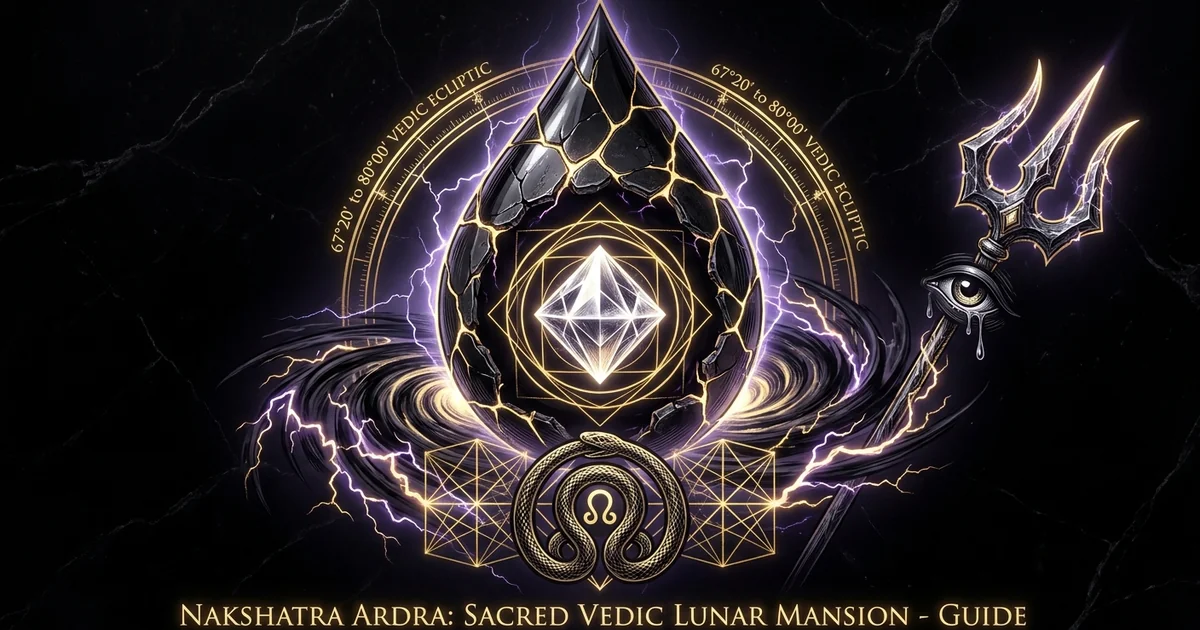
Nakshatra Ardra: Sacred Vedic Lunar Mansion - Guide
Archetypal Thesis & Systemic Paradigm: The Cataclysmic Node of Individuation
Within the structural mechanics of the 27 nakshatras in jyotish, Ardra occupies an indispensable, highly disruptive threshold. Spanning precisely from 67°20’ to 80°00’ of the sidereal ecliptic—spatially situated from 6°40’ to 20°00’ in the sign of Mithuna (Gemini)—this asterism marks the critical developmental juncture where naive sensory exploration meets existential shock.
While the preceding asterism, explored in the analysis of Mrigashira nakshatra meaning, establishes the soul’s romantic, wandering search for ideal form and sensory gratification under the reign of Soma, Ardra shatters this lyrical seeking through sudden confrontation with mortality, psychic dismemberment, and the unvarnished real. It is the ontological storm that strips consciousness of its infantile projections.
- Sidereal Span: 06°40’ – 20°00’ Mithuna (Gemini)
- Astronomical Correlate: Betelgeuse (Alpha Orionis)
- Ruling Presiding Deity: Rudra (The Howler / The Primordial Storm God)
- Planetary Overlord: Rahu (The North Lunar Node)
- Classification & Modality: Tīkṣṇa (Sharp / Piercing) / Dāruṇa (Terrible / Dreadful)
- Guna Composition: Tamas (Primary) – Rajas (Secondary) – Sattva (Tertiary)
- Sacred Symbols: Teardrop (Aśru), Polished Diamond (Vajra), Human Head
- Somatic Correspondence: Skull, Eyes, Cerebrum, Nervous Interfacing Systems
The Ecliptic Coordinates of Betelgeuse (Alpha Orionis) and Tropical-Sidereal Calibration
Astronomically, Ardra is linked with the supergiant star Betelgeuse (Alpha Orionis), an unstable, pulsating red variable situated on the shoulder of the celestial hunter Orion. Possessing an erratic radius and exhibiting dramatic shifts in luminosity, Betelgeuse mirrors the volatility inherent to the asterism’s astrological influence.
In calculating its position, the sidereal framework anchors Ardra to this variable stellar furnace, distinguishing it from tropical projections that overlook fixed-star precession.
Betelgeuse sits at the outer edge of our local interstellar bubble, periodically shedding mass in sudden, violent ejections. This thermodynamic instability matches its traditional assignment as a tīkṣṇa-dāruṇa (piercing and severe) asterism.
The ecliptic longitude of Ardra operates as an atmospheric chamber where celestial energy is supercharged, ionising human consciousness through intense emotional friction.
The Alchemical Nigredo: Suffering as an Epistemological Instrument
Viewed through archetypal psychology, the ardra nakshatra vedic astrology meaning cannot be reduced to simple misfortune. It represents the nigredo stage of the alchemical opus—the blackening, decomposition, and putrefaction of the ego that must precede psychological integration.
In the process of shadow integration and alchemical stages, Ardra serves as an epistemological tool: suffering is deployed as an instrument of perception. The primary symbol of the asterism, the teardrop (aśru), indicates that genuine insight often demands an emotional tax.
Tears serve a physiological and symbolic double function: they express sorrow while simultaneously washing the cornea, restoring unclouded sight.
Through the pressure of psychic distress, Ardra forces the individual to drop their defense mechanisms. It dismantles the intellectual rationalizations typical of Gemini, exposing the fragile, vulnerable core of the self.
Rahu’s Disruption: Shadow Integration within Gemini’s Intellectual Matrix
The dynamic tension within Ardra stems from its dual stewardship: it sits within the communicative, Mercury-governed sign of Gemini, but is ruled by Rahu, the North Lunar Node. Rahu is an insatiable, obsessional force that destabilizes whatever it touches, as detailed in our study of the Rahu-Ketu lunar nodes esoteric dynamics.
When Rahu’s compulsive drive operates through Mercury’s analytical circuits, it accelerates cognition to a fever pitch, often manifesting as paranoia, obsessional ideation, or brilliant, unconventional insight.
Ardra forces the rational mind to reckon with its repressed shadow. Gemini seeks to categorize, name, and tame reality through linguistic models, but Ardra injects an erratic, primal storm that defies neat semantic structures.
The native is compelled to master shadow integration, pulling raw instinctual fury and transpersonal terror into conscious awareness, lest those split-off energies erupt outward as self-sabotage or chaotic life crises.
Classical Provenance & Textual Lineage: From Vedic Rudra to Puranic Dissolution
The Taittiriya Brahmana and the Nakshatra Ishti Mantras of the Shatarudriya
The earliest textual strata of the Vedic tradition explicitly identify Ardra with the deity Rudra, the wild, howling hunter of the wilderness who commands cosmic storms and devastating tempests. In the Taittiriya Brahmana (3.1.2), within the Nakshatra Ishti sections, Ardra is approached with reverence, caution, and awe.
Unlike the benevolent solar deities (Adityas) or the gentle Soma, Rudra is the outsider god, deliberately denied offerings within traditional urban boundaries and instead propitiated at crossroads, funeral grounds, and wild frontiers.
“Rudra rules over Ardra, the moist and green mansion of the skies. May he, who flies through the mid-regions with his dark arrows, spare us from the blazing strike of his celestial weapon. Through the power of the crying storm, may our tears be transformed into living water; let the green shoots (ardra) rise out of the smouldering ash of our pride. We offer this oblation unto the fierce lord who strikes down perversion, seeking that his terrors turn to healing medicines (bheshaja).”
The litanies of the Shatarudriya embedded within the Yajurveda shed further light on Ardra’s inner mechanics. Rudra is invoked simultaneously as Sarva (the archer who slays with sudden sickness) and Bhava (the source of all being), as well as Mīḍhvaṣṭama (the most bountiful dispenser of grace).
The Vedic mindset recognized that the storm that tears the forest canopy also ends parched droughts, bringing life-saving rain. This duality underpins Ardra’s classic title: the moist, fertile, green ground that emerges in the wake of an elemental purge.
Varahamihira’s Brihat Samhita on the Violent Archetype of the Storm God
In classical astrological literature, Varahamihira dedicates significant attention to the structural implications of Ardra in the Brihat Samhita (Chapter XV, Nakshatravyuhadhyaya). Classifying the asterism unambiguously as dāruṇa (cruel, harsh, and dreadful), Varahamihira assigns to Ardra:
“The masters of black arts, sorcerers, poisoners, torturers, murderers, those who capture animals, hunters, thieves, and those proficient in the art of destruction, along with engineers of machines of rupture and war.”
Varahamihira’s taxonomy reflects an esoteric understanding of social and psychological realities. The classical author identifies Ardra as an astrological locus of entropy.
Yet in later chapters on celestial transits (Gocharadhyaya), he balances this view, observing that when benefic planets traverse Ardra, the world is relieved of drought, scientific breakthroughs occur, and old, stagnant regimes collapse under the weight of reform.
Kalyana Varma corroborates this view in his Saravali (c. 800 CE), noting that a native born with the Moon in Ardra possesses:
“An unyielding spirit, a fierce countenance, a propensity for deep intellectual craftiness, capacity for deceit, yet boundless endurance and an inherent bent toward profound, occult fields of study.”
Mythological Synthesis: Prajapati’s Transgression, Rudra’s Arrow, and Ecliptic Cataclysm
The definitive myth that anchors Ardra within the celestial sphere is the cosmic drama of Prajapati’s transgression. As recounted across the Brahmanas, Prajapati—the cosmic creator principle—became obsessively infatuated with his own daughter, the dawn constellation Rohini. Consumed by lust, Prajapati assumed the form of a stag (Mriga) to pursue her across the ecliptic, threatening the moral and physical harmony of the universe (Rta).
Horrified by this incestuous breach, the gods pooled their most terrifying, concentrated wraths into a single entity: Rudra. Taking aim with his celestial bow (symbolized by the belt stars of Orion, known as Trikanda or the three-pointed arrow), Rudra loosed a piercing bolt straight through Prajapati.
The stag was decapitated; its severed head was cast into the heavens to become the constellation Mrigashira, while the howling executioner took his place beside it as Ardra.
       [ PRAJAPATI'S TRANSGRESSION ]
       (Obsessional Desire / Violation of Rta)
                      │
                      ▼
     [ THE GODS' CONCENTRATED WRATH ]
       (Manifestation of Rudra / The Archer)
                      │
                      ▼
      [ THE COSMIC ARROW / DISCHARGE ]
       (Shattering of Mrigashira / Illusion)
                      │
                      ▼
        [ ARDRA: THE HOWLING AFTERMATH ]
       (Atmospheric Rain / Reconstitution)
This narrative establishes Ardra as the cosmic balance-keeper that intervenes through sudden rupture to halt spiritual decay. Ardra represents the moment the divine arrow finds its mark. It is the trauma of absolute ego-severance that preserves universal order at the cost of personal comfort.
Structural Mechanics & Symbolic Geometry: The Quadripartite Padas of Ardra
Understanding Ardra requires examining its four distinct subdivisions (padas), which trace the path from mental agitation to emotional catharsis. Falling entirely within Gemini, Ardra projects its energetic imprint into four contrasting Navamshas (ninth-harmonic divisional charts). This structural movement takes the quicksilver mentality of Mercury and routes it through the evolutionary demands of Jupiter, Saturn, Saturn-Rahu, and Jupiter-Neptune archetypes.
Pada 1 (Sagittarius Navamsha): The Ideological Archer and Philosophical Turbulence
- Span: 06°40’ to 10°00’ Gemini
- Navamsha Ruler: Jupiter (Guru)
- Esoteric Quality: Philosophical agitation and moral crusading
Pada 1 bridges Gemini’s intellectual agility with Sagittarius’s philosophical zeal. Here, the storm expresses itself through intense ideological conflict. The native becomes an intellectual archer, deploying ideas as weapons in defense of perceived truth.
This pada possesses an agitated, restless quality, driven by an urgent need to uncover cosmic meaning amidst mundane contradictions.
While planets placed here struggle with fanatical, dogmatic overcompensation, they can also cultivate exceptional philosophical depth. The mind refuses superficial explanations, turning its investigative drive inward to hunt down illusions.
Pada 2 (Capricorn Navamsha): The Heavy Burden of Material Karma and Structural Endurance
- Span: 10°00’ to 13°20’ Gemini
- Navamsha Ruler: Saturn (Shani)
- Esoteric Quality: Severe material karma, physical endurance, and structural compression
Pada 2 represents the densest, most demanding sector of Ardra. Governed by Saturn in the Navamsha, the stormy intellect of Gemini is constrained by cold, structural reality.
This is the forge where the raw carbon of consciousness undergoes the heat and pressure required to yield a diamond. Natives with major placements here experience acute frustrations, prolonged delays, material scarcity, or chronic physical ailments, often tied to the skull, eyes, or nervous system.
It also contains critical degrees related to the Pushkara Navamsha, where, through patient endurance, the soul metabolizes heavy ancestral debts. It imparts iron resilience: those who weather the trials of Pada 2 develop an unyielding capacity to bear the weight of practical responsibility.
Pada 3 (Aquarius Navamsha): The Electrified Mind and Occult Scientific Breakthrough
- Span: 13°20’ to 16°40’ Gemini
- Navamsha Ruler: Saturn and Rahu (Shani & Rahu)
- Esoteric Quality: Lightning flashes of intellectual genius, eccentric alienation, and research breakthroughs
Pada 3 brings together the co-rulership of Saturn and Rahu within an airy, innovative matrix, representing the eye of the storm. Here, lightning ceases to be purely destructive; it becomes an illuminative discharge. This pada is traditionally associated with visionary research, revolutionary scientific paradigms, computational architecture, and deep occult synthesis.
Placements here can trigger profound mental alienation, as the native’s thought processes often race far ahead of their sociocultural milieu.
The shadow expression can manifest as cold, cynical detachment or severe nervous exhaustion. Its elevated expression, however, yields the true promethean mind—an intellect capable of perceiving the invisible geometric structures underpinning physical phenomena.
Pada 4 (Pisces Navamsha): The Transmutation of Tears into Universal Compassion
- Span: 16°40’ to 20°00’ Gemini
- Navamsha Ruler: Jupiter (Guru)
- Esoteric Quality: Emotional catharsis, devotional surrender (Bhakti), and the dissolution of ego-boundaries
Pada 4 brings the storm of Ardra to its resolution. Falling into the oceanic, boundless sign of Pisces in the Navamsha, the sharp, analytical winds of Gemini are finally softened by torrential rains.
Here, the teardrop (aśru) shifts from an expression of personal suffering to an instrument of collective, empathetic sorrow.
Planets located in this pada exhibit pronounced emotional sensitivity, psychic vulnerability, and a longing for spiritual surrender. The analytical ego realizes the futility of trying to control existence through pure intellect, choosing instead to dissolve into devotional awe.
It serves as the alchemical bridge into Punarvasu nakshatra symbolism, where the post-storm rainbow reveals the light returning to a cleansed, regenerated world.
Psychological Dynamics & Operational Praxis: Navigating the Storm of Consciousness
Analytical Psychology: The Confrontation with the Terrifying Father Archetype
In the framework of archetypal psychology, Ardra represents consciousness encountering the Terrifying Father archetype—the wrathful face of the divine that sweeps away the ego’s illusions of sovereignty.
Carl Gustav Jung observed in Aion and Mysterium Coniunctionis that the human psyche cannot integrate its higher wholeness without first confronting the reality of destructive transpersonal forces.
“The encounter with the dark, terrifying aspect of the unconscious, often projected as an unsparing or destructive deity, is not an unfortunate pathological detour; it is the conditio sine qua non of individuation. The ego must experience its complete powerlessness before the numinous reality of the objective psyche can strip away the petrified shell of persona defenses. Only that which has been thoroughly shattered by the lightning of insight can be recombined into the lapis—the unyielding, incombustible self.”
The Ardra native often moves through the world with an underlying, electrified tension, anticipating crisis even in seasons of apparent peace. This psychology arises from an innate awareness that form is inherently fragile.
If this awareness is poorly integrated, the native projects their inner storm outward. They may create chaotic dynamics in their relationships or career, continually manufacturing real-world crises to justify their internal distress.
Conversely, when this complex is consciously worked through, it yields individuals of steady emotional endurance who remain grounded during widespread collective panic.
Diagnostics of Ardra Placements: Moon, Ascendant, Sun, and Dasha Sequences
[ ARDRA PLANETARY DIAGNOSTICS ]
       │
       ├─► MOON IN ARDRA: Emotional hyper-reactivity; somatization of grief;
       │   instinctive capacity to thrive in high-stress, crisis environments.
       │
       ├─► ASCENDANT (LAGNA) IN ARDRA: Acute, piercing gaze; prone to nervous
       │   exhaustion; early structural challenges forge profound tenacity.
       │
       ├─► SUN IN ARDRA: Identity grounded in disruption, research, and reform;
       │   inevitable conflicts with paternal, bureaucratic, or state authority.
       │
       └─► RAHU DASHA (ARDRA NATIVE): 18-year period initiated through shock;
dissolution of outdated life structures followed by sudden ascent.- Moon in Ardra: Produces an intensely emotional nature subject to rapid, tidal mood shifts. The mother figure may have been experienced as volatile, mourning, or deeply troubled. These individuals possess an uncanny ability to navigate crisis situations, functioning with cool, clinical focus when others fall apart.
- Ascendant (Lagna) in Ardra: Bestows a distinctive physical presence, often marked by a sharp, penetrating gaze, a prominent brow, and an active nervous system prone to stress and burnout. Early life experiences tend to be disrupted by sudden family crises, forcing the native to develop self-reliance prematurely.
- Sun in Ardra: Centers the core sense of identity on intellectual dismantling and systemic reform. These natives thrive as investigative journalists, forensic analysts, trauma surgeons, or revolutionary thinkers. They inevitably run into friction with institutional authorities, as their very nature challenges unexamined dogmas.
- Ardra Dasha Dynamics: When an individual navigates a Rahu Mahadasha with Rahu placed in Ardra, the period typically opens with sudden losses that clear out outmoded life arrangements. If the native resists these endings, the cycle brings intense psychological distress; if they embrace the purge, the dasha yields unconventional breakthroughs, deep research insights, and unexpected professional elevation.
Therapeutic and Remedial Mechanics: Chanting, Breathwork, and Cognitive Restructuring
Remediating an afflicted Ardra placement requires directly metabolizing chaotic kinetic energy rather than attempting to repress it. Traditional Jyotish prescribes propitiating Rudra through the systematic recitation of the Shri Rudram (especially the Chamakam portion, which enumerates the reconstruction of life following the storm) or the daily chanting of the Maha Mrityunjaya Mantra.
$$\text{Oṃ Tryambakaṃ Yajāmahe Sugandhiṃ Puṣṭi-Vardhanam}$$ $$\text{Urvārukam Iva Bandhanān Mṛtyor Mukṣīya Māmṛtāt}$$
From a somatic perspective, the nervous system of an Ardra native operates under continuous high-voltage tension. Rhythmic, vigorous Pranayama—such as Bhastrika (Bellows Breath) followed by extended Kumbhaka (retention) and soothing Nadi Shodhana—mechanically discharges the excess sympathetic charge stored in the body.
In therapeutic settings, cognitive restructuring must guide the native away from a default narrative of victimization toward an alchemical framework: recognizing that their personal crises are systemic clearings designed to burn away complacency and forge the unyielding diamond of integrated consciousness.
Philosophical Synthesis & Macrocosmic Correspondence: Polarity and Hermetic Alchemy
The Polarity of Ardra and Mula: The Galactic Axis of Evisceration and Transcendence
Within the architecture of the 27 lunar mansions, Ardra sits in direct 180° opposition to Mula Nakshatra (0°00’ to 13°20’ Sagittarius), creating an intense energetic axis across the celestial sphere.
While Ardra is presided over by Rudra (the celestial storm that strikes from the atmosphere down toward the earth), Mula is governed by Nirriti (the goddess of death and dissolution who drags consciousness down into subterranean roots).
Ardra Nakshatra (Gemini)
- Zodiacal Locus: 06°40’ – 20°00’ Mithuna (Gemini)
- Presiding Force: Rudra (Atmospheric Storm / Upward Lightning)
- Governing Node: Rahu (North Lunar Node / Obsessive Modernity)
- Modus Operandi: Epistemological rupture; shatters mental constructs
- Cosmic Direction: Descending lightning; strikes ego from the skies
- Elemental Core: Ionized Air / Moisture / Cerebral Nervous System
Mula Nakshatra (Sagittarius)
- Zodiacal Locus: 00°00’ – 13°20’ Dhanus (Sagittarius)
- Presiding Force: Nirriti (Subterranean Calamity / Earth Core)
- Governing Node: Ketu (South Lunar Node / Primal Annihilation)
- Modus Operandi: Ontological uprooting; pulls down ancestral structures
- Cosmic Direction: Ascending chthonic fire; destroys foundations from below
- Elemental Core: Compressed Fire / Ash / The Galactic Core (Vishwanabhi)
This axis represents the two complementary forms of cosmic destruction. Ardra dismantles the individual intellect through storms of thought and feeling, whereas Mula incinerates the native’s structural foundations, family lineages, and institutional roots.
Together, they govern the necessary cycles of death and regeneration, clearing away karmic sediment so the cosmos can continually renew itself.
Hermetic Principle of Polarity: The Wet Dewdrop versus the Incombustible Diamond
The apparent contradiction between Ardra’s primary symbols—the fragile, transient teardrop (aśru) and the unyielding, luminous diamond (vajra)—reveals a core Hermetic mystery. The Sanskrit word Ardra translates directly as “moist,” “wet,” or “fresh with life.” It refers to the dewdrop resting on a leaf in the dawn following a nocturnal tempest.
In Hermetic terms, this dualism captures the complementary alchemical operations of Separatio and Calcinatio.
The lightning strike (calcinatio) burns away the ego’s dross, while the subsequent downpour of tears (separatio and solutio) cleanses the residue.
The diamond is not the opposite of the teardrop; it is its crystallized, transcendent realization. Carbon transforms into diamond only when subjected to immense tectonic pressure and heat.
Through the trials of life, the individual’s fluid emotional pain is tempered until it crystallizes into the indestructible vajra—a mind that perceives reality without illusion, untouched by fear.
Macrocosmic Cycles: Monsoon Physics, Atmospheric Ionization, and Social Renewal
At the macrocosmic level, Ardra governs the arrival of the southwest monsoon across the Indian subcontinent. The scorching, oppressive heat of the summer months (associated with Rohini and Mrigashira) builds an intolerable thermodynamic charge in the lower atmosphere.
Ardra breaks this pressure with sudden squalls, purple thunderheads, and torrential downpours. The lightning ionizes the air, synthesizing atmospheric nitrogen into soil-nourishing nitrates, while the rain cools the earth, awakening dormant seeds.
       [ THERMODYNAMIC TENSION / SUMMER HEAT ]
              (Mrigashira: Oppressive Stagnation)
                            │
                            ▼
           [ IONIC DISCHARGE / THE STORM ]
             (Ardra: Lightning, Rain, Tears)
                            │
                            ▼
          [ BIOCHEMICAL TRANSMUTATION ]
           (Fixation of Atmospheric Nitrates)
                            │
                            ▼
          [ VEGETATIVE RESURRECTION ]
           (Punarvasu: The Green Earth Renewed)
This atmospheric cycle serves as an ecological model for sociopolitical and historical transitions. Societies inevitably build up cultural rigidities, economic inequities, and institutional corruption.
Ardra manifests in collective history as the unavoidable sociopolitical storm: revolutions, market crashes, scientific disruptions, and radical cultural realignments.
While these transitions bring real disruption, they break apart calcified social structures, ensuring the collective current of human consciousness remains dynamic, vital, and awake.
Frequently Asked Questions
Why is Ardra represented by both a teardrop and a diamond?
The dual symbolism of the teardrop (aśru) and the diamond (vajra) maps the full transformative journey of the asterism. The teardrop reflects the immediate human experience of suffering: the grief, disillusionment, and shedding of naive projections that occur when Rudra’s lightning shatters the ego’s illusions.
The diamond, forged deep within the earth under crushing heat and pressure, represents the ultimate psychological outcome of that process: a crystallized, unyielding consciousness.
The teardrop represents the work of dissolution (solutio), while the diamond represents the enduring core (coagulatio) that remains when everything non-essential has been burned away.
How does Ardra Dasha differ from standard Rahu Mahadasha effects?
While any Rahu Mahadasha amplifies worldly ambition, psychological restlessness, and unconventional experiences, an Ardra-influenced Rahu period operates with specific intensity. Because Rahu resides in its own asterism within Mercury’s intellectual sign, it operates with maximum archetypal force.
Rather than simply chasing material success or social mobility, an Ardra Rahu period triggers profound intellectual breakthroughs often accompanied by sharp, sudden identity crises.
It strips away outmoded patterns through unexpected shocks, deepens investigative and analytical abilities, and pushes the native into technical or occult fields. The early part of the dasha often demands emotional surrender, while the latter half delivers intellectual clarity and unconventional recognition.
Is Ardra inherently malefic or disastrous for worldly enterprise?
Classical Jyotish classifies Ardra as tīkṣṇa (sharp) and dāruṇa (terrible), meaning it is ill-suited for peaceful, gentle beginnings such as weddings, housewarmings, or conciliatory negotiations. However, labeling it purely malefic misinterprets its systemic role.
Ardra is an exceptional placement for endeavors that require fearless disruption, sharp analytical focus, and the capacity to confront crisis. It excels in fields such as forensic science, trauma surgery, deep psychological therapy, investigative research, structural demolition, and revolutionary art.
In worldly enterprise, Ardra provides the grit, emotional courage, and strategic detachment needed to navigate chaotic, high-stakes environments where more fragile placements falter.