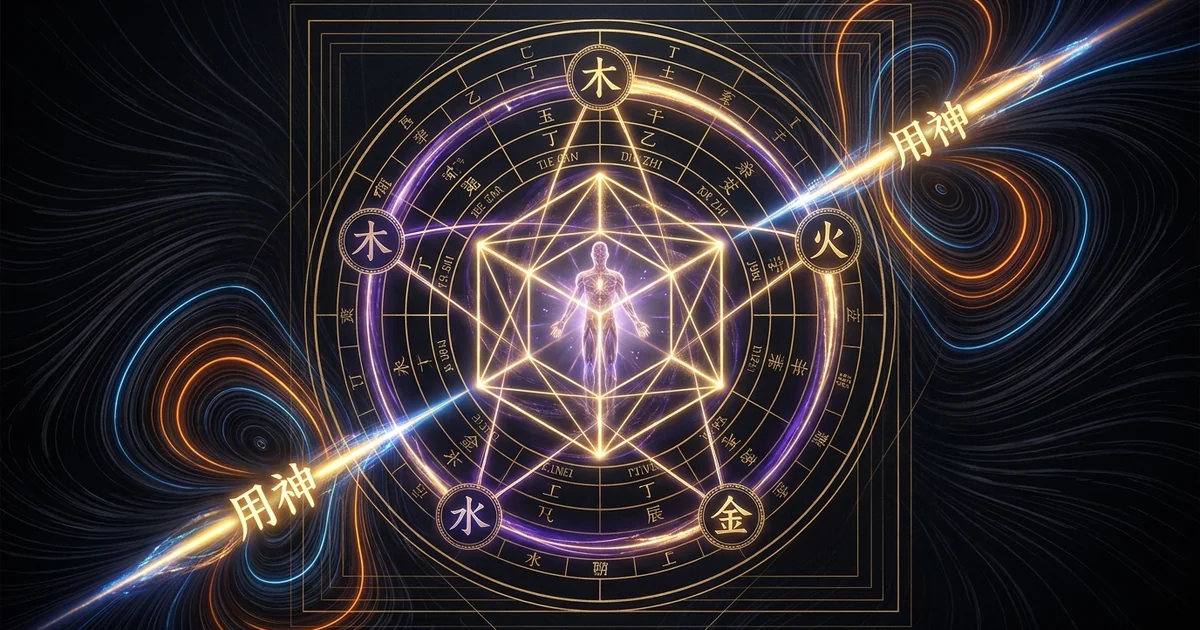
Useful Gods in BaZi: Restoring Elemental Equilibrium
Archetypal Thesis & Systemic Paradigm: The Homeostatic Imperative of the Yong Shen
Thermodynamic Non-Equilibrium in the BaZi Matrix
In the metaphysical cartography of Chinese psycho-cosmology, the Four Pillars of Destiny (BaZi, 八字) operates not as a fatalistic ledger of deterministic events, but as a discrete thermodynamic model of open systemic energetics. Cast at the precise celestial coordinate of an individual’s birth, the natal chart encodes a static energetic freeze-frame of local solar-terrestrial spacetime. This framework, synthesized systematically through the interaction of the Ten Heavenly Stems (Tian Gan, 天干) and Twelve Earthly Branches (Di Zhi, 地支), registers the dynamic state vectors of the Five Elements (Wu Xing, 五行): Wood, Fire, Earth, Metal, and Water. Rather than conceptualizing these five systemic phases as inert material substances, classical cosmology understands them as qualitative vectors of thermodynamic movement—expansion, ascension, stabilization, contraction, and conservation.
Within any given four-pillar matrix, total systemic balance is mathematically improbable. The specific configuration of planetary coordinates, seasonal commands, and diurnal shifts inevitably produces an asymmetrical energetic topography. Left unmediated, this internal asymmetry creates an entropic gradient. In the lexicon of complex systems analysis, the uncalibrated natal chart functions as an open non-equilibrium system characterized by elemental congestions, thermodynamic deficits, and functional blockages. The primary objective of authentic astrological analysis is therefore therapeutic and systemic: calculating the dynamic intervention required to restore the organism to functional homeostatic equilibrium.
[Wood (Mu)] ---> [Fire (Huo)] ---> [Earth (Tu)] ---> [Metal (Jin)] ---> [Water (Shui)]
    ^                                                                         |
    |_________________________________________________________________________|
The Day Master as Coherence Attractor
At the structural center of this non-equilibrium energetic field resides the Day Master (Ri Yuan, 日元), represented by the Heavenly Stem of the day pillar. As detailed in foundational frameworks such as the BaZi Four Pillars Introduction, the Day Master constitutes the subjective locus of consciousness—the systemic coherence attractor around which the surrounding cosmic variables are organized. The energetic integrity of this node determines the psyche’s capacity to process environmental friction, metabolic stress, and psycho-spiritual tension. When the Day Master deviates markedly from systemic equilibrium, pathology arises within the native’s psycho-somatic architecture.
A hyper-concentrated Day Master, engorged by excessive supportive resources or competitive peer elements, crystallizes into psychological inflation, rigid cognitive fixation, and relational tyranny. Conversely, a depleted Day Master, crushed under an oppressive onslaught of controlling officers or drained by unceasing expressive outputs, manifests as executive exhaustion, chronic anxiety, and somatic dissipation. The Day Master cannot be treated in isolation; its relative weight is intrinsically bound to the Month Branch (Yue Ling, 月令), the seasonal command that establishes the baseline ambient temperature and energetic density of the entire matrix. The structural friction experienced by the Day Master constitutes systemic neurosis in classical Chinese metaphysics: an acute misalignment between personal subjective intent and the cosmological field dynamics that sustain it.
Yong Shen as Cybernetic Feedback Vector
To resolve structural tension and arrest systemic entropy, BaZi deploys the operational operator designated as the Useful God (Yong Shen, 用神). Far from functioning as an external supernatural intervention or superstitious deity, the Useful God operates as an exact cybernetic feedback vector. It represents the specific elemental phase whose activation shifts the entire eight-character network from entropic fragmentation into self-regulating negentropy. By introducing the correct qualitative counterweight, the Useful God functions as the mathematical pivot through which elemental compensation, thermodynamic restoration, and psychological integration occur.
In this respect, the deployment of the Useful God aligns with dynamic systems theory and the analytical psychology of Carl Gustav Jung. Jung postulated that the human psyche constitutes a self-regulating energetic system sustained through the continuous balance of archetypal polarities. In a BaZi chart, when elemental tension escalates to critical thresholds, the Useful God acts as the catalytic variable that transmutes raw psychological conflict into structured individuation. Calculating the useful god yong shen bazi balance destiny mechanism is an exercise in structural psycho-cybernetics: it identifies the single energetic variable that, if cultivated through conscious behavioral, environmental, and chronobiological orientation, converts structural distress into creative psychic momentum.
“The psychological concept of energy is not a physical concept, but a heuristic principle of the highest importance… The psyche is a self-regulating system that maintains its equilibrium just as the physical body does. Every excess of energy (hyper-potency) in one direction produces a corresponding compensatory tension in the opposite direction, according to the principle of equivalence.” — Carl Gustav Jung, The Structure and Dynamics of the Psyche (Collected Works Vol. 8), 1960, §43–45.
Classical Provenance & Textual Lineage: From Song Dynasty Mechanics to Qing Systematization
The Ziping Revolution and Structural Internalization
The architectural lineage of the Useful God concept traces a decisive paradigm shift in the history of Chinese divination. Prior to the mid-Song Dynasty, destiny calculation relied on the antique system preserved within the Tang Dynasty texts of Li Xuzhong (761–813 CE). In this proto-system, the chart’s structural axis was anchored strictly upon the Year Branch—the Grand Duke (Tai Sui, 太歲)—evaluating fate through complex, externally deterministic constellations of Nayin (Melodic Elements) and archaic astral spirits (Shen Sha). This earlier model treated humanity as an object subjugated to macrocosmic generational currents, producing a fatalistic interpretive framework largely devoid of internal dynamic remediation.
The foundational paradigm shift occurred during the Northern Song Dynasty through the structural innovations attributed to Master Xu Ziping (c. 907–960 CE), whose methods were codified in works like the Yuan Hai Zi Ping (淵海子平). The Ziping revolution discarded the Year Pillar’s hegemony, internalizing the chart’s operational pivot by designating the Day Master Stem (Ri Yuan) as the individual self. By shifting the central reference coordinate from the collective temporal marker (Year) to the personal diurnal marker (Day), the chart ceased to be a balance sheet of external celestial decrees. It transformed into an interconnected thermodynamic system in which the Day Master negotiates with its local seasonal environment. Structural balance—and consequently the algorithmic determination of an internal homeostatic regulator (Yong Shen)—emerged as the central operational pivot of destiny analysis.
Hermeneutics of the Di Tian Sui and Zi Ping Zhen Quan
During the Ming and Qing Dynasties, the theoretical mechanics of the Useful God bifurcated into two major hermeneutic lineages, both essential for understanding modern elemental rectification. The first school, immortalized by Liu Bowen (1311–1375 CE) in the foundational treatise Di Tian Sui (滴天髓 / Dripping Heavenly Marrow), later elaborated by Qing commentators Chen Su’an and Ren Tiejiao, approaches the natal chart through holistic resonance, energetic circulation (Qi Lu), and thermodynamic realism. The Di Tian Sui prioritizes the visceral physical condition of the elements: whether the Wood is parched or saturated, whether the Metal is freezing or molten, and whether Qi flows uninterruptedly through all five phases without severe stagnation. Within this lineage, the Useful God is selected to optimize circulation, alleviate thermodynamic extremes through climatic pacing, and clear direct, violent blockages between competing nodes.
“If the dynamic configuration of Qi is entangled, clarify it; if it is obstructed, clear a path for it. Where the chart suffers from excessive heat, cold water must nourish the roots; where cold reigns absolute, sun-drenched fire must awaken the earth. The supreme operator—the Useful God—does not merely conquer the strong or lift the weak; it enables the hidden marrow of Heaven and Earth to achieve continuous, unobstructed circulation.” — Liu Bowen, Di Tian Sui, annotated by Ren Tiejiao, c. 1773.
Conversely, the second school, codified definitively by Shen Xiaochun (c. 1776 CE) in the canonical Zi Ping Zhen Quan (子平真詮 / Subtleties of Ziping Astrology), approaches the Yong Shen through structural-functional taxonomy. Shen Xiaochun defined the Useful God not as a shifting energetic remedy, but as the governing structural pattern (Ge Ju, 格局) directly derived from the Month Branch’s hidden stems (Cang Gan, 藏干). In Shen’s framework, the Useful God represents the formal office of the individual’s destiny—such as Direct Officer, Indirect Wealth, or Seven Killings. The chart’s success depends upon whether this central pattern is protected or corrupted by secondary and tertiary actors.
While modern colloquial practice often conflates these lineages, sophisticated praxis recognizes that Shen Xiaochun provides the diagnostic blueprints of sociological and institutional function, whereas Liu Bowen’s energetic framework in the Di Tian Sui offers the physiological and psychological therapeutics required to preserve individual sanity and dynamic vitality.
The Evolution from Fate Fatalism to Strategic Elemental Therapeutics
By the late Qing Dynasty, the cross-pollination of these classical texts sparked a philosophical renaissance, catalyzed further by Chen Su’an’s Ming Li Yue Yan (命理約言 / Compendium of Destiny Principles, c. 1658 CE). Destiny (Ming, 命) was systematically distinguished from movement (Yun, 運). Destiny designates the static structural hand dealt at the cosmic origin point: the natal arrangement of stems, branches, and intrinsic systemic friction. Movement, captured within the decennial Luck Pillars (Da Yun, 大運), represents the time-variant environmental flux through which the static matrix navigates.
Under this synthetic view, fate fatalism completely dissolves into strategic elemental therapeutics. If the natal matrix constitutes a landscape containing intrinsic deficits, the Useful God provides the operational protocol for conscious dynamic navigation. The chart is transformed from a terminal verdict into an architectural diagnosis of the subject’s internal energetic engine. By calculating the favorable elements that sustain the Yong Shen, the metaphysical practitioner functions as an energetic engineer, diagnosing structural failures, anticipating cyclical crises, and designing specific interventions—environmental, somatic, and behavioral—to re-establish psycho-cosmic equilibrium.
Structural Mechanics & Symbolic Geometry: Algorithmic Classification of Useful Gods
Seasonal Commanding (Yue Ling) and the Thermodynamic Baseline
The algorithmic determination of the Useful God begins with the evaluation of the Month Branch (Yue Ling, 月令). In classical BaZi mechanics, the seasonal command holds sovereign status; it acts as the primary thermodynamic engine of the chart, distributing more than fifty percent of the qualitative mass to the elemental forces. The solar calendar coordinates the twelve earthly branches with the transition of the seasons: Tiger (Yin) and Rabbit (Mao) represent Spring (Wood); Snake (Si) and Horse (Wu) command Summer (Fire); Monkey (Shen) and Rooster (You) inaugurate Autumn (Metal); and Pig (Hai) and Rat (Zi) govern Winter (Water). The four transitional branches—Ox (Chou), Dragon (Chen), Goat (Wei), and Dog (Xu)—serve as the seasonal buffer states commanding Earth.
Through the seasonal command, every element’s energetic momentum is evaluated through the Five Stages of Qi:
- Thriving (Wang, 旺): The element currently commanding the season.
- Resting (Xiang, 相): The element produced by the commanding season.
- Trapped (Xiu, 休): The element that produced the commanding season, now exhausted.
- Imprisoned (Qiu, 囚): The element that attempts to control the commanding season, rendered powerless.
- Dying (Si, 死): The element controlled by the commanding season, crushed under ambient pressure.
For example, a Jia (Yang Wood) Day Master born in the peak of Winter (Zi Month) is situated in a thermodynamic environment dominated by thriving Water. While Water generates Wood according to the standard Sheng generative cycle, the extreme refrigeration of frozen winter water paralyzes root development, threatening to cause the Wood to rot rather than flourish. The thermodynamic baseline demonstrates that simple mechanical production without climatic modulation leads to death rather than vitality. The seasonal baseline dictates the chart’s primary pathology, dictating what form of remediation must be deployed.
The Fivefold Operational Taxonomy: Fu-Yi, Tiao-Hou, Tong-Guan, Bing-Yao, and Cong-Ge
Classical Ziping theory categorizes Useful Gods into five operational modalities, each designed to treat a specific configuration of energetic imbalance:
- Support and Inhabitation (Fu-Yi, 扶抑): The baseline method applied to standard structures. If the Day Master is weak (Shen Ruo), lacking seasonal roots and overwhelmed by controlling, draining, or consuming forces, it must be supported (Fu) via resource elements (Mother) or companion elements (Peer). If the Day Master is hyper-potent (Shen Wang), it must be inhabited, drained, or suppressed (Yi) via Officer, Wealth, or Expression elements to bleed off systemic excess.
- Climatic Regulation (Tiao-Hou, 調候): Applied when the chart suffers from excessive cold or heat. Charts born in the frozen months of Winter require Bing (Yang Fire) or Ding (Yin Fire) to thaw the frozen landscape; charts born in the arid depths of Summer require Ren (Yang Water) or Gui (Yin Water) to irrigate and preserve parched matter. Climatic regulation universally supersedes standard structural balancing: without thermodynamic warmth or moisture, life-force ceases, rendering all structural equations meaningless.
- Mediating Bridge (Tong-Guan, 通關): Applied when two diametrically opposed, hyper-potent elemental forces lock into a catastrophic direct clash, creating systemic paralysis and psychological trauma. For example, when massive Wood clashes against massive Earth, Earth suffers catastrophic rupture. The introduction of Fire acts as a mediating bridge (Tong Guan), absorbing the aggressive kinetic vector of Wood through generation (Wood generates Fire) and transmitting it harmlessly to Earth (Fire generates Earth), transmuting structural violence into a continuous generative loop.
- Disease and Medicinal Remedy (Bing-Yao, 病藥): Applied when an otherwise balanced or noble chart configuration is undermined by a single identifiable pathogen (Bing). The pathogen is an element that violently disrupts the central pattern or attacks the chart’s structural organ. The medicinal remedy (Yao) is the precise element that eradicates or neutralizes that offending pathogen, restoring structural integrity to the entire mechanism.
- Surrendering Follow Pattern (Cong-Ge, 從格): Applied under extreme conditions where the Day Master completely lacks roots, resources, or companions, while a single opposing element holds absolute, monopolistic hegemony over the chart. Rather than attempting a futile, catastrophic resistance by introducing fractional support elements, the Day Master must surrender its identity and follow (Cong) the dominant current. In such cases, the monopolistic element itself becomes the chart’s paradoxical Useful God, and any attempt to re-introduce native support acts as an entropic catastrophe.
Supporting Nodes: Xi Shen (Favorable Element) and Ji Shen (Taboo Element) Interactions
The operational calculus does not operate within a crude binary. An absolute diagnosis requires calculating an ecosystem of five distinct functional roles:
- The Useful God (Yong Shen, 用神): The primary restorative vector within the chart.
- The Favorable Element (Xi Shen, 喜神): The direct fuel source, protector, and structural ally of the Useful God. For instance, if Fire is the Useful God, Wood serves as the Favorable Element, shielding Fire from destructive Water and continually feeding its combustion.
- The Taboo Element (Ji Shen, 忌神): The systemic antagonist or pathogen that directly attacks, controls, or undermines the Useful God. If Fire is the Useful God, Water operates as the Taboo Element.
- The Vengeful Element (Chou Shen, 仇神): The auxiliary pathogen that strengthens the Taboo Element while draining or attacking the Favorable Element. In a system where Water is the Taboo Element, Metal acts as the Vengeful Element by constantly generating Water and severing the Wood that feeds Fire.
- The Idle Element (Xian Shen, 閒神): Elements that occupy a dormant, neutral, or unaligned state within the natal chart, yet hold latent potential to be recruited by incoming transits into either constructive alliances or destructive clashes.
Systemic remediation requires exact differentiation between the primary actor (Yong Shen) and its protective fuel (Xi Shen), while simultaneously containing the entropy-inducing counter-force (Ji Shen). A chart may possess a brilliant Useful God, but if that node lacks a protective Favorable Element, it remains fragile, vulnerable to sudden destruction by the shifting celestial seasons of life.
Operational Mechanics: Diagnostic Typologies and Remedial Arbitration
Climatic Regulation (Tiao Hou): The Thermodynamics of Fire and Water
The thermodynamic reality of the seasonal command establishes the foundational baseline of all bazi remedy procedures. When cosmic configurations tilt toward thermal extremes, biological and psychological survival overrides conventional structural balance. A Day Master born during the seasonal commands of Hai (Pig, early winter), Zi (Rat, mid-winter), or Chou (Ox, late winter) inherits a psychic terrain saturated with cold. The molecular state of water shifts from fluid circulation to frozen crystalline stasis. In this state, the latent generative capacity of Water to nourish Wood is completely paralyzed. Wood becomes brittle and waterlogged; Earth turns into impenetrable permafrost; Fire flickers in terminal exhaustion.
Under these meteorological conditions, conventional structural calculations must be suspended. Even if the Day Master is intrinsically weak, applying cold Water resources or heavy Earth will merely freeze the matrix further, cementing psychological paralysis, deep existential depression, and psychosomatic stagnation. The sole viable bazi balance destiny intervention is the immediate application of Bing (Yang Fire)—the archetypal Sun—or Ding (Yin Fire)—the artificial furnace—to warm the cosmic atmosphere, liquefy the frozen waters, and liberate the chart’s dormant metabolic functions.
Conversely, a chart born in the apex of Summer (Si, Wu, or Wei months) experiences an aggressive thermodynamic furnace. The soil is calcined into dry dust, Metal is warped and softened, and Wood spontaneously combusts. Here, the deployment of Ren (Yang Water) or Gui (Yin Water) is an urgent existential mandate to quench the structural flames, irrigate the desiccated Earth, and prevent the complete evaporation of the native’s vital essence. Climatic regulation governs the foundational viability of the elemental ecosystem; without it, all other operational architectures collapse.
Structural Balancing (Fu-Yi)
- Operational Priority: Secondary. Operates only after thermal survival conditions are verified.
- Diagnostic Basis: Day Master strength index derived from seasonal command, root density, and peer-to-drainage ratios.
- Mechanics: Suppression of excess (via Officer/Wealth/Expression) or replenishment of deficiency (via Resource/Companion).
- Risk Profile: Misapplication induces severe internal inflation, manic neurosis, or acute structural collapse under sudden shifts.
Climatic Regulation (Tiao-Hou)
- Operational Priority: Absolute Sovereign. Transcends standard strength metrics; applied immediately upon detection of extreme season.
- Diagnostic Basis: Severe thermodynamic conditions dictated by mid-winter or mid-summer Month Branches (Hai, Zi, Chou, Si, Wu, Wei).
- Mechanics: Injection of warming vectors (Bing/Ding Fire) or cooling/irrigating vectors (Ren/Gui Water) to initiate metabolic circulation.
- Risk Profile: Neglect induces complete systemic paralysis, deep psychosomatic decay, and terminal entropy of structural elements.
Mediating Inter-Elemental Warfare (Tong Guan): Relieving Metal-Wood and Water-Fire Clashes
A secondary structural pathology involves the direct, unmediated confrontation of opposing structural superpowers, an elemental state known as mutual clashing (Xiang Chong, 相沖). Classical metaphysics identifies two deeply devastating inter-elemental wars: the collision between Metal and Wood, and the confrontation between Water and Fire.
Consider a chart configuration dominated by massive, unyielding Geng Metal locked in an irreconcilable axis against an equally potent cluster of Jia Wood:
[ Geng Metal (Aggressive Blade) ]  <=== VIOLENT CLASH ===>  [ Jia Wood (Stately Forest) ]
                                            |
                                            |  (Remedial Insertion of Water)
                                            v
[ Geng Metal ] ------------> [ Ren/Gui Water (Bridge) ] ------------> [ Jia Wood ]
   (Metal Generates Water)                                (Water Generates Wood)
In this unmediated state, the psychological signature is one of violent cognitive splitting, chronic neuromuscular tension, sudden physical trauma, and profound internal rupture. The Metal wields its sharp, blade-like axe against the living forest of Wood; the Wood shatters, while the Metal’s blade is chipped and blunted.
Standard structural analysis often fails here, as attempting to empower the Wood triggers retaliatory violence from the Metal, while empowering the Metal accelerates the destruction of the Wood. The sole operational resolution is the deployment of a Tong Guan (Mediating Bridge) Useful God: Water. By positioning Water between the combatants, the dynamic field undergoes topological transmutation. Metal, encountering Water, directs its raw, aggressive potential toward generating its child (Metal produces Water). Water, in turn, readily nourishes the struggling Wood (Water produces Wood).
The destructive collision (Ke) is transformed into a continuous generative loop (Sheng). Psychological alienation is transfigured into profound cognitive integration: the native ceases to experience their will as torn between ruthless self-policing (Metal) and spontaneous instinctual growth (Wood), discovering instead an intellectual channel (Water) that reconciles structural discipline with expansive creativity.
Dominance Submission Dynamics (Cong Ge): Surrendering to Overwhelming Elemental Flow
The most counter-intuitive diagnostic typology in classical Ziping mechanics occurs within the Cong Ge (Follow Patterns). Standard Western intuition, conditioned by heroic archetypes, presumes that every weak element must fight for its survival, asserting its agency against overwhelming environmental odds. Classical BaZi mechanics rejects this as systemic hubris. When an individual is born with an exceptionally frail Day Master—possessing no root in any branch, devoid of supportive resource elements, and surrounded entirely by an overwhelming sea of a single element (such as an all-consuming firestorm of Seven Killings or an inescapable ocean of Wealth)—any attempt to balance or strengthen the Day Master induces catastrophe.
If the metaphysical engineer attempts to inject a microscopic trace of resource or companion element to “help” this frail Day Master, it acts as a lightning rod for systemic rage. The overwhelming monopolistic force strikes down this fractional support, producing profound somatic collapse, ruinous bankruptcy, or mental breakdown.
The remedial strategy here requires a non-dual psychological surrender: the native must abandon their separate Day Master identity, entirely surrendering their allegiance to the dominant current. In a Cong Sha (Follow the Officer/Killer) structure, the Seven Killings element itself paradoxically becomes the chart’s Useful God. The native flourishes not by asserting personal ego against the cosmic environment, but by becoming the perfect, frictionless vessel for that dominant environmental demand. True homeostatic equilibrium is achieved through absolute compliance with the dominant vector of the cosmological field.
Psychological Dynamics & Operational Praxis: The Useful God as Conscious Integration
The Shadow of the Ji Shen and Enantiodromia
The mechanics of Four Pillars analysis achieve psychological depth when viewed through Jungian analytical psychology, particularly the interplay between the conscious ego and the unconscious shadow. The Taboo Element (Ji Shen), in this psycho-cosmic model, is the archetypal shadow. It constitutes that qualitative energetic complex which the conscious ego habitually mismanages, represses, or allows to run rampant as a compulsive, unintegrated drive.
When an individual’s chart is overwhelmed by an excess of the Ji Shen, the psyche is subject to the law of enantiodromia—the systemic process whereby an extreme psychological position inevitably transmogrifies into its diametrical opposite. For instance, an individual with an uncontrolled excess of the Taboo Officer element (Guan Sha), lacking the mediating grace of the Useful God (Resource, Yin), lives under the relentless internal tyranny of self-punishment, compulsive perfectionism, and acute paranoia. Eventually, the psychological system shatters under this pressure, flipping into chaotic self-sabotage, moral dissolution, and psychosomatic collapse.
The Useful God is the precise counter-attractor that interrupts this enantiodromic spiral. By deliberately orienting consciousness toward the attributes of the Useful God, the native withdraws projections from the external world and integrates the unconscious shadow. The Useful God represents the transcendent function described by Carl Jung: an active, intentional psychological mechanism that bridges the split between the conscious Day Master and the uncalibrated forces of the unconscious shadow complex.
| Elemental Vector | Somatic Correlate | Psycho-Behavioral Cultivation | Chronobiological Alignment | Spatial & Directional Coordinate |
|---|---|---|---|---|
| Wood (Mu) | Hepatic system, tendons, eyesight, neuro-pathways | Cultivation of benevolent vision (Ren), creative expansion, pioneering strategy, flexibility | Vernal equinox; dawn hours (03:00–07:00 / Yin-Mao) | East; proximity to living floral architectures, elevated forestry |
| Fire (Huo) | Cardiovascular network, small intestine, systemic vitality | Dynamic expressive articulation, intellectual illumination, ceremonial propriety (Li) | Summer solstice; solar noon (11:00–13:00 / Wu) | South; exposure to ambient natural light, dynamic energetic spaces |
| Earth (Tu) | Spleen-pancreas complex, stomach, connective fascia | Grounded equilibrium, radical integrity, contemplative stillness, trust (Xin) | Seasonal interfaces (Chen, Xu, Chou, Wei); afternoon transitions | Center / Central axis; engagement with stone, ceramics, subterranean minerals |
| Metal (Jin) | Pulmonary infrastructure, large intestine, dermal boundary | Structural rigor, decisive precision, boundary demarcation, justice (Yi) | Autumnal equinox; dusk hours (15:00–19:00 / Shen-You) | West; minimalist geometries, crystalline order, metallic precision |
| Water (Shui) | Renal reserve, bladder, endocrine fluids, marrow | Strategic stillness, intuitive fluidity, profound introspection, wisdom (Zhi) | Winter solstice; nadir midnight (23:00–01:00 / Zi) | North; proximity to flowing hydro-topographies, deep meditative quiet |
Spatial, Behavioral, and Chronobiological Compensation
The remediation of an elemental deficit transcends superficial superstition. The authentic application of the Useful God constitutes an intentional recalibration of the individual’s lived environment, behavioral patterns, and biological rhythms. This methodology is summarized in the therapeutic framework of elemental compensation. If an individual’s Useful God is Xin (Yin Metal), remediation does not consist of wearing naive trinkets; it demands the conscious embodiment of the archetypal qualities of Yin Metal:
- Cultivating ruthless intellectual clarity and analytical discernment;
- Excising systemic behavioral clutter;
- Establishing exact somatic boundaries;
- Engaging in disciplines requiring refined, microscopic precision (such as editorial logic, microsurgery, or high-precision craft).
Similarly, chronobiology plays an instrumental role in dynamic compensation. The Twelve Earthly Branches govern the twenty-four-hour diurnal cycle, segmenting time into twelve two-hour windows (Shi Chen). An individual whose Useful God is Fire benefits from structuring high-stakes cognitive tasks, public engagements, and critical decision-making vectors within the Si (09:00–11:00) and Wu (11:00–13:00) hours, when the solar terrestrial engine is saturating the environment with peak Fire Qi. Spatial alignment works upon identical geometric principles: relocating one’s domestic sanctuary, working axis, or geographic residence along the cardinal vector that mirrors the Useful God directly alters the external sensory inputs and energetic baseline of the homeostatic system.
The Decennial Luck Pillars (Da Yun) as Dynamic Environmental Oscillators
The natal chart cannot be understood as a closed terrarium; it is continuously buffeted by the moving temporal cycles of the cosmos, most prominently the decennial Luck Pillars (Da Yun, 大運) and Annual Pillars (Liu Nian, 流年). These transits function as dynamic environmental oscillators. Every ten years, the individual enters an entirely new meteorological territory commanded by an incoming Stem and Branch pair.
       [ NATAL MATRIX: Thermodynamic Blueprint ]
                           │
                           ▼
[ Decade Luck Pillar (Da Yun) ] ===> Climatic / Chemical Ingress
                           │
                           ▼
 [ Annual Cycle (Liu Nian) ]     ===> Immediate Spark / Trigger
                           │
                           ▼
    [ Systemic Transformation: Liberation or Destruction of Yong Shen ]
When the Luck Pillar introduces the exact element designated as the chart’s Useful God or Favorable Element, the native experiences an era of systemic liberation. Blockages clear, long-dormant potential materializes into sociomorphic success, and psychological neuroses dissolve into creative productivity.
Conversely, when the incoming decennial pillar introduces the dreaded Taboo Element (Ji Shen) or locks into a violent clash with the natal Useful God—such as a transiting Zi (Water) branch directly colliding with a lone, critical Wu (Fire) Useful God—the native enters an energetic winter. During such epochs, external support systems evaporate, underlying somatic frailties ignite, and the psyche is forced into deep compensatory labor. Mastering the timing of these cycles allows the individual to practice strategic non-action (Wu Wei) during hostile transits, conserving vital resources while preparing for the compensatory windows of upcoming favorable cycles.
Philosophical Synthesis & Macrocosmic Correspondence: Hermetic Polarities and Non-Linear Cycles
The Principle of Polarity and Wu Xing Generative/Destructive Cycles
The systemic mechanics governing the BaZi Useful God align directly with foundational principles of classical metaphysics across diverse traditions. Central to this alignment is the Hermetic Principle of Polarity and Rhythm, formulated in Western esoteric philosophy within the Corpus Hermeticum and later expressions like the Kybalion. The Hermetic axiom asserts that all manifested phenomena possess dual poles, that opposites are identical in nature but different in degree, and that all cycles swing through precise rhythmic tides.
In Chinese cosmology, this dynamic is formalized via the Five Phase framework, which maps this polarity not merely onto a binary axis (Yin-Yang), but through an intricate, self-correcting circular feedback network. The Sheng (generative/mother-child) cycle represents the positive feedback loop: $$\text{Wood} \longrightarrow \text{Fire} \longrightarrow \text{Earth} \longrightarrow \text{Metal} \longrightarrow \text{Water} \longrightarrow \text{Wood}$$ The Ke (controlling/destructive/grandfather-grandchild) cycle represents the negative, homeostatic feedback loop: $$\text{Wood controls Earth}, \quad \text{Earth controls Water}, \quad \text{Water controls Fire}, \quad \text{Fire controls Metal}, \quad \text{Metal controls Wood}$$
The Useful God is the intentional intervention within these intersecting loops. It recognizes that unchecked generation leads to catastrophic entropic expansion (e.g., hyper-proliferating Wood causing wildfire), while unchecked control results in systemic paralysis and structural death (e.g., hyper-dominant Metal pulverizing all Wood). The Useful God functions as the systemic brake, catalyst, or valve that prevents the circular mechanics of the Wu Xing from decaying into structural collapse.
| Dimension | BaZi (Four Pillars of Destiny) | Western Traditional Astrology | I Ching (Book of Changes) |
|---|---|---|---|
| Systemic Homeostat | Useful God (Yong Shen) The dynamic elemental vector that restores systemic negentropy and balance. |
Almuten Figuris The planetary sovereign possessing the greatest structural dignity across the entire chart. |
Governing Ruler / Transforming Line The primary dynamic Yao that commands the systemic trajectory of the hexagram. |
| Environmental Ingress | Decennial Luck Pillars (Da Yun) External temporal flux shifting seasonal baseline conditions. |
Firdaria / Time-Lord Systems Planetary rulers governing designated planetary epochs of biological life. |
Changing Hexagram (Bian Gua) The emergent situational matrix generated by thermodynamic shifts in the baseline lines. |
| Operative Philosophy | Restoration of Qi Flow (Tong Shen) Balancing thermodynamic excess/deficiency to achieve dynamic equilibrium. |
Integration of Chart Ruler Aligning conscious volition with the soul’s primary daemon/archetypal governor. |
Harmonization with the Dao Yielding to cosmic vector trajectories to act without generating systemic resistance. |
Isomorphism with Western Hermeticism, Jungian Archetypes, and I Ching Dynamics
The architectural harmony between BaZi and other esoteric cartographies reveals a universal grammar of consciousness. In traditional Western astrology (Hellenistic and Medieval-Renaissance lineages), the calculation of the Almuten Figuris—the supreme ruler of the natal chart derived through the synthesis of essential dignities across critical celestial coordinates—mirrors the search for the Useful God. Like the Useful God, the Almuten Figuris was treated by figures such as Marsilio Ficino and Iamblichus not merely as a descriptive signature, but as an operational key for theurgic remediation. If one’s Almuten was Saturn, spiritual and psychological survival demanded the deliberate integration of Saturnian virtues: contemplative solitude, profound ascetic structure, and philosophical gravitas.
Furthermore, the mechanics of BaZi Useful Gods derive their cosmological rationale directly from the I Ching Hexagram Change Mechanics. In hexagram analysis, balance is preserved through the interaction of lines (Yao) that are either centered (Zhong, 中) or correct (Zheng, 正). When an individual hexagram contains structural tension, its resolution relies on the “governing line” or moving lines that trigger metamorphosis into a balanced resultant hexagram (Bian Gua).
Within analytical psychology, this operational process matches the path of individuation mapped in the study of Jungian Individuation and Alchemy. The Day Master represents the conscious Ego complex; the Taboo Element represents the autonomous, unintegrated Shadow; and the Useful God is the Alchemical Mercurius—the catalytic agent of reconciliation that unites the polarities of the psychic apparatus into a unified Self (Atman).
Transcending Fatalism: Yong Shen as the Instrument of Daoist Wu Wei
The ultimate philosophical fruit of the Useful God doctrine is the demystification of fate and the reclamation of authentic spiritual agency. In popular superstition, destiny is conceptualized as a prison sentence written in immutable stone. Under this view, human volition is reduced to passive resignation.
Classical Daoist philosophy, however, offers an entirely different orientation through the doctrine of Wu Wei (無為)—frequently mistranslated as “inaction,” but more accurately defined as action devoid of artificial, ego-driven friction; action in absolute alignment with the prevailing currents of the Dao.
To act through one’s Useful God is the purest operational realization of Wu Wei. When an individual operates in ignorance of their chart’s thermodynamic mechanics, they routinely expend massive quantities of psychic, somatic, and spiritual energy swimming upstream against their cosmic field geometry. A native who requires cooling Water, but aggressively pursues scorched-earth Fire ambitions, experiences life as an unending series of exhausting conflicts, chronic health failures, and systemic frustration.
Conversely, when one identifies and embodies their Useful God, dynamic friction drops to zero. Life ceases to be an agonizing siege against systemic resistance. Conscious intention synchronizes with the elemental currents of the universe. The individual does not escape the cosmic order; they become an enlightened participant within it, using the Useful God as an instrument of dynamic balance to transform fate from an external prison into a masterwork of conscious self-realization.
Frequently Asked Questions: Technical Clarifications on BaZi Elemental Rectification
What occurs when the identified Useful God is entirely absent from the natal chart stems and branches?
When an exhaustive diagnostic triage reveals that a specific element is desperately required to save the chart, yet that element appears neither among the Heavenly Stems nor within the Earthly Branches, the chart is technically categorized as having a Useful God that is “Hidden” or “Deficient” (Yong Shen Bu Xian, 用神不現). In classical mechanics, this indicates that the individual’s internal psychic engine lacks an innate, automatic self-regulating mechanism for that specific operational frequency.
However, before diagnosing total absence, the practitioner must conduct a microscopic audit of the Hidden Stems (Cang Gan, 藏干) buried beneath the foundational earth of the Twelve Branches. If the required element is nestled as a secondary or tertiary Qi within a branch—such as a faint trace of Gui Water preserved within the subterranean vault of the Chen (Dragon) branch—it possesses latent, dormant reality. It exists as an unexpressed biological or psychological potential awaiting activation.
If, however, the Useful God is entirely absent even within the hidden subterranean vaults, the individual cannot rely on endogenous psychic instincts to generate that balance. Equilibrium must instead be systematically imported through exogenous, intentional compensation:
- Conscious behavioral self-discipline;
- Deliberate selection of external environments;
- Strategic cultivation of partnerships whose natal charts are richly saturated with that missing element.
Furthermore, when the temporal transits of the Luck Pillars (Da Yun) inevitably introduce this missing element into the native’s spacetime continuum, the dormant capacity ignites, offering decade-long windows of profound structural rectification.
Can an unfavorable element (Ji Shen) transform into a Useful God during specific Luck Pillars?
The operational identity of an element within a BaZi chart is not a static, dogmatic label; it is a context-dependent state variable within an evolving thermodynamic open system. An element that serves as a toxic Taboo Element (Ji Shen) within the native configuration can, under specific structural combinations introduced by the Luck Pillars, transform into a functional Useful God.
This dynamic transmutation typically occurs through the mechanics of Stems Combination (Tian Gan He, 天干合) or Branches Combination and Transformation (Di Zhi San He / Liu He, 地支三合 / 六合). Consider a chart where Ding Fire acts as a catastrophic Taboo Element, continuously searing a fragile Xin Metal Day Master. If a Luck Pillar arrives bearing Ren Water, the Ren Water does not merely clash with Ding Fire; it forms an alchemical union: $$\text{Ren Water} + \text{Ding Fire} \longrightarrow \text{Alchemical Wood}$$ If the chart’s seasonal command and supporting environment support this transformation, the formerly destructive Ding Fire is neutralized, drawn into an alliance, and transmogrified into living Wood. If Wood happens to be an element the chart requires to mediate another blockage, the formerly catastrophic Taboo Element has been functionally redeemed, converted into an operational ally. Thus, elemental roles must be continuously recalculated as the moving temporal coordinates rewrite the structural geometry of the natal baseline.
How does one resolve a contradiction between a Climatic Useful God (Tiao Hou) and a Structural Balance Useful God (Fu Yi)?
A frequent diagnostic challenge occurs when the two primary modes of determination yield diametrically opposed instructions. For example, consider a Gui (Yin Water) Day Master born in the absolute dead of Winter during the Zi (Rat) Month:
[ Mid-Winter Rat Month (Zi) ] ===> Extreme Freezing Cold (Thermodynamic Pathogen)
                                            │
               ┌────────────────────────────┴────────────────────────────┐
               ▼                                                         ▼
[ Fu-Yi Calculus (Strength Balancing) ]                  [ Tiao-Hou Calculus (Climatic Regulation) ]
* Diagnosis: Gui Water is hyper-strong.                  * Diagnosis: The entire chart is frozen solid.
* Prescribed Remedy: Drain/Control via Earth & Wood.      * Prescribed Remedy: Warm via Bing/Ding Fire.
* Systemic Conflict: Earth freezes without warmth;       * Resolution Priority: Climatic thawing (Fire)
  Fire warms, but indirectly feeds Earth.                 must occur FIRST before strength can be regulated.
If the practitioner applies standard Structural Balancing (Fu-Yi), they diagnose the Day Master as hyper-potent: Water is thriving, backed by its own seasonal throne. Standard logic dictates that this potent Water must be drained by Wood or controlled by heavy Earth.
However, if one inspects the Climatic conditions (Tiao-Hou), the chart is a block of impenetrable ice. Cold Wood cannot sprout from permafrost, and introducing heavy, frozen Earth merely turns the psychic landscape into a barren, glacial tomb. In this scenario, applying Fu-Yi balancing before resolving the climatic crisis kills the living system.
The classical rule codified across both Di Tian Sui and Zi Ping Zhen Quan establishes an absolute hierarchy of operations: Climatic Regulation (Tiao-Hou) universally supersedes Structural Balancing (Fu-Yi). Thermal viability is the prerequisite for all organic and energetic activity. Fire (Bing or Ding) must be applied immediately to thaw the frozen sea and introduce metabolic movement. Only after the thermodynamic baseline has achieved a state of fluid, liquid warmth can the practitioner safely evaluate the relative strength of the Day Master and introduce the secondary structural operators needed to refine the native’s destiny. Life must first be preserved before it can be systematically ordered.