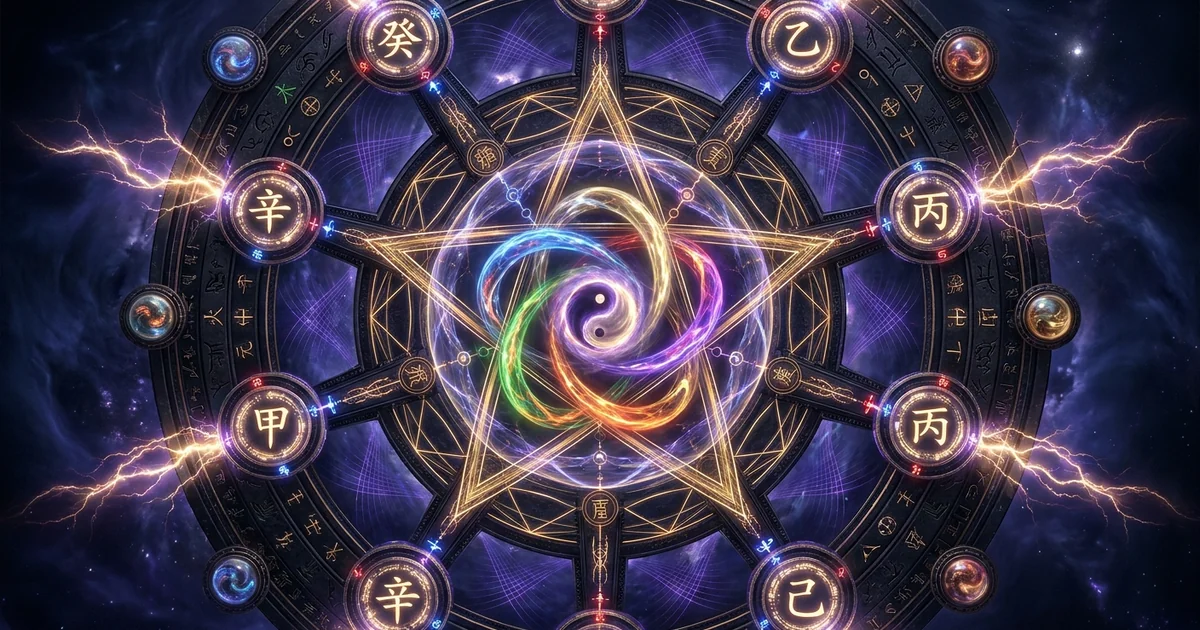
The Ten Heavenly Stems: Yin & Yang Five Element Keys
Archetypal Thesis & Systemic Paradigm: The Decanary Celestial Matrix
Tian Gan as Celestial Vector Fields and Chronobiological Oscillators
The Ten Heavenly Stems (Tian Gan, 天干) constitute a formal, decanary cybernetic coordinate system that registers the qualitative trajectory of temporal energy across cosmological and human domains. Within classical Chinese cosmometry, time is not conceived as a homogeneous, isotropic continuum of neutral quantitative units; rather, it operates as an anisotropic continuum populated by distinct energetic gradients. The Heavenly Stems define these gradients as celestial vector fields.
Where the unmanifest absolute (Taiji, 太極) fractures into the dynamic polarity of Yin and Yang, it differentiates into the qualitative operational modes historically designated as the Five Phases (Wu Xing, 五行). The Ten Heavenly Stems represent the explicit decanary resolution of this dialectic: each of the Five Phases is projected through a binary dipolar lens, producing ten distinct, mathematically precise vector states.
These ten states govern the downward emanation of celestial intention into the phenomenal sphere. In contrast to the Twelve Earthly Branches, which govern terrestrial topography, somatic instantiation, and spatial anchoring—as documented in the structural study of the /astrology/earthly-branches-chinese-zodiac-somatic-anchors—the Stems designate unmediated celestial impetus. They operate as chronobiological oscillators that entrain both biological metabolisms and psychic structures to macrocosmic temporal architectures.
                  Taiji (Unified Singularity)
                               │
                   Yin-Yang Binary Dipole
                               │
              Five Phases (Wu Xing Dynamic States)
                               │
             Ten Heavenly Stems (Decanary Vectors)
                               │
          Twelve Earthly Branches (Somatic Manifestation)
The Binary Polarisation of the Five Phases: State Space Architecture
Within the mathematical paradigm of Chinese metaphysics, the universe is modeled as an interactive state-space governed by transformations of Qi. The Five Phases—Wood (Mu), Fire (Huo), Earth (Tu), Metal (Jin), and Water (Shui)—do not denote static chemical elements, but rather fundamental topological vectors of thermodynamic phase transformation. Manfred Porkert, in his foundational treatise The Theoretical Foundations of Chinese Medicine: Systems of Correspondence (1974), designates these phases as standardized energetic qualities that maintain structural homeorhesis across macrocosmic systems. When these five thermodynamic directions are bifurcated through the binary polarity of Yang (expansive, centrifugal, structural, initiative) and Yin (contractive, centripetal, plastic, responsive), a ten-fold matrix emerges:
- Jia (甲): Yang Wood — Upward thrust, rigid axial emergence.
- Yi (乙): Yin Wood — Curvilinear branching, plastic biological adaptation.
- Bing (丙): Yang Fire — Solar radiation, total phenomenological illumination.
- Ding (丁): Yin Fire — Concentrated thermal energy, combustion, ignition.
- Wu (戊): Yang Earth — High plateaus, stabilizing mass, tectonic cohesion.
- Ji (己): Yin Earth — Cultivated soil, biochemical synthesis, porous transformation.
- Geng (庚): Yang Metal — Unrefined mineral ore, structural shearing force, martial precision.
- Xin (辛): Yin Metal — Refined crystalline lattice, precision acuity, metallurgical finish.
- Ren (壬): Yang Water — Oceanic surges, entropic dissolution, dynamic hydro-momentum.
- Gui (癸): Yin Water — Dew, interstitial fluid, silent molecular penetration.
This decimal architecture operationalizes the ten heavenly stems chinese astrology wu xing engine, offering a predictive, qualitative model for analyzing how systemic energy gathers, reaches critical mass, calcifies, and dissolves.
Cybernetic Feedback Between Macrocosmic Qi and Intrinsic Psyche
The interface between the macrocosmic celestial vectors and the human psycho-somatic matrix operates according to cybernetic feedback dynamics. In the analytical tradition established by C.G. Jung and further articulated by Marie-Louise von Franz, divination systems do not function through physical causality; they operate via acausal synchronicity rooted in qualitative time.
The Ten Heavenly Stems provide a symbolic language for mapping these synchronistic states. When an individual’s natal chart is computed in the four-pillar system (BaZi, 八字), the Stems present on the celestial plane of the chart represent the conscious, observable ego-vectors and operational dynamics through which the subject engages phenomenal reality.
These celestial vectors do not merely describe static character traits; they function as closed-loop feedback systems. Celestial Qi acts as an input signal; the internal psychological complex (governed by the individual’s Day Master or Ri Yuan) processes this energetic transmission through cognitive and somatic filters; and the subsequent output manifests as behavioral feedback that alters the subject’s environment.
Understanding the Heavenly Stems through this structural paradigm liberates the tradition from fatalism, re-establishing heavenly stems bazi analysis as an advanced psycho-cosmological coordinate system that maps structural self-actualization over developmental time.
Classical Provenance & Textual Lineage: From Shang Heliolatry to Ziping Metaphysics
The Shang Oracle Bones and the Myth of the Ten Suns (Shi Ri)
The historical genesis of the decanary stems extends into the bronze-age ritual calendar of the Shang Dynasty (ca. 1600–1046 BCE). Archaeological epigraphy recovered from the Yinxu oracle bone deposits reveals that the Ten Stems originated not as abstract metaphysical symbols, but as the sacralized nomenclature of ten distinct solar deities (Shi Ri, 十日) that cycled sequentially across the ten-day Shang ritual week, known as the Xun (旬).
Mythological texts preserved in the Shan Hai Jing (Classic of Mountains and Seas) record that the solar mother Xihe gave birth to ten suns that rested in the branches of the world-tree Fusang, ascending one by one into the sky across each ten-day cycle.
In Shang royal ancestral veneration, deceased kings received posthumous temple names derived directly from the Stem day on which they were born or received sacrifice (e.g., Tai Jia, Wu Ding). Thus, the Stems functioned as an administrative, chronological, and sacerdotal taxonomy linking sovereign political authority to astronomical cycles. The ten-day Xun established an architectural template of celestial pacing that later structured broader computational calendars across early China.
The Han Synthesis: Huainanzi and the Canonization of Stem Energetics
During the Han Dynasty (202 BCE – 220 CE), the syncretic philosophical movement known as the Han Synthesis systematized these proto-calendrical signs into a universal cosmology of correspondence. Texts such as the Huainanzi (compiled under Liu An, ca. 139 BCE) and Dong Zhongshu’s Chunqiu Fanlu (Luxuriant Dew of the Spring and Autumn Annals) reconciled previously independent cosmological models: the decanary cycle of the Stems, the duodecimal cycle of the Earthly Branches, the binary polarity of Yin and Yang, and the fivefold dynamic of the Wu Xing.
Simultaneously, the foundational astrological records compiled by Sima Qian in the Shiji (ca. 94 BCE), particularly the Tianguan Shu (Treatise on the Celestial Offices), mapped these systemic coordinates directly against astronomical phenomena, institutional statecraft, and somatic hygiene.
Under Han philosophical systematization, the Ten Stems shed their purely mythological solar identities and were canonized as functional energetic vectors. They were formally correlated with the cardinal directions, bodily viscera (Zang-Fu organs), seasonal transitions, and acoustic tuning pipes (Lu-Lu), establishing an isomorphic continuum between celestial mechanics, institutional empire, and human physiology.
Liu Bowen (attributed), Di Tian Sui (滴天髓, Dripping Heavenly Marrow):
甲木參天,脫胎要火。春不容金,秋不容土。火熾乘龍,水宕騎虎。地潤天和,植立千古。
“Jia Wood towers into the celestial canopy; to bring its embryonic essence into full expression, it requires the catalytic extraction of Fire. In Spring, it permits no severance by Metal; in Autumn, it tolerates no structural dissipation through dry Earth. When Fire blazes uncontrollably, it must ride the Dragon (Chen, yielding wet Earth); when Water surges into a chaotic deluge, it must mount the Tiger (Yin, robust rooted wood). Where the terrestrial foundations are moist and the celestial currents harmonious, it stands upright through ten thousand generations.”
乙木雖柔,刲羊解牛。懷丁抱丙,跨鳳乘猴。虛濕之地,騎馬亦憂。藤蘿繫甲,可春可秋。
“Yi Wood, though outwardly pliant and yielding, can dissect the Goat (Wei) and dismantle the Ox (Chou). Embracing Ding and holding Bing within its folds, it fearlessly straddles the Phoenix (You) and mounts the Monkey (Shen). Yet upon desiccated or waterlogged terrain, even riding the Horse (Wu) induces structural distress. But let it wind its vines around the towering trunk of Jia Wood, and it will flourish unhindered through Spring and Autumn alike.”
Song-Ming Systematization: Di Tian Sui and Yuanhai Ziping
The shift from omen-based calendrics to sophisticated psychological interiority occurred during the Five Dynasties and Song Dynasty (960–1279 CE). The decisive paradigm shift is credited to Xu Ziping (ca. mid-10th century), whose theoretical breakthroughs were later compiled in the canonical text Yuanhai Ziping (淵海子平, Deep Ocean of Ziping BaZi).
Prior to Xu Ziping, fate-calculation algorithms, such as those inherited from the Tang Dynasty master Li Xuzhong, utilized the Stem-Branch pair of the birth year as the sovereign locus of individual destiny. Xu Ziping revolutionized the field by shifting the psycho-spiritual axis to the Day Master (Ri Yuan, 日元)—the Heavenly Stem of the day of birth.
By elevating the Day Stem to the structural core of the chart, the Ziping system reoriented Chinese destiny analysis away from broad familial lineage toward subjective consciousness, individuation, and psychological orientation.
Later, during the early Ming Dynasty, texts such as the Di Tian Sui (滴天髓, Dripping Heavenly Marrow), historically attributed to Liu Bowen, refined the qualitative taxonomy of the Ten Stems into a masterwork of phenomenological structuralism. In this literature, the Stems are no longer treated as rigid fatalistic symbols; they are approached as intricate thermodynamic equations that demand dynamic balancing through conscious human intervention.
Structural Mechanics & Symbolic Geometry: The Ten Stems Exhaustively Decoded
Yang Stems (Jia, Bing, Wu, Geng, Ren): Structural, Directive, Exogenous Energy
- Vector Dynamic: Centrifugal, assertive, structural, unyielding.
- Phenomenological Manifestation: Focuses on foundational architecture, direct teleological movement, resistance to exterior coercion, and primary directional initiative.
- Psychological Modality: Conscious, proactive ego projection; directly imposes order upon chaotic environments; seeks autonomy, dominance, and institutional or systemic crystallization.
- Structural Mechanics: Breaks under excessive stress rather than bending; initiates the Sheng (generative) cycle with raw force; requires substantial resistance (controlled through the Ke cycle) to be tempered into utility.
Yin Stems (Yi, Ding, Ji, Xin, Gui): Plastic, Modulating, Endogenous Resiliency
- Vector Dynamic: Centripetal, plastic, metabolic, permeable.
- Phenomenological Manifestation: Focuses on interstitial adaptation, contextual modulation, catalytic conversion, and molecular penetration.
- Psychological Modality: Receptive, relational intelligence; operates through indirect influence, subtle negotiation, psychological infiltration, and environmental attunement.
- Structural Mechanics: Bends to absorb external pressure without losing structural integrity; initiates the Sheng cycle via catalytic mediation; metabolizes stress through continuous behavioral and systemic adjustment.
Wood and Fire: Jia-Yi and Bing-Ding as Expansive Ascent and Radiance
The phase-states governed by Wood and Fire represent the ascending, warming, and expressive phase of macrocosmic Qi, occupying the eastern and southern sectors of the spatial compass.
Jia (甲) is Yang Wood. Architecturally, it corresponds to the unbending trunk of a deciduous ancient tree or the structural framework of a building. It embodies the explosive impetus of spring, breaking through the encasement of winter. Jia Wood demands verticality and structural integrity; it is teleological, singular in purpose, and resistant to exterior compromise. When balanced, it yields towering visionary leadership; when afflicted by excessive dryness or premature cutting, it suffers catastrophic, brittle fractures.
Yi (乙) is Yin Wood. Structurally, it is the vine, the flower, the bamboo shoot, and the neural or vascular network. Unlike the rigid axiality of Jia, Yi Wood survives through morphological plasticity. It bends under atmospheric duress, twisting around obstacles to secure light. Yi Wood possesses high relational intelligence, thriving through diplomacy, strategic alignment, and aesthetic cultivation. Where Jia commands through authority, Yi navigates through networks, exemplifying the Taoist virtue of yielding to conquer.
Bing (丙) is Yang Fire. It represents solar radiance, the central thermonuclear engine, and total visual disclosure. Bing Fire is boundless, indiscriminate, and inherently generous in its energetic expenditure. It illuminates ideological structures, demands transparency, and fosters dramatic creative manifestation. However, because its nature is to illuminate without reflection, it can cause severe systemic burnout or manic energetic exhaustion if it lacks an anchoring presence—specifically, resonant Earth to absorb its heat or expansive Water to reflect its luminosity.
Ding (丁) is Yin Fire. In contrast to the cosmic scale of solar Bing, Ding Fire is the candle flame, the hearth, the kiln, and the focused electrical spark. It is introspective, volatile, intensely focused, and spiritually luminous. Ding Fire represents the alchemical spark of consciousness, artistic obsession, and deep psychological perception. It can heat metals and refine raw material, but its position is structurally precarious; it is easily smothered by wet Earth or extinguished by sudden torrents of Water, requiring a constant, meticulously calibrated supply of Yin Wood (Yi) to maintain its combustion.
       [WOOD]                             [FIRE]
  Jia (甲) : Rigid Axial Trunk       Bing (丙) : Solar Thermonuclear Core
  Yi  (乙) : Adaptive Plastic Vine    Ding (丁) : Concentrated Alchemical Hearth
                            ╲     ╱
                             [EARTH]
                        Wu (戊) : Tectonic Mountain
                        Ji (己) : Porous Fertile Soil
                            ╱     ╲
       [METAL]                            [WATER]
  Geng (庚) : Raw Tempered Axe        Ren (壬) : Oceanic Tidal Momentum
  Xin  (辛) : Refined Crystalline Gem Gui (癸) : Permeating Interstitial Mist
Earth Centering: Wu and Ji as the Pivot of Dimensional Transition
Earth occupies the metaphysical axis of the system, mediating between the ascending solar phase (Wood/Fire) and the descending lunar phase (Metal/Water). This dynamic pivot mirrors the structural logic of /iching/five-elements-trigram-polarities-wu-xing, where Earth grounds the cyclical exchange between fire and water.
Wu (戊) is Yang Earth. It corresponds to the barren, imposing mass of a mountain ridge, the bedrock, or a protective earthen levee. It represents profound inertia, massive stability, gravitational pull, and conservative structural integrity. Wu Earth is unyielding; it absorbs, contains, and directs the chaotic momentum of powerful rivers (Ren Water). Psychologically, it anchors volatile systems, providing a solid center of gravity. Yet its shadow state is dogmatic stagnation, intellectual calcification, and a refusal to adapt.
Ji (己) is Yin Earth. It represents the rich, moisture-laden, nutrient-dense humus of cultivated fields and gardens. Ji Earth is chemically complex, welcoming biological decay in order to transform necrotic matter into creative fertility. It possesses an exceptional capacity for absorption, internalization, and psychological digestion. The consciousness of Ji Earth is fundamentally nurturing, polyphonic, and metabolically integrative. If afflicted by cold moisture (Gui Water) without the warmth of the sun (Bing Fire), Ji degrades into a cold, muddy bog incapable of holding clear form.
Metal and Water: Geng-Xin and Ren-Gui as Condensation and Latency
The quadrants of Metal and Water represent the descending, cooling, condensing, and interiorizing vectors of celestial Qi, occupying the west and the north.
Geng (庚) is Yang Metal. It is the unrefined raw ore dragged from the deep earth, the cold blade, the heavy iron scythe, and the disruptive executioner’s axe. Geng Metal manifests the energy of autumn: harvest through severance. It cuts through emotional ambiguity, eliminates non-essential debris, and enforces strict boundaries. Psychologically, it corresponds to the cold logic of the objective intellect and the unyielding moral imperative. Geng Metal cannot reach its developmental maturity as a finely crafted tool without the agonizing heat of Ding Fire and the structural resistance of Jia Wood.
Xin (辛) is Yin Metal. It represents the refined crystalline lattice, the minted coin, the surgical lancet, and the polished diamond. Xin Metal is highly sensitive to impurity, prize-seeking, articulate, and structurally precise. It embodies the aesthetics of refinement, linguistic precision, and critical discernment. While Geng shears through brute resistance, Xin penetrates through targeted incisions. If smothered by heavy, unctuous Earth, Xin loses its luster; if heated excessively by raw, unmoderated Fire, its delicate crystalline structure dissolves.
Ren (壬) is Yang Water. It is the vast, untamed expanse of the ocean, the raging river, the monsoonal flash-flood, and untamed kinetic propulsion. Ren Water represents total liquid momentum, philosophical breadth, and boundless ambition. It cannot be halted through gentle suasion; it can only be directed through massive infrastructure, such as the stabilizing ramparts of Wu Earth. Ren Water is daring, intuitively brilliant, and naturally expansive. Its hazard lies in chaotic dissipation, entropic dissolution, and the sweeping away of systemic foundations.
Gui (癸) is Yin Water. It corresponds to atmospheric moisture, early morning dew, subterranean springs, and the invisible transpiration of plants. Gui Water is subtle, omnipresent, quiet, and hyper-receptive. It represents the deepest layers of the intuitive subconscious, telepathic sensitivity, and mystical introspection. Gui penetrates spaces inaccessible to coarser energies, saturating subterranean substrates without violence. Its shadow manifests as excessive anxiety, emotional volatility, melancholic rumination, and an inability to manifest sustained, solid material form.
The operational dynamics between these ten stems are governed by two fundamental systemic mechanics: Heavenly Stem Combinations (Tian Gan He, 天干合) and Heavenly Stem Clashes (Tian Gan Chong, 天干沖).
Combinations represent natural polar attractions where a Yang Stem of one phase fuses with a Yin Stem of another to produce a transformed elemental quality (e.g., Jia Yang Wood combines with Ji Yin Earth to yield Earth). This reflects the alchemical marriage of opposites (coniunctio oppositorum).
Conversely, Clashes occur between stems whose cardinal vectors directly oppose each other across the axis of generation (e.g., Jia Yang Wood violently clashed by Geng Yang Metal, or Bing Yang Fire clashed by Ren Yang Water). These clashes do not signify mere catastrophe; they are evolutionary catalysts that rupture outworn psychic structures to liberate trapped operational Qi.
Psychological Dynamics & Operational Praxis: The Day Master and the Ten Gods (Shi Shen)
The Day Master (Ri Yuan) as the Ego-Core and Archetypal Center
In the clinical architecture of contemporary psychological BaZi, the Day Master (Ri Yuan, 日元, or Ri Zhu, 日主) acts as the central coordinating complex of the psyche: the conscious ego-personality.
Surrounding this central Day Master are the Stems and Branches of the Year, Month, and Hour pillars. The Year Pillar registers the transpersonal, ancestral, and macro-cultural field; the Month Pillar registers the formative environment, early childhood conditioning, and occupational demands; and the Hour Pillar maps the interior subconscious, intimate ambitions, and creative output.
       [YEAR PILLAR]            [MONTH PILLAR]             [DAY PILLAR]             [HOUR PILLAR]
     Ancestral Archetype      Familial Conditioning      Day Master (Ego-Core)   Subconscious Telos
              │                        │                          │                        │
       Transpersonal            Developmental              Sovereign Subject        Creative/Erotic
        Field Matrix             Environment                  Consciousness            Output Field
The Day Master stands at this crossroad as an archetype navigating a systemic field of elemental forces. The primary clinical inquiry in this diagnostic framework is assessing the structural resilience (Wang Shuai, 旺衰—strength or weakness) of this Day Master.
A Day Master is deemed strong if it is sustained by its seasonal birth environment and bolstered by supportive resources; it is deemed weak if it is drained by its creative outputs, depleted by its demands for material acquisition, or pressured by structural constraints. This assessment is not a moral judgment, but a thermodynamic diagnostic that determines how an individual psyche can integrate cognitive friction without fracturing.
The systemic algorithm of the Ten Gods (Shi Shen, 十神) is derived from the polarity-aware interactions between the Day Master (Self) and the surrounding elemental phases:
- Parallel / Companion Vectors (Same Phase as Day Master):
- Friend (Bi Jian, 比肩): Same phase, identical polarity. Reinforces the conscious ego-boundary; fosters autonomy, egalitarian camaraderie, and stubborn self-reliance.
- Rob Wealth (Jie Cai, 劫財): Same phase, alternating polarity. Extroverted, competitive, charismatically assertive; drives risk-taking and can rupture collective resources.
- Output Vectors (Phase Generated by Day Master):
- Eating God (Shi Shen, 食神): Generated phase, identical polarity. Calm creative refinement, intellectual contemplation, sensory appreciation, and non-confrontational aesthetic yield.
- Hurting Officer (Shang Guan, 傷官): Generated phase, alternating polarity. Radical innovation, provocative genius, defiance of established authority, and sharp, disruptive critical output.
- Wealth Vectors (Phase Overcome by Day Master):
- Indirect Wealth (Pian Cai, 偏財): Overcome phase, identical polarity. Entrepreneurial agility, systemic resource orchestration, dynamic speculation, and strategic detachment.
- Direct Wealth (Zheng Cai, 正財): Overcome phase, alternating polarity. Diligent stewardship, systematic material consolidation, structural stability, and meticulous operational maintenance.
- Influence / Power Vectors (Phase that Overcomes Day Master):
- Seven Killings (Qi Sha, 七殺): Overcoming phase, identical polarity. Aggressive existential friction, raw challenge, martial authority, structural crises, and intense transformative encounters.
- Direct Officer (Zheng Guan, 正官): Overcoming phase, alternating polarity. Institutional integrity, legitimate authority, ethical self-regulation, societal duty, and classical structural order.
- Resource Vectors (Phase that Generates Day Master):
- Indirect Resource (Pian Yin, 偏印): Generating phase, identical polarity. Non-linear, occult intuition; esoteric analytical capacity; hyper-specialized solitary insight; and systemic alienation.
- Direct Resource (Zheng Yin, 正印): Generating phase, alternating polarity. Traditional pedagogy, emotional grounding, maternal nourishment, institutional validation, and intellectual assimilation.
Vector Transformation: Production, Exhaustion, Control, and Resource Loops
The Ten Gods (Shi Shen) are relational dynamics that map systemic, interactive circuits of consciousness. These interactions operate across four fundamental cybernetic transformation loops:
The Production Loop (Sheng, 生) represents the flow of creative projection. The Day Master directs its conscious energy into the Output vectors (Eating God / Hurting Officer), converting internal psychic potential into exterior manifestations of art, discourse, or innovation.
The Exhaustion Loop is the thermodynamic cost of that generative act. Continuous expression without caloric replenishment depletes the Day Master’s structural integrity, demanding the stabilizing nourishment of the Resource vectors (Direct/Indirect Resource).
The Control Loop (Ke, 剋) introduces structural boundary conditions. When the Day Master encounters the Influence vectors (Direct Officer / Seven Killings), it faces the constraints of social law, physical limitation, or institutional hierarchy. This dynamic mirrors the operational conditioning seen in /human-design/circuitry-and-planetary-archetypes, where raw personal force must submit to the systemic constraints of larger collective circuits.
If this incoming force is well-integrated, it tempers the ego into a refined instrument of leadership; if it acts without moderation, it subjects the ego to intense persecution complexes and severe psychosomatic symptoms.
The Resource Loop completes the cybernetic circle. The Resource phase absorbs incoming destructive pressures, transmuting exterior hostility into internal wisdom, which is then fed back to rejuvenate the Day Master.
Deciphering Systemic Shadow Dynamics via Element Excess and Depletion
Psychological complexes manifest when an individual’s energetic distribution loses homeostatic equilibrium. An extreme excess or acute deficiency of any specific Stem vector creates distinct compensatory formations within the unconscious.
For example, consider a chart characterized by an overabundance of Hurting Officer (Shang Guan) unanchored by Resource (Yin). The psyche becomes locked in compulsive anti-authoritarianism, sharp cynicism, and structural destabilization. The individual attacks external power matrices while ignoring their own inner fragmentation.
Conversely, an extreme surplus of Direct Resource (Zheng Yin) leads to psychological infantalization, intellectual paralysis through analysis, and an inability to assert the ego within competitive social fields.
Similarly, an absolute deficiency of the Wealth (Cai) vector impairs the Day Master’s capacity to ground its abstract intellectual concepts into tangible reality. The psyche remains trapped in floating ideation, unable to manipulate physical resources or embody practical boundaries.
By analyzing these elemental distributions, the BaZi practitioner does not predict fatalistic events; rather, they diagnose systemic shadow dynamics, identifying precisely which archetypal compensations are required to restore psychological integration.
Philosophical Synthesis & Macrocosmic Correspondence: Hermetic Resonances and Modern Systems
The Decanary Matrix vs. the Qabalistic Tree of Life (Sephiroth)
The structural architecture of the Ten Heavenly Stems exhibits a profound cross-cultural symmetry with the decanary emanation model of Western Hermeticism: the Ten Sephiroth of the Qabalistic Tree of Life. In both esoteric cosmologies, the transition from the absolute unmanifest—the Hermetic Ain Soph Aur or the Daoist Wuji (無極)—into tangible material manifestation is mediated through ten structural stations of descending density.
       DAOIST TIAN GAN                         QABALISTIC SEPHIROTH
   [ Jia / Yi : Wood (Spring) ]        <===>   [ Chokmah / Binah : Creative Duality ]
   [ Bing / Ding : Fire (Summer) ]     <===>   [ Chesed / Geburah : Force & Form ]
   [ Wu / Ji : Earth (Axis) ]          <===>   [ Tiphereth : Central Harmonizing Core ]
   [ Geng / Xin : Metal (Autumn) ]     <===>   [ Netzach / Hod : Expression & Discernment ]
   [ Ren / Gui : Water (Winter) ]      <===>   [ Yesod / Malkuth : Latent Foundation & Ground ]
As detailed in the formal analysis of /tarot/qabalistic-correspondences-ten-sephiroth-minor-arcana, the Sephiroth are emanational spheres of divine consciousness, each holding a distinct geometric and functional frequency.
Similarly, the Ten Stems are not ten separate “things,” but ten discrete dimensional registers through which the primordial unified energy of the cosmos steps down to govern the physical sphere.
The initial spark of Chokmah and the organizing matrix of Binah correspond structurally to the expansive, life-bearing emergence of the Wood phase (Jia and Yi). The radiant balance of Tiphereth at the center of the Tree mirrors the central, balancing functions of the Earth Stems (Wu and Ji).
Both frameworks reject the simplistic dualism of spirit versus matter, framing creation as an unbroken, mathematically ordered continuum of energetic descent.
Chronobiology and Epigenetic Clocking: Qualitative Time Architectures
The classical proposition that the Ten Heavenly Stems cycle through time to exert measurable influences upon the human organism aligns with modern discoveries in chronobiology and epigenetic regulation.
Contemporary chronobiology has established that biological systems do not function in static equilibrium; they operate as interconnected networks of circadian, ultradian, and infradian physiological rhythms. Cellular metabolism, immune responses, hormonal secretion profiles, and neural plasticity oscillate in precise periodic cycles.
In the foundational framework of classical Chinese medicine—codified in such acupuncture traditions as Zi Wu Liu Zhu (子午流注, Midnight-Noon Ebb-Flow) and Ling Gui Ba Fa (Eight Methods of the Mysterious Turtle)—the Ten Heavenly Stems dictate the open-and-closing rhythms of dynamic acupuncture apertures on specific days and double-hours.
Far from pre-scientific superstition, this paradigm anticipates modern findings on the chronobiological synchronization of biological tissues. Macrocosmic temporal cycles serve as epigenetic zeitgebers: environmental pacing signals that trigger enzymatic and genetic transcriptions within living systems.
The Stems offer a comprehensive qualitative time architecture, positing that human vitality flourishes when its energetic metabolism harmonizes with the rhythmic frequencies of the ambient environment.
Marie-Louise von Franz, Time: Rhythm and Repose (1992):
"Number, when viewed as an archetypal structure, is not a mere invention of human ratiocination designed for quantitative measurement, but a primordial psychological pre-existent that patterns both the objective cosmos and the deep unconscious psyche. In ancient civilizations—most prominently demonstrated in the Chinese calendrical mechanics of the Ten Stems and Twelve Branches—numbers operated as the qualitative descriptors of temporal fields.
Time was understood not as an empty frame of reference, but as a continuous flux of qualitative constellations, wherein each moment possessed its own irreducible archetypal signature, predisposing events and psychological systems to specific synchronized mutations."
Integrating Classical Stems with Jungian Typology and Transpersonal Dynamics
When mapped onto modern analytical psychology, the Five Elements and their ten-stem bifurcations reveal a profound correspondence with the cognitive mechanics of Jungian Typology.
The dynamic axes of the Stems correspond to the structural dialectic between the four Jungian psychological functions: Thinking, Feeling, Sensation, and Intuition, arranged around a central coordinating archetype of the Self:
- Wood (Jia / Yi) & Intuition: Future-oriented, visionary, expansive, exploring structural potentials and possibilities.
- Metal (Geng / Xin) & Thinking: Discriminating, analytical, surgical, establishing cold structural definitions and structural logic.
- Fire (Bing / Ding) & Feeling: Evaluative, value-assigning, expressive, seeking heart-centered interpersonal connection or creative combustion.
- Water (Ren / Gui) & Sensation: Visceral, primordial, tracking the physical and instinctual depths, responsive to fluid currents of somatic awareness.
- Earth (Wu / Ji) & The Self: The central reconciling ego-Self axis that anchors, synthesizes, and integrates the four functional vectors into a functional, cohesive whole.
By applying this typology to the Ten Stems, the BaZi chart is demystified: it ceases to be a tool for fatalistic fortune-telling and reveals its true nature as a high-resolution map of the human psyche’s archetypal architecture.
Frequently Asked Questions
Ontological Status of Hidden Stems (Cang Gan)
Within classical BaZi theory, the Twelve Earthly Branches are not elemental monoliths; rather, they serve as somatic vessels that house specific configurations of Hidden Heavenly Stems (Cang Gan, 藏干). The ontological status of these Hidden Stems is paramount: they represent latent, unmanifest celestial potential embedded within the physical density of the terrestrial sphere.
While the Stems visible in the upper register of a four-pillar chart designate clear, conscious, and overtly expressed psychological functions, the Hidden Stems designate the deep unconscious, genetic predispositions, and instinctual somatic memory.
A Hidden Stem may remain quiet for decades until activated by a passing Ten-Year Luck Pillar (Da Yun) or Annual Transit Pillar (Liu Nian). When this occurs, the latent celestial potential housed within the Earthly Branch is unlocked, surfacing into conscious manifestation. This provides a structural explanation for sudden psychological shifts, physical developments, and unforeseen eruptions of shadow dynamics throughout life.
Resolution of Stem Clashes (Tian Gan Chong)
Heavenly Stem Clashes (Tian Gan Chong, 天干沖)—such as the acute collision between Jia Wood and Geng Metal, or Bing Fire and Ren Water—are frequently misunderstood in popular culture as pure omens of external misfortune. In rigorous archetypal metaphysics, a Clash is an engine of dialectical evolution.
Without the shearing force of a Clash, systems settle into entropic inertia, structural calcification, and dynamic decay. Jia Wood, left entirely to its own devices without the pruning blade of Geng Metal, becomes an overgrown, untamed forest where low-lying branches starve of sunlight; Geng Metal, left without the explosive resistance of Wood or the heat of Fire, remains a brittle, useless slab of iron ore.
The structural resolution of a Stem Clash requires introducing a mediating element to construct a harmonious, three-phase generative circuit. For example, a volatile clash between Jia Wood and Geng Metal can be therapeutically harmonized through the introduction of Water. Water receives the shearing, structured discipline of the Metal vector (Metal generates Water) and translates it into fluid nourishment that feeds the Wood (Water generates Wood).
In psychological praxis, this translates to developing flexible emotional resilience, intuitive introspection, and fluid psychological processing (Water) to mediate between hyper-rigid, dogmatic rules (Metal) and uninhibited, impulsive personal ambitions (Wood).
Equivalence between Western Elements and Wu Xing Phases
A frequent source of conceptual confusion in comparative esoteric studies is the direct conflation of the four classical Western elements (Earth, Air, Fire, Water) with the Chinese Wu Xing (Wood, Fire, Earth, Metal, Water). The Western elemental paradigm—descending from Empedocles, Plato, and Aristotle—is fundamentally ontological and structural, categorizing matter and consciousness into static elemental substances based on the fundamental dualities of Warmth, Coldness, Moisture, and Dryness.
Conversely, the Chinese Wu Xing are fundamentally thermodynamic, process-oriented, and phase-relational. The character Xing (行) translates literally to “walking,” “moving,” or “processual passage.”
Therefore, Wu Xing describes dynamic phases in an unbroken cycle of energetic transformation. Wood is the phase of expansive acceleration; Fire is the phase of peak thermodynamic radiation; Earth is the phase of balance, sedimentation, and transition; Metal is the phase of condensation, crystallization, and interiorization; and Water is the phase of maximal latency and resting potential.
The absence of an isolated “Air” element within the Chinese schema is explained by the pervasive concept of Qi (氣) itself: Qi is not a single element competing with other elements; it is the universal energetic substrate that undergoes transformation across all five phases.
Recognizing this distinction ensures that the Ten Heavenly Stems are understood on their own structural terms: as dynamic, polarity-driven vectors within an integrated, ever-changing energetic field.