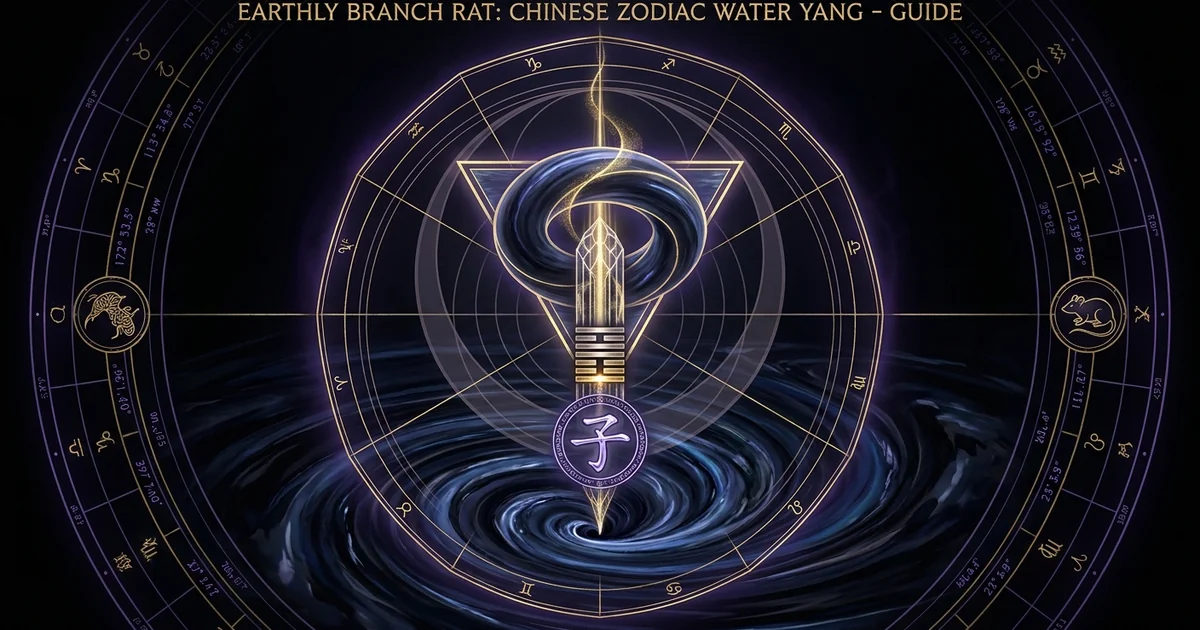
Earthly Branch Rat: Chinese Zodiac Water Yang - Guide
Archetypal Thesis & Systemic Paradigm: The Primordial Inflection of Zi
The Earthly Branch Zi (子)—conventionally exotericized within global vernacular as the Rat—occupies the premier chronomantic coordinate of the sexagenary cosmological continuum. Within the architecture of Eastern astro-metaphysics, it functions not as an anthropomorphic or zoomorphic totem, but as the primordial thermodynamic and mathematical singularity through which cyclical reality continuously generates itself. Positioned as the foundational terminal of the 12 earthly branches (di zhi 地支), Zi anchors the absolute North and the midnight nadir, governing the eleventh lunar month (encompassing the Winter Solstice). It marks that critical moment where maximum spatial and temporal entropy transitions into negentropic morphogenesis.
Within the systemic framework of classical Chinese cosmology, reality does not oscillate via random mechanical perturbation, but through the calibrated pulse of yin-yang-polarity. Zi designates the specific spatial-temporal coordinate where Yin, having reached its absolute, terminal crystallization (represented by pure receptive density), undergoes an internal thermodynamic phase change. The singular, subterranean movement generated at this juncture constitutes the birth of the first line of Yang: an indivisible, nascent filament of light sparking within the abyssal interior of absolute darkness.
Thermodynamics of the Midnight Solstice: The Germination of One Yang
The cosmological mechanics of Zi correspond to the terrestrial Winter Solstice (Dongzhi 冬至), the seasonal node wherein nocturnal duration peaks and the solar trajectory reaches its southernmost declination. Energetically, this moment does not signal inertia or vacuum. Instead, as elucidated within the macrocosmic physics of the /astrology/chinese-five-elements-wuxing-hydrodynamics system, it manifests the hyper-dense concentration of the water element (Shui 水). Water at this baseline operates as an alchemical sink: an ultra-cold, high-pressure state-space reservoir harboring total structural potential.
[Phase Space Diagram: Zero-Point Bifurcation of Zi]
Within chronobiology, the diurnal hour of Zi spans 23:00 to 01:00—the midnight bifurcation. It is precisely at 00:00 that the day’s ordinal shift occurs. It is an ungraspable zero-point where the preceding solar wave collapses and the succeeding wave coalesces. This phase transition is functionally identical to the ignition of a quantum potential field. At this exact threshold, maximum Yin (characterized by descent, coldness, latency, and gravitational compression) can no longer compress without inverting into kinetic expansion. Thus, the yang polarity does not conquer Yin from without; rather, Yin nucleates Yang from the deepest interiority of its own center. In chart synthesis and metaphysical mapping, the Zi branch embodies this foundational inflection: the unmanifest will-to-be striking like an invisible pilot light in the abyssal deep.
De-Mythologizing the Rodent: Zi as a Cybernetic State-Space Coordinate
To comprehend the esoteric function of Zi within rat chinese earthly branch astrology, one must systematically strip away the folkloric overlay of the Great Race and popular zoomorphic caricature. The assignment of the rat to the first branch reflects a precise mnemonic codification of behavioral and ecological kinetics designed by ancient Han polymaths to represent non-linear systemic traits. The rat is a creature that operates predominantly under cover of night. It dwells in subterranean passages, exhibits extraordinary auditory and tactile sensory acuity, and navigates environments via hyper-vigilant stealth, resource hoarding, and opportunistic intelligence.
Translated into cybernetic terminology, the rat symbol functions as an analogue for a state-space coordinate governed by high environmental uncertainty, ultra-low energetic input, and high computational efficiency. The organism survives the winter freeze not through brute physical dominance or kinetic expenditure, but through thermal conservation, metabolic suppression, subterranean positioning, and instantaneous exploitation of systemic cracks. The Zi coordinate in a cosmological model reflects this exact operating system: psychic latency, hyper-attuned environmental scanning, underground networking, and an uncanny capacity to locate viable energetic flows where external structures appear barren or dead.
Anchored at the cardinal North, Zi acts as the absolute homeostatic regulator within the twelve-stage bio-cosmic engine. It is the storage bank of the organism’s ancestral and sexual reserve (Jing 精), maintaining the systemic continuity of consciousness through periods of macrocosmic dissolution, hibernation, and socio-historical collapse.
Classical Provenance & Textual Lineage of the Initial Branch
The technical apparatus governing the Earthly Branch Zi evolved across two millennia of rigorous observational astrometry, calendar systems (Li Fa 曆法), and metaphysical distillation. The glyph itself, 子, philologically depicts an infant or seed with an exaggerated cranium and nascent limbs—symbolizing unformed, omnipotent potentiality waiting to differentiate. In earliest Han dynasty lexicography, the Shuowen Jiezi (說文解字) defines Zi as “to propagate” or “to seed” (孳也), identifying it with the eleventh lunar month when the Yang principle stirs beneath the frost and fecundates the dormant soil.
Solar-Lunar Calibration: From Han Horizon Astrometry to the Gan-Zhi System
The operational architecture of the sexagenary cycle (Gan-Zhi 干支) was derived from horizon astrometry, specifically tracking the circumpolar orbital sweep of the Big Dipper’s handle (Beidou 北斗) alongside the synodic cycles of Jupiter (Tai Sui 太歲). During the Han Dynasty (202 BCE – 220 CE), astromancers calibrated the canonical civil and celestial year by observing the direction of the Dipper’s handle at dusk and midnight. When the handle pointed due North into the quadrant governed by the celestial animal Xuanwu (the Black Tortoise-Serpent of the North), the sun occupied the winter solstitial sector. This celestial alignment established Zi as the immutable zero-degree reference point of the terrestrial compass and the sidereal dial.
This astrometric calibration was systematically interwoven with the fundamental medical paradigms synthesized in the Huangdi Neijing (黃帝內經, The Yellow Emperor’s Classic of Internal Medicine). In the Suwen and Lingshu treatises, the cosmic water phase represented by Zi was mapped onto the human somatic organism as the Kidney network (Shen 腎). The Kidneys govern the Gate of Vitality (Mingmen 命門), water metabolism, bone marrow production, and the storage of original essence. Just as Zi represents the singular point of Yang emergence from maximum Yin within the macrocosm, the Kidneys harbor both Kidney-Yin (primordial fluid) and Kidney-Yang (primordial fire) within the microcosm. Thus, early Chinese medical philosophy and astrological calculation operated along an identical continuum: Zi was established as the root of vital continuation, without which all kinetic outward processes collapse into terminal exhaustion.
Song and Ming Dynasty Codifications: Li Xu-Zhong to the San Ming Tong Hui
During the transition from the Tang Dynasty to the Song Dynasty, BaZi methodology underwent a structural revolution led by Master Li Xu-Zhong (李虛中) and subsequently refined by Xu Zi-Ping (徐子平). The focus shifted from analyzing an individual’s destiny purely via the Year Pillar to synthesizing the interplay of all /astrology/four-pillars-bazi-hidden-stems-guide rooted in the Day Master (Ri Yuan 日元). This methodological evolution culminated during the Ming Dynasty with grand master Wan Minying (1578) in his monumental compendium, the San Ming Tong Hui (三命通會, Compendium of the Three Fates).
“Zi is the palace of pure, unadulterated water, holding the seat of the Northern Cardinal. Its exterior is Yang because its position is first in the celestial sequence, yet its interior substance is purely Yin, harboring the solitary essence of Gui Water. It is the womb of heaven and earth, wherein the seed is protected under the frozen crust; those whose destinies anchor deeply here possess profound capacity for wisdom, penetrating the dark recesses of human nature, ever flowing toward the low places yet impossible to conquer by force.” — Wan Minying, San Ming Tong Hui, Volume 2: “Treatise on the Twelve Branches” (1578)
Wan Minying, synthesizing centuries of classical commentary, isolated Zi as the cardinal pivot of the Northern quadrant. Simultaneously, the esoteric master Liu Bowen (1311–1375) in the foundational text Di Tian Sui (滴天髓, Dripping Heavenly Marrow) stripped Zi of moralistic and simplistic folk interpretations. Liu Bowen classified the hydrodynamics of Zi as water in its most concentrated, relentless, and penetrating state: subterranean, capable of dissolving earth, dissolving metals, and eroding the hardest structural defenses through steady, unyielding kinetic persistence.
Structural Mechanics & Symbolic Geometry: The Hydrodynamics of Zi
The geometric and algebraic architecture of Zi within the system of Chinese chronomancy demonstrates profound mechanical symmetry. Zi is the absolute Cardinal Water node among the four cardinal stations, known classically as the cardinal-branches-si-zheng (四正)—Zi (North, Water), Wu (South, Fire), Mao (East, Wood), and You (West, Metal). Unlike the dual or triple-constituent intermediate branches, the cardinal branches do not harbor mixed, transitional, or hybrid elemental energies. They represent pure, uncompromised elemental power.
Wu (Horse) - S
                      [Fire]
                        ^
                        |
       Mao (Rabbit) <---+---> You (Rooster)
        [Wood] - E      |      [Metal] - W
                        v
                   Zi (Rat) - N
                     [Water]
The Hidden Stem (Cang Gan) Paradox: Yang Form Harboring Yin Substance
The structural core of the Zi branch contains an intrinsic energetic paradox that mystifies casual practitioners: the tension between its exterior mathematical parity and its interior elemental substrate. In classical BaZi theory, every branch contains one or more hidden-stems-cang-gan (藏干), which delineate the dynamic human Qi lurking beneath the macroscopic seasonal architecture.
In the standard numerical sequence of the twelve branches, Zi occupies position 1—an odd number. Odd numbers are inherently categorized as Yang; even numbers are categorized as Yin. Consequently, in the exoteric system, the Rat is designated as “Yang Water” (Ren Zi 壬子). However, when one conducts an alchemical and mechanical dissection of its energetic interior, Zi contains precisely one Hidden Stem: Gui Water (癸水), which is definitively Yin Water.
Exterior Macrocosmic Structure (Ti 體)
- Ordinal Assignment: Branch 1 (Odd Number Sequence)
- Exoteric Categorization: Yang Polarity
- Phenomenological Role: Primordial ignition, macrocosmic impulse, initiation of the seasonal cycle
- Temporal Manifestation: Midnight crossing (23:00–01:00), catalyst of the coming dawn
- Energetic Strategy: Disruptive assertion, pioneering movement, unmanifest kinetic spark
Interior Microcosmic Essence (Yong 用)
- Hidden Stem Content: 100% Pure Gui Water (癸)
- Esoteric Categorization: Pure Yin Substance
- Phenomenological Role: Dew, subterranean springs, cellular infiltration, invisible penetration
- Psychological Manifestation: Receptive intelligence, profound instinct, silent resource aggregation
- Energetic Strategy: Soft power, fluid evasion, pressure-filtration, structural erosion
This dichotomy—Yang in structural position (Ti 體), yet Yin in operational essence (Yong 用)—is not a design flaw. It is a profound metaphysical statement on the nature of reality. Zi represents Yang in its nascent emergence (the dynamic impulse to break the stasis of winter), but that emergence is entirely fueled and carried by the deep, silent, dark reservoir of Yin substance. It is the warrior soul operating inside the invisible, cloaked garment of night: masculine teleology clothed in hyper-receptive feminine adaptability.
Directional, Temporal, and Elemental Vectoring: The Cardinal Si Zheng Node
As the Cardinal North coordinate (0° / 360° on the Luo Pan compass), Zi asserts absolute authority over the water phase within the wuxing-five-phases (五行). Water in its Yin Gui state possesses the unique property of omnidirectional capillary action. It flows downward, finds the path of least resistance, penetrates fissures imperceptible to the naked eye, and exerts hydrostatic pressure over time.
Because Zi is a Si Zheng (Four Cardinal) branch, its elemental purity allows zero tolerance for compromise. Where an Earth branch like Chen (Dragon) stores water alongside residual Wood and Earth minerals, Zi is undiluted liquid consciousness. It is glacial meltwater filtering through deep limestone; it is the subterranean aquifer where light has never penetrated. Consequently, within chart synthesis, the presence of Zi indicates an area of the native’s psycho-energetic blueprint that refuses structural pretense, operating with radical transparency, acute emotional perception, and uncompromising existential reality.
Relational Dynamics: Clashes, Triple Harmonies, and Earth Penetrations
Within the systemic engine of four-pillars-bazi, Zi interacts with other coordinates through rigorous mathematical relationships:
- The Axial Clash with Wu Horse (子午沖): Zi engages in the most volatile and philosophically profound thermodynamic clash in the entire system against the South Cardinal branch, Wu (Horse). This represents the unmediated collision of Absolute Water (Subconscious/Midnight/Cold) with Absolute Fire (Conscious Spirit/Noon/Heat). Far from being a mere negative omen, this axis is the central engine of consciousness generation, analyzed further in subsequent sections and detailed in
/astrology/earthly-branch-wu-horse-fire-polarity. - The Water Bureau San He Triple Harmony (申子辰): Zi acts as the Emperor node in the Water Element Triangle, flanked by Shen (Monkey, the Birth place of Water) and Chen (Dragon, the Tomb/Storage of Water). When Shen, Zi, and Chen align, they dissolve conventional structural boundaries, creating a tidal surge of Water Qi that sweeps away rigid Earth formations and demands complete psychological and situational fluidity.
- The Earth Consolidation Liu He Six Harmony (子丑合): Zi combines with Chou (Ox, Cold Winter Earth). This interaction represents the sealing of water beneath frozen soil. It transforms rapid, erratic fluidity into stable, disciplined, and subterranean ice, locking primal libido into structural persistence and patient, methodical manifestation.
- The Punishment of Incivility (子卯相刑): Zi forms an asymmetrical, abrasive relational punishment with Mao (Rabbit, Pure Yin Wood). In classical texts, this is termed the “Uncivilized” or “Ungrateful” Punishment (Wu Li Zhi Xing 無禮之刑). Because Water gives birth to Wood, Zi is the mother of Mao. However, when an excess of cold, relentless Zi water inundates Mao wood without the warming rays of the sun (Fire), the Wood rots at the root. Psychologically, this manifests as boundary violations, emotional manipulation, or profound relational resentment born from unbalanced codependency.
Psychological Dynamics & Operational Praxis: Archetypal Substrates of Consciousness
When mapped onto the topology of depth psychology, the Earthly Branch Zi is the astrological correlate to the personal and collective unconscious in its most pristine, undifferentiated state. It is the psychic realm existing prior to the formation of the Ego—an intra-psychic space of total potential, quiet darkness, and latent libido.
The Nigredo of Consciousness: Subconscious Storage and Latent Libido
In the alchemical psychological framework established by Carl G. Jung, the initial phase of the Magnum Opus is the Nigredo (the blackening), wherein the conscious attitude is dissolved into the dark, fertile prima materia of the unconscious. Zi embodies this exact psychological territory. It is the psychic womb where conscious constructs collapse so their constituent elements can recombine.
“Water is the commonest symbol for the unconscious. The lake in the valley is the full, flowing unconscious, lying, as it were, hidden in the depths, whence it derives its subterranean supplies… It is the matrix of all life, a maternal fluid in which the conscious ego must dive if it wishes to be regenerated, but in which it also risks complete dissolution and psychic drowning.” — Carl G. Jung, The Archetypes and the Collective Unconscious, CW Vol. 9i, para. 40
In individual chart topography, a heavily populated or foundational Zi branch points directly to an individual whose psychic center of gravity rests in the deep subconscious. These individuals do not operate primarily via declarative logic or linear rationalism; they are wired to register the micro-currents of atmospheric feeling, repressed societal currents, and the latent motivations of others long before these factors manifest in physical action.
Chrono-Psychology and Behavioral Archetypes: Hyper-Vigilance, Acquisitiveness, and Strategic Fluidity
The behavioral expression of the Zi archetype in human psychology is characterized by several distinct markers:
- Hyper-Vigilant Environmental Scanning: Much like the organism that survives by keeping to the shadows, the Zi-dominated psyche possesses an innate radar for existential risk. There is a baseline assumption that the environment is unstable, resource-scarce, or fraught with latent predators. Consequently, this mind is constantly running predictive simulations, seeking safety contingencies, escape vectors, and alternative escape paths.
- Strategic Acquisitiveness & Resource Hoarding: Water flows to the lowest point and pools wherever space allows. The Zi archetype exhibits a compulsion toward the collection and retention of resources—be it capital, information, esoteric knowledge, or strategic alliances. This is not driven by petty greed, but by an archaic, solstitial instinct: the absolute imperative to survive the winter. Knowledge is hoarded because knowledge equals survival leverage when external infrastructure fails.
- Strategic Fluidity and Evasion of Direct Force: The Zi mind understands the fatal vulnerability of rigid posturing. When attacked, it does not counter with blunt impact (which it leaves to the Yang Wood or Yang Metal branches). Instead, it yields, dissipates, flows around the obstacle, and infiltrates the aggressor’s baseline from below. It is the ultimate expression of indirect strategy: winning through patient erosion, intellectual subtlety, and asymmetric subversion.
Clinical Praxis: Navigating Zi Phase Transitions in Chart Synthesis
In clinical BaZi diagnostics and psychological consulting, encountering a prominent Zi branch (especially as the Day Master’s root, an active Month Branch, or during a 10-Year Luck Pillar phase transition) requires precise strategic calibration:
[Diagnostic Matrix: Hydrodynamic Equilibrium of Zi]

Cold Water Stagnation          Dynamic Integration           Hyper-Kinetic Deluge
(Absence of Fire / Bing)       (Balanced Earth & Fire)       (Excessive Metal / Water)
-----------------------        ---------------------         ------------------------
Paralysis, Chronic Fear,  -->  Profound Strategic       -->  Emotional Volatility,
Depression, Nihilistic         Foresight, Wisdom,            Boundary Dissolution,
Dissolution of Will.           Subconscious Cohesion.        Structural Collapse.
When an individual enters a Zi time-cycle, their life often undergoes an apparent deceleration or inward collapse. Projects that relied on pure external momentum, brute marketing, or overt aggressive expansion suddenly stall. The diagnostic error is to interpret this as failure. In systemic reality, the individual has entered the midnight-solstice quadrant: a phase designed for internal restructuring, algorithmic reassessment, deep intellectual or spiritual study, and the conservation of vital resources. If the practitioner attempts to force outward kinetic action during a pure Zi phase, they deplete their Kidney Jing, resulting in systemic burnout, severe anxiety pathologies, and strategic failure. Wisdom lies in honoring the subterranean gestation: allowing the Yang filament to knit itself together beneath the dark surface before attempting to breach the outer world.
Philosophical Synthesis & Macrocosmic Correspondence: Hexagram 24 and the Dao of Return
The metaphysical architecture of the Earthly Branch Zi achieves its absolute, elegant philosophical codification through its structural isomorphism with the system of the Yijing (易經, Book of Changes). Within the classical arrangement of the Twelve Sovereign Hexagrams (Shi Er Pi Gua 十二辟卦)—which map the rise and fall of Yin and Yang across the annual lunar cycles—Zi is explicitly mapped to Hexagram 24: Fu (復, The Return).
Hexagram 24: Fu (The Return)
Line 6: - - (Yin)
Line 5: - - (Yin)
Line 4: - - (Yin)
Line 3: - - (Yin)
Line 2: - - (Yin)
Line 1: --- (Yang)  <-- The Primordial Spark Ignited at the Solstice
Isomorphism with Hexagram Fu (The Return): The Solstitial Yang Filament
Hexagram Fu consists of the trigram Zhen (震, The Arousing/Thunder) below, and Kun (坤, The Receptive/Earth) above. Its visual and mathematical structure displays five yielding Yin lines resting atop a single, solid Yang line at the base. It is the graphical representation of the Winter Solstice: darkness, cold, and passivity cover the face of the earth, but deep beneath the bedrock, kinetic movement has restarted.
As Richard Wilhelm and Cary F. Baynes illuminate in their seminal translation of /iching/hexagram-24-fu-return-analysis, the foundational counsel of Hexagram Fu during the solstitial phase is non-action:
“The winter solstice has always been celebrated in China as the resting time of the year… In winter the life power, symbolized by thunder, the arousing, is still underground. Movement is just at its beginning; therefore it must be strengthened by rest so that it may not be dissipated by being used prematurely… The return of health after illness, the return of understanding after an estrangement: everything must be treated softly and with care at the beginning, so that the new life may not be injured.” (Wilhelm/Baynes, The I Ching or Book of Changes, 1950)
This creates an unassailable philosophical link between the Zi branch and the Daoist principle of Wu Wei (無為, effortless or non-contrived action). The Yang of Zi is not the blazing, radiant sun of midsummer (Hexagram 1: Qian); it is the microscopic, fragile spark of original will. To force this nascent Yang into immediate, demanding manifestation is to smother it in the womb. The operational strategy of Zi is therefore preservation of the seed. It requires the practitioner to cultivate intense inner quietude, allowing the primordial current to gather mass and momentum organically before it breaks ground in the following temporal sectors (Chou, Yin, and Mao).
- Terrestrial Coordinate: Due North (352.5° to 007.5° azimuth)
- Solar/Temporal Station: Winter Solstice (Dongzhi), 11th Lunar Month
- Circadian Station: 23:00 to 01:00 (Midnight Bifurcation)
- Yijing Alignment: Hexagram 24 (Fu - 復, Return / Turning Point)
- Western Axis Correspondence: 0° Capricorn (The Winter Solstice Gate of the Sun) opposing 0° Cancer (Nadir/Zenith Meridian)
- Organ-Channel Substrate: Foot Shaoyin Kidney Channel (Shen Jing 腎經)
- Metaphysical Essence: Pure Gui Water (癸), primordial seed potential, unmanifest cosmic consciousness
The Polar Axis and Hermetic Principles: North-South Dynamic Alignment
The systemic axis created by Zi (North, Water, Midnight) and Wu (South, Fire, Noon) constitutes the primary structural meridian of the entire Chinese metaphysical construct. This axis embodies the Hermetic Principle of Polarity, which states that opposites are identical in nature, differing only in degree, with extremes meeting in continuous cyclical turnover.
Zi and Wu represent the two great cosmic gates: the Gate of Man (Zi, the entry into matter, incarnation, cold condensation, the subconscious roots) and the Gate of the Gods (Wu, the ascent into pure light, disembodiment, thermal expansion, super-conscious illumination). Without the cold, reflective anchor of Zi Water, the dynamic fire of Wu burns itself out in an unsustainable frenzy of entropic dissipation. Conversely, without the distant, warming radiation of Wu Fire, the water of Zi freezes into an immobile, lifeless, and petrified block of glacial stasis.
The human being whose chart integrates the Zi-Wu axis does not suffer a curse of conflict; rather, they are tasked with maintaining the ultimate alchemical tension: holding the absolute depths of the unconscious soul alongside the soaring light of conscious awareness, weaving the midnight waters of intuition directly into the noon-day fire of manifested purpose.
Frequently Asked Questions: Deconstructing the Zi (Rat) Archetype
Taxonomic Reconciliation of Polarity Distinctions
Why is the Rat labeled ‘Yang’ in popular horoscopes if classical BaZi treats it as pure Yin Water?
The apparent contradiction stems entirely from confounding the Macrocosmic Frame of Position (Ti 體) with the Microcosmic Frame of Substance and Application (Yong 用).
In the primary ordinal numbering of the Twelve Branches, Zi occupies slot number 1. Because odd integers belong to the category of Yang, popular horoscopy labels the sign as Yang Water (Yang Shui 陽水). Furthermore, at the midnight hour and the winter solstice, Zi marks the initiation of Yang movement in the universe—a proactive, initiating cosmic function.
However, professional metaphysical systems like BaZi do not analyze branches merely by their outer slot numbers. They dissect the Hidden Stems (Cang Gan) that dwell inside the branch. When Zi is cracked open structurally, it does not contain Ren Water (which is genuine Yang Water: ocean waves, raging torrents, kinetic flooding). It contains exclusively Gui Water (癸水), which is the quintessence of Yin Water: morning mist, rain, dew, subterranean water tables, and cellular fluid. Therefore, structurally and functionally, the Rat acts as Yin Water in its daily operations, despite holding a Yang ordinal seat in the grand calendar. It is a Yin-operating system executing a Yang catalytic mission.
Thermodynamics of the Solstitial Axial Clash
How does the structural clash between Zi (Rat) and Wu (Horse) operate, and why is it considered the most powerful energetic event in the sexagenary matrix?
In traditional divination, the Zi-Wu clash (Zi Wu Xiang Chong 子午相沖) is often lazily branded as an indicator of disaster, volatile emotional instability, or catastrophic accidents. In advanced metaphysical science, this clash is recognized as the universe’s ultimate thermodynamic pump.
[Zi: Cold / Water / 0° North] <== Absolute Axis ==> [Wu: Heat / Fire / 180° South]
Zi is Cardinal Water; Wu is Cardinal Fire. Neither branch contains any mediating secondary elements (such as Earth, Metal, or Wood) to soften or dilute their respective essences. When these two coordinates meet—whether in a natal chart, an interpersonal relationship, or through an incoming temporal cycle (such as a Rat native entering a Horse year)—Water directly attempts to extinguish Fire, while Fire attempts to evaporate Water.
This collision forces the total psychic apparatus out of complacency. It shatters rigid defensive structures. Psychologically, it precipitates a confrontation between the native’s deep, repressed subconscious shadow (Zi) and their overt, outward public persona and conscious aspirations (Wu). When integrated constructively via the introduction of the Wood element (which absorbs the Water and feeds the Fire), this clash does not destroy the individual. Instead, it generates the steam of profound creative transformation and psychological awakening. It is the exact alchemical friction required to awaken the sleeping soul.
Distinguishing Symbolic Coordinate from Folk Astrology
What is the exact difference between the “Year of the Rat” in cultural folklore and the “Zi Earthly Branch” in technical chronomancy?
Folk astrology is a sociological compression tool. It was created to communicate generalized ethical values, broad personality sketches, and cultural timing rituals to an agrarian populace lacking the mathematical training to calculate a comprehensive ephemeris. In that framework, an individual is generalized as a “Rat” simply because they were born during a solar-lunar year governed by the Zi branch, reducing their entire multi-dimensional energetic blueprint to a single, broad zoological caricature.
The Zi Earthly Branch in technical chronomancy, by contrast, is a multi-dimensional astronomical and energetic coordinate. In a genuine Four Pillars (BaZi) chart, Zi can appear in the Year, the Month, the Day, or the Hour:
- In the Year Pillar, it governs the macro-generational climate, ancestral karma, and the outermost social interface.
- In the Month Pillar (born in December, during the solar term of Daxue or Dongzhi), it defines the core operational engine, career strategy, and biological metabolic baseline.
- In the Day Pillar (the Day Master’s foundational seat), it governs the core psychological identity, the internal autonomic nervous system, and the primary intimate relational dynamic.
- In the Hour Pillar (born between 23:00 and 01:00), it directs the subconscious ambitions, deep creative outputs, and the terminal phase of the native’s life path.
To treat Zi as merely an annual cartoon animal is to mistake the complex, multi-tiered navigational map of a celestial chronometer for a child’s toy. Zi is the silent, pregnant root of the Chinese metaphysical continuum: the North Star of the inner compass, and the quiet space where the universe continually begins again.