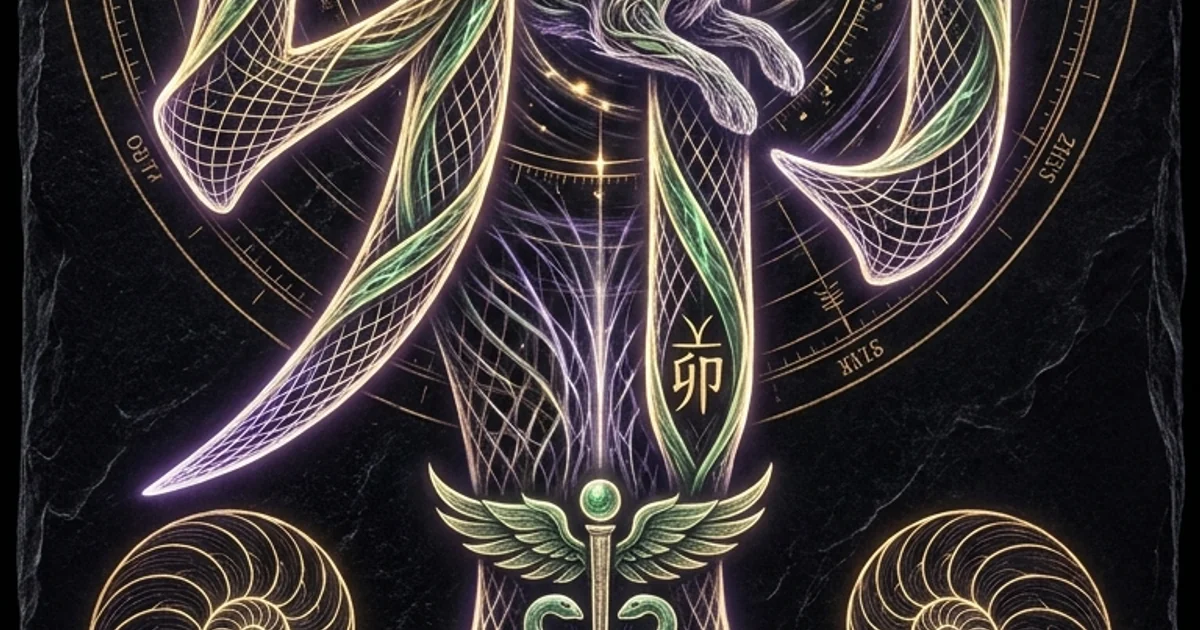
Earthly Branch Rabbit: Chinese Zodiac Wood Yin - Guide
Archetypal Thesis & Systemic Paradigm: Mao (卯) as the Vegetative Axis of Yin Wood
Within the psycho-cosmological matrix of the Chinese Four Pillars of Destiny (BaZi natal chart foundations), the Rabbit—designated systemically as the fourth of the 12 earthly branches, Mao (卯)—represents the ontological culmination of the Wood phase operating in its pure Yin polarity. Rather than serving as an arbitrary zoomorphic attribution, the Rabbit branch constitutes a precise state-space operator within East Asian chronopredictive cartography.
Positioned at 90° East on the geomantic Luo Pan compass, Mao governs the exact celestial coordinates of the vernal equinoctial threshold. In the schema of the Wu Xing five phases, Wood designates kinetic vectoring, morphogenesis, and systemic vitality. Where its predecessor, the Tiger (Yin, 寅), represents the vertical, eruptive, masculine emergence of Yang Wood (Jia Mu), the Rabbit embodies the lateral, rhizomatic, cellular consolidation of Yin Wood (Yi Mu).
The Bifurcation of Vernal Qi at the Equinoctial Threshold
The energetic mechanics of Mao are indivisible from the solar reality of the spring equinox (Chunfen). At this astronomical juncture, solar Yang radiation achieves parity with terrestrial Yin receptivity before seizing ascendance across the Northern Hemisphere. In the classical cosmology codified in the Huangdi Neijing: Suwen (Chapters 66–71, detailing the Wu Yun Liu Qi or Five Movements and Six Qi), this phase space marks the decisive emergence of Wind-Wood dynamic force (Feng Mu).
The glyph for Mao (卯) historically mirrors this astronomical bifurcation: it delineates a split seed-coat, a cellular mitosis, or the opening of double doors facing east. In this phase, the upward propulsive momentum of early spring transitions into dynamic equilibrium. Energetic velocity ceases to be strictly linear and becomes systemic, distributing resources horizontally throughout the biological substrate.
[Solar Ray Parity: Equinox (90°)]
                       |
               +-------+-------+
               |  Mao (卯) Gate |
               +-------+-------+
                       |
        +--------------+--------------+
        |                             |
[Cellular Division / Mitosis]   [Lateral Dendritic Dispersion]
The Hydrodynamics and Cellular Morphology of Yin Wood (Yi Mu)
To comprehend Mao within rabbit chinese earthly branch astrology, one must analyze the physical behavior of Yin Wood (Yi Mu). While Yang Wood is analogized to the timber tree—rigid, unyielding, and susceptible to structural fracture under excessive mechanical shear—Yin Wood manifests as vines, creepers, bamboo shoots, and capillary networks. It demonstrates structural compliance. Under severe hydraulic pressure or aerodynamic shear, Yin Wood flexes, bends, and reorients its chloroplast arrays relative to the light vector.
At the cellular scale, Mao governs dynamic turgor pressure, the elasticity of the cell membrane, and the self-similar distribution models seen in plant venation. This morphology prioritizes continuous connectivity over isolated tensile strength. It functions as an organic mesh network, rerouting systemic sap and bio-electrical charges around structural impediments rather than attempting to shatter them through blunt mechanical force.
Cybernetic Equilibrium: Dynamic Homeostasis over Kinetic Force
From a cybernetic perspective, Mao represents negative feedback loops that sustain homeostasis within living systems. The raw, unrestrained expansive drive of the Wood element, if left unchecked in its Yang modality, produces chaotic neoplastic growth, biological exhaustion, and structural collapse. Mao stabilizes this vegetative expansion. It introduces a structural calculus that balances metabolic consumption with structural synthesis.
By operating as an equinoctial gate, the Rabbit branch moderates the seasonal influx of thermodynamic heat. It registers micro-environmental fluctuations, modulating the stomata of the collective psycho-organism to regulate transpirational water loss. It secures ecological persistence through sensory attunement and behavioral flexibility rather than unilateral kinetic dominion.
Classical Provenance & Textual Lineage: Historical Epistemology of the Fourth Branch
The epistemology of the Rabbit branch extends deep into Bronze Age epigraphy and the development of early Sinitic astral chronometry. Long before its zoomorphic integration in the Han Dynasty, Mao stood as an astronomical marker linked to the synodic cycles of Jupiter (Tai Sui) and the sexagenary cycle (Ganzhi).
Tracing the textual evolution of Mao clarifies how a seasonal marker transformed into an analytical diagnostic tool for evaluating human constitution and destiny.
Paleographic Genesis in Shang Oracle Bones and the Ten Heavenly Stems Sync
In the Shang Dynasty oracle bone inscriptions (Jiaguwen), the character Mao is paleographically rendered as two symmetrically opposed curved strokes resembling opened double doors or an animal split during ritual sacrifice. This visual etymology communicates cleavage, distribution, and passage. Mao designated the spatial-temporal opening through which the Earth’s interior Qi, having gestated beneath the winter permafrost, bursts into atmospheric exposure.
When synchronized with the Ten Heavenly Stems (Tiangan), Mao aligns with Yi (乙), the second stem. This alignment forms an energetic loop: Yi represents the germinating sprout curling toward the surface, while Mao represents the biological gateway through which that sprout bifurcates into leaves and branches.
Classical BaZi Mechanics in the ‘Di Tian Sui’ and ‘San Ming Tong Hui’
The Ming Dynasty masterwork San Ming Tong Hui (Compendium of the Three Fates), compiled by Wan Minying (1578), delineates the internal architecture of the twelve branches. Most branches contain complex combinations of dominant, middle, and residual Heavenly Stems (Cang Gan). However, Mao is designated as an exceptionally pure cardinal branch (Si Zheng).
“Mao contains purely the single Qi of Yi Wood; it does not harbor soil, fire, or metal within its core. It is the throne of the Vernal Wood in its absolute sovereignty. Because its Qi is singular, its essence is concentrated. If it encounters moisture, it thrives without rot; if it encounters arid fire, its vegetative sap is consumed from within. It is designated as the door of morning sun and the axis of burgeoning life.”
This purity of essence is corroborated by the classical poetic treatise Di Tian Sui (Dripping Heaven’s Marrow), traditionally attributed to Jing Fang and annotated by Liu Bowen (1368). The text emphasizes that Yin Wood within Mao can conquer hard, dead earth through invasive, gentle root penetration. However, the commentary notes that it fears structural severed isolation (Duan Geng), requiring unbroken energetic continuity through its branch networks to survive.
The Sovereign Hexagram Da Zhuang (34) and Lunar Chronometry
In the Han Dynasty Fangshi traditions and the King Wen arrangement of the I Ching, the twelve branches correspond directly to the twelve Sovereign Hexagrams (Shi Er Pi Gua). The Rabbit branch governs the second lunar month, mapped precisely to Hexagram 34: Da Zhuang (Great Power).
---  ---  Yin (Soft exterior receptivity)
---  ---  Yin (Dynamic upper containment)
--------  Yang (Ascending structural drive)
--------  Yang (Internal pressure)
--------  Yang (Foundation vitality)
--------  Yang (Core solar power)
   Hexagram 34: Da Zhuang (Great Power)
The morphology of Da Zhuang features four solid Yang lines ascending from the base, overlain by two broken Yin lines at the summit. This hexagram models internal thermodynamic pressure pushing upward, while the external Yin lines maintain balance and boundary integrity. Mao does not unleash unchecked, destructive power; rather, its structural discipline (Da Zhuang) channels potent kinetic energy into productive growth, shielding internal vitality beneath a receptive exterior.
Structural Mechanics & Symbolic Geometry: Vector Coordinates and Branch Dynamics
In BaZi structural mechanics, an Earthly Branch is defined by its dynamic vector interactions within the four-dimensional grid of Year, Month, Day, and Hour pillars. As a pure Wood cardinal branch, Mao anchors the Eastern direction. It interacts with other earthly branches through three primary vectors: cardinal opposition, trilateral harmonization, and frictional phase punishment.
Tiger (Yin Branch / Yang Wood)
- Vector: Vertical, eruptive, unyielding
- Anatomical: Skeletal structure, liver organ proper
- Strategy: Territorial dominance, linear force
- Failure Mode: Structural snapping under catastrophic shear
Rabbit (Mao Branch / Yin Wood)
- Vector: Lateral, dendritic, compliant
- Anatomical: Capillary networks, neuromuscular reflex
- Strategy: Diplomatic negotiation, tactical camouflage
- Failure Mode: Neurotic exhaustion, parasitic entanglement
Cardinal Axis Interactions: The Mao-You (Rooster) Cardinal Clash (Chong)
The cardinal confrontation between Mao (East, 90°) and You (Rooster, West, 270°) represents the primary dialectic of the Chinese zodiac: the cardinal clash (Chong) between absolute Wood and absolute Metal. Unlike clashes involving multi-stem branches, the Mao-You clash is an undiluted collision of elemental polarities: the pure Yin Wood (Yi) of the Rabbit directly confronts the pure Yin Metal (Xin) of the Rooster.
[Mao (卯): 90° East] <===========================> [You (酉): 270° West]
   Pure Yin Wood (Yi)                                Pure Yin Metal (Xin)
   Morphogenesis, Expansion                         Demarcation, Pruning, Scythe
   Biological Elasticity                            Mechanical Precision
Metaphysically, this dynamic represents the confrontation between biological expansion and mechanical truncation. Xin Metal functions as a pruning knife or scalpel. When balanced, this clash produces necessary refinement, surgical precision, artistic craftsmanship, and the cultivation of Bonsai-like discipline.
When out of balance, it manifests as structural laceration, catastrophic neurological disruption, chronic spinal ailments, and sudden severance of familial or professional bonds.
The Hai-Mao-Wei Wood Directorate: Trilateral Frame of Synthesis (San He)
The Rabbit serves as the sovereign center (Di Wang, the Peak of the Cycle) of the trilateral Wood combination (San He), flanked by the Pig (Hai, 亥) and the Goat (Wei, 未). This triad forms a functional vegetative circuit:
[ Hai (Water) ]  ----(Birth/Nourishment)---->  [ Mao (Wood) ]  <----(Grave/Storage)----  [ Wei (Earth) ]
  Birthplace:                                  Sovereign Center:                          Storehouse:
  Raw Primordial Saps                          Peak Vegetative Matrix                     Socio-Ecological Fruit
- Hai (Pig / Yang Water): Acts as the Chang Sheng (Birth phase), supplying raw, unformed hydraulic potential, deep subterranean reservoirs, and ancestral ancestral memory.
- Mao (Rabbit / Yin Wood): Acts as the Di Wang (Peak phase), transforming this fluid potential into actualized vegetative tissue, leaves, and vascular networks.
- Wei (Goat / Yin Earth): Acts as the Mu (Grave or Storehouse), stabilizing Wood’s expansive Qi within rich, nourishing soil, transforming biological energy into socio-cultural yield.
Within this framework, Mao synthesizes formless Water into tangible Wood before depositing its structural legacy into the Earth. When this triad completes in a natal chart, it generates powerful artistic, academic, or institutional Wood Qi, establishing expansive networks that prioritize ideological propagation over brute conquest.
Frictional Entanglement: The Mao-Zi (Rat) Uncivilized Punishment (Xing)
The interaction between the Rabbit (Mao) and the Rat (Zi, 子) constitutes the Wu Li Zhi Xing (The Uncivilized or Ungrateful Punishment). In elemental theory, Water generates Wood (Shui Sheng Mu). In this configuration, however, the pure Yin Water of Zi fails to yield healthy growth in the pure Yin Wood of Mao.
   Zi (Rat / Pure Yin Water)  --[ Excessive Cold / Stagnant Fluid ]-->  Mao (Rabbit / Pure Yin Wood)
                                              |
                                              v
                              Root Rot / Epigenetic Rejection
                               (Wu Li Zhi Xing: Ungrateful)
This interaction models epigenetic failure: cold, stagnant, lightless Water drowning delicate root systems, inducing rotting rather than healthy photosynthesis. Psychologically, this punishment manifests as relational boundary violations, parental enmeshment, profound boundary confusion, or ingratitude where assistance transforms into toxic obligation.
Biomedically, this phase dynamic reflects systemic lymphatic congestion, pelvic stasis, hepatic toxicity, or inflammatory autoimmune responses triggered by metabolic stagnation.
Psychological Dynamics & Operational Praxis: Archetypal Architecture of the Ego-Self Axis
From an analytical psychological perspective, the Rabbit branch maps the instinctual vegetative nervous system and its somatosensory defense architectures. In Synchronicity: An Acausal Connecting Principle (Collected Works Vol. 8), C.G. Jung observed that profound archetypal configurations operate in acausal synchrony with unconscious instinctual states.
The Rabbit archetype embodies the survival intelligence of the mammalian somatic nervous system: soft-bodied, acute in perception, and constantly scanning the energetic horizon for micro-shifts in relational dynamics.
“The vegetative, instinctual substrate of the psyche operates through non-linear, sympathetic resonances. It does not construct fortress walls of intellectual defense; rather, it weaves an invisible, highly responsive web of somatic sensitivity that registers archetypal danger long before the conscious ego perceives a threat. It is the primordial wisdom of vegetal camouflage and adaptive yielding.”
Analytical Psychology: The Somatosensory Instinct and Vegetative Intuition
Individuals with a dominant Mao branch in their natal BaZi charts frequently display sensory processing sensitivity (SPS). Their cognitive apparatus is tuned to peripheral dynamics: body language, vocal inflections, and atmospheric shifts within an environment. Like the rabbit foraging at twilight, their operational stance is one of vigilant receptivity.
[Environmental Field / Relational Matrix]
                  |
     (Subtle Somatosensory Shifts)
                  v
[Mao Intuitive Receiver (Vagal Tone / Capillary Scan)]
                  |
  +---------------+---------------+
  |                               |
[Adaptive Diplomatic Yielding]   [Tactical Evasion / Burrowing]
This dynamic is not fear-based weakness; it is sophisticated biosocial intelligence. Mao possesses acute vegetative intuition, resolving interpersonal friction through non-confrontational reorientation before conscious conflict ignites.
Pathological Manifestations: Hyper-Vigilance, Avoidance, and Passive-Aggressive Fortification
When the Yin Wood of Mao becomes afflicted, obstructed, or excessive within a chart, its psychological mechanisms can misalign into defensive pathologies:
- Chronic Hyper-Vigilance: Prolonged autonomic arousal, leaving the sympathetic nervous system locked in continuous alarm.
- Psychological Agoraphobia: A tendency to retreat into subjective, insular inner spaces when confronted by direct, aggressive interpersonal conflict.
- Passive-Aggressive Entanglement: Rather than meeting opposition with direct force, corrupted Yin Wood mimics compliance while covertly undermining structural constraints through evasive tactics, emotional withdrawal, or administrative sabotage.
- Paralysis by Analysis: The proliferation of branching possibilities without the decisive, pruning presence of Metal leads to executive dysfunction and strategic immobility.
Natal BaZi Deconstruction: Navigating Environmental Overwhelm and Boundary Regulation
In clinical BaZi diagnostics, analyzing a chart containing a dominant Mao requires evaluating the native’s capacity for structural containment. Because Mao is pure Yi Wood, it is vulnerable to boundary dissolution. If the chart lacks stabilizing Earth branches (Chen, Chou, Wei, Xu) to provide soil, the native risks chronic overextension, taking on the emotional distress of their environment through unchecked empathetic resonance.
UNSTABLE DISPERSION                      CONTAINED EQUILIBRIUM
         (Lacks Earth)                              (Secured by Earth)
       Mao (Wood)                                   Mao (Wood)
     /     |     \                                      |
  [Enmeshment / Burnout]                     +----------+----------+
                                             |                     |
                                        Chen/Xu (Earth)       Wei/Chou (Earth)
                                             |                     |
                                        [Boundaries]          [Rooting]</code></pre>
The remediation protocol for an overextended Mao branch focuses on conscious boundary installation. Chart consultants evaluate the Day Master’s relationship to Mao:
- If the Day Master is weak Fire, Mao provides a clean fuel source of insight and sustained creative output (Yin generating Shang Guan / Shi Shen).
- If the Day Master is fragile Earth, an untamed Mao branch operates as an invasive root system (Qi Sha, Seven Killings), producing deep somatic anxiety, gastrointestinal distress, and boundary collapse. This requires the structural clarity of Metal to prune and regulate its vegetative spread.
Philosophical Synthesis & Macrocosmic Correspondence: Hermetic Resonance and Micro-Macro Alignment
The macrocosmic architecture of the Rabbit branch extends beyond regional astrology into universal, fractal expressions of natural law. As the Hermetic axiom As above, so below; as within, so without dictates, the structural mechanics governing the fourth Earthly Branch operate identically across celestial orbits, terrestrial botany, and human neuro-anatomy.
- Compass Azimuth: 82.5° to 97.5° True East (Axis of Pure Dawn)
- Solar Term (Jie Qi): Jingzhe (Awakening of Insects) through Chunfen (Vernal Equinox)
- Chronobiological Window: 05:00 – 07:00 Solar Time (Dawn Transition / Awakening)
- TCM Organ Network: Large Intestine (Hand Yangming) cross-linked to Liver (Foot Jueyin)
- Sovereign Hexagram: Hexagram 34 (Da Zhuang / Great Power)
- Esoteric Western Counterpart: Cusp of Aries (0° Vernal Gate) / Sephira Netzach (Victory / Vegetative Force)
Fractal Morphology: Dendritic Branching from River Deltas to Neuro-Architecture
The signature of Yin Wood (Mao) is the fractal branch: the structural capacity of a single trunk to divide into branches, twigs, capillaries, and neural dendrites. This morphology reappears throughout the physical universe:
In neural anatomy, the Purkinje cells of the cerebellum display the precise morphological pattern of Mao: expansive, tree-like arborizations designed to process complex sensorimotor inputs and coordinate dynamic balance. Similarly, river deltas, the bronchial pathways of the human lung, and mycelial underground networks all leverage the geometric efficiency of Mao.
This geometry maximizes surface contact while preserving structural cohesion. It proves that within dynamic systems, flexible integration consistently outperforms brittle, monolithic strength over evolutionary time.
Alchemical Parallels: The Spring Equinox and the Alchemical Viriditas
In Western esoteric traditions, particularly the green alchemy of Paracelsus and the mystical cosmology of Hildegard von Bingen, Mao finds an exact conceptual parallel in Viriditas—the divine greening power of nature. Viriditas is the living breath of the cosmos animating cold, dead matter, forcing seeds to rupture their hulls and push toward light.
[Nigredo / Chou (Winter Stasis)]
                      |
        (Solar Spark of Vernal Dawn)
                      v
      [Viriditas / Mao (Greening Matrix)]
                      |
                      v
      [Alchemical Rubedo / Wu (Solar Zenith)]
Mao corresponds to the precise moment the alchemical work transitions from the black, putrefied stage (Nigredo, associated with the Winter Water branches) into the initial greening (Viriditas) that precedes the solar redness (Rubedo) of Summer Fire. It is the regenerative impulse that sustains life against entropic collapse.
Cross-Systemic Horizons: Western Cardinal Aries Cusp and Qabalistic Netzach
When mapped across comparative symbolic frameworks, the Rabbit corresponds to the transition across 0° Aries, the Tropical Zodiac’s Cardinal Fire threshold. While Western astrology characterizes this ingress with the kinetic, martial force of the Ram, Chinese cosmology emphasizes the vegetative resilience (Mao) that this equinoctial fire ignites within the terrestrial mantle.
         CHINESE SYSTEM                          WESTERN HERMETIC SYSTEM

        Mao (卯 / 90° East)                            Cusp of 0° Aries
  [Yin Wood: Vegetal Germination]              [Cardinal Fire: Solar Ingress]
                 \                                    /
                  \                                  /
                   v                                v
                 [ Netzach: Qabalistic Sphere 7 ]
                 [ Vegetative Vitality, Desire, Rhythm ]
In the Qabalistic Tree of Life, Mao resonates with the seventh Sephira, Netzach (Victory/Endurance). Netzach represents the instinctual sphere, vegetative drive, emotional aesthetics, and relational affinity. It channels the raw, transcendent solar fire of Tiphareth down into organic manifestation, mirroring how Mao translates incoming solar radiation into biomass, leaves, and sustained biological continuity.
Frequently Asked Questions: Resolving Advanced Dialectics of the Rabbit Branch
Why is Mao (an even-numbered branch) paired exclusively with Yin polarity?
The twelve Earthly Branches alternate in numeric sequence: odd numbers designate Yang positions, while even numbers designate Yin positions. Occupying the fourth position ($4 \equiv 0 \pmod 2$), Mao is mathematically Yin.
Beyond simple sequence, its inner stem constitution confirms this: Mao contains exclusively the Heavenly Stem Yi (乙), which is the definitive expression of Yin Wood. While its seasonal sister Yin (Tiger, 3rd position) hosts Jia (Yang Wood), Bing (Yang Fire), and Wu (Yang Earth), Mao contains no discordant or dual internal elements. Its polarity is internally uniform, making it the most focused expression of Yin Wood across the sexagenary framework.
How does the Mao-You clash manifest when both branches are favorable elements (Yong Shen)?
In advanced BaZi analysis, a cardinal clash (Chong) does not inherently indicate misfortune; its outcome depends on the structural utility of the involved branches:
[Mao-You Favorable Clash Dynamic]
                               |
       +-----------------------+-----------------------+
       |                                               |
[Mao: Dynamic Vegetative Growth]              [You: Precision Pruning Instrument]
       |                                               |
       +-----------------------+-----------------------+
                               |
                               v
         [Controlled Innovation / Decisive Life Evolution]
When both Mao and You act as favorable elements (Yong Shen or Xi Shen), their clash operates like a surgeon’s scalpel or an artisan’s chisel rather than a destructive impact. It triggers timely institutional restructuring, breakthrough creative pivots, the decisive termination of outgrown career trajectories, or the deliberate pruning of systemic inefficiencies to spark a wave of biological or financial renewal.
What distinguishes the biological resilience of Yin Wood from the raw endurance of Yang Wood?
The essential distinction centers on structural mechanics: Tensile Rigidity versus Flexural Compliance.
- Yang Wood (Jia / Tiger): Embodies the oak or red pine. It resists environmental load through sheer mass, tensile strength, and rigid resistance. Under extreme loads that exceed its structural threshold, Yang Wood shatters at the base, snapping catastrophically.
- Yin Wood (Yi / Rabbit): Embodies the weeping willow, bamboo, or clinging vine. When struck by gales, heavy snowpacks, or falling debris, Yin Wood yields, bends toward the earth, shed excess drag, and relies on its distributed root system. Once the transient load passes, it straightens back toward the sun, undamaged.
Its endurance is rooted in yielding and distributed connectivity, outlasting brittle systems through dynamic, intelligent adaptation.