Earthly Branch Horse: Chinese Zodiac Fire Yang - Guide
Archetypal Thesis & Systemic Paradigm: The Solstitial Pivot of Manifest Fire
The Wu (午) Coordinate as Thermodynamic Apex and Spatial South
Within classical Sinitic chronomancy and cosmological coordinate theory, the seventh Earthly Branch, Wu (午, Horse), occupies the 180° meridian, anchoring the spatial coordinate of due South (Nan, 南) and designating the solar noon zenith (11:00–13:00 diurnal tide). In the system of the 12 earthly branches, Wu marks the thermodynamic culmination of the annual and diurnal cycles. While exoterically codified through the dynamic, untamed zoomorphic figure of the Horse, this branch represents the thermodynamic apex of manifest solar radiation: the moment where cosmic irradiance reaches absolute spatial exposure. In the seasonal progression of the Four Seasons (Si Ji), Wu designates the height of Midsummer (the fifth solar month, centered on the Summer Solstice, Xiazhi).
The energetics of the horse chinese earthly branch astrology framework delineate a state-space condition wherein the Fire element reaches its maximum exteriorization. The heat generated at this coordinate is neither nascent nor incubating; it is the blinding luminescence of midday, where shadows contract to their mathematical minimum and the boundary between physical matter and thermodynamic dissolution becomes critically thin. In spatial geometry, Wu presides over the South in the Later Heaven Bagua (Hou Tian Ba Gua), aligning with Trigram Li (☲), the archetype of radiance, ocular acuity, combustion, and clinging heat. This spatial-temporal assignment designates Wu as the primary radiating vector of the cosmological wheel, distributing solar kinetic energy outward across all intersecting systemic axes.
The Paradox of Peak Yang Polarity and Latent Yin Inception
The structural mechanics of Chinese chronomancy operate via nonlinear, dialectical phase shifts rather than static categorical states. While Wu is exoterically indexed as possessing yang polarity due to its odd-numbered cyclic position and its association with peak summer heat, the esoteric physics preserved in the Twelve Tidal Hexagrams (Shi Er Xiao Xi Gua) reveals a radical structural paradox. The Summer Solstice within the Horse branch marks the exact cosmological moment of taiyang culmination—the absolute exhaustion of pure Yang expansion—and the simultaneous, micro-mechanical genesis of the first Yin breath (Yi Yin Sheng, 一陰生).
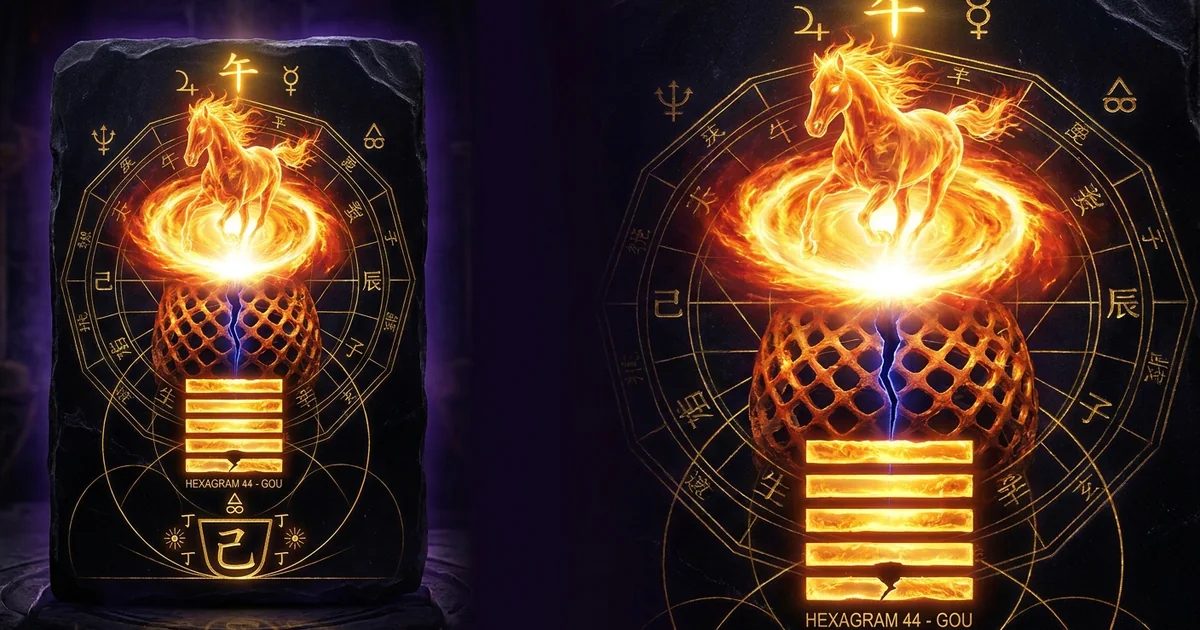
This ontological transition is crystallized in the structural geometry of the Book of Changes through Hexagram 44: Gou (姤, Coming to Meet). Within Hexagram 44, five unbroken Yang lines hover above a solitary broken Yin line penetrating the base of the hexagram from below. The Horse branch, therefore, is not a monolith of unbroken Yang, but an unstable, high-velocity threshold. It represents the precise point where radiant exteriorization can push no further into the void without precipitating its own systemic inversion. The macrocosmic envelope of Wu is ablaze with manifest Fire element dynamics, yet its hidden subterranean mechanics harbor the cold, receptive root of coming autumn and winter. To conceptualize Wu purely as a state of undifferentiated solar brilliance is to miss its operational role as the Great Turning: the point where maximal exterior manifestation meets the interior seed of systemic involution.
Psychic Libido and the Solar Equine Archetype
Transpersonally, the equine vector embodies psychic libido (Triebenergie) at its point of peak kinetic release. In Symbols of Transformation, Carl Gustav Jung recognized the Horse as one of the most vital archetypal carriers of non-human, instinctual psychic force. The horse represents the animal vitality of the unconscious, the dynamic vehicle that carries the solar hero across the vault of heaven, analogous to the Greek Helios, the Vedic Surya, and the radiant chariot of Apollo. Within the context of the tarot the sun archetype, the solar equine represents consciousness mounted upon untamed instinct, illuminating the manifest world through absolute energetic output.
                  [ Si (巳) / Snake ]
               Dual Yang Fire Incubation
                          │
                          ▼
                  [ Wu (午) / Horse ]
               Cardinal Fire Apex (180°)
               Inception of First Yin (姤)
                          │
                          ▼
                  [ Wei (未) / Goat ]
               Fire-to-Earth Transition
When the psychic libido associated with Wu remains unmediated by conscious structural vessels, it inevitably induces a severe state of archetypal inflation. The ego identifies with the solar source itself, unleashing a manic exteriorization of willpower, unyielding passion, and hyper-kinetic movement. The Horse branch refuses stasis; its thermodynamic mandate requires perpetual motion, lest its internal combustive furnace consume its own structural support. Left ungrounded, this archetype precipitates total thermodynamic exhaustion: a blinding flash of manic creative brilliance followed by sudden psychological collapse when the latent, repressed Yin forces of Hexagram 44 assert their claim upon the biological organism.
Classical Provenance & Textual Lineage: From Oracle Inscriptions to Ziping BaZi
Epigraphic Origins of the Glyph Wu (午) and Pestle Symbolism
The epigraphic history of the character Wu (午) in Shang dynasty Oracle Bone script (Jiaguwen) and Western Zhou bronze inscriptions reveals a semantic root distinct from modern zoomorphic associations. Paleographically, the glyph did not originate as a pictorial representation of a horse (Ma, 馬). Instead, the ancient character depicted a pestle (Chui, 杵)—a dense, weighted instrument utilized to crush, grind, and invert substances within a mortar. It signified an energetic motion characterized by direct collision, vertical impact, and mechanical counter-force.
       Ancient Glyph Variant             Cosmological Mechanics

             ┌───┬───┐                   Downward Pestle Strike:
             │   │   │                   Solar Culmination
                 │                       Impact with Receptive Base
             ────┼────                   Crossed Threads:
                 │                       Phase-Reversal Vector
                 ┴
The glyph Wu also shares deep etymological roots with Wu (忤), meaning opposition, resistance, and reciprocal defiance, as well as Wu (旿), meaning broad daylight or ocular illumination. The pestle strikes downward at the exact midpoint of its elevation, reversing its kinetic trajectory at the moment of impact. Similarly, the solar coordinates of the Horse branch mark the midpoint of the celestial circle where the ascending motion of solar energy is forcibly arrested and driven back into descent. The Oracle Bone scribes recognized in this character the crossing of threads on a loom: the point where the warp and the weft collide, forcing the fabric of time to fold back upon itself. The integration of the equine zoomorph occurred during the late Warring States and early Han dynasties as a mnemonic device within popular astromancy, mapping the fiery, unbridled, and muscular dynamic of the animal onto an already sophisticated astronomical coordinate of phase-reversal.
The Canonization of Branch-Stem Complexes in San Ming Tong Hui
The systematic codification of the Earthly Branches reached its scholastic peak during the Ming Dynasty, crystallized within Wan Minying’s 1578 masterwork, the San Ming Tong Hui (三命通會, The Compendium of Three Fates). Wan Minying rejected simplistic, one-dimensional categorizations of the branches, organizing them instead as multi-layered crucibles containing specific energetic ratios known as hidden heavenly stems (Cang Gan, 藏干).
“Wu belongs entirely to the South, where the Fire element reaches its purest radiance. Yet pure Fire cannot sustain its form across time without consuming itself; hence, it precipitates the central soil. Within Wu resides Ding Fire (丁) as its Primary Qi (Ben Qi), maintaining sixty-nine percent of its vital strength, and Ji Earth (己) as its Residual or Central Qi (Zhong Qi), retaining thirty-one percent of its stability. Fire is the mother; Earth is the child. When the mother reaches her extreme, the child steps forward to receive the lineage and temper the blaze.”
This formulation represents a vital structural foundation of Sinitic metaphysics. Unlike the other three Cardinal Branches—Zi (Rat), Mao (Rabbit), and You (Rooster), which contain exclusively pure, single-stem manifestations of Water, Wood, and Metal respectively—Wu is uniquely hybridized. The presence of Ji Earth inside the Horse provides an internal alchemical vessel: as Ding Fire reaches peak combustion, it deposits burnt mineral residue, creating the very Earth element required to absorb, slow, and store its lethal thermodynamic output.
Di Tian Sui’s Vector Mechanics of Cardinal Fire
In the classical canon Di Tian Sui (滴天髓, Dripping Heavenly Marrow), traditionally attributed to the Song Dynasty master Jing Fang and extensively annotated by the Ming Dynasty imperial advisor Liu Bowen, the operational laws of Cardinal Fire are subjected to exacting functional vector analysis. The text examines the thermodynamic behavior of Wu not as a static astrological placement, but as an active engine operating within the bazi four pillars framework.
The Di Tian Sui notes that when Wu Fire is properly supported by the Wood element, it manifests as intellectual illumination, strategic command, and civilization itself (Wen, 文). However, the treatise warns of systemic catastrophic failure when Fire operates in absolute unbalance:
“Yang Fire is fierce and expansive, claiming supremacy over the seasonal tides. When it encounters the horse, its radiance consumes Metal without mercy and scorches Earth into barren stone. If Water approaches without sufficient volume, it does not extinguish the blaze; rather, it is instantly vaporized, generating violent steam that shatters the internal vessels.”
The mechanical laws formulated in the Di Tian Sui establish that the Horse branch possesses an explosive catalytic capacity. In the diagnostic framework of Ziping BaZi, Wu acts as an intensifier: its presence destabilizes neighboring cold configurations, accelerates the metabolism of the entire chart, and forces stagnant elemental balances into rapid transformation or calcining destruction.
Structural Mechanics & Symbolic Geometry: Branch Dynamics, Clashes, and Combinations
Internal Stem Architecture: The Hidden Crucible of Ding Fire and Ji Earth
The internal anatomy of the Horse branch requires precise mathematical and alchemical deconstruction. In standard Ziping calculations, the energetic reserve of Wu is distributed between two distinct Heavenly Stems:
- Ding Fire (丁火): The Primary Qi (Ben Qi), representing approximately 69% (or 20 days of the solar month). Ding is the essence of concentrated, interior, radiant Fire—the flame of the furnace, the candle, the laser, and the thermodynamic core.
- Ji Earth (己土): The Central Qi (Zhong Qi), representing approximately 31% (or 10 days of the solar month). Ji is the yin, moist, fertile ash that forms at the base of the furnace, acting as a heat-sink and insulating layer.
This internal composition explains why, despite its nominal categorization as a Yang branch within the twelve-stage sequence, the Horse branch operates internally through Yin Stems. The outer shell is active, kinetic, and radiant (Yang), while the internal operational substance is dense, targeted, and alchemically receptive (Yin).
The Ji Earth component functions as a vital shock absorber. Without Ji Earth, the Ding Fire within Wu would incinerate its own environmental vessel. By continually precipitating Earth from its flames, Wu generates the substrate that eventually forms the subsequent branch, Wei (未, Goat), facilitating the natural seasonal shift from Midsummer heat to late-summer humid stability.
The Cardinal Water-Fire Axis: Zi-Wu (Rat-Horse) Opposition Dynamics
The structural polarity of the Chinese cosmological wheel is anchored along the Cardinal North-South meridian: the zi wu clash (子午沖). This structural opposition pits the absolute zenith of Cold, Midnight, Winter Solstice, and Cardinal Water (Zi, Rat, 0° North) directly against the absolute zenith of Heat, Midday, Summer Solstice, and Cardinal Fire (Wu, Horse, 180° South).
Zi (子) — The Midnight Well
- Spatial Meridian: Absolute North (0° / 360°)
- Diurnal Phase: 23:00 – 01:00 (Midnight Zenith)
- Solstitial Milestone: Winter Solstice (Dongzhi)
- Elemental Core: Pure Gui Water (癸水, 100%)
- Tidal Hexagram: Hexagram 24: Fu (復, Return)
- Thermodynamic Mode: Pure Kinetic Contraction / Latent Storage
- Psychic Vector: Deep Unconscious, Ancestral Memory, Oceanic Void
- Somatic Ecology: Renal Matrix, Bladder, Marrow, Jing Reserves
Wu (午) — The Midday Furnace
- Spatial Meridian: Absolute South (180°)
- Diurnal Phase: 11:00 – 13:00 (Noon Zenith)
- Solstitial Milestone: Summer Solstice (Xiazhi)
- Elemental Core: Ding Fire (丁火, 69%) + Ji Earth (己土, 31%)
- Tidal Hexagram: Hexagram 44: Gou (姤, Coming to Meet)
- Thermodynamic Mode: Pure Kinetic Radiation / Manifest Combustion
- Psychic Vector: Radical Ego-Consciousness, Manic Illumination
- Somatic Ecology: Heart Matrix, Small Intestine, Blood, Shen Radiance
When these two branches intersect within a natal BaZi configuration or through the arrival of an external Luck Pillar (Da Yun), the resulting interaction produces the most volatile thermodynamic collision in the canon of Chinese chronomancy. This is not a subtle friction, but a violent phase transition: Water attempting to quench Cardinal Fire, and Fire attempting to boil Cardinal Water into atmospheric vapor.
Psychologically, the Zi-Wu clash produces profound existential tension, polarizing the individual between deep instinctual withdrawal and aggressive, exhibitionist activity. Somatically, it registers as severe autonomic dysregulation, swinging between cardiac hyper-arousal and renal exhaustion. Metaphysically, however, this clash constitutes the primary axis of individuation: the friction of Water and Fire (Shui Huo Ji Ji) provides the precise thermal friction required to awaken the spiritual fetus in Daoist Internal Alchemy (Neidan).
Trine Systems and Punitive Alignments: Yin-Wu-Xu Fire Triad vs. Self-Punishment (Wu-Wu)
The functional behavior of Wu changes drastically depending on its structural alignments within the natal chart geometry. Its primary collaborative vehicle is the san he fire triad (三合火局)—the Three Harmonies Fire Frame consisting of:
- Yin (寅, Tiger): The Birth Stage (Zhang Sheng), providing dynamic Yang Wood to fuel the initial spark.
- Wu (午, Horse): The Peak Imperial Stage (Di Wang), commanding the blazing apex of thermodynamic output.
- Xu (戌, Dog): The Graveyard or Storage Stage (Mu Ku), sealing the embers within dry alchemical Earth.
When Yin, Wu, and Xu unite within a chart, the systemic gravity shifts irrevocably toward manifest combustion. The elemental identity of the other branches is subordinated; Metal is liquidated, and Water is evaporated unless reinforced by massive root systems. This Fire Triad represents the complete lifecycle of psychic libido: initial unbridled inspiration (Tiger), total systemic exteriorization and creative triumph (Horse), and ultimate consolidation into institutional or ancestral structure (Dog).
          [ Yin (寅) ] ── (Wood Feeds) ──> [ Wu (午) ]
               ▲                                │
               │                                │
          (Fire Storage)                  (Peak Empire)
               │                                │
               └────── [ Xu (戌) ] <────────────┘
Conversely, the interaction of Horse with Horse produces the destabilizing phenomenon known as the Wu-Wu Self-Punishment (Zi Xing, 自刑). Unlike traditional branch clashes that emerge from external environmental shocks, a Self-Punishment designates an internal loop of recursive, self-inflicted psychic friction. When two Wu branches stand in proximity without an intermediary cooling agent, solar pride transforms into hubris.
The individual becomes intoxicated by their own luminescence, refusing to acknowledge structural boundaries, practical constraints, or the physiological necessity of rest. The system enters a state of catastrophic thermodynamic feedback: internal heat expands exponentially, scorching the mind with anxiety, manic overreach, and impulsive behavioral patterns that inevitably sabotage the native’s material and relational security.
Psychological Dynamics & Operational Praxis: Archetypal Inflation and Chronobiological Integration
The Sol Invictus Complex: Navigating Manic Expansion and Shadow Deficit
In contemporary depth psychology, a BaZi architecture dominated by the Horse branch corresponds to the classical Sol Invictus (“Unconquered Sun”) complex. The native operating under this structural imprint perceives life as an uninterrupted heroic campaign demanding total visibility, heroic conquest, and non-negotiable personal sovereignty. The shadow of this disposition lies precisely in its structural inability to tolerate darkness, dormancy, or vulnerability.
The individual afflicted with this complex resembles Phaëthon attempting to pilot the solar chariot of Helios. Driven by an irresistible inner imperative to shine at maximum intensity, the ego identifies completely with the illuminating, unyielding conscious mind, actively repressing the chthonic, irrational, and nocturnal aspects of the psyche. In clinical practice, this dynamic registers as an intense terror of depressive states:
[ Manic Solar Elevation ] ──(Exhaustion)──> [ Catastrophic Ego Collapse ]
           ▲                                             │
           └───────────(Repression of Shadow)────────────┘
When physical vitality inevitably flags, or when material reality imposes limitations, the individual does not experience normal fatigue; rather, they plunge directly into catastrophic ego-collapse. The latent Yin, completely unintegrated, rises from the unconscious not as a gentle restorative current, but as an alien, hostile force—the devouring mother or the black sun (Sol Niger). True psychological maturation for the Wu-dominant individual requires conscious submission to the descent: voluntarily dismounting the solar steed to traverse the underworld of the neglected Yin.
Chronobiology of the Wu Double-Hour (11:00–13:00) and Heart Meridian Ecology
Traditional Chinese Medicine (TCM) constructs an intricate, chronobiological map linking the twelve Earthly Branches to the diurnal circulation of protective and nutritive energy (Ying Qi) through the twelve primary acupuncture channels. The Wu double-hour (11:00 to 13:00) governs the Shaoyin Heart Meridian (Shou Shao Yin Xin Jing, 手少陰心經).
As Jung observed in Collected Works, Vol. 5: “The horse is an equivalent of the sun in its cyclic motion… it represents the instinctual forces that drive the conscious mind forward, yet when driven beyond its measure, its fiery nature destroys the vehicle.” This archetypal dynamic is mirrored precisely in modern chronobiology: peak diurnal cardiovascular mortality, hypertensive crises, and sympathetic nervous system spikes universally cluster around the solar noon window (11:00–13:00), precisely corroborating the classical TCM coordination of the Wu branch with maximal Heart Meridian stress.
During the Wu double-hour, the solar fire reaches maximum biological externalization. Metabolic rate peaks, internal core body temperature elevates, and the sympathetic nervous system operates at absolute capacity. However, because this window also marks the precise inception of the subtle Yin current, classical medical treatises explicitly forbid violent physical exertion, excessive consumption of thermal-hot foods, or hyper-arousal during these hours.
The classical protocol for the Wu hour mandates a period of conscious deceleration: the practice of the midday repose (Wu Jiao, 午覺) or silent seated meditation. By calming the spirit (An Shen, 安神) at the noon threshold, the biological organism protects the delicate cardiac tissues from the scorching action of unanchored Ding Fire, allowing the nascent Yin breath to safely root itself within the cooling waters of the kidneys.
Practical BaZi Interpretive Protocols for Prominent Wu Branches
When executing an authentic BaZi chart diagnostic involving a prominent Wu branch, the analyst must abandon generalized personality stereotypes and deploy rigorous structural thermodynamics. The interpretive protocol proceeds through a sequence of technical vector assessments:
- Evaluation of Seasonal Command (Yue Ling, 月令): If Wu appears as the Month Branch, its Ding Fire and Ji Earth command the entire energetic constitution of the chart. The practitioner must immediately determine whether the chart belongs to a “Follow Fire” (Cong Er / Cong Ge) configuration or requires urgent thermal balancing.
- Identification of Cooling Vessels: The analyst scans the chart for the presence of Wet Earth—specifically Chen (辰, Dragon) and Chou (丑, Ox). These branches act as natural thermodynamic dampeners; their internal moisture safely absorbs the intense heat of Wu, cooling the chart without inciting the explosive steam reaction caused by direct contact with raw Water.
- Diagnostic Assessment of the Heavenly Stems:
- When Wu is crowned by Bing Fire (丙午), it forms the “Blade of the Emperor” (Yang Ren, 羊刃), an intensely aggressive configuration denoting brilliant leadership capability paired with high risk of sudden somatic or legal disaster.
- When Wu is crowned by Ren Water (壬午), an alchemical union occurs: Ren Water combines secretly with the internal Ding Fire (Ding-Ren He), transforming volatile opposition into hidden creative or financial capacity.
- Balancing Ten Gods Dynamics: If Wu manifests as the “Hurting Officer” (Shang Guan) for a Wood Day Master, it indicates dazzling intellectual output, artistic brilliance, and radical unconventionality, but warns of severe depletion of the physical vessel unless backed by deep Water Resources (Yin Xing).
Philosophical Synthesis & Macrocosmic Correspondence: Hermetic Sol and Hexagrammatic Transitions
The I Ching Connection: Trigram Li (☲) and Hexagram 44 (姤, Gou)
The structural philosophy of the Horse branch is anchored within two primary hexagrammatic and trigrammatic configurations within the I Ching: Trigram Li and Hexagram 44.
       Trigram Li (☲)                   Hexagram 44: Gou (姤)

       ───────  Yang                    ───────  Yang
       ──   ──  Yin                     ───────  Yang
       ───────  Yang                    ───────  Yang
                                        ───────  Yang
       "The Clinging / Fire"            ───────  Yang
       Outer illumination;              ──   ──  Yin
       Inner hollow receptivity.        "Coming to Meet"
                                        First Yin penetrates base.
Trigram Li (☲) represents the archetype of manifest Fire: two solid Yang lines on the perimeter, bounding a single receptive Yin line at the center. This geometric anatomy mirrors the operational reality of combustion: Fire possesses no physical body of its own; it clings (Li, 離) to a combustible substrate. Its radiant exterior is wholly dependent upon the empty, hollow receptivity within. The Wu branch operates precisely under this mechanic: its external presentation is blindingly Yang, yet its functional interiority requires the fuel of Ding Fire and the grounding containment of Ji Earth.
This dynamic deepens with the structural anatomy of Hexagram 44: Gou (姤). The Judgment of Hexagram 44 warns: “Coming to Meet. The maiden is powerful. One should not marry such a maiden.” This cryptic aphorism addresses the sudden, surreptitious emergence of the feminine, yin principle at the peak of masculine, solar dominance.
The first Yin line enters from below, unseen by the five triumphant Yang lines above. It represents the inevitable structural return of the repressed. The Horse branch embodies the exact cosmological crossroad where Yang must confront its absolute dependency upon the receptive void. To resist this incoming Yin is to court catastrophic burning; to welcome and integrate it is to master the eternal pulse of cosmic transformation.
Hermetic Calcination: Alchemical Parallels with Western Leo and Solar Solvendi
Across the Mediterranean Hermetic tradition, the thermodynamic operations of the Horse branch find their precise alchemical counterpart in the stage of calcinatio fire purification. In the Western alchemical Opus, Calcinatio represents the systematic application of intense, unyielding fire to the raw prima materia, incinerating all organic illusions, volatile impurities, and unconscious emotional attachments until nothing remains except an irreducible, white mineral ash.
This Hermetic operation is structurally identical to the inner mechanics of Wu: Ding Fire consuming the unrefined raw matter to precipitate the indestructible, highly concentrated Ji Earth ash. Astrologically, this aligns not merely with tropical Cancer (where the Summer Solstice occurs astronomically in the modern calendar), but deeply resonates with the esoteric symbolism of Fixed Fire in Western Leo: the Solar King, the heart of the beast, the lion that devours the sun.
In both systems, the solar force must undergo a severe test of humility. The King must be calcined within his own radiant furnace; the dynamic equine libido must run its course until its blinding pride is transformed into the philosopher’s stone—a permanent, immovable center of conscious awareness that remains stable regardless of seasonal fluctuations.
The Cybernetic Feedback of the 12-Branch Cosmological Engine
When observed through the lens of modern systems theory, the Chinese cosmological coordinate framework functions as a self-regulating cybernetic engine. The twelve Earthly Branches do not merely succeed one another chronologically; they operate as a continuous negative feedback loop designed to prevent energetic extremism from destabilizing the universal matrix.
Within this cybernetic engine, Wu acts as the critical phase-reversal governor. If the ascending Yang energy that begins at Zi (Rat, Winter Solstice) were permitted to expand linearly without constraint, the universe would suffer rapid thermodynamic heat-death—an irreversible runaway explosion of pure entropy. The Horse branch prevents this existential failure mode.
By hard-coding the inception of Yin into the very apex of maximum Yang expansion, the cosmic operating system ensures its own eternal regeneration. The absolute radiance of Wu summons its own complementary opposite into existence. Light reaches its zenith and instantaneously bends toward shadow; consciousness peaks and summons the dream; the Horse gallops to the edge of the universe only to discover that the ground beneath its hooves has already begun its inevitable, quiet return to the receptive dark.
- Spatial Vector: Absolute South (180° Meridian)
- Season & Solar Term: Midsummer / Summer Solstice (Xiazhi, 夏至)
- Diurnal Coordinate: 11:00 – 13:00 (Solar Zenith / Noon)
- Internal Hidden Stems: Ding Fire (丁, 69%), Ji Earth (己, 31%)
- Cosmological Polarity: Yang Shell (Ti), Yin Functional Core (Yong)
- I Ching Associations: Trigram Li (☲) / Tidal Hexagram 44 (姤, Gou)
- Chromodynamics: Cinnabar, Vermilion, Solar Gold
- Somatic Substrate: Heart (Xin), Small Intestine, Blood Vascular Matrix
- Western Correspondence: Tropical Gemini/Cancer Solstitial Cusp; Esoteric Leo (Fixed Fire)
- Alchemical Operation: Calcinatio (Thermal Purification to Indestructible Ash)
Frequently Asked Questions: Advanced Mechanics of the Horse Branch
Resolving Technical and Metaphysical Inquiries in Branch Interpretation
Why is the Horse categorized as an Earthly Branch of Yang Polarity if its internal Hidden Heavenly Stems are Ding Fire and Ji Earth, both of which are Yin?
This apparent contradiction is resolved through the classical metaphysical distinction between Essence (Ti, 體) and Function (Yong, 用). In its structural Essence (Ti) and positional coordinate, Wu is unequivocally Yang: it occupies an odd-numbered position (the seventh branch), presides over the midday zenith, and commands the summer solstice—the absolute apex of manifest solar light.
However, in its operational Function (Yong), Wu must deploy Yin stems (Ding Fire and Ji Earth). If Wu contained Bing Fire (Yang Fire), the cosmic thermodynamic engine would lack internal self-regulation; the Fire would burn outward infinitely without containment, disintegrating the material substrate. Ding Fire provides a concentrated, inward-burning thermal core, while Ji Earth acts as an immediate alchemical crucible, transforming the combustive energy into stabilizing mineral ash. Thus, Wu possesses a Yang body (Ti) housing a Yin application (Yong).
How does a practitioner differentiate between a destructive Zi-Wu Clash and a constructive Water-Fire Integration?
The outcome of the Zi-Wu Clash (Rat vs. Horse) depends entirely on the presence of structural mediators within the four pillars of the chart. If Zi Water and Wu Fire collide directly across adjacent pillars (e.g., Month Branch Wu directly adjacent to Day Branch Zi) without any insulating elements, the interaction typically produces destructive manifestations: sudden emotional crises, cardiovascular ailments, structural instability, and chronic restlessness.
However, if the chart provides an exit vector—specifically Wood (Mao Rabbit, Yin Tiger) or Wet Earth (Chen Dragon, Chou Ox)—the clash is transformed into an alchemical engine. Wood absorbs the aggressive momentum of Zi Water and transmutes it into fuel for Wu Fire (Water generates Wood, Wood generates Fire). Alternatively, Wet Earth cools the thermal violence of Wu while absorbing the overflow of Zi Water. Under these mediated conditions, the Zi-Wu interaction does not destroy the native; instead, it generates immense psychological resilience, keen intellectual dynamism, and the capacity to synthesize profound intuitive insight with sharp material execution.
What are the specific chart indicators that trigger the Wu-Wu Self-Punishment (Zi Xing)?
The Wu-Wu Self-Punishment is activated when two or more Horse branches appear within the natal chart, or when a natal Wu branch encounters an auxiliary Wu branch via the 10-Year Luck Pillar (Da Yun) or Annual Pillar (Liu Nian), and the Fire element is already an unfavorable, unanchored element in the native’s chart. The punishment is not automatically triggered merely by the spatial presence of two horses; it requires a systemic lack of thermodynamic containment.
If the chart contains no prominent Water to provide boundaries, and no Earth to receive the calcining heat, the Wu-Wu alignment triggers its destructive feedback loop. Psychologically, this manifests as extreme cognitive impatience, reckless professional speculation, refusal to accept counsel, and a destructive attraction to high-risk environments. Somatically, it signals an immediate vulnerability to inflammatory disorders, insomnia, and cardiac arrhythmias, requiring the individual to adopt strict chronobiological boundaries and intentional somatic grounding practices.