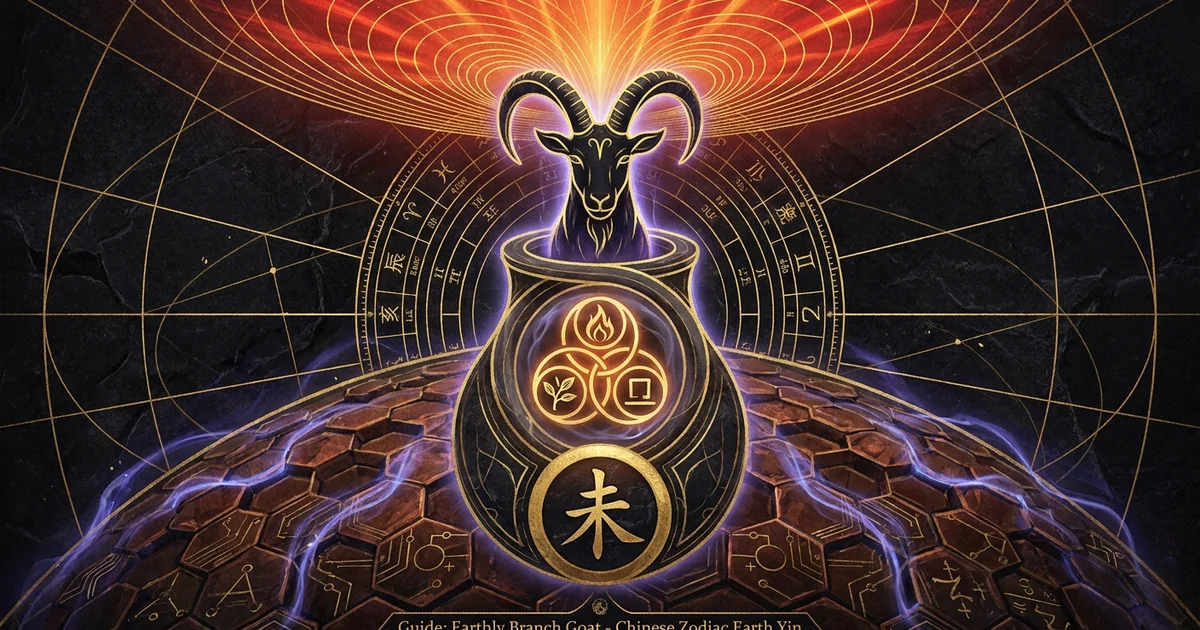
Earthly Branch Goat: Chinese Zodiac Earth Yin - Guide
Archetypal Thesis & Systemic Paradigm: The Thermodynamic Pivot of Wei
Within the psycho-cosmological coordinate system of the twelve earthly branches (di zhi 地支), the eighth branch, Wei (未)—associated Zoomorphically with the Goat, Ram, or Sheep—marks the thermodynamic apex and subsequent descent of solar Yang into lunar Yin. Rather than serving as an emblem of benign passivity or pastoral surrender, Wei constitutes an alchemical crucible. Operating under the elemental jurisdiction of Yin Earth (Ji 己土), this branch governs the precise inflection point where the southern inferno of summer begins its structural condensation into the metallic dryness of autumn. It is the systemic nexus where maximum atmospheric heat interfaces with subterranean cooling, executing an esoteric mediation that prevents the cosmos from immolating in its own kinetic radiance.
::: note [Symbolic Correspondence]
- Temporal Alignment: Sixth Solar Month (approx. July 7 – August 6); Solar Terms *Xiaoshu* (Lesser Heat) and *Dashu* (Great Heat).
- Diurnal Phase: 13:00–15:00 (Hour of the Goat / Post-Zenith Solar Radiance).
- Directional Axis: South-Southwest (210° on the Luo Pan compass).
- Somatic Network: Spleen (*Pi*) and Stomach (*Wei*) Functional Systems; Zang-Fu Earth pivot regulating assimilation, flesh (*rou*), and the distribution of fluids (*jinye*).
- Polarity & Phase: Yin Earth (Ji 土), functioning as a dry, baked matrix sheltering subterranean nascent wood and residual imperial fire.
:::
Chronobiological Thermodynamics: The Sixth Solar Month and Solar Fire Dissipation
The Sixth Solar Month encompasses the solar nodes of Xiaoshu (Lesser Heat) and Dashu (Great Heat), representing the thermal latency of the terrestrial sphere. While the summer solstice occurs astronomically in the preceding branch of Wu (Horse, 午), terrestrial physics dictates that maximum ground-level temperatures manifest weeks later, as the landmass continuously absorbs, retains, and re-radiates accumulated solar bombardment. Wei embodies this thermodynamic saturation. In the framework of Manfred Porkert’s analysis of Chinese medicine, this represents an active phase of dynamic stabilization: the Yang energy has reached its outer qualitative limit and can no longer expand without inducing systemic catastrophe.
Wei arrests this outward trajectory. It captures the dispersed, volatile radiation of southern Fire and channels it into a terrestrial heat sink. This energetic capture is not inert; it is the bio-dynamic prerequisite for agricultural and psychic maturation. The solar rays, mediated through the soil, cease their incandescent vertical ascent and shift toward the slow, metabolic baking of organic structures. Without the stabilizing mediation of Wei’s Yin Earth, the cyclical transition toward the Western quadrant of Metal (Jin 金) would precipitate an explosive thermodynamic shock, shattering organic forms through unmediated thermal contraction.
Yin Earth as the Alchemical Menstruum of Vegetative Ripening
In the dynamic schema of wuxing five elements (Wu Xing 五行), Yin Earth is the alchemical menstruum—the digestive, viscous, and receptive substratum that metabolizes raw catalytic input into structural form. Unlike the foundational, structural boulders of Yang Earth (Wu 戊土), Yin Earth is moist, permeable, garden-soil-like, and profoundly absorptive; yet within Wei, this Yin Earth is distinctively dry (Zao Tu 燥土). It operates as an earthen kiln. The soil of Wei is infused with the residual embers of the fire season, functioning precisely as a womb that ripens vegetative life to full fruition.
Vegetation at this juncture ceases its vegetative elongation (Wood phase) and halts its photosynthetic flowering (Fire phase) to channel its sucrose, lignins, and energetic sap into seeds, grains, and fruits. Yin Earth performs this bio-spiritual coagulative function: it solidifies solar will into somatic weight. It represents the psycho-spiritual capacity to internalize raw experience, digesting psychological crises through contemplative, introverted processing so that raw psychic trauma transmutes into durable wisdom.
The Archetype of the Goat: Unyielding Gentleness and Latent Tenacity
The philological derivation of the character Wei (未) illuminates its fundamental nature. As noted in the Han Dynasty lexicon Shuowen Jiezi by Xu Shen, Wei is etymologically linked to wei (味, flavor/taste) and visually depicts a tree whose upper canopy is heavy with overlapping, mature foliage, signifying that the fruit is imminent but “not yet” fully consolidated. The ideogram stands as the inverse of Mo (末, the tip or finality) and distinct from Ben (本, the root); it denotes a condition of pregnant latency, a threshold of profound interior transformation where outer appearance masks subterranean alchemy.
The Zoomorphic assignment of the Goat or Ram to this branch has frequently led to exoteric misinterpretations of the archetype as weak, servile, or melancholic. Esoterically, the mountain goat occupies treacherous vertical crags with absolute equilibrium, moving across razor-thin precipices where heavier beasts plummet. The Goat of Wei embodies this exact somatic paradox: an exterior yielding softness coupled with an intractable, iron-like structural core. Governed by Yin Earth, its gentleness is not a symptom of fragility, but a calculated energetic defense mechanism. It endures high-pressure environments by absorbing dynamic shocks into its vast, porous, subterranean emotional network, retaining stability where rigid structures shatter.
Classical Provenance & Textual Lineage: Wei in the Canonical Archives
The astronomical and mantic codification of Wei spans millennia, evolving from early astral-shamanic observations of the circumpolar stars to the highly refined mathematical grids of imperial horoscopy. The systemic comprehension of this branch requires examining its place within the cosmic orientation instruments of the Han dynasty and its subsequent technical structuralization during the Song dynasty golden age of destiny analysis.
The Imperial Sky: Shiji and the Dipper’s Handle Pointing to the Southern Quadrant
In the Shiji (Records of the Grand Historian, c. 91 BCE), Sima Qian dedicates the Tianguan Shu (Treatise on Celestial Offices) to mapping the macrocosmic coordinates that govern terrestrial fate. Central to this astral theology was the motion of the Beidou (Northern Dipper), whose celestial handle (Dou Bing 斗柄) functioned as the cosmic clock-hand of the Chinese Empire. When the handle of the Dipper pointed directly toward the South-Southwest quadrant during the post-solstitial seasonal node, the terrestrial sphere was understood to enter the jurisdiction of Wei.
::: source [Classical Manuscript / Translation]
"未者,言萬物皆成,有滋味也。在於六月,主土,其帝黃帝,其神后土。"
— Sima Qian, *Shiji: Tianguan Shu* (c. 91 BCE)

Translation: "Wei signifies that the ten thousand things are all completed and possess mature flavor (*wei*). Residing in the Sixth Month, it is governed by Earth; its sovereign ruler is the Yellow Emperor, and its presiding spirit is Houtu (Empress Earth)."
:::
This classical formulation establishes Wei as the macrocosmic point where divine celestial intention crystallizes into physical flavor and nutritional substance. The Shiji emphasizes that Earth does not merely occupy a singular season; rather, it manifests decisively at the transitions, with the Sixth Month representing the supreme manifestation of the terrestrial realm (Houtu), anchoring heaven’s dynamic light to the physical geography of the realm.
Song Dynasty Formalization: Ziping BaZi and the Hidden Stems (Cang Gan)
During the Song Dynasty (960–1279 CE), astrological theory underwent a profound structural revolution through the development of Ziping destiny analysis, formulated by Master Xu Ziping and codified by figures such as Xu Dahe in the canonical text Yuanhai Ziping (Deep Ocean of Ziping Astrology). In this sophisticated system of bazi four pillars, branches were no longer evaluated as monolithic elemental blocks, but as subterranean vessels harboring cang gan hidden stems (Cang Gan 藏干)—specific celestial energies stored within the earthly crust.
::: source [Classical Manuscript / Translation]
"未中己土三十日,丁火乙木各隨行。未為木庫,藏丁火之餘氣,納乙木之歸宿。"
— Xu Dahe, *Yuanhai Ziping* (Song Dynasty, c. 960–1279 CE)

Translation: "Within Wei, Ji Earth presides for its sovereign duration, while Ding Fire and Yi Wood follow in designated measure. Wei serves as the Tomb/Storage of Wood (*Mu Ku*), harboring the residual Qi of Ding Fire and receiving the resting retreat of Yi Wood."
:::
In the Ziping taxonomy, Wei is categorized as one of the Four Earthly Graveyards/Storages (Si Mu Ku 四墓庫). It is definitively designated as the Tomb of Wood (Mu Ku 木庫). Within its dry, compressed Earth matrix, the active growth energy of spring (Wood) is safely archived, sealed away from the predatory, cutting blade of autumn (Metal). Simultaneously, it captures the dying, smoldering embers of the Fire phase (Ding Fire 丁火). Thus, Master Xu Dahe structured Wei not merely as plain soil, but as an energetic preservation chamber where biological memory is encoded for future evolutionary cycles.
The Great Year Cycle: Macrocosmic Transitions in Han Cosmological Thought
In the broader cyclical vision of Han cosmology, as preserved in texts like the Huainanzi and Dong Zhongshu’s Chunqiu Fanlu, the Twelve Branches map the diurnal respiration of the cosmos itself—the Great Breath (Da Qi). Wei represents the great macrocosmic sigh of exhaustion that follows heroic creative expansion. Han theorists mapped this transition directly to the concept of Taiyin (Supreme Yin) gestating within the belly of Taiyang (Supreme Yang).
The Great Year cycle positions Wei as the cosmic station where civilizations and biological ecosystems undergo structural consolidation. The outward, conqueror-like drive of imperial expansion (governed by the southern Horse/Wu branch) exhausts its kinetic momentum at the threshold of Wei. At this boundary, administrative focus must shift inward toward civil governance, granary management, taxation equity, and cultural codification. The empire, like the biological organism, must retreat into its fortified boundaries to digest what it has absorbed, setting the stage for systemic survival.
Structural Mechanics & Symbolic Geometry: The Anatomy of Earthly Branch Wei
To evaluate Wei within technical metaphysics requires deciphering its internal stems, its geometry across the Luo Pan coordinate field, and its catalytic behavior when exposed to harmonious alliances or violent directional clashes.
Cang Gan Decomposition: The Triad of Ji Earth, Ding Fire, and Yi Wood
The internal architecture of Wei is tripartite, comprised of a Primary Qi (Ben Qi 本氣), a Residual Qi (Yu Qi 餘氣), and a Stored/Graveyard Qi (Mu Qi 墓氣). Understanding the fractional distribution of these subterranean forces is essential for decoding how this branch functions in dynamic astrological horoscopy:
- Ji Earth (己土) - The Sovereign Substance (Primary Qi, ~60%): The foundational shell of Wei is Yin Earth. It provides the dominant stabilizing tone. Unlike pure elemental earth, this Ji Earth has been subjected to two months of relentless solar exposure (Snake/Si and Horse/Wu), rendering it dry, parched, and structurally dense.
- Ding Fire (丁火) - The Residual Furnace (Residual Qi, ~20%): As the immediate successor to the imperial Fire branch Wu (which contains Ding Fire and Ji Earth), Wei inherits the lingering furnace heat of the south. This hidden Ding Fire acts as an internal hearth, preventing the soil from softening into mud and creating an environment that absorbs moisture rather than generating it.
- Yi Wood (乙木) - The Preserved Seed (Graveyard/Storage Qi, ~20%): Yi Wood within Wei represents the dormant germ of life—the root network, the historic blueprint of expansion that flourished during the spring months of Tiger (Yin) and Rabbit (Mao). Here, it is buried, protected from the imminent autumn frost, waiting for the subsequent spring cycle to resurrect its generative vitality.
::: diagram [San He and San Hui Interactive Circuitry]


    Si (Snake) / Wu (Horse)


    │


    ↓


{ Southern Fire Directional Frame (San Hui) }
        |
        v


    Wei (Goat)
    Hai (Pig) + Mao (Rabbit)


    │


        | Phase Shift: Terrestrial Kiln           | Alchemical Vector:
        | Captures Fire / Yields to Autumn        | Forms Wood Trinity (San He)
        v                                        v


    Shen (Monkey) / You (Rooster) Metal
    Manifest Sprouting Wood Phase


:::
Combinatorial Dynamics: The Southern Fire Frame vs. The Wood Elemental Trinity
The structural ambiguity of Wei is demonstrated through its participation in two distinct, mutually competing energetic combinations within BaZi geometry:
-
The Southern Directional Frame (San Hui Huo Ju 三會南方火): When Wei encounters the Snake (Si 巳) and the Horse (Wu 午), it completes the Seasonal Fire Trinity of the South. In this configuration, the Yin Earth of Wei effectively acts as an incendiary fuel-bed. Its dry, combustible matrix yields completely to the Fire element. The subterranean Yi Wood catches flame, feeding the overarching blaze, and the branch functions not as an earth-stabilizer, but as an auxiliary amplifier of pure solar radiation.
-
The Three Harmonies Wood Trinity (San He Mu Ju 三合木局): Conversely, when Wei encounters the Pig (Hai 亥, Water) and the Rabbit (Mao 卯, Wood), its terrestrial shell dissolves. Hai provides the hydrological nourishment, Mao provides the vegetative catalyst, and Wei opens its subterranean vault (Mu Ku), liberating the stored Yi Wood. The Earthly Branch transfigures: its earthly identity is subordinated to an alchemical eruption of biological Wood. Through the San He alliance, the dry kiln of late summer is re-hydrated and transmuted into a sprawling, verdant empire of organic vitality.
Branch Clashes and Punishments: The Earthly Torment of Wei, Chou, and Xu
Because Earth branches are dense, spatial matrices rather than ethereal elemental currents, their antagonistic interactions do not manifest as simple elemental extinguishment (as Water extinguishes Fire); instead, they produce structural seismic tremors, volcanic ruptures, and structural collapses.
The Ox-Goat Clash (Chou-Wei Chong 丑未沖)
Chou represents the frozen, wet, northern Yin Earth of midwinter, harboring Gui Water (癸水), Xin Metal (辛金), and Ji Earth. When Chou violently clashes with Wei across the 180-degree axis, an elemental war detonates within the subterranean matrix. The Ding Fire in Wei attacks the Xin Metal in Chou; the Gui Water in Chou attacks the Ding Fire in Wei; the subterranean Yi Wood in Wei is severed by Chou’s Xin Metal.
Crucially, because both branches share the primary element of Ji Earth, the clash of these two Earth repositories does not destroy Earth—it magnifies it exponentially. The terrestrial crust cracks open. The hidden stems destroy one another in mutual destruction, leaving behind a vast, barren, hyper-dense expanse of ungrounded, agitated Earth. Psychologically and medically, this clash frequently manifests as acute tumors, digestive failure, structural skeletal calcifications, and devastating emotional stubbornness.
The Earthly or “Bullying” Punishment (San Xing 三刑: Wei, Chou, Xu)
When Wei interfaces simultaneously with Chou (Ox) and Xu (Dog, 戌), the dreaded Three Penalties (San Xing) of the Earth element are activated, historically termed the “Ungrateful” or “Bullying” Punishment (Shi Shi Zhi Xing 恃勢之刑). Xu is the dry Yang Earth Tomb of Fire, Chou is the wet Yin Earth Tomb of Metal, and Wei is the dry Yin Earth Tomb of Wood.
When these three spatial vaults lock in structural resonance, the elemental Earth expands to grotesque, cancerous proportions, suffocating all Water, Metal, Wood, and Fire in the natal chart. It represents a state-space collapse of psychological flexibility. The native experiences an overwhelming sense of systemic stagnation, feeling besieged by familial burdens, bureaucratic impasses, and an insurmountable somatic density that paralyzes the will to act.
Psychological Dynamics & Operational Praxis: The Archetype in the Mind
Translated into archetypal psychology, the Earthly Branch Wei mirrors the architecture of the human unconscious when confronted with the imperative of somatic integration, sacrifice, and the boundaries of personal identity.
The Jungian Shadow of Yin Earth: Codependency, Martyrdom, and Latent Stubbornness
Through a Jungian framework, Yin Earth corresponds archetypally to the Great Mother (Magna Mater) in her receptive, nurturing, yet potentially devouring aspect. The native whose chart is dominated by the Goat branch possesses an immense capacity for empathy, somatic containment, and communal stewardship. However, the shadow of this configuration is pervasive and subtle. Because Yin Earth defines itself through utility to the other—nourishing, yielding, receiving—it easily falls victim to the martyr complex.
:::: comparison [Yin Earth Wei vs. Yang Earth Chen]
::: column [Wei (未) - Dry Yin Earth]
- **Internal Microclimate:** Arid, kiln-like, baked by residual Ding Fire.
- **Hidden Inventory:** Ji Earth, Ding Fire, Yi Wood (Tomb of Wood).
- **Psychological Posture:** Passive-resistant, interiorized emotional containment, latent melancholy, yielding facade concealing an intractable subterranean will.
- **Pathological Manifestation:** Psychosomatic digestive stagnation, neurotic codependency, martyrdom, bitter withholding.
:::
::: column [Chen (辰) - Wet Yang Earth]
- **Internal Microclimate:** Moist, marshy, energized by spring rains.
- **Hidden Inventory:** Wu Earth, Yi Wood, Gui Water (Tomb of Water).
- **Psychological Posture:** Expansive, opportunistic, emotionally turbulent, commanding presence, rapid strategic pivots.
- **Pathological Manifestation:** Volatile emotional flooding, megalomania, grandiosity, sudden structural boundary collapse.
:::
The underlying Ding Fire provides the Goat with an intense, often unspoken desire for emotional validation and aesthetic appreciation, while the buried Yi Wood harbors delicate creative ambitions. When these hidden drives are stifled by an overbearing Ji Earth crust, the personality degenerates into passive aggression. The Goat does not confront its tormentor directly—direct confrontation belongs to the Fire and Metal branches. Instead, it utilizes unyielding, immoveable inertia. It digs its hooves into the cliffside, refusing to move, weaponizing its perceived frailty to exert absolute psychological control over its interpersonal ecosystem.
Somatic Receptivity: The Goat as the Empathic and Artistic Sensory Organ
Beneath the defensive fortifications of the Yin Earth crust lie the fertile, intuitive currents of hidden Yi Wood and Ding Fire. Yi Wood is the signature of fine motor agility, organic design, calligraphy, and poetic sensitivity, while Ding Fire is the spark of divine inspiration, interior illumination, and mystical communion. When integrated constructively, the Goat branch operates as an extraordinarily refined psycho-somatic sensor.
Individuals carrying a well-balanced Wei branch process reality through somatic empathy. They do not merely understand another’s sorrow conceptually; they register it as a visceral density within their own gastrointestinal tract and solar plexus—the physiological domain of the Spleen/Stomach network. In the arts, Wei excels in disciplines requiring tactile sensitivity and patient, iterative physical labor: sculpture, ceramic masonry, architectural preservation, textiles, and classical botanical sciences. The Goat understands that authentic beauty requires time to bake; it will not force an unripe creation into the light before its alchemical incubation is complete.
BaZi Chart Diagnostics: Harmonizing a Hypertrophied or Deficient Wei Branch
In clinical BaZi diagnostics, the presence of an unbalanced Wei branch demands precise energetic remediation to restore equilibrium:
-
Hypertrophied, Dry Wei Earth (Excessive Fire-Earth):
- Diagnostic: Chart exhibits excessive Wei, Wu, or Si, with no viable Water to soften the soil. The personality becomes bitter, dogmatic, prone to inflammatory somatic disorders, and creatively desiccated.
- Therapeutic Protocol: Introduce the Metal-Water vector. Specifically, deploy the Shen (Monkey) or Hai (Pig) branches. Shen introduces Geng Metal and Ren Water, cooling the thermal excess and cleaving the over-dense Earth, allowing the hidden Yi Wood to breathe. Somatically, prescribe vigorous lymphatic drainage, rigorous cognitive boundary-setting exercises, and cold, cooling dietary protocols.
-
Deficient, Collapsed Wei Earth (Excessive Wood-Water):
- Diagnostic: Chart exhibits Wei attacked by aggressive Mao (Rabbit) or submerged under Hai (Pig) and Zi (Rat), causing the Earth element to collapse into mud. The native suffers from severe boundary dissolution, chronic exhaustion, digestive malabsorption, and an inability to assert individual desire.
- Therapeutic Protocol: Reinforce the territorial boundaries via Fire and Yang Earth. The introduction of Wu (Horse) forms the Wu-Wei Six Harmonies (Liu He 六合) alliance, which reinforces the Earth element through the direct fusion of Fire and Earth. Clinically, this requires somatic grounding practices, martial arts emphasizing low, rooted stances, and structural psychotherapies that reconstruct the fragmented ego-barrier.
Philosophical Synthesis & Macrocosmic Correspondence: Hermetic and Cross-System Mappings
The cosmological operations mediated by the Earthly Branch Wei transcend Chinese cultural borders, reflecting universal archetypal principles governing the transition of light into matter and dynamic will into structured form.
The Alchemical Nigredo-to-Albedo Transition: Digestion of the Solar Will
In Western Hermetic philosophy, the alchemical operation of Coagulatio is governed by the Earth element. Coagulatio is the process whereby that which is fluid, volatile, or ethereal is reduced to a solid, localized form. As the alchemist Edward Edinger notes, it is the incarnation of the Spirit into the heavy, suffering reality of the body. Wei is the quintessential station of Coagulatio.
The incandescent solar gold created during the southern Fire branches must enter the earthen athanor of Wei to be subjected to slow, subterranean digestion. This corresponds hermetically to the transitional interface between the destructive, burning phase of Calcinatio and the initial stages of Putrefactio or Nigredo. Within Wei’s baking earth, the outward ego-will is broken down. The fire no longer consumes outward fuel; it turns upon the self, digesting the personality’s grandiosity, preparing the psychic material to be transmuted into the clear, analytical, crystalline state of Metal (Albedo).
Comparative Western Astrological Coordinates: The Late Cancer / Early Leo Cusp and Virgo Preparation
While precise mathematical mapping between the 360-degree tropical Western zodiac and the 12 Earthly Branches requires structural care, Wei occupies the seasonal and archetypal space traversing late Cancer, the entirety of Leo, and the threshold of Virgo.
::: citation [Scholarly Citation]
"Time is not an abstract concept, but a living stream of qualitative moments, an unbroken continuum of qualitative phases where every moment brings its own psychic configuration to birth... In the rhythm of cyclical nature, the retreat into the earth is the necessary condition for the preservation of the solar seed."
— Marie-Louise von Franz, *Time: Rhythm and Repose* (1978), referencing Carl G. Jung’s *Synchronicity: An Acausal Connecting Principle*
::::
The solar zenith of early Leo embodies the blazing Ding Fire hidden within Wei. However, the operational reality of Wei mirrors the transition into late Virgo: the critical gathering of the harvest, the analytical sorting of grain from chaff, and the somatic stewardship of the earthly vessel. It holds the warmth of the Sun (Leo) contained inside the service-oriented, practical, bodily-bound sanctuary of the Earth Mother (Virgo). It is Saturnian containment operating upon a Solar core—a dynamic perfectly encapsulated by the nocturnal, reflective qualities of late-summer soil.
The I Ching Nodal Nexus: Hexagram 33 (Dun - Retreat) and Hexagram 12 (Pi - Standstill)
In the canonical sequence of the twelve sovereign hexagrams (Shi Er Bi Gua 十二辟卦), which map the ebb and flow of Yin and Yang lines throughout the solar year, Wei corresponds precisely to Hexagram 33: Dun (遯 - Retreat / Withdrawal).
Hexagram 33: Dun (Retreat)
=============================
Line 6: ——— (Yang)
Line 5: ——— (Yang)
Line 4: ——— (Yang)
Line 3: ——— (Yang)
Line 2: ── ── (Yin)
Line 1: ── ── (Yin)
=============================
Upper Trigram: Qian (Heaven / Creative Force)
Lower Trigram: Gen (Mountain / Immobility)
In Hexagram 33, two Yin lines have breached the energetic foundation of the hexagram from below, steadily displacing the four Yang lines above. The structural commentary on Dun emphasizes that this retreat is not an ignominious defeat, but a brilliant, highly calculated strategic withdrawal. The inferior, dark, vegetative Yin force is naturally rising according to cosmic law; the superior, illuminated Yang force must step back, preserving its essential structural integrity by declining to engage in direct combat with the ascending tide of darkness.
This encapsulates the strategic genius of the Goat. Wei does not resist the inevitable decline of the Fire season. Recognizing that solar Yang has expended its evolutionary mandate, Wei orchestrates a dignified retreat. It allows Yin to expand beneath the surface, sheltering the seed of consciousness (Yi Wood) within the mountain-like stillness of its Earth matrix. It demonstrates that true mastery consists not in continuous, aggressive expansion, but in knowing precisely when to withdraw into the sanctuary of the earth to gestate the future cycle.
Frequently Asked Questions: Technical and Esoteric Inquiries
Why is Wei characterized as a ‘Dry Earth’ Branch despite its Yin designation?
The Yin-Yang classification in Chinese metaphysics operates on multiple analytical planes: phenomenal manifestation (Ti 體) and operational application (Yong 用). While Wei is classified as Yin in its operational polarity—occupying an even-numbered astronomical sequence (8) and exhibiting a receptive, structural, interiorizing demeanor—its internal phenomenal microclimate is undeniably arid (Zao 燥).
This dry condition results directly from its position in the seasonal cycle. Having immediately received the residual thermal discharge of the sixth month, its internal matrix is saturated by hidden Ding Fire. Unlike the damp Yin Earth of Chou (which is saturated by northern Gui Water) or the moist Yang Earth of Chen (which harbors spring water reserves), Wei functions as an alchemical brick-kiln. It contains no native Water element whatsoever. Consequently, in BaZi chart diagnostics, Wei cannot nourish Metal (as dry, hot earth scorches Metal rather than generating it) and it aggressively absorbs and evaporates Water rather than yielding to it, earning its specialized classical designation as Arid or Scorched Earth (Zao Tu).
How does the Goat operate as the ‘Tomb of Wood’ (Mu Ku) in predictive Ziping astrology?
In the Ziping Four Pillars lineage, the concept of the Mu Ku (Tomb or Storage) is fundamental to predicting energetic releases and systemic blockages. Wood reaches its energetic birth in Hai (Pig), its absolute peak in Mao (Rabbit), and enters its final resting containment within Wei (Goat). The distinction between whether Wei acts as a “Tomb” (locking away and suffocating potential) or a “Storage” (safely preserving and archiving wealth/talent) depends entirely on the dynamic state of the overall chart:
- Operating as a Tomb (Mu 墓): If the chart’s structural Wood element is already weak, severed, or withered, and encounters Wei without an appropriate dynamic trigger, Wei acts as a crypt. The creative impulses, liver/gallbladder health, or family lineages represented by Wood are sucked into the dry earth and neutralized, resulting in psychological suppression, creative sterility, and systemic paralysis.
- Operating as a Storage (Ku 庫): If the Wood element is robust, and the chart features a calculated, controlled opening of the vault—most notably through an active Heavenly Stem penetration of Yi Wood, or a harmonious minor interaction that unlocks the gate—Wei acts as an ancestral treasury. The buried knowledge, artistic gifts, and financial capital stored within the Earth vault are unlocked and released into the conscious life of the native.
What are the spiritual repercussions of having Wei in the Day Branch (Spouse Palace)?
In BaZi horoscopy, the Day Branch represents the Spouse Palace (Qi Qie Gong / Fu Qi Gong), which simultaneously governs the somatic substrate of the physical body and the intimate core of the psychological self. Housing the Earthly Branch Wei within this coordinate produces distinct psycho-spiritual dynamics:
- Intense Interiorization of Relationship Dynamics: The native seeks an anchor—a partner who embodies stability, domestic sanctuary, and aesthetic refinement. However, because Wei is the Tomb of Wood, the native may unconsciously bury their own individuality (Wood represents the raw, assertive ego) within the relationship, surrendering personal growth to maintain domestic peace.
- The Specter of Emotional Inertia: The dry, stubborn nature of the branch can manifest as an intractable subterranean resistance to relational evolution. When interpersonal crises emerge, the native does not initiate dynamic repair through communication; instead, they retreat into defensive, stone-like silence, testing the partner’s devotion through prolonged periods of somatic withholding.
- The Spiritual Imperative of Clearing the Furnace: To achieve spiritual and relational sovereignty, an individual with Wei in the Day Branch must consciously introduce the cooling waters of vulnerability and the dynamic wind of creative self-expression. They must learn that yielding is not synonymous with self-erasure, and that authentic partnership requires the brave, active exposure of their subterranean fire, rather than hiding it behind a facade of gentle martyrdom. :::