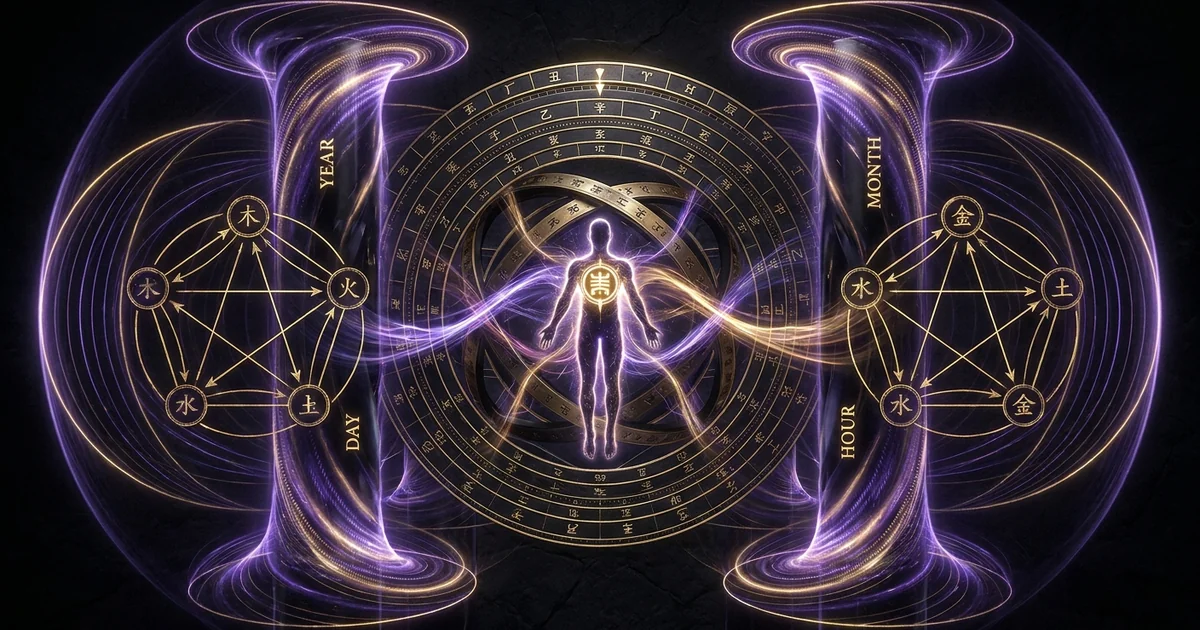
Four Pillars of Destiny: Year, Month, Day, Hour BaZi
Archetypal Thesis & Systemic Paradigm: Chronotopology and the Quadripartite State-Space
Temporal Imprinting and the Discrete Field Dynamics of Qi
The Four Pillars of Destiny, known classically as BaZi (八字, literally “Eight Characters”), constitutes an intricate chronotopological coordinate system. Far from the reductionist mechanisms of predictive fatalism, the architecture of BaZi formalizes time not as an empty, uniform quantitative continuum, but as a dynamic qualitative field. Rooted in ancient Chinese cosmological physics, this system posits that the multidimensional universe is animated by Qi (氣)—the foundational psychophysical energetic substrate—differentiating cyclically through the complementary polarities of Yin and Yang and crystallizing into the functional vectors of the Five Phases, or Wu Xing (五行: Wood, Fire, Earth, Metal, Water).
At the exact physical threshold of an individual’s nativity, marked by the severance of the umbilical cord and the inaugural respiration of ambient atmosphere, the ambient thermodynamic and cosmic configuration of Qi imprints upon the nascent organism. This inaugural respiration is not merely biological; it is an informational phase transition wherein the macrocosmic energetic state-space becomes internalized as a psychosomatic micro-architecture. BaZi models this structural imprint through a base-60 modular coordinate grid known as the sexagenary cycle (Liushi Jiazi, 六十甲子). By mapping this temporal signature onto four discrete coordinate vectors—the Year, Month, Day, and Hour of birth—the system formalizes a state-space representation of the human psyche and its prospective environmental collisions across lifespan development.
The Quadripartite Continuum: Macrocosmic to Microcosmic Scales
The systemic elegance of BaZi resides in its hierarchical boundary cascade. Rather than treating time as a flattened temporal point, the four pillars establish a fractal continuum descending from macrocosmic ancestral conditioning down to microcosmic, teleological drives.
The Year Pillar (Nian Zhu, 年柱) represents the outermost macrocosmic boundary. In psychological cartography, it delineates the transpersonal, ancestral, and collective unconscious strata. It encompasses genetic inheritance, early socio-historical context, the broad cultural milieu, and the deep psychospiritual lineage bequeathed by predecessors. The Year Pillar anchors the individual within the wider epochal current.
The Month Pillar (Yue Zhu, 月柱) demarcates the mesocosmic, seasonal, and environmental nexus. Because the Month Pillar reflects the precise solar term (Jie Qi, 節氣) and the thermodynamic climate governing the chart, it constitutes the systemic “Command of the Month” (Yue Ling, 月令). In psychodynamics, the Month Pillar maps the parental complex, early developmental conditioning, institutional schooling, and the operative social field wherein the developing ego is socialized, challenged, and structurally calibrated.
The Day Pillar (Ri Zhu, 日柱) functions as the central micro-phenomenological axis of the entire system. Its Heavenly Stem, specifically designated as the Day Master (Ri Yuan, 日元), is the structural coordinate corresponding to the Jungian Ego-Self axis. It embodies conscious self-identity, subjective agency, and the core somatic baseline. The Earthly Branch of the Day Pillar, known as the Spouse Palace (Qi Qie Gong, 妻妾宮) or Relationship Palace, reveals the primary projection surface for the Jungian anima/animus complex, somatic stability, and the immediate domestic container.
The Hour Pillar (Shi Zhu, 時柱) anchors the deep personal unconscious, teleological projections, internal drives, and generative legacy. Representing the final boundary layer, the Hour Pillar governs the output of the conscious personality: creative production, ideational offspring, progeny, private ambitions hidden from the public persona, and late-life individuation trajectories. Much like the cross-referencing mechanics found within the Incarnation Cross mechanics of alternative symbolic systems, the Four Pillars cascade from transpersonal inheritance to private intentionality, forming an integrated map of human experience.
Cybernetic Feedback and Qualitative Chronology
Regarded as an informational topology, BaZi functions as an epistemological instrument of cybernetic homeostasis. Within this framework, destiny (Ming, 命) is not an inescapable script written by an extrinsic celestial hierarchy; it is the baseline structural topology of the individual’s internal energetic ecosystem.
Human life unfolds as a continuous thermodynamic interaction between this baseline state (the Natal Chart) and fluctuating macro-environmental cycles. These incoming cycles are mediated through the ten-year developmental luck pillars (Da Yun, 大運) and annual transit cycles (Liu Nian, 流年).
When these temporal waves interact with the natal matrix, they inject specific elemental vectors that either reinforce, exhaust, obstruct, or harmonize the existing systemic tensions. BaZi destiny analysis functions as a cybernetic feedback mechanism: by diagnosing energetic deficits, systemic bottlenecks, and toxic amplifications within the Five Phase distribution, the analyst identifies compensatory pathways. Through this homeostatic diagnosis, conscious awareness transforms fatalistic vulnerability into intentional, archetypal adaptation.
Classical Provenance & Textual Lineage: The Shift from Astral Fatalism to Ziping Structuralism
Tang Dynasty Horoscopy: Li Xuzhong and the Primacy of the Year Pillar
The intellectual genealogy of BaZi reveals a fundamental epistemological shift from celestial fatalism toward structuralist psychology. During the middle to late Tang Dynasty, the primary systematizer of proto-BaZi was Li Xuzhong (李虛中, 762–813 CE), whose methodology was preserved in texts such as the Li Xuzhong Ming Shu (李虛中命書). Li’s framework operated primarily on three pillars—Year, Month, and Day—with analytical weight heavily centered upon the Year Pillar.
TANG DYNASTY (Li Xuzhong)           SONG DYNASTY ONWARD (Xu Ziping)
[Year Pillar = Sovereign/Core]  -->  [Day Master = Ego-Self Axis]
External Tribal/Astral Fate    -->  Intra-Psychic Structural Integration
Li Xuzhong’s diagnostic paradigm reflected an aristocratic, clan-oriented socio-political structure. An individual’s fate was seen as subordinate to lineage, imperial decree, and ancestral mandate. Methodologically, the Tang system relied extensively on the Na Yin (納音, Melodic or Harmonic Sound) system—an archaic combinatorial technique correlating Stem-Branch pairs with musical tones and elemental sub-phases—supplemented by an array of mythological stars (Shen Sha, 神煞). The individual in Tang horoscopy was essentially an astral satellite to the ancestral core, passive before predetermined decrees of temporal luck.
The Song Dynasty Breakthrough: Xu Ziping and the Day Master Revolution
The critical epistemological rupture occurred during the Northern and Southern Song Dynasties through the work of master chronomancer Xu Ziping (徐子平, c. 907–960 CE). Xu Ziping’s revolutionary breakthrough, historically canonized in compendiums like the Yuanhai Ziping (淵海子平, “The Deep Ocean of Ziping Destiny Analysis” compiled by Qin Jingan), fundamentally transformed Chinese divination.
Xu Ziping introduced two radical structural innovations:
- He institutionalized the Hour Pillar, cementing the modern Four Pillars (eight-character) architecture.
- He permanently displaced the Year Stem as the sovereign locus of analysis, elevating the Day Stem—the Day Master (Ri Yuan)—as the foundational reference node for all systemic evaluations.
This paradigm shift was homological to the rise of Neo-Confucian individualism, bureaucratic meritocracy, and the maturation of internal alchemy (Neidan). By designating the Day Master as the central coordinate of destiny analysis, Xu Ziping recast BaZi from an ancestral-lineage tracking matrix into an intra-psychic psychological model. Fate was no longer a static destiny visited upon a passive recipient by the stars; it became an ongoing dynamic relationship between the subjective ego-agency (Day Master) and the surrounding psychological archetypes (the remaining Stems, Branches, and seasonal environments).
The Hermeneutic Canon: Di Tian Sui and the Systematic Codification of Balance
During the Ming and Qing Dynasties, BaZi theory underwent rationalization, pruning residual folklore, superstitious talismans, and external astral fatalism in favor of an elegant, thermodynamic model of the Five Phases. The apex of this hermeneutic movement is marked by the classical treatise Di Tian Sui (滴天髓, “Dripping Heavenly Marrow”), historically attributed to the Yuan-Ming polymath Liu Bowen (劉伯溫, 1311–1375) and subsequently elevated by the definitive commentaries of the Qing Dynasty scholar Ren Tieqiao (任鐵樵, 1773–1840).
“If the Dao of Heaven is comprehended, the affairs of humanity are half-revealed; if the Earthly Stems contain hidden roots, the vital balance of the destiny pattern is established. Metal and Water flourish through dynamic circulation; Wood and Fire ascend through natural ignition. Earth anchors the four directions, regulating the extreme fluctuations of the seasonal command. Discern the pure from the turbid, and the structural integrity of fate clarifies without illusion.”
Ren Tieqiao’s rigorous commentaries in the Di Tian Sui Zhengyi established an analytical standard focused entirely on the thermodynamic balance of structural forces: Wang (旺, Prosperity/Strength), Shuai (衰, Weakness/Decline), Zhong He (中和, Central Homeostasis), and the delicate relationships of dynamic containment among Heavenly Stems and Earthly Branches. BaZi stood fully articulated as a systematic science of qualitative balance, asserting that psychological pathology, somatic vulnerability, and socio-material crises stem directly from structural imbalances (Pian Ku, 偏枯) among the Five Phases.
Structural Mechanics & Symbolic Geometry: The Stem-Branch Combinatorics and the Sixty Jiazi Cycle
The Decimal and Duodecimal Cycles: Ten Heavenly Stems and Twelve Earthly Branches
The operational engine of BaZi rests on the mathematical interaction of two distinct cyclic series: the decimal cycle of the Ten Heavenly Stems (Tiangan, 天干) and the duodecimal cycle of the Twelve Earthly Branches (Dizhi, 地支).
The Ten Heavenly Stems formalize the pure, archetypal qualities of Heaven descending into temporal expression. They emerge from the dynamic intersection of the Five Phases and the dual polarities of Yin and Yang:
- Jia (甲): Yang Wood (structural, expanding, pioneering)
- Yi (乙): Yin Wood (flexible, network-oriented, adaptive)
- Bing (丙): Yang Fire (radiant, expansive, illuminating)
- Ding (丁): Yin Fire (focused, catalytic, incandescent)
- Wu (戊): Yang Earth (solid, buffering, mountain-like)
- Ji (己): Yin Earth (yielding, fertile, internalizing)
- Geng (庚): Yang Metal (disruptive, reforming, mineral)
- Xin (辛): Yin Metal (refined, penetrating, crystalline)
- Ren (壬): Yang Water (surging, deep, oceanic)
- Gui (癸): Yin Water (receptive, mist-like, intuitive)
The Twelve Earthly Branches formalize Earth’s concrete spatio-temporal response to celestial activation. They correlate with the twelve segments of the annual solar orbit, the twelve double-hours (Shi Chen, 時辰) of the diurnal cycle, and the archetypal imagery of the twelve symbolic animals: Zi (子, Rat), Chou (丑, Ox), Yin (寅, Tiger), Mao (卯, Rabbit), Chen (辰, Dragon), Si (巳, Snake), Wu (午, Horse), Wei (未, Goat), Shen (申, Monkey), You (酉, Rooster), Xu (戌, Dog), and Hai (亥, Pig).
Because both cycles systematically interlock exclusively between poles of identical parity (Yang Stem with Yang Branch; Yin Stem with Yin Branch), their least common multiple yields precisely sixty unique combinations:
$$\text{LCM}(10, 12) = \frac{10 \times 12}{\gcd(10, 12)} = \frac{120}{2} = 60$$
This sixty-step loop constitutes the sexagenary cycle (Liushi Jiazi), which coordinates Chinese chronomancy and calendar generation. A complete BaZi natal chart consists of four such pairs, generating an eight-character matrix ($4 \times 2 = 8$).
The Twelve Earthly Branches are not uniform elemental blocks; each contains specific Hidden Heavenly Stems (Cang Gan, 藏干) categorized by energetic intensity:
-
The Four Cardinal Branches (Si Zheng, 四正): Pure expressions of their native element.
- Zi (子): Gui Water (100%)
- Mao (卯): Yi Wood (100%)
- You (酉): Xin Metal (100%)
- Wu (午): Ding Fire (70%), Ji Earth (30%)
-
The Four Growth / Corner Branches (Si Chang Sheng, 四長生): Sites of dynamic transition, housing the Major Element, the Budding Phase of the next cycle, and a Root of Yang Earth.
- Yin (寅): Jia Wood (Major/Ben Qi, 60%), Bing Fire (Secondary/Zhong Qi, 30%), Wu Earth (Residual/Yu Qi, 10%)
- Si (巳): Bing Fire (Ben Qi, 60%), Geng Metal (Zhong Qi, 30%), Wu Earth (Yu Qi, 10%)
- Shen (申): Geng Metal (Ben Qi, 60%), Ren Water (Zhong Qi, 30%), Wu Earth (Yu Qi, 10%)
- Hai (亥): Ren Water (Ben Qi, 70%), Jia Wood (Zhong Qi, 30%)
-
The Four Graveyard / Storage Branches (Si Ku, 四庫): Transitional Earth phases that conclude seasonal quarters, retaining residual Qi from the dying season and preserving subterranean elements.
- Chen (辰): Wu Earth (Ben Qi, 60%), Yi Wood (Residual/Yu Qi, 30%), Gui Water (Storage/Cang Qi, 10%)
- Wei (未): Ji Earth (Ben Qi, 60%), Ding Fire (Yu Qi, 30%), Yi Wood (Cang Qi, 10%)
- Xu (戌): Wu Earth (Ben Qi, 60%), Xin Metal (Yu Qi, 30%), Ding Fire (Cang Qi, 10%)
- Chou (丑): Ji Earth (Ben Qi, 60%), Gui Water (Yu Qi, 30%), Xin Metal (Cang Qi, 10%)
The Cang Gan Architecture: Hidden Stems as Subterranean Field Resonances
The architecture of Hidden Stems (Cang Gan, 藏干) is critical for structural BaZi analysis. It models the multi-layered depth of human psychology. If the visible Heavenly Stems denote conscious, manifest persona traits operating out in the open, the Hidden Stems within the Earthly Branches represent subterranean field resonances: unconscious complexes, repressed behavioral patterns, hidden aptitudes, and instinctual drives.
For a Heavenly Stem to express itself potently in the native’s external life, it must possess “Roots” (Tong Guan, 通根) within the Hidden Stems of the Earthly Branches. A Stem lacking root support is termed “floating” (Fu, 浮)—signifying an ego-ideal, an aspiration, or a neurosis that lacks the structural psychophysical anchoring to crystallize into tangible reality.
Conversely, an element stored deeply in an Earthly Branch without an exposed Heavenly Stem represents an introverted potentiality or latent complex, awaiting activation through cyclical shifts or environmental catalysts.
Interference Patterns: Combinations, Clashes, and Punishments
The dynamic field of a BaZi chart is sustained through geometric interference patterns among its stems and branches:
  STEM/BRANCH TOPOLOGY
  [ Combinations (He) ]    --> Cohesion, Attraction, Psychological Syntony
  [ Clashes (Chong) ]      --> Kinetic Rupture, Polar Opposition, Rapid Release
  [ Punishments (Xing) ]   --> Neurotic Friction, Internal Friction, Behavioral Loops
-
Harmonic Combinations (He, 合): Combinations operate on both celestial and terrestrial levels. The Six Stem Combinations (e.g., Jia + Ji forming Earth; Bing + Xin forming Water) model chemical fusions where polar opposites bond, generating an elemental synthesis. The Six Branch Combinations (Liu He, 六合) and Three Harmony Trinities (San He, 三合—such as Shen + Zi + Chen unifying into Water) represent systemic cohesion, psychological syntony, and relational affinity. Combinations synthesize energy, stabilizing charts while sometimes creating obsessive attachments or structural rigidity.
-
Clashes (Chong, 衝): Clashes occur across diametrically opposed duodecimal branches (e.g., Zi-Wu, Yin-Shen, Mao-You). Operating along 180-degree vectors, clashes indicate kinetic repulsions, structural crises, sudden realignments, and dynamic release. While historically misinterpreted as inherently catastrophic, a clash is simply a rapid phase transition: it shatters stagnant structures, ejects deeply hidden elements from their subterranean storages, and forces immediate conscious adaptation.
-
Punishments (Xing, 刑): Punishments (including the Uncivilized Punishment, the Insentient Punishment, the Ungrateful Punishment, and Self-Punishment) delineate deep neurotic friction and intra-psychic stress. While clashes reflect visible external events, punishments signify internal psychological knots: cognitive dissonance, somatic manifestations of stress, relational sabotage, and compulsive behavioral patterns.
Psychological Dynamics & Operational Praxis: The Ten Gods as Archetypal Configurations
The Day Master (Ri Yuan): Diagnostic Locus of Ego-Strength (Wang/Shuai)
The baseline diagnostic assessment in BaZi destiny analysis centers on the structural integrity of the Day Master, evaluated across the dual poles of strength (Wang, 旺) versus exhaustion (Shuai, 衰). This assessment is an analytical evaluation of ego-resiliency and psychological constitution.
Determining Day Master strength involves a rigorous four-fold assessment:
- Seasonality (De Ling, 得令): Does the Day Master belong to an element naturally supported by the Month Branch’s dominant phase?
- Spatial Anchoring (De Di, 得地): Does the Day Master possess robust roots (Ben Qi or Zhong Qi) within the chart’s Earthly Branches?
- Allied Support (De Shi, 得勢): Do the surrounding Heavenly Stems feature supportive companion or resource elements?
- Energetic Balance: What is the chart’s overall balance of generating versus draining forces?
An excessively strong Day Master indicates an over-concentrated ego boundary—manifesting as rigidity, narcissistic self-enclosure, interpersonal friction, and stubbornness. Such an energetic economy requires expenditure through Output (Shi Shan) or regulatory submission through Control (Guan Sha).
Conversely, an excessively depleted Day Master reflects a porous ego boundary—leaving the individual vulnerable to environmental overwhelm, anxiety, somatic depletion, and boundary disintegration. Here, the energetic system requires structural supplementation through Resource (Yin) and Companion (Bi Jie) elements.
Direct Officer (Zheng Guan - 正官)
- Systemic Relation: Polar opposite controlling element (e.g., Yin Metal regulating Yang Wood).
- Jungian Complex: Conscious Ego-Ideal and integrated Superego.
- Psychological Manifestation: Respect for lawful authority, ethical conservatism, social decorum, bureaucratic diplomacy, structural integrity, and measured impulse control.
- Pathological Expression (Excess): Bureaucratic paralysis, fear of divergence, crippling conformism, and severe somatic repression.
Seven Killings (Qi Sha - 七殺)
- Systemic Relation: Homogeneous polarity controlling element (e.g., Yang Metal striking Yang Wood).
- Jungian Complex: The Autonomous Shadow, primal aggression, and instinctual assertion.
- Psychological Manifestation: Ruthless efficiency, revolutionary dynamism, appetite for danger, survival instincts, radical independence, and crisis leadership.
- Pathological Expression (Excess): Paranoia, violent self-destruction, predatory behaviors, hyper-vigilance, and somatic trauma cycles.
The Ten Gods (Shi Shen) as Transpersonal Archetypes and Intra-Psychic Drives
From the central locus of the Day Master, the remaining elements are categorized into five functional vectors, which further divide into ten distinct archetypal nodes based on Yin-Yang parity: the Ten Gods (Shi Shen, 十神). These are not anthropomorphic deities, but psycho-cosmological coordinates mapping relational dynamics, cognitive processes, and archetypal drives.
┌──────────────┐
                  │  DAY MASTER  │
                  │   (Ego/Self) │
                  └──────┬───────┘
          ┌──────────────┼──────────────┐
          ▼              ▼              ▼
   [ OUTPUT ]       [ WEALTH ]     [ OFFICER ]
  Expression/Id     Desire/Obj.    Superego/Power
  (Shi/Shang)       (Zheng/Pian)    (Guan/Sha)
          ▲                             │
          │      ┌──────────────┐       │
          └──────┤  RESOURCE    │◄──────┘
                 │ Mother/Arche │
                 │  (Zheng/Pian)│
└──────────────┘-
Companion Elements (The Self and the Shadow / Peer Field):
- Friend / Companion (Bi Jian, 比肩): Homogeneous polarity. Represents the conscious peer, autonomous identity, fraternal solidarity, self-confidence, and structural self-reliance.
- Rob Wealth (Jie Cai, 劫財): Heterogeneous polarity. Represents the split-off instinctual Shadow, aggressive competition, charisma, financial volatility, and impulsive interpersonal projection.
-
Output Elements (The Creative Id, Expression, and Catharsis):
- Eating God (Shi Shen, 食神): Balanced, harmonious creative output, philosophical rumination, calm aesthetic discernment, somatic pleasure, and restorative leisure.
- Hurting Officer (Shang Guan, 傷官): Hyper-dynamic, insurgent intellectualism, provocative artistic genius, subversive defiance of institutional orthodoxy, and sharp rhetorical aggression.
-
Wealth Elements (The Reality Principle and Externalized Material Libido):
- Direct Wealth (Zheng Cai, 正財): Disciplined allocation of material reality, incremental labor, structural pragmatism, traditional resource management, and emotional fidelity.
- Indirect Wealth (Pian Cai, 偏財): Speculative acumen, entrepreneurial vision, broad relational networks, fluid manipulation of resources, and systemic strategic leverage.
-
Officer Elements (The Law, the Superego, and Hierarchical Authority):
- Direct Officer (Zheng Guan, 正官): Legitimate institutional authority, structured ethical conscience, systemic equilibrium, social recognition, and integrated superego governance.
- Seven Killings (Qi Sha, 七殺): The raw, untamed instinctual shadow, structural violence, primal will to power, transformational crucible, and dynamic self-overcoming.
-
Resource Elements (The Great Mother, Archetypal Memory, and Psycho-Somatic Nourishment):
- Direct Resource (Zheng Yin, 正印): Benevolent maternal nourishment, intellectual contemplation, preservation of sacred traditions, spiritual shelter, and gentle cognitive integration.
- Indirect Resource (Pian Yin, 偏印 / Xiao Shen, 梟神): Unorthodox epistemology, occult intuition, esoteric investigations, intense introversion, detached cognitive hyper-abstraction, and profound psychological alienation.
Cybernetic Correction: Identifying the Useful God (Yong Shen) and Favorable Elements
The diagnostic pinnacle of BaZi praxis is the identification of the Useful God (Yong Shen, 用神)—the structural linchpin of the chart. The Useful God is the precise elemental vector required to resolve systemic blockages, regulate thermodynamic extremes, and restore homeostatic equilibrium to the psycho-energetic economy.
Methodologically, the determination of the Useful God follows distinct diagnostic procedures:
- Structural Balance (Fu Yi, 扶抑): Supporting the depleted or draining the excessive.
- Thermodynamic Regulation (Tiao Hou, 調候): Supplying thermal warmth (Fire) to a frozen winter chart, or providing systemic cooling (Water) to an arid, combustible summer landscape.
- Mediation of Stagnant Stems (Tong Guan, 通關): Introducing a mediating element between two locked, clashing forces (e.g., using Water to bridge a destructive Wood-Metal conflict via productive transmission: Metal $\rightarrow$ Water $\rightarrow$ Wood).
- Catalytic Transformation (Cong Ge, 從格): Surrendering to an insurmountable elemental surplus when an extremely weak Day Master must completely yield to a dominant systemic current.
Isolating the Useful God elevates BaZi beyond descriptive diagnostics into intentional transformation. The individual consciously introduces the archetypal qualities, behaviors, intellectual paths, relational environments, and geographic landscapes governed by the Useful God, establishing balance within their personal matrix.
Philosophical Synthesis & Macrocosmic Correspondence: Hermetic Axioms and Acausal Synchronicity
As Above, So Below: The Trinity of Heaven, Earth, and Humanity (Tian-Di-Ren)
The conceptual architecture of BaZi provides an empirical, systematic realization of the foundational Hermetic axiom: Quod est superius est sicut quod est inferius (“That which is Above corresponds to that which is Below”). Daoist cosmology models this homological unity through the Triad of the Three Powers (San Cai, 三才):
[ TIAN ]  --> Heaven: Qualitative Temporal Imprint (BaZi Natal Matrix)
          │
       [ REN  ]  --> Humanity: Volitional Consciousness, Ethics, Self-Cultivation
          │
       [ DI   ]  --> Earth: Spatial Geomancy, Landscape, Physical Architecture
Heaven (Tian, 天) delivers the qualitative temporal imprinting: the baseline structural conditions of the natal BaZi matrix and the unfolding cyclical sequences of the temporal luck pillars.
Earth (Di, 地) constitutes the terrestrial, spatial, and geopolitical arena: environmental geography, terrestrial magnetism, somatic heredity, and spatial architecture analyzed through geomancy (Feng Shui).
Crucially, Humanity (Ren, 人) sits squarely between these cosmic and terrestrial currents as the conscious agent. Human fortune is not governed exclusively by the celestial imprint of Heaven; it is mediated through conscious volitional effort, ethical cultivation (De, 德), psychological individuation, and wise strategic maneuvering. Fate sets the structural parameters of the stage, but the actor’s conscious agency determines the quality of the drama.
BaZi as Chrono-Resonance: Qualitative Time and Analytical Synchronicity
To evaluate BaZi through the lens of modern Western mechanistic causality is an epistemological category error. BaZi does not propose that distant planets or abstracted calendar cycles cast linear, Newtonian physical rays down upon human physiology. Instead, the theoretical foundation of destiny analysis is grounded entirely in chrono-resonance and meaningful acausal connectivity.
“Synchronicity takes the coincidence of events in time and space as meaning something more than mere chance, namely, a peculiar interdependence of objective events among themselves as well as with the subjective (psychic) states of the observer or observers… The Chinese mindset does not ask what causes something to happen, but rather: what likes to occur together in a given moment? Time, in this view, is an energetic field qualified by archetypal configurations.” — Carl Gustav Jung, Synchronicity: An Acausal Connecting Principle (1952)
As the Jungian scholar Marie-Louise von Franz noted in On Divination and Synchronicity, ancient civilizations formulated sophisticated mathematical grids to track the qualitative “taste” of moments in time. The four pillars matrix calculated at the second of nativity constitutes an archetypal time-stamp. Just as a premier vintage wine preserves the precise thermodynamic, chemical, and hydrological weather conditions of its seasonal development, the newborn human organism crystallizes the qualitative, psychic state-space of the macrocosmic moment. The unfolding events of an individual’s life do not stem from the planetary symbols; rather, the dynamic unfolding of time activates the latent internal archetypes encoded in the natal imprint.
Transmuting Fatum into Vocation: Epistemological Autonomy over Determinism
Interpreted through the prism of modern depth psychology, BaZi shifts from external fatalism into a rigorous instrument for conscious individuation. Unconscious complexes invariably manifest as external occurrences; as Jung famously observed, when an inner situation is not made conscious, it appears outside as fate.
When an individual remains unconscious of their BaZi dynamics, they drift along their elemental imbalances. A suppressed Seven Killings inevitably projects outward, manifesting as destructive authority figures, recurring crises, and volatile disruptions. An unintegrated Hurting Officer erupts as compulsive self-sabotage, social isolation, and professional friction.
Destiny analysis brings these subterranean patterns into conscious awareness. By charting the individual’s energetic topography, BaZi clarifies innate paradoxes, developmental impasses, and latent capacities. The chart ceases to be a deterministic sentence; it becomes an architectural blueprint of the soul’s energetic constraints and possibilities. Fate (Ming) is transmuted into genuine vocation: the dynamic pursuit of self-realization within one’s existential coordinates.
Frequently Asked Questions: Analytical Diagnostics and Epistemological Inquiries
The Clock Time Dilemma: Solar Time Rectification in Contemporary BaZi Calculations
A primary source of technical calculation error in contemporary BaZi chart calculation is the uncritical reliance on standard civil clock time. Standard civil time is an artificial socio-political convention designed for industrialized commerce, dividing vast geopolitical territories into uniform, flattened time zones.
Because BaZi models the precise thermodynamic and cosmic intersection of Solar Qi with terrestrial coordinates, an accurate chart requires calculating the True Solar Time (Zhen Tai Yang Shi, 真太陽時) of the physical birth location.
To convert standard Local Standard Time (LST) into True Solar Time (TST), the analyst applies two mandatory astronomical adjustments:
$$\text{TST} = \text{LST} + 4 \times (\lambda_{\text{local}} - \lambda_{\text{standard}}) + \text{EoT}$$
Where:
- $\text{LST}$ = Local Standard Time recorded by civil clocks.
- $\lambda_{\text{local}}$ = Exact geographical longitude of the physical birthplace (in decimal degrees).
- $\lambda_{\text{standard}}$ = Central reference meridian of the civil time zone (e.g., $120^\circ\text{E}$ for Beijing Standard Time, $75^\circ\text{W}$ for Eastern Standard Time).
- $4$ = The planetary constant: Earth rotates 1 degree of longitude every 4 minutes.
- $\text{EoT}$ = The Equation of Time adjustment (varying from approximately $-14$ to $+16$ minutes across the year), correcting for Earth’s orbital eccentricity and axial tilt.
Failure to execute these calculations can shift the Hour Pillar across branch boundaries—for example, misidentifying a birth occurring at the edge of the Zi hour (23:00–01:00) with the Chou hour (01:00–03:00)—which distorts the useful god diagnostic and the foundational reading of the chart.
The Problem of Identical Twins: Volitional Divergence within Identical Four Pillars Matrices
A classical epistemological challenge raised against BaZi is the phenomenon of identical twins: individuals born within the same double-hour window who possess identical Four Pillars matrices, yet develop divergent life trajectories, careers, and lifespans.
This apparent divergence reveals why BaZi is not an isolated, absolute determinism. Within classical Daoist thought, the natal chart supplies only the Heavenly Luck (Tian Yun, 天運) component—roughly one-third of the total existential equation. The operational outcome of that identical blueprint is mediated through the two remaining powers of the San Cai triad:
- Earthly Luck (Di Yun): Twins rarely occupy the exact same physical space simultaneously. Even small spatial variations introduce differing environmental and energetic conditions. When twins separate geographically, their Day Masters interact with markedly different climate conditions, regional cultures, and geographic directions.
- Human Luck (Ren Yun): Each twin retains an independent, autonomous center of conscious awareness. Confronted with the same archetypal tensions, one twin may integrate an elemental pattern consciously, while the other acts it out unconsciously. A strong Metal-Fire conflict might inspire one twin to become a trauma surgeon, while steering the other toward a career in defense or structural engineering. The underlying archetypal dialectic remains consistent; its developmental expression is shaped by conscious volitional choices.
Predictive Fatalism vs. Archetypal Agency: The Role of Consciousness in Fate Modulation
Does the Four Pillars matrix establish an unalterable, predestined life trajectory, or does human consciousness retain genuine freedom to modulate fate? The answer lies within the classical distinction between the structural matrix (Ming, 命) and the cyclical climate (Yun, 運).
Ming is the structural baseline: the cards dealt at nativity. An individual cannot alter the biological parentage into which they were born, their native neuro-chemical profile, or the qualitative temporal signature of their birth moment. The baseline distribution of elements remains structural reality.
However, conscious awareness fundamentally shifts how those internal tensions express themselves. Fate analysis does not trap the individual; it liberates the ego from blind identification with instinctual shadow complexes. An individual who understands their seasonal dynamics can plan strategically—consolidating resources during volatile clashes, and expanding boldly during supportive cycles.
Consciousness modulates fate by elevating how an archetypal frequency is lived. The four pillars establish the boundaries of the energetic river; volitional human consciousness chooses whether to drown in the current, exhaust itself swimming upstream against the seasonal tide, or navigate the waters with purpose and skill.
Archival References & Critical Apparatus
- Ho, Peng Yoke. Chinese Mathematical Astrology: Reaching Out to the Stars. London: Routledge Needham Series, 2003.
- Jung, Carl Gustav. Synchronicity: An Acausal Connecting Principle. Translated by R.F.C. Hull. Bollingen Series XX. Princeton: Princeton University Press, 1952.
- Li, Xuzhong. Li Xuzhong Ming Shu (李虛中命書, Master Li Xuzhong’s Book of Destiny). Tang Dynasty Canon. Siku Quanshu Edition.
- Liu, Bowen, and Ren Tieqiao. Di Tian Sui Zhengyi (滴天髓闡微, Dripping Heavenly Marrow with Authentic Exegesis). Qing Dynasty Redaction, 1815.
- von Franz, Marie-Louise. On Divination and Synchronicity: The Psychology of Meaningful Chance. Toronto: Inner City Books, 1980.
- Xu, Ziping. Yuanhai Ziping (淵海子平, The Deep Ocean of Ziping Destiny Analysis). Redacted by Qin Jingan. Ming Dynasty Woodblock Edition. :::