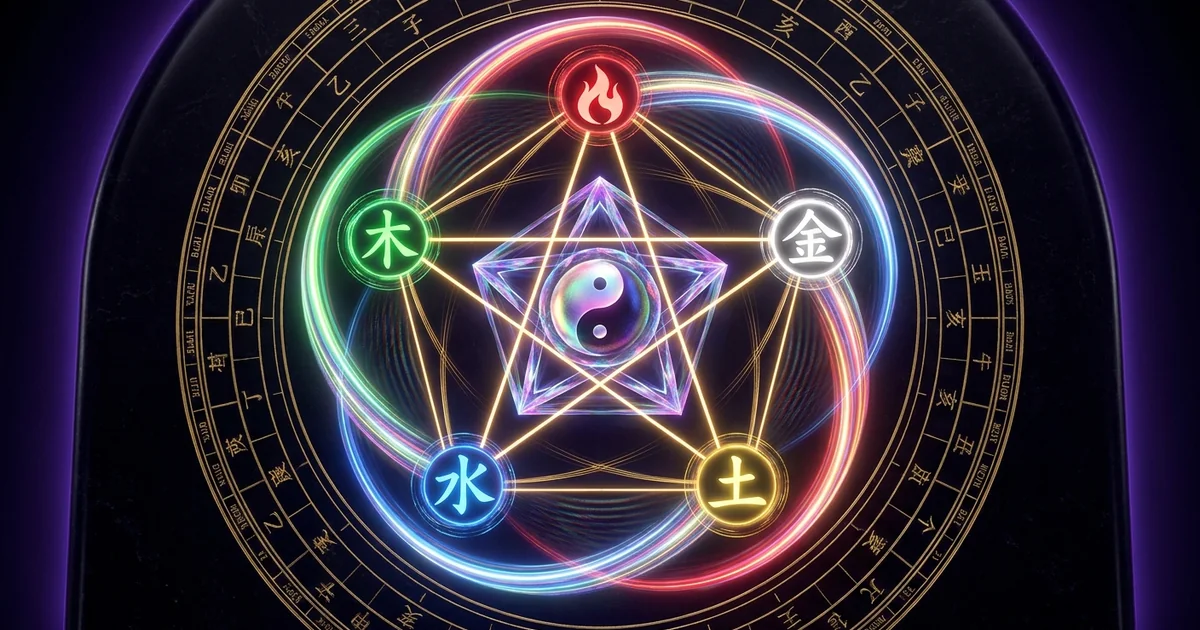
Five Elements Wu Xing: Generating and Controlling Cycles
Archetypal Thesis & Systemic Paradigm: Wu Xing as a Dynamic Phase-State Framework
Deconstructing the Elemental Misnomer: Wu Xing as Functional Phase Transitions
The rendering of Wu Xing (五行) into European languages as the “Five Elements” represents one of the most persistent epistemic distortions in comparative philosophy and esoteric cartography. The character Xing (行) possesses an etymological core fundamentally divorced from static, irreducible ontological substances such as the Empedoclean rhizomata (roots) or the Aristotelian stoicheia. Derived from an archaic ideograph depicting a crossroads or walking feet, Xing denotes motion, step, conduct, transition, and behavioral vector. Rather than cataloging primordial chemical constituents or rigid cosmic building blocks, the Wu Xing defines five operational phase-states of Qi (氣) as it alternates across the continuum of Yin and Yang. These phases—Wood (Mu, 木), Fire (Huo, 火), Earth (Tu, 土), Metal (Jin, 金), and Water (Shui, 水)—constitute functional modes of energetic transformation.
The Western intellectual heritage, conditioned by substance-based ontology and Cartesian dualism, has consistently struggled to assimilate systems wherein reality is conceived as pure process. When Zou Yan (鄒衍) and the Naturalist School formalised these correlations during the Warring States period, they were not proposing that the universe was physical matter carved into five distinct parts. They were articulating an acausal, inductive geometry capable of modeling change across systemic boundaries. Wood is not merely botanical cellulose; it is the thermodynamic vector of expanding, centrifugal, vegetative uprising. Water is not simple fluid hydrogen dioxide; it is the state of terminal rest, maximum gravitational descent, concentrated dormancy, and bio-electric reserve. To interpret the Wu Xing as elementary chemistry strips the doctrine of its cybernetic utility, reducing an advanced state-space coordinate engine into a quaint relic of primitive physics.
“The Chinese concept of xing implies active, functional movement rather than passive material constituent. Western science, grounded in causal-mechanistic ontology, isolates an invariant substantia whose properties are deduced from atomic composition. Classical Chinese natural philosophy, conversely, establishes an inductive syntony: phenomena are grouped into categories of operational correspondence (xiang) based upon identical phases of motion within a dynamic, cyclic energetic circuit. The Five Phases are not the material components of things, but the standard evolutionary postures assumed by energetic configurations throughout time.” — Manfred Porkert, The Theoretical Foundations of Chinese Medicine: Systems of Correspondence (MIT Press, 1974)
Cybernetic Feedback Loops: Feedforward and Regulative Balances in Chinese Cosmology
Within contemporary systems theory, a dynamic homeostat requires two fundamental topological structures to maintain integrity without collapsing into thermodynamic entropy or runaway instability: feedforward amplification (positive feedback) and restrictive regulation (negative feedback). The Wu Xing architecture formalizes precisely these operational mechanics through its twin generative (Sheng, 生) and regulatory (Ke, 克) circuits. Operating as a unified cybernetic machine, the system maintains homeostasis by preventing any single vector from monopolizing the global energetic reserve.
Feedforward circuits, embodied by the Sheng cycle, ensure the transmission of developmental impulse through a chain of continuous generation. Left unmitigated, however, positive feedback loops inevitably induce structural cataclysm, precipitating the entropic exhaustion of the host architecture. The regulatory Ke cycle functions as the essential negative feedback limiter. By traversing the internal diagonals of the phase matrix, the Ke cycle imposes constraints upon systemic expansion. The Wu Xing models cosmic, physiological, and psychological systems as inherently dynamic equilibriums. In this framework, health, sanity, and cosmological harmony do not consist of a static, unmoving stillness, but of the ceaseless, dialectical dance between production and restriction.
Chronobiological and Thermodynamic Manifestations of the Five Vectors
The Five Phases serve as an operational coordinate matrix for mapping temporal, chronobiological, and thermodynamic shifts across macrocosmic and microcosmic scales. Each phase corresponds to a precise vector of kinetic energy within systemic transformation:
- Wood (Mu, 木): The phase of emergence and directional vectoring. Thermodynamically, it represents low-density expansion, generative kinetic acceleration, and the upward translation of potential energy into kinetic form. In chronobiology, it governs the dawn, the vernal equinox, and the neuro-endocrine activation that terminates metabolic hibernation.
- Fire (Huo, 火): The phase of maximal manifestation and systemic illumination. It is characterized by high entropy, radiant heat dispersion, maximal kinetic agitation, and centrifugal expansion. Chronobiologically, it corresponds to local solar noon, the summer solstice, and the peak of metabolic output.
- Earth (Tu, 土): The phase of central balance, stabilization, and metabolic buffering. Thermodynamically, it constitutes the nodal inflection point wherein expansion ceases and condensation commences. It represents isothermal equilibrium, grounding the volatile transformations of the other vectors. Chronobiologically, Earth demarcates the transition between seasons—the lingering late summer or the final solar terms of each quadrant.
- Metal (Jin, 金): The phase of contractive condensation, purification, and boundary fortification. Thermodynamically, it represents centripetal containment, crystallization, increasing density, and the reduction of entropic chaos. Chronobiologically, it corresponds to dusk, the autumnal equinox, and the biological transition toward catabolism and structural preservation.
- Water (Shui, 水): The phase of maximum condensation, latency, and absolute energetic concentration. It is characterized by minimal kinetic dissipation, systemic cooling, downward gravitational pull, and profound potential energy. Chronobiologically, it corresponds to midnight, the winter solstice, and the deep vegetative state of anabolic recovery.
This dynamic cycle demonstrates that the wu xing five elements generating controlling cycle is fundamentally an empirical mapping of non-linear thermodynamics applied to living systems.
Classical Provenance & Textual Lineage: Historical Genesis of the Five Phases
The Hong Fan Codification: The Earliest Functional Definitions of the Five Activities
The systematic textual emergence of the Five Phases is canonically rooted in the Shangshu (尚書, Book of Documents), specifically within the revered “Hong Fan” (洪範, The Great Plan) chapter. Purportedly transmitted to King Wu of Zhou by the Viscount of Ji following the fall of the Shang dynasty (c. 1046 BCE), the Hong Fan outlines nine systemic categories for the governance of human society in total resonance with heaven and earth. The first category establishes the primordial definitions of the Wu Xing, defining each not by physical appearance, but by behavioral signature and energetic trajectory.
“The first category is called the Five Phases. The first is Water; the second is Fire; the third is Wood; the fourth is Metal; the fifth is Earth. The nature of Water is to soak and descend (Run Xia, 潤下). The nature of Fire is to blaze and ascend (Yan Shang, 炎上). The nature of Wood is to bend and straighten (Qu Zhi, 曲直). The nature of Metal is to yield and conform to change (Cong Ge, 從革). The nature of Earth is to receive seeds and yield harvests (Jia Se, 稼穡). That which soaks and descends creates saltiness. That which blazes and ascends creates bitterness. That which bends and straightens creates sourness. That which yields and conforms to change creates acridity. That which receives seeds and yields harvests creates sweetness.” — Shangshu, “Hong Fan” (Section 1)
These fundamental formulations established the operational boundaries for classical Chinese epistemology. Run Xia (soaking downward) and Yan Shang (blazing upward) establish the primary vertical polarities of descending Yin and ascending Yang. Qu Zhi (the capacity to yield yet remain erect) articulates the elastic biomechanical properties of growing organisms. Cong Ge (malleability yielding to structural reform) defines the process of refining systemic boundaries. Finally, Jia Se (sowing and reaping) positions Earth as the central metabolic crucible from which all developmental processes emerge and into which all exhausted energy returns.
Zou Yan and the School of Naturalists (Yin-Yang Jia): Succession of Virtues and Seasonal Dynasties
During the 4th to 3rd centuries BCE, Zou Yan of the Jixia Academy elevated the functional definitions of the Hong Fan into a universal socio-cosmological matrix. Recognizing that political, historical, and biological phenomena abide by identical energetic currents, Zou Yan formulated the doctrine of the De (德, Virtues or Powers) of the Five Phases. He operated primarily through the prism of the Mutual Overcoming or Controlling sequence (Ke), asserting that the historical succession of ruling dynasties directly mirrored the macrocosmic degradation and conquest of elemental forces.
Zou Yan posited that each imperial era derives its mandate from an ascendant phase whose energetic dominance must inevitably wane and fall to its cosmological conqueror. The Yellow Emperor reigned under the Power of Earth; his dynasty was overcome by the Xia Dynasty, which aligned with the Wood phase because Wood penetrates Earth. The Xia was conquered by the Shang under Metal, which severs Wood. The Shang was overthrown by the Zhou under the banner of Fire, which melts Metal. The future conqueror of Zhou was predicted to govern under the auspices of Water, which extinguishes Fire—a prophetic mantle consciously claimed by the first Emperor of Qin. Zou Yan demonstrated that human history does not operate as an arbitrary linear trajectory or an erratic drama of individual egos, but as a cyclically ordered, homeostatic meta-system governed by elemental necessity.
Han Dynasty Systematization: Dong Zhongshu and the Moral-Cosmological Integration in the Chunqiu Fanlu
The theoretical codification of the Wu Xing into an all-encompassing imperial, ethical, and medical architecture was finalized during the Western Han dynasty, prominently catalyzed by Dong Zhongshu (c. 179–104 BCE). In his masterwork, the Chunqiu Fanlu (春秋繁露, Luxuriant Dew of the Spring and Autumn Annals), Dong integrated the dialectical polarity of Yin-Yang with the Wu Xing, explicitly structuring both the generative Sheng cycle and the regulatory Ke cycle into a moral-political cosmography.
Heaven --> Yin/Yang Oscillations --> Five Dynamic Phases --> Four Seasons --> Terrestrial Harmony
Dong Zhongshu elevated the Sheng cycle as the supreme manifestation of filial piety (Xiao, 孝) and celestial benevolence (Ren, 仁). In Chapter 42 (“The Meaning of the Five Phases”), Dong declares: “Wood produces Fire; Fire produces Earth; Earth produces Metal; Metal produces Water; Water produces Wood. This is the order of father and son, the sequence of generation.” By fusing macrocosmic state transitions with the Confucian social hierarchy, Dong asserted that societal cohesion and metaphysical order depend upon maintaining these precise phase rotations. A breach in environmental, behavioral, or ritual ethics disrupts the generative current, converting the supportive dynamic of the Sheng cycle into systemic catastrophe and ecological retribution.
Concurrent with Dong’s political theology, the authors of the medical canon Huangdi Neijing (黃帝內經, The Yellow Emperor’s Inner Classic) translated this cosmology into structural human physiology. Within the Suwen and Lingshu treatises, the visceral organs (Zang-Fu, 臟腑) were mapped across the five vectors: Liver to Wood, Heart to Fire, Spleen to Earth, Lung to Metal, and Kidney to Water. Through this profound step, the human body was redefined not as a biological machine of disconnected parts, but as an interiorized cosmos operating via the continuous feedback mechanisms of the Wu Xing.
Structural Mechanics & Symbolic Geometry: The Sheng, Ke, Cheng, and Wu Topologies
The Generative Circuit: The Sheng Cycle as Constructive Feedforward Topology
The Sheng (生) cycle represents the constructive, nourishing, and amplifying feedforward network of the Wu Xing. Characterized by maternal transmission, each phase acts as the “Mother” (Mu, 母) to the subsequent phase, which acts as the “Son” (Zi, 子). This unidirectional circuit describes the path through which energy is seamlessly converted from potential latency to dynamic expression, and then consolidated into dense preservation:
- Water Generates Wood: Deep hydrologic latency soaks the dormant seed, nourishing the expansive, upward cellular proliferation of the vernal current.
- Wood Generates Fire: The combustion of bio-matter, combined with its centrifugal thermodynamic acceleration, serves as the fuel that ignites radiant thermal release.
- Fire Generates Earth: The exhaustive incinerating process reduces volatile forms to mineral-dense ash, reconstituting the central ground of stable substrate.
- Earth Generates Metal: The compression, stabilization, and geological maturation of earth transforms organic residue into crystallized, purified veins of ore and structural minerals.
- Metal Generates Water: The cool, interiorized surface of condensed minerals initiates atmospheric condensation, transforming vapors into liquid springs that return to the hydrologic reservoir.
In clinical diagnostics and psychosomatic mechanics, whenever a phase experiences metabolic starvation or exhaustion, remediation begins with its Mother. Deficient Wood demands the nourishment of Water; exhausted Fire requires the supplementation of Wood.
The Restrictive Governor: The Ke Cycle as Negative Feedback and Boundary Maintenance
The Ke (克) cycle constitutes the regulatory, inhibitory, and governing negative feedback mechanism of the Wu Xing. Geometrically, while the Sheng cycle traces the circular periphery of the five-fold system, the Ke cycle traverses internal diagonals, forming an intersecting pentagram. The Ke cycle preserves functional limits, ensuring that the constructive momentum of the Sheng cycle does not produce hypertrophic stagnation or entropic dissolution.
The structural constraints of this regulatory geometry operate as follows:
- Wood Controls Earth: Root systems breach, aerate, and anchor the soil, preventing geological compaction or formless mud dispersion.
- Earth Controls Water: Dense riverbanks, geological dikes, and absorbent silt contain, channel, and direct hydraulic pressure, preventing formless inundation.
- Water Controls Fire: Descending, cooling hydraulic masses dampen and extinguish excessive thermal ignition and radiative dispersion.
- Fire Controls Metal: Concentrated radiative thermal energy liquifies, softens, and reshapes rigid crystalline forms, preventing brittle calcification.
- Metal Controls Wood: Sharpened axes, saws, and pruning blades cut and restrain erratic, wild, hyperactive arboreal expansion.
Without the regulatory governor of the Ke cycle, the feedforward architecture would trigger runaway systemic collapse. For instance, Wood would generate excessive Fire, exhausting fuel reserves, reducing the matrix to terminal ash, and leaving behind structural devastation.
Pathological Degenerations: Cheng (Overacting Hyperactivity) and Wu (Insulting Counter-Control)
When systemic equilibrium is fractured through internal deficiency (Xu, 虛) or dynamic excess (Shi, 實), the topological geometry of the Ke cycle destabilizes into two distinct pathological states: Cheng (乘, Overacting or Over-controlling) and Wu (侮, Insulting or Counter-controlling).
Cheng Cycle (Overacting / 乘)
- Structural Vector: Unidirectional acceleration along the traditional Ke trajectory.
- Dynamic Mechanism: Occurs when an excessively dominant phase attacks an already compromised subordinate phase, or an average phase exerts uncontrolled aggression against a severely deficient phase.
- Diagnostic Signature: Authoritarian suppression, atrophy of downstream reserves, and functional collapse of the controlled organ.
- Clinical Example: Hyperactive Wood (stagnant Liver Qi transforming to Fire) hyper-invades deficient Earth (Spleen/Stomach), producing acute gastrointestinal collapse, chronic malabsorption, and severe functional exhaustion.
Wu Cycle (Insulting / 侮)
- Structural Vector: Retrograde reversal against the standard Ke trajectory.
- Dynamic Mechanism: Occurs when a phase designated for subjugation becomes unnaturally concentrated or hypertrophic, rebounding to attack its nominal controller.
- Diagnostic Signature: Pathological revolt, structural subversion of executive boundaries, and paradoxical reverse-symptom cascades.
- Clinical Example: Hypertrophic, congested Wood insults Metal, causing Liver fire to ascend and scorch Lung Yin, manifesting as dry spasmodic coughing, thoracic pain, and hemoptysis. Alternatively, hyper-concentrated Earth insults Wood, producing dense dampness that suffocates the Liver’s dredging capacity.
These pathological regressions illustrate the strict thermodynamic accountability of the Wu Xing. The moment an operational boundary is transgressed, the topology converts systemic nourishment into symptomatic crises, requiring structural intervention to restore equilibrium.
Psychological Dynamics & Operational Praxis: BaZi Diagnostics and Elemental Balance
The Four Pillars Natal Chart as a State-Space Differential Equation
In the esoteric cartography of BaZi (八字, Eight Characters), also known as the Four Pillars of Destiny, the temporal coordinate of a subject’s birth is transcribed into a sophisticated energetic blueprint. By translating the Year, Month, Day, and Hour of biological arrival into pairs of Heavenly Stems (Tian Gan, 天干) and Earthly Branches (Di Zhi, 地支), BaZi establishes a precise psycho-cosmological matrix. As illuminated in fundamental BaZi models, this matrix acts as a state-space differential equation: an operational diagram of the dynamic Qi balance governing the subject’s biological constitution, psychological disposition, and rhythmic progression through time.
The Eight Characters are not superstitious determinants of fatalistic events; they operate as a structural map of energetic tensions. The Heavenly Stems manifest as pure, overt, externalized elemental expressions, while the Earthly Branches house the “Hidden Stems” (Cang Gan, 藏干)—latent, complex archetypal drives embedded within the unconscious. Through this analytical architecture, personality is decoded not as an arbitrary synthesis of traits, but as the dynamic tension of the Wu Xing seeking equilibrium under the continuous temporal stresses of the Ten-Year Luck Pillars (Da Yun, 大運) and annual transits (Liu Nian, 流年). This conceptual architecture interfaces deeply with other modalities, revealing mathematical resonances with /astrology/chinese-astrology-bazi-foundations as well as the hexagram permutations explored in /divination/i-ching-hexagram-structural-dynamics.
The Day Master Under Pressure: Quantifying Elemental Balance in BaZi
The psycho-spiritual core of the Four Pillars chart is the Day Master (Ri Yuan, 日元)—the Heavenly Stem situated atop the Day Pillar. The Day Master serves as the primary subjective reference point, the psychological “Ego-Complex” across which all other energetic dynamics in the chart are calibrated. The fundamental diagnostic task within BaZi consists of evaluating the elemental balance of the Day Master relative to its surrounding environmental matrix.
+---------------------------------------------------------------+
|                      THE NATAL QUADRANT                       |
|   Year Pillar       Month Pillar      Day Pillar      Hour    |
|   [Social Realm]    [The Commander]   [Ego/Spouse]    [Mind]  |
+---------------------------------------------------------------+
                                |
             Evaluated against the Month Branch
                                v
               [ SEASONAL COMMANDER: The Anchor ]
                                |
        +-----------------------+-----------------------+
        v                                               v
   WEAK STATUS                                     STRONG STATUS
   Requires: Resource & Companion                  Requires: Output, Wealth, Officer
The decisive parameter of this evaluation is the Earthly Branch of the Month of birth, designated the “Seasonal Commander” (Yue Ling, 月令). The Seasonal Commander dictates the thermodynamic climate of the entire chart. A Fire Day Master born in the depths of the Winter month of Zi (子, peak Water) arrives into an environment of radical suppression, rendering it intrinsically “Weak” (Shen Ruo, 身弱) regardless of surface indicators. Conversely, the same Fire Day Master born in the height of the Summer month of Wu (午, peak Fire) is intrinsically “Strong” (Shen Wang, 身旺), saturated with seasonal vitality.
Equilibrium is never an egalitarian distribution where each phase holds exactly twenty percent of the systemic reserve. True balance is contextual, homeostatic adequacy. A Strong Day Master requires draining via its expressive output, engagement through its regulated wealth, or discipline by the controlling officer. A Weak Day Master demands protection through nourishing resources and reinforcement via companion phases. Pathologies emerge when an excessively strong Day Master overacts (Cheng) across the system, or when an excessively depleted Day Master is insulted (Wu) by the very elements it is designated to direct.
Remediating Deficiencies and Excessive Loads via Ten Gods (Shi Shen) Behavioral Archetypes
To translate raw energetic interactions into precise behavioral and psychological patterns, BaZi deploys the interpretive lens of the Ten Gods (Shi Shen, 十神). The Ten Gods are archetypal roles derived directly from the relationship between the Day Master’s phase and the remaining phases in the chart, nuanced by Yin-Yang polarity. These archetypal functions map directly to the Sheng and Ke dynamics, providing both diagnostic precision and clear paths for remedial intervention.
- Output / The Generative Vector (Shi Shen / Shang Guan, Eating God / Hurting Officer):
- Topological Relation: Phase generated by the Day Master (Day Master $\rightarrow$ Output).
- Psychological Function: Centrifugal expressive drive, intellectual innovation, creative discharge, artistic talent, and ideological rebellion.
- Systemic Role: Depletes Day Master reserve; overcomes the Officer (Ke); generates Wealth (Sheng).
- Wealth / The Controlled Vector (Zheng Cai / Pian Cai, Direct Wealth / Indirect Wealth):
- Topological Relation: Phase controlled by the Day Master (Day Master $\dashrightarrow$ Wealth).
- Psychological Function: Executive management, spatial awareness, pragmatic realism, resource acquisition, emotional stability.
- Systemic Role: Consumes the Day Master’s attention; generates the Officer (Sheng); drains Resource (Ke).
- Officer & Power / The Controlling Vector (Zheng Guan / Qi Sha, Direct Officer / Seven Killings):
- Topological Relation: Phase that controls the Day Master (Officer $\dashrightarrow$ Day Master).
- Psychological Function: Conscience, super-ego discipline, internal boundaries, societal status, capacity to withstand crisis, authority.
- Systemic Role: Restrains the Day Master’s expansiveness; generates Resource (Sheng); destroys Companions (Ke).
- Resource / The Generating Vector (Zheng Yin / Pian Yin, Direct Resource / Indirect Resource):
- Topological Relation: Phase that generates the Day Master (Resource $\rightarrow$ Day Master).
- Psychological Function: Introspective receptivity, somatic nourishment, parental integration, intellectual depth, theoretical assimilation.
- Systemic Role: Directly recharges the Day Master; drains the Officer (Sheng); suppresses Output (Ke).
- Companion / The Parallel Vector (Bi Jian / Jie Cai, Friend / Rob Wealth):
- Topological Relation: Phase identical to the Day Master.
- Psychological Function: Self-affirmation, peer association, unyielding persistence, competitive drive, raw ego strength.
- Systemic Role: Bolsters the Day Master against pressure; attacks Wealth (Ke); generates Output (Sheng).
Remediation of psychological disequilibrium in BaZi involves the conscious introduction of the “Useful God” (Yong Shen, 用神)—the specific phase-state archetype whose presence restores structural balance to the dynamic circuit. For example, when a Day Master is crushed under the oppressive authoritarian weight of excessive Officer energy (producing severe anxiety, chronic fear, and neurosis), classical remediation does not attack the Officer directly. Such counter-assaults risk provoking a devastating clash (Chong).
Instead, remediation introduces the Resource phase. The Resource absorbs the excessive force of the Officer through the Sheng cycle (as Officer generates Resource) and redirects it to nourish the exhausted Day Master (as Resource generates Day Master). In psychological terms, authoritarian self-condemnation is transformed into deep introspective contemplation, study, somatic restoration, and maternal self-compassion. The energetic threat is converted into systemic strength through the natural mechanics of the Wu Xing.
Philosophical Synthesis & Macrocosmic Correspondence: East-West Cosmological Comparative Matrix
Tetrasomy vs. Pentasomy: Aristotelian-Hermetic Static Qualities versus Chinese Functional Phases
A deep structural divergence marks Western Hermetic natural philosophy and Eastern Wu Xing cosmology. The Western Hermetic tradition, running from Empedocles and Aristotle through the medieval alchemists and the foundational doctrines of astrological aspectation (such as those analyzed in /astrology/western-planetary-dignities-aspects), structures its universe around a Tetrasomy (a four-fold division). This quaternary taxonomy is grounded in the intersection of two primary qualitative axes: Hot versus Cold, and Moist versus Dry.
Fire is Hot and Dry; Air is Hot and Moist; Water is Cold and Moist; Earth is Cold and Dry. These elements operate primarily as static, spatial, and geometric categories. They are physical and metaphysical building blocks that assemble into compounds through mechanical attraction (Philia, Love) or repulsion (Neikos, Strife).
The Chinese Pentasomy (Wu Xing), conversely, completely bypasses this static spatial architecture. It replaces Aristotelian ontological categorization with a five-fold temporal continuum of processual phases. The addition of the fifth node fundamentally alters the topological possibilities of the system. In a four-fold matrix, relations are inherently organized around binary oppositions (polar crosses, squares, and trines). In a five-fold matrix, non-linear cyclical feedback becomes the primary structural law.
Western Hermetic Quaternary (Tetrasomy)
- Structural Model: Static geometric spatial framework; the Fourfold Root (Tetraktys).
- Core Mechanism: Ontological qualities organized along two primary axes: Warmth and Moisture.
- Relational Mode: Mechanical mixing, proportional aggregation, and spatial opposition (elemental antipathies).
- Systemic Goal: Crystalline perfection, structural balance, and alchemical transmutation toward the fixed quintessence.
Chinese Five-Phase Topology (Pentasomy)
- Structural Model: Dynamic, processual temporal framework; the Five Movements (Wu Xing).
- Core Mechanism: Inductive phase transitions governed by cyclical transformation and kinetic vectors.
- Relational Mode: Perpetual transformation via the circular feedforward Sheng cycle and internal diagonal regulatory Ke cycle.
- Systemic Goal: Maintenance of perpetual flow, avoidance of static crystallization, and systemic adaptability across time.
The pentagonal topology of the Wu Xing is intrinsically bound to the mathematical properties of the golden ratio and cyclical renewal. These geometric characteristics are explored in foundational studies of /sacred-geometry/pentagram-golden-ratio-harmonics. While the Western four-element framework describes what matter is, the Chinese five-phase framework maps how systems behave.
Analytical Psychology: The Self-Regulating Psyche and the Transcendent Function
Carl Gustav Jung recognized that the human psyche operates as a complex, self-regulating energetic system. In Synchronicity: An Acausal Connecting Principle and Symbols of Transformation, Jung observed that the unconscious spontaneously mobilizes dynamic archetypal figures to restore balance whenever the conscious ego-complex adopts an extreme, one-sided posture. This compensatory dynamic corresponds directly to the negative feedback mechanisms of the Ke cycle.
The Ke cycle is the cosmological blueprint for Jung’s doctrine of enantiodromia—the immutable psychological law whereby an extreme position inevitably converts into its precise opposite:
$$\text{Ego Inflation (Hyper-Yang)} \xrightarrow{\text{Structural Ke Intervention}} \text{Unconscious Collapse (Hyper-Yin)}$$
When the conscious attitude becomes dangerously inflated—analogous to a hyperactive Wood phase expanding without restraint—the unconscious constellates the controlling archetype of Metal. This manifestation often appears somatically or circumstantially as depression, sudden loss of vitality, or external limitation. The psyche enforces boundaries to prevent the destruction of the broader personality.
The generative Sheng cycle models the process of psychic individuation through the progressive circulation of libido. Libido must not remain trapped within a single functional complex; it must transform continuously. As psychic energy moves from instinctual physical drives (Water) into willful self-assertion (Wood), it radiates outward into relational illumination (Fire), stabilizes into grounded somatic integration (Earth), and undergoes rigorous ethical purification (Metal).
The Jungian Transcendent Function—the dynamic capacity to synthesize conscious and unconscious opposites into a superior psychological unity—mirrors the mediating function of the Earth phase (Tu). As the central pivot of the Wu Xing, Earth absorbs the incendiary clashes of polar vectors, grounding their destructive friction and transmuting it into practical wisdom.
Cybernetic Law of Requisite Variety in Metaphysical State Transitions
The functional elegance of the Wu Xing receives modern confirmation through cybernetics, particularly via W. Ross Ashby’s Law of Requisite Variety. Ashby’s Law establishes that for any regulatory mechanism to maintain control and homeostatic stability over a system, the regulator must possess at least as many internal phase-states of variety as the system itself:
$$V_{\text{Regulator}} \ge V_{\text{System}}$$
A binary system (possessing only two states, such as unmediated Yin and Yang) lacks internal variety. It can only swing between total expansion and total contraction, producing catastrophic systemic shocks. A three-phase system introduces mediation, but cannot support separate, self-correcting networks for both generation and regulation simultaneously. A four-phase system establishes two polar axes, but remains vulnerable to static opposition, often freezing into rigid dichotomies.
The five-phase network of the Wu Xing is the minimal mathematical architecture required to sustain an autonomous, self-balancing homeostatic entity capable of simultaneous feedforward expansion (Sheng) and internal regulatory control (Ke) without requiring an external controller. Five nodes, when connected through perimeter transformations and internal diagonals, establish precisely ten unique relational pathways: five generative transformations and five regulatory checks.
This gives the system the structural flexibility needed to absorb shock, re-route energetic bottlenecks, and preserve dynamic equilibrium indefinitely. The Wu Xing is not an archaic philosophical curiosity, but an advanced, self-referential cybernetic blueprint that models the essential conditions for resilience in living, dynamic systems.
Frequently Asked Questions Regarding Wu Xing Mechanics
Translation and Nomenclature: Why ‘Phase’ Supersedes ‘Element’
The historical persistence of the term “Five Elements” is an artifact of 19th-century Sinological translations. Early European scholars routinely mapped unfamiliar Chinese metaphysical concepts onto Greco-Roman paradigms. When early translators encountered Xing, they mapped it directly onto the Latin elementum and the Greek stoicheion, projecting static physical properties onto what the Chinese classical tradition explicitly understood as temporal vectors.
The character Xing (行) denotes functional activity, progression, and phase shifts. In contemporary physics and systems theory, a “phase” describes a distinct state of matter or energetic balance within a thermodynamic cycle (such as solid, liquid, gas, and plasma, or the expansion-condensation phases of dynamic waveforms).
Translating Wu Xing as the “Five Dynamic Phases” or “Five Operational Vectors” rescues the doctrine from erroneous physical reductionism. It re-establishes the framework as an epistemological tool for modeling relational movement, whether in chronobiology, interpersonal psychology, or internal energetics.
Resolving Diagnostic Conflict: How to Identify Pathological Cheng and Wu in Practice
Differentiating between healthy regulation (Ke) and pathological invasion (Cheng or Wu) requires precise observation of functional output and systemic vitality:
- Healthy Regulation (Ke): The controlling phase restrains the targeted phase without diminishing its functional integrity. For example, in physiological diagnostic methods, healthy Metal disciplines Wood by ensuring that Liver Qi rises with elastic grace, preventing hyperactive headache or rage while preserving vision and tendon suppleness.
- Pathological Overacting (Cheng): The controlling phase invades aggressively, producing symptoms of acute suppression, atrophy, and functional breakdown in the controlled organ. In Cheng, Wood does not merely anchor Earth; it attacks the digestive capacity of the Spleen, precipitating immediate gastrointestinal pain, systemic lethargy, and profound cognitive fog.
- Pathological Insulting (Wu): The relationship inverts completely. The phase that ought to be governed becomes hyper-concentrated, counter-attacking its natural controller. When Earth insults Wood, dampness suffocates the free-flowing action of the Liver, inducing severe lethargy, biliary stagnation, and emotional despondency.
In BaZi chart analysis, the distinction depends upon structural quantification. If the controlling element possesses excessive seasonal strength while the target element is fundamentally unrooted and depleted, the relationship transitions instantly from healthy Ke to pathological Cheng.
Thermodynamic Distinction: Why the Sheng Cycle Does Not Lead to Runaway Entropy
In simplistic models of positive feedback, a purely generative loop quickly runs away: Phase A accelerates Phase B, which accelerates Phase C, driving the system toward an explosive thermodynamic exhaustion of its fuel reserves. The Wu Xing prevents runaway entropy through two structural safeguards:
[ Phase A: Wood ]
       | (Generates)
       v
[ Phase B: Fire ]
       | (Generates)
       v
[ Phase C: Earth ]
       | (Generates)
       v
[ Phase D: Metal ]
       | (CONTROLS Phase A: Negative Feedback Intercept)
       v
[ Phase A: Wood ] <--- Inversion Loop Closes
First, generation is energetically non-conservative: it exacts a metabolic cost from the generating “Mother” phase. When Wood generates Fire, Wood is depleted; its substance is consumed to produce thermal output. The Son phase thrives only through the expenditure of the Mother.
Second, the system is woven with internal, self-braking counter-loops. Wood generates Fire, but Fire in turn creates Earth, which produces Metal—and Metal immediately imposes a direct regulatory check (Ke) back upon Wood.
Every generative step sets into motion the exact downstream phase that will ultimately discipline its own source. Through this embedded geometry, the Wu Xing ensures that feedforward momentum automatically generates its own corrective restraint. The cycle achieves sustained equilibrium without requiring intervention from outside the systemic loop.