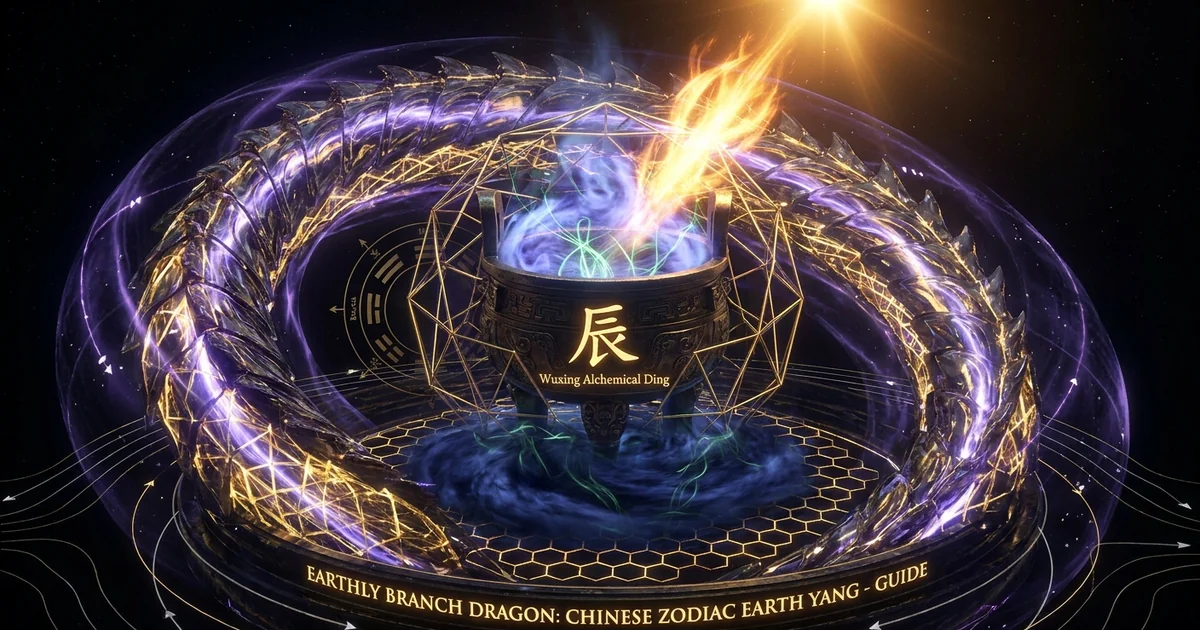
Earthly Branch Dragon: Chinese Zodiac Earth Yang - Guide
Archetypal Thesis & Systemic Paradigm: The Dragon as the Yang Earth Phase Gate
The Earthly Branch Dragon (Chen 辰), positioned at the pivotal nexus of late spring, constitutes the premier Yang Earth reservoir within the East Asian chronopsychological coordinate framework. Far from an arbitrary mythological projection, Chen operates within Chinese cosmological physics as a thermodynamic phase-gate. Within the cyclical deployment of the 12 earthly branches, Chen occupies the fourth solar month—spanning approximately April 4/5 through May 5/6, across the solar terms of Qingming (Pure Brightness) and Guyu (Grain Rain). In this spatiotemporal node, the expansive, hyper-kinetic trajectory of Wood (Mu) reaches its terminal saturation and requires structural deceleration before early summer’s incipient Fire (Huo) can ignite without causing systemic entropy.
Chen stabilizes this boundary by deploying the immense gravitational mass of Yang Earth (Wu Tu 戊土). Where cardinal branches (Zi, Wu, Mao, You) represent pure, unadulterated elemental states of unidirectional momentum, Chen operates as an integrative, composite buffer. It is classified in classical systems as a “Storage” or “Tomb” vault (Ku 庫 / Mu 墓). Specifically, it serves as the Water Storage (Shui Ku 水庫), retaining the dormant memory of winter’s deep liquidity while anchoring the biological surge of spring. This structural mechanism dampens potential volatility, ensuring that seasonal progression maintains cyclical integrity rather than cascading into energetic exhaustion.
Thermodynamic Mechanics of Chen (辰) in the Hexagonal Earthly Branch Framework
Within the systemic geometry of the BaZi (Four Pillars of Destiny), the twelve branches are plotted not merely as chronological markers, but as thermodynamic vector points distributed along an ecliptic cycle. The transitional quadrants are governed entirely by the Earth element (Tu 土), which serves as the central metaphysical axis around which the other four phases (Wu Xing) rotate. Chen functions as the bridge between the east (Wood) and the south (Fire).
Thermodynamically, spring is characterized by outward, branching kinetic energy (Wood). Left unchecked, this expansion risks sudden flashover upon encountering the thermal intensification of the south. Chen resolves this macrocosmic instability by introducing a moist, dense earthen medium. Designated as Damp Earth (Shi Tu 濕土), Chen absorbs the kinetic excess of late spring Wood, absorbs latent moisture from the subterranean hydrological matrix, and structures this energy into an organized, concentrated reservoir. It acts as an environmental capacitor, absorbing excess kinetic charge and converting it into potential systemic stability.
Yang Earth as Systemic Buffer: Mediating Wood Expansion and Fire Dispersal
The structural deployment of Yang Earth (Wu) provides the formal boundary architecture of Chen. In the classical metaphysics of the Five Elements, Yang Earth evokes the archetype of the mountain, the levee, the high terrace, or the continental shelf. It possesses structural mass, resistance to displacement, and an innate capacity to contain vast liquid pressures.
This containment capability is essential during the transition into the Si (Snake) branch. Incipient Fire demands a fuel source that does not combust instantaneously. By filtering the residual vegetative fibers of Yi Wood through the stabilizing strata of Wu Earth, the Dragon branch converts raw growth into durable bio-mass. It simultaneously prevents the unconstrained dissipation of Water (Gui 水), banking this vital coolant within its deep geodetic layers. Consequently, when summer’s thermal apex arrives, the systemic ecology retains sufficient interior moisture to prevent immediate drought and systemic burnout.
The Dragon Archetype: Psychospiritual Architecture of the Latent Reservoir
Transposed into the topology of analytical psychology established by Carl Gustav Jung, the Dragon branch delineates the archetypal threshold of psychic condensation. In The Structure and Dynamics of the Psyche (CW 8), Jung outlines the cybernetic dynamics of libido, asserting that unchannelled psychic energy inevitably regresses into the unconscious unless intercepted by an adequate symbolic container capable of transforming instinctual drives into cultural and executive structures.
+---------------------------------------------------------------+
|                 ARCHETYPAL TOPOLOGY OF CHEN                   |
|                                                               |
|   [ Latent Unconscious Contents ] ---> ( Gui Water: Instinct )|
|                                                  |            |
|   [ Vegetative Libidinal Surge ]  ---> ( Yi Wood: Drive )     |
|                                                  v            |
|                 +-------------------------------+             |
|                 |   WU YANG EARTH EMBANKMENT    |             |
|                 |  Psychic Condensation Matrix  |             |
|                 +-------------------------------+             |
|                                  |                            |
|                                  v                            |
|             [ Conscious, Coherent Executive Reality ]         |
+---------------------------------------------------------------+
The Dragon archetype in East Asian metaphysics embodies this containment function. It is not an aerial, fire-breathing terror, but a liminal, chimeric leviathan emerging from mist, lakes, and subterranean springs to command the clouds. Psychologically, Chen represents the vessel wherein deep unconscious contents—instinctual drives, emotional crypts, and archetypal primordial memories (Gui Water)—are bound and integrated with the nascent ego-impulses of self-actualization (Yi Wood) through the organizing matrix of the conscious Self (Wu Earth). Chen marks the psychological moment where latent potential crystallizes into manifest form, bridging the primal abyss of the unconscious with the ordered territory of the conscious mind.
Classical Provenance & Textual Lineage: Astronomical and Esoteric Genesis
The Stellar Dragon: Eastern Palace of the Azure Dragon (Canglong) and the Dipper Handle
The astronomical codification of Chen traces back to early Chinese observational astronomy, explicitly detailed in Sima Qian’s Shiji (Records of the Grand Historian, c. 91 BCE) within the Tianguan Shu (Treatise on the Celestial Offices). The celestial coordinate framework mapped the nocturnal sky into Four Megaconstellations (the Four Symbols or Si Xiang), with the Eastern Palace governed by the Azure Dragon (Canglong 蒼龍), comprising seven lunar mansions (Xiu): Jiao (Horn), Kang (Neck), Di (Root), Fang (Room), Xin (Heart), Wei (Tail), and Ji (Winnowing Basket).
          [THE SEVEN LUNAR MANSIONS OF THE AZURE DRAGON]
Horn (Jiao) -> Neck (Kang) -> Root (Di) -> Room (Fang) -> Heart (Xin) -> Tail (Wei) -> Basket (Ji)
The designation of the Earthly Branch Chen aligns directly with the diurnal pointing of the Northern Dipper’s handle (Beidou Doubing) and the counter-rotational progression of the Jupiter cycle (Tai Sui). When the Dipper handle points to the azimuth of Chen (approximately 120 degrees east-southeast) during the dawn hours of 07:00 to 09:00, it marks the exact intersection of celestial vitality with terrestrial awakening. Astronomically, Chen signifies the vernal constellation’s ascension above the horizon, heraldic of the seasonal distribution of atmospheric moisture and the systemic quickening of agricultural biology.
Sanming Tonghui and Di Tian Sui: Codification of the Storage Vault (Ku) Mechanics
The definitive systematization of Chen’s mechanics emerges in the canonical Ming Dynasty BaZi treatises, notably Wan Minying’s Sanming Tonghui (Compendium of the Three Fates, 1578 CE) and the foundational verses of the Di Tian Sui (Dripping Marrow of Heaven). These texts formally classify the branch not as dry, inert earth, but as an active hydrosphere-lithosphere interface.
“Chen is designated as the marsh and the low-lying bank; its nature is damp earth containing deep pools. Belonging to the directional East-Southeast, it houses the residual breath of spring Wood while serving as the conclusive graveyard and treasury of the Northern Water cycle. When the Water Qi enters Chen, it does not perish into absolute non-being; rather, it is gathered, banked, and retained beneath the firm crust of Wu Earth, awaiting the dynamic impact of a key to unlock its hidden riches.”
The classical texts make a vital distinction between dry Earth (Zao Tu 燥土), represented by the Dog (Xu) and the Goat (Wei), and Damp Earth (Shi Tu 濕土), represented by the Dragon (Chen) and the Ox (Chou). Because of its internal water retention, Chen does not scorch or obstruct Metal; instead, it nurtures Metal through wet sedimentary condensation, while possessing the unique capacity to cool, soften, and regulate volatile Fire.
The Jing Fang Hexagram Arrays: Alignment with Hexagram Guai (43) and Yang Emergence
In the esoteric Han Dynasty scholarship of Jing Fang (c. 40 BCE), preserved through the Jing Shi Yi Zhuan (Commentary on the Changes of Master Jing), the twelve earthly branches were mapped to the Twelve Tidal Hexagrams (Xiao Xi Gua 消息卦), which chart the rhythmic inhalation and exhalation of systemic Yin and Yang across the annual cycle.
THE DIURNAL TIDAL HEXAGRAM ASCENT (TOWARD SUMMIT OF YANG)
-----------------------------------------------------------------
[ Hexagram 24: Fu ]      --> 1 Yang line emerging at base
[ Hexagram 19: Lin ]     --> 2 Yang lines ascending
[ Hexagram 11: Tai ]     --> 3 Yang lines balancing 3 Yin lines
[ Hexagram 34: Da Zhuang]--> 4 Yang lines displacing Yin
[ Hexagram 43: Guai ]    --> 5 Yang lines pressing 1 residual Yin line [CHEN]
[ Hexagram 1: Qian ]     --> 6 Yang lines (Total Yang realization)
Chen corresponds precisely to Hexagram 43: Guai (Breakthrough / Resoluteness). In Guai, five dynamic Yang lines surge upward from the base, directly confronting and displacing the single, tenuous Yin line remaining at the summit. This hexagramic architecture reveals the Dragon’s inner condition: an overwhelming, nearly complete crystallization of solar Yang power, operating beneath a delicate skin of receptive Yin reality. Guai signifies the critical systemic moment where resolute executive consciousness must make a decisive, measured breakthrough, utilizing rational structure to prevent unconscious regression without resorting to tyrannical violence.
Structural Mechanics & Symbolic Geometry: The Hidden Stems and Elemental Dynamics
Anatomy of the Hidden Heavenly Stems (Cang Gan): Wu Earth, Yi Wood, and Gui Water
The operative complexity of the Earthly Branch Dragon is governed by its internal composition of Hidden Heavenly Stems (Cang Gan 藏幹). Unlike the single-element purity of Cardinal branches, Chen acts as a tri-elemental dynamic engine consisting of a Principal Qi, a Residual Qi, and a Gravitational/Storage Qi.
+-------------------------------------------------------------------------+
|                  HIDDEN STEM (CANG GAN) INTERNAL ARCHITECTURE           |
+-------------------------------------------------------------------------+
|  Primary Qi (Ben Qi)     | Wu Earth (戊)  | 60% (18 Days) | Structural Boundary |
|  Residual Qi (Yu Qi)     | Yi Wood (乙)   | 30% (9 Days)  | Vegetative Memory   |
|  Treasury Qi (Mu/Ku Qi)  | Gui Water (癸) | 10% (3 Days)  | Latent Unconscious  |
+-------------------------------------------------------------------------+- Wu Earth (戊土 - Yang Earth): Forms the Primary Qi (Ben Qi), governing 60% of the branch’s cyclical energetic allocation. Wu Earth provides the skeletal container, the continental bedrock, and the executive ego-framework. It is stabilizing, structural, and unyielding.
- Yi Wood (乙木 - Yin Wood): Operates as the Residual Qi (Yu Qi), accounting for approximately 30% of the branch’s influence. Yi Wood represents the living structural fiber of late spring, the lingering energetic habitus of the wood element that prevents the earth from calcifying into sterile clay.
- Gui Water (癸水 - Yin Water): Constitutes the Storage or Graveyard Qi (Mu Ku Zhi Qi), comprising the final 10% of the energetic ledger. Gui Water represents the locked, subterranean liquid essence—the primordial waters of wisdom, instinct, and psychic memory held secure within the mountain vault.
In advanced BaZi chart computation, these percentages are not static quantities, but dynamic vector coordinates. During the first nine days following the Qingming solar term, Yi Wood commands the seasonal mandate (Dang Ling). From the tenth to the twelfth day, the residual Gui Water registers its subterranean influence. Only during the final eighteen days of the solar cycle does Wu Earth assume absolute dominion over the seasonal energetic field, serving as the terrestrial threshold through which the solar system transitions into the Fire phase of summer.
The Trine and Clash Formations: Shen-Zi-Chen Water Alliance vs. Chen-Xu Polar Confrontation
Within Chinese astrological mechanics, Chen serves as the terminal anchor of the Three Harmony Water Alliance (San He Shui Ju 水三合局), collaborating with the Monkey (Shen 申) and the Rat (Zi 子).
THE WATER ALLIANCE TRINE (SAN HE SHUI JU)
------------------------------------------------------------------
[ Shen (Monkey) ]   --> Birth Stage (Zhang Sheng): The Springhead
[ Zi (Rat) ]        --> Peak Stage (Di Wang): The Raging River
[ Chen (Dragon) ]   --> Storage Stage (Mu Ku): The Continental Ocean/Reservoir
In this trine, Chen serves as the essential terminus. Without Chen, the elemental output of the Shen-Zi axis remains an untamed, destructive flood. Chen supplies the hydraulic engineering: the vast, deep-water ocean trenches and reservoir embankments that stabilize raw kinetic emotion into structured reserves of psychological insight and creative fuel.
THE POLAR CONFRONTATION (CHENG-XU CHONG)
------------------------------------------------------------------
[ Chen: Damp Yang Earth ]  <--- Structural Collision --->  [ Xu: Dry Yang Earth ]
  (Water Storage / Spring)                                   (Fire Storage / Autumn)
             \                                                         /
              +--> SHATTERING OF THE SUBTERRANEAN VAULTS <------------+
                   [ Gui Water Unleashed vs. Ding Fire Cleared ]
Conversely, the structural opposition to the Dog (Xu 戌) forms one of the most volatile confrontations in BaZi: the Chen-Xu Clash (Chong 沖). Both branches share Wu Earth as their primary essence, yet they inhabit diametrically opposed thermodynamic parameters. Chen is Damp Earth containing subterranean Water; Xu is Dry Earth containing interior Fire (Ding 丁) and residual Metal (Xin 辛).
When these two Yang Earth landmasses collide, the tectonic impact shatters the outer earthen walls of both vaults. The result is the violent release and confrontation of the subterranean components: Gui Water directly attacks Ding Fire, and Xin Metal shears through Yi Wood. Far from a purely destructive event, this clash functions structurally as a psychological demolition, clearing calcified neuroses and exposing repressed unconscious material to the light of day.
The Self-Punishment (Xing) Dynamic: Chen-Chen Redundancy and Narcissistic Psychic Traps
When two or more Dragon branches cluster within a single natal chart or across cyclical progressions (such as a Chen year encountering a Chen natal pillar), they trigger the operational condition known as the Dragon-Dragon Self-Punishment (Chen Chen Zi Xing 辰辰自刑).
In symbolic terms, Self-Punishment is not inflicted from an external adversary; it is generated by systemic redundancy and structural over-saturation. When damp earth is piled upon damp earth without the regulating intervention of pure Wood to bore through it (Mu Ke Tu), or the blazing heat of Fire to dry its saturated depths, the earth collapses into a heavy, impassable morass.
Psychologically, the Chen-Chen dynamic manifests as obsessive rumination, narcissistic inflation, stubborn resistance to systemic adaptation, and profound emotional entrapment. The individual constructs elaborate psychic fortresses that ultimately become their own subterranean prisons. The abundance of uncirculated Gui Water trapped within the double-earth vault breeds chronic dampness, manifesting psychologically as melancholic inertia, self-sabotaging executive stubbornness, and an inability to release expired ideological or emotional attachments.
Psychological Dynamics & Operational Praxis: The Dragon in Bazi Analysis and Archetypal Integration
The Architect of the Latent: Ego Inflation versus Grounded Sublimation
Individuals whose natal configurations are anchored by the Earthly Branch Dragon invariably display the psychological imprint of the Master Architect or Systemic Custodian. Because Chen houses both the kinetic enterprise of Yi Wood and the deep instinctual resource of Gui Water within the executive casing of Wu Earth, these individuals possess an inherent capacity to synthesize chaotic inputs into ordered, functional architecture. They are drawn to structural paradigms, institutional governance, systemic logistics, and long-range strategic enterprises.
+----------------------------------------------------------------------+
|                 DRAGON ARCHETYPAL POLARITY MATRIX                    |
+----------------------------------------------------------------------+
|  PATHOLOGICAL DRIFT (UNINTEGRATED)  |  SUBLIMATED PRAXIS (INTEGRATED) |
+-------------------------------------+--------------------------------+
|  Ego Inflation & Grandiosity        |  Pragmatic Systems Builder     |
|  Subterranean Emotional Paralysis   |  Profound Psychological Depth  |
|  Hoarding of Expired Material       |  Generative Resource Custody   |
|  Authoritarian Levee-Building       |  Flexible Earthen Containment  |
+----------------------------------------------------------------------+
The psychological shadow of the Dragon resides in the mythic hubris of the ungrounded sovereign. When the Yang Earth ego over-identifies with the primordial treasures of the latent Gui Water, the psyche falls prey to archetypal inflation. The individual conceives of their plans not as provisional human systems, but as indisputable cosmic architectures. They demand absolute deference from their environment, refusing to acknowledge the reality of emotional boundaries.
The path of sublimation requires the individual to consciously operate as the humble custodian rather than the divine possessor of the waters. They must deploy their Earth to irrigate the surrounding world rather than construct impenetrable internal dams.
Diagnostics of the Open vs. Locked Tomb: Operational Protocol for BaZi Consultation
In professional BaZi diagnostics, the practitioner must execute a precise forensic analysis to determine whether the Dragon’s Water Storage is operational in an “Open” (Kai Ku 開庫) or “Locked” (Bi Ku 閉庫) condition.
Chen (Dragon) - Damp Yang Earth / Water Storage
- Thermodynamic Nature: Cold, saturated, alluvial sediment; highly fertile.
- Hidden Stems: Wu Earth (60%), Yi Wood (30%), Gui Water (10%).
- Functional Vector: Nurtures Metal, absorbs intense Fire, stores instinctual Water.
- Psychological Expression: Architect of deep structures; prone to subterranean rumination, damp inertia, and emotional storage.
Xu (Dog) - Dry Yang Earth / Fire Storage
- Thermodynamic Nature: Arid, hot, brittle, volcanic stone; baked clay.
- Hidden Stems: Wu Earth (60%), Xin Metal (30%), Ding Fire (10%).
- Functional Vector: Forges Metal, repels Water, contains volatile thermal Fire.
- Psychological Expression: Sentry of ideological borders; prone to anxious vigilance, thermal defensiveness, and cognitive rigidity.
The structural status of the vault dictates the functional protocol:
- The Locked Vault (Bi Ku): When Chen appears in a natal chart isolated from clashing or combining branches, the subterranean wealth of Gui Water and the regenerative vitality of Yi Wood remain hermetically sealed beneath the Wu Earth crust. The native experiences these energies as latent, inaccessible gifts: profound intellectual, financial, or intuitive capacities that cannot easily be actualized in diurnal consciousness. The individual frequently struggles with a sense of unrecognized potential or an inability to draw upon their deepest psychic reserves.
- The Opened Vault (Kai Ku): When the natal chart features an appropriate key—typically a controlled clash from the Dog (Xu) or specific directional branch combinations—the crust fractures constructively, liberating the Gui Water. If the chart’s Day Master possesses the structural strength to navigate this surge, the liberation of the vault manifests as a sudden breakthrough in financial, psychological, or creative self-mastery. If the Day Master is structurally weak, the opening of the vault precipitates an overwhelming psychic flood, manifesting as affective decompensation, professional ruin, or metabolic exhaustion.
Transmutation of the Water Graveyard: Integrating Shadow Material through Yang Earth Stability
When Chen acts pathologically as a “Graveyard” (Mu) rather than an active “Storage” (Ku), it indicates that vital psychological material has been suppressed and buried alive within the somatic unconscious. In these configurations, the individual uses the rigid boundary of Wu Earth as an intellectual defense mechanism, constructing an elaborate rational exterior to suppress difficult affective material.
Transmuting the Water Graveyard into a fertile Storage Vault requires intentional somatic and psychological intervention:
[ Graveyard / Mu: Suppressed Shadow ]
        --> Intentional Somatic Grounding (Wu Earth Stabilization)
        --> Cultivation of Dynamic Creativity (Yi Wood Aeration)
        --> Deep Affective Confrontation (Gui Water Extraction)
[ Storage / Ku: Conscious Psychic Reservoir ]
The individual must develop the capacity to endure the dark, cold depths of their subterranean affect without relying on avoidant cognitive levees. Through rigorous self-inquiry, creative production (aerating the soil through the dynamic agency of Yi Wood), and physical embodiment (grounding the Yang Earth), the stagnant swamp of the unconscious is dredged and transformed into a generative reservoir capable of hydrating the personality’s ongoing individuation.
Philosophical Synthesis & Macrocosmic Correspondence: Hermetic Resonances and Cyclical Chronobiology
The Hermetic Principle of Polarity and Rhythm in the Four Earth Branches
When surveyed through comparative esoteric philosophy, the architecture of the Four Earth Branches (Chen, Xu, Chou, Wei) demonstrates a profound structural resonance with the Hermetic Principle of Rhythm. As formulated in the classical Hermetic corpus, the pendulum swing manifests in all dimensional planes: to every action, there is an equal and rhythmic rebound.
In the macrocosmic cycle of the seasons, the dynamic movement between the fundamental polarities—Yin (contraction, cold, darkness, water) and Yang (expansion, heat, light, fire)—cannot occur instantaneously without fracturing the cosmic vessel. The four Earth branches represent the Hermetic “Neutral Hubs” or points of rhythmic suspension.
Chen operates as the Yang phase of this neutral ground. It takes the expansive momentum of vernal Yang and grounds it within terrestrial stability, moderating the cosmic swing so that the transition into summer’s solar Fire remains orderly, fertile, and generative. It is the earthly crucible within which the elements submit to distillation, recalibration, and rhythmic transformation.
Taurus-Scorpio Axis and Chen-Xu Cross-Cultural Synchronisms
The cross-cultural cartography between East Asian chronometry and Western tropical astrology reveals an evocative synchronism between the Chen-Xu axis and the archetypal dynamic of Taurus and Scorpio.
       CROSS-CULTURAL ESOTERIC POLARITY CARTOGRAPHY
------------------------------------------------------------
EAST ASIAN SYSTEM                WESTERN TROPICAL ZODIAC
[ Chen: Dragon (Yang Earth) ]    --> Late Aries / Early Taurus
  - Fixed fertility                  - Fixed Earth / Biomass
  - Moisture containment             - Grounding of the Vernal Fire
  - The Subterranean Spring          - Venusian Terrestrial Wealth
               VS.                                VS.
[ Xu: Dog (Yang Earth) ]         --> Late Libra / Early Scorpio
  - Calcified dry earth              - Fixed Water / Subterranean Fire
  - Skeletal preservation            - Confrontation with the Abyss
  - The Sentry at the Gate           - Plutonian Destruction/Rebirth
Chen corresponds directly to the tropical solar coordinate of late Aries moving into early Taurus. This coordinate marks the descent of the initial celestial fire into the heavy, fecund humus of physical manifestation. Taurus embodies the absolute stabilization of biological life: the materialization of form, the establishment of physical security, and the stewardship of terrestrial wealth.
Meanwhile, its polar opposite, the Dog (Xu), occupies the coordinates of late Libra and early Scorpio—the psychological threshold of the underworld, the seasonal harvesting of life, and the confrontation with mortality. The Chen-Xu clash within BaZi functions as the Eastern equivalent of the dynamic tension governing the Taurus-Scorpio axis: the perpetual, sacred conflict between the instinct to build, cultivate, and physically embody (Chen/Taurus) versus the instinct to strip away, confront death, and catalyze volcanic regeneration (Xu/Scorpio).
Chronobiological Systematics: The 07:00–09:00 Stomach Meridian and Metabolic Homeostasis
Within Traditional Chinese Medicine (TCM), the cyclical chronobiology of the Horary Clock maps the Twelve Earthly Branches to the twelve primary acupuncture meridians governing physiological homeostasis. The Dragon branch commands the diurnal coordinate of 07:00 to 09:00, the period of absolute energetic ascendancy for the Stomach Meridian of Foot-Yangming (Zuyangming Weijing 足陽明胃經).
THE DIURNAL HORARY CLUSTER (THE EARTH METABOLIC PHASE)
-------------------------------------------------------------------------
[ 03:00 - 05:00 ] Yin (Tiger)   --> Lung Meridian (Metal) - Qi Intake
[ 05:00 - 07:00 ] Mao (Rabbit)  --> Large Intestine (Metal) - Elimination
[ 07:00 - 09:00 ] Chen (Dragon) --> Stomach Meridian (Yang Earth) - Assimilation
[ 09:00 - 11:00 ] Si (Snake)    --> Spleen Meridian (Yin Earth) - Transformation
“In ancient divinatory chronometry, time is not treated as a uniform, quantitative continuum of empty metric coordinates. Rather, it is perceived as an organized field of qualitative moments, wherein each temporal sector possesses an archetypal signature that simultaneously informs macrocosmic phenomena, psychological readiness, and the physiological rhythms of the somatic vessel.”
The Stomach Meridian represents the archetypal Yang Earth biological function: the “Sea of Water and Grain” (Shui Gu Zhi Hai). At this hour, the human physiological core demands fuel to anchor the waking executive ego. The internal mechanics of the Dragon are reflected directly in this metabolic threshold: the dense muscular structure of the stomach (Wu Earth) receives external caloric material, hydrates it through digestive fluids and enzymes (Gui Water), and breaks it down to feed the vegetative cellular vitality of the biological system (Yi Wood).
Far from being an abstract symbolic artifact, the Earthly Branch Dragon governs the essential metabolic bridge between cosmic temporal rhythm and physical human survival. It functions as an ancient, highly sophisticated model of archetypal chronobiology, linking the macroscopic dance of the seasons to the microscopic maintenance of somatic homeostasis.
Frequently Asked Questions
How Does the Dragon Function as Both a ‘Graveyard’ and a ‘Storage’ Vault in Chinese Astrology?
The distinction between the Dragon operating as a “Graveyard” (Mu 墓) or a “Storage Vault” (Ku 庫) is entirely contextual, governed by the structural condition of the BaZi chart and the utility of the Hidden Heavenly Stems to the Day Master (Ri Zhu).
The term Mu designates a state of energetic burial, suppression, and inertia. When the Water element within Chen is the source of the individual’s functional imbalance, or when the chart lacks the necessary dynamic triggers to utilize the hidden resources, Chen acts as a tomb. In this state, emotional, intellectual, or energetic assets are buried, causing psychological stagnation and systemic frustration.
Conversely, Chen operates as a Ku (Storage/Treasury) when the hidden Gui Water is a favorable element (Xi Yong Shen) and the vault is unlocked through a structural clash or harmonious combination. Under these conditions, the vault functions as an active strategic reservoir, dispensing financial resources, emotional stability, and intellectual acumen to the native at critical junctures.
Why is Chen Classified as Yang Earth when it Contains Yin Water and Yin Wood?
This classification illustrates the foundational metaphysical principle of “External Polarity versus Internal Substance” (Ti Yong 體用). The macrocosmic designation of Chen as Yang Earth (Wu) refers to its external framework, seasonal responsibility, and principal structural essence (Ti). In the macrocosm, it operates as a massive, stabilizing, masculine terrestrial force that regulates seasonal progression.
However, its internal contents (Yong / functional applications) are composed of Yin Wood (Yi) and Yin Water (Gui). This polar tension is deliberate: a secure, expansive Yang Earth boundary requires interior Yin flexibility and moisture to remain fertile. Were the interior also composed of rigid Yang materials, the branch would calcify into brittle, unyielding stone, incapable of supporting the delicate biological transitions of spring.
What Occurs Psychologically and Structurally During a Chen-Xu (Dragon-Dog) Clash?
A Chen-Xu clash represents an acute structural collision between two polar iterations of Yang Earth: Damp Earth (Chen) versus Dry Earth (Xu). Psychologically, this event triggers a profound tectonic rupture within the individual’s executive ego structures.
Because Earth governs stability, habit, and fundamental security, a clash between the Dragon and the Dog destabilizes long-standing institutional affiliations, career foundations, and familial narratives. On an interior level, the collision shatters the containment vessels of both branches: the subterranean Gui Water of the Dragon directly attacks the Ding Fire hidden within the Dog, while the Xin Metal of the Dog shears through the Yi Wood of the Dragon.
Far from indicating an inevitable crisis, this confrontation acts as an evolutionary clearing mechanism. It dismantles outworn cognitive and emotional patterns, exposing the repressed psychological material buried within both vaults and forcing the individual to integrate these shadow aspects into a more resilient, dynamic personality framework. :::