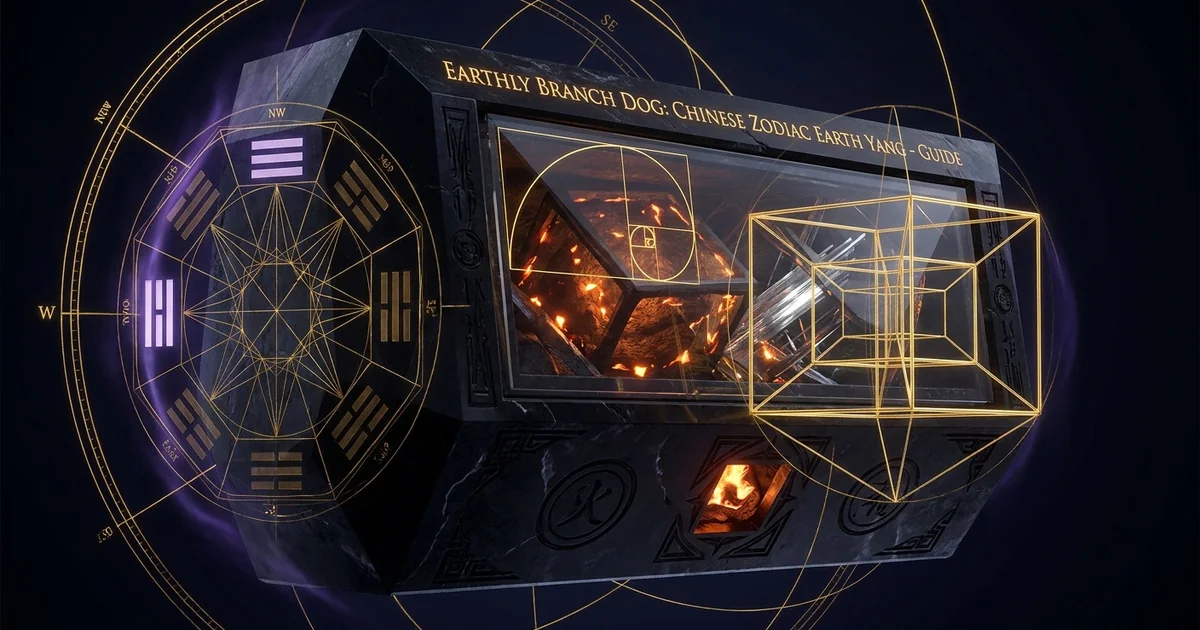
Earthly Branch Dog: Chinese Zodiac Earth Yang - Guide
Archetypal Thesis & Systemic Paradigm: The Yang Earth Matrix of Late Autumn
The eleventh Earthly Branch, Dog (戌, Xū), functions within Chinese psycho-cosmological mechanics not as an anthropomorphic totem, but as the thermodynamic regulator of Late Autumn: a Yang Earth matrix operating as the Fire Tomb or Storage (Huǒ Kù, 火庫). Positioned at the West-Northwest compass sector within the 12 earthly branches (dìzhī, 地支), Xū coordinates an entropic consolidation of lingering solar luminescence into an unyielding, mineralized vault. Within the four pillars system (/astrology/four-pillars-bazi-foundations), Xū executes an energetic transition: it intercepts the descending kinetic motion of Autumn’s Metal phase and calcifies it before the absolute nocturnal descent of Winter’s Water phase. Rather than serving as passive soil, this Yang Earth polarity functions as a high-density ceramic crucible, insulated by its intrinsic dryness, engineered to shield the latent spark of universal consciousness from premature entropic extinction.
Chronobiological Position: The Solar Term of Cold Dew (Hanlu) and Frost’s Descent (Shuangjiang)
Temporally, the Dog governs the ninth lunar month of the traditional lunisolar calendar, spanning two pivotal solar terms (jiéqì, 節氣): Cold Dew (Hánlù, 寒露) and Frost’s Descent (Shuāngjiàng, 霜降). During this solar window, the Sun transits from 195° to 225° ecliptic longitude, marking the decisive shift where atmospheric condensation transitions from liquid drops into crystalline frost. In the diurnal cycle, Xū governs the double-hour of 19:00 to 21:00 (the twilight watch or Chūgēng, 初更), the exact chronobiological boundary where solar irradiance departs the terrestrial horizon and nocturnal dormancy claims the biosphere.
This diurnal and seasonal boundary constitutes a critical thermodynamic threshold. In the human organism, chronobiological rhythms during this two-hour interval initiate the shift from sympathetic nervous system dominance to parasympathetic homeostatic conservation. Core physiological body temperature begins its downward trajectory, while peripheral circulation contracts to preserve visceral warmth. The Dog’s temporal domain is precisely this defensive withdrawal. The systemic intelligence of Xū dictates that external kinetic manifestation ceases, compelling the living organism to internalize its operational thermal reserves.
::: note [Spatial, Temporal, and Elemental Coordinates of 戌 (Xū)]
• Vector Coordinates: 292.5° to 322.5° (West-Northwest, Qian/Heaven Trigram Border)
• Diurnal Gate: 19:00 – 21:00 Solar Time (Twilight Horizon / Watch of the Watchman)
• Phenological Solar Terms: Cold Dew (寒露, Hánlù) and Frost's Descent (霜降, Shuāngjiàng)
• Structural Polarity: Yang Earth (戊, Wù) containing secondary Yin thermal and crystalline signatures
• Functional Thermodynamics: Dry Earth (燥土, Zào Tǔ); Fire Storage/Graveyard (火庫, Huǒ Kù)
• Associated Five Elements Category: Earth (Five Movements / Wǔ Xíng)
:::
Thermodynamic Containment: The Dual Nature of Dry Yang Earth (燥土 - Zào Tǔ)
Within the taxonomy of the five elements (wǔxíng, 五行), Earth is bifurcated into Wet Earth (Shī Tǔ, 濕土, represented by Chǒu and Chén) and Dry Earth (Zào Tǔ, 燥土, represented by Wèi and Xū). This categorization governs how structural matter interacts with thermal energy. The Yang Earth of Xū is fundamentally an arid, calcified lithosphere. Devoid of ambient moisture, it possesses high thermodynamic resistance and a low specific heat capacity. Whereas Wet Earth absorbs and transmits water while nurturing organic vegetation, Dry Earth repels water and absorbs thermal kinetic energy without undergoing chemical dissolution.
This arid composition alters its astrological chemistry: Dry Yang Earth cannot directly generate Metal, despite the elementary formula stating “Earth gives birth to Metal.” Because Xū is permeated by residual internal combustion, its soil is scorched; rather than producing refined crystalline ore, it tempers it through heat. In structural mechanics, Xū behaves as a refractory furnace wall. It prevents the dissolution of terrestrial forms into the amorphous, primordial chaos of the incoming Northern Water sector (Hài, Zǐ, Chǒu). It maintains the integrity of form through sheer density, setting boundaries across both geographical landscapes and psychological architectures.
Classical Provenance & Textual Lineage: The Dog (Xū) in Classical BaZi Canon
The formal lineage of the Dog branch within classical destiny analysis (Bàzì, 八字) is anchored in foundational Ming and Qing dynasty texts. Far from presenting folk superstitions, treatises such as the San Ming Tong Hui (三命通會) and the Di Tian Sui (滴天髓) construct an intricate mechanics of phase transitions, treating Xū as an energetic valve that alters its ontological status between a passive receptacle of death and an active operational storehouse of latent vitality.
The Di Tian Sui Paradigm: Deciphering the Tomb vs. Storage Mechanics
In the Di Tian Sui, attributed to Jing Fang and later redacted by Liu Bowen, the structural nature of Earth branches is analyzed through the lens of storage (kù, 庫) versus tomb/graveyard (mù, 墓). Classical theory establishes that an Earthly Branch serves as a Graveyard when its internal elements are locked, dormant, or extinguished by cold suppression; it transforms into a Storage facility when activated by dynamic environmental stimuli. For Xū, this mechanic centers on the preservation of Fire.
::: source [Di Tian Sui (滴天髓) — Commentary on Arid Earth and Metal Generation]
"生方怕動,旺方怕沖,庫方愛沖,生方怕沖... 戌為燥土,火之墓也,非金之生母。若逢燥烈,土焦金脆;得水潤之,則火不烈而金自生。"
"The Cardinal Branches fear clashes; the Storage Branches love to be clashed open... Xū is Arid Earth, the Tomb of Fire, not the nurturing mother of Metal. If it encounters dry intensity, the Earth scorches and the Metal turns brittle; but if it obtains Water to moisten it, the Fire ceases to rage and Metal is naturally produced."
— Liu Bowen, Commentary on *Di Tian Sui*, Chapter on Earth Formations.
:::
The functional transformation between Mù and Kù carries profound implications within destiny analysis. When a BaZi chart presents Xū in a state of excessive elemental dryness without Water mitigation, the Fire trapped within is entombed; the individual experiences cognitive calcification, metabolic inflammation, and stubborn psychological entrenchment. Conversely, when the branch is cracked open via harmonic dynamic tension—such as through controlled elemental interactions or proper seasonal hydration—the vault unlocks. Rather than an ash-heap, the interior revealed is a reservoir of vital fuel: the latent Fire releases its generative, illuminating power, and the hidden Metal refines into actionable strategic intellect.
San Ming Tong Hui and the Celestial Dog (Tian Quan) Lineage
In Wan Minying’s sixteenth-century compendium, San Ming Tong Hui, Xū is designated as Tiān Quí (天魁) or the Celestial Dog, occupying the West-Northwest directional axis directly corresponding to the Qián (乾) trigram gate in the Later Heaven Bagua (Hòutiān Bāguà). In Ming cosmological geography, this sector marks the “Gate of Heaven” (Tiān Mén, 天門). While the southeastern axis governed by Chén (the Dragon) marks the terrestrial portal through which earthly waters flow downward, the northwestern axis governed by Xū marks the divine threshold where the solar energy ascends to and descends from the celestial vault.
Wan Minying emphasizes that the Dog’s positioning at the Qian gateway assigns it an archetypal mandate of vigilance and gatekeeping. Because it guards the transition from manifestation into the void of winter, Xū is inherently skeptical of superficial changes. The San Ming Tong Hui describes persons born under this influence as possessing an instinctual gravity, profound loyalty to structural lineage, and an uncompromising resistance to external coercion. The branch does not invite novelty; it inspects all incoming influences at the psychological and metaphysical boundary of the self, ensuring that only what has been hardened and purified by late-autumnal frost crosses the threshold into the internal sanctum.
Structural Mechanics & Hidden Stems: The Thermodynamic Anatomy of the Fire Graveyard
To master the mechanics of the Dog branch within BaZi, one must decipher its sub-elemental matrix. Earthly Branches are not monolithic; they serve as structural vessels containing specific ratios of Heavenly Stems (Tiāngān, 天干). These subterranean components—known as Hidden Heavenly Stems or Càng Gān (藏干)—dictate the internal thermodynamic circuitry and systemic behavior of the branch under varying chart conditions.
Cang Gan Decomposition: The Tripartite Inner Architecture (Wu, Xin, Ding)
The energetic composition of Xū is traditionally divided into three distinct operational vectors, each defined by an elemental force and a mathematically derived operational influence over the branch’s 30-day seasonal domain:
- Primary Qi (Ben Qi, 本氣) — Wu Earth (戊土, Yang Earth): Comprising approximately 60% of the branch’s total volume (governing 18 days of the solar month), Wu Earth acts as the exterior lithosphere. It provides the macroscopic qualities of stability, weight, mass, immobility, and structural density.
- Residual Qi (Zhong Qi, 中氣) — Xin Metal (辛金, Yin Metal): Comprising roughly 30% of the internal makeup (governing 9 days of the solar month), Xin Metal represents the refined sediment of the preceding Autumn season (Shen and You branches). It is a crystal, mineralized needle, or blade—signifying distilled intellectual logic, precise moral discrimination, and hardened boundaries.
- Graveyard/Tomb Qi (Yu Qi, 餘氣) — Ding Fire (丁火, Yin Fire): Comprising the remaining 10% of the internal makeup (governing 3 days of the solar month), Ding Fire is the buried ember. It is the remnant of the summer cycle (Si, Wu, Wei) that has completed its external manifestation and now resides sequestered beneath the heavy Wu Earth crust.
::: diagram [Thermodynamic Architecture of 戌 (Xū)]
<div class="diagram-flow flex flex-col items-center gap-3 my-4 w-full">
  <div class="diagram-row flex flex-wrap items-center justify-center gap-3">
    <div class="diagram-node px-4 py-2 rounded-xl bg-elevated border border-gold/30 text-primary font-mono shadow-md transition-all">External Lithospheric Crust: 戊 Wu Earth (60%)</div>
  </div>
</div>
                 │
                 ▼
<div class="diagram-flow flex flex-col items-center gap-3 my-4 w-full">
  <div class="diagram-row flex flex-wrap items-center justify-center gap-3">
    <div class="diagram-node px-4 py-2 rounded-xl bg-elevated border border-gold/30 text-primary font-mono shadow-md transition-all">Intermediate Crystalline Layer: 辛 Xin Metal (30%)</div>
  </div>
</div>
                 │
                 ▼
<div class="diagram-flow flex flex-col items-center gap-3 my-4 w-full">
  <div class="diagram-row flex flex-wrap items-center justify-center gap-3">
    <div class="diagram-node px-4 py-2 rounded-xl bg-elevated border border-gold/30 text-primary font-mono shadow-md transition-all">Latent Subterranean Core: 丁 Ding Fire (10%)</div>
  </div>
</div>
:::
The Subterranean Furnace: Preservation of the Fire Core within Arid Lithosphere
The spatial arrangement of these hidden stems creates an internal energetic paradox. In classical metaphysics, Ding Fire melts Xin Metal, while Wu Earth absorbs Ding Fire and produces Xin Metal. Within the insulated confines of Xū, these elements are locked into a self-sustaining catalytic loop. The 10% Ding Fire is insulated by the dense 60% Wu Earth mantel, preventing it from dissipating into the encroaching cold of the external environment. This thermal preservation maintains the 30% Xin Metal in an eternally tempered state: neither completely liquefied by blazing heat nor rendered brittle by absolute zero.
This configuration functions as a metabolic furnace. In Jungian psychology, this structural arrangement mirrors the containment of the scintilla—the archetypal spark of divine light buried deep within the gross material unconscious. When consciousness undergoes the seasonal cycle of involution, it does not dissolve; rather, it enters the hermetic vessel of Xū. The buried ember of Ding Fire represents subjective memory, inner conviction, and the spark of individuality. Protected by the stoic defenses of Wu Earth and sharpened by the structural discipline of Xin Metal, the self endures psychic trials and collective pressures without disintegration.
Relational Dynamics & Astrological Mechanics: Combinations, Punishments, and Clashes
The behavior of the Dog branch is never static; its latent thermodynamic properties are radically activated, redirected, or fractured through its geometric relationships with other members of the 12 earthly branches. These interactions expose the delicate balance between structural equilibrium and catastrophic volatility inherent to the Fire Storage.
The Water-Fire Reservoir Conflict: The Dragon-Dog Axis (Chen-Xu Chong)
The opposition between Chén (辰, Dragon) and Xū (戌, Dog) across the astrological wheel is one of the most structurally disruptive clashes (Chōng, 沖) within BaZi mechanics. This is not merely an opposition between spatial directions (Southeast versus West-Northwest); it is an elemental conflict between the Water Reservoir (Shuǐ Kù, 水庫) and the Fire Reservoir (Huǒ Kù, 火庫).
:::: comparison [The Ontological Axis: Chén (辰) vs. Xū (戌)]
::: column [Chén (辰) - Dragon Matrix]
• Spatial Vector: 112.5° to 142.5° (East-Southeast, Xun Gate)
• Elemental Classification: Wet Earth (濕土, Shī Tǔ)
• Internal Hidden Stems: 戊 (Wu Earth), 乙 (Yi Wood), 癸 (Gui Water)
• Ontological Function: Water Reservoir / Biological Spring Surge
• Dynamic Vector: Fluid, centrifugal expansion; vegetative germination
• Psychological Expression: Visionary, adaptive, holistic, ambitious
:::
::: column [Xū (戌) - Dog Matrix]
• Spatial Vector: 292.5° to 322.5° (West-Northwest, Qian Gate)
• Elemental Classification: Dry Earth (燥土, Zào Tǔ)
• Internal Hidden Stems: 戊 (Wu Earth), 辛 (Xin Metal), 丁 (Ding Fire)
• Ontological Function: Fire Reservoir / Crystalline Autumn Consolidation
• Dynamic Vector: Arid, centripetal contraction; structural mineralization
• Psychological Expression: Vigilant, defensive, forensic, skeptical
:::
When Chén and Xū collide in a natal chart or through a dynamic time cycle (luck pillars or annual transits), the crusts of both Earth matrices rupture. The subterranean contents spill into open conflict: the Yin Water (Guǐ Shuǐ) of Chén directly extinguishes the Yin Fire (Dīng Huǒ) of Xū, while the Yin Metal (Xīn Jīn) of Xū severs the delicate roots of the Yin Wood (Yǐ Mù) harbored within Chén. This dynamic registers psychologically and physically as an intense existential upheaval. The native experiences acute boundary disputes, crises of faith, structural breakdowns in long-standing institutions, and somatized stress manifesting in the digestive system (Earth), spine, or cardiovascular network.
The Triad Synthesis: Tiger-Horse-Dog (Yin-Wu-Xu Fire Frame)
While the Dragon clash unleashes subterranean destruction, the Three Harmonies (Sān Hé, 三合) structural alliance reveals the Dog’s ultimate evolutionary teleology. When Xū conjoins with Yín (寅, Tiger) and Wǔ (午, Horse), the three branches merge to generate the Fire Element Frame (Huǒ Jú, 火局). Within this energetic triangle:
- Yín (Tiger) serves as the Birth/Sprouting phase (Chángshēng, 長生) of Fire.
- Wǔ (Horse) serves as the Peak/Imperial phase (Dìwàng, 帝旺) of Fire.
- Xū (Dog) serves as the Tomb/Storage phase (Mùkù, 墓庫) of Fire.
In this triadic union, Xū relinquishes its stoic, terrestrial isolation. It opens its subterranean vaults to receive the blazing luminescence generated by Horse and initiated by Tiger, acting as the stabilizing grounding rod and storage capacitor for the entire dynamic Fire current. Within a BaZi chart, an activated Yin-Wu-Xu combination transmutes dry, stubborn skepticism into impassioned spiritual vision, immense creative output, and an unshakeable devotion to a transcendent cause. The arid crust of Wu Earth is heated into a glowing ceramic radiant body.
The Uncivilized/Bullying Punishment: Ox-Goat-Dog (Chou-Wei-Xu San Xing)
The most psychologically grueling configuration involving the Dog is the Earthly Punishment (Sān Xíng, 三刑), often termed the “Bullying” or “Ungrateful” Punishment, composed of Chǒu (Ox), Wèi (Goat), and Xū (Dog). Because all three branches belong to the Earth element, their conjunction produces an overwhelming concentration of lithic density: an immovable mountain of unyielding matter.
::: diagram [The Earthly Punishment Engine: 丑-未-戌]
<div class="diagram-flow flex flex-col items-center gap-3 my-4 w-full">
  <div class="diagram-row flex flex-wrap items-center justify-center gap-3">
    <div class="diagram-node px-4 py-2 rounded-xl bg-elevated border border-gold/30 text-primary font-mono shadow-md transition-all">丑 Chǒu: Cold Wet Earth</div>
  </div>
</div>
          │          ▲
          │ (Clash/   │ (Mutual Friction)
          ▼  Grind)   │
<div class="diagram-flow flex flex-col items-center gap-3 my-4 w-full">
  <div class="diagram-row flex flex-wrap items-center justify-center gap-3">
    <div class="diagram-node px-4 py-2 rounded-xl bg-elevated border border-gold/30 text-primary font-mono shadow-md transition-all">未 Wèi: Hot Dry Earth</div>
    <div class="diagram-node px-4 py-2 rounded-xl bg-elevated border border-gold/30 text-primary font-mono shadow-md transition-all">戌 Xū: Arid Fire-Tomb Earth</div>
  </div>
</div>
::::
Within this dynamic, the internal hidden stems wage a war of attrition. The Chǒu branch unleashes cold Water and Metal; the Wèi branch unleashes Wood and scorching Fire; the Xū branch retaliates with its arid Yang Earth and internal Ding Fire. The outcome is not transformation, but heavy friction. Psychologically, this punishment manifests as obsessive self-doubt, structural paralysis, administrative gridlock, hyper-fixation on protocol, and a pervasive sense of being undermined by colleagues, institutions, or family systems. When unmitigated by dynamic Wood (which carves away excess Earth) or refined Metal (which vents the dense mass), the Chou-Wei-Xu punishment turns inward, ossifying into severe psychological complexes and chronic physical conditions related to tissue stagnation and cellular overgrowth.
Psychological Dynamics & Operational Praxis: The Archetype of the Threshold Sentinel
Approached through the lens of analytical psychology pioneered by Carl Gustav Jung, the Dog branch operates as an embodiment of the Senex (the archetypal Wise Old Man/Guardian) combined with the universal motif of the Threshold Sentinel. It governs the psychological mechanisms of boundary enforcement, existential vigilance, systemic loyalty, and shadow betrayal.
::: citation [Jungian Archetypal Psychology and the Senex Complex]
"The Senex archetype is inherently bound to the principles of time, limits, boundaries, and containment. In its positive aspect, it provides structural integrity, patience, and the capacity to guard the sacred precinct from pollution. In its negative or unintegrated aspect, it degenerates into defensive calcification, cold authoritarianism, and a pathological terror of dissolution into the unconscious realm."
— C.G. Jung, *The Archetypes and the Collective Unconscious*, CW 9i, §215-218.
:::
The Analytical Psychology of Xū: Vigilance, Territorial Boundaries, and Shadow Loyalty
The personality matrix dominated by the Dog branch reflects its chronobiological position at the twilight gate. Individuals with prominent Xū placements operate with an instinctual, perimeter-focused awareness. They are the systemic sentinels of humanity. Just as the biological canine preserves the perimeter of the camp, the Xū native monitors ideological, institutional, and interpersonal perimeters. They detect subterranean dissonance long before it breaches the surface.
This vigilance is driven by an underlying existential dynamic: the latent Ding Fire provides deep loyalty, intense moral commitments, and sudden flashes of intuitive perception, while the overarching Wu Earth demands concrete, empirical proof before granting trust. Consequently, the Dog archetype is profoundly defensive. Loyalty is not granted lightly; it is forged through shared trials. However, when the shadow of this archetype takes control, vigilance decays into paranoia. The native constructs impenetrable psychological fortresses, viewing all unfamiliar inputs as threats, mistaking defensive rigidity for strength, and isolating themselves from the very emotional nourishment they require.
Clinical Chart Integration: Navigating the Calcified Ego Structure
In destiny consultation and depth psychological analysis, an excessive or afflicted Xū indicates psychic calcification—a defensive refusal to experience vulnerability, loss, or grief. The individual hardens their posture against dynamic changes, clinging dogmatically to rules, traditions, or historical grievances.
To metabolize and liberate this blocked psychic energy, practical chart mitigation requires the introduction of balancing elemental vectors:
- The Application of Yin Water (癸水, Gui Water): Yin Water introduces moisture, softening the arid Wu Earth crust of Xū. Psychologically, this corresponds to somatic release, grief-work, and embracing the fluid realm of unconscious emotions. Water transforms dry clay into pliable loam, enabling the hidden Xin Metal to be washed and the Ding Fire to provide gentle, sustained incubation rather than scorched defensiveness.
- The Catalytic Release via Yin Wood (乙木, Yi Wood): Because Earth cannot move itself, it risks spiritual stagnation. Yin Wood (representing organic growth, philosophical flexibility, and interpersonal empathy) penetrates the dense terrain of Xū. It introduces systemic cracks into calcified dogmas, redirecting the native’s protective instincts outward into social reform, environmental advocacy, and genuine spiritual protection.
Philosophical Synthesis & Macrocosmic Correspondence: Hermetic and I Ching Parallels
The mechanics of the Dog branch are not isolated to Chinese metaphysics; they reflect macrocosmic phase transitions observable across esoteric and cosmological traditions. By mapping Xū against the I Ching (Book of Changes) and Western Hermetic astrology, the structural blueprint of the late-autumnal threshold Sentinel reveals its universal architecture.
::: note [Cosmological and Hermetic Correspondences of the Dog (Xū)]
• I Ching Hexagram: Hexagram 23 (剝, Bō - Splitting Apart / Stripping)
• Bagua Gateway: Northwest / Trigram Qián (Heaven) Transition
• Western Astrological Alignment: Late Libra / Scorpio Decanate Transition
• Planetary Signatures: Mars (Internal Ding Fire) & Saturn (External Wu Earth)
• Hermetic Alchemical Operation: Fixatio / Coagulation via Fire-Hardened Salt
:::
Hexagram 23 (Bo - Splitting Apart) and the Autumnal Decapitation of Yang
Within the seasonal cycle of the Twelve Sovereign Hexagrams (Shí’èr Pì Guà, 十二辟卦), the Dog corresponds to Hexagram 23: Bō (剝), classically translated as “Splitting Apart,” “Stripping,” or “Peeling.” The architecture of Hexagram 23 consists of five Yin lines ascending from the base, systematically displacing the active energetic lines until only a single Yang line remains at the summit (Line 6).
::: diagram [Hexagram 23 (剝 - Bō): The Architecture of Stripping]
─── ───  Line 6 (Nine at the Top): The Solitary Yang Roof / Sovereign Spark
─── ───  Line 5 (Six in the Fifth): Yin Receptive Matrix
─── ───  Line 4 (Six in the Fourth): Yin Ascendant Mass
─── ───  Line 3 (Six in the Third): Yin Structural Interior
─── ───  Line 2 (Six in the Second): Yin Earth Grounding
─── ───  Line 1 (Six at the Bottom): Yin Foundation
:::
This hexagram visually and dynamically captures the systemic function of Xū. The five ascending Yin lines represent the encroaching cold, darkness, and material inertia of late autumn strip-mining the terrestrial sphere of its summer vitality. The solitary Yang line perched at the summit represents the Ding Fire hidden within the Dog’s crust: the irreducible core of conscious awareness, the seed that refuses to decompose.
The Tuan Zhuan (Commentary on the Decision) for Hexagram 23 notes: “Stripping: The weak alters the strong… it is favorable to have nowhere to go.” This classical instruction advises stillness and conservation. The Dog does not attempt to fight the changing season through reckless outward expansion. It acknowledges that superficial forms must be stripped away. It embraces structural decay so that the foundational kernel—the indestructible Yang essence—is preserved within its vault, preparing for its eventual rebirth at the Winter Solstice in Hexagram 24 (Fù, 復 - Returning).
The Western Astrological Intersection: Scorpio Decans and the Saturn-Mars Signature
In Western astrological taxonomy, the temporal coordinates of Xū (late October to late November) overlap the transition from late Libra into the heart of Scorpio. This domain is traditionally governed by Mars (ancient ruler of Scorpio) and Saturn (exaltation ruler of Libra and natural lord of the Senex).
This planetary binary encapsulates the Dog’s dual nature:
- Saturnian External Shell: Represented by the hardened Wu Earth and the cold demands of seasonal frost. It dictates spatial discipline, structural integrity, patience, and the imposition of boundaries.
- Martian Subterranean Engine: Represented by the concealed Ding Fire. It fuels relentless internal focus, forensic suspicion, and an unshakeable instinct to defend the sacred core against existential encroachment.
In the Hermetic alchemical tradition, this dynamic corresponds precisely to the process of Fixatio (Fixation)—the operational stabilization of volatile elements into permanent crystalline states. Through the application of steady, subterranean heat (Ding Fire) upon heavy mineral bases (Wu Earth and Xin Metal), the alchemist prevents dynamic spirits from evaporating into the ether. The Dog branch is the natural laboratory where this fixation occurs. It takes the expansive, volatile light of the solar year and crystallizes it into an unshakeable seed of gold, hidden within the darkest recesses of the earth.
Frequently Asked Questions Regarding Earthly Branch Dog (Xū)
The Myth of the ‘Unlucky’ Fire Tomb
In popular BaZi superstition, encountering a “Tomb” or “Graveyard” branch (Mù, 墓) in a natal chart is frequently misinterpreted as an omen of death, physical infirmity, or persistent misfortune. This reductionist reading ignores classical structural mechanics.
A Graveyard branch is fundamentally an energetic capacitor. For those with Day Masters (Rì Zhǔ, 日主) that benefit from the Fire element (such as weak Jia or Yi Wood, or cold Gui Water), Xū is not a cemetery of decay; it is a thermal battery. It protects delicate internal embers from being extinguished by cold winter branches. When properly calibrated by supporting stems, an individual with a prominent Fire Tomb possesses exceptional endurance, deep emotional reserves, and the ability to maintain hope, purpose, and creative focus long after external support structures have vanished.
Resolving Clashes between the Dog and Dragon in Natal Charts
The presence of a Chén-Xū clash in a natal chart—or its activation during an operational 10-Year Luck Pillar (Dà Yùn, 大運)—indicates fundamental friction between contradictory life strategies: expansive growth versus defensive consolidation. Rather than attempting to suppress the clash, structural mitigation introduces mediator elements:
- Intervention via the Metal Element (Shen or You): Metal absorbs the crushing mass of excess Earth generated when the two crusts collide, utilizing the released energy to forge sharp, decisive systems, intellectual frameworks, and clear boundaries.
- Irrigation via Yin Water (Gui Water): Gui Water directly soothes the arid friction of Xū while validating the moist, generative instincts of Chén. It prevents the internal Ding Fire from turning destructive and stops the clash from damaging the delicate digestive and immune systems.
- Behavioral Protocol Adjustment: On a practical level, individuals navigating a Chen-Xu activation must avoid territorial expansion and bureaucratic warfare. Operational efficiency during these windows is achieved through structural audits, decluttering, settling outstanding legal obligations, and consolidating existing assets.
Interpreting Hidden Xin Metal vs. Prominent Metal Day Masters
When an individual with a Geng (Yang) or Xin (Yin) Metal Day Master is born in the month of the Dog, a specific thermodynamic dynamic emerges. While standard textbook analysis asserts that “Earth generates Metal,” the dry, arid nature of Xū complicates this relationship.
Because Xū contains Wu Earth heated by Ding Fire, it functions as a warm, dry kiln. For a delicate Xin Metal Day Master, unmitigated Xū Earth does not provide comfortable maternal nourishment; it threatens to scorch the native, causing respiratory vulnerabilities, severe cognitive anxiety, and defensive hypersensitivity.
To transform Xū into an effective supportive foundation for Metal, the presence of Water in the natal chart (specifically Ren or Gui Water sitting on the Heavenly Stems) is mandatory. Moisture cools the internal furnace of the Dog, allowing the 60% Wu Earth to soften into receptive, mineral-rich soil. Under these conditions, the internal 30% Xin Metal acts as an ancestral forge, refining the native’s analytical precision, moral courage, and capacity to articulate crystalline, timeless wisdom. :::