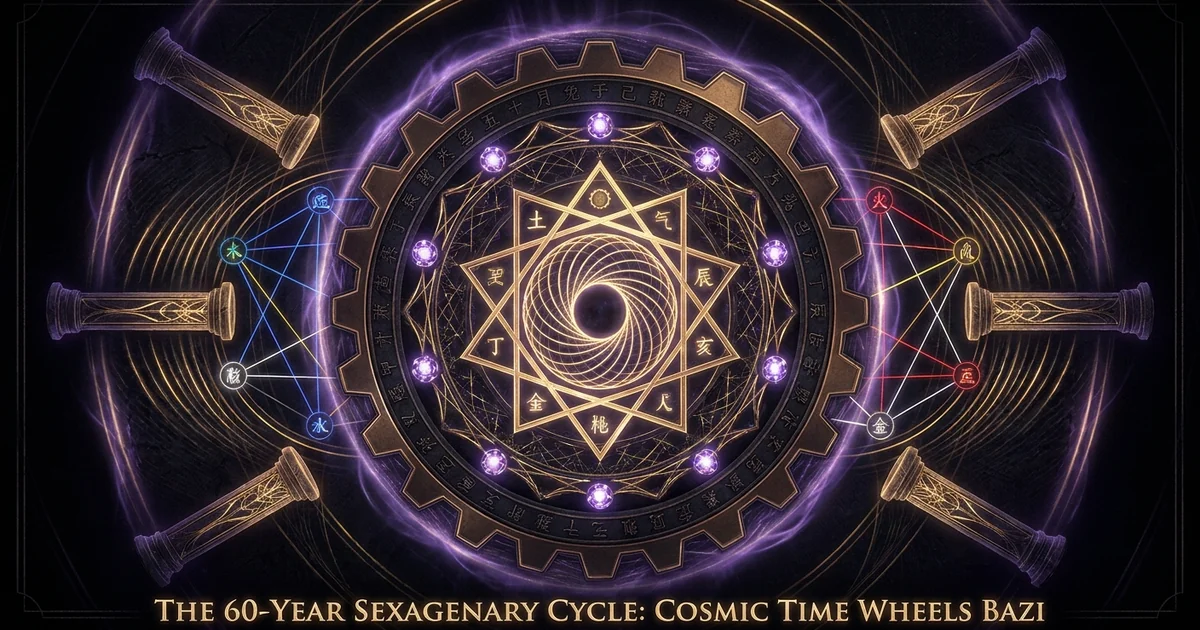
The 60-Year Sexagenary Cycle: Cosmic Time Wheels BaZi
Archetypal Thesis & Systemic Paradigm: The Ganzhi Wheel as a Psycho-Cosmological State Space
The Non-Linear Epistemology of Chinese Time Cycles
Western chronometry has historically conceptualized temporal progression through an entropic, rectilinear vector—a unidirectional arrow measuring the quantitative dissipation of energy across a uniform, homogeneous continuum. Conversely, traditional Sinitic natural philosophy, codified across three millennia of astronomical observation and correlative dialectics, conceptualizes time as an undulating, multi-tiered qualitative field. Within this epistemological paradigm, time does not merely pass; it informs, conditions, and mutates physical and psychic phenomena through alternating energetic polarities of Yin and Yang, governed by the continuous topological phase shifts of the Five Phases (Wuxing 五行).
This non-linear topology operates as an ecology of nested waveforms. Rather than divorcing duration from spatiality, classical Chinese chronodesign binds celestial movement directly to terrestrial response, generating a qualitative metric termed Shi (時)—an untranslatable nexus signifying both chronological moment and systemic opportunity. The mechanics of this qualitative temporality find their definitive expression in the 60-year sexagenary cycle Chinese calendar Ganzhi. Here, time is modeled not as an absolute Newtonian container, but as a dynamic energetic continuum wherein macrocosmic archetypes systematically cycle through concrete qualitative states. Each temporal station possesses distinct thermodynamic, psychological, and morphological propensities, establishing an analytical topology wherein past, present, and future are structured around recurrent systemic resonances rather than linear irrecoverability.
Understanding this cyclical architecture requires departing from reductionist perspectives that categorize ancient calendrical frameworks as primitive chronometric approximations. As explored in foundational studies of /sacred-geometry/cosmic-clocks-astronomical-cycles, ancient temporal systems functioned simultaneously as mathematical engines of astronomical tracking and symbolic state-spaces mapping the structural interplay between celestial vectors and biological emergence.
Ganzhi as a Discrete State-Space Coordinate Framework
At the core of this psycho-cosmological engine lies the Ganzhi (干支) system, an algorithmic combinatorial matrix generated by coupling two discrete cyclical sequences: the Ten Heavenly Stems (Tiangan 天干) and the Twelve Earthly Branches (Dizhi 地支). The Ten Stems represent celestial vector potentials—solar energetic charges differentiated into the Five Phase polarities of Wood, Fire, Earth, Metal, and Water across their initial expanding (Yang) and contracting (Yin) phases. The Twelve Branches represent terrestrial somatic receptacles, stations of physical grounding mapped to the orbital resonance of Jupiter, the twelve lunar lunations, and the spatial topography of the terrestrial sphere.
When these two rings of discrete variables rotate concurrently, they produce a closed phase space of sixty unique permutations, classically designated as the Liushi Jiazi (六十花甲子). This matrix constitutes a mathematical state-space coordinate framework. Rather than permitting all $10 \times 12 = 120$ mathematically possible configurations, the system enforces a fundamental parity constraint: odd-numbered (Yang) Stems couple exclusively with odd-numbered (Yang) Branches, and even-numbered (Yin) Stems couple exclusively with even-numbered (Yin) Branches.
The resulting sixty-state continuum forms an immutable, self-referential discrete dynamical matrix. In this combinatorial framework, each stem-branch combination operates as a composite operator defining the specific energetic vector of a given temporal unit—be it a year, a month, a day, or a double-hour (Shichen). In the diagnostic discipline of BaZi (Eight Characters / Four Pillars of Destiny), these sixty states are not abstract markers; they function as precise ontological coordinates detailing the baseline structural balance of celestial Qi (Stems) embedded within physical, geographic, and biological environments (Branches).
The mathematical architecture governing the sexagenary sequence is derived from the least common multiple of the decimal and duodecimal sets under a strictly preserved parity constraint. Let the Ten Heavenly Stems be defined as the cyclic group $\mathbb{Z}{10} = {0, 1, \dots, 9}$ and the Twelve Earthly Branches as the cyclic group $\mathbb{Z}{12} = {0, 1, \dots, 11}$.
The theoretical direct product space $\mathbb{Z}{10} \times \mathbb{Z}{12}$ yields $|\mathbb{Z}{10} \times \mathbb{Z}{12}| = 120$ coordinate states. However, physical manifestation within correlative Sinitic cosmology requires binary parity synchronization (Yin-Yang polarity alignment). Let a parity function $P: \mathbb{Z}n \to {0, 1}$ be defined such that $P(x) = x \pmod 2$. The admissible state space of the Jiazi matrix, $\mathcal{J}$, is restricted to the subset: $$\mathcal{J} = {(s, b) \in \mathbb{Z}{10} \times \mathbb{Z}_{12} \mid P(s) = P(b)}$$
Because $P(s) = P(b)$ demands that both elements are simultaneously even ($0 \equiv \text{Yin}$) or simultaneously odd ($1 \equiv \text{Yang}$), precisely half of the Cartesian product is eliminated: $$|\mathcal{J}| = \frac{10 \times 12}{2} = \operatorname{lcm}(10, 12) = 60$$ This demonstrates that the 60-state cycle is the minimal non-trivial orbit traversed by the coupled dynamic system before both registers return to their shared initial phase coordinate $(0,0)$, designated as Jia-Zi.
The Synchronistic Matrix: Translating Qualitative Chronos to Kairos
The structural convergence between celestial mechanics and subjective psychological reality necessitates an analytical framework transcending mechanical determinism. The Ganzhi architecture does not operate via linear physical causality, wherein distant planets exert direct gravitational or electromagnetic control over human neural substrates. Instead, the paradigm operates according to the principle of acausal correspondence, formalized in analytical psychology by Carl Gustav Jung as synchronicity (synchronicity-jungian).
In her seminal epistemological treatise On Divination and Synchronicity: The Psychology of Meaningful Chance, Marie-Louise von Franz articulated that traditional divination matrices, most notably the I Ching and Chinese astrological systems, treat time as a qualitative, psycho-physical field. In this view, whatever is born or created at a specific temporal locus inevitably takes on the archetypal qualities of that moment. The 60-year sexagenary cycle Chinese calendar Ganzhi translates the quantitative continuity of Greek Chronos—sequential, undifferentiated duration—into an array of Kairos: qualitatively charged, critical thresholds of archetypal activation.
When an individual emerges at a specific chronological juncture, the ambient configuration of the cosmic calendar wheels provides a symbolic cross-section of the macrocosmic energetic field. BaZi chart analysis—the mapping of the Four Pillars of Year, Month, Day, and Hour—functions as an archetypal chronogram. The system formalizes the initial boundary conditions of the psychophysical organism, projecting a multidimensional map of complexes, psychological drives, and instinctual tensions that seek dynamic homeostasis throughout the individuating lifespan.
Classical Provenance & Textual Lineage: From Shang Oracle Bones to the Han Synthesis
The Shang Epigraphs: Ganzhi as Ritual Sacrificial Chronometry
The historical emergence of the sexagenary framework predates its philosophical systematization in Hellenistic or Warring States literature by nearly a millennium. Archaeological discoveries of late Shang dynasty (ca. 1250–1046 BCE) epigraphic records at Yinxu (modern Anyang) demonstrate that the sixty stem-branch combinations were systematically utilized not for horoscopic natal analysis, but as an invariant, ritual day-count engine etched onto bovine scapulae and turtle plastrons (Jiaguwen).
The Ten Heavenly Stems (Tiangan) originally designated the names of the ancestral Shang sovereigns and the ten days of the Shang week (Xun 旬). Within the Shang ritual calendar, royal ancestors were grouped according to the specific stem-day on which they were to receive sacrifices. The stems—Jia, Yi, Bing, Ding, Wu, Ji, Geng, Xin, Ren, Gui—operated as a sacred administrative protocol governing ancestral theocracy. Simultaneously, the Twelve Earthly Branches—Zi, Chou, Yin, Mao, Chen, Si, Wu, Wei, Shen, You, Xu, Hai—tracked diurnal solar positions, the directions of the horizon, and seasonal markers.
Crucially, the Shang epigraphs demonstrate that this sixty-day cycle was maintained with absolute, unbroken continuity, unaffected by the logistical intercalations required to harmonize the synodic lunar months with the tropical solar year. While the agricultural and civil calendars frequently required intercalary months (Runyue) to prevent seasonal drift, the sacred sequence of the Ganzhi ran underneath civil time as an unalterable metric. It established an immutable ritual baseline that shielded the Shang ruling elite from cosmic irregularity, anchoring the sociopolitical apparatus directly to an idealized, invariant cadence.
Shang Epigraphic Day-Count (Ritual Invariance)
          │
          ▼
Warring States Correlative Cosmology (Zou Yan & Wuxing)
          │
          ▼
Han Imperial Synthesis (Sima Qian, Huainanzi, Taisui Engine)
          │
          ▼
Tang Three Pillars (Li Xuzhong: Year-Centric Nodal Karmic Matrix)
          │
          ▼
Song Four Pillars (Xu Ziping: Day Master Psychological Individuation)
The Han Cosmological Unification: Sima Qian and the Huainanzi
The transformation of the Ganzhi from a simple ritual day-count into a comprehensive psycho-cosmological coordinate engine occurred during the cosmological synthesis of the Western and Eastern Han dynasties (202 BCE – 220 CE). Under imperial patronages seeking universal coherence, scholars such as Dong Zhongshu, Liu An (compiler of the Huainanzi), and the Grand Historian Sima Qian integrated the Stem-Branch system with the Five Phase (Wuxing) dialectics codified by Zou Yan, the astronomical mechanics of the Twelve Pitch Pipes (Lüxü 律呂), and the orbital physics of the visible planets.
In the Shiji (Records of the Grand Historian), Sima Qian formalized this union within the foundational treatises Tianguan Shu (Treatise on the Celestial Offices) and Lishu (Treatise on the Calendar). The mechanics of the Earthly Branches were explicitly wedded to the sidereal movement of Jupiter (Suixing 歲星), whose approximately 11.86-year orbital period was idealized into a clean twelve-year cycle. Because Jupiter moves through the zodiacal stations in a counter-clockwise direction relative to the diurnal rotation of the heavens, Han calendrical mechanists conceptualized an invisible, programmatic counter-body: Taisui (太歲, the Grand Duke of Jupiter), which tracked the twelve-year sequence in a clockwise, terrestrial direction.
Simultaneously, the Huainanzi (specifically Chapter 3, Tianwenxun) anchored the Ten Heavenly Stems to the spatial vectors of the Five Phases, aligning their energetic signatures with the seasonal cardinalities and planetary orbits. The Heavenly Stems became the operational representations of celestial energy descending toward the earth, while the Earthly Branches represented the physical stations, cardinal points, and climatic manifestations of the earth rising to meet the heavens. It was during this Han consolidation that the cosmic calendar wheels achieved programmatic status, establishing an unbroken correspondence between macrocosmic rotation, geopolitical fate, and human physiology.
“The celestial movement of the Year-Star [Jupiter] establishes the cardinal directions and the seasonal transitions of the earth. When the Year-Star stands in the station of Xingji, the terrestrial branch corresponds to Chou, and the ambient celestial energy manifests the quality of Northern Yin yielding to Eastern Yang… The Ten Stems govern the celestial vectors of the Five Planets; the Twelve Branches govern the terrestrial response of the Twelve Pitch Pipes. Thus, heaven and earth interact through sixty shifts of the seasonal loom, producing the diverse forms of all living things.” — Sima Qian, Shiji, Treatise on the Celestial Offices (Tianguan Shu), ca. 91 BCE.
Evolution of the Four Pillars: From Li Xuzhong’s Three Pillars to Xu Ziping’s Day Master
While the Han synthesis successfully mapped the sixty-year cycle to broad cosmological and geopolitical realities, the analytical application of Ganzhi to individual human psychology underwent a crucial evolution during the Tang and Song dynasties. In the mid-Tang dynasty, the proto-BaZi system, credited to the scholar-official Li Xuzhong (758–807 CE), analyzed a subject’s psychological and social destiny using only three temporal pillars: the Year, the Month, and the Day of birth.
Under Li Xuzhong’s system, the natal analysis was anchored almost entirely on the Year Pillar. The Year Stem and Year Branch represented the foundational energetic baseline, the ancestral lineage, and the overarching karmic envelope of the individual. Human destiny was conceptualized as a sub-component of ancestral and societal trajectories; the individual was essentially an offshoot of the collective lineage, with limited personal agency outside the predetermined ancestral framework.
The profound paradigm shift toward psychological agency occurred during the early Song dynasty under the master cosmologist Xu Ziping (ca. 907–960 CE). As codified in foundational texts such as the Yuan Hai Zi Ping (淵海子平), Xu Ziping introduced the Hour Pillar—establishing the true Four Pillars framework—and altered the focal point of chart interpretation. Xu dismantled the Year Pillar’s supremacy, repositioning the Day Master (Ri Yuan 日元 or Ri Gang 日干)—the Heavenly Stem of the birth day—as the absolute phenomenological locus of the chart.
This transition from the Year Stem to the Day Master represents an epistemological revolution akin to the emergence of modern psychological individuation. The individual was no longer analyzed merely as an echo of their ancestral continuum (Year Pillar). Instead, the Day Master came to represent the conscious self—the central Ego complex navigating the external matrix of societal demands (Month Pillar), familial roots (Year Pillar), somatic and interpersonal relationships (Day Branch), and latent aspirational intentionality (Hour Pillar). For a comprehensive breakdown of natal pillar calculations and Day Master interactions, see /astrology/bazi-four-pillars-birth-chart-analysis.
Structural Mechanics & Symbolic Geometry: Mathematical Architecture of Stems, Branches, and Phase Resonances
The Ten Heavenly Stems: Solar Vector Fields and Phase Polarities
The Ten Heavenly Stems (Tiangan) function mathematically as an ordered sequence of five bipolar phase states. They represent the active, radiating emanations of celestial Qi, operating through the dynamic transformation cycles explored in /iching/wuxing-five-elements-generative-cycles. Each element of the Five Phases is partitioned into its Yang (centrifugal, initiating, structuralizing) and Yin (centripetal, receptive, consolidating) operational expressions:
- Jia (甲): Yang Wood. Archetype of the sprouting seed rupturing its husk; upward, rectilinear vector energy; visionary, unyielding, developmental intentionality.
- Yi (乙): Yin Wood. Archetype of the pliable vine; winding, adaptable, horizontal expansion; resilient, strategic, aesthetically responsive intelligence.
- Bing (丙): Yang Fire. Archetype of the solar disc; radiant, omnipresent, illuminating energy; passion, visibility, dramatic projection, intellectual clarity.
- Ding (丁): Yin Fire. Archetype of the candle flame or furnace; concentrated, warm, inward-burning focus; spiritual acuity, tactical precision, volatile intensity.
- Wu (戊): Yang Earth. Archetype of the massive mountain or continental crust; stabilizing, immovable, consolidating gravity; conservative weight, emotional resilience.
- Ji (己): Yin Earth. Archetype of cultivated, fertile garden loam; nurturing, absorbing, internalizing transformation; reflective processing, patient mediation.
- Geng (庚): Yang Metal. Archetype of the raw, unrefined ore or the executioner’s broadsword; reforming, abrasive, destructive-constructive discipline; structural rigor.
- Xin (辛): Yin Metal. Archetype of the refined jewel or surgical scalpel; acute, discerning, self-conscious refinement; precision, pride, sharp discrimination.
- Ren (壬): Yang Water. Archetype of the torrential river or oceanic tide; relentless, powerful, deep, forward-moving kinetic force; profound philosophical scope.
- Gui (癸): Yin Water. Archetype of atmospheric mist, dew, or subterranean springs; penetrating, quiet, pervasive, intuitive reception; psychological depth.
The Twelve Earthly Branches: Spatial Topography and Hidden Stems (Canggan)
While the Stems represent pure elemental vectors of celestial origin, the Twelve Earthly Branches (Dizhi) represent complex, embodied terrestrial realities. The Branches are not elemental monoliths; they serve as thermodynamic resonance chambers containing internal sub-elemental distributions known as the Hidden Stems (Canggan 藏干).
The phenomenon of the Hidden Stems mathematically mirrors the layered, stratified architecture of the human psyche. An Earthly Branch contains between one and three Stems, categorized into three distinct operational strata:
- Primary Qi (Benqi 本氣): The dominant, homeostatic elemental polarity of the Branch, commanding the largest percentage of its operational energy.
- Middle/Residual Qi (Zhongqi 中氣): The elemental vector preserved from the preceding phase in the seasonal cycle, representing unconscious emotional residue or transitional memory.
- Remnant/Nascent Qi (Yuqi 餘氣): The nascent seed of the emerging element entering the seasonal cycle, representing latent, emergent psychic propensities.
| Earthly Branch | Chinese Name | Primary Qi (Benqi) | Middle Qi (Zhongqi) | Remnant Qi (Yuqi) | Psychological Correlate |
|---|---|---|---|---|---|
| Zi (子) | Rat | Gui (Yin Water) | — | — | Undifferentiated unconscious flow; nocturnal introspection. |
| Chou (丑) | Ox | Ji (Yin Earth) | Gui (Yin Water) | Xin (Yin Metal) | Somatic containment harboring hidden intellectual clarity. |
| Yin (寅) | Tiger | Jia (Yang Wood) | Bing (Yang Fire) | Wu (Yang Earth) | Dynamic kinetic impulse; emerging ego vitality and ambition. |
| Mao (卯) | Rabbit | Yi (Yin Wood) | — | — | Pure instinctual adaptiveness; acute sensory boundary perception. |
| Chen (辰) | Dragon | Wu (Yang Earth) | Yi (Yin Wood) | Gui (Yin Water) | Complex psychic reservoir; transformative ideological tension. |
| Si (巳) | Snake | Bing (Yang Fire) | Geng (Yang Metal) | Wu (Yang Earth) | Intense solar drive hiding nascent analytical detachment. |
| Wu (午) | Horse | Ding (Yin Fire) | Ji (Yin Earth) | — | Culmination of radiant consciousness; existential intensity. |
| Wei (未) | Goat | Ji (Yin Earth) | Ding (Yin Fire) | Yi (Yin Wood) | Consolidating metabolic field; lingering creative desires. |
| Shen (申) | Monkey | Geng (Yang Metal) | Ren (Yang Water) | Wu (Yang Earth) | Emergence of sharp critical intellect; latent deep drive. |
| You (酉) | Rooster | Xin (Yin Metal) | — | — | Pure analytical discrimination; crystallization of value systems. |
| Xu (戌) | Dog | Wu (Yang Earth) | Xin (Yin Metal) | Ding (Yin Fire) | Protective psychic fortress; latent spiritual warmth. |
| Hai (亥) | Pig | Ren (Yang Water) | Jia (Yang Wood) | — | Oceanic collective unconscious harboring seeds of new creation. |
The Combinatorial Lattice: Vector Interactions, Clashes, and Harmonic Trines
The dynamic balance of a natal chart or a temporal moment is governed by the structural vector interactions operating across the four stems and four branches. These interactions are geometric operations within the duodecimal circular lattice of the celestial compass:
- Six Combinations (Liuhe 六合): Bipolar pairings of Branches occupying symmetrical coordinates across the solstitial axis (e.g., Zi-Chou, Yin-Hai, Mao-Xu, Chen-You, Si-Shen, Wu-Wei). These represent mutual chemical and psychological affinities, binding energy into specialized compounds that suppress volatility and establish stability.
- Three Harmonies (Sanhe 三合): Trilinear 120° geometric alignments linking Branches into four fundamental elemental networks:
- Water Harmony: Shen (Birth) – Zi (Peak) – Chen (Graveyard)
- Wood Harmony: Hai (Birth) – Mao (Peak) – Wei (Graveyard)
- Fire Harmony: Yin (Birth) – Wu (Peak) – Xu (Graveyard)
- Metal Harmony: Si (Birth) – You (Peak) – Chou (Graveyard) These harmonic trines channel dispersed psychological drives into an integrated, unstoppable elemental focus.
- Clashes (Chong 沖): Direct 180° polar oppositions across the diameter of the wheel (e.g., Zi-Wu, Chou-Wei, Yin-Shen, Mao-You, Chen-Xu, Si-Hai). Clashes operate as thermodynamic disruptions, producing acute psychic tension, behavioral crises, geographic displacement, and the rapid dismantling of crystallised ego defenses.
- Punishments (Xing 刑) and Harms (Hai 害): Asymmetrical, non-Euclidean angular tensions (such as the Three Punishments of Yin-Si-Shen or the Uncivilized Punishment of Zi-Mao). These configurations correlate to insidious, intrapsychic shadow mechanics—self-sabotage, systemic friction, structural betrayals, and deep somatic stresses.
Psychological Dynamics & Operational Praxis: BaZi Four Pillars as an Analytical Matrix of Individuation
The Day Master as the Core Ego Complex and Phenomenological Locus
In contemporary psychological BaZi, the Day Master (Ri Yuan) functions as the functional equivalent of the Jungian Ego—the operational locus of conscious identity, intentionality, and self-appraisal. However, unlike the post-Cartesian Western conception of an isolated, autonomous ego, the Day Master is fundamentally relational and contextual. Its psychological capacity, resilience, and functional pathology can only be determined by assessing its relative strength (Wang Shuai 旺衰) against the environmental terrain established by the Month Branch (Yue Ling 月令, the seasonal commander).
[ YEAR PILLAR ]              [ MONTH PILLAR ]
Ancestral Epigenetics      Socialization & Superego
Transpersonal Karma        Parental Conditioning
         │                              │
         └──────────────┬───────────────┘
                        ▼
             [ DAY MASTER (EGO) ]
                        ▲
         ┌──────────────┴───────────────┐
         │                              │
  Interpersonal Interiority    Latent Intentionality
  Somatic Vessel (Day Branch)  Unconscious Urges (Hour)
   [ DAY BRANCH ]               [ HOUR PILLAR ]
The four spatial-temporal coordinates form an integrated mandala of the human psyche:
- The Year Pillar (Ancestral / Collective Transpersonal): Represents the collective unconscious, ancestral epigenetic inheritance, transgenerational patterns, and the socio-historical matrix into which the soul emerges.
- The Month Pillar (Parental / Cultural / Superego): Represents social conditioning, educational upbringing, vocational demands, and the systemic rules of survival enforced by the social collective.
- The Day Pillar (Ego / Somatic Interiority / The Anima-Animus): The Day Master (Stem) embodies the conscious identity, while the Day Branch represents the internal somatic vessel, physical vitality, instinctual base, and the psychological projection field of the romantic partner (the Anima or Animus).
- The Hour Pillar (Latent Potential / The Shadow / The Unconscious Offspring): Represents deep aspirational drives, unconscious creative projections, the private inner life shielded from society, and the ultimate fruit of the individuation process.
The Ten Gods (Shi Shen): Archetypal Relational Dynamics and Projection Fields
The structural relationship between the Day Master’s element and the remaining seven characters of the chart generates the Ten Gods (Shi Shen 十神). These are not anthropomorphic deities, but sophisticated archetypal relational vectors modeling the energetic balance of the psyche. By calculating whether another element produces, is produced by, controls, is controlled by, or is identical to the Day Master, the system maps the totality of human experience into ten operational roles:
The Controlling Cycle: Officer / Superegoic Constraint
- Archetypal Structure: Zheng Guan (Direct Officer) and Qi Sha (Seven Killings / Indirect Officer).
- Elemental Vector: The element that actively restrains, disciplines, or subjugates the Day Master (e.g., Metal controlling Wood).
- Psychological Function: Represents the moral conscience, internal parental authority, society’s legal codes, systemic discipline, and the structural Superego.
- Positive Expression: Executive integrity, healthy social boundaries, self-restraint, profound civic responsibility, high leadership capacity.
- Pathological Expression: Paralyzing guilt, neurotic anxiety, susceptibility to authoritarian oppression, masochistic submissiveness, somatic muscular tension, or projective paranoia.
The Expressive Cycle: Output / Individuated Expression
- Archetypal Structure: Shi Shen (Eating God) and Shang Guan (Hurting Officer).
- Elemental Vector: The element that is produced, radiated, and discharged outward by the Day Master (e.g., Wood producing Fire).
- Psychological Function: Represents the expressive impulse, somatic libido, creative generation, philosophical defiance, and instinctual individuation.
- Positive Expression: Artistic brilliance, innovative rebellion, communicative charisma, pedagogical ability, dynamic problem-solving.
- Pathological Expression: Promethean arrogance, contempt for legitimate authority, somatic exhaustion through chronic expressive depletion, narcissistic acting out, boundary violations.
Beyond the Controlling and Expressive dynamics, the chart resolves three additional relational pairs:
- The Resource Cycle (Yin / Mother Complex): Elements producing the Day Master (Zheng Yin / Pian Yin). Corresponds to maternal care, cognitive nourishment, academic capacity, introversion, and contemplative retreat. Pathologically, it manifests as infantile dependency, cognitive paralysis, and agoraphobic withdrawal.
- The Wealth Cycle (Cai / Ego Mastery & Objective World): Elements controlled by the Day Master (Zheng Cai / Pian Cai). Corresponds to the objective physical world, pragmatic reality testing, financial manipulation, emotional management, and the capacity to shape the physical environment.
- The Companion Cycle (Bi Jie / Tribal Identification): Elements identical to the Day Master (Bi Jian / Jie Cai). Corresponds to peer relations, the social mirror, competitive rivalry, communal belonging, and the drive for self-validation across horizontal social fields.
Decennial Luck Pillars (Da Yun): State Transition Phasing and Chronobiological Metamorphosis
The natal Four Pillars chart is not a static monolith; it is an energetic baseline interrogated by the passage of dynamic time. This interaction is primarily mediated through the Decennial Luck Pillars (Da Yun 大運). The Da Yun represents a sequence of ten-year energetic epochs derived algorithmically from the Month Pillar of birth, progressing either forward or backward through the 60 Jiazi sequence depending on the gender of the individual and the Yin-Yang polarity of their birth year’s Heavenly Stem.
Each ten-year Luck Pillar introduces a new pair of Stem-Branch operators into the natal system. The incoming Luck Pillar does not merely present external fortune; it functions as a chronological epigenetic trigger. As the Decennial Pillar interacts with the natal chart, it alters the baseline thermodynamic equilibrium. An incoming Fire branch may vaporize a fragile Water Day Master’s resource base, forcing a psychological crisis of intellectual exhaustion; conversely, an incoming Metal branch may cleave an overbearing Wood structure, prompting the sudden emergence of structured executive autonomy. The sixty-year calendar wheels thus operate as an unfolding transformational theater wherein the latent archetypal potentials embedded within the natal chart are systematically activated, challenged, and metabolized across the individual lifespan.
Philosophical Synthesis & Macrocosmic Correspondence: Hermetic Axioms, Chronobiology, and Non-Linear Temporal Geometry
Hermeticism and Ganzhi: As Above, So Below in Chinese Cosmography
The systemic paradigm underlying the 60-year sexagenary cycle Chinese calendar Ganzhi directly mirrors the foundational Hermetic axiom articulated in the Western esoteric tradition: Quod est superius est sicut quod est inferius (“That which is above is like that which is below”). In the Ganzhi framework, the Ten Heavenly Stems embody the celestial archetypes (As Above), while the Twelve Earthly Branches embody the terrestrial, biological vessels (So Below).
This correspondence is not an abstract metaphysical assertion, but an operational geometry of mutual reflection. Sinitic cosmology posits that cosmic forces do not operate upon humanity from an extrinsic, tyrannical height; rather, the cosmos and the human organism are homologous, co-extensive manifestations of the same uncarved energetic baseline (Qi). The sixty stem-branch combinations are the precise joints of this macrocosm-microcosm isomorphism. When the celestial needle moves across a given Stem, the terrestrial compass needle in the human biological substrate swings in synchronous alignment, demonstrating that human subjective consciousness is an organic node within a singular, intelligent, cosmic metabolic circuit.
Macrocosm (Celestial Archetypes)      [ 10 Heavenly Stems (Solar Vectors) ]
              │                                      │
              │  "As Above, So Below"                │ Synchronistic Coupling
              ▼                                      ▼
Microcosm (Somatic Architecture)     [ 12 Earthly Branches (Terrestrial Form) ]
              │                                      │
              └──────────────────┬───────────────────┘
                                 ▼
               [ Integrated Human Organism (Psyche) ]
              60-State Topological Field of Individuation
Endogenous Chronobiology: Circadian Infradian Cycles and the Epigenetic Clock
While contemporary academia frequently relegates ancient correlative systems to the realm of superstitious ethnography, modern empirical chronobiology increasingly validates the foundational premises of the Ganzhi system. Human physiology is not an invariant, static machine operating in temporal isolation. Endogenous cellular clocks—governed by oscillating transcriptional feedback loops of genes such as CLOCK, BMAL1, and PER—regulate metabolic, hormonal, and immunological states across precise circadian (24-hour) cycles, precisely matching the ancient Chinese operational division of the day into the twelve Shichen double-hours.
Furthermore, medical science increasingly acknowledges the existence of infradian rhythms—multiday, circannual, and decennial cycles that pace biological susceptibility, psychological volatility, and cellular degeneration. In his landmark multi-volume treatise Science and Civilisation in China (Volume 3: Mathematics and the Sciences of the Heavens and the Earth), Joseph Needham noted that Chinese astronomical systems were singular in their capacity to link natural organic rhythms directly to astronomical cycles without falling into dogmatic mechanistic geocentrism.
The sexagenary cycle’s connection to the orbital period of Jupiter (~11.86 years), solar activity periods (the ~11-year Schwabe solar cycle), and the systemic shifts in atmospheric ionisation provides an empirical substrate for the ancient observation that human psychological and physiological resilience fluctuates across broader, predictable temporal waves. The Ganzhi architecture represents an intuitive, highly sophisticated model of archetypal chronobiology—mapping how subtle shifts in macrocosmic environments interact with the cellular and psychological epigenetics of the human organism over time.
“The Chinese did not ask what caused an event to happen, but rather: what are the things that like to occur together at this particular moment in time? In this sense, the sixty-fold Ganzhi cycle represents an exquisite instrument of qualitative time-reckoning. Time is here conceived as a concrete, qualitative continuum carrying archetypal patterns of meaning. The hexagrams of the I Ching and the pillars of BaZi are not determinants of a mechanistic fate; they are the symbolic language through which the psyche reads the synchronistic state of the universal field.” — Marie-Louise von Franz, On Divination and Synchronicity: The Psychology of Meaningful Chance, Inner City Books, 1980, pp. 12–15.
Consciousness as an Observer in a Recursive Cyclical Topology
The ultimate philosophical utility of the 60-year sexagenary cycle Chinese calendar Ganzhi lies in its capacity to emancipate human consciousness from the paralyzing polarity between deterministic fatalism and chaotic nihilism. In vulgarized interpretations of astrology, the Four Pillars are frequently mistaken for an inescapable biological prison—a rigid script dictating wealth, health, and tragedy with mechanical certainty.
Within authentic Taoist-Confucian philosophy, however, the natal chart delineates Ming (命)—the allotment, the systemic boundary conditions, the initial energetic cards dealt to the organism at the physical threshold of birth. Yet, operating concurrently with Ming is Yun (運)—the dynamic movement, the trajectory of adaptation—and De (德)—the moral cultivation, spiritual clarity, and integrated self-awareness achieved by the individual. A third balancing vector, Renwei (人為, conscious human intervention), dictates how the individual responds to systemic pressures.
When an individual remains unconscious of their internal dynamics, they function as a passive thermodynamic casualty of the cosmic calendar wheels, reacting blindly to the clashing and combining vectors of the incoming temporal weather. However, when the observer brings conscious awareness to this matrix, the Ganzhi architecture transforms into a navigational instrument.
By understanding that their Day Master is currently traversing an acute clash, a freezing season, or a phase of expressive depletion, the individual achieves cognitive detachment from their temporary psychological states. They recognize that their suffering is not an arbitrary, permanent existential failing, but a seasonal, cyclical phase within a closed, recurring sixty-state topological manifold. Through this integration, human consciousness ceases to be a victim of temporal fate and becomes an active, self-regulating sovereign navigator across the cosmic wheels of time.
Technical Appendix: Structural Mechanics of the Ganzhi Continuum
Parity Restrictions and Mathematical Null Combinations
A recurrent technical inquiry regarding the structural mechanics of the Ganzhi sequence centers on why the combination of the Ten Heavenly Stems and the Twelve Earthly Branches yields precisely 60 unique coordinates rather than the full Cartesian product of $10 \times 12 = 120$.
The mathematical engine strictly preserves binary parity across the combinatorial sequence. In classical Sinitic cosmology, the polarities of Yin and Yang are mutually exclusive ontological states; an active, initiating Yang vector cannot bind directly to a receptive, interiorizing Yin vessel without an operational intermediary, nor can a Yin celestial charge mount an explicitly Yang terrestrial engine.
The Heavenly Stems are divided into five odd-indexed Yang stems and five even-indexed Yin stems: $$\text{Yang Stems } (\mathcal{S}{\text{yang}}) = {\text{Jia } (1), \text{Bing } (3), \text{Wu } (5), \text{Geng } (7), \text{Ren } (9)}$$ $$\text{Yin Stems } (\mathcal{S}{\text{yin}}) = {\text{Yi } (2), \text{Ding } (4), \text{Ji } (6), \text{Xin } (8), \text{Gui } (10)}$$
Similarly, the Twelve Earthly Branches are strictly divided into six odd-indexed Yang branches and six even-indexed Yin branches: $$\mathcal{B}{\text{yang}} = {\text{Zi } (1), \text{Yin } (3), \text{Chen } (5), \text{Wu } (7), \text{Shen } (9), \text{Xu } (11)}$$ $$\mathcal{B}{\text{yin}} = {\text{Chou } (2), \text{Mao } (4), \text{Si } (6), \text{Wei } (8), \text{You } (10), \text{Hai } (12)}$$
Because valid couples are strictly limited to $(\mathcal{S}{\text{yang}} \times \mathcal{B}{\text{yang}}) \cup (\mathcal{S}{\text{yin}} \times \mathcal{B}{\text{yin}})$, combinations such as Jia-Chou (Yang Wood over Yin Earth) or Yi-Zi (Yin Wood over Yang Water) are systemic null combinations—mathematically impossible within the physical manifestation engine. The system operates as two interlocked gears rotating in the same direction: gear A has 10 teeth and gear B has 12 teeth. Because both gears step forward simultaneously one tooth at a time, odd teeth on gear A can only mesh with odd teeth on gear B, and even teeth with even teeth. This mechanical parity halves the theoretical combinations, producing precisely 60 coordinated energetic permutations before the gear train resets to coordinate $(1,1)$, Jia-Zi.
Gear A (10 Stems)       Gear B (12 Branches)
[1, 3, 5, 7, 9]   ───►  [1, 3, 5, 7, 9, 11]    = 30 Yang/Yang Combinations
[2, 4, 6, 8, 10]  ───►  [2, 4, 6, 8, 10, 12]   = 30 Yin/Yin Combinations
                                                 ────────────────────────
                                                 Total Admissible: 60 States
Solar Versus Lunar Calendar Anchoring in BaZi
A foundational error in the application of the sexagenary cycle is the conflation of the Chinese Civil Lunar Calendar (Nongli 農曆) with the Chinese Astrological Solar Calendar (Jieqi 節氣).
Pop-cultural astrological treatments regularly assign the transition of the Chinese New Year—and consequently the transition of the Year Pillar and the sovereign animal of the Earthly Branches—to the Lunar New Year (the second New Moon following the Winter Solstice, typically occurring between late January and mid-February).
In authentic BaZi calculations, however, the lunar phase is functionally irrelevant to the demarcation of the pillars. The Four Pillars framework is an absolute solar-topological system. The transition of the Year Pillar, as well as the transition of all twelve Month Pillars, is strictly determined by the 24 Solar Terms (Ershisi Jieqi), which measure the tropical movement of the Sun along the ecliptic in precise $15^\circ$ increments:
- The astrological year commences precisely at the astronomical moment of Lichun (立春, “Start of Spring”), the moment the Sun reaches exactly $315^\circ$ solar celestial longitude (invariably occurring on February 3, 4, or 5 of the Gregorian calendar).
- An individual born on February 2, even if several weeks past the civil Lunar New Year, remains energetically anchored to the preceding year’s Ganzhi pillar.
- Similarly, the Month Pillars do not begin on the first day of a lunar month, but at the entry of the sun into specific seasonal nodes: Jingzhe (Awakening of Insects, $\sim 345^\circ$) initiates the Mao (Rabbit) month; Qingming (Pure Brightness, $\sim 15^\circ$) initiates the Chen (Dragon) month, and so forth.
Because the Four Pillars model the reception of solar radiation and seasonal energetics within the terrestrial sphere, this strict solar anchoring ensures that the energetic coordinates of the BaZi chart represent physical thermodynamic reality rather than civil or religious administrative conventions. For related inquiries regarding comparative calendrical grids and archetypal wheels, examine /human-design/rave-mandala-64-gates-zodiac-codons.
Reconciling Determinism and Agency in the Sexagenary Continuum
The core philosophical problem presented by the sexagenary cycle is the apparent negation of individual human agency. If an individual’s psychological structure, subconscious complexes, and chronological turning points are encoded within an ancient 60-state discrete dynamical matrix, does this reduce existence to an elaborate mechanical performance?
The answer within Sinitic philosophy is framed by the doctrine of the Three Powers (Sancai 三才): Heaven (Tian), Earth (Di), and Humanity (Ren):
- Heaven (Tian): Constitutes roughly one-third of the systemic equation, representing the timing, cosmic boundary conditions, and archetypal imprints mapped by the natal BaZi chart.
- Earth (Di): Constitutes the spatial, geographical, epigenetic, and cultural environment into which the individual is born, traditionally analyzed through the spatial science of Feng Shui.
- Humanity (Ren): Constitutes the non-negotiable operational capacity of human consciousness—the choices, cognitive self-awareness, moral discipline (De), and conscious effort executed by the individual.
The Ganzhi framework does not determine what will happen in an absolute, concrete narrative sense. Instead, it delineates the ambient energetic weather and the structural fault lines of the psyche.
A severe clash between an incoming Luck Pillar and the natal Day Branch indicates an unavoidable release of systemic structural pressure, analogous to seismic strain accumulating along a fault line. The unconscious individual experiences this clash as external catastrophe—a sudden divorce, a somatic collapse, or a violent professional crisis. Conversely, the individuated practitioner, cognizant of the unfolding geometric tension, consciously facilitates the necessary systemic transition: they may undergo voluntary psychological shadow work, proactively dismantle outmoded relational patterns, or channel the disruptive kinetic energy into rigorous artistic, physical, or professional restructuring.
The 60-year sexagenary cycle does not dictate the narrative outcome; it defines the qualitative arena within which human consciousness struggles, adapts, and realizes its ultimate spiritual and psychological autonomy.
Archival Concordance & Epistemological Registers
To trace the cross-traditional, archetypal, and chronobiological threads woven through the Chinese sexagenary engine, the following structural concordance establishes direct homologies between the Ganzhi matrix, Western depth psychology, and chronobiological systems:
| Ganzhi Parameter | Chinese Metaphysical Register | Jungian Psychological Homology | Chronobiological / Systemic Register |
|---|---|---|---|
| Tiangan (Heavenly Stems) | Celestial Qi; pure solar vectors; 5-Phase polarities. | Archetypal intent; conscious conscious-striving drives; the unmanifest Logos. | Photoperiodic solar radiation; external exogenous Zeitgebers. |
| Dizhi (Earthly Branches) | Terrestrial grounding; physical seasons; Jovian stations. | Somatic containment; instinctual shadow; bodily affect registers. | Infradian biological rhythms; terrestrial seasonal feedback loops. |
| Canggan (Hidden Stems) | Sub-elemental distributions within terrestrial form. | Multi-layered autonomous sub-complexes; ancestral imprints. | Latent epigenetic programming; suppressed genetic expression. |
| Ri Yuan (Day Master) | The conscious self; the focal pivot of the four pillars. | The Ego complex; central operational locus of conscious identity. | The integrated central nervous system maintaining homeostatic balance. |
| Shi Shen (Ten Gods) | Relational vector interactions based on Wuxing mechanics. | Archetypal projection fields (Superego, Shadow, Anima/Animus). | Neuroendocrine adaptations to environmental threat/nurturance. |
| Da Yun (Luck Pillars) | Decennial chronological passage through the 60 Jiazi wheel. | Individuation thresholds; sequential activation of psychic archetypes. | Long-term biological metamorphosis; senescence; developmental stages. |
| Jiazi (The 60 States) | Closed discrete state-space of manifestation. | Structural limits of archetypal human experience. | Complete planetary, solar, and biological systemic cycle. |
By approaching the 60-year sexagenary cycle not as an archaic curio of divinatory superstition, but as a rigorous, mathematically self-consistent coordinate framework of qualitative temporality, contemporary researchers bridge ancient correlative cosmologies with modern depth psychology and chronobiology. The Ganzhi wheel emerges as a sophisticated instrument of psycho-cosmological cartography, mapping human consciousness within the living, recursive architecture of universal time.