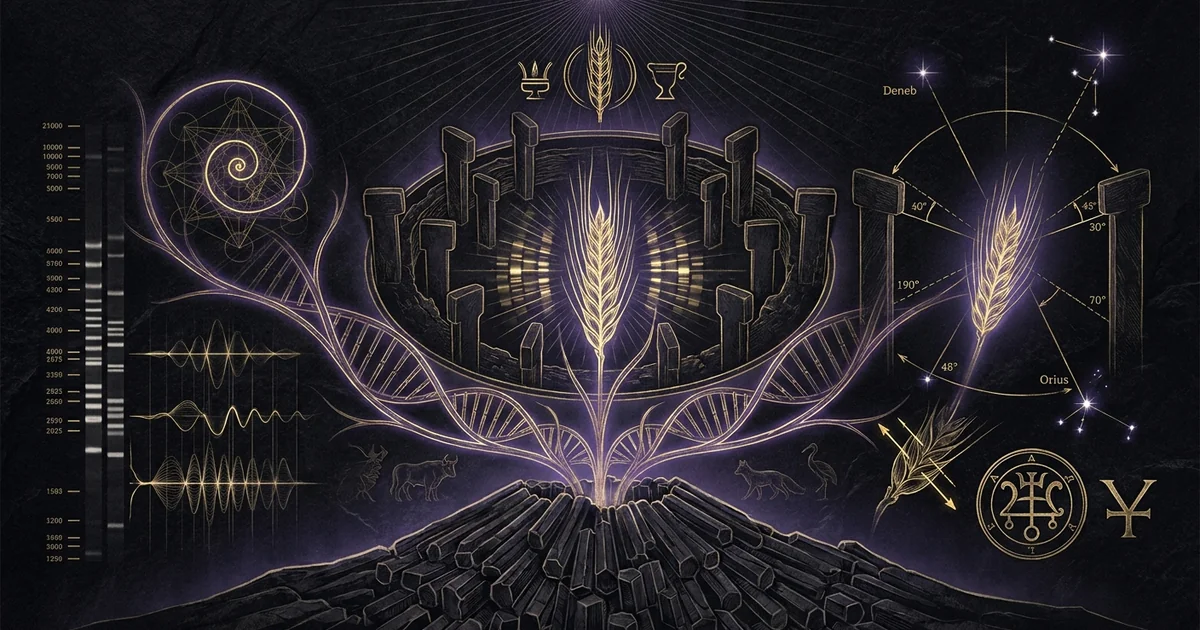
Ancient Grain Cultivation: Einkorn Wheat Birthplace Tree
Executive Summary & Theoretical Thesis
The Karaca Dağ Monophyletic Anomaly
High-density molecular profiling through amplified fragment length polymorphism (AFLP) markers has definitively revised the spatial and ecological parameters governing the origin of Near Eastern agriculture. Domesticated einkorn (Triticum monococcum subsp. monococcum) exhibits a monophyletic cladistic architecture that converges upon wild progenitor populations (Triticum monococcum subsp. boeoticum) endemic to the basaltic slopes of the Karaca Dağ volcanic complex in modern southeastern Turkey. This geographical localization invalidates earlier hypotheses asserting diffuse, polycentric domestication zones distributed uniformly across the Fertile Crescent.
The basaltic shield of Karaca Dağ provided a unique edaphic and microclimatic refugium during the Younger Dryas climatic oscillation (c. 10,900–9600 BCE). This environment permitted dense stands of wild diploid cereals to maintain elevated genetic heterozygosity while adjacent lowland populations suffered severe demographic contractions. The lineage tree connecting wild boeoticum to domesticated monococcum demonstrates that the fixation of the non-shattering spikelet phenotype was confined to an exceptionally tight phylogeographical node. This specific lineage constitutes the absolute root of the einkorn wheat wild domestication karacadag gobekli tepe origin nexus.
Socio-Spiritual Catalysis: The Inversion of the Childean Model
For nearly a century, the dominant socioeconomic paradigm regarding plant domestication—rooted in the environmental determinism of V. Gordon Childe’s “Oasis Theory”—postulated that systematic cultivation emerged as a desperate subsistence strategy driven by desiccation, ecological collapse, and catastrophic resource deficits. Archaeological and paleobotanical sequences derived from the Urfa plain decisively invert this functionalist premise. The emergence of monumental megalithic complexes across the Tas Tepeler region, anchored by the T-shaped enclosures at Göbekli Tepe and Karahan Tepe, demonstrates that large-scale communal labor aggregation, architectural design, and symbolic expression preceded sedentary agrarian surplus.
The labor investment required to quarry, transport, carve, and erect monolithic limestone pillars weighing up to twenty metric tons demanded massive, predictable infusions of bioavailable caloric energy. These communal aggregations were sustained not by baseline foraging, but by the ritualized consumption of cereals. Cultic feasting, ceremonial commensality, and large-scale fermentation served as the primary socio-metabolic catalysts for grain manipulation. Human populations did not stumble passively into agriculture under starvation pressure; rather, ritualized aggregation compelled early communities to systematically extract, manage, and ultimately domesticate wild cereals to fuel the ideological and cosmological apparatus of the Pre-Pottery Neolithic (PPN).
“Phylogenetic analysis of 288 amplified fragment length polymorphism (AFLP) marker lines demonstrates that wild einkorn (Triticum monococcum subsp. boeoticum) accessions from the Karaca Dağ volcanic shield in southeastern Turkey are genetically closer to domestic einkorn (T. monococcum subsp. monococcum) than are wild populations from any other investigated region. The tree topologies indicate a monophyletic origin for domestic einkorn within this distinct geographical micro-center.” — Heun, M., Schäfer-Pregl, R., Klawan, D., Castagna, R., Accerbi, M., Borghi, B., & Salamini, F. (1997). Science, 278(5341), 1312–1314.
Structural Demands of Non-Shattering Triticum Phenotypes
In wild Triticum monococcum subsp. boeoticum, the central architectural axis of the inflorescence—the rachis—is brittle. Upon physiological maturity, the abscission zone between individual spikelets undergoes programmed cell separation, fracturing into discrete dispersal units that disseminate freely via anemochory and zoochory. This biological adaptation ensures natural propagation, but it presents a catastrophic barrier to human harvesting: unharvested wild stands shatter upon mechanical contact, depositing seeds directly into the substrate out of reach of ancestral foragers.
The transition to domestic einkorn required a fundamental macroevolutionary shift mediated by recessive mutations at loci controlling rachis fragility:
Wild Phenotype (Brittle Rachis):
[Spikelet] --- (Abscission Zone: Hydrolysis & Cleavage) --- [Spikelet]
-> Spontaneous disarticulation at maturity (Natural seed dispersal)

Domestic Phenotype (Non-Brittle Rachis):
[Spikelet] === (Continuous Lignification / No Cleavage) === [Spikelet]
-> Mechanical retention on stem (Obligate dependence on human harvesting)
This structural modification constitutes an evolutionary suicide under natural conditions; non-shattering plants are rendered incapable of independent seed dispersal. However, within an anthropogenic harvesting regime utilizing sickles or uprooting techniques, this mutation inverts selective pressures. The non-brittle rachis ensures that grain remains affixed to the spike until threshing, selectively enriching the harvested seed stock with the mutant alleles.
The demographic demands of ritual brewing and grain-based feasting at monumental sites provided the sustained selective harvesting pressure needed to drive these rare recessive alleles from baseline mutation rates to fixation. This cultural entrainment permanently integrated the human social apparatus with the reproductive lifecycle of the plant within the agricultural revolution cradle turkey.
Historical Lineage & Experimental Precedents
Vavilov’s Centers of Diversity and the Fertile Crescent
The systematic search for the geographical cradle of domestic crops was inaugurated by Russian geneticist and agronomist Nikolai Ivanovich Vavilov in the 1920s. Vavilov formulated the law of homologous series in variation and postulated that the geographic center of origin for any cultivated plant species coincides with the geographic locus displaying its highest phenotypic and allelic diversity. Synthesizing data collected during global expeditions between 1916 and 1933, Vavilov mapped primary, secondary, and tertiary centers of crop origin.
Vavilov's Phytogeographic Hierarchy:
┌────────────────────────────────────────────────────────┐
│ Primary Center: Maximum Allelic Diversity              │
│ (Endemic Ancestral Progenitors, Wild Diploids)         │
└──────────────────────────┬─────────────────────────────┘
                           │ Dispersal & Founder Events
                           ▼
┌────────────────────────────────────────────────────────┐
│ Secondary Center: Landrace Differentiation             │
│ (Adaptive Introgression, Polyploid Hybridization)       │
└────────────────────────────────────────────────────────┘
Vavilov placed the origin of small-grain cereals—specifically the ancestral diploid and tetraploid wheats—firmly within his “Near Eastern Center,” encompassing the mountainous tracts of Anatolia, the Levant, the Transcaucasus, and the Zagros range. Vavilov’s methodology relied on phenotypic observation, seed morphology, and landrace variation indices. While his morphological mapping lacked the granular resolution of molecular sequencing, his core intuition—that the wild progenitors of domestic cereals were localized to mountain-ringed valleys of the Near East rather than wide alluvial floodplains—established the foundation for subsequent archaeobotanical inquiry.
“The mountainous districts of the Near East, particularly the southern slopes of the Anatolian and Armenian volcanic plateaus, show a concentration of primary varietal traits of Triticum species that cannot be found elsewhere in Eurasia. It is here that one encounters the primary links between the wild forms and their domesticated descendants, suggesting that these elevated basaltic and limestone soils functioned as the primary crucible for early plant manipulation.” — Vavilov, N. I. (1926). Studies on the Origin of Cultivated Plants. Bulletin of Applied Botany and Plant Breeding, 16(2), 1–248.
The Braidwood Hilly Flanks Hypothesis
In the mid-twentieth century, Robert J. Braidwood operationalized Vavilov’s phytogeographic concepts through targeted field archaeology. Directly challenging Childe’s Oasis Theory, Braidwood formulated the “Hilly Flanks Hypothesis.” He argued that the earliest food-producing economies arose not in arid river basins driven by drought, but within the natural habitat zone of wild cereal and ungulate progenitors: the well-watered, undulating piedmont zones flanking the Zagros and Taurus mountains.
Through the Iraqi-Jarmo Project (begun in 1947) and subsequent excavations across southeastern Turkey, notably at Çayönü Tepesi in collaboration with Halet Çambel, Braidwood integrated palynological, zoological, and botanical analyses into archaeological stratigraphy. The excavations at Çayönü, located fewer than 70 kilometers from the Karaca Dağ volcanic massif, yielded continuous cultural sequences spanning the transition from hunter-gatherer round-house occupations to sedentary, rectilinear “grill-plan” architecture.
Crucially, the early phases at Çayönü provided clear physical remains of both wild einkorn and morphologically transitional variants, confirming that early farming occurred alongside the ecological zone of wild progenitors. Braidwood situated plant domestication as an evolutionary process enabled by a lengthy period of technological and cultural familiarization with local wild flora, laying the groundwork for testing these models with molecular archaeobotany.
Molecular Revolution: From Phenotypic Taxonomy to AFLP and Genomic Mapping
During the late 20th and early 21st centuries, the transition from phenotypic taxonomy to molecular genetics unlocked new tools for genetic tracking ancestral wheat. Early biochemical approaches utilizing isozyme markers and restriction fragment length polymorphisms (RFLPs) established that domestic einkorn harbored dramatically reduced genetic polymorphism compared to its wild relatives, a clear indication of a narrow evolutionary bottleneck. However, the precise geographical provenance of that bottleneck remained elusive due to the extensive modern distribution of Triticum monococcum subsp. boeoticum across the Balkans, Anatolia, and the Zagros.
The definitive breakthrough was achieved by Heun et al. (1997) using amplified fragment length polymorphism (AFLP) fingerprinting. By analyzing hundreds of polymorphic bands across a comprehensive geographic sample of 262 wild and 68 domestic einkorn lines, researchers reconstructed phylogenetic trees via neighbor-joining and maximum parsimony algorithms.
The resulting cladograms split subsp. boeoticum into three discrete genetic races:
- Race $\alpha$ (Anatolian core),
- Race $\beta$ (Southern Levant),
- Race $\gamma$ (Balkan and western Aegean).
Every single domestic accession clustered exclusively within the clade defined by Race $\alpha$, and within that clade, mapped with statistical precision directly to the wild populations collected from the Karaca Dağ volcanic complex. Subsequent single nucleotide polymorphism (SNP) genotyping and whole-genome sequencing have confirmed this topology, ruling out diffuse multi-regional models in favor of a spatially circumscribed, monophyletic domestication event.
Mathematical Formalism & Physical Mechanics
Wright-Fisher Diffusion and Selection Coefficients of Non-Brittle Rachis (q/br alleles)
The evolutionary trajectory of the non-shattering phenotype in early Triticum domesticates can be formalized through the mathematics of non-linear population genetics. Let the wild-type brittle-rachis allele be denoted as $A$ and the recessive non-brittle domestic allele as $a$. In an unmanaged, wild ecosystem, the fitness of the homozygous recessive mutant $aa$ is severely compromised due to its inability to disperse seeds, yielding a natural negative selection coefficient ($s_{nat} < 0$). Under human harvest and cultivation, the non-brittle ear is disproportionately collected, threshing selectively preserves its grain, and this grain is subsequently planted, imparting a strong anthropogenic positive selection coefficient ($s_{anth} > 0$).
We model the change in the frequency $p$ of the domestic allele $a$ across discrete generations $t$ using the classic selection difference equation. Assuming a diploid locus with complete recessivity where relative fitnesses are $w_{AA} = 1$, $w_{Aa} = 1$, and $w_{aa} = 1 + s$, the mean population fitness $\bar{w}$ is given by:
$$\bar{w} = (1 - p^2) + (1 + s)p^2 = 1 + sp^2$$
The domestic allele frequency in the subsequent generation, $p_{t+1}$, is expressed as:
$$p_{t+1} = \frac{p_t^2(1 + s) + p_t(1 - p_t)}{\bar{w}} = \frac{p_t + sp_t^2}{1 + sp_t^2}$$
The net shift in allelic frequency per generation, $\Delta p$, is derived directly:
$$\Delta p = p_{t+1} - p_t = \frac{p_t + sp_t^2 - p_t(1 + sp_t^2)}{1 + sp_t^2} = \frac{sp_t^2(1 - p_t)}{1 + sp_t^2}$$
For low initial frequencies of the rare recessive mutation ($p_0 \ll 1$), the denominator approaches unity ($1 + sp_t^2 \approx 1$), reducing the differential expression to:
$$\frac{dp}{dt} \approx s p^2 (1 - p)$$
Integrating this equation between an initial mutation-drift balance frequency $p_0 \approx 10^{-4}$ and near-fixation $p_f \approx 0.99$:
$$\int_{p_0}^{p_f} \left( \frac{1}{p^2} + \frac{1}{p} + \frac{1}{1-p} \right) dp = \int_0^T s , dt$$
$$\left[ -\frac{1}{p} + \ln\left(\frac{p}{1-p}\right) \right]_{p_0}^{p_f} \approx s T$$
For an anthropogenic selection coefficient $s = 0.08$ (reflecting harvesting using sickle blades or uprooting full stalks, paired with seed caching), the required generations $T$ to reach phenotypic fixation ($p \to 0.99$) evaluate to approximately 200–400 generations. This window matches the archaeological transition visible in the archaeobotanical record of the Pre-Pottery Neolithic A to B transition (c. 9500–8500 BCE).
In continuous-time regimes characterized by demographic fluctuations, the fixation trajectory is expressed through the Kolmogorov backward equation for the fixation probability $u(p)$:
$$\frac{1}{2} V_{\delta p} \frac{\partial^2 u}{\partial p^2} + M_{\delta p} \frac{\partial u}{\partial p} = 0$$
Where $M_{\delta p} = s p^2(1-p)$ represents the deterministic selection drift, and $V_{\delta p} = \frac{p(1-p)}{2N_e}$ describes stochastic genetic drift within an effective population size $N_e$. This confirms that without deliberate, persistent anthropogenic gathering selection ($s > 0.05$), stochastic loss of the non-shattering allele is guaranteed within five generations.
Biomechanical Shear Stress and Fracture Mechanics of the Spikelet Abscission Zone
The spontaneous shattering of wild einkorn inflorescences is governed by physical fracture mechanics localized to the spikelet disarticulation node. In wild T. monococcum subsp. boeoticum, an abscission layer forms across the rachis internode during the final stages of seed maturation. This zone consists of a thin parenchymatous layer displaying reduced secondary wall thickening and elevated pectin content within the middle lamella.
Wild Abscission Zone (Enzymatic Degradation):
   Spikelet
  ┌────────┐
  │ Cells  │
  ├────────┤
--│ Pectin │ <--- Endoglucanase Hydrolysis: Tensile Strength F_crit -> 0 N
  ├────────┤
  │ Cells  │
  └────────┘
   Rachis
Upon terminal dehydration, endogenous polygalacturonases and cellulases degrade the unlignified primary cell walls, precipitating spontaneous mechanical failure. The fracture toughness $K_{IC}$ of this abscission zone drops drastically toward zero:
$$K_{IC} = \sigma_f \sqrt{\pi a} \to 0$$
Where $\sigma_f$ is the failure stress and $a$ is the micro-crack length along the node boundary. In the wild phenotype, normal environmental disturbances—such as aerodynamic drag from ambient winds ($v > 4.5 \text{ m/s}$) or contact with avian vectors—induce kinetic shear forces that exceed the critical failure threshold:
$$F_{\text{shear}} \ge F_{\text{crit}} \approx 0.15 \text{ N}$$
This causes clean, smooth-edged disarticulation along the transverse plane.
Conversely, the domestic mutant T. monococcum subsp. monococcum suppresses the enzymatic breakdown of the middle lamella. Secondary lignification proceeds uninterrupted across the nodal junction, depositing dense polymeric networks of coniferyl and sinapyl alcohols:
Domestic Rachis Node (Continuous Lignification):
   Spikelet
  ┌────────┐
  │ Lignin │
  │ Matrix │ <--- Interlocking Sclerenchyma: F_crit > 3.5 N
  │ Fibers │
  └────────┘
   Rachis
The resulting joint presents no preformed mechanical weakness. Disarticulation requires rough, torn fractures running obliquely through sclerenchymatous vascular bundles. Laboratory testing demonstrates that the shear force required to sever a domesticated einkorn rachis node consistently exceeds $3.5 \text{ N}$, up to an ultimate tensile failure limit:
$$F_{\text{tensile}} \approx 8.2 \text{ N}$$
This structural threshold requires deliberate mechanical intervention—such as flint-edged sickles or aggressive hand-beating—for grain extraction, ensuring that seeds remain on the stem until human intervention.
Thermodynamics and Reaction Kinetics of Starch Gelatinization and Amylase Hydrolysis
The utility of einkorn in early ritual brewing operations relies on the thermodynamic kinetics of converting insoluble cereal starches into fermentable monosaccharides and disaccharides. Einkorn endosperm starches are packaged in semi-crystalline granules composed of linear amylose ($\alpha$-1,4-glucan chains) and branched amylopectin ($\alpha$-1,4-chains cross-linked via $\alpha$-1,6-glucosidic bonds).
Before endogenous enzymes can hydrolyze these polymers, the grain must undergo thermal gelatinization: a disruption of the crystalline lattice driven by hydration and heat. For Triticum monococcum, this endothermic phase transition occurs within a narrow temperature envelope:
$$T_{\text{gel}} \in [62^\circ\text{C}, 68^\circ\text{C}]$$
The kinetic rate of starch hydrolysis during mashing is dictated by the catalytic efficiency of $\alpha$-amylase (an endo-hydrolase cleaving internal $\alpha$-1,4-bonds) and $\beta$-amylase (an exo-hydrolase releasing maltose units from non-reducing chain ends). The temperature-dependent reaction velocity follows Arrhenius kinetics:
$$k(T) = A \exp\left(-\frac{E_a}{RT}\right)$$
Where $E_a$ is the activation energy ($E_a \approx 45.2 \text{ kJ/mol}$ for native barley and einkorn $\alpha$-amylase), $R$ is the universal gas constant, and $A$ is the pre-exponential frequency factor.
Mashing Reaction Kinetics Curve:
  Rate (k)
    ^               Optimal Saccharification Zone
    |                    [ 62°C - 68°C ]
    |                         /---\
    |                        /     \
    |                       /       \ <--- Rapid Thermal Denaturation
    |                      /         \     (k -> 0 above 72°C)
    |   Gelatinization -> /           \
    0────────────────────┴─────────────┴─────> Temperature (°T)
                        60°C        70°C
Above $70^\circ\text{C}$, the rate of irreversible thermal denaturation of $\beta$-amylase outpaces catalytic acceleration, causing rapid enzymatic deactivation:
$$\frac{d[\text{Enz}]}{dt} = -k_d [\text{Enz}]$$
Where $k_d$ increases exponentially. Consequently, effective saccharification—the prerequisite for producing maltose-rich wort capable of sustained fermentation—requires stable, prolonged incubation within the precise range of $62^\circ\text{C} \le T \le 68^\circ\text{C}$.
Maintaining this thermodynamic equilibrium in aceramic Pre-Pottery Neolithic contexts was achieved using dense, high-heat-capacity limestone vats and recurring additions of heated basalt river-cobbles, a technique confirmed by trace-element and thermal micro-fracturing analyses on Neolithic ground stone assemblages.
Empirical Evidence & Observational Data
Cladistic Dendrograms of Triticum monococcum subsp. boeoticum
The empirical architecture verifying the Karaca Dağ origin rests on phylogenetic trees generated via neighbor-joining (NJ) and maximum likelihood (ML) methods applied to multi-locus marker panels. In the landmark studies directed by Francesco Salamini and Manfred Heun, 288 polymorphic AFLP loci were amplified across dozens of wild diploid lines gathered throughout the Mediterranean basin, the Levant, the Zagros mountains, and central Anatolia.
Phylogenetic Cladogram Topology (AFLP Markers):
  ┌── Balkan & Aegean Wild Lines (Race γ)
  │
──┤  ┌── Southern Levant Wild Lines (Race β)
  └──┤
     │  ┌── General Anatolian Wild Lines
     └──┤
        └── Karaca Dağ Wild Lineage (Race α)
              │
              └─── [ DOMESTIC EINKORN (T. monococcum subsp. monococcum) ]
                   (Bootstrap Support: >95%)
The tree topology separates the wild accessions into geographically distinct clusters:
- Southern Balkan/Aegean populations branch basal to Near Eastern lines;
- Southern Levantine accessions form a distinct, highly divergent monophyletic clade;
- Southeastern Anatolian accessions form a tight, derived clade (Race $\alpha$).
Crucially, all cultivated einkorn lines—encompassing historical European landraces, Transcaucasian isolates, and Near Eastern village collections—cluster directly within the specific sub-branch formed by the wild populations endemic to the Karaca Dağ volcanic complex. Statistical bootstrapping yields node confidence exceeding 95%, excluding other candidate regions such as the Anti-Lebanon mountains, the Judean hills, and the Zagros range as primary domestication centers.
Archaeobotanical Stratigraphy of Göbekli Tepe, Nevalı Çori, and Çayönü
The stratigraphy of the Upper Euphrates and Tigris basins traces the morphological transition from wild harvest to fixed domestic cultivation. At Göbekli Tepe, the deepest, oldest archaeological horizon—Layer III (PPNA, late 10th millennium BCE)—contains extensive macro-botanical assemblies dominated by wild flora. Einkorn remains are prevalent, but rachis internodes demonstrate the smooth, clean abscission scar characteristic of wild T. monococcum subsp. boeoticum. The inhabitants were processing vast quantities of wild-harvested grain transported from nearby basalt plains.
Archaeobotanical Chronostratigraphy:
  Chronology      Site               Stratum      Rachis Morphology
  ──────────────────────────────────────────────────────────────────────
  c. 9500 BCE     Göbekli Tepe       Layer III    100% Wild Abscission
  c. 8800 BCE     Nevalı Çori        Layer IV     ~80% Wild / 20% Non-Brittle
  c. 8300 BCE     Çayönü Tepesi      Cell-Plan    Domestic-Dominant (>85%)
By the transition to Layer II (early-to-middle PPNB, 9th millennium BCE) at Göbekli Tepe, and concurrently within the architectural sequence at nearby Nevalı Çori, the archaeobotanical record shows a marked shift. The frequency of rough-edged, torn rachis internodes rises sharply, signaling the emergence of the non-brittle rachis phenotype.
This transformation culminates at Çayönü Tepesi. The basal “round-building” sub-phase contains exclusively wild-type einkorn. As the architecture evolves through the “grill-plan” to the “cell-plan” phases, domesticated-type rachis scars steadily increase until non-shattering domestic einkorn accounts for more than 85% of recovered cereal remains. This macro-botanical sequence matches the selection coefficient models, recording an uninterrupted developmental trajectory situated squarely within the Karaca Dağ catchment.
Biochemical Residue Analysis: Calcium Oxalate and Alkylresorcinols in Monolithic Troughs
Direct evidence for grain processing and early fermentation at monumental complexes is derived from organic residue analysis of stationary stone vessels. Deep within the enclosures of Göbekli Tepe, archaeologists excavated monolithic limestone vats with individual holding capacities reaching 160 liters. These vessels were carved directly from native bedrock or installed as immovable fixtures adjacent to the megalithic enclosures.
Chemical testing of residues extracted from the porous interior walls of these basins has yielded significant concentrations of calcium oxalate ($CaC_2O_4$), colloquially known as “beerstone.”
Beerstone precipitates when oxalic acid, naturally present in high concentrations within the husk and aleurone layers of cereal grains, binds with dissolved calcium ions in the presence of water:
$$\text{H}_2\text{C}_2\text{O}_4 + \text{Ca}^{2+} \longrightarrow \text{CaC}_2\text{O}_4 \downarrow + 2\text{H}^+$$
Because native limestone surfaces liberate calcium ions directly into aqueous solutions:
$$\text{CaCO}_3 + \text{H}_2\text{O} + \text{CO}_2 \rightleftharpoons \text{Ca}^{2+} + 2\text{HCO}_3^-$$
The chemical micro-environment of these limestone basins accelerated the precipitation and permanent entrapment of calcium oxalate within the mineral matrix. Gas chromatography-mass spectrometry (GC-MS) applied to these samples reveals diagnostic alkylresorcinols—phenolic lipids that serve as stable, genus-specific biomarkers for Triticum grasses. Combined with abundant concentrations of carbonized cereal phytoliths, these biochemical markers establish that these massive basins were repeatedly used for the thermal gelatinization, enzymatic mashing, and alcoholic fermentation of ancestral einkorn wheat.
Metaphysical Implications & Unified Synthesis
The Megalith as Metabolic Engine: Labor Entrainment via Altered States
The construction of pre-pottery monumental architecture must be analyzed as a continuous thermodynamic and biological process. Sites like Göbekli Tepe and Karahan Tepe operated as physical systems that concentrated labor from disparate mobile hunter-gatherer bands, entraining their collective kinetic energy to transform local landscapes. The energetic fuel for this engine was grain-derived calories, consumed both as flatbreads and as fermented, nutrient-dense ale.
Commensal Labor Feedback Loop:
┌────────────────────────────────────────────────────────┐
│ Megalithic Construction: Ideological Imperative       │
└──────────────────────────┬─────────────────────────────┘
                           │ Requires Mass Labor Mobilization
                           ▼
┌────────────────────────────────────────────────────────┐
│ Cultic Feasting: Psychoactive Ale & High-Calorie Mash  │
└──────────────────────────┬─────────────────────────────┘
                           │ Requires Mass Grain Supplies
                           ▼
┌────────────────────────────────────────────────────────┐
│ Agronomic Selection: Harvesting Pressure on Einkorn    │
└────────────────────────────────────────────────────────┘
The production of fermented beverages in temple environments functioned as a transformative psycho-social catalyst. The physiological effects of primitive beer—combining ethanol, remaining complex sugars, B-vitamins, and residual wild yeasts—provided both metabolic sustenance and an altered neurochemical state that reduced interpersonal aggression among visiting clans.
This ritualized commensality forged lasting alliances, integrated disparate social groups, and organized communal labor around shared cosmological alignments. The megalithic enclosure was not merely a passive setting for worship; it was an industrial-scale processing installation designed to transform wild grass into ideological cohesion and kinetic work.
Subsistence Survival Model (Childe)
- Primary Driver: Climate-induced resource stress; drought-driven desperation.
- Systemic Dynamic: Defensive ecological retreat to shrinking oasis habitats.
- Labor Focus: Energy conservation; risk mitigation; foraging optimization.
- Chronological Sequence: Environmental shock precedes plant domestication, which precedes monumental architecture and complex ritual systems.
- Biological Outcome: Diffuse, opportunistic selection of accessible seed lines.
Cultic Feast & Ritual Entrainment Model
- Primary Driver: Ideological, ritual, and ceremonial consumption demands.
- Systemic Dynamic: Coordinated social aggregation; massive symbolic expenditure.
- Labor Focus: Coordinated energy mobilization; construction of monuments.
- Chronological Sequence: Monumental architecture and ritual aggregation precede domestic agrarian surpluses, forcing botanical selection.
- Biological Outcome: Spatially bounded, highly accelerated monophyletic fixation of non-shattering phenotypes.
Sacred Agronomy: The Ritualized Seed as Cosmic Microcosm
The spatial layout of early Neolithic Anatolia reveals a deliberate polarity between chthonic, raw geological forces and refined, geometric human enclosures. The Karaca Dağ volcanic shield stands as an imposing chthonic source: a vast basalt plateau formed by deep-seated volcanic eruptions, yielding dark, iron-rich, porous soils that naturally nurtured wild Triticum monocultures. In contrast, the limestone sanctuaries of the Urfa plain, such as Göbekli Tepe, represent light, crystalline, organized sacred spaces oriented toward celestial axes.
This geographical dialogue can be viewed through the lens of early cosmology:
[ Chthonic Volcanic Source ]             [ Celestial Sacred Center ]
   Karaca Dağ (Basalt Shield)   =======>     Göbekli Tepe (Limestone Ridge)
   Raw Biological Diversity                 Architectural Geometrization
   Wild Triticum monococcum                 Cultic Consumption & Brewing
The physical transport of wild seeds from the basaltic volcanic slopes down to the limestone temple complexes established an unbroken material vector. Seeds were not merely gathered; they were ritualized. Within the megalithic enclosures, the seed was conceptualized as a spark of biological light buried within the earth, mirroring the subterranean installation of the megaliths themselves. The manual processing of this grain—crushing it on basalt querns, mashing it in limestone vats, and consuming it during astronomical alignments—integrated human seasonal labor with cosmic renewal. Cultivation emerged as a sacred technology designed to perpetuate cosmic order through the controlled regeneration of the seed.
Synthesis: Cultural Intentionality as an Evolutionary Phase Transition
The monophyletic origin of domestic einkorn at Karaca Dağ represents an evolutionary phase transition driven by human intentionality. In standard biological frameworks, speciation is viewed as a slow, stochastic process governed by passive adaptation, geographic isolation, and natural selection unfolding across deep geological time.
The domestication of einkorn contradicts this gradualist template:
Standard Evolutionary Drift:
Stochastic Mutations ---> Weak Natural Selection ---> Diffuse Speciation (10^5 - 10^6 Years)

Anthropogenic Ritual Entrainment:
Targeted Harvesting ---> Cultural Selection Vector ---> Rapid Fixation (10^2 - 10^3 Years)
By imposing sustained, goal-oriented harvesting methods—motivated not by basic survival, but by ideological, ritualized consumption—Neolithic communities acted as a directional vector within the regional ecosystem. Human culture functioned as a dissipative structure that organized local biological systems, driving the Triticum genome across an evolutionary threshold in an exceptionally short period (roughly 200–400 generations).
The emergence of domestic einkorn was neither a passive ecological response to drought nor a random biological accident. It was the material consequence of a culture that brought monumental architecture, liturgical brewing, and sacred agronomy into alignment on the plains of southeastern Turkey, setting the template for agricultural civilization worldwide.
Frequently Asked Questions
Technical Dissection of Einkorn Agronomics and Archaeo-Genetics
What are the structural and ploidy distinctions separating diploid einkorn from younger hybrid wheats?
Domestic einkorn (Triticum monococcum subsp. monococcum) is an ancient diploid cereal exhibiting a chromosome count of $2n = 2x = 14$, containing the fundamental $A^m A^m$ genome. This structure distinguishes it from polyploid wheats that emerged through subsequent allopolyploidization events:
Diploid:
Triticum monococcum (Einkorn) -> 2n = 14 [ A^m A^m ]

Tetraploid:
Triticum dicoccum (Emmer)      -> 2n = 28 [ A^u A^u B B ]
(Spontaneous hybrid of T. urartu and Aegilops speltoides)

Hexaploid:
Triticum aestivum (Bread Wheat) -> 2n = 42 [ A^u A^u B B D D ]
(Hybrid of tetraploid wheat and Aegilops tauschii)
Because einkorn possesses only a single diploid genome ($A^m$), it lacks the structural plasticity and genetic buffering seen in polyploid wheats. Its grains remain tightly enclosed within tough glumes (hulled wheat), requiring laborious mechanical dehulling or parching before consumption. Its gluten matrix features an altered ratio of gliadins to glutenins, resulting in low dough elasticity and preventing the production of high-volume leavened breads. However, its protein content (frequently exceeding 16–18% by dry weight), elevated concentrations of carotenoids (lutein), and compact mineral density rendered it an ideal caloric foundation for early Neolithic porridge, dense flatbreads, and high-gravity fermentations.
How does organic residue analysis distinguish calcium oxalate (beerstone) from simple animal fat residues in stone vessels?
The identification of calcium oxalate monohydrate ($\text{CaC}_2\text{O}_4 \cdot \text{H}_2\text{O}$, whewellite) relies on specific micro-chemical, spectroscopic, and chromatographic assays:
Residue Differentiation Profile:
  Analytical Marker        Cereal Fermentation (Beerstone)   Animal Adipose Boiling
  ──────────────────────────────────────────────────────────────────────────────────
  Feigl Spot Test          Positive (Specific Decolorization) Negative
  FTIR Absorption Peak     1620 cm⁻¹ & 1318 cm⁻¹ (Oxalate)    1740 cm⁻¹ (Ester Carbonyl)
  GC-MS Profile            Alkylresorcinols / Cereal Sterols  Palmitic/Stearic Free Fatty Acids
  Micro-Botanical Matrix   High-Density Glume Phytoliths     Collagen & Osteological Traces
The Feigl spot test utilizes a redox reaction where calcium oxalate dehydrohalogenates and decolorizes a specialized sodium nitroprusside/potassium permanganate reagent matrix under acidic conditions.
Fourier-transform infrared (FTIR) spectroscopy confirms this identification through characteristic absorption bands at $1620 \text{ cm}^{-1}$ (asymmetric carbonyl stretching) and $1318 \text{ cm}^{-1}$ (symmetric C-O stretching coupled with O-C-O bending vibrations), which differ from the ester carbonyl peaks ($1740 \text{ cm}^{-1}$) typical of animal triglycerides.
Gas chromatography-mass spectrometry (GC-MS) isolates homologous series of 5-$n$-alkylresorcinols, phenolic lipids found exclusively in the outer coverings of Poaceae grains, while simultaneously ruling out degraded animal fats via low ratios of palmitic to stearic acid ($P/S < 1.2$) and the complete absence of cholesterol oxidation products.
Why cannot a domestic, non-shattering einkorn population persist wild in nature without human intervention?
The non-shattering phenotype generated by continuous lignification across the rachis abscission zone is an evolutionary dead end in unmanaged ecosystems. In the wild, successful reproduction depends entirely on effective seed dissemination:
Wild Phenotype:
Maturation ---> Wind Shear/Contact ---> Disarticulation ---> Wedge Spikelets Penetrate Soil
-> Successful Generation Seedling

Domestic Phenotype:
Maturation ---> Intact Inflorescence Falls Intact ---> Grains Germinate In Situ (Clumping)
-> Severe Root Competition & Fungal Rot -> Local Population Extinction
Because wild einkorn spikelets feature an elongated, barbed awn paired with a pointed, sharp-tipped rachis segment, they function as mechanical wedges. Driven by daily hygroscopic humidity cycles, the awns expand and contract, physically drilling the seed into soil crevices and beneath leaf litter.
In domestic einkorn, this cycle is broken. The ear remains intact upon drying and eventually falls directly beneath the parent plant as a dense, single unit. When dozens of spikelets germinate concurrently within a space of only a few square centimeters, intense intraspecific competition for water, nitrogen, and sunlight chokes the seedlings, while dense ground humidity promotes fatal fungal blights.
Deprived of an intentional human harvesting cycle—encompassing sickle cutting, threshing, storage in protected silos, and deliberate broadcast sowing—domestic einkorn populations face rapid local extinction within three to five growing seasons. The non-brittle rachis locks the plant into an obligate, permanent evolutionary symbiosis with human cultivation.