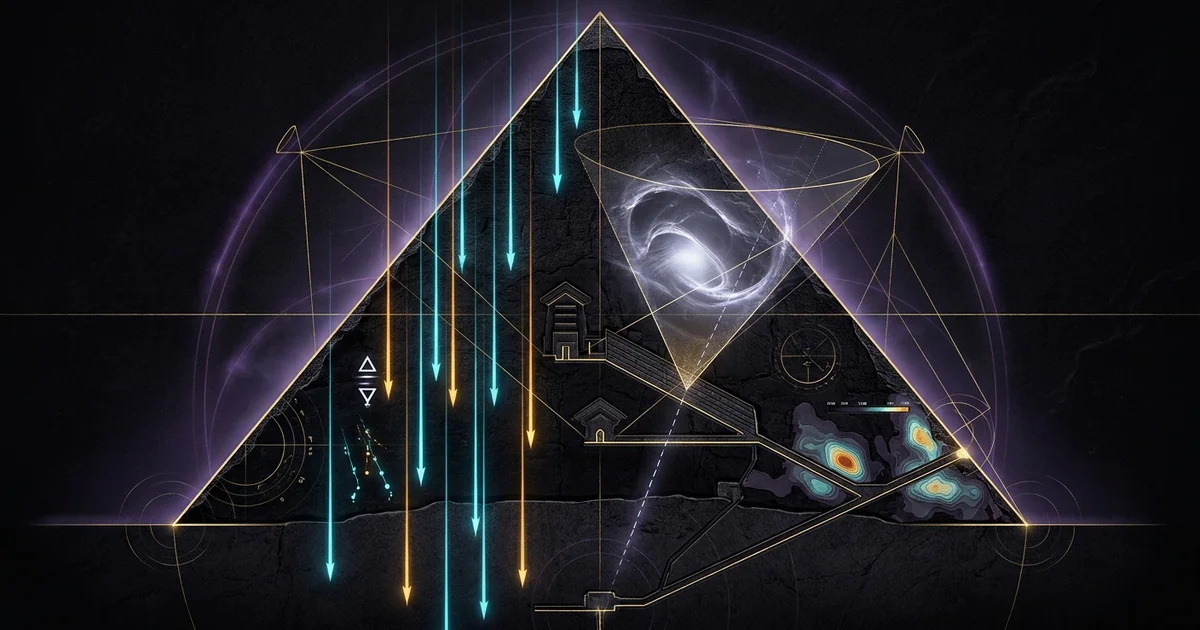
Void Discovery via Muon Tomography: ScanPyramids Data Art
Executive Summary & Theoretical Thesis: High-Energy Particle Radiography and Lithic Anomalies
Relativistic Muon Attenuation and Matter Opacity
Cosmic-ray muon radiography exploits the continuous flux of naturally occurring elementary leptons produced in the Earth’s upper atmosphere to probe macroscopic condensed matter systems. Primary galactic and solar cosmic rays—predominantly relativistic protons and alpha particles—interact with atmospheric nuclei ($^{14}\text{N}$, $^{16}\text{O}$) at altitudes between 15 and 20 kilometers, triggering hadronic cascades that yield charged mesons ($\pi^{\pm}, K^{\pm}$). These mesons rapidly decay via weak interactions into muons ($\mu^{\pm}$) and corresponding muon neutrinos ($\nu_{\mu}, \bar{\nu}_{\mu}$). At sea level, the resulting muon spectrum exhibits a mean kinetic energy of approximately $\langle E \rangle \approx 4\text{ GeV}$, characterized by a hard differential momentum distribution extending beyond several teraelectronvolts, with an integrated vertical flux of approximately $I_0 \approx 70\text{ m}^{-2}\text{s}^{-1}\text{sr}^{-1}$ (or $\sim 1\text{ cm}^{-2}\text{min}^{-1}$).
Because muons possess a rest mass of $m_{\mu} \approx 105.66\text{ MeV}/c^2$—roughly 207 times that of the electron—their radiative bremsstrahlung losses are suppressed by a factor of $(m_e/m_{\mu})^2 \approx 2.3 \times 10^{-5}$. Consequently, in the energy regime between $1\text{ GeV}$ and $1\text{ TeV}$, the dominant mechanism governing their propagation through dense lithic media is non-destructive electromagnetic ionization and atomic excitation, formally modeled by the relativistic Bethe-Bloch formulation. As a relativistic muon traverses hundreds of meters of dense nummulitic limestone ($\text{CaCO}_3$), it undergoes a nearly continuous rate of energy loss (stopping power, $-\langle dE/dx \rangle$).
The survival probability of a muon along a directional path trajectory $(\theta, \phi)$ is an exact analytical function of its initial energy $E_0$ and the integrated mass along its vector—a quantity designated as the opacity or rock thickness equivalent $\varrho(\theta, \phi) = \int \rho® , dr$. By deploying particle tracking systems deep within subterranean infrastructure or internal voids, variations in the recorded flux directly reveal macroscopic variations in material density along specified lines of sight.
Primary Cosmic Rays (p+, He2+)
                              │
                              ▼ [Upper Atmosphere ~15 km]
                    Hadronic Shower (π±, K±)
                              │
                              ▼ Weak Decay
                     Relativistic Muons (μ±)
                     (Mean Energy ~4 GeV)
                              │
                              ▼
           ┌───────────────────────────────────────┐
           │        Pyramid Lithic Mass            │
           │      (Nummulitic Limestone)           │
           │  Energy Loss via Ionization (-dE/dx)  │
           │                                       │
           │        [ MACRO-VOID DEFICIT ]         │
           │     Reduced Opacity: Δϱ = ∫ Δρ dr     │
           │                                       │
           └───────────────────────────────────────┘
                              │
                              ▼ Transmitted Flux
                 Multi-Detector Triangulation
           (Nuclear Emulsions / Scintillators / Micromegas)
The Paradigm Shift in Non-Destructive Archaeo-Tomography
Archaeological methodologies operating within megalithic masonry systems have historically relied upon invasive interventions—such as core-drilling, mechanical tunneling, and destructive trench excavation—or near-surface geophysical modalities including ground-penetrating radar (GPR), electrical resistivity tomography (ERT), and micro-gravimetry. Ground-penetrating radar exhibits severe physical limitations within high-conductance, heterogeneously aggregated, or multi-layered limestone complexes; electromagnetic wavefronts undergo rapid dielectric dissipation and severe clutter scattering, restricting resolving depth to typically less than 5 to 10 meters.
Gravimetric analysis, while depth-independent in principle, is fundamentally confounded by non-unique inversion solutions, sensitivity to localized micro-fractures, and structural voids near the instrument that mask deeper macroscopic anomalies.
The emergence of non-destructive archaeological scanning via cosmic-ray muon attenuation formalism eliminates these limitations. Rather than injecting synthetic mechanical or electromagnetic fields into the monument, muon tomography relies entirely on external, ambient cosmic rays. The deep lithic matrix of the Fourth Dynasty pyramid of Khufu acts as an immense particle filter: the solid stone absorbs lower-energy leptons, transmitting only high-momentum muons whose trajectories intercept lower-density internal features.
The ScanPyramids consortium—an international collaboration uniting Cairo University, the HIP Institute, Nagoya University, the High Energy Accelerator Research Organization (KEK), and the French Alternative Energies and Atomic Energy Commission (CEA)—mobilized this passive particle flux to conduct the first sub-atomic internal structural survey of Khufu’s monument. This non-invasive diagnostic regime proved that high-energy physics could resolve millimeter-scale trajectories across hundreds of meters of limestone, establishing a transformative paradigm for structural diagnostics in cultural heritage.
Geometric Localization of the 30-Meter Big Void
Between 2015 and 2017, the ScanPyramids consortium identified an immense, previously undocumented internal anomaly denominated the “Big Void” (ScanPyramids Big Void, SP-BV). Triangulated through multiple independent observation stations, this macro-cavity was resolved with a statistical significance exceeding $5\sigma$—the threshold of definitive particle discovery. The spatial trajectory analysis places the lower boundary of this macro-void between 40 and 50 meters above the floor of the Queen’s Chamber, precisely spanning an axial longitudinal trajectory parallel to, and directly above, the Grand Gallery.
“Here we report the full confirmation of a large void (with a cross-section similar to that of the Grand Gallery and a minimum length of 30 m) situated above the Grand Gallery of the Great Pyramid of Khufu… The discovery was made using three complementary technologies: nuclear emulsion films, scintillator hodoscopes, and micromegas gaseous detectors. The observed excess of muon flux exhibits an absolute statistical significance well above $5\sigma$ in nuclear emulsions and is independently corroborated by both hodoscope and gaseous detector arrays, defining an empty space spanning $\ge 30\text{ meters}$ with an inclination comparable to the underlying corridor.” — Morishima, K., Kuno, M., Nishio, A. et al. Nature 552, 386–390 (2017). DOI: 10.1038/nature24647
The geometrical co-axiality and inclination of the Big Void relative to the underlying Grand Gallery provides critical clues regarding its architectural function. With a documented minimum length of 30 meters and a volumetric cross-section roughly equivalent to that of the Grand Gallery ($8.6\text{ m}$ height by $2.1\text{ m}$ width), the structure rejects traditional characterizations of Khufu’s core as a homogeneous or random packing of irregular backing blocks. Whether conceived as a continuous inclined gallery, an ascending succession of compartmentalized rooms, or a deliberate structural-decompression chamber designed to mitigate downward stress vectors onto the Grand Gallery’s corbelled vaulting, the Big Void represents an extraordinary intentional architectural void.
Moreover, this discovery intersects with the non-linear mechanics of Khufu pyramid acoustic resonator systems, demonstrating that the monument’s interior is not an inert mountain of stone, but an intricate spatial network configured with structural and energetic purpose.
Historical Lineage & Experimental Precedents: From Alvarez’s Spark Chambers to Multi-Detector Hodoscopes
The 1968–1970 Joint U.A.R.–USA Khafre Experimentation
The foundational attempt to deploy high-energy cosmic-ray physics within an archaeological context was initiated by Nobel laureate Luis W. Alvarez between 1968 and 1970. Working in collaboration with Ain Shams University and the United Arab Republic Department of Antiquities, Alvarez sought to identify unknown chambers within the Pyramid of Khafre at Giza. The experimental apparatus was situated in the subterranean burial chamber, aligned directly beneath the monument’s apex, to record muons traversing the bulk masonry.
Alvarez utilized two parallel magnetostrictive spark chambers, each measuring $1.8 \times 1.8\text{ meters}$, separated by a vertical distance of $1.0\text{ meter}$. When a coincident cosmic muon triggered a set of plastic scintillation counters flanking the spark chambers, a high-voltage pulse was applied to the chamber planes. The resulting electrical discharge localized the trajectory along orthogonal wire planes, reading out acoustic-induced magnetic pulses across magnetostrictive delay lines.
Over months of passive monitoring, the joint team gathered data across an acceptance cone of approximately $35^\circ$ half-angle from the zenith. Alvarez successfully reconstructed the external geometry of the pyramid, resolving the four corner ridges, the stepped degradation of the outer facing, and the relative thinning of rock toward the summit. His team concluded that no chambers exceeding a few meters in characteristic dimension existed within the scanned cone.
However, this pioneer experiment was constrained by the detector hardware of its era: magnetostrictive spark chambers suffered from significant dead-times (hundreds of milliseconds per trigger), low data acquisition rates, and limited continuous operational durability within the humid, fluctuating ambient conditions of subterranean Giza.
Alvarez Khafre Apparatus (1968–1970)
- Detector Modality: Dual-plane magnetostrictive spark chambers with intervening plastic scintillation counters.
- Effective Sensitive Area: $\sim 3.24\text{ m}^2$ ($1.8 \times 1.8\text{ m}$), rigid geometry.
- Spatial Resolution: $\sim 1\text{ to }2\text{ cm}$ at detector plane; angular resolution $\delta\theta \approx 1^\circ$ to $2^\circ$.
- System Redundancy: Zero. Single instrument located in a single subterranean chamber.
- Operational Latency: High dead-time per event; analog data stored on magnetic tape; frequent chamber gas purging required.
- Target Reach: Limited to a single $70^\circ$ acceptance cone centered directly above Khafre’s burial vault.
ScanPyramids Array (2015–2023)
- Detector Modality: Nuclear Emulsion Plates (Nagoya), Plastic Scintillator Hodoscopes (KEK), Micromegas Gas Detectors (CEA).
- Effective Sensitive Area: Distributed, modular footprint tailored to micro-chambers and exterior elevations.
- Spatial Resolution: Emulsion plates achieve sub-micrometric grain precision ($\approx 1\text{ }\mu\text{m}$); Micromegas gaseous sensors achieve $\approx 100\text{ }\mu\text{m}$.
- System Redundancy: Triple-confirmation protocol across fundamentally distinct physical detection principles.
- Operational Latency: Continuous exposure without electrical infrastructure (emulsions); real-time, zero-deadtime digital DAQ (Micromegas/Hodoscopes).
- Target Reach: Omnidirectional internal triangulation across Queen’s Chamber, subterranean corridors, and outer North Face.
Evolution of Particle Tracking: Emulsion Plates to Micromegas
The technological gulf between Alvarez’s initial investigations and the ScanPyramids survey represents a half-century of continuous advancement in experimental high-energy particle detection. Nuclear emulsion plates, engineered by Nagoya University, transformed passive scanning inside Khufu’s monument. These plates contain silver bromide ($\text{AgBr}$) crystals dispersed uniformly through an organic gelatin matrix. As a relativistic lepton traverses the emulsion layer, it ionizes the silver halide crystals, generating a latent image consisting of atomic silver clusters along its vector.
Following chemical development, high-speed automated optical microscopes scan the plates layer by layer, digitizing millions of micro-tracks. By matching vector tracks across double-sided emulsion sheets deposited on a clear plastic base, Nagoya researchers reconstruct cosmic-ray angles with an angular resolution better than $10\text{ milliradians}$. Critically, nuclear emulsions require zero internal high-voltage power lines or gaseous delivery infrastructures, operating continuously within the volatile, high-humidity, dust-laden environment of the Queen’s Chamber without perturbing the micro-climate of the monument.
In complement to nuclear emulsions, KEK deployed automated plastic scintillator hodoscopes. These arrays utilize long bars of polystyrene doped with fluorescent fluors, coupled directly to optical wavelength-shifting fibers and multi-pixel photon counters (MPPCs). When a muon deposits energy via ionization within a plastic bar, it generates scintillation photons that propagate via total internal reflection to the MPPCs, producing discrete electrical pulses with nanosecond timing resolution. Hodoscopes allow continuous, time-resolved tracking of cosmic-ray arrivals, effectively filtering environmental backgrounds through directional velocity calculations and coincident trigger logic.
The third technological pillar was contributed by the CEA in the form of micro-mesh gaseous structures, or Micromegas detectors. Operating via micro-pattern gaseous amplification, these detectors feature a conversion drift gap coupled to an amplification gap separated by a thin micro-mesh positioned roughly $100\text{ }\mu\text{m}$ above a segmented anode readout strip.
A charged particle entering the gas volume ionizes argon-isobutane molecules, producing primary electron-ion pairs. The electrons drift under an electric field through the micro-mesh into the high-field amplification zone ($E \sim 40\text{ to }50\text{ kV/cm}$), yielding an avalanche of secondary ionization that induces localized image charges on orthogonal readout strips. The CEA Micromegas units achieve high spatial resolution ($< 100\text{ }\mu\text{m}$), operational stability, and rapid rate-handling capacity, allowing detectors placed outside the monument to identify subtle mass variations within the North Face masonry with sub-meter spatial accuracy.
+─────────────────────────────────────────────────────────────+
|               PRIMARY IONIZATION DRIFT REGION               |
|            Ar/iC4H10 Gas Volume: Primary e- Production       |
|                 E-field: ~600 V/cm (Downward)               |
+─────────────────────────────────────────────────────────────+
==================== MICRO-MESH (Cathode) =====================  <-- 100 µm Gap
+─────────────────────────────────────────────────────────────+
|               AVALANCHE AMPLIFICATION REGION                |
|              E-field: ~50 kV/cm (Townsend Cascade)          |
+─────────────────────────────────────────────────────────────+
|         STRIP ANODE READOUT (X and Y Orthogonal Strips)      |
|             Sub-100 µm Precision Spatial Readout            |
+─────────────────────────────────────────────────────────────+
Lessons in Systematic Errors and Lithic Density Heterogeneity
The primary technical vulnerability of archaeological muography resides in the characterization of material heterogeneity within the lithic medium. Nummulitic limestone—the primary structural stone quarried from the Giza plateau—is not an isotropic solid. Its macroscopic bulk density exhibits significant spatial variation, ranging from $\rho \approx 2.05\text{ g/cm}^3$ in weathered or highly porous zones to $\rho \approx 2.50\text{ g/cm}^3$ in crystalline strata.
Furthermore, historical accounts and geophysical measurements confirm that the interior core of the Great Pyramid contains variable joints, mortar deposits consisting of calcined gypsum and sand, and backfilled consolidation zones between primary dressed blocks.
To prevent structural or petrological variations from manifesting as false-positive chambers, the ScanPyramids consortium implemented rigorous Monte Carlo particle simulation frameworks. Geometrical models derived from high-resolution, billions-of-points 3D terrestrial LiDAR scans, unmanned aerial photogrammetry, and internal tachymetric surveys were compiled within the GEANT4 particle physics simulation platform.
The simulated models accounted for exact elevation gradients, known galleries, King’s and Queen’s Chambers, relieving spaces, and exterior masonry steps. Synthetic muon propagation was tested across thousands of randomized internal density profiles. A detection was classified as an authentic macroscopic void only if the recorded muon excess over baseline solid-rock calculations persisted when assuming the lowest plausible bulk density ($\rho \approx 2.05\text{ g/cm}^3$) across the entire mass.
Through this dual-model framework, known anomalies—such as the Grand Gallery—yielded expected transmission signatures, validating the analytical baseline against which the Big Void was confirmed.
Mathematical Formalism & Physical Mechanics: The Bethe-Bloch Regime and Opacity Integrals
Differential Energy Loss Dynamics (dE/dx) in Lithic Media
The analytical deceleration of a cosmic-ray muon as it transverses nummulitic limestone is quantified by the Bethe-Bloch equation of relativistic quantum electrodynamics. In the momentum interval $0.1\text{ GeV}/c < \beta\gamma < 1000\text{ GeV}/c$, radiative losses (pair production, photo-nuclear interactions, bremsstrahlung) remain subordinate to collision-induced atomic ionization. The mean differential stopping power is formalized as:
$$-\left\langle \frac{dE}{dx} \right\rangle = 2\pi N_A r_e^2 m_e c^2 \rho \frac{Z}{A} \frac{1}{\beta^2} \left[ \ln\left( \frac{2 m_e c^2 \beta^2 \gamma^2 T_{\max}}{I^2} \right) - 2\beta^2 - \delta(\beta\gamma) - \frac{2C}{Z} \right]$$
Here, $N_A$ denotes Avogadro’s number, $r_e = e^2 / (4\pi \epsilon_0 m_e c^2)$ represents the classical electron radius, $m_e$ is the electron mass, and $c$ is the speed of light in vacuum. The target lithic medium is characterized by its bulk mass density $\rho$, mean atomic number $Z$, and mass number $A$. The parameter $\beta = v/c$ defines the relativistic velocity ratio, $\gamma = 1/\sqrt{1 - \beta^2}$ is the Lorentz factor, and $I$ corresponds to the mean excitation potential of the medium (for calcium carbonate, $\text{CaCO}_3$, $I \approx 136\text{ eV}$).
The maximum kinetic energy transferrable to a free electron in a single peripheral two-body collision is given by the kinematic expression:
$$T_{\max} = \frac{2 m_e c^2 \beta^2 \gamma^2}{1 + 2\gamma \frac{m_e}{m_\mu} + \left( \frac{m_e}{m_\mu} \right)^2}$$
The term $\delta(\beta\gamma)$ constitutes the Fermi density correction factor, which compensates for the dielectric polarization of the condensed medium at relativistic velocities, effectively screening the Coulomb field of distant electrons. The variable $C/Z$ introduces inner-shell atomic corrections, which are negligible at high relativistic energies.
As a muon’s kinetic energy $E$ exceeds a few gigaelectronvolts, $-dE/dx$ reaches a broad local minimum known as the minimum ionizing particle (MIP) plateau, where the energy loss rate hovers around:
$$-\frac{1}{\rho}\frac{dE}{dx} \approx 1.7 \text{ to } 2.0\text{ MeV}\cdot\text{cm}^2/\text{g}$$
Consequently, to penetrate 100 meters of solid nummulitic limestone ($\rho \approx 2.3\text{ g/cm}^3$, path length equivalent to $2.3 \times 10^4\text{ g/cm}^2$), an incident cosmic-ray muon must possess a minimum cut-off energy $E_{\min} \gtrsim 45\text{ to }50\text{ GeV}$.
Integrated Opacity and Path-Length Formalism
The total matter traversed by a muon along a discrete angular vector defined by the spherical zenith angle $\theta$ and azimuthal angle $\phi$ is expressed as the rock opacity, $\varrho(\theta, \phi)$, measured in units of hecto-water equivalent ($\text{hg/cm}^2$) or standard density-distance metrics ($\text{g/cm}^2$):
$$\varrho(\theta, \phi) = \int_{0}^{L(\theta, \phi)} \rho\big(r, \theta, \phi\big) , dr$$
Where $L(\theta, \phi)$ denotes the linear path length from the external atmosphere entry boundary to the internal detector sensitive plane. In a completely homogeneous medium characterized by uniform density $\rho_0$, the opacity simplifies to $\varrho_0 = \rho_0 L$. If the muon path intersects an internal macroscopic cavity of length $\Delta \ell$ containing air ($\rho_{\text{air}} \approx 0.0012\text{ g/cm}^3 \approx 0$), the actual opacity exhibits an integrated deficit:
$$\Delta \varrho(\theta, \phi) = \int_{\text{void}} \big(\rho_{\text{rock}} - \rho_{\text{air}}\big) , dr \approx \rho_{\text{rock}} \cdot \Delta \ell$$
This opacity deficit lowers the minimum threshold energy $E_{\min}$ required for a muon to reach the internal detector.
The transmitted differential muon intensity $I(\theta, \phi)$ measured per unit solid angle $\Omega$ is determined by the continuous integral of the atmospheric cosmic-ray energy spectrum folded with the cumulative survival probability $P(E, \varrho)$:
$$I(\theta, \phi) = \int_{0}^{\infty} \frac{d^2\Phi(E, \theta)}{dE , d\Omega} , P\big(E, \varrho(\theta, \phi)\big) , dE$$
Because the atmospheric differential spectrum $d^2\Phi / dE d\Omega$ is a monotonically decreasing power-law function of energy ($d\Phi/dE \propto E^{-\gamma}$ with $\gamma \approx 2.7$), any angular path marked by a lower opacity threshold $\Delta\varrho$ admits lower-energy muons that would otherwise be stopped. This registers experimentally as an excess in particle count rate $N(\theta, \phi)$ over the baseline expectation:
$$\Delta N(\theta, \phi) = A_{\text{eff}}(\theta, \phi) \cdot \Delta t \cdot \Delta\Omega \int_{E_{\min}(\varrho)}^{E_{\min}(\varrho_0)} \frac{d^2\Phi}{dE , d\Omega} , dE$$
where $A_{\text{eff}}$ represents the effective detection area, $\Delta t$ the integrated live-time exposure, and $\Delta\Omega$ the angular solid angle acceptance pixel.
The surface differential muon flux across wide angular zenith variations is modeled using the modified Gaisser parameterization for high-energy atmospheric leptons (Groom et al., 2001):
$$\frac{d^2\Phi}{dE , d\Omega} \approx \frac{0.14 , E^{-2.7}}{\text{cm}^2 \cdot \text{s} \cdot \text{sr} \cdot \text{GeV}} \left[ \frac{1}{1 + \frac{1.11 E \cos\theta^}{\epsilon_\pi}} + \frac{0.054}{1 + \frac{1.11 E \cos\theta^}{\epsilon_K}} \right]$$
In this expression, $\epsilon_\pi \approx 115\text{ GeV}$ and $\epsilon_K \approx 850\text{ GeV}$ are the critical decay energies of charged pions and kaons, where atmospheric interaction and weak decay probabilities equalize. The parameter $\theta^*$ corresponds to the zenith angle corrected for terrestrial curvature:
$$\cos\theta^* = \sqrt{1 - \frac{\sin^2\theta}{\left(1 + \frac{h_{\text{atm}}}{R_\oplus}\right)^2}}$$
with $R_\oplus \approx 6371\text{ km}$ and $h_{\text{atm}} \approx 32\text{ km}$.
Boundary Detection Threshold: To establish a statistically irrefutable $5\sigma$ anomaly for a void segment where density drops by $\Delta\rho \ge 0.30\text{ g/cm}^3$ across an extent of $\Delta \ell \ge 10\text{ m}$ within a background path length of $L = 80\text{ m}$ ($\varrho \approx 18,400\text{ g/cm}^2$), the required fractional precision on the measured flux is:
$$\frac{\delta I}{I} = \frac{\partial \ln I}{\partial \varrho} \Delta\varrho \ge \frac{5}{\sqrt{N_{\text{observed}}}}$$
Given the differential index of the integral spectrum $\gamma - 1 \approx 1.7$, a path length deficit of $\Delta\varrho \approx 300\text{ g/cm}^2$ produces an integrated flux excess of approximately $12.4%$. To confirm this margin at $5\sigma$, the detector must accumulate at least $N \approx 1,600$ coincident events within that discrete angular bin $(\theta, \phi)$, dictating total exposure regimes ranging from several months to over a year depending on the detector’s active area.
Angular Reconstruction and Point Spread Functions (PSF)
Converting raw detector hits into an unambiguous spatial representation of internal architecture requires deconvolution of the instrument’s Point Spread Function (PSF). While a muon’s path in deep space is a rectilinear vector, inside condensed matter it undergoes multiple Coulomb scattering (MCS) off target atomic nuclei. The distribution of deflection angles is approximately Gaussian for small angles, governed by the Highland approximation:
$$\theta_0 = \frac{13.6\text{ MeV}}{\beta c p} z_p \sqrt{\frac{x}{X_0}} \left[ 1 + 0.038 \ln\left( \frac{x}{X_0} \right) \right]$$
Here, $p$ is the muon momentum, $z_p = 1$ is the particle charge, $x$ represents the distance traversed, and $X_0$ is the radiation length of the medium (for calcium carbonate, $X_0 \approx 8.4\text{ cm} \approx 20\text{ g/cm}^2$).
When a muon transverses 50 to 100 meters of limestone, multiple Coulomb scattering smears the true track vector by a Gaussian dispersal of roughly $\theta_0 \approx 5\text{ to }15\text{ milliradians}$. This scattering defines the fundamental physical limit of spatial resolution for lithic muography.
Regardless of whether a nuclear emulsion achieves sub-micrometric particle tracking precision, the backward-projected line of sight exhibits an intrinsic scattering uncertainty at the target void depth:
$$\sigma_{\text{spatial}} \approx L_{\text{distance}} \cdot \theta_0$$
For a feature located 40 meters from the detector plane, the spatial envelope cannot be resolved to better than approximately $\pm 0.4\text{ to }0.6\text{ meters}$. To handle this physical dispersion, numerical 3D ray-tracing algorithms incorporate the measured Point Spread Function directly into maximum likelihood expectation maximization (MLEM) iterative inversions, preventing single block boundaries from being misidentified as continuous internal structures.
Empirical Evidence & Observational Data: Triangulating the Big Void and North Face Corridor
Nagoya University Emulsion Film Trajectory Analysis in the Queen’s Chamber
Nagoya University initialized the primary detection phase by deploying dozens of nuclear emulsion film plates across multiple designated stations inside the Queen’s Chamber. These positions permitted an expansive wide-angle projection through the monument’s mid-height sections. The films were anchored to rigid aluminum structures to ensure mechanical stability, oriented to capture cosmic rays descending across the structural planes of the Grand Gallery and King’s Chamber.
+─────────────────────────────────────────────────────────────────────────────+
|                    SCANPYRAMIDS DETECTION & INVERSION PIPELINE              |
|                                                                             |
|  [ COSMIC RAY MUON FLUX ]                                                   |
|        │ (Primary Atmospheric Protons -> Relativistic Leptons, ~4 GeV Mean) |
|        ▼                                                                    |
|  [ TRAVERSE THROUGH PYRAMID LITHIC MASS ]                                   |
|        │ (Megalithic CaCO3 Core; Density Variation ρ ≈ 2.05 to 2.50 g/cm³)  |
|        ▼                                                                    |
|  [ ATTENUATION / ENERGY LOSS DIFFERENTIAL ]                                 |
|        │ (Continuous -dE/dx Ionization Loss; Δϱ = ∫ [ρ_rock - ρ_air] dr)    |
|        ▼                                                                    |
|  [ MULTI-DETECTOR CAPTURE ]                                                 |
|        ├─> [ Nagoya Nuclear Emulsions ] (1 µm track grain resolution)       |
|        ├─> [ KEK Scintillator Hodoscopes ] (Nanosecond MPPC readout)        |
|        └─> [ CEA Micromegas Gaseous Drift Arrays ] (Sub-100 µm precision)   |
|        │                                                                    |
|        ▼                                                                    |
|  [ 3D INVERSION & GEANT4 SIMULATION MATCHING ]                              |
|        │ (Point Spread Function Deconvolution + LiDAR Envelope Baseline)    |
|        ▼                                                                    |
|  [ STRUCTURAL VOID IDENTIFICATION ]                                         |
|        ├─> 30-Meter "Big Void" (Parallel above Grand Gallery, >5σ)          |
|        └─> North Face Corridor (9m x 2m corridor behind Chevrons)           |
+─────────────────────────────────────────────────────────────────────────────+
Following exposure runs exceeding 60 to 90 days, the emulsion plates were extracted, developed in a controlled darkroom laboratory installed on-site at the Giza base camp, and digitized using high-speed multi-axis automated tracking microscopes. The resulting angular transmission maps yielded an unambiguous, highly concentrated excess of muon flux centered at an elevation between 40 and 50 meters above the chamber floor.
Angular back-projection demonstrated that this muon excess occupied an ascending trajectory parallel to the Grand Gallery, spanning a minimum length of 30 meters. The recorded excess departed from the expected solid-masonry simulation baseline by a statistical divergence exceeding $5\sigma$, ruling out statistical anomalies or local stone density variations.
Scintillator Hodoscope Cross-Verification Outside and Inside the Monument
To validate the emulsion findings without relying on a single detection methodology, KEK deployed independent plastic scintillator hodoscopes within the Queen’s Chamber. These hodoscopes operated on automated digital triggers, recording muon arrival vectors via high-speed counter networks. Concurrently, CEA installed pressurized Micromegas gaseous detectors outside the monument, along its north and northeast base perimeters, to record complementary trajectories through the core masonry.
The electronic hodoscopes confirmed the emulsion anomaly. The digital stream from the KEK arrays, analyzed using time-of-flight directional discrimination, established an identical excess of muon counts along the same angular coordinates.
The CEA external Micromegas detectors observed a correlating flux modulation along the upper axis of the Grand Gallery corridor. Combining internal upward-looking lines of sight with external lateral projections enabled the first cross-detector triangulation of the anomaly. The multi-angle data confirmed that the Big Void was not a dispersed set of small interstitial cavities, but a concentrated macro-scale space within the core masonry.
The 2023 Endoscopic and Micromegas Validation of the North Face Corridor
Beyond the Big Void, preliminary ScanPyramids scans revealed a secondary anomaly behind the monumental chevron blocks of the North Face. The chevron architecture, long visible on the exterior, consists of pairs of limestone blocks pitched against each other, typically deployed in ancient Egyptian construction to bridge and redirect overhead compressive loads away from an underlying portal or corridor.
Between 2019 and 2023, the CEA deployed high-precision multiplexed Micromegas detectors in the descending corridor to image this North Face anomaly (designated ScanPyramids North Face Corridor, SP-NFC). The resulting high-resolution muographic reconstruction proved the existence of an horizontal corridor measuring approximately $2.1\text{ meters}$ in width by $2.0\text{ meters}$ in height, extending into the core for roughly 9 meters.
“By combining the precise trajectories of millions of cosmic-ray muons measured by Micromegas gaseous detectors… we reveal the precise three-dimensional geometry of a corridor-shaped structure behind the chevrons on the North Face of Khufu’s Pyramid. The void measures approximately $2.0\text{ m} \pm 0.1\text{ m}$ in width, $2.1\text{ m} \pm 0.1\text{ m}$ in height, and extends $9.1\text{ m} \pm 0.5\text{ m}$ horizontally into the monument. The location and dimensions were verified by non-destructive endoscopic imaging through a $6\text{ mm}$ drill-hole through the mortar joints, confirming the sub-atomic tomography with direct optical observations.” — Procureur, S., Morishima, K., Kuno, M. et al. Nature Communications 14, 1144 (2023). DOI: 10.1038/s41467-023-36351-0
In early 2023, this muographic model was verified by direct visual inspection. Guided by the coordinate boundaries calculated from the Micromegas arrays, engineers introduced an industrial video endoscope through a 6-millimeter gap between masonry joints behind the chevrons. The optical footage revealed an intact, structurally engineered, vaulted corridor.
The chevron blocks above the ceiling spanned the space, corroborating the muography measurements to within an absolute spatial deviation of less than $\pm 10\text{ centimeters}$. This physical confirmation demonstrated that muon radiography can reliably identify, localize, and map hidden architectural spaces within dense megalithic masonry.
Metaphysical Implications & Unified Synthesis: Archaeo-Acoustic and Morphic Geometry
Resonance Cavity Mechanics: Acoustic Coupling of the Grand Gallery and Void
The confirmation of an immense internal space situated immediately above the Grand Gallery challenges purely load-bearing interpretations of the pyramid’s internal architecture. The underlying Grand Gallery itself represents an acoustic paradox: its $8.6\text{ meter}$-high corbelled walls of dressed nummulitic limestone form an extended, highly reflective acoustic duct.
When analyzed from the perspective of wave mechanics and Helmholtz resonance in sacred architecture, coupled parallel cavities behave as an acoustic wave-guide network capable of supporting low-frequency infrasound-acoustics.
                      [ BIG VOID RESONANT VOLUME ]
                       Length: ~30m | Air Cavity
            ══════════════════ Boundary ══════════════════
            ────────────────── Lithic Septum ─────────────
                       Dressed Limestone Ceiling
            ──────────────────────────────────────────────
                     [ GRAND GALLERY CORBEL DUCT ]
                47m Incline | Corbelled Limestone Vault
If an acoustic excitation occurs within the pyramid—driven by ambient subterranean microseismic oscillations, aerodynamic shear currents through the shafts, or ritualistic vocal excitation—the Grand Gallery acts as a primary resonator. The close physical proximity of the Big Void, separated by only a few meters of structural limestone, enables acoustic-wave coupling through the separating masonry septum.
The structural limestone layer acts as an elastic mechanical membrane, transmitting low-frequency acoustic vibrations across the structural interface. This acoustic coupling produces distinct standing-wave nodes and anti-nodes, filtering ambient noise while amplifying specific infrasonic harmonics between $1.5\text{ Hz}$ and $16\text{ Hz}$—frequencies that intersect directly with natural terrestrial schumann-resonance modes.
“The Grand Gallery is an architectural masterpiece of extraordinary accuracy… The roof is formed of 36 overlapping stones, each projecting slightly beyond the one below it, producing a corbelled vault of remarkable acoustic reflective power. The acoustic resonance of the Gallery is exceptional; even moderate sounds produce long-sustained reverberations… The incline is $26^\circ 2’ 30’'$, matching the ascending passage with an error of mere seconds of arc, exhibiting an intentionality of spatial execution that transcends simple passage utilitarianism.” — Petrie, W. M. Flinders. The Pyramids and Temples of Gizeh. Field & Tuer, London, 1883, pp. 65–71.
Electrodynamic Field Distribution in Megalithic Configurations
Beyond acoustic-wave interactions, the material distribution of the pyramid complex interacts directly with electromagnetic field distributions. Highly crystalline, quartz-bearing granites (such as those comprising the King’s Chamber ceiling beams and relieving chambers) and high-calcite nummulitic limestones behave as an anisotropic dielectric-field network.
Under the influence of cyclic diurnal thermal variations, tectonic stress fluctuations along the Cairo-Suez shear zone, and subterranean tidal forces, these crystalline materials generate localized electric polarizations via piezoelectric-resonance.
+─────────────────────────────────────────────────────────────+
|               PIEZOELECTRIC RESISTIVE TRANSLATION           |
|                                                             |
|   Tectonic / Micro-Seismic Strain (σ_ij)                    |
|                      │                                      |
|                      ▼                                      |
|   Dielectric Polarization: P_i = d_ijk * σ_jk               |
|                      │                                      |
|                      ▼                                      |
|   Piezoelectric Transduction in Calcite/Quartz Matrix       |
|                      │                                      |
|                      ▼                                      |
|   Standing Electromagnetic & Scalar Potential Dispersion    |
|                      │                                      |
|                      ▼                                      |
|   Cavity-Boundary Modulation (Grand Gallery & Big Void)     |
+─────────────────────────────────────────────────────────────+
When a dielectric medium is pierced by macroscopic internal air cavities, the boundary conditions governing Maxwell’s equations change substantially:
$$\nabla \cdot \mathbf{D} = \rho_{\text{free}}, \quad \nabla \times \mathbf{E} = -\frac{\partial \mathbf{B}}{\partial t}$$
At the interface between the dense nummulitic limestone ($\epsilon_r \approx 6.5 \text{ to } 8.0$) and the air within the Big Void ($\epsilon_r \approx 1.0$), the normal component of the electric displacement field $\mathbf{D}_\perp$ is conserved, forcing an abrupt step-discontinuity in the electric field intensity:
$$E_{\text{air},\perp} = \frac{\epsilon_{\text{rock}}}{\epsilon_{\text{air}}} E_{\text{rock},\perp} \approx 7 \cdot E_{\text{rock},\perp}$$
This physical configuration concentrates ambient electromagnetic fields within the void space. Combined with static geo-potentials, this boundary modulation can sustain high localized scalar-potential configurations, establishing an internal energetic architecture that parallels its physical stone geometry.
Sacred Architectural Functionality vs. Structural Stress Relief
Within mainstream architectural archaeology, the dominant hypothesis explains the Big Void as a technical construction feature—an internal decompression cavity intended to divert the vertical load of millions of tons of superincumbent masonry away from the inclined ceiling of the Grand Gallery.
This argument mirrors the verified function of the five superimposed granite lintel spaces situated directly above the King’s Chamber (the Davidson, Wellington, Nelson, Arbuthnot, and Campbell Chambers), where massive stone beams, capped by pitched limestone chevrons, direct the downward vector of lithic stress outward into the core masonry.
       CONVENTIONAL STRUCTURAL                 INTEGRATED SYSTEMIC
             HYPOTHESIS                            HYPOTHESIS
          (Pure Mechanics)                (Mechanics, Sound & Fields)
                 │                                     │
                 ▼                                     ▼
        Masonry Stress Divergence             Volumetric Field Tuning
                 │                                     │
                 ▼                                     ▼
          Weight Abatement                      Acoustic Coupling
                 │                                     │
                 ▼                                     ▼
        Corbel Failure Relief                 Harmonic Standing Waves
However, a strictly functional stress-relief explanation remains incomplete when evaluated against the geometry and orientation of the surrounding architecture. If the Big Void served solely to alleviate mechanical stress, structural mechanics would favor placing it immediately adjacent to the Grand Gallery ceiling.
Yet muon radiography confirms a solid rock septum several meters thick separating the two spaces. Placing a structural void above this load-bearing layer without direct mechanical coupling is an inefficient method for simple compressive stress dissipation.
Instead, the synthesis of particle radiography and archaeoastronomical alignment points toward an integrated architectural purpose. The spatial orientation of the Big Void matches the $26^\circ$ axial inclination of the internal corridors, which align with precision to the lower meridian transit of circumpolar stars (such as Alpha Draconis/Thuban during the Third Millennium BCE).
The combination of exact geometric proportions, acoustic wave-guide configurations, and directional alignments suggests an architectural system designed to integrate multiple physical domains. The Great Pyramid’s internal structure balances mechanical load redistribution, electromagnetic field concentration, and infrasonic resonance.
Far from being an unorganized pile of rough stone, the monument was designed with an exacting internal spatial configuration, fully vindicated by modern non-destructive particle physics.
Frequently Asked Questions
Technical Distinctions Between Muon Tomography and Ground-Penetrating Radar
Ground-Penetrating Radar (GPR) functions by transmitting ultra-high frequency electromagnetic pulses (typically between $50\text{ MHz}$ and $1.5\text{ GHz}$) into a target medium and recording the amplitude and travel time of back-scattered reflections produced at dielectric interfaces. Within dense lithic structures like the Giza pyramids, GPR suffers from severe physical constraints.
High-frequency electromagnetic energy attenuates rapidly in thick nummulitic limestone due to ohmic dissipation and dielectric relaxation losses, especially in zones containing damp mortar or high mineral salinity. Furthermore, the complex network of mortar joints, irregular backing blocks, and internal fractures causes diffuse scattering, creating clutter that obscures structural reflections beyond 5 to 10 meters.
+─────────────────────────────────────────────────────────────+
|               GEOPHYSICAL PENETRATION COMPARISON            |
+─────────────────────────────────────────────────────────────+
| GPR / EM RADAR:                                             |
| [Tx Pulse] ==> (Limestone: Dielectric Absorption/Clutter)   |
| Extinction Depth: 5 to 10 meters MAXIMUM.                   |
+─────────────────────────────────────────────────────────────+
| COSMIC-RAY MUON RADIOGRAPHY:                                |
| [Cosmic μ±] ==> (Traverses 100 to 300+ meters of rock)      |
| Relativistic Leptons; Negligible Bremsstrahlung/Thermal Loss|
| Full-Scale Megalithic Penetration Capability.               |
+─────────────────────────────────────────────────────────────+
Cosmic-ray muon tomography, in direct contrast, relies on sub-atomic particle penetration governed by the weak and electromagnetic forces at relativistic velocities. Because the muon’s mass is far greater than that of an electron, it does not suffer from high dielectric absorption or destructive surface scattering.
Relativistic muons with energies exceeding $100\text{ GeV}$ readily traverse through hundreds of meters of dense stone, losing energy almost exclusively through predictable, low-rate atomic ionization. Muon tracking detectors measure absolute matter opacity along line-of-sight vectors through the entire structure, rendering the method immune to the surface attenuation limits that constrain high-frequency radar.
Resolving Physical Boundaries: Is the Big Void a Single Chamber or Modular Series?
Current muon tomography reconstructions cannot definitively differentiate between a single continuous open gallery and an organized series of discrete, modular chambers. Muography records an integrated density deficit along a line-of-sight vector; it projects a three-dimensional volume onto a two-dimensional angular transmission matrix, analogous to a clinical X-ray radiograph.
While multi-station triangulation demonstrates that the aggregate volume spans at least 30 meters along its longitudinal axis, multiple architectural configurations remain consistent with the experimental particle flux data:
- A Single Continuous Incline: An open gallery matching the cross-section and $26^\circ$ incline of the underlying Grand Gallery, perhaps featuring a similar stepped-corbel ceiling.
- A Horizontal Chamber Complex: A sequence of horizontal rooms or compartments separated by thin structural dividing walls, which fall within the statistical blurring of multiple Coulomb scattering.
- An Ascending Structural System: An engineered series of staggered stress-alleviation vaults designed to step upward over the Grand Gallery corbeling to redistribute compressive load vectors.
Resolving these structural hypotheses requires higher-density angular sampling. This can be achieved by deploying high-resolution gaseous detectors within the Big Void itself, introducing micro-robotic probes via endoscopic access, or deploying higher-efficiency muon trackers in both the King’s and Queen’s Chambers to resolve structural boundaries with sub-decimeter precision.
Material Penetration Limits of Cosmic-Ray Leptons in Archaeoastronomy
The operational limit of cosmic-ray muon tomography is governed by the energy distribution of the primary atmospheric muon spectrum and the geometric dimensions of the target monument. The integral surface muon flux decreases rapidly at higher energies, following a steep power-law:
$$I(>E_0) \propto E_0^{-1.7} \quad (\text{for } E_0 \ll \epsilon_\pi)$$
$$\text{transitioning to } E_0^{-2.7} \quad (\text{for } E_0 \gg \epsilon_\pi \approx 115\text{ GeV})$$
As the target rock thickness increases beyond several hundred meters, the minimum muon kinetic energy $E_{\min}$ required to completely traverse the mass increases linearly at first, then logarithmically as pair production and photo-nuclear interactions become dominant above $1\text{ TeV}$.
| Lithic Path Length ($L$) | Rock Density ($\rho$) | Minimum Muon Energy ($E_{\min}$) | Surface Flux Transmitted | Exposure Time Required ($1\text{ m}^2$) |
|---|---|---|---|---|
| $10\text{ meters}$ | $2.3\text{ g/cm}^3$ | $\approx 4.5\text{ GeV}$ | $\approx 28%$ | Hours |
| $50\text{ meters}$ | $2.3\text{ g/cm}^3$ | $\approx 24\text{ GeV}$ | $\approx 3.2%$ | Days |
| $100\text{ meters}$ | $2.3\text{ g/cm}^3$ | $\approx 52\text{ GeV}$ | $\approx 0.65%$ | Weeks |
| $200\text{ meters}$ | $2.3\text{ g/cm}^3$ | $\approx 118\text{ GeV}$ | $\approx 0.08%$ | Months |
| $500\text{ meters}$ | $2.3\text{ g/cm}^3$ | $\approx 380\text{ GeV}$ | $\approx 0.003%$ | Years |
For megalithic structures with thicknesses between 100 and 200 meters—such as the Great Pyramid of Khufu—muon radiography operates within a viable operational envelope. The integrated muon flux remains high enough to acquire statistically robust data sets ($\ge 5\sigma$) within a few months of exposure using portable detectors with active areas of roughly one square meter.
Beyond 500 meters of continuous rock (equivalent to $\sim 1150\text{ meters of water equivalent}$), the transmitted flux drops by multiple orders of magnitude. Scanning masses of that scale requires massive multi-ton detectors operated over multi-year baselines, similar to those used in deep underground neutrino and dark matter physics facilities. At the scale of the Giza monuments, the natural cosmic-ray muon spectrum provides a suitable, non-invasive probe for illuminating the internal architecture of ancient civilizations.