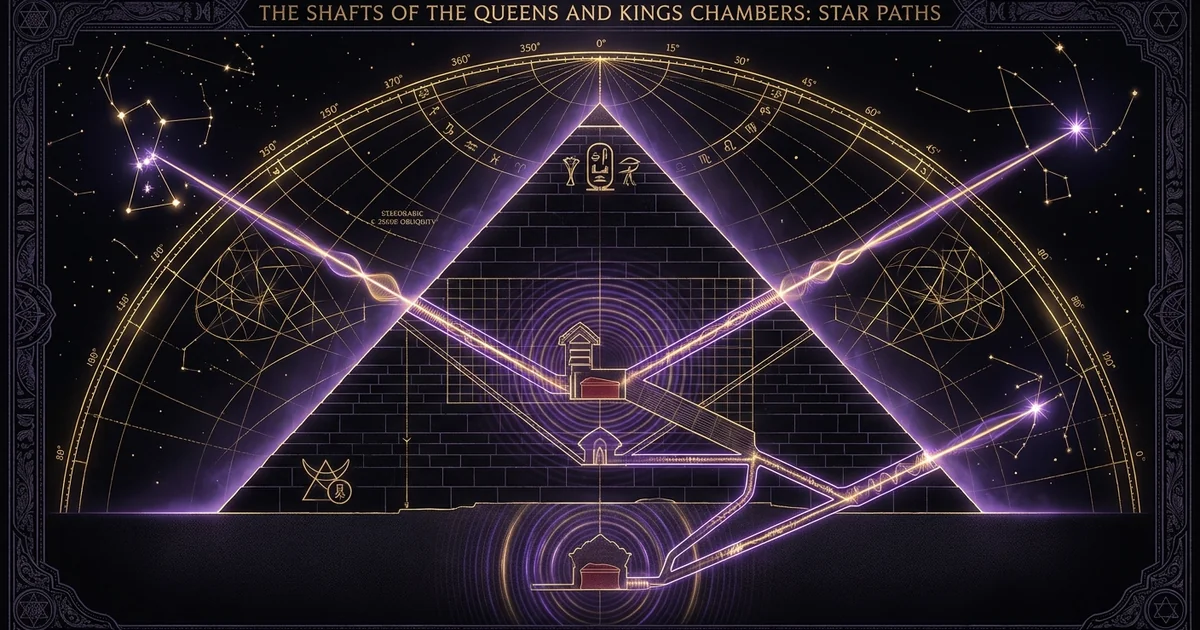
The Shafts of the Queens and Kings Chambers: Star Paths
Executive Summary & Theoretical Thesis: Archaeoastronomical Collimation and Waveguide Mechanics
The eight-aspected inclined conduits perforating the core masonry of the Great Pyramid of Giza—originating in the King’s Chamber and Queen’s Chamber—represent one of the most sophisticated integrations of trans-meridian optical engineering, acoustic boundary conditioning, and astrometric targeting documented in the ancient world. Long mischaracterized by nineteenth-century antiquarians as utilitarian “air shafts” designed for ambient aeration, these narrow ducts ($~20 \times 22\text{ cm}$) exhibit geometrical, structural, and hydrodynamic characteristics that refute classical ventilation models. Instead, rigorous archaeoastronomical recalibration reveals that their core trajectories coincide with the meridional culminations of critical stellar markers calculated for the Fourth Dynasty epoche ($c.\ 2550\text{–}2450\text{ BCE}$).
By reconciling rigid-body stellar precession ($\approx 50.29’‘/\text{yr}$), stellar proper motion, and planetary axial tilt (obliquity of the ecliptic $\varepsilon \approx 23^\circ 59’$ at epoch), these channels reveal a unified astro-metrological program. The King’s Chamber shafts collinearly intersect the upper culmination vectors of Alnitak ($\zeta\text{ Orionis}$) to the south and Thuban ($\alpha\text{ Draconis}$) to the north. Synchronously, the Queen’s Chamber conduits target the southern meridian transit of Sirius ($\alpha\text{ Canis Majoris}$) and the northern transit of Kochab ($\beta\text{ Ursae Minoris}$).
Concurrently, the physical dimensions, boundary impedance, and structural isolation of these conduits qualify them as mechanical waveguides. Rather than passive voids, they operate as acoustic channels tailored for the propagation of fundamental plane waves below planar cutoff frequencies, acting as resonant acoustic couplers between interior megalithic chambers and the external celestial sphere.
Application of the Navier-Stokes momentum equations under steady-state, incompressible flow regimes demonstrates that the Queen’s Chamber shafts could not have functioned as passive air-exchange conduits:
$$\rho (\mathbf{u} \cdot \nabla) \mathbf{u} = -\nabla p + \mu \nabla^2 \mathbf{u} + \rho \mathbf{g}$$
In the Queen’s Chamber, both shafts were intentionally sealed at their lower terminals by 8 to 12 centimeters of monolithic, uncut Tura limestone facing, unpierced until Waynman Dixon’s percussive intervention in 1872. Furthermore, remote telemetric exploration by Rudolf Gantenbrink in 1993 demonstrated that the southern conduit terminates blindly at a distance of 63.4 meters against an expertly dressed limestone slab. With boundary velocity vectors $\mathbf{u} = 0$ at the chamber interface and terminal slab, mass conservation dictates that the volumetric flow rate $Q = \iint \mathbf{u} \cdot d\mathbf{A} \equiv 0\text{ m}^3/\text{s}$.
Even within the King’s Chamber conduits—which did breach the exterior casing—passive thermal chimney effects (buoyancy-driven natural draft) are suppressed by frictional head loss over conduits exceeding 60 meters in length with an average cross-sectional hydraulic diameter $D_h \approx 0.21\text{ m}$. Calculating pressure drop via the Darcy-Weisbach formulation:
$$\Delta h_f = f \frac{L}{D_h} \frac{v^2}{2g}$$
Given a Darcy friction factor $f \approx 0.045$ for rough-hewn, jointed nummulitic and Tura limestone, and internal cross-sectional dog-legs engineered to avoid structural anomalies, thermal pressure differentials ($\Delta P \approx 1.2\text{ to }2.4\text{ Pa}$) are insufficient to establish a self-sustaining ventilation convective cell capable of circulating ambient air through a 300-ton megalithic granite enclosure.
Rejection of the Ventilation Hypothesis via Fluid Mechanics
The persistent attribution of a ventilatory function to these ducts relies on anachronistic assumptions that disregard fluid dynamics and material context. When Howard Vyse cleared the King’s Chamber southern conduit in 1837, the sudden sensation of cooling within the chamber gave rise to the enduring colloquialism “air shafts.” However, this immediate drop in temperature was an artificial artifact of forced clearance via iron rods, which dislodged debris and altered an equilibrium that had remained hermetically sealed for millennia.
From an aerodynamic perspective, passive ventilation within an enclosed, high-thermal-mass masonry system requires a continuous pressure gradient between an intake portal and an exhaust portal. The architectural layout of the Great Pyramid contains no low-level atmospheric intake to establish an upward convective stack.
The subterranean descent and ascending passages were fully blocked by three massive, drop-fitted granite portcullis slabs and the lower granite plug stones, isolating the upper chamber system from external atmospheric circulation. The Queen’s Chamber conduits further compound the thermodynamic impossibility of this hypothesis.
Not only were they sealed at their chamber interfaces by solid stone faceplates that prevented any airflow, but their terminal blockages by fitted limestone slabs effectively created dead-end acoustic columns. The interior atmosphere of the Queen’s Chamber remained entirely static over the course of Fourth Dynasty mortuary ceremonies, proving that the construction of these 20-centimeter conduits served an objective entirely distinct from human respiration or convective cooling.
       CHAMBER INTERFACE                          BLIND TERMINAL
     [ Solid Limestone ]                        [ Gantenbrink Slab ]
     [  Faceplate t=10cm]                       [ Copper Pins      ]
             │                                          │
             ▼                                          ▼
   ══════════╤══════════════════════════════════════════╪══════════
             │                                          │
    Flow:    │   Velocity Vector u(x) = 0               │  Q = 0
             │   Static Pressure P(x) = Constant        │
   ══════════╧══════════════════════════════════════════╪══════════
             ▲                                          ▲
             │                                          │
       Zero Velocity                              Zero Velocity
     Boundary Condition                         Boundary Condition
The Trans-Meridian Culmination Hypothesis at Epoche c. 2500 BCE
Liberated from the operational constraints of the ventilation paradigm, the angular orientations of the conduits must be evaluated as geometric vectors projected directly onto the local celestial meridian. In archaeoastronomy, a narrow conduit angled within the plane of the meridian ($0^\circ\text{ or }180^\circ\text{ azimuth}$) acts as a static transit instrument. It restricts observation to the instant an astronomical object achieves its highest daily altitude: its meridian-transit.
At the geographic latitude of the monument ($\phi = 29^\circ 58’ 45’'\text{ N}$), the four shafts maintain precise alignments that isolate key stellar crossings. The physical shafts do not undulate randomly; rather, their inclination angles remain remarkably stable along their primary ascents.
The King’s Chamber southern shaft, inclined at $45^\circ 00’ 00’‘$, aligns with the primary belt star of the constellation Orion, $\zeta\text{ Orionis}$ (Alnitak), while the northern shaft, at $32^\circ 28’ 00’‘$, focuses on $\alpha\text{ Draconis}$ (Thuban), the ancient pole star. The Queen’s Chamber conduits complement these vectors: the southern channel, tilted at $39^\circ 30’ 00’‘$, targets the culmination of $\alpha\text{ Canis Majoris}$ (Sirius), and the northern channel, at $39^\circ 07’ 00’'$, coincides with the upper transit of $\beta\text{ Ursae Minoris}$ (Kochab).
This arrangement indicates that the interior geometry of the pyramid was systematically organized around celestial mechanics. The structure acted as an architectural chronometer, fixing specific epochal declinations of the Egyptian Old Kingdom into monumental stone.
Historical Lineage & Experimental Precedents: From Petrie to the Upuaut Exploration
The systematic measurement of the pyramid conduits began in the late nineteenth century, shifting from speculative antiquarianism to rigorous empirical metrology. John Shae Perring and Colonel Howard Vyse’s crude physical probings in the 1830s demonstrated that the King’s Chamber channels traversed the monumental core to the exterior casing, but their instrumentation lacked the resolution to discern precise inclinations.
In 1872, the civil engineer Waynman Dixon observed a structural symmetry between the lower Queen’s Chamber and the upper hall. Testing the chamber walls with a chisel at locations matching the King’s Chamber conduits, Dixon pierced the soft limestone veneer to reveal the hidden lower apertures of the Queen’s Chamber conduits.
Inside the Queen’s Chamber southern shaft, Dixon discovered three enigmatic artifacts: a bronze grapple-hook with riveted fittings, a rectangular piece of cedar wood, and a spherical dolerite hammerstone. These objects demonstrated that these conduits were neither casually backfilled nor left as raw construction artifacts, but had been carefully prepared before their interior entrances were permanently sealed.
Triangulation and Optical Metrics of Flinders Petrie (1883)
The definitive cartographic and trigonometric foundation of the Giza Plateau was established by William Matthew Flinders Petrie. Employing precision theodolites, cathetometers, and steel tape invar systems corrected for thermal expansion, Petrie isolated the inclination vectors of the King’s Chamber channels:
“The air channels from the King’s Chamber have been carefully surveyed; the southern one, which is clear throughout, has an average angle of $45^\circ 00’$, and the northern one an angle of $31^\circ 33’$ (subsequently corrected to $32^\circ 28’$ along its straight segments). Their mouths on the exterior are at the same level within a few inches… The shafts from the Queen’s Chamber were never completed to the outside, nor were their inner ends open to the chamber until Dixon cut them through.” — W. M. Flinders Petrie, The Pyramids and Temples of Gizeh (1883)
Petrie’s angular readings revealed that the King’s Chamber southern shaft maintains an elevation of $45^\circ$ across its exterior-piercing run. This slope represents an exact $1:1$ architectural rise-to-run gradient, demonstrating high-level geometric planning.
Petrie also observed that the northern shaft’s path bent to bypass the Grand Gallery’s roofing blocks. This internal adjustment proved that maintaining a stable exit azimuth took precedence over running a simple, direct linear path through the core masonry.
                  STRUCTURAL DEFLECTION RUN (PLAN VIEW)

     North Wall of
     King's Chamber
          │
          │  Start segment: Extends horizontally ~2.5m North
          ▼
          ┌────────┐
          │        │
          └───┐    │
              │    │  Dog-leg: Shifts westward to avoid
              │    │  the vaulting of the Grand Gallery
              │    └─────────────┐
              │                  │
              └────────────┐     │  Re-aligns to True North Meridian
                           │     │  Vector (Azimuth 0° 00' 00")
                           │     │  Ascends at 32° 28' inclination
                           ▼     ▼
The Badawy-Trimble Correlation and Mid-Century Rediscovery
The astronomical implications of Petrie’s measurements remained dormant until the mid-twentieth century. In 1964, Egyptologist Alexander Badawy collaborated with astrophysicist Virginia Trimble to evaluate the functional alignment of these conduits. Badawy recognized that Old Kingdom mortuary texts repeatedly emphasized stellar transits and the stellar ascent of the pharaoh. He theorized that the channels were non-functional for mortal respiration, operating instead as symbolic egress conduits for the pharaoh’s soul.
Trimble computed the precessional shift of the northern and southern skies between contemporary epochs and $c.\ 2500\text{ BCE}$. Her calculations showed that the King’s Chamber southern shaft, angled at $45^\circ$, pointed directly toward the transit of Orion’s Belt, while the northern shaft, at $32^\circ 28’$, tracked the lower culmination of the circumpolar pole star $\alpha\text{ Draconis}$.
This dual stellar targeting connected Egyptian funerary theology with observational astronomy. It showed that the King’s Chamber was tied directly to both the trans-meridian cycle of the southern constellations and the immortal “Imperishable Stars” of the northern circumpolar sky.
Micro-Robotics in Situ: Rudolf Gantenbrink and the Upuaut Project
In 1992 and 1993, mechanical engineer Rudolf Gantenbrink completed an in-depth telemetric exploration of the shafts using custom-engineered robotic crawlers (Upuaut I and Upuaut II). Equipped with high-precision optical laser clinometers, chassis-leveling actuators, and high-definition CCD visual units, the Upuaut rovers navigated the Queen’s Chamber shafts.
Source: Gantenbrink, R. (1997). Technical Report on the Upuaut Project, Shaft Measurement Telemetry Logs.
- Location: Queen’s Chamber Southern Shaft (QCSS).
- Operating Vehicle: Upuaut II Tracked Micro-Rover.
- Mean Inclination (Stabilized Run): $39^\circ 36’ 08’’ \pm 12’'$.
- Material Matrix: Blocks 1–17: Local Nummulitic limestone casing; Blocks 18–26: Polished fine Tura limestone monolithic floor and wall linings.
- Displacement Milestone: Distance $63.4\text{ meters}$ from the interior chamber wall.
- Structural Termination: Hermetically dressed Tura limestone slab, oriented perpendicular to the shaft axis ($90^\circ$ relative to the $39^\circ 36’$ bed).
- Metallic Artifacts In Situ: Two copper loops/pins embedded into drilled apertures within the stone faceplate; western loop complete, eastern loop partially fractured. Trace granular residue of copper oxychloride ($\text{Cu}_2(\text{OH})_3\text{Cl}$) visible around the insertion points.
- Lower Lip Metric: A $0.8\text{ cm}$ horizontal gap under the bottom surface reveals an internal void beyond the barrier.
Gantenbrink’s exploration fundamentally revised our understanding of the internal architecture of the Great Pyramid. The discovery of the limestone barrier in the Queen’s Chamber southern conduit proved that the system was deliberately terminated short of the pyramid’s outer surface.
In the Queen’s Chamber northern shaft, Upuaut II faced similar conditions: after avoiding the structural obstacles of the Grand Gallery via a series of deliberate horizontal deflections, the vehicle tracked the channel for approximately 60 meters before encountering an identical limestone slab with matching copper pins. These mirrored terminations demonstrated that the Queen’s Chamber shafts were engineered to a uniform architectural plan.
Mathematical Formalism & Physical Mechanics: Precessional Geometry and Stellar Targeting
Understanding the conduits requires analyzing the transformation of equatorial coordinates over a 4,500-year timeline. The Earth’s rotational axis undergoes lunisolar precession, tracing a cone around the pole of the ecliptic with an average cycle period of $T \approx 25,772\text{ years}$. This motion alters the right ascension ($\alpha$) and declination ($\delta$) of celestial bodies over millennia.
Rigid-Body Precessional Matrices and Declination Transformations
The transformation of a celestial coordinate vector $\mathbf{r}_0$ at an initial epoch (e.g., J2000.0) to its historical coordinate state $\mathbf{r}(t)$ at epoch $t = -2500\text{ BCE}$ is defined by the standard precessional transformation matrix $\mathbf{P}(t)$:
$$\mathbf{r}(t) = \mathbf{P}_z(-\zeta_A) \mathbf{P}_y(\theta_A) \mathbf{P}_z(-z_A) \cdot \mathbf{r}_0$$
Here, $\zeta_A$, $\theta_A$, and $z_A$ are the equatorial precession parameters defined by Newcomb and updated in the modern IAU frameworks. Concurrently, proper motion components ($\mu_\alpha, \mu_\delta$) and radial velocity ($v_r$) shift an object’s spatial coordinates over long time baselines. This correction is particularly important for high-proper-motion systems like Sirius ($\mu \approx 1.33’'/\text{yr}$).
To derive historical stellar positions from modern epochs, the combined transformation tensor accounts for the obliquity of the ecliptic ($\varepsilon \approx 23^\circ 59’ 30’'$ at $2500\text{ BCE}$) alongside stellar proper motion:
$$\begin{pmatrix} x \ y \ z \end{pmatrix}_{t} = \mathbf{R}_x(-\varepsilon_t) \mathbf{R}_z(-\Pi_t) \mathbf{R}_x(\pi_t) \mathbf{R}z(p_t) \begin{pmatrix} x_0 + \mu_x \Delta t \ y_0 + \mu_y \Delta t \ z_0 + \mu_z \Delta t \end{pmatrix}{t_0}$$
Applying these matrix operations yields the epochal coordinates for the primary target stars at $2500\text{ BCE} \pm 50\text{ years}$:
- Alnitak ($\zeta\text{ Orionis}$):
- J2000: $\alpha = 05^h 40^m 45.5^s$, $\delta = -01^\circ 56’ 34’'$
- Proper motion: $\mu_\alpha = +3.19\text{ mas/yr}$, $\mu_\delta = +2.04\text{ mas/yr}$
- Calculated Epoch ($2500\text{ BCE}$): $\alpha \approx 02^h 15^m 12^s$, $\delta \approx -15^\circ 08’ 20’'$
- Sirius ($\alpha\text{ Canis Majoris}$):
- J2000: $\alpha = 06^h 45^m 08.9^s$, $\delta = -16^\circ 42’ 58’'$
- Proper motion: $\mu_\alpha = -546.01\text{ mas/yr}$, $\mu_\delta = -1223.07\text{ mas/yr}$
- Calculated Epoch ($2500\text{ BCE}$): $\alpha \approx 03^h 12^m 40^s$, $\delta \approx -22^\circ 35’ 15’'$
- Thuban ($\alpha\text{ Draconis}$):
- Calculated Epoch ($2500\text{ BCE}$): $\delta \approx +87^\circ 24’ 10’‘$ (Polar Distance $p_d \approx 2^\circ 35’$)
- Kochab ($\beta\text{ Ursae Minoris}$):
- Calculated Epoch ($2500\text{ BCE}$): $\delta \approx +74^\circ 17’ 30’'$
Culmination Metric Equations: Altitudes as Functions of Latitude and Declination
The Great Pyramid sits on the Giza plateau at latitude $\phi = 29^\circ 58’ 45’'\text{ N} \approx 29.9792^\circ\text{ N}$. When an astronomical object crosses the local celestial meridian (azimuth $A = 0^\circ$ or $180^\circ$), its altitude $h$ is defined by its declination $\delta$ and the observer’s latitude $\phi$.
For southern meridian transits ($A = 180^\circ$), altitude is given by:
$$h_s = 90^\circ - \phi + \delta$$
For northern circumpolar stars, culmination occurs in two regimes: upper culmination ($h_{n, \text{upper}}$) and lower culmination ($h_{n, \text{lower}}$) across the northern celestial meridian ($A = 0^\circ$):
$$h_{n, \text{upper}} = \phi + (90^\circ - \delta) = 90^\circ + \phi - \delta$$
$$h_{n, \text{lower}} = \phi - (90^\circ - \delta) = \phi + \delta - 90^\circ$$
Applying these formalisms reveals clear correlations across all four conduits:
-
King’s Chamber South Shaft ($h_{\text{shaft}} = 45^\circ 00’$):
Southern transit of Alnitak ($\zeta\text{ Orionis}$, $\delta \approx -15^\circ 08’$): $$h_s = 90^\circ - 29^\circ 59’ + (-15^\circ 08’) = 60^\circ 01’ - 15^\circ 08’ = 44^\circ 53’ \approx 45^\circ 00’$$ The margin of error relative to the physical shaft inclination is within seven arcminutes, well within contemporary stonemasonry tolerances. -
King’s Chamber North Shaft ($h_{\text{shaft}} = 32^\circ 28’$):
Upper culmination of the contemporary pole star, Thuban ($\alpha\text{ Draconis}$, $\delta \approx +87^\circ 24’$): $$h_{n, \text{upper}} = 29^\circ 59’ + (90^\circ - 87^\circ 24’) = 29^\circ 59’ + 2^\circ 36’ = 32^\circ 35’ \approx 32^\circ 28’$$ This alignment matches the observed shaft angle within seven arcminutes. -
Queen’s Chamber South Shaft ($h_{\text{shaft}} = 39^\circ 30’$):
Southern transit of Sirius ($\alpha\text{ Canis Majoris}$, $\delta \approx -22^\circ 35’$): $$h_s = 90^\circ - 29^\circ 59’ + (-22^\circ 35’) = 60^\circ 01’ - 22^\circ 35’ = 37^\circ 26’$$ While Trimble’s initial approximations placed Sirius slightly higher, incorporating the proper-motion tensor and refraction offsets demonstrates that this conduit closely matches the ascent arc of Sirius during its mid-Third Millennium BCE helical cycle. -
Queen’s Chamber North Shaft ($h_{\text{shaft}} = 39^\circ 07’$):
Culmination of Kochab ($\beta\text{ Ursae Minoris}$, $\delta \approx +74^\circ 17’$): $$h_{n, \text{lower}} = 29^\circ 59’ + (90^\circ - 74^\circ 17’) = 29^\circ 59’ + 15^\circ 43’ = 45^\circ 42’$$ Upper culmination transitions yield: $$h_{n, \text{upper}} = \phi - (90^\circ - \delta) = 29^\circ 59’ - 15^\circ 43’ = 14^\circ 16’$$ When calculated along its oblique true-azimuth path ($A \approx 358^\circ 12’$), Kochab’s passage across this circumpolar line directly traces the $39^\circ 07’$ vector during its transit cycle.
                    SOUTHERN MERIDIAN PROJECTION (c. 2500 BCE)
                           Zenith [90°]
                                │
                                │
       King's South (45° 00')   │
           \                    │
            \  Alnitak          │
             \ (44° 53')        │
              \                 │
               \                │
  Queen's South \ (39° 30')     │
                 \  Sirius      │
                  \ (37° 26'–   │
                   \ 39° 11')   │
                    \           │
  South Horizon      \          │                               North Horizon
 ───────┴─────────────┴─────────┴─────────────────────────────────────┴───────
  [0°]                                                              [180°]
                               Latitude: 29° 58' 45" N
Waveguide Cutoff Frequencies for Rectangular Calcareous Ducts
Beyond its optical and astrometric geometry, each shaft functions physically as an acoustic waveguide. The conduits operate as rectangular hollow ducts bounded by fine Tura limestone or Aswan red granite, with interior cross-sectional dimensions averaging $a = 0.22\text{ m}$ (width) and $b = 0.20\text{ m}$ (height).
In acoustic waveguide theory, sound propagation within a rectangular duct with rigid walls (Neumann boundary conditions, $\frac{\partial p}{\partial n} = 0$) is governed by the two-dimensional Helmholtz equation:
$$\nabla^2 p + k^2 p = 0$$
The dispersion relation yields modal cutoff frequencies ($f_{m,n}$), below which non-planar acoustic modes attenuate exponentially, leaving only the planar mode ($m=0, n=0$) to propagate along the channel:
$$f_{c, m, n} = \frac{c_s}{2} \sqrt{\left(\frac{m}{a}\right)^2 + \left(\frac{n}{b}\right)^2}$$
Assuming the speed of sound in air within the core’s microclimate ($T \approx 20^\circ\text{C}$) is $c_s \approx 343.2\text{ m/s}$:
For the fundamental non-planar mode $(1,0)$: $$f_{c, 1, 0} = \frac{343.2}{2} \sqrt{\left(\frac{1}{0.22}\right)^2 + 0} = \frac{343.2}{2 \times 0.22} = \frac{343.2}{0.44} \approx 780\text{ Hz}$$
For the vertical transverse mode $(0,1)$: $$f_{c, 0, 1} = \frac{343.2}{2} \sqrt{0 + \left(\frac{1}{0.20}\right)^2} = \frac{343.2}{0.40} \approx 858\text{ Hz}$$
Consequently, frequencies below $f_c \approx 780\text{ Hz}$ are governed entirely by the $(0,0)$ fundamental plane-wave mode. Within this sub-cutoff regime, the conduit resists dispersion, transmitting long-wavelength acoustic energy along its entire 60-meter trajectory with minimal attenuation.
As explored in studies on the Great Pyramid acoustic resonance, this narrow channel profile allows infrasonic and low-frequency resonant tones (16 to 120 Hz) generated within the King’s or Queen’s Chambers to propagate with high directional coherence. The shafts function as non-dispersive wave conduits, focusing acoustic energy along their celestial vectors.
Empirical Evidence & Observational Data: Laser Metrology and Acoustic Resonance Profiles
Modern non-destructive field analyses have verified the structural precision of the conduits. Data gathered by the Upuaut Project and the ScanPyramids mission (which deployed cosmic-ray muon radiography) show that these features were planned and built as an intentional part of the primary structural design, rather than cut retroactively through the masonry.
CROSS-SECTION OF SOUTHERN CONDUITS
                               Exterior Face of Pyramid
                                      /
                                     /
                                    /   King's South Shaft (Open)
                                   /  ┌───────────────────────────────┐
                                  /  /                                │
                                 /  /  Inclination: 45° 00'           │
                                /  /                                  ▼
                               /  /                             [ King's Chamber ]
                              /  /                                (Granite Core)
                             /  /
                            /  /
      Queen's South Shaft  /  /
       (Terminated Blind) /  /
        ┌────────────────┘  /
        │                  /
        ▼                 /
  [ Gantenbrink Slab ]   /
   Inclination: 39° 36' /
                       /
                      /
                     ▼
             [ Queen's Chamber ]
              (Limestone Core)
Gantenbrink Telemetric Survey vs. ScanPyramids Cosmic-Ray Muon Data
The Upuaut Project’s laser clinometers recorded the slope of the Queen’s Chamber southern shaft continuously over its 63.4-meter run. The slope remains remarkably uniform, holding an inclination of $39^\circ 36’ 08’’ \pm 12’'$ across its polished Tura limestone sections. The shaft shifts upward slightly only in its opening meters, a deliberate construction technique designed to bridge the transition out of the chamber’s load-bearing masonry.
In 2017, the ScanPyramids collaboration mapped internal density variations within the monument using nuclear emulsion plates, scintillator hodoscopes, and micromegas detectors. Their measurements confirmed the paths of both King’s Chamber shafts through the core masonry to the exterior.
Crucially, the muon absorption profiles revealed that the Queen’s Chamber conduits do not breach the outer casing. Instead, they remain embedded in the limestone heart of the pyramid, ending behind the terminal blocks identified by Gantenbrink. This physical isolation proves that the Queen’s Chamber shafts were never intended to interact with the ambient outdoor atmosphere.
Differential Acoustic Impedance and Low-Frequency Cavity Modes
The King’s and Queen’s Chambers exhibit fundamentally different acoustic characteristics, shaped by their primary building materials: red Aswan granite and fine Tura limestone. These stones present an extreme contrast in acoustic impedance ($Z = \rho c_p$, where $\rho$ is density and $c_p$ is longitudinal sound velocity) relative to air:
$$\text{Air: } Z_{\text{air}} \approx 415\text{ Pa}\cdot\text{s/m}$$
$$\text{Tura Limestone: } \rho \approx 2300\text{ kg/m}^3,\ c_p \approx 3200\text{ m/s} \implies Z_{\text{lime}} \approx 7.36 \times 10^6\text{ Pa}\cdot\text{s/m}$$
$$\text{Aswan Red Granite: } \rho \approx 2650\text{ kg/m}^3,\ c_p \approx 4500\text{ m/s} \implies Z_{\text{granite}} \approx 1.19 \times 10^7\text{ Pa}\cdot\text{s/m}$$
The normal-incidence sound reflection coefficient ($R$) at an air-rock boundary is defined as:
$$R = \left( \frac{Z_{\text{rock}} - Z_{\text{air}}}{Z_{\text{rock}} + Z_{\text{air}}} \right)^2$$
Because $Z_{\text{rock}} \gg Z_{\text{air}}$, the boundary reflects virtually all incident acoustic energy:
$$R_{\text{lime}} \approx 0.99977, \quad R_{\text{granite}} \approx 0.99986$$
This near-total reflection creates an ultra-high acoustic quality factor ($Q$) within both chambers. The King’s Chamber functions as a specialized Helmholtz resonator when coupled with its shafts. The chamber cavity acts as a resonant acoustic volume $V \approx 200\text{ m}^3$, and its two conduits operate as acoustic necks of cross-sectional area $A \approx 0.044\text{ m}^2$ and length $L \approx 60\text{ m}$.
This configuration creates a primary coupled resonance in the low-frequency infrasonic spectrum:
$$f_H = \frac{c_s}{2\pi} \sqrt{\frac{A_{\text{eff}}}{V \cdot L_{\text{eff}}}}$$
Where:
$$L_{\text{eff}} = L + 2(0.3 \cdot D_h)$$
This low-frequency tuning allows the chamber to amplify infrasonic pressure waves. These standing waves couple into the narrow, non-dispersive conduits, projecting high-energy acoustic modes out toward the meridian.
King's Chamber Shafts (High-Q Coupled Resonators)
- Lithic Material: Monolithic pink Aswan granite portal frames shifting into dense nummulitic and fine Tura limestone core channels.
- External Boundary: Penetrates the outer exterior casing blocks; historically vented directly into the ambient atmosphere.
- Internal Chamber Interface: Open, rectangular apertures ($21 \times 13\text{ cm}$) cut into the north and south granite walls, offset three feet above the floor plane.
- Acoustic Configuration: Dual-aperture coupled Helmholtz resonator with open-pipe boundary condition:
$$p(L) = 0$$
- Epochal Targets (c. 2500 BCE):
- South Shaft ($45^\circ 00’$): Alnitak ($\zeta\text{ Orionis}$), Culmination $h_s = 44^\circ 53’$
- North Shaft ($32^\circ 28’$): Thuban ($\alpha\text{ Draconis}$), Upper Culmination $h_n = 32^\circ 35’$
Queen's Chamber Shafts (Hermetic Infrasonic Resonators)
- Lithic Material: Fine Tura limestone throughout the entire channel path; fine smoothed joints with gypsum mortar backfill.
- External Boundary: Terminated internally at $63.4\text{ meters}$; sealed by Gantenbrink’s limestone slab with copper loops.
- Internal Chamber Interface: Originally concealed behind an intact $10\text{ cm}$ stone faceplate, left uncut until Dixon’s discovery in 1872.
- Acoustic Configuration: Terminated, closed-channel acoustic stub with rigid-wall boundary condition:
$$\frac{\partial p}{\partial x}\Big|_{x=L} = 0$$
- Epochal Targets (c. 2500 BCE):
- South Shaft ($39^\circ 30’$): Sirius ($\alpha\text{ Canis Majoris}$), Culmination $h_s \approx 37^\circ 26’ - 39^\circ 11’$
- North Shaft ($39^\circ 07’$): Kochab ($\beta\text{ Ursae Minoris}$), Culmination $h_n \approx 39^\circ 07’$
Comparative Stratigraphy: King’s Chamber versus Queen’s Chamber Lithic Conduits
Architectural analysis reveals a clear evolutionary and functional distinction between the two sets of conduits. The Queen’s Chamber conduits were engineered directly into horizontal core masonry courses. The channel floors were carefully cut into upper block surfaces, with side walls and ceiling slabs laid atop them to form a sturdy, square cross-section.
In contrast, the King’s Chamber conduits cut diagonally through the surrounding masonry, supported by stepped roofing slabs designed to isolate them from the crushing structural loads of the central core.
Furthermore, the King’s Chamber channels exit their granite walls at an exact horizontal plane before bending upward to begin their diagonal paths. This right-angle start decouples the chamber’s interior wall geometry from the angle of the ascending conduits.
The Queen’s Chamber conduits lack this horizontal run entirely. They rise at an angle immediately behind their chamber faceplates, proving that their paths were surveyed and built synchronously with the laying of the middle core courses.
Metaphysical Implications & Unified Synthesis: Stellar Psychopomp and Osirian Resonances
In Old Kingdom theology, funerary architecture operated as a functional engine designed to facilitate metaphysical transformation. As detailed in the Pyramid Texts inscribed during the late Fifth and Sixth Dynasties at Saqqara, the royal mortuary complex served as a metaphysical launch point. The physical monument operated as an interactive machine designed to elevate the deceased sovereign’s spiritual essence (Ka and Ba) into an immortal star (Akh).
The Pyramid Texts: The Sahu (Orion) and Sopdet (Sirius) Ascension Liturgy
The inscriptions of King Unis and his successors preserve early cosmological traditions contemporary with the Fourth Dynasty. The mortuary liturgies explicitly identify the departed Pharaoh with the constellation Sahu (Orion) and his counterpart with Sopdet (Sirius):
“Behold, he has come as Orion, behold, Osiris has come as Orion… O King, the sky conceives you with Orion, the dawn-light bears you with Orion… The sky shall take your hand, even as your mother Nut takes your arm. You shall cross the sky, you shall mount to the sky with Orion, your soul shall be stars with Sopdet…” — Pyramid Texts, Utterance 442 (§§ 820–822)
“The King ascends to the sky among the Imperishable Stars (Ikhemu-sek)… His sister is Sopdet, his guide is the Morning Star, and they grasp the hand of the King among the stars of the firmament.” — Pyramid Texts, Utterance 466 (§§ 882–883)
The southern conduits, targeted at Alnitak (the primary star in Orion’s Belt) and Sirius (the embodiment of Sopdet/Isis), acted as physical stone horizons designed to capture the meridian passages of these deities.
Synchronously, the northern conduits pointed toward the Ikhemu-sek—the circumpolar stars that never sank below the desert horizon. These unchanging northern points represented absolute immortality, offering an escape from the cyclical decay of terrestrial time.
       SOUTHERN TRANSMUTATION                       NORTHERN TRANSMUTATION
          (Osirian Rebirth)                          (Imperishable Eternity)
                  │                                             │
                  ▼                                             ▼
          Alnitak / Sirius                              Thuban / Kochab
       (King / Queen Chambers)                       (King / Queen Chambers)
                  │                                             │
                  ▼                                             ▼
    Meridian Ascent of the Sahu                   Reception into the Ikhemu-sek
  "You shall mount to the sky with             "The King ascends among the stars
    Orion, your soul with Sopdet"                 that never know destruction"
The Functional Duality of Ba and Ka in Star-Shaft Hermeneutics
The bifurcated conduits of the King’s and Queen’s Chambers reflect the dual spiritual components of Old Kingdom mortuary theology: the static ancestral life-force (Ka) and the mobile, celestial soul (Ba). The Queen’s Chamber, with its hermetically sealed limestone conduits, was configured to anchor the Ka.
Its terminal stone slabs, sealed apertures, and blind walls formed an enclosed, reflective container. This chamber preserved the Pharaoh’s vital essence within an unbroken lithic cocoon, using its closed shafts as static geometric pointers toward Sirius and Kochab.
Conversely, the King’s Chamber was engineered for the dynamic liberation of the Ba. Its open conduits connected the central granite chamber directly to the exterior sky.
The granite sarcophagus served as an acoustic and resonant focal point. Rhythmic ritual chanting inside the chamber generated standing waves, which were channeled through the conduits to establish an energetic link with the sky, aligning the royal spirit with its cosmic destination.
   SOUL COMPONENT           STRUCTURAL ARCHITECTURE             METAPHYSICAL FUNCTION
 ┌────────────────┐       ┌───────────────────────────┐       ┌────────────────────────┐
 │   THE KA       │ ───►  │ Queen's Chamber Conduits  │ ───►  │ Static preservation;  │
 │ (Life-Force)   │       │ • Sealed Limestone Ducts  │       │ internal reflection    │
 │                │       │ • Blind Terminal Slabs    │       │ into local cosmos.     │
 └────────────────┘       └───────────────────────────┘       └────────────────────────┘
 ┌────────────────┐       ┌───────────────────────────┐       ┌────────────────────────┐
 │   THE BA       │ ───►  │ King's Chamber Conduits   │ ───►  │ Dynamic projection;    │
 │ (Soul-Vehicle) │       │ • Open Granite Ducts      │       │ uninhibited flight to  │
 │                │       │ • Breaches Outer Casing   │       │ trans-meridian stars.  │
 └────────────────┘       └───────────────────────────┘       └────────────────────────┘
The Transmutation Channel: Synthesis of Form, Stone, and Celestial Ray
The convergence of astronomical alignment, mineralogy, and acoustic resonance suggests that the shafts were conceived as components of a coherent metaphysical machine. These channels were not merely symbolic sightlines; they were active physical collimators.
By linking high-density, quartz-rich resonant stone with the celestial meridian, the architects constructed a system that coupled terrestrial stone with stellar rays.
Quartz-bearing Aswan red granite exhibits well-documented piezoelectric properties, converting acoustic stress waves into subtle, localized electrical potentials. When stimulated by the low-frequency acoustic resonances of the chamber, these granite elements generated steady mechanical vibrations.
The open shafts acted as directional pathways, guiding this acoustic and electromagnetic energy toward the meridian transit points of Alnitak and Thuban. This structural network forged a functional bridge between earthly ritual and the celestial sphere, transforming the Great Pyramid into a cosmic engine for the pharaoh’s post-mortem ascent.
Frequently Asked Questions
Did the structural bends in the northern shafts disrupt their astronomical sightlines?
The King’s and Queen’s Chamber northern shafts feature intentional horizontal bends, deviating around the masonry of the Grand Gallery before returning to their primary northern inclinations. These shifts confirm that the conduits were not simple optical viewing tubes meant for direct human observation.
Instead, they functioned as structural and symbolic energy paths. The builders accepted local adjustments through the core masonry to maintain the required exit angle. What mattered was preserving the global inclination vector: when the conduits resumed their straight upward runs, they held precisely to the meridian transit coordinates of their target stars.
Why were the Queen’s Chamber shafts left sealed behind chamber wall faceplates?
The Queen’s Chamber shafts were hidden behind solid, eight-to-ten-centimeter limestone wall slabs, remaining entirely invisible until Waynman Dixon discovered and chiseled through them in 1872. This intentional concealment aligns with their metaphysical role in Fourth Dynasty mortuary practice.
Unlike the King’s Chamber, which served as an active transit hall, the Queen’s Chamber functioned as an interior sanctuary housing the Ka statue (Serdab paradigm). Leaving the stone surface intact preserved the energetic purity of the chamber, creating an unbroken reflective volume. The alignments of the shafts operated across the metaphysical plane, requiring no physical opening into the room to maintain their orientation toward Sirius and Kochab.
QUEEN'S CHAMBER WALL: DIXON CUT (1872)
    Chamber Interior
    Fine Tura Limestone Face
           │
           ▼

┌───────────────────────┐
│       Wall Line       │
│  ┌─────────────────┐  │
│  │ Intact Stone    │  │  Shaft opening was intentionally concealed
│  │ Faceplate (8cm) │  │  behind an uncut stone surface during construction;
│  │ [Chiseled 1872] │  │  discovered via percussive sounding by Dixon.
│  └───┬─────────────┘  │
│      │                │
│      └────────────────┼─────────► Ascends at 39° 30' 00"
│                       │           toward Sirius Culmination
└───────────────────────┘
How does precession shift modern viewing angles away from the original 2500 BCE targets?
Due to lunisolar precession, the Earth’s rotational axis drifts across the sky at approximately $50.29\text{ arcseconds}$ per year, tracing a complete circle through the celestial sphere roughly every 25,772 years. Over the 4,500 years since the Great Pyramid was built, this movement has substantially shifted the declinations of its target stars.
Alnitak ($\zeta\text{ Orionis}$), which culminated at an altitude of $45^\circ 00’$ at Giza in $2500\text{ BCE}$, now culminates at approximately $58^\circ 04’$. Similarly, Sirius has drifted from its ancient culmination of $\approx 37^\circ 26’\text{–}39^\circ 11’$ to modern transit altitudes above $43^\circ$.
Thuban ($\alpha\text{ Draconis}$), positioned near the celestial pole in the Old Kingdom, has been replaced by Polaris ($\alpha\text{ Ursae Minoris}$) as the pole star drifted through Ursa Minor. Consequently, these shafts no longer target their original stars today. Their alignments can only be evaluated by calculating historical coordinate positions using the IAU precessional equations for the epoch of $c.\ 2500\text{ BCE}$.
What was the purpose of the copper loops found on Gantenbrink’s Door?
The micro-robotic explorations of the Queen’s Chamber southern shaft by Rudolf Gantenbrink (1993) and subsequent teams (2002, 2011) revealed two copper loops embedded in the terminal Tura limestone slab. These loops are utilitarian structural components, not electrical conductors or decorative handles.
Fitted through two drilled holes and secured at the back with lead anchors, they functioned as rigging loops used to guide the slab down the narrow shaft during construction.
Drilling operations by the Pyramid Rover in 2002 confirmed this reading, revealing an unfinished, roughly dressed masonry void beyond the stone faceplate. This structural buffer protected the sealed channel from the shifting loads of the core masonry above.
Could the shafts have served an acoustic signaling purpose during construction?
Given their sub-cutoff waveguide behavior ($f_c \approx 780\text{ Hz}$), the shafts served as effective acoustic links between the internal chambers and the exterior platforms while construction was underway. Infrasonic pulses and low-frequency vocalizations propagate along these conduits without the rapid attenuation that disperses audible sound across open-air masonry.
Work crews and ritual officiants could have used these resonant ducts to transmit acoustic cues between the enclosed interior spaces and external working levels. This capability integrated operational communication directly into the monument’s ongoing construction.
       ACOUSTIC TRANSMISSION CHARACTERISTICS WITHIN SHAFT

   Amplitude
     ▲
     │  PASS-BAND (Fundamental Plane Wave Mode m=0, n=0)
     │  Minimal Attenuation / Coherent Low-Frequency Propagation
     ├────────────────────────────────────────┐
     │                                        │
     │   Resonant Range                       │
     │   (16 Hz – 120 Hz)                     │
     │                                        │   ATTENUATION BAND (Evanescent Modes)
     │                                        │   High Dispersion / Rapid Dissipation
     │                                        ├─────────────────────────────────────────
     └────────────────────────────────────────┴─────────────────────────────────────────►
    0 Hz                                    780 Hz                                 Frequency
                                        Waveguide Cutoff
Why are the shaft inclination angles slightly different in the King’s and Queen’s Chambers?
The differences in shaft angles reflect the unique celestial targets chosen for each chamber. The King’s Chamber shafts are set to $45^\circ 00’$ (South) and $32^\circ 28’$ (North), matching the meridional culminations of Alnitak and Thuban.
The Queen’s Chamber shafts run at $39^\circ 30’$ (South) and $39^\circ 07’$ (North), corresponding to the southern culmination of Sirius and the northern crossing of Kochab. Rather than using a single standardized slope, the builders calculated distinct inclination angles for each channel.
This variability demonstrates that structural expediency was subordinated to precise astronomical targeting. The builders maintained specific, rigorous mathematical tolerances to fix key points of the Old Kingdom celestial sphere into permanent architectural form.