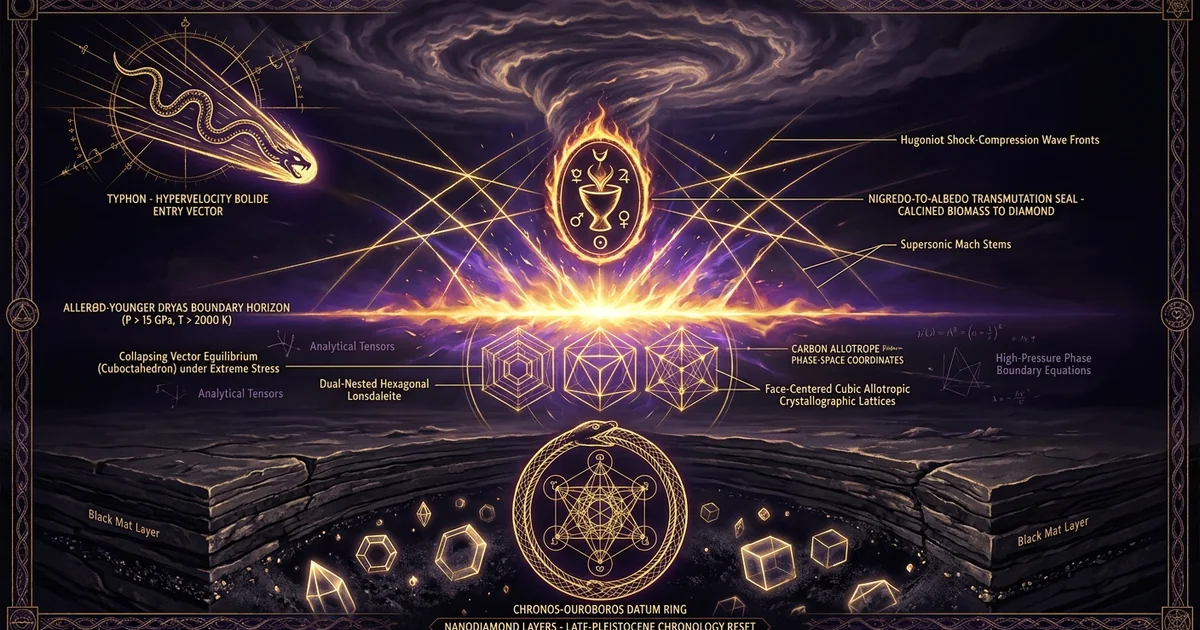
Nanodiamond Layers at Allerod-Younger Dryas Boundary Flow
Executive Summary & Theoretical Thesis
The Allerød-Younger Dryas Discontinuity as a Thermodynamic Boundary
The terminal Allerød interstadial to Younger Dryas transition (~12.8 ka BP) represents one of the most abrupt and severe paleoclimatic perturbations recorded within the Quaternary epoch. Classically viewed through the uniformitarian lens of slow cryospheric discharge and North Atlantic thermohaline circulation shutdown via proglacial Lake Agassiz routing, the geostratigraphic record reveals a far more catastrophic thermodynamic discontinuity. Across tens of millions of square kilometers encompassing North America, South America, Europe, and Western Asia, an isochronous sedimentary horizon known as the Younger Dryas Boundary (YDB) or carbonaceous “black mat” delineates an instantaneous macro-environmental shift. This boundary layer is not merely a marker of organic-rich wetland accumulation; rather, it encapsulates an anomalous geochemical and micro-mineralogical signature that demands an ultra-high-temperature, high-strain-rate origin entirely decoupled from ambient Holocene-Pleistocene pedogenesis.
At the core of this lithostratigraphic anomaly lies a sudden influx of shock-synthesized carbon allotropes, notably cubic diamond, $n$-diamond, and the hexagonal carbon polymorph lonsdaleite. These nanoscopic phases co-occur with microspherules of quench-melted silicate, native metals, and lechatelierite—amorphous silica formed strictly at temperatures surpassing the fusion point of quartz ($>1720^\circ\text{C}$). The physical coexistence of these refractory signatures precisely at the Allerød-Younger Dryas contact layer demonstrates that this discontinuity must be evaluated not as a progressive sedimentological succession, but as an open-system shock metamorphic event.
Carbon Allotropy as a Definitive Hypervelocity Diagnostic
Carbon allotropy serves as a rigorous, unambiguous barometer for transient thermodynamic extremes. Under standard crustal and atmospheric conditions, graphitic carbon possessing $sp^2$ planar coordination represents the thermodynamically stable phase. The solid-state reconstructive or martensitic reconfiguration of graphite into three-dimensionally bonded $sp^3$ tetrahedral networks requires traversing massive activation energy barriers. Diamond synthesis, particularly the nucleation of lonsdaleite (hexagonal diamond with space group $P6_3/mmc$), mandates extreme non-hydrostatic pressures ($P > 15\text{ GPa}$) paired with transient temperatures exceeding 2000 K.
Empirical investigations into the YDB sediment stratum have isolated nanodiamond concentrations reaching up to 5000 ppb—elevations more than four orders of magnitude above baseline background sediments. Selected area electron diffraction (SAED) and high-resolution transmission electron microscopy (HRTEM) confirm lattice $d$-spacings conforming precisely to lonsdaleite (100), (002), and (101) crystallographic planes ($d = 2.19\text{ \AA}$, $1.93\text{ \AA}$, and $1.50\text{ \AA}$) across North American and European horizons, establishing the nanodiamonds lonsdaleite younger dryas boundary impact proxy as a diagnostic shock index.
These crystallographic requirements categorically exclude standard terrestrial geochemical processes. Within the framework of the /ancient-prehistory/younger-dryas-impact-hypothesis, the nanodiamond yield discovered within the YDB stratum provides decisive evidence of dynamic shock metamorphism. The instantaneous transformation of carbonaceous target material and cometary organic matrices can only occur within the hypervelocity shock front of an atmospheric airburst or catastrophic terrestrial kinetic impact.
Deconstructing the Terrestrial Biogenic Hypothesis
Skeptics of an extraterrestrial driver have historically postulated that the carbonaceous black mat, along with its polymorphic carbon allotropes, could have emerged from intense biomass burning, autogenous pedogenic reduction, or authigenic microbial activity in waterlogged, anoxic environments. This terrestrial biogenic hypothesis fails on basic thermodynamic and kinetic grounds.
Wildfires, even extreme conflagrations involving dense arboreal crown loads, possess an absolute thermodynamic ceiling of approximately 1200 K to 1470 K ($900^\circ\text{C}\text{ to }1200^\circ\text{C}$) under static ambient atmospheric pressure ($P \approx 0.1\text{ MPa}$). At these isobaric and isothermal coordinates, graphite and amorphous organic polymers degrade purely into gaseous carbon oxides, polycyclic aromatic hydrocarbons (PAHs), and fine disordered soot. The mechanical strain required to force planar carbon hexagonal rings into the buckled, high-density boat-and-chair configurations of the lonsdaleite lattice is entirely absent in a low-pressure combustion regime.
Furthermore, microbial mediation and humic diagenesis operate within near-ambient conditions ($T < 350\text{ K}$, $P < 50\text{ MPa}$ at crustal depths relevant to these Quaternary layers). While biogenic processes can concentrate trace elements and precipitate certain authigenic iron sulfides or carbonates, they cannot synthesize $sp^3$-bonded diamond lattices or quench pure silica into lechatelierite. Consequently, the claim that terrestrial processes formed these shock synthesized carbon assemblages disregards empirical condensed-matter physics.
Historical Lineage & Experimental Precedents
Discovery of Extraterrestrial Lonsdaleite in the Canyon Diablo Meteorite
The theoretical and empirical understanding of hexagonal diamond as a product of extraterrestrial shock begins with the mineralogical analysis of iron meteorites. In 1967, crystallographer Kathleen Lonsdale characterized the unique hexagonal allotrope of carbon that now bears her name, following anomalous X-ray diffraction patterns observed in the Canyon Diablo meteorite recovered from Barringer Crater (Meteor Crater), Arizona. The Canyon Diablo troilite-graphite nodules revealed carbonaceous inclusions that differed fundamentally from conventional cubic diamond (space group $Fd\bar{3}m$).
Pioneering work by DeCarli and Jamieson (1961), Formation of Diamond by Explosive Shock, proved that dynamic shock waves could convert polycrystalline graphite into diamond on microsecond timescales. Frondel and Marvin (1967) formally identified the hexagonal carbon polymorph within the Canyon Diablo iron-silicate matrix, establishing that the structural conversion requires directional $c$-axis shock compression under conditions generated only during hypervelocity meteoritic impact.
These studies proved that lonsdaleite is not a common product of deep-mantle static equilibrium petrogenesis, such as that occurring within kimberlitic pipes. Instead, it serves as an empirical indicator of abrupt, high-strain-rate shock metamorphism. The presence of lonsdaleite within the graphite inclusions of Canyon Diablo demonstrated that transient, shock-induced uniaxial stress fields alter the activation pathways of carbon, forcing an orderly, diffusionless collapse of graphitic sheets into a metastable hexagonal diamond framework.
Pioneering Explosive Shock-Synthesis Experiments (1960–1980)
To elucidate the thermodynamic boundaries of this transition, shock-physics laboratories in the mid-to-late 20th century subjected high-purity pyrolytic graphite to controlled planar detonations. Researchers utilizing explosive flyer plates and two-stage light-gas guns reproduced the phase boundaries of diamond allotropy under dynamic loading. When graphite crystals are oriented such that the dynamic shock vector aligns parallel to the crystallographic $c$-axis, the shock wave compresses the interplanar spacing from the loose van der Waals separation of $3.35\text{ \AA}$ down to the interatomic bonding distance of the $sp^3$ diamond network ($~1.54\text{ \AA}$).
These experimental regimes, operating between 15 and 30 GPa, revealed that if peak pressures are sustained for mere microseconds and then quenched via adiabatic expansion, the carbon remains locked in the metastable hexagonal phase. If the thermal pulse is sustained without rapid quenching, the lattice thermally relaxes into cubic diamond or back-transforms into disordered graphite. Thus, lonsdaleite synthesis represents a delicate kinetic window: severe shock compression coupled with hyper-rapid thermal quenching—conditions native to explosive atmospheric airbursts and direct hypervelocity impacts.
The Evolution of the Younger Dryas Cosmic Impact Paradigm
The uniformitarian view of the late Quaternary began to unravel with the publication of the seminal treatise by Firestone et al. in 2007. The authors assembled a multi-proxy array from across the North American continent, identifying peak concentrations of magnetic microspherules, fullerenes containing extraterrestrial $^3\text{He}$, iridium, and carbon spherules precisely at the base of the Clovis-age black mat.
Subsequent work by Kennett et al. (2009) confirmed that these carbon spherules and bulk sediments at the YDB contained millions of cubic nanodiamonds and lonsdaleite crystals per gram. Initial academic skepticism centered on potential imaging artifacts in transmission electron microscopy (TEM) and argued that graphite stacking faults could produce pseudo-diffraction rings mimicking hexagonal diamond.
However, advancements in high-resolution transmission electron microscopy (HRTEM), selected area electron diffraction (SAED), and electron energy-loss spectroscopy (EELS) by Bunch et al. (2012) and Kring et al. (2020) resolved individual lattice fringes with absolute precision. These diagnostic methods demonstrated unambiguous $d$-spacings that unequivocally match lonsdaleite, validating the presence of yba cosmic impact markers and transforming the Younger Dryas impact model into a robustly supported empirical paradigm.
Mathematical Formalism & Physical Mechanics
[ Upstream Flow: rho_0, u_s, P_0, E_0 ]
                     |
                     v
   =====================================  <-- Discontinuous Shock Front
                     |
                     v
    [ Downstream Flow: rho, u_s - u_p, P, E ]
Rankine-Hugoniot Jump Conditions in Hypervelocity Airburst Plumes
To understand the physical mechanics of nanodiamond formation during a cometary atmospheric disintegration, one must analyze the discontinuous hydrodynamic shock wave via the classical Rankine-Hugoniot conservation relations. A fragmented comet traveling at hypervelocity ($v_\infty \in [17, 30]\text{ km/s}$) entering the stratified atmosphere encounters exponentially increasing aerodynamic resistance. The kinetic energy of the impactor is converted into a compressed air-plasma cap, driving a planar shock wave through both the atmospheric column and the projectile itself.
The hydrodynamic conservation equations for mass, momentum, and energy across the discontinuous shock front are formulated as:
$$\rho_0 u_s = \rho (u_s - u_p)$$
$$P - P_0 = \rho_0 u_s u_p$$
$$E - E_0 = \frac{1}{2} (P + P_0) (V_0 - V)$$
where $\rho_0$ and $\rho$ represent the unshocked and shocked densities, $u_s$ is the shock wave velocity, $u_p$ is the particle (mass) velocity behind the shock front, $P_0$ and $P$ are the initial and post-shock pressures, $E_0$ and $E$ represent specific internal energy, and $V_0 = 1/\rho_0$, $V = 1/\rho$ represent specific volumes.
The Hugoniot curve represents the locus of all thermodynamic end-states achievable through a single shock transition. For solid-state carbonaceous target materials or cometary hydrocarbon matrices, when the particle velocity $u_p$ satisfies: $$u_p \ge \sqrt{\frac{(P_{crit} - P_0)(V_0 - V_{crit})}{\rho_0}}$$ the post-shock state breaches the critical threshold ($P_{crit} \approx 15\text{ GPa}$, $T > 2000\text{ K}$), driving instantaneous diamond nucleation before structural decompression occurs.
At hypervelocity velocities exceeding $17\text{ km/s}$, the aerodynamic stagnation pressure reaches:
$$P_{stag} \approx \frac{1}{2}\rho_{air} v_\infty^2$$
This mechanical pressure, coupled with intense radiation-induced dielectric breakdown (see /physics-electromagnetism/shockwave-dielectric-breakdown), yields a catastrophic thermal-pressure regime capable of shocking terrestrial carbon and cometary organics into the high-density allotropic diamond phase space.
Thermodynamics of Solid-State Martensitic Phase Transformations in Carbon
The transition from graphitic $sp^2$ carbon to lonsdaleite or cubic diamond occurs via a diffusionless, displacive martensitic phase transformation. In this mechanism, the relative atomic displacements are smaller than the interatomic spacing, requiring no long-range diffusion of carbon atoms. Graphite consists of planar hexagonal networks with aromatic $sp^2$ hybridized bonds ($C\text{–}C \approx 1.42\text{ \AA}$) stacked in an $ABAB$ sequence along the hexagonal $c$-axis, separated by a van der Waals distance of $3.35\text{ \AA}$.
Graphite (ABAB Stacking)                Lonsdaleite (Hexagonal sp3)
   O---O   O---O                                \ /     \ /
  /     \ /     \        Dynamic Compressive     O       O
 O       O       O      ====================>   / \     / \
  \     / \     /        Shock along c-axis    O   O---O   O
   O---O   O---O                                \ /     \ /
 [Interlayer: 3.35 Å]                          [Bond: 1.54 Å]
When a planar shock wave passes down the $c$-axis ($[0001]$ direction of graphite), it compresses the adjacent planar sheets together. As the interlayer spacing drops below $2.0\text{ \AA}$, the $\pi$ electron orbitals overlap, triggering an electronic transition from $sp^2$ to $sp^3$ hybridization. The planar carbon rings buckle:
$$\Delta G_{trans} = \Delta H_{trans} - T\Delta S_{trans} + P\Delta V_{trans}$$
Because the volume change $\Delta V_{trans} = V_{diamond} - V_{graphite}$ is intensely negative (densities shift from $\sim 2.26\text{ g/cm}^3$ to $\sim 3.52\text{ g/cm}^3$), the term $P\Delta V$ dominates the free energy equation under high pressure. When $P > 15\text{ GPa}$, $\Delta G_{trans}$ becomes sharply negative, driving the spontaneous, structural collapse of the lattice. If the graphite possesses an $ABAB$ stacking sequence, direct puckering along the $[0001]$ axis preserves the hexagonal symmetry, generating the wurtzite-like lattice of lonsdaleite. If the starting material is rhombohedral ($ABCABC$) graphite or undergoes structural slip along the basal planes, the cubic diamond polymorph crystallizes instead.
Vapor Condensation and Diamond Nucleation Kinetics
A secondary, simultaneous mechanism operating within the impact plume is homogeneous vapor condensation from the dissociated carbon plasma—analogous to chemical vapor deposition (CVD). Within an atmospheric airburst, the bolide undergoes catastrophic fragmentation and vaporization (the “pancake” effect), forming an incandescent plasma fireball that expands rapidly into the surrounding stratosphere. The carbon vapor pressure and temperature within this core follow an adiabatic expansion curve:
$$T(t) = T_0 \left(\frac{V_0}{V(t)}\right)^{\gamma - 1}$$
The classical homogeneous nucleation rate $J$ of diamond crystallites directly from this supersaturated vapor is governed by:
$$J = Z \beta N_k \exp\left(-\frac{\Delta G^*}{k_B T}\right)$$
where $Z$ is the Zeldovich factor, $\beta$ is the molecular impingement rate, $N_k$ is the concentration of nucleation sites, and $\Delta G^*$ represents the critical free energy required to form a stable diamond nucleus:
$$\Delta G^* = \frac{16\pi \sigma^3 V_m^2}{3(\Delta \mu)^2}$$
Here, $\sigma$ is the surface free energy of the diamond-vapor interface, $V_m$ is the molar volume, and $\Delta \mu$ is the chemical potential supersaturation. In the ultra-high-temperature, ionized plasma regime, rapid adiabatic expansion leads to quench rates exceeding $10^7\text{ K/s}$. This rapid cooling halts atomic reorganization, freezing the nanometer-scale diamond nuclei ($1\text{ to }50\text{ nm}$) before they can thermally back-transform into the thermodynamically favored graphite phase at ambient pressures.
Shock Metamorphic Proxies: Comparative System Dynamics
Kinetic Segregation of Carbon Polymorphs
The carbonaceous inventory found within the YDB stratum reveals a distinct polymorphic segregation that mirrors modern detonation soot profiles. High-resolution analytical extractions display cubic nanodiamonds, $n$-diamonds (a face-centered cubic allotrope of carbon with lattice parameters similar to diamond but distinct extinction rules caused by interstitial stacking arrangements), and hexagonal lonsdaleite.
These allotropes do not occur in isolation; they are intimately bonded to carbon onions (concentric fullerenic cages) and enclosed within fullerenes carrying trapped noble gases. This spectrum of allotropy indicates differential shock-loading regimes across the airburst field. Target graphite transformed via the solid-state martensitic route produces lonsdaleite and cubic diamond pseudomorphs, while vaporized hydrocarbons and atmospheric carbon that condense inside the rapidly cooling plasma plume produce sub-5 nm cubic diamond and multi-layered fullerenes.
Petrogenesis of Lechatelierite and High-Temperature Melt Silicates
A key mineralogical association within the YDB layer is the co-occurrence of nanodiamonds with high-temperature melt products. The most decisive of these is lechatelierite—amorphous, pure $\text{SiO}_2$ glass. The melting point of pure crystalline quartz is $1726^\circ\text{C}$ ($1999\text{ K}$). Terrestrial conflagrations cannot sustain such thermal conditions, as forest fires and grass fires burn below $1200^\circ\text{C}$, failing to melt quartz grains.
Quartz Grains (SiO2)
   |
   |-- Terrestrial Wildfire (T < 1200 °C) -------> Quartz Fractured / Unmelted
   |
   `-- Cosmic Airburst Shock (T > 2000 °C) ------> Amorphous Lechatelierite Glass
Within the YDB strata across North America (e.g., Melrose, Pennsylvania) and Western Asia (e.g., Abu Hureyra, Syria), lechatelierite is observed both as inclusions within magnetic microspherules and as vesicular siliceous scoria droplets. Scanning electron microscopy (SEM) coupled with energy-dispersive X-ray spectroscopy (EDS) reveals that these glasses formed under near-instantaneous thermal heating followed by dynamic aerodynamic shearing and rapid quench cooling. The presence of flow structures (schlieren) and vesicular degassing voids in the lechatelierite requires an intense thermal pulse followed by atmospheric flight, matching the fluid mechanics of an impact-generated thermal radiation front.
Terrestrial Wildfire / Pedogenic Domain
- Thermal Ceiling: Maximum 1000–1200 °C in severe arboreal crown conflagrations
- Dynamic Shock Pressure: $P \approx 0.1\text{ MPa}$ (ambient atmospheric baseline)
- Carbon Morphologies: Amorphous carbon, charcoal, soot, polycyclic aromatic hydrocarbons (PAHs)
- Silicate Behavior: No quartz melting; lechatelierite formation is thermodynamically forbidden
- Accompanying Minerals: Detrital quartz, clay minerals, unshocked iron oxides
Hypervelocity Cosmic Impact / Airburst Domain
- Thermal Regime: Exceeds 2000–3000 °C within the radiant fireball shock front
- Dynamic Shock Pressure: $P > 15\text{ to }30\text{ GPa}$ (Rankine-Hugoniot shock regime)
- Carbon Morphologies: Lonsdaleite, cubic nanodiamonds, fullerenes with trapped extraterrestrial $^{3}\text{He}$
- Silicate Behavior: Instantaneous quartz melting yielding diaplectic glass and vesicular lechatelierite
- Accompanying Minerals: Native iron, dendritic titano-magnetite, suessite ($\text{Fe}_5\text{Si}$)
Thermal Decoupling: Impact Airburst vs. Anthropogenic/Wildfire Combustions
Beyond lechatelierite, the microspherules within the YDB contain exotic iron-silicide minerals, most notably suessite ($\text{Fe}_5\text{Si}$). Suessite is an extremely rare mineral that requires highly reducing (anoxic) conditions and crystallization temperatures in excess of $2000\text{ K}$ ($1727^\circ\text{C}$). It is absent in standard crustal petrogenetic settings, appearing primarily in enstatite chondrites and ureilite meteorites.
The synthesis of suessite alongside dendritic titano-magnetite within the YDB spherules requires a specialized chemical-thermal environment: rapid reduction of iron-rich silicates within a vaporized carbonaceous matrix at high temperatures. In contrast, anthropogenic hearths and catastrophic forest fires are open-system, oxygen-rich environments dominated by oxidative combustion, precluding the formation of reduced silicides and pristine nanodiamond arrays. The thermal and kinetic signatures observed at the YDB boundary demonstrate that terrestrial combustion cannot account for this geochemical assemblage.
Empirical Evidence & Observational Stratigraphy
High-Resolution Electron Microscopy: TEM, SAED, and EELS Diagnostics
The definitive structural verification of nanodiamonds within the Allerød-Younger Dryas boundary relies on high-resolution transmission electron microscopy (HRTEM), selected area electron diffraction (SAED), and electron energy-loss spectroscopy (EELS). Initial skepticism suggested that graphene sheets with rotational stacking faults could mimic the electron diffraction patterns of hexagonal diamond.
However, modern aberration-corrected HRTEM imaging reveals lattice fringes and interplanar d-spacings that directly match the crystallographic unit cell of lonsdaleite:
$$d_{100} = 2.19\text{ \AA}, \quad d_{002} = 1.93\text{ \AA}, \quad d_{101} = 1.50\text{ \AA}$$
In contrast, the fundamental graphite interplanar spacings are:
$$d_{002} = 3.35\text{ \AA}, \quad d_{100} = 2.13\text{ \AA}, \quad d_{101} = 2.03\text{ \AA}$$
Lonsdaleite Lattice Planes (HRTEM SAED)
-----------------------------------------------------------
Plane (100) : ||||||||||||||||||||  d = 2.19 Å
Plane (002) : |||||||||||||||||      d = 1.93 Å
Plane (101) : |||||||||||||          d = 1.50 Å
-----------------------------------------------------------
(Graphite baseline d_002 = 3.35 Å is completely absent)
Furthermore, EELS analysis provides distinct electronic core-loss spectra at the carbon $K$-edge. The $K$-edge spectrum of $sp^2$-bonded carbon exhibits an initial sharp peak at $285.5\text{ eV}$, corresponding to the transition of $1s$ core electrons into unoccupied $\pi^$ molecular orbitals, followed by a broader absorption band above $290\text{ eV}$ representing transitions to $\sigma^$ states. In the YDB lonsdaleite and cubic nanodiamonds, the $1s \to \pi^$ peak is suppressed or absent, replaced by a dominant $\sigma^$ threshold beginning at $289\text{ eV}$ with a structural dip at $302\text{ eV}$. This spectrum matches tetrahedrally coordinated $sp^3$ bonding, confirming that the isolated nanoparticles are hexagonal diamond rather than misidentified graphite or graphene oxide flakes.
Global Isochronous Marker Horizons Across Four Continents
The distribution of the nanodiamond-bearing stratum across the globe demonstrates the vast scale of this event. Rigorous stratigraphic profiling has identified this layer at more than 50 discrete locations across North America, South America, Europe, and Western Asia. In North America, the layer is recorded at classic sites such as Murray Springs (Arizona), Blackwater Draw (New Mexico), and Gainey (Michigan), where the nanodiamond-bearing layer directly overlies the final terminal artifacts of the Clovis culture (see /ancient-prehistory/clovis-comet-dispersion).
In South America, excavations at Pilauco Bajo and Los Choros in Chile confirm the presence of the identical proxy suite: lonsdaleite, magnetic spherules, and charcoal peaks. In Western Asia, excavations at Tell Abu Hureyra, Syria, document impact-melted scoria glass containing lechatelierite, nanodiamonds, and suessite resting within the terminal Epipaleolithic habitation levels. Bayesian radiocarbon chronological modeling across these disparate geographic coordinates converges on an isochronous age bracket:
$$\text{Age} = 12,835 \text{ to } 12,735 \text{ Cal BP}$$
This chronostratigraphic synchronization across both hemispheres precludes regional or localized explanations, documenting a planetary-scale event.
Geochemical Corroboration: Platinum, Osmium, and Helium Isotopic Anomalies
The nanodiamond boundary is corroborated by independent geochemical proxies, notably platinum-group elements (PGEs) and noble gas isotope signatures. Sedimentary profiling throughout the Greenland Ice Sheet (GISP2 ice core) and dozens of terrestrial stratigraphic sequences reveals a pronounced positive platinum (Pt) anomaly precisely at the YDB.
The Pt/Pd ratio within the YDB layer regularly exceeds 100, which diverges from the typical terrestrial crustal ratio ($Pt/Pd \approx 0.8\text{ to }1.2$). This matches extraterrestrial non-chondritic or magmatic iron-nickel fragments.
Pt/Pd Ratios:
Terrestrial Crust Baseline : [==] 1.0
YDB Stratigraphic Anomaly   : [===================================================>] > 100.0
Simultaneously, the endohedral fullerenes extracted alongside the nanodiamonds contain helium-3 ($^3\text{He}$) concentrations several orders of magnitude above background terrestrial mantle or crustal degassing ratios. The isotope ratio of trapped helium within these buckyballs displays:
$$\frac{^3\text{He}}{^4\text{He}} > 1.5 \times 10^{-4}$$
This matches the values found in solar-wind-irradiated interplanetary dust particles (IDPs) and cometary matrices, while differing fundamentally from the terrestrial radiogenic decay baseline ($\sim 10^{-8}$). These platinum-group elemental peaks and cosmogenic noble gas signatures confirm that the nanodiamond-bearing layer represents an extraterrestrial deposition horizon.
Cosmic Catastrophism, Cyclic Mechanics & Archaeoastronomical Convergence
The Taurid Complex Progenitor and Giant Comet Hierarchical Fragmentation
To understand how high-temperature melt glass, suessite, and lonsdaleite could be deposited synchronously across four continents without a single, localized impact crater (such as the Chicxulub structure), celestial mechanics must be integrated with the geological record. The orbital architecture of the Inner Solar System contains a dense, coherent debris stream known as the Taurid Complex. First analyzed in detail by British astrophysicists Victor Clube and William Napier, the Taurid meteoroid stream, along with periodic Comet 2P/Encke and numerous near-Earth asteroids (such as 2004 TG10), are remnants of the hierarchical fragmentation of a giant, 100-kilometer-class short-period comet that entered the inner solar system during the late Pleistocene.
Giant Progenitor Comet (~100 km)
   |
   |-- Hierarchical Fragmentation (Cascade Breakdown)
   v
[ Taurid Complex / Comet 2P/Encke / Near-Earth Asteroids / Dense Resonant Debris Swarms ]
   |
   v  (Orbital Intersections at Nodes)
[ Multi-Body Atmospheric Airbursts & Hypervelocity Fragment Storms at ~12.8 ka BP ]
As a giant comet fragments, it sheds massive volumes of refractory dust, carbonaceous hydrocarbons, and dense clusters of kilometer- and sub-kilometer-sized fragments trapped in orbital resonance with Jupiter. When the Earth’s orbit intersects this dense debris trail, the result is not a single point-source impact, but a distributed bombardment: a multi-body atmospheric airburst storm. Hypervelocity bolides enter the upper atmosphere simultaneously across an entire hemisphere, generating vast planar shockwaves, catastrophic atmospheric thermal radiation fields, and localized ground-burst overpressures capable of shocking terrestrial carbon into lonsdaleite without requiring a deep crust-penetrating impact crater.
Clube and Napier’s The Cosmic Serpent (1982) framed the mechanics of ‘Coherent Catastrophism’, predicting periodic terrestrial intersections with the dense core of the Taurid Complex. Wolbach et al. (2018) integrated this orbital model with global charcoal, soot, and platinum anomalies, demonstrating that the YDB coincides with catastrophic planetary-scale biomass burning fueled by distributed Taurid airbursts that consumed approximately $10%$ of Earth’s arboreal biomass.
Orbital Resonances and Precession-Driven Intersections with the Earth Crossing Node
The temporal mechanics of these cosmic intersections are governed by secular orbital perturbations and the precession of the Earth’s axis. The cycle of the precession-of-equinoxes, completing a full period every $\sim 25,772$ years, systematically shifts the spatial intersection of Earth’s orbit with the nodes of the Taurid stream. The perihelion of the Taurid complex precesses at a rate dictated by secular gravitational resonances with Jupiter.
Every few thousand years, this resonance aligns the densest section of the debris stream—a dense cluster of fragments trapped in a 7:2 orbital resonance with Jupiter—directly across Earth’s path at its nodal crossing points (see /sacred-geometry/precessional-cycles-catastrophism). At approximately 12.8 ka BP, this alignment triggered a multi-day bombardment, generating the stratigraphically defined Allerød-Younger Dryas boundary.
Precession of Earth's Axis (T ~ 25,772 yr)
               x
Jupiter 7:2 Mean Motion Resonance
               =
Cyclic Resonant Nodal Intersections (Catastrophic Airburst Windows)
This cyclic interaction indicates that the late Quaternary environment was shaped not solely by gradualist terrestrial dynamics, but by episodic cosmic inputs. This cyclical catastrophism, recorded in Greenland ice-core micro-particle spikes and global paleoclimatic variations, accounts for the sudden climatic cooling, abrupt faunal shifts, and dramatic human behavioral adjustments that characterized the late-Pleistocene transition.
Epistemological Reintegration of Catastrophism into Quaternary Geochronology
The verification of nanodiamond layers at the Allerød-Younger Dryas boundary requires an epistemological realignment within Quaternary geology. For nearly two centuries, uniformitarianism assumed that all geological features must be explained exclusively through ongoing, low-intensity processes observed in the modern era. Dynamic events that operated outside this steady-state paradigm were often dismissed as unscientific catastrophism.
The empirical verification of the nanodiamonds lonsdaleite younger dryas boundary impact proxy, combined with high-temperature lechatelierite, suessite, platinum anomalies, and global soot markers, reframes this perspective. Catastrophic, high-strain-rate phenomena are an intrinsic component of the Holocene-Pleistocene chronological framework.
Cosmic airbursts, generating pressures in excess of $15\text{ GPa}$ and temperatures over $2000\text{ K}$ through Rankine-Hugoniot shock relations, possess the capacity to restructure Earth’s climate, melt cryospheric sheets, trigger continental megafaunal extinctions, and preserve diagnostic shock synthesized carbon assemblages in the sedimentary record. The Allerød-Younger Dryas boundary stands as a prominent geological example of such an event, marking a transformative macro-environmental shift that reshaped the planet.
Frequently Asked Questions
Petrological, Methodological, and Historical Clarifications
Can lonsdaleite form through high-intensity crown forest fires or pedogenic diagenesis?
No. The formation of lonsdaleite (hexagonal diamond) requires dynamic shock pressures between $15\text{ and }30\text{ GPa}$ ($150,000\text{ to }300,000\text{ atmospheres}$) and temperatures exceeding $1700^\circ\text{C}$ to $2200^\circ\text{C}$. Forest fires, even extreme arboreal crown fires, have a maximum thermodynamic ceiling of $\sim 1200^\circ\text{C}$ under static atmospheric pressure ($0.1\text{ MPa}$).
At these low pressures, carbonaceous material oxidizes into $\text{CO}_2$ or pyrolyzes into disordered graphite, soot, and polycyclic aromatic hydrocarbons. Pedogenic diagenesis operates under near-ambient crustal conditions that lack the strain energy necessary to drive the solid-state martensitic collapse of $sp^2$ graphite into the dense, buckled $sp^3$ lonsdaleite crystal lattice.
How do crystallographers differentiate lonsdaleite from disordered stacking faults in graphitic or graphene oxide sheets under TEM?
Crystallographers utilize high-resolution transmission electron microscopy (HRTEM), selected area electron diffraction (SAED), and electron energy-loss spectroscopy (EELS). While disordered graphite or rotational graphene stacking faults can sometimes generate diffuse pseudo-diffraction rings near $2.1\text{ \AA}$, lonsdaleite is identified by three distinct, unambiguous lattice $d$-spacings:
$$d_{100} = 2.19\text{ \AA}, \quad d_{002} = 1.93\text{ \AA}, \quad d_{101} = 1.50\text{ \AA}$$
Additionally, EELS core-loss spectra across the carbon $K$-edge distinguish $sp^2$ from $sp^3$ hybridized allotropes. The $1s \to \pi^$ peak at $285.5\text{ eV}$ (characteristic of graphite) is heavily suppressed or absent in lonsdaleite, replaced by a dominant $\sigma^$ threshold at $289\text{ eV}$ with a diagnostic absorption drop at $302\text{ eV}$. This combination of SAED lattice measurements and EELS bonding analysis confirms the presence of true hexagonal diamond.
Why does a multi-body airburst scenario leave widespread microspherules and nanodiamonds without a solitary, classic circular impact crater?
A large cometary body entering the atmosphere at hypervelocity ($17\text{ to }30\text{ km/s}$) experiences massive aerodynamic drag, causing rapid deceleration. The drag generates an internal shock wave within the bolide that exceeds its tensile strength, causing it to flatten and break apart via the “pancake” effect before reaching the ground.
Bolide Entry (17-30 km/s)
         |
         v
Aerodynamic Stagnation & Internal Shock
         |
         v
Catastrophic Fragmentation ("Pancake" Effect)
         |
         v
Atmospheric Airburst Plume (T > 2000 °C, P > 15 GPa)
         |
         v
Radial Thermal & Mechanical Shock Footprint (No Primary Crater)
The resulting explosive kinetic energy release occurs entirely within the mid-to-lower atmosphere. The downward-directed supersonic fireball and hypervelocity shock wave scorch the ground, melting surficial quartz into lechatelierite and converting terrestrial and cometary carbon into nanodiamonds across a broad footprint. Because the energy is distributed through an atmospheric explosion rather than a focused, ground-penetrating kinetic displacement, widespread shock-metamorphic proxies and high temperature melt glass spherules are deposited across millions of square kilometers without producing a single, localized deep-crustal impact crater.