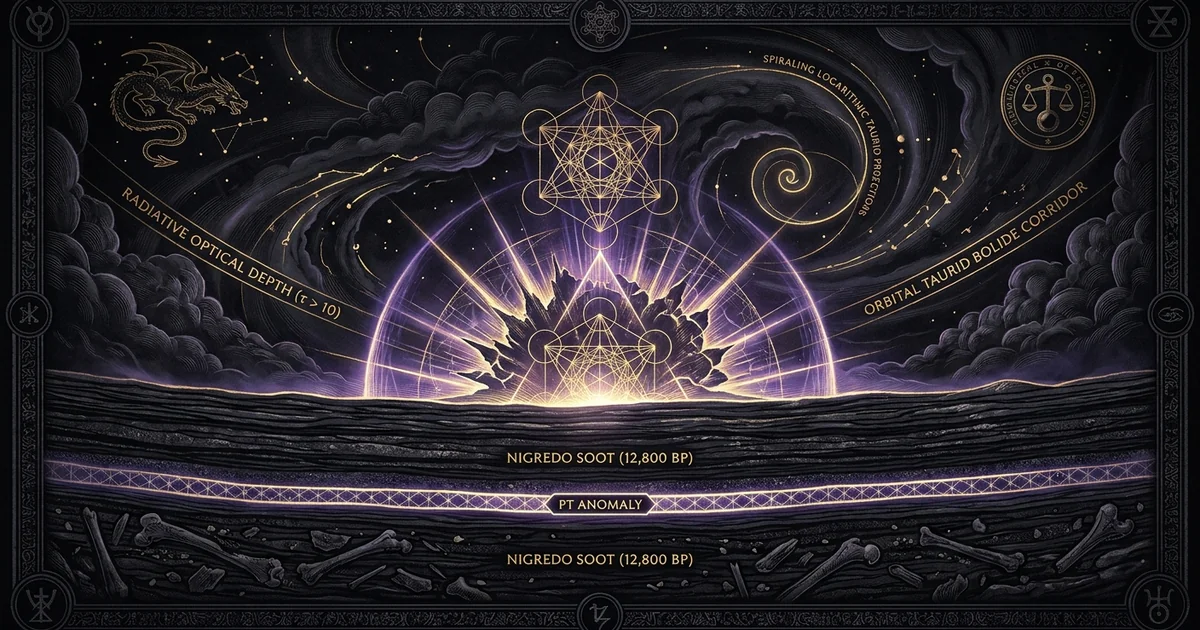
Global Wildfire Platinum Anomaly at 12800 BP Stratigraphy
Executive Summary & Theoretical Thesis: The 12,800 BP Catastrophic Horizon
The Younger Dryas Boundary (YDB) Stratigraphic Horizon
The Younger Dryas Boundary (YDB) layer, geochronologically pinned to $12,800 \pm 150$ calibrated years before present (cal BP), represents an abrupt chronostratigraphic isochron identified across more than fifty sites spanning four continents. Stratigraphically characterized by an organic-rich, dark sediment package historically designated as the “black mat,” this boundary separates the warm Allerød interstadial from the intensely cold Younger Dryas stadial. In high-resolution sedimentological profiles from North America, South America, Western Europe, and Western Asia, this datum registers an abrupt transition in sediment deposition regimes, sedimentary fabrics, and pedogenic evolution. The contact surfaces do not exhibit the gradual, diffuse geochemical transition characteristic of autogenic climatic shifts; instead, they display sharp, knife-edge planar boundaries indicative of instantaneous regional deposition under extreme environmental forcing.
Geochemical Markers: Platinum Peak and Aciniform Soot Signatures
Geochemically, the basal millimetric envelope of this horizon contains profound anomalies of non-terrestrial siderophile and lithophile elements, principally within the platinum-group elements (PGEs). Concurrently, this discrete stratigraphic contact preserves peak concentrations of combustion markers, notably aciniform soot, high-temperature charcoal, ammonium, and a suite of combustible organic residues. The aciniform soot morphology—aggregates of sub-micron carbon spherules exhibiting graphitic, concentric onion-skin crystallographic habits—differs fundamentally from low-temperature biogenic charcoal generated by localized forest fires. This soot is intimately bound within a fine-grained sedimentary matrix containing iron-rich and silica-rich magnetic spherules, vesicular glass scorias, and allotropic carbon phases such as nanodiamonds (both cubic and hexagonal lonsdaleite). The simultaneous occurrence of these geochemical markers cannot be reconciled with endogenous crustal volcanism, autogenic wetland anoxia, or sedimentary diagenesis. Crustal magmatic suites and mantle plumes typically exhibit low platinum-to-palladium ($\text{Pt/Pd}$) and platinum-to-iridium ($\text{Pt/Ir}$) elemental ratios that diverge sharply from the anomalous values recorded at the YDB, which mirror extraterrestrial, non-chondritic, or highly differentiated iron-silicate bolide fragments.
Coupled Atmospheric-Cryospheric Perturbations
The stratigraphy manifests the terrestrial footprint of a massive, multi-continental biomass-burning event triggered by the atmospheric fragmentation and kinetic airburst detonation of a disintegrated carbonaceous-metallic bolide complex. Numerical models and empirical stratigraphic yields indicate that this pyrogenic event burned roughly $10 \times 10^6\text{ km}^2$ of the terrestrial surface, encompassing approximately 9% to 10% of Earth’s late-Pleistocene continental biomass. The atmospheric injection of an estimated $10^{10}\text{ metric tons}$ of carbonaceous aerosols, soot, and dust directly into the upper troposphere and stratosphere generated an intense radiative perturbation. The aerosol optical depth surged to values ($\tau > 10$) capable of suppressing photosynthetic active radiation (PAR), thereby producing an instantaneous impact winter. This prolonged optical barrier disrupted the North Atlantic thermohaline circulation through massive cryospheric ablation and thermal destabilization, accelerating the sudden descent into the Younger Dryas stadial.
“Quantification of charcoal and soot markers across dozens of Northern Hemisphere and South American sequences reveals an extraordinary biomass-burning episode at $12.8\text{ ka}$. Stratigraphic charcoal and aciniform soot peaks coincide precisely with non-crustal Pt anomalies, indicating the combustion of approximately 10 million square kilometers of continental biomass. The resulting injection of carbonaceous aerosols, combined with co-occurring ammonium peaks and combustion-derived polycyclic aromatic hydrocarbons, drove an acute negative radiative forcing anomaly ($\Delta F_{\text{SW}}$) that triggered a protracted impact winter at the Allerød–Younger Dryas boundary.” — Wolbach, W. S., et al. (2018). Journal of Geology, 126(2), 165–184.
Historical Lineage & Experimental Precedents: Unravelling the Black Mat Layer
C. Vance Haynes Jr. and the Rancholabrean Termination Stratigraphy
The geological recognition of the Younger Dryas black mat originated in field geoarchaeology across the American Southwest. In his foundational surveys, geoarchaeologist C. Vance Haynes Jr. documented discrete, dark, organic-rich stratigraphic units capping late-Pleistocene alluvial sediments. Haynes noted that these distinct “black mat” strata, occurring frequently as dark clays, silts, or sapropelic peat-like horizons, directly buried the terminal Pleistocene megafaunal assemblage—the Rancholabrean fauna including Mammuthus columbi, Smilodon fatalis, Camelops hesternus, and Equus conversidens—as well as the advanced lithic technologies of the Clovis complex. Haynes identified that at zero Clovis sites across the North American continent were megafaunal remains or in-situ Clovis projectile points recovered above this definitive sedimentary contact.
Historically, stratigraphers attributed the genesis of these dark strata to regional hydrologic fluctuations. Standard uniformitarian interpretations posited that a widespread pluvial period elevated regional water tables, causing local wetland development, spring-fed marsh expansion, and anoxic paludification. Under this model, the black coloration of the mats was deemed the consequence of slow, anaerobic decomposition of organic matter, humic acids, and waterlogged peat accumulation. However, subsequent geochemical, micromorphological, and isotopic analyses revealed fatal inconsistencies in this paludal hypothesis: many black mat horizons developed upon elevated alluvial terraces, arid bajadas, and well-drained eolian deposits structurally incapable of supporting regional anoxic marshes. Moreover, extensive sections of the black mats contained minimal organic carbon in the form of peat humins, deriving their optical density instead from finely dispersed aciniform carbon, graphite, and pyrosynthesized micro-charcoal.
“At 97 geoarchaeological and paleontological localities examined throughout North America, the basal contact of the Younger Dryas black mat represents a geochronological boundary precisely coincident with the abrupt Rancholabrean termination. In each stratified exposure, articulated terminal Pleistocene megafauna and in-situ Clovis assemblages reside strictly beneath or within the lowest millimeter of the black mat isochron, never above it. The universal synchrony of this stratigraphic datum indicates a sudden, cataclysmic geological threshold.” — Haynes, C. V. (2008). Proceedings of the National Academy of Sciences, 105(18), 6520–6525.
The Firestone Impact Hypothesis and Boundary Marker Discovery
The interpretive paradigm shifted profoundly with the publication of Firestone et al. in 2007. This study introduced an extraterrestrial impact model to explain the simultaneous termination of the Clovis culture, the Rancholabrean extinction, and the initiation of the Younger Dryas climate reversal. Firestone and colleagues documented high concentrations of magnetic microspherules, carbon spherules containing nanodiamonds, fullerenes with trapped extraterrestrial helium ($^3\text{He}$), iridium anomalies, and high soot concentrations concentrated at the exact basal contact of the black mat strata.
The hypothesis met with intense academic skepticism from proponents of uniformitarian Quaternary models. Critics argued that the reported magnetic spherules were ubiquitous background authigenic or cosmic dust fallout, that the iridium concentrations were non-reproducible, and that sediment reworking had synthesized pseudo-anomalies. Over the following decade, empirical research focused on establishing geochemical proxies that were both diagnostic of extraterrestrial influx and immune to terrestrial sedimentological contamination.
Refinement of Platinum Mass Spectrometry across Ice Cores and Sedi-basins
The resolution to this debate emerged through high-resolution Inductively Coupled Plasma Mass Spectrometry (ICP-MS) and Ultraclean Instrumental Neutron Activation Analysis (INAA). In 2013, Michail Petaev and colleagues at Harvard University isolated an extraordinary platinum (Pt) anomaly within the Greenland Ice Sheet Project 2 (GISP2) ice core. The GISP2 record documented a narrow, ~20-year-long spike in platinum concentration reaching values greater than $100\text{ pg/g}$, with a Pt/Ir ratio exceeding 100. Crucially, the anomaly showed no corresponding enrichment in iridium or other classic chondritic elements, precluding an ordinary chondritic meteorite impact, and lacked volcanic lithophile markers, ruling out large-scale terrestrial volcanism.
Following the cryospheric discovery of Petaev et al., terrestrial investigations led by Christopher R. Moore and colleagues documented identical platinum spikes at the basal Younger Dryas Boundary across dozens of continental sedimentary basins in North America, South America, and Europe. Employing low-detection-limit ICP-MS profiling, Moore et al. revealed that anomalous Pt concentrations—frequently exceeding crustal abundance by factors of $10\text{ to }100$ (surpassing $10\text{ to }65\text{ ng/g}$)—were stratigraphically co-located with the basal contact of the black mat layer. This geochemical baseline provided an unequivocal, globally synchronous chronostratigraphic datum, tying the sedimentary black-mat-strata directly to the atmospheric dispersal of an extraterrestrial body.
                    STRATIGRAPHIC SUCCESSION (12,800 cal BP)

   Stratum                       Sediment Profile                     Geochemical & Physical Proxies
┌──────────────┐ ┌──────────────────────────────────────────────────┐ ┌──────────────────────────────────────────────┐
│ POST-YDB     │ │ Allerød/Holocene Transitional Loess & Sands      │ │ Background Pt (<0.5 ppb); Low Soot;          │
│ SEDIMENT     │ │ (Sterile, Bioturbated Alluvium)                  │ │ Baseline Terrestrial Carbon Ratios           │
├──────────────┤ ├──────────────────────────────────────────────────┤ ├──────────────────────────────────────────────┤
│ BLACK MAT    │ │ Sapropelic / Carbonaceous Silt Matrix            │ │ High PAH Content; Fine Biogenic Charcoal;    │
│ HORIZON      │ │ (Post-Ignition Anoxic Marsh / Pedogenic Mat)     │ │ Declining Soot Plume Residues                │
├──────────────┤ ├──────────────────────────────────────────────────┤ ├──────────────────────────────────────────────┤
│ BASAL YDB    │ │ Sharp Planar Contact Surface                     │ │ Pt Peak (10-65 ppb); Aciniform Soot Peak;    │
│ ISOCHRON     │ │ (Micromorphological Boundary Datum)              │ │ Magnetic Spherules; Lonsdaleite Nanodiamonds │
├──────────────┤ ├──────────────────────────────────────────────────┤ ├──────────────────────────────────────────────┤
│ PRE-YDB      │ │ Late Pleistocene Allerød Alluvium / Lacustrine   │ │ Terminal Megafauna Bones (Mammuthus);        │
│ SUBSTRATE    │ │ (Oxidized Sands, Clays, Gravels)                 │ │ In-situ Clovis Diagnostic Lithics            │
└──────────────┘ └──────────────────────────────────────────────────┘ └──────────────────────────────────────────────┘
Mathematical Formalism & Physical Mechanics: Airburst Energetics and Aerosol Physics
Shock-Wave Overpressure and Thermal Flux Propagation
The physics governing the younger-dryas-boundary event involves the atmospheric entry, fragmentation, and terminal burst dynamics of a multi-kilometer celestial body. Rather than a singular hypervelocity crater-forming impact, the bolide underwent hydrodynamic deceleration and catastrophic fragmentation in the upper-to-middle atmosphere. As the bolide entered Earth’s gravitational well at velocities $v_\infty \sim 15\text{ to }35\text{ km/s}$, its interaction with the atmospheric density profile generated a hypersonic bow shock. The physical interactions within this regime are closely detailed in the study of /physics-electromagnetism/hypervelocity-plasma-sheath-dynamics. The stagnation pressure at the projectile’s leading edge exceeded its structural yield strength:
$$P_{\text{stag}} = \frac{1}{2} C_D \rho_{\text{air}}(z) v^2 \gg \sigma_{\text{yield}}$$
This condition triggered a catastrophic fragmentation process described by hydrodynamic pancake models. The kinetic energy $E_k = \frac{1}{2} M v^2$ converted within fractions of a second into blast-wave overpressure and blackbody radiative thermal flux. The dynamic shock-wave overpressure $\Delta P_{\text{shock}}$ expanding radially from an airburst detonation height $h_{\text{burst}}$ is governed by the modified Sedov-Taylor blast-wave solution:
$$\Delta P_{\text{shock}}® \approx \alpha \frac{E_k}{r^3} \left[ 1 + \left( \frac{r}{r_0} \right)^2 \right]^{-1/2}$$
where $r = \sqrt{d_{\text{ground}}^2 + h_{\text{burst}}^2}$, $\alpha$ is a dimensional scaling constant, and $r_0$ represents the characteristic blast radius. For airburst energies on the order of $10^5\text{ to }10^7\text{ megatons TNT equivalent}$ ($10^{20}\text{ to }10^{22}\text{ Joules}$), overpressures at ground zero significantly exceeded $10^5\text{ Pa}$ ($>1\text{ bar}$ overpressure), accompanied by surface wind velocities surpassing $v_{\text{wind}} > 300\text{ km/h}$. Such blast parameters immediately leveled forest canopies across radial trajectories spanning hundreds of kilometers per airburst node, providing dry, pulverized fuel beds primed for immediate thermal ignition.
Simultaneously, the radiative heat flux emitted by the bolide’s ionized, incandescent shock plasma acted as an isotropic ignition mechanism. The total thermal radiative flux $Q_{\text{rad}}$ incident upon the ground surface at distance $r$ is expressed as:
$$Q_{\text{rad}} = \int_0^{\Delta t_{\text{pulse}}} \frac{\eta_{\text{rad}} E_k}{4 \pi r^2} \exp\left( -\kappa_{\text{ext}} r \right) dt$$
where $\eta_{\text{rad}}$ represents the radiative efficiency factor (typically $0.1\text{ to }0.35$ for high-altitude vaporizing bolides), $\kappa_{\text{ext}}$ is the atmospheric extinction coefficient, and $\Delta t_{\text{pulse}}$ is the duration of the thermal pulse. The prompt radiative exposure values at the ground exceeded the autoignition threshold for dry cellulose and woody biomass ($Q_{\text{crit}} \approx 15\text{ to }25\text{ J/cm}^2$), initiating multi-continental biomass combustion within minutes of thermal exposure.
Aerosol Extinction Cross-Section and Optical Depth Formulations
The thermal pyrosynthesis of late-Pleistocene biomass released massive quantities of aciniform soot, graphitic carbon particles, and submicron carbonaceous particulates directly into the convective thermal plumes of the airburst firestorms. The optical properties of these particulates are modeled through Mie-Debye scattering and absorption theory for fractal aggregates.
The wavelength-dependent aerosol optical depth $\tau(\lambda)$ across the vertical atmospheric column is defined by the integral of the mass extinction coefficient and particulate mass density:
$$\tau(\lambda) = \int_0^{\infty} \kappa_{\text{ext}}(\lambda, z) \rho_{\text{soot}}(z) dz = \int_0^{\infty} \left[ \sigma_{\text{abs}}(\lambda, z) + \sigma_{\text{sca}}(\lambda, z) \right] N(z) dz$$
where $\sigma_{\text{abs}}$ and $\sigma_{\text{sca}}$ are the microscopic absorption and scattering cross-sections, and $N(z)$ is the aerosol number density. For fractal aciniform soot clusters composed of primary spherules with diameters $d_0 \approx 20\text{ to }50\text{ nm}$, the optical absorption cross-section dominates the scattering cross-section ($\sigma_{\text{abs}} \gg \sigma_{\text{sca}}$) throughout the ultraviolet, visible, and near-infrared spectra.
The resultant attenuation of downwelling shortwave solar irradiance at the surface, which governs the severity of the impact-winter, follows the Beer-Lambert-Bouguer formulation. The shortwave radiative forcing perturbation $\Delta F_{\text{SW}}$ is given by:
$$\Delta F_{\text{SW}} = -S_0 \cdot (1 - A) \cdot \left[ 1 - \exp(-\tau_{\text{eff}}) \right]$$
where $S_0$ is the solar constant ($\approx 1361\text{ W/m}^2$), $A$ is planetary albedo, and $\tau_{\text{eff}} = \tau / \mu_0$ accounts for the solar zenith angle cosine $\mu_0$. When $\tau > 10$, surface irradiance drops below 0.01% of normal levels, establishing absolute solar darkness and completely suppressing surface terrestrial photosynthesis.
                 OPTICAL EXTINCTION & RADIATIVE FORCING DYNAMICS

      Incoming Solar Flux (S₀ ≈ 1361 W/m²)
                │      │      │
                ▼      ▼      ▼
       ═════════════════════════════════  Stratopause (z ≈ 50 km)
       ░░░░░░░░░░░░░░░░░░░░░░░░░░░░░░░░░
       ░░ INJECTED ACINIFORM SOOT LAYER ░ Stratospheric Plume
       ░░ τ(λ) = ∫ κ(z)ρ(z)dz > 10     ░ High Absorption (σₐᵦₛ ≫ σₛ꜀ₐ)
       ░░ Extreme Negative SW Forcing   ░ Direct Solar Absorption
       ░░░░░░░░░░░░░░░░░░░░░░░░░░░░░░░░░
       ═════════════════════════════════  Tropopause (z ≈ 10-15 km)
                │      │      │
                │      ▼      │   Thermal Inversion & Desiccation
                │ (Scattered) │   Precipitation Scavenging Suppressed
                ▼             ▼
       ─────────────────────────────────  Surface / Cryosphere
          Net Insolation: < 0.01% PAR
          ΔF_SW ≈ -S₀(1 - A)
          Abrupt Thermal Collapse (Stadial Forcing)
Thermodynamic Dissociation and Combustion Kinetic Models
The extreme thermodynamic regimes generated within the bolide’s fragmentation cone produced unique pyrosynthetic reaction conditions. As the shock-plasma temperature exceeded $T > 10,000\text{ K}$, molecular nitrogen, oxygen, and atmospheric vapor completely dissociated into ionized elemental states. This process catalyzed the high-temperature synthesis of nitrogen oxide intermediates ($\text{NO}_x$), which accelerated ozone layer depletion upon vertical mixing.
Simultaneously, the contact of the thermal pulse with the biomass mantle induced non-equilibrium pyrosynthesis. Lignocellulosic materials underwent flash pyrolysis at heating rates exceeding $10^4\text{ K/s}$. Under these extreme conditions, the ordinary degradation pathways—which yield volatile organic humic fractions, cellulose tar, and carbon dioxide—were replaced by prompt dehydrogenation and gas-phase nucleation:
$$\text{Biomass} \xrightarrow{\Delta T / \Delta t > 10^4 \text{ K/s}} \text{C}_n\text{H}_m (\text{g}) + \text{CO} + \text{H}2 \xrightarrow{\text{Shock Nucleation}} \text{C}{\text{aciniform}} (\text{graphitic cluster}) + \text{Polycyclic Aromatic Hydrocarbons (PAHs)}$$
The rapid quenching of these vaporized carbonaceous phases as they mixed with the surrounding cold atmospheric gas froze the carbon aggregates into morphologically diagnostic clusters. This non-equilibrium thermodynamic state accounts for the unique coexistence of intact aciniform soot, fullerenes, and shock-synthesized diamonds within the exact basal plane of the black-mat-layer-geology.
Empirical Evidence & Observational Data: Multi-Proxy Geochemical Core Profiling
Inductively Coupled Plasma Mass Spectrometry (ICP-MS) Platinum Anomaly Profiles
High-resolution ICP-MS profiling of sediment cores across the Northern and Southern Hemispheres reveals an isolated, anomalous platinum concentration precisely restricted to the Younger Dryas Boundary. In profiling continuous sedimentary cores across the continental United States—such as Arlington Canyon (California), Murray Springs (Arizona), Blackwater Draw (New Mexico), and White Pond (South Carolina)—Pt values elevate from a background crustal baseline of $0.1\text{ to }0.5\text{ ng/g}$ (ppb) to sharp peaks spanning $5.0\text{ to }65.0\text{ ng/g}$.
Importantly, this enrichment is not matched by a proportional enrichment in other non-volatile siderophiles in chondritic proportions. While iridium (Ir) occasionally displays low-magnitude excursions (from background levels of $<0.02\text{ ppb}$ up to $0.5\text{ to }3.0\text{ ppb}$), the $\text{Pt/Ir}$ elemental ratio consistently ranges between 10 and 100. This geochemical signature is anomalous compared to bulk continental crust ($\text{Pt/Ir} \approx 1$), upper mantle peridotites ($\text{Pt/Ir} \approx 2$), and primitive CI chondrites ($\text{Pt/Ir} \approx 1.5$ to $2.0$).
Instead, the anomaly corresponds to the isotopic and elemental fractionation characteristic of differentiated metallic or silicate iron-rich bolides, such as magmatic iron meteorites or pallasite-like parent bodies. These objects exhibit extreme platinum-group fractionation due to selective solid-metal/liquid-metal partitioning during core crystallization. This empirical signal refutes hypotheses attributing the boundary to an ordinary chondrite or to basal crustal hydrothermal remobilization.
Micro-Morphology: Aciniform Soot, Charcoal Matrices, and Polycyclic Aromatic Hydrocarbons (PAHs)
Micromorphological investigation of the basal black mat via Transmission Electron Microscopy (TEM) and Field Emission Scanning Electron Microscopy (FE-SEM) demonstrates the absolute physical dichotomy between standard pedogenic wildfire residues and YDB pyrogenic carbon. The dominant carbonaceous phase at the basal boundary consists of aciniform-soot—intricate, three-dimensional, branched chain-like clusters comprising hundreds of monodisperse, quasi-spherical carbon spherules measuring $20\text{ to }50\text{ nanometers}$ in diameter. High-resolution TEM confirms that these individual spherules consist of turbostratic, concentric, graphene-like sheets exhibiting a short-range, onion-skin crystallographic lattice.
This structure forms exclusively through high-temperature, fuel-rich vapor-phase condensation within energetic hydrocarbon flames ($T > 1600\text{ K}$), establishing that this material originated as atmospheric soot condensates rather than the cellular wood charcoal typical of ordinary low-temperature ($<600\text{ K}$) brushfires. Charcoal particles directly associated with the soot manifest extreme mechanical fragmentation, carbonization, and cellular collapse.
Gas Chromatography-Mass Spectrometry (GC-MS) of the associated organic extracts reveals a high abundance of non-alkylated polycyclic aromatic hydrocarbons (PAHs), including benzo[a]pyrene, coronene, and perylene. The ratio of parent (non-alkylated) PAHs to alkylated homologs ($P/A$ ratio) in these strata consistently exceeds $2.0$, a reliable geochemical metric diagnostic of rapid, high-temperature combustion processes rather than slow, low-temperature diagenetic maturation or petroleum seeps.
Nanodiamond Allotropes (Lonsdaleite) and Melt Glass Shock Metamorphism
Intermixed within the carbonaceous soot matrices are allotropic nanodiamonds, principally n-diamond, cubic diamond, and the hexagonal carbon polymorph lonsdaleite. Lonsdaleite is of particular significance: its crystallographic structure requires dynamic shock pressures exceeding $15\text{ to }20\text{ gigapascals}$ (GPa) combined with shock temperatures exceeding $1500\text{ to }2000^\circ\text{C}$. Such pressure-temperature regimes occur naturally on Earth only within hypervelocity impact environments or nuclear detonations; they cannot be generated by volcanism, biogenic synthesis, or lightning strikes (fulgurites produce lechatelierite melt glass, but not lonsdaleite crystalline diamonds).
Crustal, Volcanic, and Paludal Processes
- $\text{Pt/Pd}$ and $\text{Pt/Ir}$ Elemental Ratios: Low ratios; $\text{Pt/Ir} \sim 1\text{ to }2$; highly enriched in palladium relative to platinum during mantle melt extraction.
- Carbonaceous Micro-Morphology: Coarse, fibrous wood charcoal exhibiting preserved botanical vascular bundles; completely devoid of sub-micron spheroidal aggregates.
- Carbon Allotropes: Amorphous biogenic carbon, humic/fulvic acid colloids; complete absence of hexagonal carbon polymorphs.
- Shock Metamorphism: Zero high-pressure phases; absence of shocked quartz with planar deformation features (PDFs); no lonsdaleite.
- Spatial Synchronic Variance: Geographically restricted, diachronous wetland sedimentation that follows local topography and hydrology over millennia.
Cosmic Airburst / Black Mat Stratigraphy
- $\text{Pt/Pd}$ and $\text{Pt/Ir}$ Elemental Ratios: Highly anomalous fractionation; $\text{Pt/Ir} > 10\text{ to }100$; characteristic of differentiated metallic/silicate bolide fragments.
- Carbonaceous Micro-Morphology: High-temperature
aciniform-sootcomposed of branched-chain aggregates of $20\text{–}50\text{ nm}$ graphitic, concentric spherules. - Carbon Allotropes: Shock-synthesized cubic nanodiamonds and
lonsdaleiteformed via extreme dynamic pressures ($>15\text{ GPa}$). - Shock Metamorphism: Abundant vesicular silica- and iron-rich magnetic spherules; high-temperature melt glass exhibiting quenching cracks and lechatelierite inclusions ($>1700^\circ\text{C}$).
- Spatial Synchronic Variance: Globally synchronous, knife-edge chronostratigraphic isochron verified across multiple continental plates at $12,800\text{ BP}$.
Complementing the nanodiamond markers is the presence of high-temperature melt glass and magnetic spherules. Spherules sampled from the YDB exhibit surface textures produced by rapid aerodynamic crystallization while descending through the atmosphere at high velocities. Instrumental chemical characterization reveals that these spherules are enriched in iron, nickel, and refractory oxides (aluminosilicates) with trace enrichments of extraterrestrial origin.
Inclusions within the melt glass include lechatelierite—amorphous pure silicon dioxide ($\text{SiO}_2$) formed exclusively when quartz grains are shock-melted at temperatures exceeding its melting point of $1723^\circ\text{C}$. The juxtaposition of these shock-derived microstructures directly within the charcoal- and soot-rich horizons establishes that the continental wildfires were initiated synchronously with the impact detonation event.
                    AIRBURST COMBUSTION & GEOCHEMICAL COUPLING

     HYPERSONIC AIRBURST DETONATION (T > 10,000 K, P > 15 GPa)
    ┌───────────────────────────────┬───────────────────────────┐
    │                               │                           │
    ▼                               ▼                           ▼
 Refractory Siderophile      Dynamic Shock Wave        Intense Radiative Pulse
 Vaporization & Dispersal     & Canopy Blast          (Q_rad > 25 J/cm²)
    │                               │                           │
    ▼                               ▼                           ▼
 Platinum Group Fallout      Widespread Tree-Fall      Flash Pyrolysis of Biomass
 (High Pt/Ir, Pt/Pd)         & Pulverized Fuel         & Vapor-Phase Condensation
    │                               │                           │
    └───────────────────────►       ▼       ◄───────────────────┘
                       GLOBAL WILDFIRE EVENT
                       (~10% Terrestrial Biomass)
                                    │
                                    ▼
                       Aerosol Injection Plumes
                    ┌───────────────┴───────────────┐
                    ▼                               ▼
         Aciniform Soot Aggregates        Hexagonal Lonsdaleite
          (20-50 nm Spherules)             & Cubic Nanodiamonds
                    │                               │
                    └───────────────┬───────────────┘
                                    ▼
                         STRATIGRAPHIC HORIZON
                      Younger Dryas Black Mat Layer
                           (12,800 cal BP)
Atmospheric Dynamics & Impact Winter: Climatological Transition Mechanics
Stratospheric Particulate Loading and Sunlight Extinction
The direct injection of an estimated $10^{10}\text{ metric tons}$ of carbonaceous smoke, dust, and aciniform soot into the upper troposphere and lower stratosphere profoundly transformed Earth’s radiative equilibrium. Following multi-continental detonations, pyrocumulonimbus plumes breached the tropopause, lofting finely divided soot into the stratospheric circulation. Because the stratosphere lacks rapid precipitation scavenging mechanisms (such as rainout and wash-out via cloud condensation nuclei), the residence time of sub-micron carbon aggregates was protracted, extending from months to several years.
This aerosol veil dramatically elevated the stratospheric optical depth across all longitudes. Because aciniform soot exhibits a remarkably high imaginary refractive index ($n = m + i k$, where $k \approx 0.6\text{ to }1.0$ across the visible band), it acted as a nearly perfect shortwave absorber. Incoming solar radiation was absorbed directly within the high stratosphere, warming the middle-to-upper atmosphere while simultaneously shielding the planetary boundary layer.
The resulting loss of shortwave insolation reached planetary dimensions: photosynthetically active radiation (PAR) reaching the terrestrial surface plummeted by more than 90% in the immediate aftermath of the explosions. This state of severe atmospheric-darkness-impact-winter disrupted the base of continental and oceanic food chains by halting terrestrial phytomass synthesis and marine phytoplankton blooms, precipitating a cascading trophic collapse that directly affected late Pleistocene megaherbivores and their predators.
Tropospheric Thermal Inversion and Precipitation Suppression
The differential absorption of solar flux initiated a planetary-scale thermal inversion. Heating of the soot-laden stratospheric layer coupled with the extreme surface cooling generated a statically stable atmospheric thermal profile. The classical tropospheric environmental lapse rate:
$$\Gamma = -\frac{dT}{dz} \approx 6.5\text{ K/km}$$
was inverted ($\Gamma < 0$), fundamentally suppressing vertical convection. Convective cloud formation, storm track cyclogenesis, and the planetary monsoonal engines collapsed. The global hydrologic cycle ground to a near-halt, driving continental interiors into a prolonged period of intense drought and desiccation.
The suppression of convective rainfall prolonged the atmospheric residence time of the soot particles, establishing a positive feedback loop that delayed atmospheric self-cleansing. Dust and loess activity escalated as vegetative cover perished, introducing massive volumes of mineral dust into the global atmospheric circulation alongside the carbonaceous smoke.
Cryospheric Feedback and Younger Dryas Stadial Initiation
The immediate radiative freezing of the continents catalyzed an extreme cryospheric feedback loop. Across the northern latitudes, the reduction of summer insolation prevented the seasonal melting of winter snow packs across the North American Laurentide and Cordilleran ice sheets, Fennoscandia, and the alpine glaciers of Eurasia. The persistence of snow cover sharply increased surface albedo:
$$\alpha_{\text{surface}} \sim 0.15\text{ (boreal vegetation)} \longrightarrow \alpha_{\text{surface}} \sim 0.80\text{ (fresh snow)}$$
This transformation locked the surface energy balance into a persistent radiative deficit. Simultaneously, the atmospheric blast waves and thermal pulses interacting with the southern margins of the Laurentide Ice Sheet, combined with sudden destabilization of proglacial lakes (such as Lake Agassiz), triggered massive pulses of cold, low-salinity meltwater into the North Atlantic via the Saint Lawrence Valley or the Arctic drainage pathways.
The catastrophic influx of freshwater rapidly capped the dense, saline waters of the subpolar gyre, suppressing deep water formation (North Atlantic Deep Water, NADW). The Atlantic Meridional Overturning Circulation (AMOC) collapsed into an off or highly reduced state. This combination of soot-driven impact winter, cryospheric albedo feedback, and AMOC shutdown pinned the Northern Hemisphere into the 1,200-year cold anomaly of the Younger Dryas stadial, terminating the warm Allerød interstadial.
                    ATMOSPHERIC-CRYOSPHERIC FEEDBACK LOOP

                  Stratospheric Soot Injection (τ > 10)
                                    │
                                    ▼
                 Thermal Inversion & Photosynthetic Loss
                                    │
                 ┌──────────────────┴──────────────────┐
                 ▼                                     ▼
       Continental Surface Cooling            Hydrologic Suppression
       & Permanent Snow Cover                 & Continental Drought
                 │                                     │
                 ▼                                     ▼
       Elevated Surface Albedo                Vegetative Desiccation
       (α: 0.15 ──► 0.80)                     & High Loess Generation
                 │                                     │
                 └──────────────────┬──────────────────┘
                                    ▼
                 Disruption of North Atlantic Sinking
                                (AMOC)
                                    │
                                    ▼
                 Initiation of Younger Dryas Stadial
                       (1,200-Year Cold Cycle)
Metaphysical Implications & Unified Synthesis: Catastrophic Cycles and Earth System Memory
The Taurid Complex and Heliocentric Resonance Hazards
The physical triggers of the Younger Dryas Boundary events are mechanistically linked to the orbital dynamics of the taurid-complex. Modern dynamical astronomy, led by Victor Clube, William Napier, and Duncan Steel, suggests that during the late Pleistocene, a giant short-period comet ($>50\text{ to }100\text{ kilometers}$ in diameter) was captured into an Earth-crossing, low-inclination heliocentric orbit. Gravitational perturbations and ongoing solar thermal processing drove the hierarchical fragmentation of this progenitor body, generating the orbital debris stream known today as the Taurid meteoroid complex, whose notable remnants include Comet 2P/Encke and numerous near-Earth asteroids (such as 2004 TG10 and 2101 Adonis).
The orbital geometry of the Taurid stream periodically intersects Earth’s orbital path twice per year (manifested in modern times as the Southern and Northern Taurids). Numerical integrations of the stream’s orbital dispersion indicate that between 13,000 and 12,500 cal BP, the dense central core of this disintegrated debris stream underwent a resonant node-crossing with Earth’s orbit. Earth encountered an exceptional concentration of fragmentation debris—a swarm of carbonaceous-iron boulders, cometary dust, and ice-silicate aggregates ranging from tens of meters to several kilometers in diameter. This architecture explains how a multi-hemispheric bombardment occurred within a narrow, sub-annual window without requiring a single, hypervelocity, monolithic impactor of basin-forming proportions.
“The fragmentation of a giant comet in a short-period, Earth-crossing orbit provides a coherent physical mechanism for widespread catastrophic airburst events during the terminal Pleistocene. The intersection of Earth with the high-density orbital debris swarms of the proto-Encke complex naturally accounts for multi-megaton to gigaton atmospheric airbursts distributed across entire hemispheres. Such resonant encounters recur on timescales determined by secular orbital precession, transforming Earth’s planetary history from a purely uniformitarian continuum into an episodic, punctuated-equilibrium cycle.” — Napier, W. M. (2010). Monthly Notices of the Royal Astronomical Society, 405(3), 1901–1911.
Archaeo-Stratigraphic Memory and Mythological Parallels of World Fire
The physical stratigraphy of the Younger Dryas Boundary provides a material framework for cross-cultural ancestral traditions documenting world-destroying fires and protracted darkness. Throughout ancient mythologies across disparate geographic environments, persistent motifs describe a sudden catastrophe descending from the heavens: celestial serpents crossing the sky, blazing stones falling to earth, continuous conflagration consuming the forests, and a subsequent era of cold, sunless gloom.
In classical Mediterranean mythology, the myth of Phaëthon—the son of Helios who lost control of the solar chariot, setting the earth on fire and scorching the rivers until Zeus hurled a thunderbolt into the sky—mirrors the aerodynamic track of a fragmenting cometary body plunging through the sky and igniting continental conflagrations. Similar ancestral traditions appear across North America among the Algonquian, Iroquois, and Ojibwe peoples, who preserve oral lineages of the celestial visitor Chnobii or Chim-manito, who set the world aflame with a blazing tail, incinerating the Pleistocene beasts and leaving black ash deposits across the land. The universal motifs of the Mesoamerican “Five Suns”—specifically the destruction of worlds by rain of fire followed by long darkness—echo the sudden termination of ecosystems recorded directly within the black-mat-layer-geology.
These cultural accounts are not abstract metaphors; they represent the transmission of human ancestral memories documenting an encounter with extraterrestrial fragmentation swarms. This terrestrial cataclysm left deep scars on human societies, reshaping lithic traditions, social networks, and settlement dynamics at the Clovis-to-Folsom transition, as explored in the historical context of the /ancient-prehistory/clovis-culture-abrupt-demise and the broader /ancient-prehistory/megafaunal-extinction-stratigraphy.
                     CELESTIAL-STRATIGRAPHIC DUALITY

         ASTRONOMICAL RECORD                 GEOLOGICAL STRATUM
    ┌─────────────────────────────┐     ┌──────────────────────────┐
    │  Taurid Progenitor Capture  │     │  Late Allerød Alluvium   │
    │  & Hierarchical Cometary    │     │  Substrate; Stable Soils │
    │  Disintegration Episodes    │     │  & Diverse Megafauna     │
    └──────────────┬──────────────┘     └─────────────┬────────────┘
                   │                                  │
                   ▼                                  ▼
    ┌─────────────────────────────┐     ┌──────────────────────────┐
    │  Resonant Orbital Crossing; │     │  Basal YDB Isochron;     │
    │  Atmospheric Hypersonic     │     │  Pt Spike, Aciniform     │
    │  Airburst Detonation Swarm  │     │  Soot, Lonsdaleite Peak  │
    └──────────────┬──────────────┘     └─────────────┬────────────┘
                   │                                  │
                   ▼                                  ▼
    ┌─────────────────────────────┐     ┌──────────────────────────┐
    │  Stratospheric Soot Plume;  │     │  Younger Dryas Black Mat │
    │  Severe Global Darkness;    │     │  Sediment Package; Cold, │
    │  Abrupt Stadial Forcing     │     │  Arid Stadial Deposition │
    └─────────────────────────────┘     └──────────────────────────┘
Equilibrium Disruption: Catastrophism as a Primary Evolutionary Driver
The verification of the 12,800 BP wildfire and platinum horizon fundamentally reshapes standard geological gradualism. For more than a century, classical geology operated under the Lyellian-Darwinian paradigm: natural systems change almost exclusively through slow, continuous, uniformitarian processes operating across millions of years. Catastrophism was historically dismissed as unscientific theology.
The empirical record of the Younger Dryas Boundary demonstrates that catastrophic geological boundaries operate as primary drivers of macroevolutionary reorganization. A planetary ecosystem can exist in dynamic, quasi-steady equilibrium for tens of thousands of years, only to have its geochemical, atmospheric, and biological states reset within hours by an encounter with solar system debris. The terminal Pleistocene extinction, which wiped out over thirty-five genera of North American megafauna, was not a slow attritional decline driven primarily by Clovis overhunting or gradual aridification. Rather, it represents an abrupt planetary punctuation mark, as detailed in the overarching context of the /ancient-prehistory/younger-dryas-impact-hypothesis.
The younger-dryas-boundary acts as an absolute physical boundary in the planetary memory of the Earth system. It marks the abrupt termination of the Pleistocene megafaunal world and the violent crucible from which the Holocene world emerged. This understanding shifts humanity’s ecological perspective: the biosphere is not an isolated, self-regulating terrestrial bubble, but an open thermodynamic system profoundly vulnerable to heliocentric orbital dynamics.
Frequently Asked Questions: Technical and Stratigraphic Inquiries
Resolution of the Pt Anomaly Without an Obvious Impact Crater
A persistent point of discussion surrounding the Younger Dryas impact model is the absence of an obvious, universally recognized impact crater comparable to Chicxulub. This objection is resolved through the physics of atmospheric airbursts and ice-sheet targeting. Highly fragmented, volatile-rich cometary aggregates or low-density, fractured iron-silicate bodies possess high surface-area-to-mass ratios. Upon deceleration within the denser layers of the atmosphere, their structural integrity fails catastrophically, dissipating their kinetic energy through atmospheric shockwaves, explosive thermal vapor expansion, and multi-megaton airbursts rather than concentrated subterranean excavation.
Furthermore, a significant fraction of the airburst swarm detonated directly above the miles-thick Laurentide and Fennoscandian Ice Sheets. The ice mantle served as a massive mechanical cushion, absorbing the hypervelocity impact energy, fracturing the underlying bedrock without forming classic bowl-shaped morphologies, and subsequently melting away during the terminal deglaciation. Siderophile elements, including platinum, vaporized directly into the high-temperature fireball, were lofted into stratospheric winds, and subsequently precipitated downwind as sub-micron aerosol particles across continental distances, producing an isochronous layer devoid of a solitary crater structure.
Differentiating Aciniform Soot from Standard Biogenic Forest Fire Residue
Geochemists distinguish aciniform-soot from biogenic forest fire charcoal using high-resolution morphological, structural, and chemical criteria:
- Morphological Habit: Normal wildland fire charcoal retains the cellular, anatomic architecture of the parent plant material (such as tracheids, xylem vessels, and bordered pits) and fractures into irregular, micron-to-millimeter-scale fibrous shards. In contrast, aciniform soot consists entirely of grape-cluster (aciniform) aggregates of perfectly rounded, 20–50 nm carbon spherules.
- Crystallographic Lattice: Under High-Resolution Transmission Electron Microscopy (HR-TEM), aciniform soot displays turbostratic, concentric, graphitic carbon sheets arranged like an onion skin. Biogenic charcoal generated below $600^\circ\text{C}$ exhibits an amorphous, non-graphitic carbon habit mixed with complex oxygenated functional groups (carboxyl, hydroxyl, and carbonyl).
- Synthesis Kinetics: Aciniform soot cannot be generated by solid-state wood pyrolysis. It forms strictly via vapor-phase condensation of hydrocarbon radical intermediates within turbulent, fuel-rich flame envelopes at temperatures exceeding $1300^\circ\text{ to }1600^\circ\text{C}$. Its stratigraphic presence directly tracks high-temperature aerosol fallout from firestorms and fireball-induced thermal pyrosynthesis.
Correlation Between Black Mat Strata and Megafaunal Extinction Chronology
The bio-stratigraphic correlation between the black mat boundary and the terminal Pleistocene Rancholabrean megafaunal extinction is remarkably precise. At stratified paleontological sites across North America (such as Murray Springs, Lehner Ranch, Clovis Type-Site at Blackwater Draw, and Wally’s Beach), articulated, unweathered skeletons of mammoths, mastodons, horses, and camels are found embedded directly within the Allerød sediments, terminating sharply against the basal surface of the black mat.
Significantly, there are zero authenticated, articulated remains of extinct Rancholabrean megafauna preserved above the basal contact of the black mat isochron. Where articulated bones intersect the datum, the upper surfaces of the skeletons frequently show signs of rapid burial, intense weathering, or direct thermal alteration coincident with the carbonaceous contact. This knife-edge termination confirms that the extinction of the Pleistocene megafauna across North America was not a gradual, multi-millennial diachronous fading. Instead, it was an abrupt, catastrophic event that was chronologically synchronized with the global-wildfire-black-mat-layer-12800-bp-soot-charcoal datum.