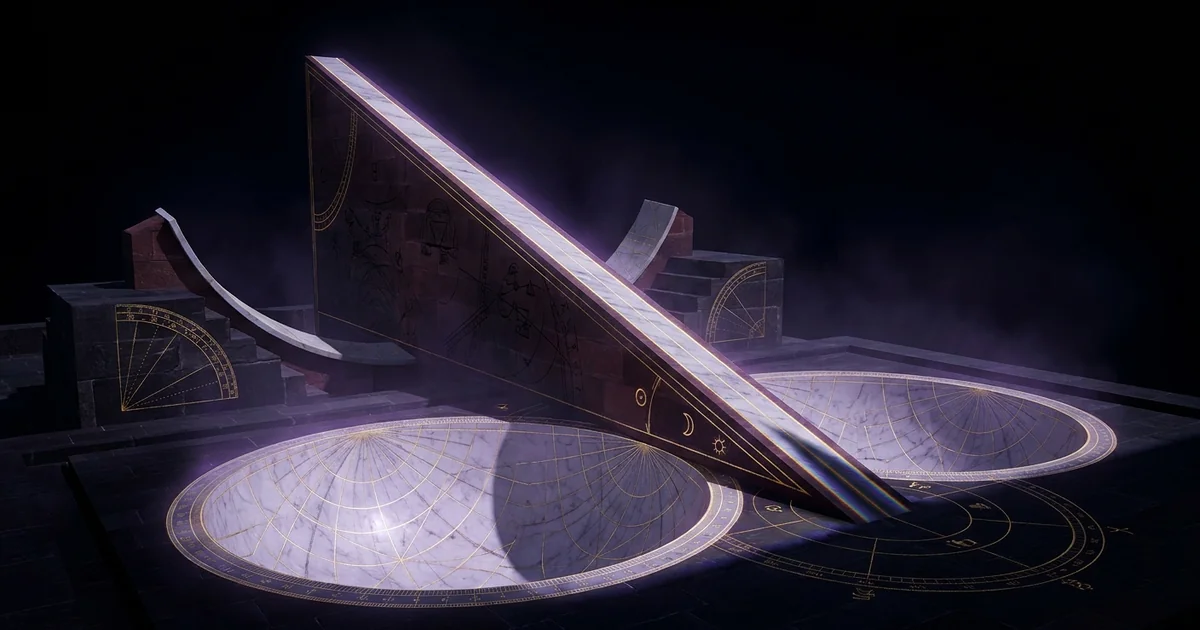
Jantar Mantar: Giant Precision Stone Instruments of India
Executive Summary & Theoretical Thesis: Lithic Megastructures as Sub-Arcminute Positional Engines
Elimination of Thermal Volatility and Mechanical Flexure in Classical Astrometry
The monumental observatories constructed under the patronage of Maharaja Sawai Jai Singh II across eighteenth-century northern India—most prominently preserved in the Jaipur complex—represent an uncompromising empirical response to the systemic physical failures of classical astronomical instrumentation. In traditional observational astronomy, portable metallic armillary spheres, brass astrolabes, and quadrant sextants had long constituted the primary hardware for resolving planetary, lunar, and solar coordinates. However, these metallic assemblies suffered from inescapable material liabilities: gravity-induced flexure torque across extended radii, bearing wear at pivot junctions, mechanical backlash within gear trains, and elevated volumetric thermal expansion coefficients. For brass, the linear thermal expansion coefficient ($\alpha_{\text{brass}} \approx 18.7 \times 10^{-6} , \text{K}^{-1}$) introduces dynamic spatial deformations across the extreme diurnal temperature deltas typical of the semi-arid Rajasthani plateau, where ambient fluctuations routinely span $\Delta T \ge 25 , \text{K}$.
Under these thermodynamic regimes, an unbraced brass quadrant with an operational radius of two meters experiences thermal drift and gravitational micro-sagging that introduce angular deviations far exceeding the intrinsic resolving power of the human retina. Jai Singh II recognized that mechanical deformation in metallic instrumentation systematically corrupted baseline observational tables. In response, he initiated an ambitious paradigm shift: transmuting ephemeral brass armatures into immobilized, geodetically anchored macro-architectures composed of calcified masonry, unyielding lime plaster (chunam), dense sandstone, and crystalline white Makrana marble scale-plates. By establishing the jantar mantar jaipur sawai jai singh stone astronomical instruments, Jai Singh bypassed mechanical flexure entirely.
The planetary-scale mass of these structures anchored their operational planes directly to the local crustal bedrock, effectively eliminating micro-vibrational noise and thermal hysteresis. In this framework, astrometric observation transcended the limitations of handheld brass instruments, transforming observational sites into terrestrial stone engines whose geometric stability was preserved over centuries. The architectural stability operates within geodetic principles explored in /ancient-prehistory/megalithic-acoustics-archaeoastronomy, demonstrating how high-mass lithic assemblies mitigate environmental entropy to preserve angular baselines.
+-----------------------------------------------------------------------------------+
|               METROLOGICAL COMPARISON: INSTRUMENT THERMAL DRIFT                   |
+----------------------+--------------------+---------------------------------------+
| Instrument Class     | Linear Coeff (α)   | Maximum Arc Drift (at ΔT = 25 K, R=2m)|
+----------------------+--------------------+---------------------------------------+
| Brass Astrolabe      | 18.7 × 10⁻⁶ K⁻¹    | ~19.3 arcseconds (linear shift ΔL)    |
| Bronze Armillary     | 18.0 × 10⁻⁶ K⁻¹    | ~18.6 arcseconds (linear shift ΔL)    |
| Sandstone/Marble Bed |  5.5 × 10⁻⁶ K⁻¹    | Thermal mass dampens ΔT core to < 3 K |
+----------------------+--------------------+---------------------------------------+
The Gnomonic Gradient: Dimensional Scaling Over Refractive Lenses
Rather than adopting nascent European optical refractor systems—which during the early eighteenth century remained severely compromised by chromatic dispersion, spherical aberrations, and narrow fields of view—Jai Singh scaled the physical geometry of naked-eye observation. The underlying physics rests upon a direct geometric transformation: by magnifying the radius of an arc, an angular increment is mapped onto an expanded linear distance along the instrument’s measuring periphery. In optical physics, the minimum angular separation resolvable by the unaided human eye (the Rayleigh limit of visual acuity) is constrained by diffraction across the pupil aperture to approximately one arcminute ($\theta_{\text{eye}} \approx 1’ \approx 2.91 \times 10^{-4} , \text{radians}$). To read fractions of an arcminute or individual arcseconds without magnifying lenses, the reading surface must physically expand such that one arcsecond corresponds to a linear dimension perceptible to the naked eye through vernier or sub-divided interpolations.
Through the physics of gnomonic projection, the celestial sphere is mapped onto massive graduated stone quadrants. The Jaipur complex functioned not as an archaic anachronism, but as an empirical laboratory systematically constructed to resolve critical ephemeris discrepancies between Ulugh Beg’s fifteenth-century Zij-i Sultani, contemporary Mughal observational records, and Philippe de La Hire’s Tabulae Astronomicae. By transmuting angular divisions into metric intervals spanning several millimeters per arcminute, Jai Singh’s masonry instruments elevated naked-eye astrometry to its theoretical performance ceiling, establishing a sub-arcminute baseline for measuring celestial coordinates naked eye before the dominance of achromatic compound lenses.
The fundamental linear resolution governing Jai Singh’s masonry quadrants is derived from the linear arc length formulation: $$s = R \cdot \theta$$ where $s$ is the physical metric distance etched along the quadrant face, $R$ is the structural radius of the instrument arc, and $\theta$ is the angular coordinate measured in radians.
Differentiating with respect to the angular coordinate yields the linear scale sensitivity: $$\frac{ds}{d\theta} = R$$ In the Vrihat Samrat Yantra of Jaipur, where the quadrant radius reaches $R \approx 15.15 , \text{meters}$: $$\frac{ds}{d\theta} = 15150 , \text{mm/radian} \approx 4.407 , \text{mm per arcminute} \approx 0.0734 , \text{mm per arcsecond}$$ A temporal interval of two seconds of right ascension corresponds to an angular displacement of $\Delta \theta = 30’’ \approx 1.454 \times 10^{-4} , \text{radians}$. Substituting into the metric scale: $$s = 15150 , \text{mm} \times 1.454 \times 10^{-4} \approx 2.20 , \text{mm}$$ Because a metric gap of $2.20 , \text{mm}$ is easily discerned and subdivided by the unaided eye using a fine stylus, the physical dimensions of the instrument convert temporal fractions into directly measurable human-scale lengths. This directly overcomes the tactile Vernier limits of miniature brass astrolabes.
Historical Lineage & Experimental Precedents: The Maragha-Samarkand Lineage to Jaipur
From Nasir al-Din al-Tusi to Ulugh Beg: The Macro-Sextant Evolution
The structural typology realized at the Jaipur Jantar Mantar is neither an isolated anomaly nor an esoteric departure from classical scientific methodology; it represents the mathematical zenith of the Islamic observational tradition. This lineage traces back to the Maragha Observatory, founded in 1259 CE under the intellectual stewardship of Nasir al-Din al-Tusi. At Maragha, mechanical instabilities in metal apparatuses prompted the construction of fixed meridian arcs carved directly into stone and masonry trenches. This paradigm was radically expanded by Ulugh Beg at the Samarkand Observatory in 1420 CE, where astronomers constructed the monumental Fakhri sextant (Suds-i Fakhri) with a radius of approximately 40 meters, embedded within a trench aligned precisely along the local meridian axis.
Ulugh Beg recognized that isolating structural movement required subterranean excavation and massive stone substructures. However, the Samarkand sextant was restricted primarily to meridian transits, limiting its capacity for dynamic, continuous celestial tracking across arbitrary altitude-azimuth or equatorial coordinates. Jai Singh II inherited this lineage through Persian translations of Islamic astronomical texts, notably Nasir al-Din al-Tusi’s recension of the Almagest and Ulugh Beg’s Zij-i Sultani. Navigating within this tradition, Jai Singh observed that despite the monumental achievements of Samarkand, the computational tables of Ulugh Beg exhibited drift when compared with real-time empirical transits observed in the eighteenth century, partially due to the secular shifts in the precession-of-equinoxes and accrued observational inaccuracies.
       MARAGHA OBSERVATORY (1259 CE)
       Nasir al-Din al-Tusi: Fixed stone meridian trenches
                     │
                     ▼
      SAMARKAND OBSERVATORY (1420 CE)
       Ulugh Beg: 40-meter Fakhri meridian sextant
                     │
                     ▼
      JANTAR MANTAR OBSERVATORIES (1724–1738 CE)
       Sawai Jai Singh II: Universal equatorial, hemispherical,
       and alt-azimuth lithic precision instruments (Delhi, Jaipur,
       Ujjain, Varanasi, Mathura)
Jai Singh’s Systematic Critique of European Brass Telescopy and Mughal Armillaries
In the preface to his magnum opus, the Zij-i Muhammad Shahi (1734), Jai Singh documented his empirical comparative testing of traditional metallic astrolabes, small brass armillaries, and contemporary European instruments. He established an observational foundry in Delhi, casting high-tolerance brass instruments according to classical Islamic and Hindu designs. Parallel to these metal assemblies, he erected initial masonry prototypes. Diurnal testing revealed that the metallic instruments exhibited non-linear drift under direct solar exposure. As radiant thermal flux heated the brass arms, their center of mass migrated, altering the concentricity of their pivots and degrading graduation alignment.
Furthermore, Jai Singh critically examined the observational apparatuses introduced by European travelers and Jesuit missionaries, including Father Emmanuel de Figueiredo and later French and Bavarian Jesuits. While aware of the optical configurations deployed by European astronomers, Jai Singh observed that early eighteenth-century portable telescopes, mounted on wooden or brass tripods without clock-driven equatorial mounts, lacked absolute coordinate grids. They were prone to optical distortion and flexure, making them poorly suited for establishing reference baselines across centuries.
He determined that European planetary tables—specifically the Tabulae Astronomicae of Philippe de La Hire and the ephemerides of John Flamsteed—contained persistent errors in planetary conjunctions and solar-lunar transits. To rectify these discrepancies, Jai Singh prioritized unyielding mass over glass lenses. His vision was to create stone-and-mortar reference standards capable of holding permanent calibrations against the moving sky, wedding astrolabe and meridian stone architecture into a unified observational complex.
"He found that the brass instruments did not come up to the ideas which he had formed of accuracy, because of the smallness of their size, the want of division into minutes, the shaking and wear of their axes, the displacement of the centers of the circles, and the instability of the planes of the instruments.
Therefore, he constructed in Dar al-Khilafat Shahjahanabad [Delhi], which is the seat of empire and prosperity, instruments of his own invention, such as the Jai Prakash, the Ram Yantra, and the Samrat Yantra, the semi-diameter of which is eighteen cubits, of stone and lime of perfect stability, with its parts graduated into minutes and seconds, so that the shaking from the movement of the axes and the inaccuracy of the minutes were eradicated." — Zij-i Muhammad Shahi, translated in part by William Hunter (1799), Asiatic Researches, Vol. V.
Mathematical Formalism & Physical Mechanics: Coordinate Systems and Geometrical Transmutation
The Vrihat Samrat Yantra: Equatorial Geometry, Trig Shadows, and Solar Transits
The structural centerpiece of the Jaipur observatory is the Vrihat Samrat Yantra (“Supreme Instrument”), an equinoctial gnomon sundial rising to a height of 27 meters. The central gnomon comprises a massive right-angled triangular masonry ramp whose hypotenuse is inclined at an angle precisely equal to the terrestrial latitude of the site: $$\phi = 26^\circ 55’ 27.4’’ , \text{N}$$ This alignment places the hypotenuse parallel to the Earth’s rotational axis, projecting it toward the north celestial pole.
Flanking this central ramp are two symmetrical quadrants constructed of brick masonry faced with polished Makrana marble. These quadrants lie precisely in the plane of the celestial equator, perpendicular to the gnomonic edge: $$\theta_{\text{quadrant}} = 90^\circ - \phi$$ As the sun traverses the sky, the hypotenuse casts a shadow down the western quadrant during the ante-meridian hours and across the eastern quadrant during post-meridian hours.
                  NORTH CELESTIAL POLE
                         ▲
                        /
                       /  Hypotenuse / Gnomon Edge (Inclined at φ = 26°55'27")
                      /
                     /│
                    / │
                   /  │
                  /   │  Vertical Gnomon Wall (Height: 27 m)
                 /    │
                /     │
  HORIZONTAL   /______│
  BASE PLANE   ◀──────┴─────────────────────────▶
                      Equatorial Quadrants (Radius: 15.15 m)
                      (Lie in the Celestial Equator Plane)
The graduation along the quadrant arcs maps directly to the local solar hour angle ($H$). The relationship between the linear coordinate $s$ along the quadrant arc and the hour angle is linear: $$s(H) = R \cdot H$$ where $H$ is measured in radians from the local meridian.
To determine the Sun’s declination ($\delta$), astronomers observed the shadow edge across the seasonal transition plates. By observing the intersection of the shadow cast by the gnomon’s edge along the northern and southern graduations, the instantaneous equatorial coordinates—Right Ascension ($\alpha$) and Declination ($\delta$)—were derived without complex spherical conversions: $$\sin \delta = \sin \epsilon \sin \lambda$$ $$\tan \alpha = \cos \epsilon \tan \lambda$$ The massive scale allowed the arc to be divided down to increments of two seconds of time, transforming the giant sundial into a high-precision solar transit chronometer.
Jai Prakash and Kapala Yantras: Hemispherical Inversion and Dual-Bowl Coordinate Mapping
Beyond the equatorial geometry of the Samrat Yantra, Jai Singh developed innovative hemispherical concave tracking instruments: the Jai Prakash and the Kapala Yantras. The Jai Prakash consists of twin complementary concave hemispherical bowls hollowed into the masonry foundation. Each bowl represents an inverted stereographic projection of the visible celestial hemisphere, mapped via an inverted gnomonic projection.
At the geometric center of each hemisphere, taut crosswires align along the cardinal North-South and East-West axes. The central intersection point of these wires represents the zenith of the sky directly above the observer.
TOP-DOWN VIEW: COMPLEMENTARY TWIN-BOWL ARCHITECTURE (JAI PRAKASH)
Bowl A: Active Observation Sectors        Bowl B: Complementary Sectors
      ┌───────────┐                             ┌───────────┐
      │  / /   / /│                             │/ /   / /  │
      │ / /     / │  === Spatial Inversion ===> │ /     / / │
      │  / /   / /│                             │/ /   / /  │
      └───────────┘                             └───────────┘
   (White: Stone Scale)                      (White: Stone Scale)
   (Hatched: Access Passages)                (Hatched: Access Passages)
To permit the observer to access the measuring surfaces without casting shadows or walking across calibration lines, Jai Singh split the hemispherical surface into complementary sections. Bowl A features alternating stone segments with intervening recessed pathways for the observer, while Bowl B contains the exact inverse pattern:
$$\text{Surface}{\text{total}} = \text{Surface}{\text{Bowl A}} \cup \text{Surface}{\text{Bowl B}}$$ $$\text{Surface}{\text{Bowl A}} \cap \text{Surface}_{\text{Bowl B}} = \emptyset$$
During an observation, the shadow of the crosswire intersection falls onto the graduated marble surface of one of the bowls. Etched across these marble plates are the local altitude circles (almucantars), azimuth lines, the celestial equator, the ecliptic path, and hour-angle grids. Consequently, the shadow’s position delivers an instantaneous visual solution to the spherical astronomical transformation equations:
$$\sin a = \sin \phi \sin \delta + \cos \phi \cos \delta \cos H$$ $$\cos A = \frac{\sin \delta - \sin \phi \sin a}{\cos \phi \cos a}$$
The coordinate system operates as an analog computer, translating celestial coordinates directly into physical geometry without demanding concurrent trigonometric calculations. For nighttime stellar observations, the astronomer descended into the access pathways, sighted a target star through an open aperture, aligned it visually with the central intersection point, and read the star’s altitude and azimuth coordinates off the marble plate.
       CROSSWIRE ZENITH JUNCTION
                 ┼
                / \
               /   \  Solar Ray or Stellar Sight-line
              /     \
             /       ▼
┌───────────/─────────\───────────┐
│          /           \          │
│ Marble Hemispherical Scale Plate │
│ (Direct Inverted Celestial Vault)│
└─────────────────────────────────┘
Ram Yantra and Digamsa Yantra: Altitude-Azimuth Cylinder Vector Mechanics
The Ram Yantra and the Digamsa Yantra were engineered to measure horizontal topocentric coordinates: altitude ($a$) and azimuth ($A$). The Ram Yantra consists of a matched pair of open-topped, unroofed cylindrical masonry structures. At the radial center of each cylinder stands an upright vertical gnomon pillar whose height ($h_g$) equals the inner radius of the enclosing cylindrical wall ($R_c$): $$h_g = R_c$$
The floor and interior vertical wall surfaces of the Ram Yantra are divided into radially graduated sectors of marble. Like the Jai Prakash, the Ram Yantra is split into two complementary structures. One instrument contains thirty raised stone radial sectors interspaced with thirty open air gaps of equal angular width; its twin contains the complementary arrangement:
$$\theta_{\text{sector}} = \theta_{\text{trench}} = 6^\circ \implies \sum_{i=1}^{30} (\theta_{\text{sector}, i} + \theta_{\text{trench}, i}) = 360^\circ$$
This interspaced configuration allows observers to walk between the sectors to read graduations along both the floor and vertical walls.
When observing the Sun, the top edge of the central gnomon pillar projects a shadow onto the floor or wall. If the shadow terminates on the floor at a radial distance $r$ from the central pillar base, the altitude angle is derived via: $$\tan a = \frac{h_g}{r}, \quad \text{for } r \le R_c , (a \ge 45^\circ)$$
When the solar altitude drops below $45^\circ$, the shadow moves off the floor and ascends the vertical wall to a height $z$ above the floor, shifting the geometric calculation to: $$\tan a = \frac{h_g - z}{R_c}, \quad \text{for } a < 45^\circ$$
The azimuth angle ($A$) is read directly off the radial angular scale etched around the base of the cylinder: $$A = \arctan \left( \frac{y_{\text{shadow}}}{x_{\text{shadow}}} \right)$$
This direct cylindrical mapping converts vertical and horizontal line-of-sight sightlines into altazimuth values while maintaining structural rigidity across its architectural components.
                    RAM YANTRA: GEOMETRIC PROJECTION

                          Central Pillar (Gnomon)
                                Height = h_g
                                    │
                                    ▼
                             ┌──────┬──────┐
                             │      │      │
                             │      │      │
                             │      │      │ Wall Height = h_g
                             │      │      │ Cylinder Radius = R_c
                             │      │      │
          ───────────────────┴──────┴──────┴───────────────────
                             ▲      ▲      ▲
                             │      │      │
                             └───r──┴──r───┘
                                Floor Scale
                       (tan a = h_g / r  for r ≤ R_c)
Empirical Evidence & Observational Data: Metrological Benchmarks and Error Budgets
Laser Theodolite Surveys and Modern Optical Alignment Audits
Modern archaeoastronomical investigations have yielded empirical data regarding the mechanical tolerances and alignment fidelity of the Jaipur and Delhi Yantras. In comprehensive surveys led by Virendra Nath Sharma and contemporary metrological teams using electronic total stations and laser theodolites, the geodetic orientations of the major instruments were quantified against true astronomical North and local geodetic plumb lines.
The central gnomon of the Vrihat Samrat Yantra at Jaipur deviates from the true celestial pole by less than an arcminute across its 27-meter height. The axial inclination of the hypotenuse was measured to be $26^\circ 55’ 10’‘$, matching the true terrestrial latitude of the site ($26^\circ 55’ 27.4’'$) within an error margin of approximately 17 arcseconds. This small discrepancy falls within the structural settling margin expected for lime-mortar megastructures over a three-century baseline.
The horizontal foundations of the quadrant arcs demonstrate planar leveling tolerances with a vertical deviation: $$\frac{\Delta z}{L} < 1.2 \times 10^{-4}$$ This structural precision indicates that Jai Singh’s engineers employed hydraulic leveling channels—flooding foundational stone raceways with water during initial construction—to establish an equipotential gravitational plane across expansive structural footprints.
+-----------------------------------------------------------------------------------+
|               METROLOGICAL SURVEY OF JAIPUR VRIHAT SAMRAT YANTRA                  |
+------------------------------+--------------------+-------------------------------+
| Instrument Parameter         | Theoretical Target | Measured Value (Laser Survey) |
+------------------------------+--------------------+-------------------------------+
| Gnomon Elevation Angle (φ)   | 26° 55' 27.4"      | 26° 55' 10" (± 8")            |
| Meridian Azimuth Alignment   | 0° 00' 00" (North) | 0° 00' 42" East of True North |
| Quadrant Normal Orthogonality| 90° 00' 00"        | 89° 58' 50"                   |
| Hydraulic Leveling Gradient  | Δz = 0.00 mm       | Δz / L < 1.2 × 10⁻⁴           |
+------------------------------+--------------------+-------------------------------+
Penumbra Dissipation and Shadow-Sharpening Techniques at the Gnomon Edge
A significant challenge in naked-eye solar astrometry using monumental gnomons is the penumbral dispersion effect. Because the Sun is an extended disc with an angular diameter of approximately $\delta_\odot \approx 32’$, light rays passing the gnomon edge are not parallel. They generate a graduated shadow consisting of a full shadow (umbra), a partial shadow (penumbra), and ambient skylight. For a gnomon height of $H = 27 , \text{meters}$, the linear width of the penumbral shadow cast onto the equatorial quadrant at an operational distance $L$ from the hypotenuse is determined by:
$$W_p = 2 L \tan \left( \frac{\delta_\odot}{2} \right) \approx L \cdot \theta_\odot$$
When the sun casts a shadow across a slant distance of $L \approx 10 , \text{meters}$: $$W_p \approx 10000 , \text{mm} \times 0.0093 , \text{radians} \approx 93 , \text{mm}$$
A diffuse shadow boundary spanning nearly 10 centimeters would obscure the quadrant graduations, rendering two-second ($2.2 , \text{mm}$) precision unachievable through casual inspection.
To resolve this limitation, Jai Singh’s observational methodology relied on shadow-sharpening optical techniques. Observers did not read the edge of the penumbra directly. Instead, they placed an adjustable specular marker or a thin target pin along the quadrant surface, observing the intensity gradient of the shadow. By utilizing the human visual system’s capacity to identify luminance inflection points (Mach bands), astronomers located the umbral centroid where the solar disc is precisely half-occluded: $$I(x) = \frac{1}{2} I_{\text{max}}$$
Furthermore, narrow sightline slits and pinhole apertures running through the gnomon structure acted as camera-obscura projection channels. These threw a sharp inverted image of the solar disc onto the graduated marble, reducing reading errors to under one millimeter, or roughly $\pm 1$ to $2$ arcseconds of celestial coordinate precision.
Virendra Nath Sharma’s quantitative metrological audit (Sawai Jai Singh and His Astronomy, 1995) verified that when using the umbral centroid methodology on the Vrihat Samrat Yantra, the empirical reading error budget of solar transit measurements is bounded within tight limits: $$\sigma_{\text{transit}} = \pm 1.5 \text{ to } 2.5 , \text{seconds of time}$$ This performance level validates Jai Singh’s assertion in the Zij-i Muhammad Shahi that masonry instrumentation can achieve observational precision matching the theoretical limit of unaided optical mechanics.
    SOLAR DISC (Angular Width: ~32 arcmin)
          (O)  (Extended Light Source)
         /   \
        /     \
       /       \
      /         \
     /    ┌──────┴──────┐
    /     │ Gnomon Edge │
   /      └──────┬──────┘
  /              │
 /               ▼
┌────────────────┼──────────────────────────────┐
│  Full Ambient  │   Penumbra   │  Full Umbra   │
│   Luminance    │ (Gradient)   │ (Total Shadow)│
└────────────────┼──────────────┼───────────────┘
                 ▲              ▲
                 │              │
                 x₁             x₂
                 Width W_p = x₂ - x₁ ≈ L · θ_☉
                 Centroid resolved at I(x) = 0.5 · I_max
Material Thermal Inertia: Sandstone Core vs. Specular Marble Surfacing
The thermal stability of the Jantar Mantar instruments relies directly on their structural mass and the thermodynamic properties of their materials. The core masonry consists of local red sandstone and dense lime aggregate (surkhi), while the outer graduation plates are clad in fine-grained Makrana marble. The red sandstone and lime mortar exhibit low thermal diffusivity: $$\kappa = \frac{k}{\rho \cdot c_p} \approx 0.65 \times 10^{-6} , \text{m}^2/\text{s}$$ where $k$ is thermal conductivity, $\rho$ is density, and $c_p$ is specific heat capacity.
Because of this thermal mass, ambient temperature fluctuations across diurnal cycles penetrate only into the outer few centimeters of the structure, decaying exponentially according to the classic Fourier thermal penetration depth: $$d_p = \sqrt{\frac{\kappa \cdot P}{\pi}}$$ For a diurnal cycle with period $P = 86400 , \text{seconds}$, the thermal penetration depth into the sandstone-lime core is: $$d_p \approx \sqrt{\frac{0.65 \times 10^{-6} \times 86400}{\pi}} \approx 0.133 , \text{meters} = 13.3 , \text{cm}$$
Because the structural foundations and quadrant backings measure between one and four meters in thickness, the interior thermal mass remains near the long-term seasonal mean temperature. Consequently, thermal expansion in the substrate is heavily dampened: $$\Delta T_{\text{core}} < 3 , \text{K}$$
+-----------------------------------------------------------------------------------+
|            THERMODYNAMIC DECOUPLING IN MASONRY MEGASTRUCTURES                     |
+--------------------------+--------------------+-----------------------------------+
| Parameter                | Symbol / Formula   | Empirical Value                   |
+--------------------------+--------------------+-----------------------------------+
| Diurnal Surface Swing    | ΔT_surface         | 25 K to 30 K (Rajasthani plateau) |
| Thermal Diffusivity      | κ = k / (ρ · c_p)  | ~0.65 × 10⁻⁶ m²/s (Sandstone/Lime)|
| Thermal Penetration Depth| d_p = √(κP / π)    | ~0.133 m (13.3 cm)                |
| Core Substrate Swing     | ΔT_core            | < 3 K                             |
| Linear Metric Expansion  | ΔL_quadrant        | < 0.05 mm over 15.15 m quadrant   |
+--------------------------+--------------------+-----------------------------------+
The specular white Makrana marble scale-plates reflect incoming shortwave solar radiation, further shielding the structural core from radiant heating. As a result, the linear thermal expansion of the quadrant scale over an observation session is constrained to: $$\Delta L = \alpha_{\text{marble}} \cdot L \cdot \Delta T_{\text{eff}} \approx 5.5 \times 10^{-6} , \text{K}^{-1} \times 15150 , \text{mm} \times 0.6 , \text{K} \approx 0.049 , \text{mm}$$ This metric displacement corresponds to an angular error below $0.7$ arcseconds.
By utilizing mass as a thermodynamic dampener, the instrument designers achieved geometric stability that handheld metal apparatuses could not match without temperature-controlled laboratory environments. The spatial harmonics and geometric proportions echo principles found in /sacred-geometry/astronomical-alignments-monumental-architecture, linking astronomical functionalism with geometric order.
Comparative Paradigm: Stone Masonry Megastructure vs. European Glass Telescopy
Lithic Masonry Yantras (Jai Singh II)
- Structural Anchoring & Inertia: Directly coupled to the terrestrial bedrock via brick, sandstone, and lime mortar. Gravitational flexure and mechanical backlash are non-existent.
- Thermal Volatility: Deep thermal mass dampens diurnal fluctuations. Core temperature variation is kept under $\Delta T < 3 , \text{K}$, yielding sub-millimeter arc stability ($\Delta L < 0.05 , \text{mm}$).
- Angular Resolution: Constrained to the naked-eye visual acuity limit (Rayleigh limit $\approx 1’$). Achieves $\approx 2’'$ coordinate resolution solely through macro-scale linear expansion ($R \approx 15.15 , \text{m}$).
- Optical Distortions: Free from chromatic aberration, spherical blur, and refractive light loss. The naked-eye line of sight provides a clean celestial aperture.
- Penumbra & Atmosphere: Prone to gnomonic penumbral diffusion ($\sim 93 , \text{mm}$ across large throws), requiring umbral centroid estimation techniques and spatial apertures to resolve.
- Operational Mobility: Geodetically fixed to a single terrestrial coordinate set. Instruments cannot be relocated to track transient events at alternative latitudes.
Early European Telescopic Sextants (Flamsteed / Cassini)
- Structural Anchoring & Inertia: Mounted on metallic hinges, pivots, and wooden tripods. Prone to mechanical sag, friction wear, bearing play, and gear backlash over time.
- Thermal Volatility: Thin brass structural components ($\alpha_{\text{brass}} \approx 18.7 \times 10^{-6} , \text{K}^{-1}$) flex under ambient temperature swings, shifting the focal plane and vernier indices.
- Angular Resolution: Optical magnification separates targets below visual eye thresholds, but observations were limited by uncorrected chromatic and spherical aberrations before modern achromats.
- Optical Distortions: Early single-element and non-achromatic doublet objectives suffered from chromatic fringing and coma, blurring faint celestial targets.
- Penumbra & Atmosphere: Micrometer-driven reticles allowed targeted crosshair bisections on stellar objects, avoiding solar penumbra challenges via direct focal-plane projection.
- Operational Mobility: Portable, adaptable coordinate frameworks that could be redeployed across varying latitudes to establish coordinated continental baselines.
Divergence in Scientific Trajectories: Lithic Immobility vs. Lens Chromatic Aberration
The divergence between Sawai Jai Singh II’s masonry instruments and the trajectory pursued by contemporary European observatories—such as the Royal Greenwich Observatory under John Flamsteed or the Paris Observatory under Gian Domenico Cassini—highlights fundamentally different approaches to observational precision. Flamsteed and Cassini focused their efforts on improving optical magnification, working to refine compound glass lenses and micrometer-equipped eyepieces.
Yet, during the late seventeenth and early eighteenth centuries, refractor optics were beset by chromatic aberration: different wavelengths of light bent at varying angles through glass lenses, surrounding stellar targets with secondary optical fringes. To mitigate this chromatic dispersion, European astronomers were forced to build unwieldy long-focus aerial telescopes, some exceeding 30 to 45 meters in length. These fragile configurations suffered from air currents, flexed under their own weight, and were difficult to hold in alignment.
       EUROPEAN REFRACTIVE PARADIGM (1700s)
       Glass Lens Lenses ──▶ Chromatic Aberration ──▶ Aerial Tubes (Unstable)

       JAI SINGH LITHIC PARADIGM (1720s)
       Stone Masonry ──▶ Bedrock Anchoring ──▶ Macro-Scale Equatorial Translation
Jai Singh recognized that while magnifying lenses enlarged visual targets, they did not inherently establish a fixed, stable reference coordinate system. Small metallic quadrants equipped with early telescopic sights were still vulnerable to mechanical drift, bearing wear, and thermal expansion.
His lithic instruments solved the reference baseline problem by providing an immovable coordinate frame. In this system, the coordinate grid was permanently integrated into the local landscape, transforming the observatory into an analog calculating engine grounded in stone. For a deeper analysis of the electromagnetic behavior of optical interfaces and early lenses, see /physics-electromagnetism/optical-dispersion-and-coherence.
The Limits of Naked-Eye Astrometry against Early Refractor Optics
Despite its physical stability, Jai Singh’s lithic methodology arrived at a definitive boundary: the diffraction limit of the human eye. The pupil of the human eye, with a dark-adapted aperture diameter of $D \approx 6 , \text{mm}$, imposes an absolute diffraction limit (Rayleigh criterion) for visible light ($\lambda \approx 550 , \text{nm}$): $$\theta_R \approx 1.22 \frac{\lambda}{D} \approx 1.22 \frac{550 \times 10^{-9} , \text{m}}{0.006 , \text{m}} \approx 1.12 \times 10^{-4} , \text{radians} \approx 0.385’ \approx 23’'$$
In practical observing conditions, atmospheric turbulence and retinal neural packing density cap visual acuity at roughly one arcminute ($60’'$). While macro-scale engineering allowed Jai Singh to divide an equatorial arc into two-second intervals, the observer’s eye could not resolve stellar separations below the visual acuity threshold without optical aid:
$$\lim_{R \to \infty} \sigma_{\text{angular}} = \theta_{\text{eye-diffraction}} \approx 1’$$
European astronomy ultimately overcame this limit by developing achromatic doublet lenses (patented by John Dollond in 1758), which aligned disparate wavelengths of light to resolve distant optical targets. Once magnifying optics were matched with thermally stable, geared equatorial clock drives in the nineteenth century, portable metallic telescopes surpassed the resolving power of the giant masonry instruments.
Political instability in eighteenth-century northern India following the decline of the Mughal court further constrained sustained developments of Jai Singh’s program. Consequently, Jantar Mantar stands as the ultimate technological expression of naked-eye classical astrometry—pushing the laws of mechanics, masonry engineering, and geometry to their absolute physical limits.
           RESOLUTION THRESHOLD BOUNDARIES

  Angle (arcsec)
   ▲
60 │────────────────────────────────────────── Retinal Naked-Eye Baseline Limit
   │
   │
30 │  [Vrihat Samrat Yantra Linear Scale: s = 2.2 mm / 30"]
   │
   │
10 │
   │
 0 └───┴────────────────────────────────────── European Achromat Refractor Optics
      1720                                  1800
Metaphysical Implications & Unified Synthesis: Cosmic Geometry as Lithic Epistemology
Vastu Vidya, Mandala Topography, and the Geometry of the Heavens
The architecture of Jantar Mantar cannot be fully understood through metrological formulas alone; it also reflects a spatial synthesis of functional science and classical Hindu cosmology. Jai Singh II planned the urban geography of Jaipur and its central observatory complex around the principles of Vastu Vidya and the Vastu Purusha Mandala. In this design philosophy, architectural forms are structured to mirror the underlying order of the cosmos, echoing the spatial geometry detailed in /ancient-prehistory/vedic-altars-astronomical-geometry.
Rather than adopting a purely utilitarian or utilitarian-industrial layout, the instruments are arranged within an intentional mandala matrix. The gnomons, arcs, and hemispherical cavities establish a network of geometric sightlines across the terrain:
NORTH-SOUTH MERIDIAN AXIS
                       ▲
                       │
       ┌───────────────┼───────────────┐
       │               │ [Samrat]      │
       │   [Kapala]    │  Equatorial   │
       │  Hemisphere   │  Spire        │
       │               │               │
  ─────┼───────────────┼───────────────┼───── EAST-WEST AXIS
       │               │               │
       │  [Jai Prakash]│ [Ram Yantras] │
       │  Dual Bowls   │ Cylinders     │
       │               │               │
       └───────────────┼───────────────┘
                       │
This geometric order establishes an architectural resonance, translating theoretical mathematics into functional structural forms. By materializing these celestial geometries in stone, the observatory functioned as a spatial bridge between the observer and the broader cycles of the celestial sphere. The site operates as an analog computer where the observer moves through the coordinate system itself, embedding the physical human form directly within the observational geometry.
The Convergence of Vedanga Jyotisha with Islamic and Cartesian Epistemologies
The Jantar Mantar complexes represent a unique convergence point where three distinct scientific traditions met and influenced one another:
- The Vedic Vedanga Jyotisha tradition, emphasizing accurate calculation of solar, lunar, and stellar cycles to determine ritual and temporal baselines (Muhurta);
- The medieval Islamic (Zij) mathematical tradition, contributing spherical trigonometry, coordinate transformations, and the heritage of macro-scale observatory engineering;
- The early modern European scientific framework, introducing Cartesian analytical models and early observational data via Jesuit correspondence.
Jai Singh II engaged critically with each of these lineages. He translated Islamic treatises (such as the works of Ulugh Beg and al-Tusi) and European Latin texts (including Euclid’s Elements and works by contemporary astronomers) into Sanskrit, working alongside figures like Jagannatha Samrat and Nayanasukha Upadhyaya. This program led to the composition of seminal technical works, such as the Samrat Siddhanta.
The masonry instruments materialize this cross-pollination in stone: spherical trigonometric equations are converted into walk-through spaces where an astronomer could trace lines of celestial latitude, longitude, and hour angle with a handheld stylus. This integration avoided intellectual silos, using classical geometric intuition alongside rigorous quantitative measurement to construct a robust empirical framework.
       VEDIC ASTRONOMY            ISLAMIC TRADITION           CARTESIAN / EUROPEAN
      (Vedanga Jyotisha)           (Maragha / Zij)             (Analytic Geometry)
              │                           │                             │
              ▼                           ▼                             ▼
       Ritual-Temporal Baselines   Spherical Trigonometry      Systematic Metric Grids
       & Cosmological Harmony      & Macro-Sextants            & Planetary Ephemerides
              │                           │                             │
              └───────────────────────────┼─────────────────────────────┘
                                          │
                                          ▼
                             JANTAR MANTAR MEGASTRUCTURE
                          Spatialized Lithic Epistemology
Ultimately, Jantar Mantar transformed physical space into an instrument of mathematical calculation. By turning coordinate geometry into stepped marble pathways and equatorial arcs, Jai Singh bypassed the mechanical weaknesses of smaller portable metal apparatuses. The Jaipur observatory remains an enduring monument to precision astrometry, demonstrating how large-scale architecture, empirical physics, and geometric principles were synthesized to track the motions of the sky with remarkable accuracy.
Frequently Asked Questions
Technical and Archaeoastronomical Inquiries
- What was the ultimate angular resolution threshold of the Vrihat Samrat Yantra? The instrument delivers a linear graduation of approximately $4.4 , \text{mm}$ per arcminute along its $15.15\text{-meter}$ radius quadrants. This metric scaling allows a visual reading precision of $\pm 2$ seconds of time, or roughly $\pm 30$ arcseconds of celestial coordinate displacement. This performance represents the practical limit for naked-eye observation without the benefit of optical magnification.
- How did astronomers mitigate the solar shadow penumbra across massive gnomon throws? Observers avoided reading the diffuse outer edge of the penumbra directly. Instead, they relied on shadow-sharpening methods to locate the umbral centroid—the point of equal contrast gradient ($I = 0.5 \cdot I_{\text{max}}$). This was achieved using fine-line specular targets, pinhole camera-obscura channels built directly into the gnomon, and physical interpolation styluses set flush against the marble scale.
- Why did Jai Singh prioritize macro-lithic architecture over telescopic lenses? Early eighteenth-century refractor telescopes were non-achromatic, suffering from significant chromatic aberration and structural flexure across their long-focus aerial mounts. Jai Singh recognized that these systems lacked the stable, long-term spatial calibration needed to correct planetary ephemeris errors. Grounded masonry megastructures provided a permanent, immovable coordinate frame immune to the mechanical backlash and thermal expansion seen in small brass apparatuses.
- What is the functional purpose of the complementary twin-bowl layout in the Jai Prakash Yantra? The hemispherical bowl represents an inverted projection of the sky. To allow astronomers to read graduations without casting shadows or walking across the calibration lines, the bowl was divided into alternating sections of polished stone and open access trenches. The second, matched bowl contained the reciprocal configuration, ensuring continuous $360^\circ$ spatial coverage across the two instruments.
How did the Vrihat Samrat Yantra achieve sub-arcminute temporal precision without optical lenses?
The Vrihat Samrat Yantra achieved its high temporal resolution by using scale to convert angular measurement into linear distance. By building an equatorial quadrant with a large radius of approximately 15.15 meters, the arc length corresponding to a single angular unit expanded significantly:
$$\frac{ds}{d\theta} = 15150 , \text{mm/radian} \approx 4.407 , \text{mm per arcminute}$$
A time interval of two seconds corresponds to an angular displacement of 30 arcseconds, which translates into an arc distance of roughly $2.20 , \text{mm}$ on the marble quadrant face. Because a millimeter-scale division is easily resolved by the healthy unaided eye using a fine-tipped pointer or stylus, the instrument allowed observers to measure solar transits down to two-second intervals without requiring magnifying lenses. The sheer mass of the masonry structure maintained these tolerances, isolating the calibrated surfaces from the mechanical flexure and balance issues common to handheld metallic astrolabes.
What optical techniques resolved the penumbral boundary issue created by the 27-meter-tall gnomon?
Because the Sun has an angular diameter of roughly 32 arcminutes, the shadow cast by the 27-meter-tall gnomon produces an extended penumbra. Over a 10-meter slant path, this penumbra can widen to nearly 93 millimeters, blurring the transition between full shadow and direct sunlight:
$$W_p = L \cdot \theta_\odot \approx 10000 , \text{mm} \times 0.0093 , \text{radians} \approx 93 , \text{mm}$$
To read this diffuse edge accurately, Jai Singh’s astronomers used optical principles rather than basic edge detection. By taking advantage of how the human visual system perceives contrast boundaries (Mach band effects), observers tracked the shadow’s luminance gradient to locate its true umbral centroid, where the solar disc is precisely half occluded ($I = 0.5 \cdot I_{\text{max}}$). Observers also used specular reference plates, fine-thread targets held parallel to the quadrant face, and integrated pinhole camera-obscura channels in the central gnomon. These apertures projected a crisp, inverted image of the Sun directly onto the graduated marble floor, bypassing penumbral blur and preserving millimeter-level readings.
Why did Jai Singh reject the portable telescopes introduced by European Jesuit missions in favor of stone observatories?
Jai Singh’s preference for monumental stone instruments was a reasoned response to the technical limitations of early eighteenth-century European optics. The telescopes brought to India by Jesuit missionaries—such as Father Emmanuel de Figueiredo—were simple refractor systems built before the development of achromatic doublet lenses. These instruments suffered from severe chromatic and spherical aberrations, blurring targets with colored fringing.
To achieve usable magnification, European astronomers relied on long-focus aerial telescopes mounted on wooden tripods and brass fittings. These assemblies were unstable, lacked automated tracking drives, and flexed under environmental changes.
While acknowledging that lenses could magnify an image, Jai Singh saw that portable telescopes could not provide a permanently calibrated geodetic coordinate frame. Handheld instruments could not independently resolve discrepancies in existing tables, such as Philippe de La Hire’s Tabulae Astronomicae. Jai Singh chose to scale up masonry architecture because its structural stability anchored the coordinate system directly to the Earth’s crust, creating an enduring reference grid for measuring celestial coordinates naked eye.
How do the interspaced, complementary sectors of the Jai Prakash and Ram Yantras operate during an observation?
The complementary twin-architecture of the Jai Prakash and Ram Yantras was engineered to solve a practical observational challenge: how to position an astronomer at the measurement point without disturbing the instrument or casting stray shadows over the graduations.
In the hemispherical Jai Prakash, an unsegmented concave surface would have forced the observer to lean precariously over the bowl or stand directly on the graduated markings. Jai Singh resolved this by splitting the instrument into two matched hemispherical structures:
- Bowl A features alternating stone sectors with cutaway access pathways;
- Bowl B features the complementary configuration, where pathways replace the stone sectors of the first bowl.
$$\text{Surface}{\text{Total}} = \text{Surface}{\text{Bowl A}} \cup \text{Surface}_{\text{Bowl B}}$$
During an observation, if the shadow of the central crosswire fell into an open pathway in Bowl A, the astronomer moved to Bowl B, where the identical coordinate location was rendered in polished, graduated marble. The observer descended into the trench to read the hour angle, azimuth, altitude, and declination directly off the plate at eye level.
The Ram Yantra applied the same layout to an upright cylindrical frame. By dividing the floor and walls into thirty radial stone sectors alternating with thirty access trenches, the design allowed the observer to walk directly alongside the shadow paths. This design ensured that structural accessibility was achieved without sacrificing any part of the 360-degree field of view. :::