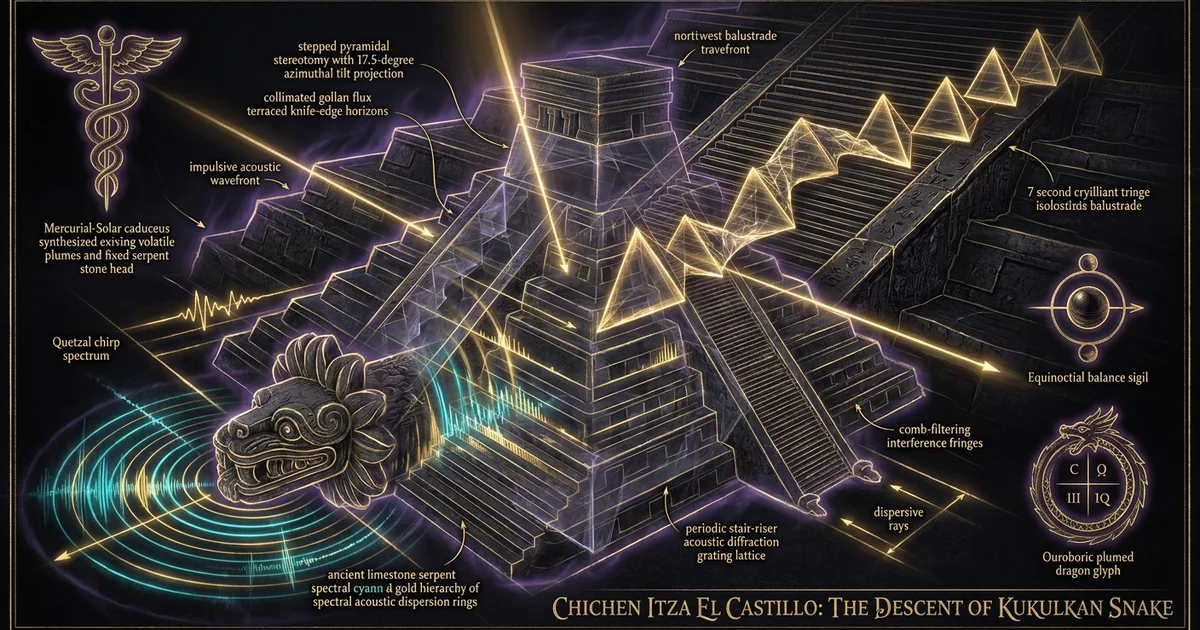
Chichen Itza El Castillo: The Descent of Kukulkan Snake
Executive Summary & Theoretical Thesis: Optico-Acoustic Hierophany and Chronometry
Kinematic Wave Fronts and Archaeoastronomical Alignment
The Temple of Kukulcan (El Castillo) at Chichén Itzá represents an engineered convergence of celestial mechanics, structural stereotomy, and non-linear wave physics. Rather than serving as an inert funerary pile or a purely symbolic locus of liturgical performance, the monument functions as a macro-instrument: a multi-band architectural transducer. Through rigorous spatial calibration, the pyramid couples solar orbital kinematics with terrestrial sensory thresholds.
The structure operates within an absolute framework of archaeoastronomy, wherein its orientation vector deviates deliberately from true geodetic north. By orienting the principal axis to an azimuth of approximately 111.5° (with its complimentary perpendicular alignment at 291.5° on the north-northwest descent), the architects engineered an exact optico-kinetic condition. At the astronomical equinoxes, the solar vector interacts with the stepped profile of the western facade to project seven undulating, isosceles triangles of light down the north-northwest balustrade. This optical sequence culminates precisely at the basal monumental zoomorphic serpent heads, manifesting the chthonic-solar avatar Kukulkan.
The north-northwest staircase balustrade is situated along an azimuth vector of 17.5° ± 0.2° east of true north, yielding an axial orthogonal alignment of 107.5°/287.5° to 111.5°/291.5° depending on structural baseline measurement (Aveni, 2001; Šprajc & Sánchez Nava, 2013). The equinoctial hierophany operates as an edge-diffraction shadow-casting system governed by the solar altitude angle $\alpha$ and azimuth angle $\beta$: $$\tan(\phi) = \frac{\sin(\alpha)}{\cos(\alpha)\cos(\beta - \beta_{\text{wall}})}$$ where $\phi$ defines the projection strike across the stepped terrace arrises onto the inclined balustrade plane. This configuration confirms that the resulting shadow morphology depends strictly upon deliberate stone dressing rather than architectural coincidence.
This temporal convergence is not merely qualitative. The kinematic movement of the projected shadow demonstrates an acute understanding of the local solar elevation and azimuth curves during the late afternoon. As the sun approaches the horizon, the stepped corners of the nine tiers of the pyramid act as spatial knife-edge apertures. These stone projections slice the collimated rays of the sun into discrete geometry, throwing a series of alternating luminous lozenges against the shadowed vertical face of the balustrade. This sequence visualizes the interaction between astronomical geometry and spatial stereotomy, cementing the status of the monument as a triumph of Mesoamerican engineering.
+-------------------------------------------------------------------------+
|                  THE DUAL-TRANSDUCER ARCHITECTURE                       |
|                                                                         |
|        [ SOLAR TRANSMITTER ]                [ ACOUSTIC IMPULSE ]        |
|                  |                                   |                  |
|                  v                                   v                  |
|        Declining Solar Vector               Excitation Handclap         |
|         (291.5° Equinoctial)                 (Broadband Noise)          |
|                  |                                   |                  |
|                  v                                   v                  |
|        Stepped Terrace Arrises             Periodic Stair Risers        |
|        (Knife-Edge Apertures)            (1D Diffraction Grating)       |
|                  |                                   |                  |
|                  v                                   v                  |
|        Kinematic Triangular               Bragg-Scattered Echo          |
|        Shadow Morphogenesis                (Down-Chirp 1.5-0.9 kHz)     |
|                  |                                   |                  |
|                  v                                   v                  |
|        VISUAL SERPENT DESCENT              BIOACOUSTIC QUETZAL CALL     |
+-------------------------------------------------------------------------+
The Transducer Paradigm: Coupling Solar Mechanics and Cymatic Architecture
To interpret El Castillo solely through the lens of passive solar alignment neglects half of its operational capacity. The pyramid is simultaneously an acoustic diffraction grating. When an impulse sound—such as a percussive handclap or ceremonial struck lithophone—is generated at the base of the monumental northern staircase, the regular, periodic geometry of the stone steps alters the reflected acoustic wave front. The high, narrow risers and narrow treads, composed of dense, crystalline Yucatecan limestone, break the incident shock front into a rapid train of discrete, periodic secondary wavelets.
This acoustic transformation relies on the exact physical dimensions of the stair flight. The spatial distribution of the risers imposes a progressive phase shift upon the returning echoes, converting an acoustic white-noise spike into a downward frequency-modulated tonal sweep. This resulting acoustic signature mimics the chirp of the Resplendent Quetzal (Pharomachrus mocinno), a sacred bird identified in Maya cosmology as the avian alter-ego of the Feathered Serpent.
The monument therefore unifies light and sound. As the visual apparition of the serpent descends the balustrade via photon path-geometry, the acoustic signature of the serpent’s avian counterpart is generated via phononic wave dispersion. Through these paired mechanisms, the monument translates both photons and phonons into an embodied liturgical reality.
This dual transducer architecture establishes El Castillo as a rare example of multisensory sacred engineering. The structural builders integrated the mechanical constraints of masonry stereotomy directly with the dynamic vectors of the tropical solar year, linking the /ancient-prehistory/acoustic-resonance-ancient-temples to the wider framework of /ancient-prehistory/mesoamerican-calendrical-astronomy.
Historical Lineage & Experimental Precedents: Rediscovery of the Equinoctial Shadow
Post-Conquest Chronicles and Early Epigraphic Neglect
Following the Spanish conquest of the Yucatán peninsula in the sixteenth century, the operational logic of Chichén Itzá was fractured by structural suppression and colonial depopulation. Friar Diego de Landa, in his foundational 1566 manuscript Relación de las cosas de Yucatán, recorded the physical dimensions, stepped terraces, and serpent balustrades of the main temple with relative clarity, yet he omitted any technical mention of the equinoctial light-and-shadow hierophany. For centuries, post-conquest Western historiography classified the serpentine balustrades as static ornamental emblems of a dead pantheon.
+-------------------------------------------------------------------------+
|                  HISTORICAL REDISCOVERY TIMELINE                        |
|                                                                         |
|  1566      Diego de Landa documents basic dimensions; omits hierophany. |
|  1920s-30s Carnegie Institution of Washington reconstructs facades;     |
|            focus remains strictly architectural and epigraphic.         |
|  1968-74   Jean-Jacques Rivard photographically notes step-shadow link; |
|            Luis E. Arochi publishes quantitative temporal logs.        |
|  1980s-90s Aveni & Lubman conduct formal archaeoastronomical theodolite |
|            surveys and acoustic dispersion spectrographic analyses.     |
|  2000s+    Declercq, Šprajc, and Sánchez Nava confirm wave-scattering   |
|            equations and horizon-calendar solar azimuth models.         |
+-------------------------------------------------------------------------+
During the nineteenth and early twentieth centuries, pioneering explorers such as John Lloyd Stephens, Frederick Catherwood, and Désiré Charnay mapped and illustrated the monument. Yet their surveys, framed by Romantic antiquity, lacked the chronometric tools necessary to decipher the dynamic alignments of the structure. When the Carnegie Institution of Washington initiated the large-scale reconstruction of the pyramid in the 1920s and 1930s under the direction of Sylvanus Morley, architectural conservation took precedence over archaeoastronomical documentation. The Mexican government systematically reconstructed the north and east facades, while deliberately leaving the west and south facades partially ruinous to reveal the underlying structural stratigraphy. This operational split inadvertently preserved the precise solar-casting edges of the northern and western arrises, keeping the dynamic shadow mechanism functionally intact.
       CARNEGIE / INAH CONSERVATION PROFILE (c. 1930)

              [Upper Temple Sanctuary]
                     /        \
                    /          \
  Restored North   /            \  Unrestored / Stratified
  Facade (Serpent /              \  South & West Facades
  Balustrades)   /                \ (Preserved internal
                /                  \ terrace core profiles)
   ============+                    +=============
   [Transducer Balustrade]         [Ruined Terrace Arrises]
Twentieth-Century Photographic Documentation and Archaeoastronomical Quantification
The formal identification of the shadow-casting mechanism as a calculated equinoctial hierophany re-emerged through twentieth-century field photography and amateur documentation. Although indigenous Maya communities throughout the northern lowlands retained oral traditions regarding the seasonal activation of the pyramid, it was not until the late 1960s that modern researchers systematically quantified the phenomenon. The French-American investigator Jean-Jacques Rivard first documented the precise triangle formation, which was soon followed by extensive, multi-year photographic and analytical field surveys led by the Mexican researcher Luis E. Arochi between 1974 and 1977.
Luis E. Arochi documented the minute-by-minute progression of the solar projection in his monograph La Serpiente Emplumada: Cuatro Tiempos del Sol (Editorial Diana, 1977). Arochi recorded the precise geometry of the seven isosceles triangles and demonstrated that the optical phenomenon achieves optical symmetry within an approximate 45-minute temporal window centered near 16:30 local solar time, directly preceding the spring and autumn equinoxes. This photographic sequence was subsequently verified via theodolite and horizon-profile surveys conducted by Anthony F. Aveni (2001) and Ivan Šprajc (2013).
Archaeoastronomers contextualized Arochi’s observational logs within the broader framework of Maya solar-zenith and horizon-alignment calendars. The work of Anthony Aveni established that the orientation of El Castillo was calibrated not simply to celebrate modern cardinal equinoxes, but to establish an agricultural-solar matrix. Aveni proved that the ~17.5° offset from true north belonged to an extensive architectural tradition that aligned sacred administrative centers with critical solar horizon points. These sightlines marked the spatial geometry of agricultural cycles, planting dates, and the return of the seasonal rains across the northern lowlands of Yucatán.
Mathematical Formalism & Physical Mechanics: Stereotomy, Shadows, and Diffraction Grating
CROSS-SECTION: SUN-TERRACE-BALUSTRADE INTERACTION
             \ Solar Vector (\alpha = Altitude, \beta = Azimuth)
              \
               \

[Tier Arris] -----=======================
\                     |
\    Shadow Cone     |  Terrace N
\                   |
North Balustrade      \                  |
Plane            \                 |
\                \                |
\                * Edge Intercept (Projects apex of triangle)
\

\

=============================


* Balustrade Plane Intercept
Trigonometric Shadow Formation on the Northern Balustrade
The visual illusion of the descending serpent is governed by the principles of three-dimensional stereotomy, ray-tracing, and solar vector coordinate transformations. Let the solar position be defined in spherical coordinates by the local solar altitude angle $\alpha$ and the solar azimuth angle $\beta$. The coordinate framework of the pyramid is governed by the orientation of the principal north-northwest balustrade, which lies at an azimuth angle of $\beta_0 \approx 17.5^\circ$, and the horizontal stepped arrises of the western facade tiers, oriented along $\beta_1 \approx 287.5^\circ$.
The pyramid features nine distinct stepped platforms, traditionally linked to the nine structural levels of the Maya underworld, Xibalba. As the declining equinoctial sun sinks toward the horizon along an azimuth of roughly $291.5^\circ$, its rays run almost parallel to the vertical faces of the western stepped tiers. Each of the nine platform corners casts a long, oblique shadow cast across the open void, intersecting the inclined ramp of the north-northwest staircase balustrade.
Because the angle of inclination of the northern staircase ($\theta_{\text{stair}} \approx 45^\circ$) differs from the slope and setback profile of the nine stepped terraces, the light passing between the edges of the successive tiers is projected onto the balustrade as an undulating band of illumination. The intersection between the geometric planes can be expressed as a linear vector transformation. The edge of each terrace acts as a linear aperture defined by the vector:
$$\mathbf{L}_k(t) = \mathbf{P}_k + t,\mathbf{u}_w$$
where $\mathbf{P}_k$ represents the spatial coordinates of the $k$-th tier corner, $\mathbf{u}_w$ is the unit vector oriented along the western terrace wall, and $t$ is a real scalar. The solar rays trace a family of parallel lines along the unit vector:
$$\mathbf{S}(\alpha, \beta) = \begin{bmatrix} \cos(\alpha)\sin(\beta) \ \cos(\alpha)\cos(\beta) \ -\sin(\alpha) \end{bmatrix}$$
The projected coordinate $\mathbf{X}_k$ of the terrace corner shadow cast upon the planar face of the northern balustrade—defined by the plane equation $\mathbf{n}_b \cdot (\mathbf{X} - \mathbf{B}_0) = 0$, where $\mathbf{n}_b$ is the normal vector to the balustrade and $\mathbf{B}_0$ is an anchor point at the balustrade base—is determined by solving:
$$\mathbf{X}_k = \mathbf{P}_k + \left( \frac{\mathbf{n}_b \cdot (\mathbf{B}_0 - \mathbf{P}_k)}{\mathbf{n}_b \cdot \mathbf{S}(\alpha, \beta)} \right) \mathbf{S}(\alpha, \beta)$$
As the solar azimuth $\beta$ matches the wall strike angle within precise angular boundaries, the intersection $\mathbf{X}_k$ produces a set of precisely seven illuminated isosceles triangles along the balustrade. These bright fields interlock with the intervening shadows thrown by the upper terraces. The lowest triangle merges directly into the massive limestone serpent head carved at the foot of the balustrade, closing the circuit of the optico-kinetic display.
       ISOSCELES TRIANGLE PROJECTION GEOMETRY

      |\
      | \  Shadow from Upper Tier Edge
      |  \
      |   \___________________
      |   /                  /
      |  / Illuminated Field/  Balustrade Face
      | /  (Solar Ray Path)/
      |/__________________/

      [Seven repeated triangular units construct the body]
Periodic Grating Acoustics and the Chirped Quetzal Echo
The acoustic phenomenology of the northern staircase operates as a spatial diffraction filter, governed by equations identical to those that describe optical and acoustic Bragg scattering in periodic systems. The staircase consists of $N = 91$ steps characterized by an average rise $h \approx 0.26$ meters and an average tread depth $d \approx 0.26$ meters, yielding an inclination angle $\theta \approx 45^\circ$.
When an observer stationed at the base of the staircase introduces an impulsive acoustic source (a Dirac-like delta signal $\delta(t)$ containing a broad continuum of frequencies), the spherical wave front expands outward and strikes the periodic structural array of stone steps.
Nico F. Declercq, Joris Degrieck, Rudy Briers, and Oswald Leroy (2004), building upon the field work of David Lubman (1998), provided the continuous mechanical and numerical simulation of the El Castillo acoustic echo. The staircase acts as an acoustic diffraction grating. The periodic succession of stone risers imposes an array of time delays $\Delta \tau_m$ on the scattered wave front: $$\Delta \tau_m = \frac{2 m d \cos(\theta)}{c}$$ where $m$ is the step reflection index, $d$ is the tread depth, $\theta$ is the angle of incidence relative to the stairway normal, and $c$ is the speed of sound in air ($\approx 343 \text{ m/s}$). Because higher steps present an increasing distance from the source-receiver position, the returned wave front displays a continuous downward frequency modulation (a chirp): $$f(t) = \frac{c}{2 d \sin[\theta(t)]}$$ As time progresses through the echo duration ($t \approx 0 \text{ to } 250 \text{ ms}$), the effective angle of incidence $\theta(t)$ increases, causing the dominant echo frequency to sweep downward from approximately $1500 \text{ Hz}$ to below $900 \text{ Hz}$.
+-------------------------------------------------------------------------+
|                STEPPED DIFFRACTION GRATING MECHANICS                    |
|                                                                         |
|  Incident Impulse Wave Front: \delta(t)                                 |
|  ------------------------------------->                                 |
|                                                                         |
|          Step n+2    |___________                                       |
|                      |          ^                                       |
|          Step n+1    |______    | Risers: h \approx 0.26 m              |
|                      |     ^    v                                       |
|          Step n      |     | Treads: d \approx 0.26 m                   |
|                      v     v                                            |
|                                                                         |
|  Reflected Chirp Wavelet Train:                                         |
|  < - - - - - - - - - - - - - - - - - - - - - - - - - - - - - - - - - -  |
|   t = 0 ms (1500 Hz) ---------> t = 200 ms (900 Hz)                    |
+-------------------------------------------------------------------------+
Because the dimensions of the steps are comparable to the acoustic wavelength of mid-frequency audible sound ($\lambda \approx 0.23 \text{ to } 0.38 \text{ m}$ across the range from $900 \text{ Hz}$ to $1500 \text{ Hz}$), the backscattered wave exhibits constructive and destructive wave interference. The risers act as a discrete series of coherent secondary line sources via the Huygens-Fresnel principle.
As the sound wave returns to an auditor situated near the base, the reflected energy does not register as a standard reverberant smear. Instead, it arrives as a coherent, downward-gliding whistle. This profile matches the fundamental voice print of Pharomachrus mocinno, which exhibits an identical spectral envelope spanning $1.5 \text{ kHz} \rightarrow 0.9 \text{ kHz}$. Detailed derivations of this mechanism can be explored through /sound-cymatics/acoustic-diffraction-and-wave-dispersion.
Architectural Chronometry: The 365-Day Solar Pyramid Calendar
MONUMENTAL TALLY SYSTEM
                 [ Upper Temple ]  --> 1 Unified Base
                        |
       +----------------+----------------+
       |                                 |
 Four Staircases                  Nine Terraces

(91 steps * 4 = 364)            (Bisected by stairs)
|                                 |
v                                 v
Total Steps: 365 Days              18 Axial Divisions
(Haab' Solar Year)               (Haab' Solar Months)
Structural Metrics: Treads, Platforms, and the Mesoamerican Long Count
Beyond its dynamic wave-scattering behavior, El Castillo serves as a stone compilation of the Mesoamerican calendrical corpus. The geometry of the pyramid coordinates the civil solar year (Haab’), the sacred ritual cycle (Tzolk’in), and the broader synodic and orbital periods of Venus and the Moon into a single unified profile. This structural encoding is grounded in strict calendrical arithmetic.
Each of the pyramid’s four cardinal faces bears a monumental projecting stairway containing exactly 91 stone risers. When these four axial ascents are summed:
$$4 \times 91 = 364 \text{ steps}$$
By incorporating the final, raised platform of the upper temple sanctuary as an additional, unifying step, the structural count equals the number of days in the tropical solar year:
$$364 + 1 = 365 \text{ steps}$$
This matches the 365 days of the Haab’ calendar, which comprised 18 named months (uinal) of 20 days each, supplemented by the five-day intercalary period known as the Wayeb’.
The spatial arrangement of the monumental platforms further reflects this mathematical scheme. The core structure consists of nine radial stepped terraces, representing the vertical architecture of the cosmos. On each facade, these nine terraces are bisected into symmetrical halves by the central ascending stairway, yielding $9 \times 2 = 18$ distinct recessed terraces per face. These 18 structural platforms match the 18 months of the Haab’.
Furthermore, the lateral stone panels flanking the stairways on each terrace level bear a sequence of carved decorative registers. Across the four faces, these panels sum to exactly 52 rectangular bas-reliefs, mapping directly to the 52-year cycle of the Calendar Round—the critical period required for the 260-day Tzolk’in and the 365-day Haab’ to return to the identical joint permutation.
Structural Metric
- 4 axial staircases of 91 steps each + 1 summit platform
- 9 horizontal stepped platform terraces (bisected by staircases)
- 52 bas-relief structural panels per facade profile
- Spatial alignment deviation of ~17.5° East of Geodetic North
Astronomical & Calendrical Correlate
- 365 days of the solar year (Haab’ cycle: $18 \times 20 + 5$)
- 18 distinct 20-day solar months (uinal) of the Mesoamerican calendar
- 52-year synchronization era of the Calendar Round (Xiuhmolpilli)
- Sunset alignment marking solar zenith passage and agricultural shifts
Azimuth Offset and the Agricultural Horizon System
The intentionality of the pyramid’s rotational offset is corroborated by regional archaeoastronomical surveys. Rather than conforming to geodetic north, the primary axis of El Castillo is oriented to an azimuth of approximately 111.5° (azimuth of the east-southeast facade) with its orthogonal face oriented to approximately 287.5°–291.5° (azimuth of the west-northwest facade).
This skew is not an error in compass calibration; it is a structural signature shared by dozens of monumental sites throughout the Maya lowlands and central Mexico. This architectural distribution has been documented extensively in studies of /sacred-geometry/astronomical-alignments-and-stereotomy.
       AZIMUTHAL HORIZON ORIENTATION OF EL CASTILLO

                      True North (000.0°)
                             |  /
                             | /
                             |/ Principal Axis Skew: +17.5°
                             *----------------------- Azimuth: ~017.5°
                            / \
                           /   \
                          /     \
                         /       \
  Sunset Zenith Vector  /         \
  Azimuth: ~291.5°     *           * Orthogonal Axis: ~107.5°-111.5°
Investigations by Ivan Šprajc and Pedro Francisco Sánchez Nava confirm that these 17.5° axial orientations served a practical purpose: they anchored an agricultural horizon ephemeris. At the latitude of Chichén Itzá ($\approx 20.68^\circ \text{ N}$), an orientation of 291.5° tracks solar sunsets on specific dates within the tropical year, most notably around May 20–23 and July 18–21.
These dates coincide directly with the solar zenith passages at this latitude—the critical temporal points when the sun traverses the local zenith at noon and casts no shadow from a vertical gnomon. The spring zenith passage serves as the environmental harbinger of the convective wet season in the Yucatán, alerting agricultural communities that the land-clearing burning cycle (roza) must end immediately to prepare for the seeding of maize (Zea mays).
Empirical Evidence & Observational Data: Photometric and Bioacoustic Verification
+-------------------------------------------------------------------------+
|                  ACOUSTIC SPECTROGRAM DECAY CURVE                       |
|                                                                         |
|  Freq (kHz)                                                             |
|   2.0 |                                                                 |
|       |                                                                 |
|   1.5 |     *                                                           |
|       |      \                                                          |
|   1.2 |       \ *                                                       |
|       |          \                                                      |
|   0.9 |           \ * * *                                               |
|       |                  \                                              |
|   0.5 |                   * * * * * *                                   |
|       +------------------------------------- Time (ms)                  |
|       0            50           150        250                          |
|                                                                         |
|   Observed Profile: Instantaneous downward sweep from 1500 Hz to 900 Hz  |
+-------------------------------------------------------------------------+
Spectrographic Verification of the Acoustic Grating Phenomenon
To verify that the staircase functions as an intentional or structural acoustic grating rather than a perceptual phantom, field acoustic measurements have been conducted using calibrated, high-sample-rate audio equipment and fast Fourier transform (FFT) analysis. The acoustic experiments initiated by David Lubman in 1998, and subsequently verified by Declercq et al. through computational boundary-element simulations, reveal that an impulse excitation generates an acoustic signal that mirrors the vocalizations of Pharomachrus mocinno.
Spectrograms derived from recordings captured at the base of the northern staircase demonstrate that the primary acoustic reflection does not behave like a standard, broad-spectrum reverberation from a smooth vertical boundary. The reflected wave exhibits an instantaneous downward frequency sweep spanning an interval of approximately 200 to 250 milliseconds.
At the onset of the echo ($t \approx 0 \text{ ms}$), the fundamental frequency registers at approximately $f_{\text{start}} \approx 1500 \text{ Hz}$. Over the course of the next 200 milliseconds, as successive wavelets scatter back from the higher stair treads, the observed frequency drops toward an asymptotic value of $f_{\text{end}} \approx 900 \text{ Hz}$.
The duration of this return sweep ($\tau_{\text{total}}$) is governed by the two-way acoustic path length between the base of the stairway and the upper temple platform:
$$\tau_{\text{total}} = \frac{2 L_{\text{flight}}}{c} = \frac{2 \times 32.5 \text{ m}}{343 \text{ m/s}} \approx 0.19 \text{ seconds}$$
This value matches the empirical spectrogram metrics. The periodic profile of the steps acts as an acoustic comb filter that selectively attenuates out-of-phase frequencies while concentrating energy into a chirped band. This signal matches the distinctive vocal signatures documented in field recordings of Pharomachrus mocinno nesting in the cloud-forest biomes of the Guatemalan highlands.
Photometric Decay and Duration Analysis of the Equinoctial Hierophany
Photometric analyses of the equinoctial hierophany corroborate the temporal and geometric precision of the light show. Modern sensors measuring illuminance levels (in lux) verify that the formation of the seven triangles is not an instantaneous event, but a gradual morphological process lasting roughly 45 to 55 minutes. The process begins approximately one hour before local sunset on the equinox. The shadow of the southwestern corner of the upper platform first casts an indistinct penumbra near the top of the balustrade.
As the solar altitude drops from approximately $\alpha = 15^\circ$ toward the local horizon, the geometry sharpens into higher resolution. The penumbral blur yields to a sharp umbral boundary due to the small angular diameter of the sun ($\approx 0.53^\circ$).
The seven triangular patches of light stabilize into clean isosceles geometry, each linking to the adjacent terrace shadow. During the critical 15-minute window preceding sunset, the seven light lozenges form a continuous undulating serpentine body that appears to terminate directly in the jaws of the colossal serpent head at ground level.
Once the solar disk drops below an elevation of $\alpha \approx 2^\circ$, atmospheric extinction and horizon topography rapidly diminish the intensity of the incoming light. The seven illuminated triangles dissolve into the ambient shade, completing the visual illusion of an earthly descent and subterranean disappearance.
Metaphysical Implications & Unified Synthesis: Solar Descent as Cosmological Axis
+-------------------------------------------------------------------------+
|                    THE ARCHITECTURAL AXIS MUNDI                         |
|                                                                         |
|         Celestial Realm          [ Upper Sanctuary / Solar Vector ]     |
|                                                  |                      |
|                                                  v                      |
|         Terrestrial Plane        [ 7-Triangle Serpent Balustrade ]      |
|                                                  |                      |
|                                                  v                      |
|         Chthonic Underworld      [ Colossal Serpent Heads / Cenote ]    |
+-------------------------------------------------------------------------+
The Hierophany as Epistemological Integration of Sky, Earth, and Underworld
In Maya ontology, architecture was never merely functional, commemorative, or aesthetic; it was an active participant in reality generation. El Castillo stands at the geographic center of the urban grid of Chichén Itzá, serving as an architectural axis mundi that physically binds the sky, the earth, and the subterranean underworld.
The equinoctial descent of Kukulkan represents a direct translation of solar mechanics into public political theology. The appearance of the undulating shadow-serpent visually demonstrated that the supreme authority of the state was synchronized with celestial law.
As analyzed by Anthony Aveni in Skywatchers and Ivan Šprajc in Astronomía en la arquitectura de Chichén Itzá, the public manifestation of the Feathered Serpent provided visible proof of the ruler’s ability to intermediate between the cosmic order and the mundane world. The equinoctial hierophany occurred before assemblies gathered in the expansive northern plazas. It visually confirmed that the agricultural schedule—and the seasonal rains controlled by the deity—flowed through the specialized knowledge of the ruling priesthood.
The descent of the light-and-shadow serpent follows a specific directional path: moving from the upper temple sanctuary down the northern balustrade toward the sacred Cenote Sagrado, located directly to the north along a paved sacbe (causeway).
This north-south trajectory was understood as a path of divine communion. The serpent descended from the sky, touched the terrestrial surface of the plaza, and headed toward the water-filled abyss of the cenote—the primary threshold to Xibalba and the dwelling place of the rain deity Chaac. The hierophany integrated the three cosmic planes into a singular, cyclic flow of life-bearing energy.
COSMIC GEOGRAPHIC VECTOR AT CHICHÉN ITZÁ
[ EL CASTILLO ]
|
| (North Balustrade Descent: Equinoctial Hierophany)
v
[ Great North Plaza ]
|
| (Sacred Cause-Way / Sacbe No. 1)
v
[ CENOTE SAGRADO ] --> Chthonic Axis (Dwelling of Chaac)</code></pre>
Acoustic Animism and Infrasonic Induction in Sacro-Civic Rites
The simultaneous activation of the acoustic diffraction grating indicates that the monument was designed to evoke a state of multisensory immersion. Within the Mesoamerican worldview, dynamic sound was treated as an animistic force: an acoustic entity capable of transforming space and communicating with divine agencies.
When a presiding officiant stepped forward onto the northern platform and clapped their hands, the structure responded with the voice of the quetzal. The monument operated as an interactive system: mechanical human motion triggered an immediate bioacoustic response from the stone facade.
Furthermore, recent acoustic testing reveals that the geometry of the surrounding grand plaza, combined with the multiple staircases of El Castillo, generates low-frequency resonant modes and infrasonic modulations when large crowds assemble and move in synchrony. The auditory processing of the quetzal chirp, paired with the gradual descent of the undulating serpent shadow, engaged both the visual and auditory faculties of the assembled audience.
Physical wave mechanics—both electromagnetic and acoustic—were deployed to evoke deep metaphysical resonance, anchoring the sociopolitical framework of the Maya-Toltec state within the observable fabric of physical reality.
Frequently Asked Questions
Mathematical and Architectural FAQ
Does the equinoctial shadow-serpent appear exclusively on the exact astronomical equinox?
The optical hierophany is not confined to the single day of the astronomical equinox (March 20/21 or September 22/23). Because of the physical width of the stair balustrade, the angular diameter of the solar disk (roughly 0.5 degrees), and the geometric tolerances of the terrace arrises, the seven-triangle shadow formation can be observed with near symmetry for approximately five to seven days before and after the astronomical equinox.
The visual effect shifts subtly from day to day as the sun’s declination changes. Peak visual balance—defined as the precise moment when all seven isosceles triangles form complete, closed contours that touch the undulating shadow border—occurs within a narrow 48-hour window centered on the true equinox, provided local atmospheric conditions permit clear solar projection.
Was the chirped quetzal echo deliberately engineered, or is it an incidental artifact of staircase design?
Acousticians and archaeologists remain divided on the question of architectural intent. While physical scientists such as David Lubman have demonstrated that the stair risers and treads produce a frequency sweep matching the call of the Resplendent Quetzal, others, including Nico Declercq, treat the effect as a natural consequence of periodic scattering from any stepped masonry structure possessing similar proportions.
However, comparative field testing of contemporary staircases throughout the Maya lowlands demonstrates that not all stepped structures yield this specific down-chirp profile. The distinct height-to-tread ratio ($h \approx d \approx 0.26\text{ m}$) used at El Castillo, combined with the dense acoustic reflectivity of its smoothed limestone masonry, strongly suggests intentional optimization.
Even if the initial acoustic scattering phenomenon was discovered empirically during construction rather than derived through modern wave mechanics, the builders systematically preserved and refined the geometry across multiple reconstruction phases, fully aware of its auditory impact.
ACOUSTIC COMPARISON: MASONRY TYPES
Smooth, Dressed Limestone (El Castillo)
[Impulse] ----> [Riser 1] -> [Riser 2] -> [Riser 3] ====> Coherent Chirp
Porous, Rubble-Core Masonry (Unfinished / Degraded Steps)
[Impulse] ----> [Diffuse Scattering & Absorption]   ====> Reverberant Smear
How has the precession of the equinoxes affected the visual alignment of El Castillo over the past millennium?
The axial precession of the Earth, which operates along a roughly 25,772-year cycle, has altered the tropical year’s celestial coordinates since the primary construction phases of the monument (circa 800 to 1100 CE). However, the visual manifestation of the equinoctial hierophany is governed by the sun’s declination and local horizon coordinates rather than by the background sidereal constellations.
Because the Earth’s axial tilt (obliquity of the ecliptic) has varied by less than 0.08 degrees over the past thousand years, the solar altitude and azimuth paths on the modern equinox remain nearly identical to those in the Terminal Classic period.
Consequently, the light-and-shadow projection on the northern balustrade continues to align with remarkable precision, demonstrating the long-term optical resilience of its underlying solar-geometric design.