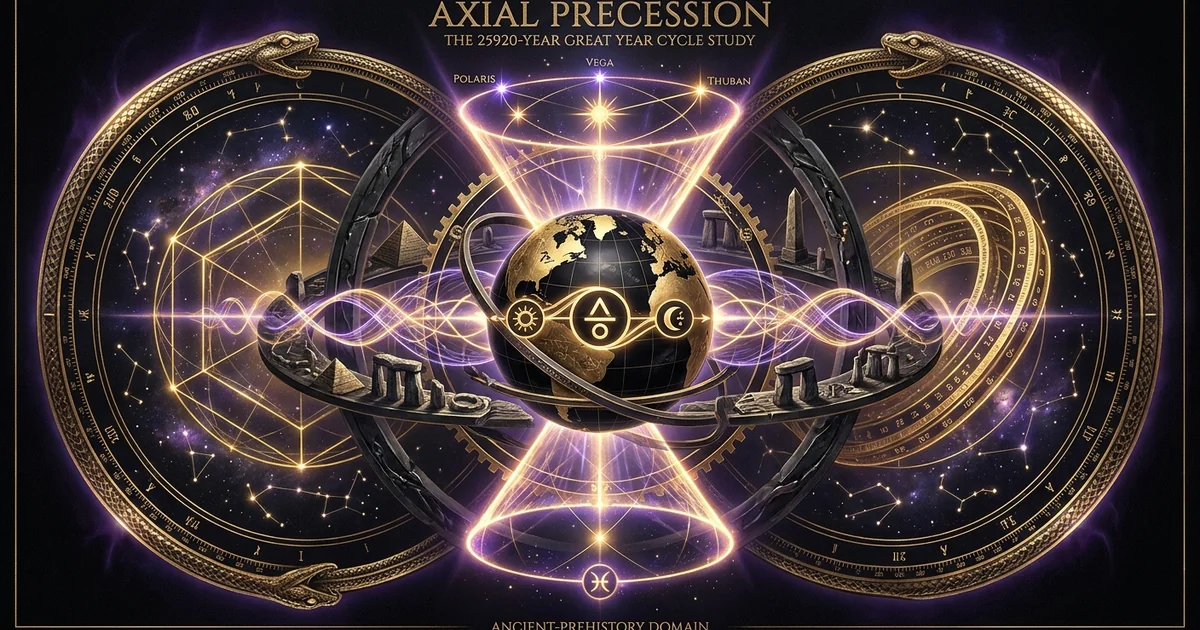
Axial Precession: The 25920-Year Great Year Cycle Study
Executive Summary & Theoretical Thesis
Lunisolar Gravitational Torque and the Precession Vector
Earth operates as a macroscopic, oblate spheroid exhibiting rotational symmetry about its polar axis yet perturbed by significant equatorial bulging. This geometric departure from sphericity establishes an asymmetric mass distribution, quantitatively characterized by a non-zero second degree zonal harmonic or gravitational quadrupole-moment ($J_2$). When subjected to the differential gravitational fields of the Sun and the Moon, whose orbital planes are inclined relative to the terrestrial equatorial plane, the terrestrial equatorial ring experiences an anisotropic gravitational gradient.
The resultant external mechanical torque ($\mathbf{\tau}$) does not alter the Earth’s primary spin velocity ($\omega$) significantly, but instead induces a gyroscopic precession of its angular momentum vector ($\mathbf{L}$). This dynamical interaction manifests as an earth wobbling axis gyroscopic motion, generating a retrograde conical sweep of the rotational axis about the normal to the ecliptic plane. The macroscopic manifestation of this gyroscopic perturbation is axial-precession, historically recognized as the equinoctial-drift—a continuous westward migration of the equinoctial intersections across the background of the sidereal-zodiac.
The secular angular velocity of axial precession ($\Omega_p$) can be derived through Euler’s dynamical equations for an axisymmetric rigid rotor undergoing perturbing external gravitational potentials:
$$\Omega_p = \frac{3}{2} \frac{G M_{\text{ext}}}{\omega , r_{\text{ext}}^3} \left( \frac{C - A}{C} \right) \cos\theta$$
Where:
- $G$ represents the Newtonian gravitational constant.
- $M_{\text{ext}}$ and $r_{\text{ext}}$ denote the perturbing celestial body’s mass and its mean geocentric orbital distance.
- $\omega$ is Earth’s sidereal diurnal rotational angular velocity ($7.292115 \times 10^{-5} \text{ rad/s}$).
- $C$ and $A$ are the polar and equatorial principal moments of inertia, respectively.
- $\theta$ designates the mean ecliptic-obliquity (presently $\approx 23.44^\circ$).
The 25,920-Year Platonic Ideal vs. Empirical Secular Drift
Classical philosophical traditions and archaic astronomical treatises canonicalized the duration of this complete precessional cycle at precisely 25,920 years—an epoch historically designated as the Platonic Great Year (or platonic-year). This canonical temporal interval corresponds to a uniform precessional displacement rate of exactly 50.00 arcseconds per Julian year ($50.00’‘/\text{a}$), yielding an angular velocity of $1^\circ$ every 72 years, or $30^\circ$ (a standard zodiacal house) every 2,160 years. Modern astronomical measurements through the International Earth Rotation and Reference Systems Service (IERS), however, yield an instantaneous general precessional rate in longitude of approximately $p = 50.28796’'/\text{a}$ at epoch J2000.0, corresponding to an astronomical cycle length of approximately 25,772 years.
This divergence between the ideal 25,920-year cycle and the instantaneous empirical measurement of 25,772 years is not indicative of archaic observational incompetence. Instead, it underscores the difference between a time-invariant sexagesimal harmonic model and an instantaneous dynamical state. The contemporary rate of precession is accelerating slightly due to secular variations in orbital eccentricity and geodynamic shifts in the Earth’s dynamical oblateness caused by post-glacial isostatic rebound.
Over deep geological epochs, this rate oscillates non-linearly within the broader spectrum of milankovitch-cycles, periodically passing through the idealized 50.00 arcsecond-per-year harmonic baseline. The 25,920-year figure represents a geodetic and numerological integration baseline: a base-60 harmonic quantization of Earth’s gyroscopic secular drift, synchronizing orbital mechanics with the sacred metrology of antiquity.
Archaeoastronomical Geodesy as a High-Precision Chronometer
The systematic examination of archaic monumental architecture, meridian sighting corridors, and sacred geodetic grid systems reveals that pre-classical civilizations deployed precision horizon astronomy specifically calibrated to track equinoctial drift. Contrary to the standard historiographical paradigm—which isolates the discovery of axial precession to Hellenistic Greece in the second century BCE—global architectural orientations attest to deliberate observational compensation for precessional displacement over multi-millennial baselines.
Monolithic sites such as the temple complexes of Upper Egypt, the radial alignments of the Giza plateau explored in /ancient-prehistory/archaeoastronomical-alignments-giza, and the megalithic enclosures of the Fertile Crescent demonstrate structural realignments that trace stellar drift across millennia.
These sites functioned not merely as primitive solar calendars, but as permanent lithic observatories. By fixing terrestrial coordinate systems to the rising of specific heliacal marker stars along the horizon, archaic societies converted monumental architecture into high-precision, long-baseline chronometers. These structures continuously calibrated the axial precession equinoxes 25920 years great year platonic cycle against terrestrial civil calendars, treating precession as the absolute metric of geological and epochal time.
Historical Lineage & Experimental Precedents
The Classical Narrative: Hipparchian Star Catalogues and Spica Displacements
The orthodox history of science attributes the initial identification and quantitative isolation of axial precession to the Hellenistic astronomer Hipparchus of Nicaea (c. 190–120 BCE). As recorded in Claudius Ptolemy’s Syntaxis Mathematica (Almagest, Books III and VII), Hipparchus deduced the secular shift of the celestial framework by comparing his own naked-eye equatorial coordinate observations with the positional data compiled by the Alexandrian astronomers Timocharis and Aristyllus approximately 150 to 170 years prior.
Hipparchus focused his observational baseline on bright zodiacal stars, most notably the alpha-virginis star Spica. By cross-referencing the angular distance of Spica from the autumnal equinoctial point during lunar eclipses, Hipparchus detected that the star’s celestial longitude had increased by approximately $2^\circ$ over the intervening century and a half, while its celestial latitude remained invariant relative to the plane of the ecliptic.
Longitudinal Displacement Measurement (Hipparchus):
  Timocharis (c. 280 BCE):  Spica at 8° W of Autumnal Equinox
  Hipparchus (c. 130 BCE):  Spica at 6° W of Autumnal Equinox
  Observed Secular Drift:   Δλ ≈ +2° over ~150-170 years
  Empirical Rate Derived:   ≥ 1° per 100 years (46.8" to 48.0"/year bound)
Hipparchus formulated the hypothesis that this motion did not reflect the kinematic trajectories of individual stellar bodies, but rather an intrinsic, progressive displacement of the equinoctial and solstitial points along the ecliptic band. He computed a conservative minimum drift rate of $1^\circ$ per century ($36’'/\text{a}$), though he noted the data pointed toward higher values. While this classical deduction represents a triumph of Hellenistic empiricism, historicist analysis reveals that Hipparchus was standardizing a long-accumulated body of empirical astronomical data inherited from the Near East. His primary accomplishment was the mathematical formulation of equinoctial drift within the geometric framework of Greek spherical trigonometry.
Pre-Hellenistic Equinoctial Tracking: Babylonian MUL.APIN and Egyptian Decanal Clocks
Centuries before the Alexandrian era, the neo-Babylonian and earlier Kassite astronomers preserved records detailing the shifting positions of primary stellar alignments relative to agricultural and lunar cycles. The Babylonian compendium known as the MUL.APIN (compiled c. 1000 BCE from observational data stretching into the second millennium BCE) presents an elaborate tripartite division of the celestial dome into the Paths of Enlil, Anu, and Ea. Careful translation of the MUL.APIN demonstrates an awareness that the heliacal rising of the constellation Zu-pu (the stars of the modern zodiacal constellations) drifted relative to fixed civil-calendar dates across successive centuries, requiring periodic re-anchoring of the intercalary calendar months to specific asterisms.
Concurrently, the astronomical architecture of Dynastic Egypt relied upon the decanal system: thirty-six specific star groups rising successively at ten-day intervals over the course of the civil year. The star Sirius (Sopdet) anchored the Sothic cycle, functioning as an observational baseline due to the unique coincidence of its proper motion and precessional shift, which matched the un-intercalated 365-day Egyptian year over a 1,460-year period.
However, other decanal stars drifted conspicuously from their designated seasonal hours. Egyptian structural engineering adjusted for this secular displacement through the deliberate axial realignment of primary temple sanctums. Temple structures such as the temple of Amun-Ra at Karnak and Hathor at Dendera contain superposed structural foundations exhibiting small, systematic azimuthal shifts. These realignments precisely tracked the shifting horizon azimuth of heliacally rising target stars over centuries-long construction intervals, providing clear physical evidence of systematic equinoctial tracking long preceding Hellenistic records.
Hellenistic Empirical Model
- Foundational Method: Positional star cataloguing comparing single-generation coordinate baselines (e.g., Hipparchus vs. Timocharis).
- Coordinate Framework: Polar spherical geometry isolating longitude ($\lambda$) displacement while confirming latitude ($\beta$) invariance relative to the ecliptic.
- Quantification: Calculated precession conservatively as $\ge 1^\circ / 100 \text{ years}$ ($36.0’'/\text{a}$), later codified by Ptolemy at exactly $1^\circ / 100 \text{ years}$.
- Epistemic Context: Geometric kinematic model of the celestial sphere operating under a geocentric worldview.
Archaic Archaeoastronomical Model
- Foundational Method: Longitudinal horizon astronomy employing multi-generational monumental sightlines and azimuth re-orientation.
- Coordinate Framework: Horizon-altazimuth and equatorial heliacal-rise frameworks tracking the colure shifts through the sidereal-zodiac.
- Quantification: Canonical integer sexagesimal formulations: $1^\circ / 72 \text{ years}$ ($50.0’'/\text{a}$), yielding the 2,160-year age and the 25,920-year cycle.
- Epistemic Context: Astro-theological and geodetic integration of macrocosmic epochs linked directly to cyclical temporal paradigms.
Hamlet’s Mill and the Archaic Encoding of the Vernal Point Shift
The thesis that pre-literate and archaic civilizations possessed an advanced understanding of the shift through twelve zodiacal ages was comprehensively formulated in 1969 by Giorgio de Santillana and Hertha von Dechend in their seminal text, Hamlet’s Mill: An Essay on Myth and the Frame of Time (analyzed further in /ancient-prehistory/hamlets-mill-mythological-astronomy). De Santillana and von Dechend conducted a transcultural comparative analysis of mythological motifs spanning Indo-European, Amerindian, Polynesian, and ancient Near Eastern traditions.
They demonstrated that the recurring mythic trope of a cosmic “mill” or axle—an apparatus responsible for grinding out seasons, gold, or fertility, which inevitably breaks, unseats its pivot, and plunges into the ocean—is a precise allegorical formulation of the shift of the vernal equinoctial colure away from its ancestral celestial reference points.
De Santillana & von Dechend Precessional Number Matrix:
  Base Unit:            72 years   = 1° precessional drift
  Duodecimal Unit:   2,160 years   = 30° zodiacal constellation epoch
  Macro-Cycle:      25,920 years   = 360° complete Platonic Great Year
  Harmonic Multiples:  108, 432, 864, 1296 (Vedic, Nordic, and Near Eastern mythos)
The underlying mathematical architecture of these mythologies systematically encodes numbers that derive directly from the base-60 sexagesimal quantification of the precessional rate. In the Icelandic Prose Edda, the 540 doors of Valhalla, each admitting 800 warriors to fight the Fenris wolf, yield $540 \times 800 = 432,000$ combatants—a canonical figure matching the 432,000-year Kali Yuga of classical Vedic cosmology.
The numbers 72 (years required for a $1^\circ$ shift), 108 (the number of beads on the Buddhist and Hindu japa mala, and the radius-to-distance harmonic ratios of the Sun and Moon), 432, and 2,160 occur globally with statistical consistency. These recurring numerical matrices indicate that pre-Hellenistic societies did not merely notice axial drift, but integrated its mathematical harmonics as the structural foundation of their macrocosmic timelines.
Mathematical Formalism & Physical Mechanics
Rigid Body Dynamics: Oblateness, Moments of Inertia, and the J2 Factor
The physical mechanics governing the precessional torque on the Earth depend directly on the deviation of the Earth’s geoid from a true sphere. This oblateness is the direct result of hydrostatic equilibrium achieved by a rotating, self-gravitating planetary body. The planetary mass distribution can be expressed via its principal moments of inertia along three orthogonal axes: the two equatorial axes ($A$ and $B$, where $A \approx B$) and the polar axis ($C$).
Because the Earth is an oblate ellipsoid, $C > A$, generating a mass excess around the equator. In multipole gravitational potential theory, this equatorial mass distribution is parameterized by the dynamic form factor or second-degree zonal harmonic, $J_2$, defined as:
$$J_2 = \frac{C - A}{M_\oplus R_\oplus^2}$$
Where $M_\oplus$ represents the mass of the Earth ($5.9722 \times 10^{24} \text{ kg}$) and $R_\oplus$ is the equatorial radius ($6.378137 \times 10^6 \text{ m}$). Modern space geodesy measures $J_2$ to be approximately $1.08263 \times 10^{-3}$ (Yoder, 1995). The Earth’s non-zero quadrupole-moment generates a gravitational target for external celestial bodies.
If the Earth’s rotational axis were strictly orthogonal to the ecliptic plane, the net gravitational force on the near-side and far-side equatorial bulges would balance symmetrically relative to the center of mass. However, the ecliptic-obliquity ($\theta \approx 23.44^\circ$) establishes a persistent, asymmetric gravitational lever arm, allowing solar and lunar gravitational potentials to apply a restorative torque that attempts to pull the equatorial plane into alignment with the planes of their respective orbits.
Torque Generation Mechanics on Equatorial Bulge:
               F_near (Gravitational pull greater on near-equator)
                \
    [N-Pole]     \
       |          \
       |===[Equator Bulge] ===> Net Restoring Torque (τ)
       |          /
    [S-Pole]     /
                /
               F_far  (Gravitational pull weaker on far-equator)
Result: Conical gyroscopic precession perpendicular to applied torque.
Lunisolar vs. Planetary Precession: Deriving the 50.29" Secular Rate
The total precessional motion observed from the terrestrial surface—designated historically as general precession ($p$)—is the vector sum of two distinct gravitational phenomena: lunisolar precession ($p_{LS}$) and planetary precession ($p_{PL}$). Lunisolar precession represents the dominant component, driven by the combined gravitational pull of the Moon and the Sun on the Earth’s equatorial bulge.
Because the Moon’s proximity compensates for its relatively small mass, the lunar tidal torque is roughly 2.17 times greater than that of the Sun. Together, they induce a retrograde westward migration of the equinoctial points along the ecliptic at a secular rate of approximately:
$$p_{LS} \approx 50.3878’'/\text{a}$$
Planetary precession, by contrast, does not stem from a torque acting on the Earth’s equatorial bulge. Instead, it is caused by the gravitational perturbations exerted by the other planets (primarily Venus and Jupiter) on the Earth’s orbital plane.
These perturbations force the orbital plane itself—and consequently the ecliptic—to slowly rotate about an axis residing within the plane of the orbit, producing an eastward drift of the vernal equinox along the equator of approximately $p_{PL} \approx 0.1055’'/\text{a}$. Subtracting this planetary contribution from the lunisolar component gives the general precessional rate along the ecliptic:
$$p = p_{LS} - p_{PL} \cos\theta \approx 50.3878’’ - (0.1055’’ \times \cos(23.44^\circ)) \approx 50.2879’'/\text{a}$$
In “A long-term numerical solution for the insolation quantities of the Earth” (Astronomy & Astrophysics, 428(1), 261–285), J. Laskar et al. established high-precision polynomial and quasi-periodic solutions for the precessional frequency ($p$) and the fundamental frequencies of the Solar System.
Laskar demonstrated that the secular motion of the spin axis is coupled to orbital eccentricity variations ($e$) and inclination frequencies ($s_k$), meaning the precessional parameter is non-static over multi-million-year spans:
$$p(t) = p_0 + p_1 t + p_2 t^2 + \sum_{k} C_k \cos(s_k t + \phi_k)$$
The primary precessional period oscillates systematically within a boundary envelope between 25,600 and 26,100 years throughout the late Cenozoic era.
Milankovitch Resonance: Precession-Obliquity-Eccentricity Couplings
Axial precession does not operate in mechanical isolation; it constitutes the highest-frequency orbital pacemaker within the broader Milankovitch orbital cycles that drive Quaternary climate dynamics. The climatic impact of precession is mediated primarily through its influence on the seasonal distribution and geographic gradient of solar insolation. Precession modulates the point along the Earth’s elliptical orbit where specific seasons occur.
When the northern hemisphere summer coincides with perihelion (the orbital point of closest approach to the Sun), the seasonal contrast is maximized: summers are brief and exceptionally warm, while winters are long and cold. Conversely, when northern summer occurs at aphelion, summers are cooler and prolonged, conditions that favor the preservation and growth of high-latitude glacial ice sheets.
The precessional index is formalized by paleoclimatologists as $\Delta e \sin \varpi$, where $e$ represents the orbital eccentricity and $\varpi$ is the longitude of perihelion measured from the moving equinox. Because the Earth’s elliptical orbit itself undergoes orbital precession (apsidal precession), the climatic precessional cycle does not repeat at the 25,772-year sidereal period, but at quasi-periodic intervals of approximately 19,000 and 23,000 years.
This precessional forcing couples non-linearly with the 41,000-year cycle of ecliptic-obliquity variations and the 100,000-to-400,000-year cycles of eccentricity. This coupled system modulates summer insolation at $65^\circ \text{ N}$ latitude, operating as the primary driver of Pleistocene glacial and interglacial terminations.
Empirical Evidence & Observational Data
Modern VLBI and Space Geodesy: Measuring Sub-Milliarcsecond Drift
Contemporary verification of the Earth’s rotational dynamics relies on space geodesy, primarily Very Long Baseline Interferometry (VLBI), Satellite Laser Ranging (SLR), and Global Navigation Satellite Systems (GNSS). The International Earth Rotation and Reference Systems Service (IERS) monitors the orientation of the Celestial Intermediate Pole (CIP) relative to the International Celestial Reference Frame (ICRF). The ICRF is anchored by hundreds of extragalactic radio sources—primarily distant quasars—which are essentially fixed in space and show negligible proper motion.
Through VLBI observation of these quasars, geophysicists track the precession and nutation of the terrestrial axis down to sub-milliarcsecond precision. These measurements verify the IAU 2000A Precession-Nutation Model, which incorporates hundreds of frequency terms describing both smooth secular precessional drift and short-term periodic nutations caused by the Moon’s 18.6-year nodal regression.
These empirical measurements confirm that the instantaneous secular rate of axial precession is $50.287961’'/\text{a}$, validating the classical lunisolar mechanical models while providing empirical data on how real-time geodynamic phenomena—such as core-mantle boundary coupling and glacial isostatic adjustment—slightly adjust the rate of precessional drift.
Cyclostratigraphy and Deep-Sea Sedimentary Forcing Records
Empirical evidence for the continuity and stability of axial precession across deep geological time comes from cyclostratigraphy. Deep-sea sediment cores extracted by the International Ocean Discovery Program (IODP) and terrestrial sedimentary successions preserve high-resolution records of paleoclimatic oscillation. By measuring the ratio of stable oxygen isotopes ($\delta^{18}\text{O}$) in the fossilized calcium carbonate shells of benthic and planktonic foraminifera, geochemists can reconstruct continuous records of global ice volume and sea-surface temperature spanning millions of years.
Spectral analysis of these $\delta^{18}\text{O}$ time series systematically reveals high-amplitude power peaks corresponding to the 23,000- and 19,000-year climatic precessional periods. These precessional cycles are preserved continuously through the Quaternary, Neogene, and into the Mesozoic era.
Milankovitch cycles are similarly recorded in rhythmic sedimentary deposits known as sapropels in the Mediterranean Sea, as well as in lacustrine varves and alternating limestone-marl successions. These geological deposits function as empirical terrestrial strip-charts, proving that the lunisolar gravitational coupling responsible for the earth wobbling axis gyroscopic motion has remained stable throughout geological history.
Cyclostratigraphic Power Spectrum Analysis (δ18O Proxy):
Frequency Spectral Amplitude:
  ▲
  │        [Eccentricity: ~100 ka]
  │               █
  │               █           [Obliquity: ~41 ka]
  │               █                  █
  │               █                  █          [Precession: ~23 & ~19 ka]
  │               █                  █                     █
  │               █                  █                     █      █
  └───────────────┴──────────────────┴─────────────────────┴──────┴────────►
  0              0.01               0.024                0.043  0.052  Frequency (1/ka)
Astro-Archaeological Verification: Giza, Gobekli Tepe, and Angkor Wat
Astro-archaeological analyses confirm that ancient monumental structures served as physical instruments for monitoring precessional shifts. The megalithic enclosures of Göbekli Tepe in southeastern Turkey (dated to approximately 9500–8000 BCE) feature central T-shaped limestone pillars aligned along precise horizon sightlines. Archaeoastronomical calculations indicate that the primary axes of Enclosures D, C, and B were oriented toward the rising position of Sirius (Alpha Canis Majoris).
Due to axial-precession, Sirius migrated from below the local horizon around 10,500 BCE into visibility as a bright horizon star by 9000 BCE, requiring the megalithic builders to rotate the orientation of successive enclosures over millennia to track the star’s precessional climb.
On the Giza Plateau in Egypt (built c. 2550 BCE during the Fourth Dynasty), the Great Pyramid of Khufu shows an extraordinary degree of structural geodetic calibration. Its four base sides align to the cardinal points with an average error of less than four arcminutes ($0.067^\circ$). The northern descending passage, sloped at an angle of approximately $26.5^\circ$, was aligned precisely with the lower transit of Alpha Draconis (Thuban), which served as the north pole star during the Old Kingdom.
Furthermore, the southern shafts projecting from the King’s and Queen’s Chambers targeted the meridian transits of the belt stars of Orion (notably Alnitak) and Sirius, respectively, during that epoch.
Giza Meridian Alignments (c. 2500 BCE):
  Descendant / Passage Sightline ───► Meridian Passage of Thuban (α-Draconis: Celestial Pole)
  King's Chamber Southern Shaft  ───► Meridian Passage of Alnitak (ζ-Orionis: Osiris Colure)
  Queen's Chamber Southern Shaft ───► Meridian Passage of Sirius (α-Canis Majoris: Isis Colure)
Similarly, the 12th-century Khmer temple city of Angkor Wat in Cambodia is laid out according to astronomical axes that encode both the solar year and precessional numbers within its baseline measurements. The monument’s causeways and distances between key sanctums, measured in native Cambodian cubits (hat), incorporate recurrent intervals of 72, 108, 432, and 1,728 units. These spatial layouts mirror the angular rates of precessional movement across the sky, demonstrating that ancient architects unified terrestrial surveying with the cosmic cycle of the equinoxes.
Metaphysical Implications & Unified Synthesis
The Twelve Zodiacal Ages as Macrocosmic Epochal Phases
The interaction of axial precession with the band of the ecliptic establishes the cosmological concept of the Astrological Ages. The sidereal zodiac is divided into twelve equal $30^\circ$ segments, mapping the circular ecliptic into twelve constellations. Because the precessional motion of the equinoxes is retrograde (advancing westward relative to the apparent annual eastward path of the Sun), the vernal equinox point slowly regresses through the constellations of the zodiac over millennia.
Dividing the canonical 25,920-year Platonic Great Year by the twelve zodiacal houses yields the standard epochal duration of a single Astrological Age:
$$\text{Age Duration} = \frac{25,920 \text{ years}}{12} = 2,160 \text{ years}$$
Retrograde Precession through the Great Year Epochs:
  ... ◄── [Age of Taurus] ◄── [Age of Aries] ◄── [Age of Pisces] ◄── [Age of Aquarius] ◄── ...
          (c. 4300-2140 BCE)  (c. 2140-0 BCE)    (c. 0-2160 CE)       (c. 2160-4320 CE)
The migration of the vernal point from one constellation to the next historically correlates with major shifts in cultural symbolism, iconographic motifs, and religious traditions across ancient civilizations. The transition from the Age of Taurus (c. 4300–2140 BCE) to the Age of Aries (c. 2140–0 BCE) coincided with a widespread iconographic shift away from bull worship (seen in Minoan bull-leaping, the Egyptian Apis bull cult, and the Mesopotamian Bull of Heaven) toward ram symbolism (represented by the Judeo-Hebraic shofar, the ram-headed manifestations of Amun-Ra in Egypt, and the Golden Fleece of Greek myth).
The subsequent passage of the vernal colure into Pisces (c. 0–2160 CE) coincided with the emergence of the fish motif (Ichthys) in early Christianity. Rather than treating these shifts as coincidences, archaic traditions viewed the precessional transit of the equinox as an objective macrocosmic cycle that set the overarching energetic and psychological conditions for terrestrial civilization.
Harmonic Geometry: Base-60 Numerics and Spatial-Temporal Invariance
The numerical parameters of the 25,920-year cycle reflect a mathematical framework linking time, angular geometry, and spherical trigonometry. Ancient Near Eastern science, particularly within the Sumerian and Babylonian traditions, structured its astronomical and civic systems around a sexagesimal (base-60) numerical architecture.
In this system, units of time and units of circular space were treated as identical: the $360^\circ$ circle, the 24-hour day ($24 \times 60 = 1,440$ minutes), and the 360-day administrative year share common divisors. This harmonic geometry connects directly to the mechanics of the platonic-solids-orbital-harmonics detailed in /sacred-geometry/platonic-solids-orbital-harmonics.
Base-60 Harmonic Resonance Matrix:
  Base Unit:            60 Seconds = 1 Minute of Arc
  Angular Geometry:     60 Minutes = 1 Degree of Arc (360° per complete circle)
  Temporal Cycle:       72 Years   = 1° Precessional Movement
  Zodiacal Epoch:    2,160 Years   = 30° Sector (72 × 30 = 2,160)
  Great Year:       25,920 Years   = 360° Complete Circuit (2,160 × 12 = 25,920)
The rate of precessional drift ($1^\circ$ every 72 years) acts as the bridge connecting spatial geometry with temporal cycles. The canonical numbers derived from this relationship—72, 144, 216, 432, 864, and 25,920—recur throughout archaic sacred metrology. The canonical diameter of the Moon (approximately 2,160 miles) and the Sun (approximately 864,000 miles) align closely with these precessional intervals.
This numerical consistency demonstrates that archaic mathematical systems sought to unify spatial measurement, geodesic coordinates, and orbital mechanics within a single, integrated scale of cosmic time.
In the Timaeus, Plato articulates the classical definition of the complete planetary return cycle, establishing the theoretical framework for the Great Year:
“And so people are all but ignorant of the fact that the periods of these other bodies are also time—periods that are astonishingly large and amazingly complex… None the less, it is still quite possible to grasp that the complete number of time fulfills the Complete Year at the moment when the relative speeds of all the eight revolutions together coincide and are measured by the circle of the Same and Similarly moving.”
Plato defines the Annus Magnus not merely as the precessional regression of the equinox, but as the higher-order macrocosmic epoch achieved when the axial rotation, orbital paths, and precessional cycles of all celestial spheres simultaneously return to their initial coordinates.
Geodetic Resonance: Microcosmic Architecture Mirroring Macrocosmic Dynamics
Archaic cosmological frameworks operated on the principle that terrestrial structures should mirror celestial mechanics. Under this model, the construction of a monument was not an isolated architectural project, but a geodetic anchoring designed to couple the terrestrial site to planetary and astronomical frequencies.
By building temples aligned to the precessing stars and designing monuments with dimensions derived from the precessional ratio, ancient builders created physical interfaces between earthly geography and the broader cosmos.
This geodetic mirroring appears throughout ancient urban planning and sacred sites, linking structural dimensions directly to the proportions of the terrestrial sphere. The perimeter of the base of the Great Pyramid of Giza (approximately 921.4 meters) matches half a minute of equatorial latitude with remarkable precision. Scaled by a factor of 43,200 ($600 \times 72$), this base perimeter corresponds to the Earth’s equatorial circumference, while its height corresponds to the planet’s polar radius.
Giza Terrestrial-Cosmic Scaling Factor:
  Pyramid Base Perimeter: ~921.4 m  ──(× 43,200)──►  39,804 km (Equatorial Circumference: ~40,075 km)
  Pyramid Vertical Height: ~146.6 m ──(× 43,200)──►   6,333 km (Polar Radius: ~6,357 km)
  Scalar Multiplier: 43,200 (A primary harmonic constant of the precessional cycle: 72 × 600)
This structural relationship demonstrates that ancient metrology was intentionally calibrated to the planet’s physical dimensions and axial movement. Architecture, geodesy, and astronomy were synthesized into a unified system: the slow wobble of the terrestrial axis served as the temporal standard governing sacred architecture, religious ritual, and civilizational development.
Frequently Asked Questions
Why is there an empirical discrepancy between 25,772 and 25,920 years?
The distinction between the empirical astronomical measurement of approximately 25,772 years and the canonical 25,920-year Platonic Year reflects the difference between an instantaneous dynamical rate and an idealized harmonic cycle. Modern space geodesy measures the instantaneous general precessional rate at epoch J2000.0 as approximately $50.28796’'/\text{a}$, which yields a cycle of 25,772 years if that rate were assumed to remain completely constant.
However, this rate is dynamic. As shown by Laskar et al. (2004), the terrestrial precessional rate varies over geological time due to gravitational interactions with other planets, which induce cyclic variations in Earth’s orbital eccentricity and obliquity.
Furthermore, geodynamic processes such as post-glacial isostatic rebound alter the Earth’s moment of inertia, continuously tweaking its axial spin velocity and precessional rate. Over deep time, the precessional period oscillates within a band between 25,600 and 26,100 years. The figure of 25,920 years represents the canonical base-60 harmonic mean—an idealized mathematical baseline that unifies spatial degrees and temporal intervals into a stable sexagesimal model.
Could naked-eye ancient astronomers detect a drift of only 1 degree per 72 years?
Archaic astronomers could detect the $1^\circ$ drift per 72-year precessional interval without modern instrumentation through horizon astronomy and long-baseline meridian observations. A displacement of $1^\circ$ corresponds to twice the angular diameter of the full Moon—an angular shift that is easily visible against fixed terrestrial landmarks.
By constructing permanent stone sighting corridors and horizon markers, an astronomical school could track the rising and setting positions of heliacal marker stars over successive generations.
Naked-Eye Horizon Astronomy Precision:
  Apparent Angular Diameter of Lunar Disc:  ~0.5° (30 arcminutes)
  Precessional Drift across 72 Years:      1.0° (60 arcminutes = 2 Full Moon Diameters)
  Precessional Drift per Generation (24y): 0.33° (20 arcminutes = Highly visible against stone sightlines)
Across an observational baseline of three generations (72 years), a star that previously rose directly in line with a megalithic notch would drift by two full lunar diameters away from that structural sightline. When tracking stars near the celestial poles or measuring the equinoctial rising points against the solar horizon, these displacements were obvious.
Civilizations that maintained centralized astronomical records over centuries—such as the Sumerians, Egyptians, and ancient Mayans—could readily detect, measure, and calculate this continuous equinoctial shift without optical lenses.
Does Earth’s axial precession trigger catastrophic climatic collapse?
Axial precession does not trigger catastrophic planetary crustal displacements or sudden global disasters. Hypotheses proposing catastrophic “earth crustal displacement” over short intervals fail to account for basic geomechanical constraints, including the stabilizing effect of Earth’s rotational angular momentum ($L \approx 7.05 \times 10^{33} \text{ kg m}^2/\text{s}$) and the rheological properties of the terrestrial mantle and crust.
Instead, precession acts as an orbital pacemaker within the Milankovitch climate framework. Precession alters seasonal patterns by shifting the point along the Earth’s orbit where perihelion and aphelion occur, modulating the intensity of sunlight reaching high northern latitudes.
Over thousands of years, these changes can trigger major climatic shifts, driving the cyclic expansion and retreat of continental ice sheets, altering monsoon systems, and raising or lowering global sea levels. These transitions unfold gradually over millennia, driving environmental changes that test civilizational resilience, rather than causing instantaneous physical destruction.
Scholarly Synthesis & Methodological Conclusions
Axial precession is fundamentally a physical phenomenon: a gyroscopic perturbation driven by lunisolar gravitational torque acting upon the oblate figure of the rotating Earth. Yet its influence extends far beyond orbital dynamics. As demonstrated by cyclostratigraphy, precession operates as an essential pacemaker of global climate throughout the Quaternary period. Concurrently, the archaeoastronomical record proves that ancient civilizations measured this equinoctial migration with remarkable mathematical precision.
By integrating this secular drift into their architectural orientations, canonical metrology, and mythological motifs, archaic societies unified terrestrial timekeeping with the macrocosmic rhythms of the cosmos. The Platonic Great Year of 25,920 years survives not merely as an archaic mythological construct, but as an elegant harmonic integration of the cyclical mechanics that shape the conditions of the terrestrial sphere. :::