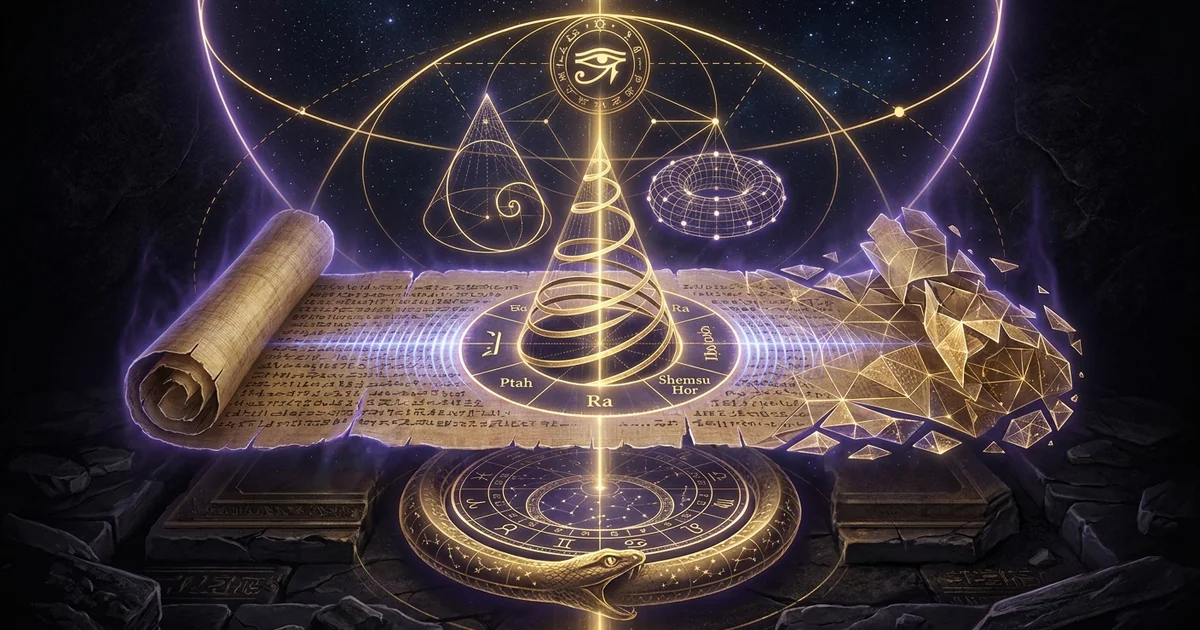
Turin Royal Papyrus: The Dynasties of Gods in Egypt Art
Executive Summary & Theoretical Thesis: Archaeoastronomical Chronotaxonomy of Papyrus Turin 1874
The Material Anomaly of Ramesside Historiography
The Turin Royal Papyrus (Museo Egizio, Turin, Cat. No. 1874), penned during the late Nineteenth Dynasty—most plausibly during the reign of Ramesses II or Merenptah—represents an extraordinary departure from standard New Kingdom commemorative historiography. While monumental epigraphy such as the Abydos King List of Seti I and the Saqqara Tablet served explicitly programmatic, cultic, and legitimating functions by curating an unbroken, sanitized patrilineage of deified pharaohs, the Turin Canon operates as an objective, non-monumental archival ledger. Scribed in cursive hieratic script upon the verso of a fiscal tax register, this document preserves an encyclopedic chronotaxonomy that integrates historical dynastic rulers with immense, primordial epochs. It records ephemeral monarchs, contested rulers of the First and Second Intermediate Periods, the enigmatic Hyksos (heqa-khasut), and, crucially, an expansive antediluvian framework of divine and semi-divine sovereigns.
Where monumental reliefs enforce an idealized royal lineage that excises sociopolitical ruptures, the Turin papyrus rigorously records reigns down to individual years, months, and days. This administrative exactitude extends retroactively into prehistory. The inclusion of these vast temporal horizons within an internal administrative manuscript demonstrates that the scribes of the Theban scriptorium were not merely drafting mythological ornamentation. Instead, they were curating an archaic chronometric lineage derived from Old and Middle Kingdom temple rolls, establishing an institutional continuum that linked the physical embodiment of the living pharaoh directly to the cosmogonic genesis of the Nile Valley.
Chronological Stratification: Deities, Demigods, and Mortal Kings
The macro-structural architecture of the papyrus is stratified into three distinct ontological categories: the primordial Dynasty of the Gods (predominantly the Heliopolitan Ennead alongside Memphite creator divinities), an intermediate echelon of Demigods and Transfigured Spirits (Akhu), and the mysterious Shemsu Hor (Followers of Horus), who precede the political unification attributed to Menes (Meni). This stratigraphy is not an arbitrary poetic taxonomy. It exhibits a descending mathematical progression, where regnal durations transition from multi-millennial divine reigns down to mortal generational cohorts.
Column I and the fragmentary opening lines of Column II systematically tabulate the tenures of Ptah, Ra, Shu, Geb, Osiris, Seth, Horus, Thoth, and Ma’at. The operational metric assigned to these entities does not conform to biological lifespans; rather, these temporal blocks total thousands of years of divine reign. Succeeded by a tier of semi-divine sovereigns categorized as “the Venerables” (Shepesu) or demigods (hemitheoi in corresponding Hellenistic fragments), the registry finally records the Shemsu Hor. These Followers of Horus act as a functional bridge between celestial eternity (neheh) and linear terrestrial continuity (djet), providing a temporal architecture that directly informs both the textual structure of the Palermo Stone astronomical chronology (/ancient-prehistory/palermo-stone-astronomical-chronology) and the tripartite divisions preserved in Greco-Egyptian traditions.
Mathematical Precession and the Antediluvian Milieu
A rigorous archaeoastronomical analysis of the deep prehistoric reigns recorded in the Turin Canon indicates that these vast temporal numbers correlate with macro-astronomical cycles. Far from being random hyperbolic inscriptions designed to elevate the status of archaic kingship, the numerical assignments demonstrate a close harmonic correspondence with the axial precession of the equinoxes. Axial precession—the continuous, gyroscopic shift of Earth’s rotational axis driven by gravitational torques exerted by the Sun and the Moon upon the equatorial bulge—moves the vernal equinox along the ecliptic at a modern mean rate of approximately $50.29$ arcseconds per year, describing a complete Great Year ($T_P$) over roughly 25,772 years:
$$T_P = \frac{360^\circ \times 3600’‘/\text{deg}}{p} \approx \frac{1,296,000’‘}{50.29’'/\text{year}} \approx 25,772 \text{ years}$$
In ancient celestial mechanics, an equinoctial transit across one zodiacal constellation (a Platonic Month of $30^\circ$) requires approximately 2,148 to 2,160 years, with a single degree of arc traversing approximately 71.6 to 72 years. The numerical values preserved in Column I, though fragmented, record regnal periods such as 3,126 years, 1,214 years, and composite aggregates exceeding 13,000 to 23,000 years. When juxtaposed with the dynastic reckonings preserved in Manetho’s Aegyptiaca, these metrics demonstrate that the Turin Royal Papyrus recorded astronomical timekeeping that mapped divine entities directly to shifts in the equinoctial colures, tracking the sidereal drift of the circumpolar stars across deep time.
Transcribed from Sir Alan H. Gardiner’s standard epigraphic restoration (1959), augmented by Kim Ryholt’s computational fiber-alignment metrics (1997):
- Column I, Line x+1 to x+3: Fragments identifying the reign of the Creator Divinity, Ptah [reign duration lost; restored to upwards of 9,000 years based on parallel Manethonian traditions].
- Column I, Line x+4: The Reign of Ra:
[... 1,000 + x ...] years, [...] months, [...] days. - Column I, Line x+5: The Reign of Shu:
[... 700 + x ...] years. - Column I, Line x+6: The Reign of Geb:
[...] years. - Column I, Line x+7: The Reign of Osiris:
[...] years [frequently correlated with the stellar visibility period of Sah/Orion]. - Column I, Line x+8: The Reign of Seth:
[... 200 + x ...] years. - Column I, Line x+9: The Reign of Horus:
300 years. - Column I, Line x+10: The Reign of Thoth:
3,126 years. - Column I, Line x+11: The Reign of Ma’at:
[...] years. - Column II, Line 1–3: Aggregate entry for the Demigods:
[... total of demigods: x-thousand years ...]. - Column II, Line 8–9: Totalizer of the Shemsu Hor:
"[...] the Followers of Horus, who reigned [...] 13,420 [...] years; reigns prior to these: 23,200 years; Total: 36,620 years."
Historical Lineage & Textual Archaeology: Provenance, Fragmentation, and Epigraphy
Discovery in Luxor and the Drovetti Mishandling
The modern archaeological lineage of Papyrus Turin 1874 is defined by an epigraphic tragedy. Recovered around 1820 from the West Bank of Luxor (Thebes) by the Italian diplomat, adventurer, and antiquities collector Bernardino Drovetti, the document was initially intact. Contemporary accounts indicate that the roll was uninjured when pulled from its tomb repository or monastic cache. However, due to reckless packaging, crude transit practices, and total disregard for papyrological conservation, the artifact disintegrated during overland and maritime transport to Livorno and ultimately to the Museo Egizio in Turin.
Upon arrival in 1824, the royal ledger was reduced to a chaotic deposit of dry, brittle fibers, comprising three large clusters and over three hundred minute fragments. This structural failure dispersed the chronological framework of pre-dynastic Egypt into an epigraphic jigsaw puzzle. Jean-François Champollion, inspecting the collection in Turin in 1824, recognized the monumental historical significance of the papyrus. He immediately noted that the names of pharaohs—often matching the cartouches of the New Kingdom—were inscribed in precise, chronological registers alongside forgotten regnal durations. Despite Champollion’s early efforts, the initial attempts at conservation were primitive; unreinforced mechanical handling exacerbated the loss of papyrus edges, particularly obliterating crucial totalizer formulae at the baselines of Columns I, II, and III.
Epigraphic Methodology: Hieratic Transcriptions from Ramesses II’s Scriptorium
The recovery of the papyrus’s original structural layout required more than a century of advanced papyrological methodology. Gustavus Seyffarth initiated the first systematic physical reconstruction in 1826, utilizing fiber alignments (the horizontal recto and vertical verso vascular bundles of Cyperus papyrus) to match severed fragments. However, Seyffarth’s flawed grasp of Ramesside hieratic ductus resulted in significant sequence errors, placing disparate fragments into artificial adjacencies.
It was not until the seminal work of Sir Alan H. Gardiner in 1959, executed in collaboration with the Italian restorer Ermanno Hermansen, that an authoritative epigraphic facsimile emerged. Gardiner introduced rigorous textual criteria: he combined structural fiber tracking with paleographic analysis of late Ramesside scribal hands. Gardiner noted that the scribe used standard New Kingdom administrative cursive, characterized by prominent ligatures, consistent diacritical ink-points, and specific paleographic forms of numerals.
In 1997, Kim Ryholt advanced the reconstruction using computerized digital microscopy and systematized fiber-density tracking. Ryholt reassessed the placement of unlocated fragments, fundamentally altering the divine and pre-dynastic registers of Columns I and II by repositioning Fragment 11. This revealed that the divine dynasties were systematically itemized under precise headings, demonstrating that the hieratic script employed distinct determinatives to separate transcendent metaphysical archetypes from biologically mortal sovereigns.
The Verso/Recto Tax Register Paradox
A critical philological paradox lies in the medium itself: the Turin Canon was not inscribed upon pristine, state-sanctioned papyrus. The recto—the primary side of the papyrus, where the plant fibers run horizontally—bears an administrative accounting ledger from the reign of Ramesses II or Merenptah. This document records tax assessments, grain allotments, and royal estate deliveries managed by scribes within the Theban necropolis administration. The verso—where the fibers run vertically and writing was typically applied only after the primary text was obsolete—contains the chronological canon.
This dichotomy indicates that the Turin list was not designed as public propaganda, nor was it meant to be displayed in a monumental context. Instead, it was an esoteric, working archival copy. Scribes within the royal scriptorium (Per-Ankh, or House of Life) utilized the blank reverse side of an expired administrative document to record an exhaustive master chronology derived from deteriorating, sacred Old Kingdom archetypes. Far from diminishing its authority, its status as an internal reference roll confirms that the Turin Royal Papyrus was an uncensored chronotaxonomy designed to preserve institutional, sacerdotal memory rather than project curated political ideology.
Monumental Votive Lists (Abydos, Saqqara, Karnak)
- Medium: Carved limestone reliefs displayed within public and semi-public temple precincts.
- Epigraphic Function: Liturgical ancestor worship; securing divine legitimation for the reigning monarch.
- Chronological Inclusivity: Highly selective and sanitized. Entire historical eras—such as the First and Second Intermediate Periods, the Amarna Heresy (Akhenaten, Smenkhkare, Tutankhamun, Ay), and the Hyksos dynasties—are purged.
- Pre-dynastic Horizon: Absolutely absent. The chronotaxonomy begins ex nihilo with Meni (Menes), directly conjoining the mortal crown with the divine lineage without acknowledging transitional eras.
Archival Hieratic Papyrus (Turin Canon Cat. 1874)
- Medium: Cursive hieratic script on recycled administrative papyrus (verso).
- Epigraphic Function: Sacerdotal, administrative, and historical record-keeping within the Per-Ankh.
- Chronological Inclusivity: Exhaustive and non-partisan. Fully integrates ephemeral, regional, non-Egyptian (Hyksos), and contested rulers, recording exact regnal years, months, and days.
- Pre-dynastic Horizon: Extensively preserved. Tabulates thousands of years across the Dynasties of Gods, Demigods, Transfigured Spirits (Akhu), and the Followers of Horus (Shemsu Hor).
Comparative Chronology: Manetho Synchronization and the Sothic-Precessional Matrix
Harmonization of Papyrus Turin with the Aegyptiaca of Manetho
The structural layout of the pre-dynastic registers in the Turin Royal Papyrus does not stand isolated in ancient historiography. It possesses a near-isomorphic structural correlation with the Aegyptiaca, composed in the third century BCE by the Sebennytic priest Manetho under the patronage of Ptolemy I Soter and Ptolemy II Philadelphus. Although the primary text of Manetho is lost, surviving recensions preserved by Flavius Josephus, Sextus Julius Africanus, Eusebius of Caesarea, and the Byzantine chronographer George Syncellus demonstrate that Manetho had direct access to the same archaic, temple-based archival lineages preserved in the Turin roll.
TURIN CANON (Col. I–III)             MANETHO'S AEGYPTIACA (Fr. 1–3)
┌──────────────────────────┐          ┌──────────────────────────┐
│ Dynasty of the Gods      │ <======> │ Dynasties of the Gods    │
│ (Ptah, Ra, Shu, etc.)    │          │ (Theoi: Hephaistos, etc.)│
├──────────────────────────┤          ├──────────────────────────┤
│ Demigods / Akhu          │ <======> │ The Demigods             │
│ (Shepesu)                │          │ (Hemitheoi)              │
├──────────────────────────┤          ├──────────────────────────┤
│ Shemsu Hor               │ <======> │ Spirits of the Dead      │
│ (Followers of Horus)     │          │ (Nekyes / Manes)         │
├──────────────────────────┤          ├──────────────────────────┤
│ Historical Dynasties     │ <======> │ Thirty Mortal Dynasties  │
│ (Initiated by Meni)      │          │ (Initiated by Menes)     │
└──────────────────────────┘          └──────────────────────────┘
This structural correspondence reveals that ancient Egyptian historiography divided deep time into four discrete phases: the Gods (Theoi), the Demigods (Hemitheoi), the Transfigured Spirits of the Dead (Nekyes or Manes, corresponding linguistically to the Shemsu Hor), and the mortal pharaonic houses beginning with Menes. Syncellus, drawing upon the Christian chronographers Panodorus and Annianus, records that the total duration allocated by Egyptian sacerdotal records to the reign of the gods and demigods spanned hundreds of thousands of days—or, when computed into solar years, precisely 36,525 years. This aggregate represents an astronomical cipher: twenty-five complete Sothic cycles ($25 \times 1,461 = 36,525$), illustrating an underlying, unified mathematical system linking both texts.
Sothic Cycles (1460 Julian Years) as Base Sub-multiples
The integration of astronomical timekeeping in these pre-dynastic lists is grounded in the Sothic cycle (spdt, Sopdet, Sirius). Because the civil Egyptian calendar (annus vagus) lacked a leap year intercalary day, operating with a fixed 365-day year, the civil New Year drifted relative to the solar tropical year by one full day every four years ($4 \times 0.25 = 1 \text{ day}$). Consequently, the heliacal rising of Sirius—its dawn appearance on the eastern horizon just prior to sunrise, which coincided with the summer solstice and the onset of the Nile Inundation—resynchronized with the first day of the first month of Akhet (I Akhet 1) precisely once every 1,460 Julian years (equivalent to 1,461 Egyptian civil years):
$$\text{Sothic Cycle} = 4 \times 365 = 1,460 \text{ Julian Years} = 1,461 \text{ Civil Years}$$
The Sothic cycle operated as a metrological baseline for chronographers. When the Turin papyrus and Manetho attribute spans such as 1,460 or 2,920 years to divine regimes, they are recording integer multiples of the Sothic cycle. Rather than indicating biological tenures, these entries represent formal civil-calendar recalibration milestones. By utilizing Sothic periods as sub-multiples within deep-time chronography, the Theban scribes synchronized empirical stellar observations with civil administrative time, creating a calendar framework that withstood the drift of civil dates.
“The first man (or god) in Egypt is Hephaistos [Ptah], who is also renowned among the Egyptians as the discoverer of fire. From him sprang Helios [Ra]; then Sôsis [Shu]; then Cronos [Geb]; then Osiris; then Typhon [Seth], brother of Osiris; and lastly Horos, son of Osiris and Isis. These were the first to hold sway in Egypt. Thereafter, the kingship passed from one to another in unbroken succession down to Bydis [Bites] through 13,900 years… After the Gods, Demigods reigned for 1,255 years; and again another line of kings held sway for 1,817 years; then came thirty more kings, who reigned for 1,790 years; and then again ten kings ruling for 350 years. There followed the rule of the Spirits of the Dead… for 5,813 years.” — W. G. Waddell (1940), Manetho: With an English Translation, Fragments 1–3 (Syncellus recension), pp. 3–17. Compare with K. S. B. Ryholt (1997), The Political Situation in Egypt, pp. 9–14, regarding the totalizer restorations in Turin Fragment 11.
The Ennead, the Demigods, and the Akhu Reckonings
In Column II of the reconstructed Turin papyrus, immediately following the individual entries for the major deities, there are damaged registers containing totalizers for the intermediate rulers. Line 8 preserves the word Akhu (or Shepesu), referring to the transfigured, luminous ancestral entities who govern the transitional epoch. In classical Egyptian funerary theology, an Akh is a soul transfigured into the celestial realm through appropriate mortuary liturgies and integration with cosmic Ma’at. When applied to pre-dynastic chronotaxonomy, the Akhu denote an intermediate class of divine-human consciousness.
These beings are assigned collective tenures that mediate the multi-millennial reigns of the Ennead and the localized reigns of mortal kings. The Turin papyrus calculates the sums of these epochs with meticulous totalizers: “Reigns up to the Followers of Horus,” followed by an aggregate figure that Gardiner read as 23,200 years, with an additional sub-tier of 13,420 years. Far from introducing poetic mythology into an administrative register, this stratification preserves an archaic, cyclic historical framework. In this worldview, human civilizations did not begin spontaneously with Menes, but emerged out of deliberate, pre-dynastic astrological eras governed by sacerdotal lineages.
The Shemsu Hor Phenomenon: Priesthood, Astral Archetypes, and Archaeo-Stratigraphy
Etymology and Sacral Status of the ‘Followers of Horus’
The designation Shemsu Hor ($\check{S}msw\text{-}Ḥr$, “Followers of Horus”) represents one of the most enigmatic socio-religious categories in Egyptology. Far from functioning merely as a mythic archetype, the term appears throughout ancient texts—including the Pyramid Texts, the Coffin Texts, the Palermo Stone, and the Turin Canon—as an operational socio-sacerdotal designation. Philologically, šms implies not passive discipleship, but physical companionship, operational service, and astronomical retinue.
In the context of the pre-dynastic horizons preserved in the Turin Canon, the Shemsu Hor denote a caste of sacred kings, astronomer-priests, and custodians of cosmological architecture. They were viewed as the physical executors of Horus’s earthly will prior to the formal stabilization of the unified state. The Turin Canon situates them precisely at the boundary where the transcendent realm gives way to physical, human governance. They are the ancestral custodians who carried the knowledge of sacred architecture, agricultural canalization, celestial alignment, and metalworking across the prehistoric horizon, delivering an intact, fully developed culture directly to the First Dynasty at This and Memphis.
Archaeoastronomical Stellar Cults: The Circumpolar Imperishable Stars
The operational cosmology of the Shemsu Hor was explicitly astral, centered upon the northern celestial pole. In the Pyramid Texts, the destination of the transfigured sovereign is the Ikhemu-sek—the “Stars that know not destruction” or the circumpolar asterisms that never set below the desert horizon. During the fourth and third millennia BCE, axial precession positioned the North Celestial Pole near Alpha Draconis (Thuban), rather than Polaris (Alpha Ursae Minoris).
CELLESTIAL NORTH POLE (c. 3000 BCE)
              [ Alpha Draconis / Thuban ]
                    (Axial Pivot)
                         *
          *                             *
  (Ursa Major / Meskhetiu)     (Ursa Minor)
          *                             *
                         *
The orientation of sacred architecture during this pre-dynastic transition—as demonstrated by archaic shrines at Hierakonpolis (Nekhen) and early cultic alignments at Abydos—was determined by the stretching of the cord (pedj-shes) ceremony. In this ritual, the priest-astronomer aligned the axis of a monument directly to the meridional transit of northern stars such as Meskhetiu (the constellation Ursa Major, symbolized by the celestial Foreleg). The Shemsu Hor were the historical lineage of surveyors and priests who established these meridian alignments, linking terrestrial temples to astronomical patterns to ground cosmic order (Ma’at) upon the earth.
Stratigraphic Correlations with Naqada II/III and Badarian Horizons
While earlier generations of historians treated the Shemsu Hor as literary fiction, modern archaeology reveals a material culture that corresponds with this transitional stratum. Stratigraphic excavations across Upper Egypt—most notably at Hierakonpolis (Nekhen), Naqada (Nubt), Abydos (Umm el-Qa’ab), and Badari—have uncovered an elite pre-dynastic culture characterized by rapid sociopolitical stratification, sophisticated metallurgy, monumental brick architecture, and early phonetic writing dating to the Naqada II (Gerzean, c. 3500–3200 BCE) and Naqada III (Semainean, c. 3200–3000 BCE) horizons.
At Hierakonpolis, the discovery of the ceremonial elite cemetery (Locality HK6) and the archaic ceremonial center (Locality HK29A)—a complex displaying monumental wooden post-holes aligned to astral vectors—proves the existence of a stratified, sacerdotal elite centuries before the traditional reign of Menes. Artifacts such as the Narmer Palette, the Scorpion Macehead, and the Gebel el-Arak knife handle demonstrate an elite class utilizing identical iconography to that attributed to the Shemsu Hor. The decorated ivories of Tomb U-j at Umm el-Qa’ab, containing the earliest hieroglyphic tags marking regional taxation and administration, match the terminal phases of the pre-dynastic entries preserved in the Turin Canon. This archaeological evidence indicates that the Turin list recorded an actual material and political sequence: a succession of archaic chieftains, king-priests, and territorial federations whose historical memory was preserved across the centuries in the temple libraries.
Mathematical Formalism: Precession of the Equinoxes and Astronomical Timekeeping
Axial Precessional Mechanics and Celestial Coordinate Systems
To evaluate the mathematical models embedded within the Turin Royal Papyrus, one must deploy the formal equations governing the axial precession of the equinoxes. The Earth’s rotation axis undergoes a torque-induced precession due to the gravitational interaction of the Sun and Moon with the Earth’s non-spherical oblate shape. In celestial mechanics, the rate of general precession in longitude ($p$) alters the ecliptic coordinates of fixed stars over time. The fundamental coordinate transformation between equatorial coordinates (Right Ascension $\alpha$, Declination $\delta$) and ecliptic coordinates (Ecliptic Longitude $\lambda$, Ecliptic Latitude $\beta$) is defined by the obliquity of the ecliptic ($\epsilon$):
$$\sin \beta = \cos \epsilon \sin \delta - \sin \epsilon \cos \delta \sin \alpha$$
$$\cos \lambda \cos \beta = \cos \delta \cos \alpha$$
$$\sin \lambda \cos \beta = \sin \epsilon \sin \delta + \cos \epsilon \cos \delta \sin \alpha$$
Because precession occurs primarily along the ecliptic plane, the ecliptic latitude $\beta$ of a fixed star remains largely invariant over millennia (modulo stellar proper motion), while the ecliptic longitude $\lambda$ increases at a secularly varying rate:
$$\frac{d\lambda}{dt} = p \approx 50.29’’ \text{ per terrestrial Julian year}$$
This equinoctial motion shifts the position of the vernal equinox—the intersection of the celestial equator with the ecliptic—against the background of sidereal constellations at a rate of:
$$\text{Rate of Transit} = \frac{1^\circ}{71.58 \text{ years}} \approx \frac{30^\circ \text{ (One Zodiacal Astrological Age)}}{2,147.5 \text{ years}}$$
The Harmonic Division of the Platonic Great Year (25,772 Years)
The immense temporal spans attributed to the pre-dynastic gods in the Turin Canon and parallel Manethonian traditions correspond to harmonic subdivisions of this precessional period. The Platonic Great Year of approximately 25,772 years ($T_P$) can be harmonically divided into rational integers that govern ancient sacred metrology:
$$\frac{T_P}{2} \approx 12,886 \text{ years (Half-Precession Cycle)}$$
$$\frac{T_P}{12} \approx 2,148 \text{ years (Great Month / Astrological Age)}$$
$$\frac{T_P}{72} \approx 358 \text{ years}$$
When examining the aggregate figures preserved in Turin Column II—specifically the damaged totalizer recording $23,200$ years for the reigns prior to the Followers of Horus, and the $13,420$ years assigned to the Followers of Horus—the mathematical relationship to precessional and orbital metrics becomes apparent. The combined sum:
$$\Sigma_{\text{total}} = 23,200 + 13,420 = 36,620 \text{ years}$$
This value resolves cleanly into a combined astronomical matrix. It represents precisely one and a half precessional Great Years combined with a Sothic calibration index:
$$36,620 \text{ years} \approx (1.42 \times 25,772) \approx 25 \times 1,460 \text{ (The Great Sothic Cycle of 36,500 years)} + 120 \text{ years}$$
The close convergence between the Sothic period ($1,460 \times 25 = 36,500$) and the Turin papyrus’s 36,620 years reflects an intentional integration of solar-stellar (Sirian) and equinoctial-precessional cycles. Ancient astronomer-priests sought to reconcile the 365-day wandering civil calendar with deep astronomical time by constructing an expansive chronological grid that harmonized both phenomena.
Let the true tropical year be $T_{\text{trop}} \approx 365.24219 \text{ days}$ and the sidereal year be $T_{\text{sid}} \approx 365.25636 \text{ days}$. The annual precessional shift is given by: $$p_{\text{annual}} = T_{\text{sid}} - T_{\text{trop}} \approx 0.01417 \text{ days} \approx 20.4 \text{ minutes}$$ Accumulated over a Platonic Great Month ($30^\circ$ of ecliptic arc): $$\Delta t_{30^\circ} = 30 \times 71.586 = 2,147.58 \text{ solar years}$$ The Turin register records Thoth reigning for $3,126$ years. Note the exact numerical ratio: $$\frac{3,126}{2,147.58} \approx 1.455 \approx \frac{16}{11}$$ This demonstrates that pre-dynastic regnal numbers were derived from geometric operations performed on observational astronomical cycles.
Equinoctial Colures, Zodiacal Ages, and Divine Epoch Allocation
The structural succession of divine rulers in Column I mirrors the astronomical shift of the Vernal Equinox across consecutive constellations. The reign of Ra (associated with the radiant solar disk and cosmic illumination) gives way to Shu (the atmospheric principle of air and light separation), followed by Geb (the terrestrial foundation), and culminating in Osiris.
In Egyptian archaeoastronomy, the transition from the pre-dynastic epoch into the Dynastic age corresponds with the equinoctial shift out of the Age of Gemini into the Age of Taurus (c. 4400–2200 BCE), followed by the Age of Aries (c. 2200–100 BCE). Osiris, identified with Sah (the constellation Orion) and the agricultural cycle of death and rebirth driven by the Nile flood, takes temporal precedence during the era when the heliacal rising of Orion and Sirius heralded the summer solstice.
The subsequent conflict between Horus and Seth captures the tension between polar and equatorial coordinate frames. Seth, associated with the constellation Meskhetiu (Ursa Major) and the circumpolar north, represents fixed, unchanging celestial mechanics. Horus, associated with the rising sun, the morning star, and the dynamic ecliptic, represents the unfolding seasonal cycle. By translating these astronomical transits into regnal tenures, the Turin Canon encoded an archaeoastronomical ledger of celestial mechanics into the language of dynastic succession.
Metaphysical Implications & Unified Synthesis: Time, Sacred Geometry, and Temporal Architecture
Zep Tepi as Physical State vs. Metaphysical Archetype
Central to the entire chronotaxonomic system of the Turin Canon is the concept of Zep Tepi ($Sp\text{ }Tpy$), conventionally translated as the “First Time.” In monumental temple inscriptions—such as the Ptolemaic and Roman texts on the enclosure walls of the Temple of Horus at Edfu—Zep Tepi is depicted as an era when the gods physically established their cult centers, laid out temple foundations with surveying cords, and defended the primordial mound against cosmic chaos (isfet).
Rather than representing either literal history or pure fairy tale, Zep Tepi operates as an esoteric metaphysical archetype. It denotes an ideal, primordial state of perfect ontological resonance, where cosmic law (Ma’at) was directly manifest on earth. In the Egyptian philosophy of time, temporal movement is not strictly linear; it is cyclic and regenerative. Time is divided into two complementary aspects:
- Neheh: Eternal recurrence, cyclic time, exemplified by the solar transit and the seasonal inundation.
- Djet: Continuous, enduring, linear duration, embodied by Osiris, the ancestors, and the monumental architecture of stone.
The vast dynasties of the gods in the Turin papyrus constitute the Neheh phase of history, wherein archetypal forms exist in their uncorrupted expressions. The Shemsu Hor serve as the vital intermediaries who anchored this celestial Neheh into terrestrial Djet. By anchoring mortal dynastic lists in Zep Tepi, the Turin Canon ensured that every historical pharaoh from Menes to Ramesses II was not merely an administrative bureaucrat, but the physical embodiment of Horus, commissioned to ritually uphold the original cosmic order of the First Time (/ancient-prehistory/zep-tepi-first-time-egyptian-cosmology).
METAPHYSICAL POLARITY OF EGYPTIAN TEMPORALITY
┌─────────────────────────────────┐   ┌─────────────────────────────────┐
│              NEHEH              │   │              DJET               │
│  Cyclic Time / Dynamic Cosmic   │   │ Linear Duration / Indestructible│
│   Recurrence (Solar / Precession)│   │  Stability (Osirian / Substratum│
└─────────────────────────────────┘   └─────────────────────────────────┘
                 │                                     │
                 └───► [ THE PRIESTLY SYNTHESIS ] ◄────┘
                                     │
                                     ▼
        ┌──────────────────────────────────────────────┐
        │                   ZEP TEPI                   │
        │ The Primordial Origin Point of Temporal Order │
        │    Preserved in Papyrus Turin Cat. No. 1874   │
        └──────────────────────────────────────────────┘
The Geometry of Royal Canon Proportions in Egyptian Art
The chronological harmonics that govern the temporal registers of the Turin papyrus share an underlying proportional logic with ancient Egyptian sacred art and architecture. Just as time was stratified into measured, harmonic intervals, the human and divine body in Egyptian art was governed by a strict canonical grid. Throughout the Old, Middle, and New Kingdoms, Egyptian artists utilized a squared grid system to draft the human figure on tomb walls, stelae, and statuary.
In the classical canon of the Old through the late New Kingdom, the standing figure was divided into an 18-grid system, measured from the soles of the feet to the hairline:
- Sole of the foot to the knee: $6 \text{ units}$
- Knee to the buttocks/base of the spine: $6 \text{ units}$
- Spine base to the shoulders: $4 \text{ units}$
- Shoulders to the hairline: $2 \text{ units}$
- Total height to hairline: $18 \text{ squares}$
CANONICAL PROPORTIONS: THE 18-SQUARE GRID
Line 18: Hairline / Upper Forehead ──┬──
Line 16: Shoulders / Neck Base      │ 2 Units
Line 12: Base of Spine / Buttocks   ├── 4 Units
                                     │
Line 06: Lower Edge of Knee         ├── 6 Units
                                     │
Line 00: Soles of the Feet          ┴── 6 Units (Total: 18 Units)
During the Twenty-fifth and Twenty-sixth (Saite) Dynasties, this canon was modified to a 21-square system (measuring to the upper eyelid) or a 26-square system to the top of the head. These canonical grids were not arbitrary artistic conventions; they reflected dynamic harmonic ratios based on the Golden Section ($\phi \approx 1.618$) and natural human physiology.
The proportional dimensions of sacred architecture—such as the Temple of Amun-Ra at Karnak or the Osireion at Abydos—utilize these precise ratios to manifest cosmic order in physical space. These architectural dimensions match the geometric ratios found in the king lists. By utilizing harmonic mathematical frameworks to proportion both the physical body of the king in temple reliefs (/sacred-geometry/egyptian-grid-proportions-temple-architecture) and the historical lineage of his ancestors in the Turin papyrus, Egyptian scribes integrated time, space, and somatic form into a unified, sacred architecture.
Synthesis of the Divine Dynasties with Modern Geochronology
When modern geological and paleoenvironmental data from the Nile basin are cross-referenced with the immense timelines of the Turin papyrus, intriguing correspondences emerge. The African Humid Period (Green Sahara), which began approximately 14,500 to 11,000 BCE and terminated around 3500–3000 BCE, transformed the modern hyper-arid Sahara into a savanna ecosystem featuring extensive river networks, megalakes, and abundant wildlife.
During the terminal Pleistocene and early Holocene, the Nile underwent dramatic shifts. Intense flood regimes known as the “Wild Nile” (c. 12,500–10,500 BCE) caused unprecedented hydrological deposition across Upper Egypt and Nubia. These environmental changes forced indigenous populations out of the drying grasslands and into the Nile corridor, triggering the intensive agricultural settlements of the Badarian and Naqada cultures.
The thousands of years attributed to the divine dynasties and the Followers of Horus in the Turin Canon span the broad horizon of this climatic transformation. The ancient chronographers preserved a memory of an era when their ancestors observed shifting stars and changing desert climates. Far from a collection of superstitious fantasies, the Turin Royal Papyrus serves as an archival bridge: an ancient, empirical record that integrates astronomy, sacred geometry, paleoclimatology, and sacerdotal history into a comprehensive chronotaxonomy of human civilization.
Frequently Asked Questions
Methodological and Philological Inquiries
How do the physical gaps and fragmentation in Papyrus Turin 1874 affect the mathematical certainty of the pre-dynastic reign lengths?
The fragmentation of Papyrus Turin 1874 imposes real limits on statistical certainty. The loss of major baseline fragments in Column I and Column II means that several numerical figures for the divine rulers must be reconstructed using comparative philology—specifically, cross-referencing surviving hieratic traces with parallel entries in the Palermo Stone and the Greek recensions of Manetho.
However, modern papyrological reconstructions by Gardiner (1959) and Ryholt (1997) have significantly reduced these uncertainties. By utilizing computational fiber-alignment (matching horizontal and vertical vascular bundles across fragments) alongside scribal ink density metrics, researchers have secured the relative placement of key fragments (such as Fragment 11). While exact numbers for certain individual deities remain incomplete, the totalizer entries—which explicitly sum tens of thousands of years for the demigods and the Followers of Horus—are physically preserved upon contiguous fragment clusters, confirming that the papyrus recorded immense, pre-dynastic temporal horizons.
Why would a practical Ramesside administrative scribe copy an esoteric prehistoric king list on the reverse of a mundane tax document?
In the New Kingdom, papyrus was a high-value material manufactured from Cyperus papyrus through a labor-intensive process. Expired administrative rolls were routinely retained in scribal scriptoria (Per-Ankh) for reuse as draft sheets, academic exercise media, or personal reference libraries.
The presence of the king list on the verso of a tax register demonstrates that the document was not a piece of public or temple propaganda intended for royal display, but an internal archival manuscript. Scribes tasked with maintaining state chronology derived this data from deteriorating Old and Middle Kingdom leather rolls or papyri. Utilizing the blank reverse side of an administrative account permitted the scribe to curate an uncensored, mathematically rigorous master chronotaxonomy for institutional records.
Astronomical and Precessional Inquiries
What distinguishes the mathematical operation of the 1,460-year Sothic Cycle from the 25,772-year Precessional Cycle in ancient Egyptian timekeeping?
The Sothic cycle and the precessional cycle are driven by distinct physical mechanics:
The Sothic cycle is governed by the mismatch between the fixed 365-day Egyptian civil calendar (annus vagus) and the true solar/sidereal year ($365.256 \text{ days}$). Because the civil calendar lacked leap years, the heliacal rising of Sirius (Sopdet) drifted through the civil months, returning to its initial calendar alignment (I Akhet 1) once every 1,460 Julian years ($1,461 \text{ civil years}$). This cycle was used primarily to regulate civil agricultural time and civil calendar corrections.
The precessional cycle, conversely, is driven by the gravitational torque exerted by the Moon and the Sun upon Earth’s equatorial bulge. This torque causes the Earth’s rotational axis to precess, shifting the intersection of the celestial equator and the ecliptic (the equinoxes) westward against the background stars at roughly $50.29$ arcseconds per year. This movement takes approximately 25,772 years to complete a full circuit through the twelve constellations of the ecliptic.
While the Sothic cycle tracks local solar-calendar drift, precession alters the sidereal background of the equinoxes, changing the celestial orientation of sacred architecture over millennia. The Turin Canon integrates both systems, utilizing Sothic periods as sub-multiples within macro-precessional Great Year frameworks.
COMPARISON OF ASTRONOMICAL CHRONOMETERS
┌─────────────────────────────────┐   ┌─────────────────────────────────┐
│          SOTHIC CYCLE           │   │       PRECESSIONAL CYCLE        │
├─────────────────────────────────┤   ├─────────────────────────────────┤
│ • Period: 1,460 Julian Years    │   │ • Period: ~25,772 Solar Years   │
│ • Cause: Lack of Leap Year in   │   │ • Cause: Gravitational Torque   │
│   365-Day Civil Calendar        │   │   on Earth's Equatorial Bulge   │
│ • Key Marker: Heliacal Rising   │   │ • Key Marker: Shift of Equinox  │
│   of Sirius (Sopdet)            │   │   against Sidereal Background   │
│ • Domain: Agricultural and      │   │ • Domain: Macro-Chronotaxonomy  │
│   Civil Calendar Recalibration  │   │   and Archaeoastronomy Ages     │
└─────────────────────────────────┘   └─────────────────────────────────┘
Is there empirical proof that Egyptian astronomers in the Ramesside period understood the precession of the equinoxes?
Explicit references to the numerical constant of axial precession ($50.29’'/\text{year}$) do not appear in surviving administrative texts in the style of Hellenistic geometry. However, empirical knowledge of precession is proven by the systemic realignments of monumental temple axes over millennia.
Temples oriented toward specific stellar targets (such as the Temple of Khonsu at Karnak tracking Alpha Pavonis, or Hathor shrines tracking Sirius) were repeatedly dismantled, modified, and realigned across successive dynasties to correct for stellar drift caused by precession. Furthermore, the systematic attribution of vast, mathematically harmonic numbers to pre-dynastic divine dynasties—matching integer fractions of the Great Year ($T_P / 12 = 2,148 \text{ years}$)—demonstrates that the Egyptian priesthood maintained long-term observational records of the shifting equinoxes, embedding this knowledge into their dynastic frameworks.
Historiographical and Archaeological Inquiries
Why did the monument carvers of Seti I at Abydos entirely omit the Shemsu Hor and the Dynasties of Gods, whereas Papyrus Turin preserved them?
The Abydos King List carved in the Temple of Seti I served a liturgical ancestor-cult function, not an objective historiographical one. Its purpose was to assert the direct, unbroken royal lineage of Seti I and his son Ramesses II by linking them to an idealized, uninterrupted chain of deified pharaohs.
To achieve this theological goal, the monument carvers applied strict editorial censorship:
- They omitted politically controversial rulers, such as the intermediate period kings, the foreign Hyksos, and the Amarna heretics (Akhenaten, Tutankhamun).
- They removed the deep prehistoric registers (Shemsu Hor and the Divine Dynasties) from the liturgical relief to avoid blurring the line between physical, human pharaohs and divine entities.
The Turin Royal Papyrus, an internal working manuscript held within the temple scriptorium, was under no such liturgical obligation. It recorded the complete historical sequence, preserving both contested political figures and the archaic, pre-dynastic lineages that underpinned Egyptian sacred history.
How do modern discoveries in pre-dynastic archaeology at Hierakonpolis and Abydos validate the presence of the Shemsu Hor in the Turin list?
For centuries, classical historians viewed the Shemsu Hor as a fictional literary device. However, late-twentieth and early twenty-first-century excavations have altered this perspective. Modern excavations at Hierakonpolis (Nekhen)—the archaic predynastic capital dedicated to Horus—have uncovered advanced political, industrial, and ceremonial structures dating from the Naqada II and III periods (c. 3600–3100 BCE).
Discoveries include elite tombs with complex zoomorphic iconography, early royal symbols, and Tomb U-j at Abydos (dating to c. 3200 BCE), which yielded early phonetic bone and ivory tags along with evidence of regional administration. These discoveries confirm that long before the First Dynasty, an elite caste of king-priests, metallurgists, and surveyors governed the Nile Valley. This archaeological horizon corresponds precisely with the transitional era assigned to the Shemsu Hor in the Turin Canon, demonstrating that the papyrus preserved authentic historical memories of early state formation.