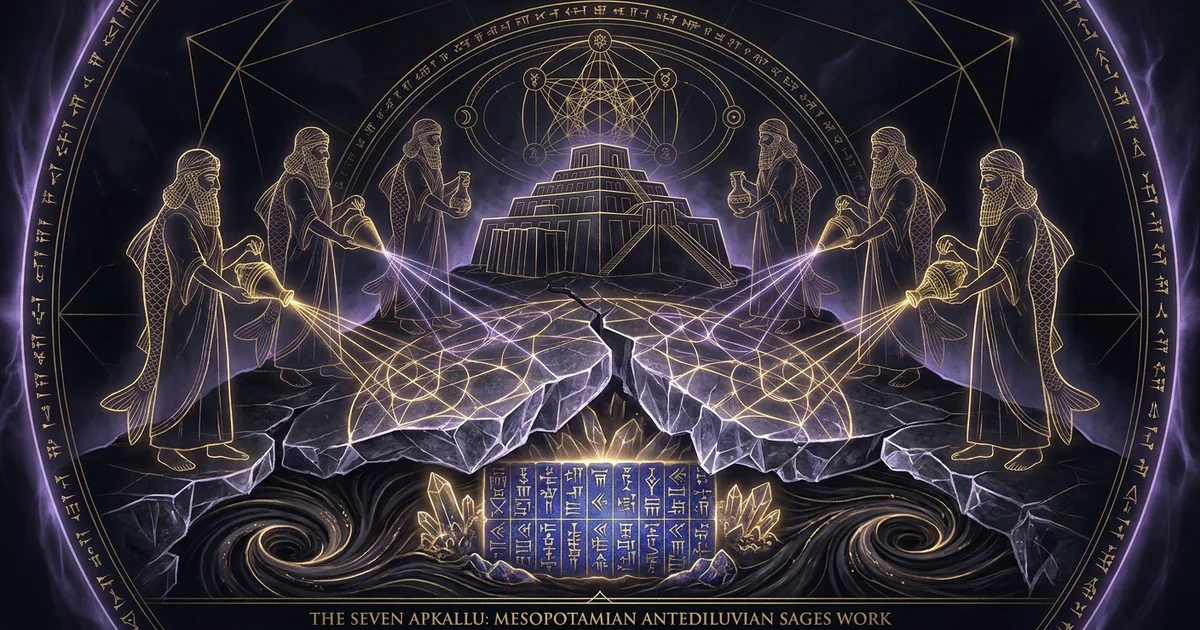
The Seven Apkallu: Mesopotamian Antediluvian Sages Work
Executive Summary & Theoretical Thesis
The Morphogenetic Function of the Seven Apkallu
The Mesopotamian tradition of the Seven Apkallu (cuneiform: 𒉣𒈨; Sumerian: abgal) cannot be reduced to simplistic anthropomorphic myth-making or primitive superstition. It represents a structured socio-technological and archaeoastronomical taxonomy codified following catastrophic mid-Holocene alluvial inundations within the Tigris-Euphrates basin. Within the ancient Near Eastern cosmological framework, these seven apkallu antediluvian sages enki wisdom civilizers cuneiform agents functioned as sacerdotal engineers, hydraulic architects, and cosmic metrologists. Operating under the direct patronage of Enki (the Akkadian Ea), the lord of subterranean freshwater aquifers (abzu or apsû), these beings were tasked with an explicit civil engineering mission: establishing the baseline morphogenetic parameters of urban civilization prior to an inevitable civilizational reset.
[ A P S Û ]
           (Subterranean Hydrological Engine)
                       │
             ┌─────────┴─────────┐
             ▼                   ▼
    [ Divine Metrology ]  [ Hydro-Tectonic ]
     60-Base Harmonics       Engineering
             │                   │
             └─────────┬─────────┘
                       ▼
           [ SEVEN APKALLU CIPHER ]
          (Ontological Stabilization)
                       │
      ┌────────────────┼────────────────┐
      ▼                ▼                ▼
[ Hydraulic     [ Apotropaic Cist   [ Precessional ]
 Canal Networks]   Geometries ]      Calendrics   ]
      │                │                │
      └────────────────┼────────────────┘
                       ▼
            [ POST-DILUVIAN RESCUE ]
             (Anti-Entropic Buffer)
The morphological characterization of the Apkallu—frequently represented in monumental bas-reliefs and terracotta models as amphibious beings cloaked in the skin of the sacred purādu-carp (Cyprinus carpio or Barbus grypus) or as raptor-headed anthropomorphs—physically reflects their dual jurisdiction over the terrestrial earth and the primeval freshwater deeps. Rather than signaling mythological fantasy, this liminal anatomy signifies an operative capacity to navigate both the visible surface architecture of cities and the subterranean hydrological conduits that supported early alluvial infrastructure. The Apkallu established the primeval canon across agriculture, metallurgy, temple architecture, civic jurisprudence, and astronomical observation, thereby stabilizing the human social ecosystem against wild environmental oscillations.
Investigating the archaeological traces of these early epochs reveals deep systemic continuities; as documented in empirical analyses of antediluvian civilizational evidence, urban centers across the Persian Gulf basin were routinely subjected to marine transgressions and rapid climate oscillations that required sophisticated mitigation techniques. The Seven Sages operated as systemic stabilizers, engineering structural and institutional defenses capable of surviving severe hydrological shocks.
Enkian Me and Information Transmission Across Cataclysmic Thresholds
At the core of the Apkallu’s operational domain is the administration of the me (Sumerian: 𒈨), an elusive term designating the fundamental operating codes or ontological archetypes of civilized reality. The me-decrees functioned as universal, immutable algorithms dictating every facet of ordered existence: high-priesthood, kingship, sexual conduct, textile manufacture, bronze metallurgy, musical instrumentation, and sacred metrology. The mythologem of the Apkallu details how these non-material principles were drawn upward from the formless depths of the Apsû, passed through the intellect of Ea, and translated into physical civic infrastructure by the pre-flood sages.
Thermodynamically, human culture exhibits continuous information loss. Without rigorous institutions of transmission, cultural memory experiences irreversible decay. The Apkallu mitigated this systemic breakdown by hardcoding the me-decrees into structural formats: monumental architecture, precise metrological standards, repetitive liturgies, and buried apotropaic deposits. By locking cosmic constants into the geometry of the ziggurat and the proportions of irrigation canals, the sages formed an institutionalized knowledge-preservation apparatus. This matrix insulated scientific axioms from catastrophic floods, civil disruptions, and temporal drift, effectively preserving wisdom before deluge conditions erased surface infrastructures.
       CATASTROPHIC BOUNDARY (Alluvial Reset)
────────────────────────────────────────────────────
  Surface Infrastructure         Subterranean Cist
   [ High Entropy Decoupling ]    [ Lithic Invariance ]
         │                              │
         ▼                              ▼
  Civil Decay / Erasure          Apotropaic Capsule
                                        │
                                        ▼
                                 Re-Excavation &
                                 Lineage Renewal
Archaeological Discontinuity and the Antediluvian Civilizing Matrix
Stratigraphic excavations across Lower Mesopotamia—specifically at Ur, Kish, Shuruppak, and Eridu—reveal sharp, sterile silt deposits separating the late Ubaid and early Uruk strata from later dynastic developments. These geological unconformities verify that mid-Holocene alluvial communities experienced severe, localized marine transgressions and mega-floods. The scribal tradition captured these physical events in texts such as the Epic of Atrahasis, the Sumerian King List (WB 444), and the eleventh tablet of the Epic of Gilgamesh. Rather than viewing these catastrophic accounts as hyperbolic fable, epigraphers recognize them as the historical catalyst for Mesopotamian deep-time planning.
The Apkallu tradition institutionalized the memory of these crises. To prevent the terminal loss of mathematical and mechanical knowledge during cyclical alluvial inundations, the sages developed multi-tiered preservation protocols. These included inscribed stone stelae buried in deep-foundation matrices, standardized cuneiform prisms deposited within structural pilasters, and subterranean terracotta figurations intended to stabilize the terrestrial foundations of palaces and temples.
“Uanna, who completes the plans of heaven and earth; Uannedugga, who is endowed with comprehensive intelligence; Enmedugga, who was brought forth to a good destiny; Enmegalamma, who was born in a house; Enmebulugga, who grew up in an irrigated pasture; An-Enlilda, the conjuror of the city of Eridu; Utuabzu, who ascended to heaven; The pure purādu-fish, the carp of the sea, the seven of them, Born in the river, who maintain the correct functioning of heaven and earth…” — Tablet Series Bīt Mēseri, III, lines 1–28 (transcription based on Borger 1974: 186; Kvanvig 2011: 108).
Historical Lineage & Experimental Precedents
The Uruk and Eridu Stratigraphy: Architectural Genesis of the Apsû
The architectural origin of the Apkallu tradition is rooted in the deep stratigraphy of Tell Abu Shahrain, ancient Eridu. Excavations conducted by Fuad Safar, Mohammad Ali Mustafa, and Seton Lloyd between 1946 and 1949 uncovered eighteen successive architectural phases at the E-abzu (the “House of the Apsû”), dedicated to Enki. This architectural sequence extends from the pristine sand floor of Temple XVIII (late Ubaid period, c. 5400 BCE) through increasingly massive mud-brick platforms to the monumental ziggurats of the Ur III period (c. 2100 BCE).
[Temple I-V (Ur III / Protoliterate Ziggurat)]
   └── Monumental platform over ancient water-table
[Temples VI-VIII (Ubaid 4: Terminal Fluvial Levels)]
   └── High concentration of freshwater fish-bone strata
[Temples IX-XIV (Ubaid 3: Early Structural Cists)]
   └── Mud-brick niches, hearth-altars, threshold caches
[Temples XV-XVIII (Ubaid 1-2: Sand Substrate Matrix)]
   └── Primary aquifer alignment at bedrock level
In Temples VI through VIII, excavators identified meters-thick deposits consisting almost entirely of the calcined bones of freshwater sea-catfish and purādu-carp surrounding the primary altars. This zooarchaeological signature directly links prehistoric liturgical rites to the ichthyomorphic Apkallu iconography found millennia later in the Neo-Assyrian period. The progressive elevation of the shrine atop layered platforms physically expressed the emergence of structured civic space out of the subterranean hydrological matrix (apsû). The temple did not merely symbolize the primeval mound; it acted as an engineered interface between the high-pressure artesian aquifers flowing beneath the alluvium and the urban surface.
Taxonomy of the Sages: Uanna-Adapa to Utuabzu
The definitive taxonomy of the pre-flood sages was preserved in the cuneiform tablet W.20030,7, recovered during the 1959/60 German excavation campaigns at Uruk-Warka (published by J. J. A. van Dijk in UVB 18). Dating to the Seleucid era (147 BCE), this tablet confirms an unbroken scribal lineage matching specific antediluvian monarchs to their corresponding Apkallu counselors:
- Uanna (Adapa): Associated with King Alulim of Eridu; credited with introducing writing, calendar systems, and sacred architecture.
- Uannedugga: Associated with King Alalgar of Eridu; credited with completing hydraulic works and the canonical laws of land drainage.
- Enmedugga: Associated with King Enmenluanna of Bad-tibira; institutionalized the rituals of pastoralism and agrarian administration.
- Enmegalamma: Associated with King Enmengalanna of Bad-tibira; developed bronze metallurgy and structural cuneiform accounting.
- Enmebulugga: Associated with King Dumuzi, the shepherd, of Bad-tibira; codified the distribution of life-sustaining water networks.
- An-Enlilda: Associated with King Ensipadzidanna of Larag; master of mechanical and apotropaic arts against epidemic pestilence.
- Utuabzu: Associated with King Enmenduranki of Sippar; legendary figure who ascended to heaven (ana šamê ēlû) to receive the secrets of divination, mathematics, and the oil-mirror from Shamash and Adad.
This alignment demonstrates that political power (nam-lugal, kingship) was structurally invalid in Mesopotamian constitutional theology without the technical, theological, and scientific guidance of an Apsû-derived sage. The monarch held temporal authority; the Apkallu provided the epistemic foundation that sustained it.
Post-Diluvian Transmission Lines and the Berossus Babyloniaca Concordance
The transition across the diluvial boundary generated a distinct shift in Near Eastern intellectual lineage. When Berossus, a priest of Bel-Marduk at Babylon, composed his Babyloniaca in Greek for Antiochus I Soter (c. 281 BCE), he preserved this historical memory in his account of the monster-sage Oannes. Berossus describes Oannes emerging from the Persian Gulf (Erythraean Sea) as an amphibious creature with the complete body of a fish, beneath which was a human head and feet. Oannes spent his days instructing mankind in letters, sciences, geometry, agriculture, and urban construction, returning beneath the ocean waves at sunset.
Berossus recorded that subsequent amphibious beings—the Musari—appeared across generations to elaborate upon this initial body of knowledge. This Hellenistic account aligns with cuneiform lists documenting the post-diluvian Ummiânu (human master scholars). While the antediluvian Apkallu were purely divine beings born of the Apsû, their post-diluvian successors were human sages endowed with partial divine descent. These later figures operated within imperial courts, maintaining the antediluvian canon via continuous scribal transmission.
Antediluvian Apkallu (7 Sages)
- Ontological Origin: Born directly of the subterranean freshwater Apsû; non-human, divine status.
- Iconographic Expression: Purely composite forms; purādu-carp cloaks, eagle-headed wings, ritual bucket (banduddû) and purifier cone (mullilu).
- Epistemic Function: Direct transmission of the unmediated me-decrees; foundational generation of urban arts, astronomy, geometry, and agriculture.
- Temporal Boundary: Pre-flood period ending with Shuruppak’s inundation; infallible custodians of structural world-order.
Post-Diluvian Ummiânu (Human Scholars)
- Ontological Origin: Human parentage with distant semi-divine lineage; mortal, subject to hubris and administrative error.
- Iconographic Expression: Anthropomorphic sacerdotal vestments; scribal tablets, measuring rods, standard court apparel.
- Epistemic Function: Hermeneutic interpretation and scholastic preservation of pre-existing canonical cuneiform corpora.
- Temporal Boundary: Post-diluvian era (Gilgamesh of Uruk down to the Seleucid era); bureaucratic integration within imperial courts.
Mathematical Formalism & Physical Mechanics
Sexagesimal Metrology and the 60-Base Celestial Matrix
The foundational architecture deployed by the Seven Apkallu was mathematically structured on a strictly sexagesimal harmonic system (base-60). This computational framework was not an arbitrary cultural choice; it represented an optimized mathematical matrix designed to simplify fractions and integrate complex astronomical cycles with terrestrial metrology. Sixty is the smallest integer divisible by the first six counting numbers ($1, 2, 3, 4, 5, 6$), as well as by $10, 12, 15, 20,$ and $30$. This highly composite character enabled Mesopotamian surveyors to partition land, allocate hydraulic capacity, and divide temporal cycles without encountering irrational repeating fractions.
The sexagesimal-harmonic-system integrated linear measure, temporal reckoning, and spherical astronomy into a unified field of calculation. The fundamental spatial unit—the Nippur cubit ($L_{\text{cubit}} \approx 51.85 \text{ cm}$)—informed the standard unit of geographic survey, the uš ($60 \text{ cubits} \approx 31.11 \text{ m}$), and the bēru ($1,800 \text{ rods} = 10,800 \text{ m}$), which directly corresponded to the angular transit of the sun across a two-hour civil watch. In this computational architecture, celestial mechanics and earthly construction were mutually calibrated expressions of a singular harmonic continuum.
This mathematical matrix provided the computational foundation for sexagesimal astronomy in Mesopotamia. By dividing the celestial sphere into 360 degrees ($6 \times 60$) and tracking the slow displacement of the equinoctial points against the sidereal background, the temple astronomers established an empirical method for calculating the precession-of-equinoxes across centuries of continuous observation.
The Mesopotamian astronomical canon defines precessional time through base-60 increments: the soss ($60$), the ner ($600$), and the sar ($3,600$). The complete precessional cycle of the equinoxes—the “Great Year”—was recognized as an integer harmonic within this system: $$T_{\text{precess}} = 25,920 \text{ solar years}$$ Decomposing this duration into sexagesimal base components demonstrates exact factorizability: $$25,920 = 7.2 \times 3,600 \text{ (sars)} = 43.2 \times 600 \text{ (ners)} = 432 \times 60 \text{ (soss)}$$ This factor of $432$ is structural: it forms the exact duration of the ten antediluvian kings listed in the Sumerian King List (432,000 years, or $120 \text{ sars}$). The precessional rate of equinoctial drift per zodiacal house ($30^\circ$) resolves as: $$T_{\text{zodiac}} = \frac{25,920}{12} = 2,160 \text{ years} = \frac{3,600}{5} \times 3 = 36 \times 60$$ This harmonic formulation demonstrates that the chronological figures recorded by the Apkallu scribal schools were not random exaggerations, but rather an interconnected system of calendrical mathematics matching planetary orbital cycles to long-term precessional mechanics.
Acoustic Cavity Resonances of Brick-Cist Foundation Vaults
The apotropaic foundation cists housing the Apkallu figurines were not merely symbolic reliquaries; they operated as resonant acoustic cavities designed to interface with ground-borne mechanical vibrations. Neo-Assyrian architectural guidelines (codified in texts analyzed by F. A. M. Wiggermann) prescribed precisely laid mud-brick boxes buried below room floorboards, door thresholds, and structural corners. These cists, constructed using standardized sun-dried or kiln-fired rectangular bricks bonded with natural asphalt (bitumen), formed enclosed Helmholtz-style resonant chambers.
Incoming Telluric / Seismic Strain (f_0)
                          │
                          ▼
            [ Masonry Threshold Flagstone ]
                          │
  ┌───────────────────────┴───────────────────────┐
  ▼                                               ▼
[ Bitumen Mortar ]                              [ Bitumen Mortar ]
  (Viscoelastic Damping)                          (Viscoelastic Damping)
  │                                               │
  └───────────────────────┬───────────────────────┘
                          ▼
             [ AIR-FILLED INTERNAL CAVITY ]
               Volume V, Neck Length L_eff
                          │
                          ▼
         [ APOTROPAIC FIGURINE DIELECTRIC CORE ]
            Resonant standing wave cancellation
The resonant acoustic properties of early temples, detailed in studies on acoustic resonance in ancient architecture, reveal that sacred enclosures were deliberately tuned to specific vibrational frequencies. For a rectangular subterranean cist with interior dimensions $L_x, L_y, L_z$, the characteristic resonant frequencies for acoustic standing waves are governed by the classic boundary equation:
$$f_{n_x, n_y, n_z} = \frac{c_s}{2} \sqrt{\left(\frac{n_x}{L_x}\right)^2 + \left(\frac{n_y}{L_y}\right)^2 + \left(\frac{n_z}{L_z}\right)^2}$$
where $c_s$ is the speed of sound through the interior air cavity ($\approx 343 \text{ m/s}$ at $20^\circ\text{C}$), and $n_x, n_y, n_z$ represent the integer modal indices ($0, 1, 2 \dots$).
When seismic energy, ground-water pressure transients, or ambient structural stresses transmit through the alluvial soil, these energy waves encounter the cist. The viscoelastic bitumen lining dampens shear waves ($S$-waves), while the internal air pocket and the central ceramic mass of the figurine create localized acoustic impedance mismatches. This acoustic mismatch disrupts the coherence of destructive telluric frequencies moving toward the vulnerable timber-and-mudbrick load-bearing walls overhead.
Information-Theoretic Modeling of Lithic and Terracotta Encapsulation
The physical survival of antediluvian knowledge relies on the mathematical principles of information-entropy. Under Claude Shannon’s foundational formulation, the capacity $C$ of a noisy physical channel to transmit information without terminal corruption is bounded by:
$$C = B \log_2 \left(1 + \frac{S}{N}\right)$$
In the historical framework of Mesopotamian deep-time scribal preservation, the transmission “channel” is the physical stratigraphic medium of Lower Mesopotamia across centuries of weathering, seasonal floods, soil salinization, and military demolition ($N$, environmental noise). To ensure the civilizational signal $S$ persisted over millennia, the Seven Apkallu and their scribal schools applied maximal redundancy and physical medium hardening:
[ Cuneiform / Spatial Signal (S) ]
               │
               ▼
┌──────────────────────────────────────────────┐
│  REDUNDANCY ENCODING MATRIX                  │
│  - Triple Cist Reductions                    │
│  - Standardized Cuneiform Inscriptions       │
│  - High-Alumina Baked Terracotta Encapsulation│
│  - Bitumen Hydrophobic Sealing               │
└──────────────────────────────────────────────┘
               │
               ▼
[ Environmental Noise (N): Salinization, Marine Floods, Strata Shearing ]
               │
               ▼
[ High Fidelity Epistemic Recovery: 100% Uncorrupted Architectural Me ]
By encoding their structural blueprints not on transient organic media (papyrus, leather, or textiles) but within high-fired, high-alumina silicate terracotta and dense crystalline diorite or basalt, the scribes achieved near-zero material decay rates. Furthermore, by repeating foundational formulas across hundreds of independent subterranean nodes, they introduced distributed error-correcting storage. If seventy percent of the apotropaic cists beneath a palace were crushed or waterlogged, the remaining thirty percent preserved the complete, uncorrupted civic data package.
Empirical Evidence & Observational Data
Excavated Foundation Deposits at Nimrud, Nineveh, and Ur
Modern field archaeology has systematically corroborated the ritual prescriptions recorded in Mesopotamian exorcism and building texts. During Sir Leonard Woolley’s excavations at the Royal Cemetery and the sacred temenos of Ur (1922–1934), excavators uncovered intact brick apotropaic-deposit boxes placed sub-floor beneath the corners of residential, administrative, and religious complexes. Subsequent systematic excavations by M. E. L. Mallowan at Nimrud (ancient Kalhu) during the 1950s—specifically within the Northwest Palace of Ashurnasirpal II and the Fort Shalmaneser military complex—yielded dozens of undisturbed foundation cists containing precise configurations of the Seven Apkallu.
PLAN VIEW: TYPICAL FOUNDATION DEPOSIT CIST
              (Neo-Assyrian Architectural Node)
   ┌────────────────── Brick Lid ──────────────────┐
   │                                               │
┌──┴───────────────────────────────────────────────┴──┐
│  [Bitumen Seal]                    [Bitumen Seal]   │
│  ┌─────────────────────────────────────────────┐   │
│  │       Internal Air-Gap Cavity               │   │
│  │                                             │   │
│  │                  ▲                          │   │
│  │                 / \  (mullilu cone)         │   │
│  │                [   ]                        │   │
│  │                 | |                         │   │
│  │                [===] (banduddû bucket)      │   │
│  │                 | |                         │   │
│  │           Terracotta Apkallu                │   │
│  │            (High-Silica Clay)               │   │
│  │                 | |                         │   │
│  │               ┌─┴─┴─┐                       │   │
│  │               │CIST │                       │   │
│  │               │FLOOR│                       │   │
│  └───────────────┴─────┴───────────────────────┘   │
└──┬───────────────────────────────────────────────┬──┘
   │                                               │
   └────────────── Sub-Floor Matrix ───────────────┘</code></pre>
These deposits were not randomly placed. Spatial analysis demonstrates that the cists were positioned precisely at structural stress points: door jambs, room corners, threshold transitions, and immediately beneath internal water-drainage outlets. The figurines within these boxes were positioned facing into the room or outward through the doorway, fulfilling an explicit apotropaic mandate: establishing a boundary layer to deflect malevolent forces, pestilence (namtar), and structural collapse.
“You make seven clay statues of the Wise Men (apkallu), with faces of fish, cloaked in the skins of fish… You coat them with lime, and draw their fish-skins in black paint. In their right hands they hold a purifier (mullilu), and in their left hands they carry a bucket (banduddû). You bury them in the foundation of the house, at the head of the bed, beneath the threshold, and in the four corners, and you recite: ‘Wise Men, born in the river, who maintain the correct functioning of heaven and earth!’” — F. A. M. Wiggermann, Mesopotamian Protective Spirits: The Ritual Texts (1992: 44–47).
Iconographic Typology: Fish-Cloaked (Purādu) and Bird-Headed Figures
Comprehensive typological analysis of the material corpus from Nimrud, Nineveh, Khorsabad, and Assur classifies these apotropaic figurines into three distinct iconographic groups:
ICONOGRAPHIC TYPOLOGIES
                          │
       ┌──────────────────┼──────────────────┐
       ▼                  ▼                  ▼
[ Fish-Cloaked ]   [ Bird-Headed ]    [ Winged Anthropomorphic ]
 (Purādu-Carp)      (Nisroc/Raptor)       (Polos Crown)
       │                  │                  │
 - Ea/Apsû Descent   - Sky-Sovereignty   - Pure Civil
 - Hydraulic Arts    - Spatial Shield     Jurisprudence
- Water Lustration - Pinecone Filter - Terrestrial Order- Fish-Cloaked Apkallu (Šu-klat Apsî): Anthropomorphic figures draped in the skin of a mature carp. The gaping fish-head forms a helmet above the human skull, while the scaly torso trails down the priest-sage’s back, terminating in caudal fins at the ankles. This figure holds the sacred bucket (banduddû) and the purifying cone (mullilu). This form materializes their emergence from the freshwater Apsû to bring life-sustaining technologies to dry land.
- Bird-Headed Apkallu (Uri-gallu): Figures with avian heads—specifically modeled on the predatory steppe raptor (Accipitridae)—possessing large, recurved beaks, sharp ocular crests, and four divine wings. These bird headed fish cloaked statues represent the upper-atmospheric authority of the celestial gods Anu and Enlil, functioning as active spatial guardians capable of intercepting atmospheric and airborne spiritual afflictions.
- Winged Anthropomorphic Apkallu: Fully human-faced figures distinguished by four wings and the horned polos headdress of Mesopotamian divinity. These figures carry the lustration bucket and date-spathe cone, embodying the refined civil arts and administrative jurisprudence of the ancient city.
Petrographic and Mineralogical Analysis of Apotropaic Clay Substrates
Petrographic thin-section analysis and X-ray diffraction (XRD) of apotropaic figurines recovered from the Neo-Assyrian palaces demonstrate that their material composition was strictly controlled. The clay was not harvested from standard mudbrick quarries. Instead, epigraphic texts and geological markers indicate that clay for the figures was collected from specific, liminal hydraulic zones: riverbeds at the confluence of canals, deep well-drilling silt, and the perimeter of temple irrigation channels—locations where the water table of the Apsû intersected the upper alluvium.
Mineralogically, these figurines consist of fine-grained illite and kaolinite clays mixed with microscopic quartz grains, feldspar inclusions, and fine-ground calcite tempering agents. Once shaped, the figures were fired at temperatures exceeding $800^\circ\text{C}$ to induce partial ceramic vitrification, transforming the raw clay into a water-resistant ceramic matrix.
Following firing, the figures were coated with a slurry of slaked lime (calcium hydroxide, $\text{Ca(OH)}_2$) or gypsum plaster ($\text{CaSO}_4 \cdot 2\text{H}_2\text{O}$), providing a white dielectric ground layer. Upon this prepared surface, scribes drew details using pure black bitumen pigments and natural carbon suspensions. The resulting composite artifact was structurally insulated against waterlogging, biological decay, and soil chemical leaching within the high-salinity alluvium of southern and central Iraq.
Subterranean Field Geometries & Apotropaic Networks
The Threshold as a Boundary Layer in Archaeo-Acoustic Defense
In Mesopotamian spatial theory, architectural thresholds were not passive openings; they were structurally vulnerable boundaries requiring continuous defense. The doorway was the spatial interface through which external forces—dust storms, floodwaters, hostile armies, pestilence, and spiritual adversaries (alû, gallû, asakku)—could enter an ordered interior environment. The installation of the Seven Apkallu beneath these entryways established an apotropaic boundary layer.
By embedding the figurines directly into the subterranean threshold sub-strata, the builders formed a physical boundary matching the energetic nodes of the domestic or sacred complex. When sound waves, footsteps, or environmental vibrations traveled across the threshold paving stones, mechanical stress was transferred directly down into the brick cists. The cist acted as a mechanical anchor, while its symbolic and material composition established an energetic perimeter that demarcated the protected interior from the chaotic exterior.
Circuit Mapping: Interconnecting Palatial Foundation Cists
When the positions of foundation cists across major Neo-Assyrian administrative complexes—such as the Northwest Palace at Nimrud or the Southwest Palace of Sennacherib at Nineveh—are plotted into a unified spatial network, a deliberate geometric circuit emerges. Cists were not deposited in isolated, haphazard clusters. Instead, they formed an interconnected perimeter network enclosing the inner royal quarters, the throne room, and the sacred treasury.
Outer Gate [ Cist 1 ] ◄═════════► [ Cist 2 ] Guard Chamber
       │                                 │
       ▼                                 ▼
Courtyard Perimeter               Hydraulic Sluice
   [ Cist 3 ]                       [ Cist 4 ]
       │                                 │
       ▼                                 ▼
Throne Room Threshold             Sanctum Sanctorum
   [ Cist 5 ] ═══════════════════► [ Cist 6 & 7 ]
This configuration produced a continuous perimeter buffer. The movement of an individual through the palace required passing over successive nodes in this geometric grid. At each major transition (outer gate, courtyard portal, corridor intersection, throne-room threshold), the body moved through a boundary zone framed by submerged foundation cists containing paired fish-cloaked and bird-headed guardians.
The Apsû as a Hydrodynamic and Piezoelectric Energy Reservoir
The theological insistence that the Apkallu emerged directly from the Apsû points to an underlying physical reality: the unique hydrogeological behavior of the Tigris-Euphrates alluvial system. Beneath the dry silt plain of Lower Mesopotamia lay an extensive, pressurized system of artesian aquifers. These subterranean waters were continuous with the limestone bedrock aquifers that extended from the Zagros and Taurus mountain ranges down to the Persian Gulf.
       Zagros Mountain Recharge Zone (Hydrostatic Head)
                              │
                              ▼
        [ Deep Limestone Subterranean Aquifers (Apsû) ]
                              │
         High-Pressure Artesian Seepage (Telluric Flow)
                              │
                              ▼
    ┌─────────────────────────────────────────────────────┐
    │  Alluvial Silts: Quartz-Sand Saturated Matrix       │
    │  - Electrokinetic Streaming Potentials              │
    │  - Micro-Piezoelectric Stress Wave Transduction     │
    └─────────────────────────────────────────────────────┘
                              │
                              ▼
        [ Piezoelectric Clay Cist / Foundation Stone ]
                              │
                              ▼
     [ Localized Electric Double-Layer (Threshold Plane) ]
The interaction of moving subterranean groundwater with quartz-bearing sands generates distinct electrokinetic streaming potentials. Furthermore, telluric stress fields act on subterranean minerals to produce weak, low-frequency electromagnetic variations. As detailed in the operational physics of piezoelectric quartz and telluric currents, dynamic hydrological pressure moving through mineral-dense sedimentary strata yields measurable boundary voltages.
By siting their sacred foundation stones babylon complexes, temples, and apotropaic cists directly over known subterranean freshwater springs and primary canal junctions, ancient builders grounded their architecture into these natural telluric and electrokinetic currents. The buried Apkallu figurines, fabricated from quartz-bearing clays and sealed with carbon-rich bitumen, acted as dielectric nodes within this localized environmental field, coupling the architectural mass to the hydro-tectonic forces of the subterranean deeps.
Metaphysical Implications & Unified Synthesis
The Preservation of Civilizational Axioms Across Epochal Resets
The tradition of the Seven Apkallu preserves a fundamental principle of ancient cyclical cosmology: civilization is not an irreversible, linear climb from primitivism to enlightenment, but an oscillating system vulnerable to catastrophic environmental and technological resets. The mythic narrative of the deluge (abūbu) recognizes that nature periodically reaches self-regulatory tipping points. Whether triggered by hyper-salinization of agricultural topsoil, tectonic displacement of river channels, or oceanic sea-level surges, the surface structures of human civilization are vulnerable to sudden systemic collapse.
The Apkallu tradition represents a structured, proactive mitigation strategy against this deep-time vulnerability. The sages did not attempt to halt the flood; they recognized the inevitability of the cycle and focused on the lossless preservation of foundational civilizational blueprints. By transcribing civil algorithms—the me—into lithic materials, deeply buried foundation tablets, and architectural forms, the sages ensured that when the alluvial plains dried, the surviving remnant could reconstruct high-order urban systems without repeating millennia of trial-and-error development.
CIVILIZATIONAL TRAJECTORY UNDER DETERMINISTIC CYCLICAL DYNAMICS
Civilization Index
▲
│         Peak Urban Matrix
│            (Pre-Flood)
│              /

│             /  \    Catastrophic Reset (Abūbu)
│            /    \   [Information Bleed Controlled via Cists]
│           /      \

│          /        \         Re-Seeded Urban Matrix
│         /          \             (Post-Flood)
│  Primeval           \               /

│   Climb              \             /

│   (Apkallu Input)     \           /

│     /                  \         /

│    /                    _______/

└─────────────────────────────────────────────► Time
The Sages as Archetypes of Integrated Empirical-Spiritual Science
In the worldview of modern technocracy, empirical physics is disconnected from ethical and metaphysical frameworks. The Seven Apkallu embody an opposing, integrated epistemology: the laws governing physical construction, hydraulic engineering, and agricultural distribution are identical to the cosmological laws governing ethical conduct, ritual purification, and celestial harmony. The fish-skin cloak worn by the Apkallu is not an ornamental mask; it visualizes the practitioner’s immersion in the living dynamics of nature.
UNIFIED APKALLU EPISTEMOLOGY
                            │
       ┌────────────────────┴────────────────────┐
       ▼                                         ▼
[ Empirical Mechanics ]                  [ Spiritual Cosmogony ]
 - Hydraulic Gradient Physics             - Metaphysical Jurisprudence
 - Mudbrick Stress Distributions          - Precessional Harmonization
 - Base-60 Metrological Grids             - Liturgical Resonances
       │                                         │
       └────────────────────┬────────────────────┘
                            ▼
              [ Integrated Civilizational Me ]
When an Apkallu measures the foundation of a wall using the measuring cord and the rod, he is not merely executing a mechanical task; he is aligning the physical coordinates of the city with the precessional harmonics of the cosmos. To build a wall off-axis or construct a canal without the proper geometric gradient was considered an ontological crime—an infraction that disrupted the flow of life-giving water (apsû) and exposed the urban center to collapse.
Thermodynamics of Myth: Encoding Epistemic Blueprints in Lithic Forms
Myth operates as an efficient, low-entropy transmission system for preserving critical knowledge across deep-time civilizational discontinuities. Abstract scientific equations, dry geometric algorithms, and technical engineering manuals are easily lost, corrupted, or abandoned during imperial collapses, linguistic shifts, and climatic catastrophes. In contrast, narrative myth—when paired with recognizable monumental iconography—survives linguistic shifts by anchoring complex concepts to universal archetypes.
       Abstract Technical Data
  (Vulnerable to Semantic Drift / Noise)
                 │
                 ▼
  [ NARRATIVE-ICONIC CONDENSATION ]
   - The Amphibious Sage (Apkallu)
   - The Purifier Cone (Mullilu)
   - The Sacred Bucket (Banduddû)
                 │
                 ▼
  [ LITHIC-ARCHITECTURAL LOCK ]
   Subterranean Foundation Cist
                 │
                 ▼
       Centuries of Transmission
 (Survives Epistemic Resets and Linguistic Erasure)
                 │
                 ▼
     [ RE-DECRYPTION AT POST-DILUVIAN HORIZON ]
The Seven Apkallu consolidate complex hydrodynamics, acoustic isolation, seismic mitigation, and celestial calendrics into an unforgettable visual and ritual syntax: the wise sage cloaked in the fish, stepping through the doorway with the purifier and bucket, burying the protective box beneath the earth.
Centuries after the names of specific hydraulic engineers faded from memory, subsequent generations continued to replicate their protective foundation cists with absolute geometric precision, preserving the structural and seismic defenses of their cities. The myth carried the technical code safely through cultural dark ages, ensuring that the structural principles of antediluvian engineering remained operative even when the original scientific terminology had been forgotten.
Frequently Asked Questions
Distinction Between Antediluvian and Postdiluvian Sages
The boundary between the antediluvian sages (apkallu) and the post-diluvian scholars (ummiânu) represents a fundamental ontological transition in Mesopotamian scribal history. The seven antediluvian Apkallu were beings of direct divine creation, brought forth by Ea/Enki from the depths of the subterranean Apsû. They possessed an amphibious or avian morphology, held direct mastery over the unmediated me-decrees, and operated as the foundational teachers of humanity before the catastrophic flood described in the Epic of Atrahasis.
In contrast, the post-diluvian Ummiânu were human scholars and ritual masters who lived after the flood, beginning around the reign of Gilgamesh of Uruk. While texts like the Uruk King and Sage List trace the intellectual lineage of these later scholars directly back to the pre-flood sages, the Ummiânu were subject to human mortality, political influence, and epistemic fallibility. They did not originate new civilizational arts; rather, they translated, interpreted, and preserved the antediluvian canon via continuous scribal copying and architectural maintenance.
Iconographic Purpose of the Pinecone and Bucket
The ritual tools carried by the Apkallu in monumental Neo-Assyrian bas-reliefs and terracotta models—the cone held in the right hand and the bucket held in the left—are technical instruments of lustration and spatial boundary control. The cone, known in Akkadian as the mullilu (“purifier”), is frequently identified as the male spathe of the date palm (Phoenix dactylifera) or an acoustic-dispersion wand modeled on the seed-cone of the cedar. It was used to sprinkle purified water onto persons, doorway thresholds, and architectural jambs.
The bucket, designated the banduddû, was a portable container fabricated from bronze, woven reed, or asphalted textile. It held sacred lustral water drawn directly from the subterranean aquifer or the river—the physical waters of the Apsû. In apotropaic ritual procedures, dipping the mullilu into the banduddû and flicking it toward an architectural threshold was understood to project an invisible, sanctified boundary layer across the portal. Mechanically, the salt-and-lime lustral wash functioned as a disinfectant against biological pathogens in the humid river basin; ritually and acoustically, it sealed the physical aperture against disruptive spiritual and telluric influences.
       APOTROPAIC THRESHOLD TRANSIT DYNAMICS

  [ Unsanctified Outer Zone ]
              │
              │   (External Biological / Dynamic Perturbation)
              ▼
  ═══════════════════════════════════════════════════
  THRESHOLD RECEPTACLE INTERFACE
  - Mullilu (Purifier Cone): Aerosol Dispersion Field
  - Banduddû (Sacred Bucket): Subterranean Hydro-Charge
  ═══════════════════════════════════════════════════
              │
              │   (Phase Coherence / Impurity Filtering)
              ▼
  [ Sanctified Interior Space ]
Epigraphic Parallels with the Genesis Watchers and Enochic Scribes
The cuneiform Apkallu tradition directly informed the primeval narratives of Second Temple Jewish literature, specifically the traditions of the Watchers (Grigori) in the Book of Enoch (1 Enoch) and the Book of Giants from the Dead Sea Scrolls. As demonstrated in the comparative analyses of Helge S. Kvanvig, the biblical and Enochic figures mirror the structural and chronological frameworks of the Mesopotamian antediluvian king and sage lists.
“The antediluvian traditions in Genesis and the Enochic literature do not reflect an independent Levantine memory; they are an explicit, critical, and polemical adaptation of the cuneiform Apkallu texts. The seventh sage, Utuabzu, who ascended to heaven according to the cuneiform lists, provides the direct literary prototype for Enoch, the seventh antediluvian patriarch, who walked with God and was taken up to heaven to receive the tablets of celestial wisdom. However, while the Mesopotamian tradition honors the Apkallu as the divine sources of all urban sciences, the Enochic literature performs a polemical inversion: the descending Watchers are condemned as fallen angels whose transmission of metallurgy, astronomy, and cosmetics brought moral corruption and physical ruin to the earth.” — Helge S. Kvanvig, Primeval History: Babylonian, Biblical, and Enochic (2011: 159–163).
The crucial divergence between these traditions lies in their theological evaluation of human technological development. In the Mesopotamian view, the technological sciences introduced by the Apkallu—metallurgy, writing, astronomy, and architecture—were necessary divine gifts that lifted humanity out of primordial chaos.
In the Enochic reinterpretation, this same technical transmission is reframed as an unauthorized breach of celestial secrets. The Watchers are cast as transgressive entities whose transmission of advanced metallurgical and astronomical arts accelerated the moral decay of the antediluvian world, necessitating the divine intervention of the biblical Deluge. Despite this moral divergence, the structural core of the narrative remains identical: an elite cadre of non-human teachers descended from the higher realm to impart foundational technological knowledge to humanity before a catastrophic civilizational reset.