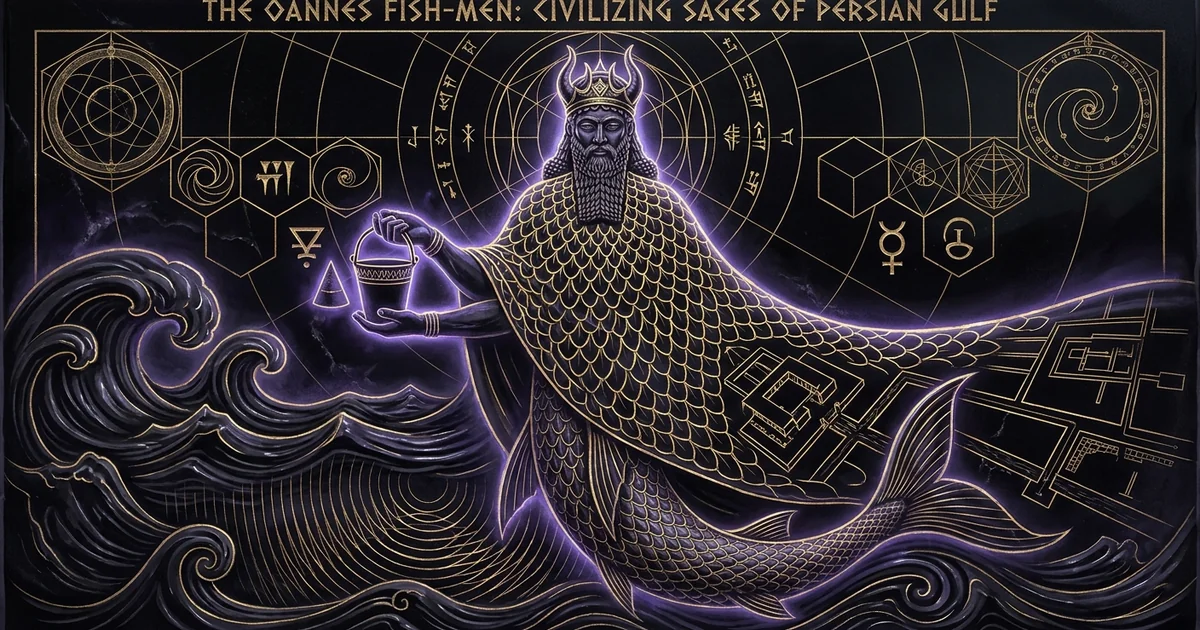
The Oannes Fish-Men: Civilizing Sages of Persian Gulf
Executive Summary & Theoretical Thesis
Epistemological Reassessment of the Berossian Fragment
The historical fragment preserved from the Babyloniaca of Berossos (c. 281 BCE) concerning the composite entity Oannes constitutes one of the most enigmatic cruces in Near Eastern historiography. Writing as a priest of Bēl Marduk in Seleucid Babylon, Berossos documented a foundational cultural contact event situated at the dawn of Mesopotamian memory: an amphibious intelligence, emerging from the Erythraean Sea (the Persian Gulf), that gifted humankind the structural components of civilization. Rather than categorizing this narrative within the generic taxonomy of mythopoeic zoomorphism, an epistemological reassessment demands that we analyze the Berossian account as an encoded historiographical record. The description of Oannes—a being whose entire body was that of a fish, yet possessed an articulated human head beneath the piscine head and human feet protruding from the caudal fin—articulates a precise phenomenology: the interaction between an autochthonous, terrestrial population and a maritime-adapted order bearing a specialized technotaxic apparatus.
The core historiographical paradox resides in the epistemic maturity of the gifts delivered. According to Berossos, this entity conversed with humans without taking sustenance, imparting literacy, mathematical computation, geometry, jurisprudence, agricultural management, and urban architecture. Crucially, the text insists that following the departure of Oannes, “nothing new has been invented”—an explicit assertion of an antediluvian horizon characterized by technological completeness. This report aligns with archaeological observations at the foundational levels of the southern Mesopotamian alluvium, where the primary components of complex irrigation, monumental brick architecture, and institutional specialization emerge with an anomalous stratigraphic suddenness.
Modern scholarship has frequently dismissed the Berossian fragments as Hellenistic fabulation or symbolic allegories of royal sovereignty. However, cross-referencing these Hellenistic remnants with early cuneiform documentation reveals an unbroken scribal genealogy. The Hellenistic “Oannes” represents the direct phonetic transliteration of the cuneiform Uanna, the premier figure within the canonical apkallu-sequence. By peeling back the interpretive layers imposed by Greek mythography and later Christian chronography, we reveal a remarkably consistent operational paradigm: a cadre of technological vectors, designated by the scribes as fish-cloaked sages, deliberately dispatched across a littoral frontier to establish civilizational equilibrium amidst unstable coastal ecologies.
The Persian Gulf Oasis Hypothesis and Marine Transgression
The geographic theater of this civilizing event—the Persian Gulf—underwent radical environmental deformation across the Terminal Pleistocene and Early to Mid-Holocene epochs. Current bathymetric models and sea-level reconstructions establish that during the Last Glacial Maximum (c. 20,000–18,000 calibrated BCE), eustatic sea levels fell approximately 120 meters below present levels. This global oceanic retraction entirely drained the shallow Persian Gulf basin, transforming the modern marine floor into an emergent, hyper-fertile terrestrial refugium known as the Persian Gulf Oasis.
This basin was nourished by the confluence of the proto-Tigris, proto-Euphrates, Karun, and the fossil Wadi Batin river networks. It formed an expansive, resource-rich riparian sanctuary isolated from the hyper-arid environmental stresses of the surrounding Arabian and Iranian plateaus. For millennia, this subterranean basin provided an insulated biome wherein human populations could develop sedentary foraging, specialized hydrological manipulation, and advanced coastal-estuarine navigational methodologies. However, the subsequent post-glacial warming cycle triggered the cataclysmic flandrian-transgression. The melting of global ice sheets drove episodic, high-velocity sea-level rises that breached the Strait of Hormuz, progressively inundating the basin floor between 12,000 and 5,500 BCE.
“In the first year there appeared, coming up from that part of the Erythraean Sea which borders on Babylonia, an intelligent creature by the name of Oannes, whose whole body was like that of a fish; and under the fish’s head was another head, and also feet below, similar to those of a man, subjoined to the fish’s tail. His voice too, and language, was articulate and human; and a representation of him is preserved even to this day… He gave them an insight into letters and sciences, and arts of every kind. He taught them to construct cities, to found temples, to compile laws, and explained to them the principles of geometrical knowledge. He made them distinguish the seeds of the earth, and showed them how to collect the fruits; in short, he instructed them in everything which could tend to soften manners and humanize their lives. From that time, nothing material has been added by way of improvement.”
The socio-ecological consequence of this marine transgression was absolute displacement. As the waters of the Indian Ocean advanced up the Gulf trough—often drowning kilometers of low-gradient terrain within single generations—the populations inhabiting the oasis were forced to migrate northward along retreating shorelines. The apex of this displacement intersected precisely with the southern Mesopotamian delta during the sixth millennium BCE. Here, the refugee populations, carrying thousands of years of littoral adaptation, astronomical observational data, and canalization technologies, encountered the raw, swampy alluvium of what would become Sumer. The “arrival” of civilizers emerging from the Erythraean Sea is thus the socio-historical memory of these maritime and estuarine survivors making contact with less sophisticated communities along the prograding deltaic margins.
The Antediluvian Technotaxic Rupture
The archaeological transition marking the inception of the ubaid-horizon (specifically Ubaid 0 and 1, c. 6500–5000 BCE) presents what can be structurally classified as a technotaxic rupture. Rather than exhibiting a slow, Darwinian progression from rudimentary upland foraging to alluvial urbanization, the lower Mesopotamian sequence, crystallized at Eridu (Tell Abu Shahrein), demonstrates an instantaneous deployment of complex civil engineering, ceramic pyrotechnology, and sacred administrative architectures.
This abrupt appearance challenges purely autochthonous evolutionary paradigms. The foundational architectural layers of the Eridu temple sequence (Levels XIX–XV) do not reveal crude, experimental shelters; they expose carefully oriented, mud-brick structures featuring central altars, niche-and-buttress facades, and specialized hearths explicitly dedicated to the presentation of aquatic fauna. The material culture is saturated from its inception with sophisticated sexagesimal-metrology, standardized tripartite floorplans, and an administrative apparatus capable of marshaling communal labor for complex hydraulic canalization.
This empirical discontinuity points toward an exogenous transmission vector. When considered alongside global Holocene environmental shocks explored in the context of the /ancient-prehistory/younger-dryas-impact-hypothesis, the sudden appearance of the me—the divine decrees and technical arts documented in the cuneiform corpus—mirrors an emergency restoration of complex systemic protocols rather than their initial invention. The legendary Oannes-Apkallu interaction represents the precise interface of this rupture: an intentional, highly organized transfer of civilizational operating software by an elite cadre of littoral survivors seeking to reconstitute systemic order upon a precarious alluvium.
Historical Lineage & Epigraphic Precedents
The Cuneiform Apkallu Lexicon: Uanna to Adapa
To comprehend the morphology and function of Oannes, one must trace the philological and scribal evolution from the Hellenistic Greek back to the foundational Sumerian and Akkadian lexical tablets. The Greek name Oannes ($\Omega\alpha\nu\nu\eta\varsigma$) is linguistically verified as the direct reflex of the Sumerian proper noun U’an (or Uanna), which translates contextually as “Light of Heaven” or “He who completes the plans of Heaven and Earth.” In the bilingual scribal traditions of the Old Babylonian, Middle Assyrian, and Neo-Assyrian periods, Uanna is consistently identified as the foremost of the Seven Antediluvian Sages, the Sebetti Apkallu.
   Scribal Evolution of the Littoral Sage

   Sumerian (c. 2500 BCE)   : U'an / Uanna (Enki's Primary Sage)
            ↓
   Akkadian (c. 1800 BCE)   : Adapa (Uanna-Adapa)
            ↓
   Neo-Assyrian (c. 700 BCE): Apkallu (Purādu-Carp Hybrid Entity)
            ↓
   Hellenistic (c. 281 BCE) : Oannes (Berossos, Babyloniaca)
The cuneiform corpus firmly establishes that these sages did not originate from the celestial spheres of the upper pantheon; they were direct emanations of the Apsû, the cosmic subterranean reservoir of fresh water personified by the god Enki (Akkadian Ea). In the myth of Adapa and the South Wind, Uanna-Adapa is portrayed as an exceptional human-divine hybrid, an elite priest-sailor of Eridu who navigates the waters of the Gulf, steers the sacred barge, and regularly communes with the depths to harvest fish for the cult of Enki. The mythological convergence of Adapa with Uanna underscores the liminal character of this figure: a mortal possessing the boundless technical insight (nemequ) of the freshwater abyss, operating at the structural interface between terrestrial society and the untamed ocean.
Furthermore, the cuneiform tradition preserves a distinct taxonomy for these beings. The apkallu are fundamentally distinguished from the postdiluvial sages, who are termed ummânū. The antediluvian apkallu belong to an unrepeatable biological and metaphysical epoch; they are of divine extraction, inherently amphibious, and serve as cosmic demiurges who establish the sacred blueprints of temples, the metrology of fields, and the governance of early city-states before the cosmic deluge wipes the geographic slate clean.
The Bīt Mēseri Ritual Protocols and Purifying Casts
The architectural and ritual reality of the Apkallu is nowhere more concretely realized than in the apotropaic ritual sequence known as Bīt Mēseri (“The House of Confinement” or “House of the Enclosure”). This extensive multi-tablet incantation series, utilized systematically by Assyrian and Babylonian exorcists (āšipu), provides minute operational instructions for manufacturing, consecrating, and interring prophylactic figurines designed to shield domestic, royal, and sacred spaces from chaotic demonic incursions and unaligned field potentials.
“Uanna, who completes the plans of heaven and earth, Uannedugga, who is endowed with comprehensive intelligence, Enmedugga, for whom a good fate has been decreed, Enmegalamma, who was born in a house, Enmebulugga, who grew up in pasture land, An-Enlilda, the conjurer of the city of Eridu, Utuabzu, who ascended to heaven… Seven of them, the magnificent sages, carp of the river, Apkallu who have emerged from the pure river, Who direct the decrees of heaven and earth.”
Within these ritual texts, the physical realization of the sages is explicit: they are designated as purādu-carp hybrids (māt purādi). The ritual prescribes fashioning figurines from tamarisk wood, coating them in gypsum, and painting them with black pitch to delineate the scales and the dual anatomy: a human body encased in the skin and head of a giant riverine carp. These talismans were not decorative. They were consecrated through complex dynamic rites, imbued with an energetic charge via oral incantations that invoked the pristine, uncorrupted purity of the Apsû, and subsequently buried beneath the thresholds, wall foundations, and bedchambers of palaces and temples.
The placement of these figurines, as excavated systematically by Julian E. Reade at Nimrud and Nineveh, indicates that the fish-man morphology was conceptualized as a literal psychic and operational insulator. By anchoring an entity that bridged the fluidic deep (Apsû) and the structured earth, the ancient practitioners established a stable energetic boundary layer. This prophylactic boundary neutralized disruptive environmental forces, demonic vectors, and anomalous field fluctuations at the physical and conceptual points of entry into human inhabited space.
Hellenistic Historiography and the Babylonian King Lists
The historical continuum binding the Hellenistic account of Berossos to original Mesopotamian records is structurally authenticated by the discovery of bilingual king and sage lists, most notably the Uruk List of Kings and Sages (Tablet W 20030, 7), discovered in the Anu temple library and dating to the Seleucid era. This tablet explicitly synchronizes the reigns of antediluvian kings with their specific, assigned apkallu, creating a parallel chronological framework that corroborates Berossos’s assertions down to the sequence of individual dynasties.
+-----------------------------------------------------------------------------------+
| SYNCHRONIZED CHRONOLOGICAL ARCHITECTURE: THE ANTEDILUVIAN LINEAGE                |
+-----------------------------------------------------------------------------------+
| King (Sumerian / Greek)       | Sage (Cuneiform)   | Berossian Greek Rendering   |
+-----------------------------------------------------------------------------------+
| Alulim (Aloros)               | Uanna (U'an)       | Oannes                      |
| Alalgur (Alaparos)            | Uannedugga         | (Amelon's Sage)             |
| En-men-lu-ana (Amelon)        | Enmedugga          | Anedotos                     |
| En-men-gal-ana (Ammenon)      | Enmegalamma        | (Composite forms)           |
| Dumuzi (Amillaros)            | Enmebulugga        | (Composite forms)           |
| En-sipad-zid-ana (Daonos)     | An-Enlilda         | (Composite forms)           |
| En-men-dur-ana (Euedoranchos) | Utuabzu            | Odakon                      |
+-----------------------------------------------------------------------------------+
In the Uruk text, the lineage begins precisely where Berossos begins: under the reign of King Ayalu (the Aloros of the Babyloniaca), the sage U-an emerges to inaugurate human intellectual culture. The list proceeds through the antediluvian sequence, documenting how each successive king received an apkallu charged with preserving, refining, or repairing the institutional fabric of society. The synchronism continues uninterrupted through the deluge, shifting in tone to record that postdiluvial kings were attended by ummânū—human masters of mortal parentage.
This epigraphic alignment shatters the hypothesis that Berossos fabricated his accounts to pander to the mythic tastes of his Seleucid patron, Antiochus I. Instead, Berossos was transcribing directly from the archaic, highly guarded archival tablets within the Esagila temple complex. He was rendering into Hellenistic terminology an unbroken, three-thousand-year-old scribal science of historiographical continuity, one that viewed the amphibious sages not as poetic phantoms, but as the concrete socio-technological vectors responsible for the initial configuration of the Mesopotamian ecumene.
Mathematical Formalism & Archaeoastronomical Geometry
Sexagesimal Invariance and Precessional Harmonics
The transmission universally attributed to Oannes-Uanna is the foundational system of sexagesimal-metrology (base-60 calculation), an infrastructural advance that permanently governed Mesopotamian civilization. Unlike the biological base-10 decimal framework, which provides minimal divisibility, the base-60 framework introduces absolute computational optimization. The number 60 is the smallest integer divisible by the first six counting numbers (1, 2, 3, 4, 5, 6), as well as by 10, 12, 15, 20, and 30. This mathematical flexibility allowed ancient astronomers and administrators to calculate complex geometric divisions, lunar-solar synchronizations, and land parcels without generating non-terminating fractional irrationalities.
This sexagesimal architecture was inextricably linked to the observation and quantification of the precession-of-equinoxes. The slow, wobbling gyroscopic motion of the Earth’s polar axis causes the background stellar constellations to shift along the ecliptic at an approximate rate of 1 degree every 72 years. The sexagesimal metrology introduced at the initial urban horizon maps directly onto these celestial harmonics.
The mathematical relationship governing axial precession and antediluvian chronological cycles is expressed via the precessional angular displacement equation:
$$\Delta \theta = \frac{360^\circ}{T_p} \cdot t$$
Where $T_p$ is the Great Precessional Year of 25,920 solar years, and $t$ represents elapsed linear time.
The sexagesimal canon breaks down the ecliptic circle into:
- $1^\circ$ of ecliptic arc $= 72\text{ years}$
- $30^\circ$ (one Zodiacal Constellation / House) $= 2,160\text{ years}$
- $360^\circ$ (complete precessional revolution) $= 25,920\text{ years}$
Berossos records the total duration of the antediluvian era—ruled by the ten kings and guided by the seven apkallu—as 120 saroi. In Mesopotamian sexagesimal reckoning, a saros ($šār$) equals 3,600 years:
$$\text{Total Duration} = 120 \times 3,600 = 432,000\text{ years}$$
This massive temporal span is not arbitrary hyperbole; it is a harmonic multiple of the precessional constant. When normalized to the Great Precessional Year:
$$\frac{432,000}{25,920} = 16.666\dots = \frac{50}{3}$$
The 432,000-year antediluvian baseline represents exactly 50 half-cycles ($8,640\text{ years}$) or 16.66 complete precessional circumambulations, proving that the chronological architecture transmitted by the Apkallu tradition was rooted in long-term observational archaeoastronomy designed to preserve chronological invariance across cataclysmic temporal resets.
By grounding both temporal cycles and spatial measurements (the nindan, the kùš, and the iku) in a unified base-60 framework, the civilizers established a system wherein terrestrial metrology directly mirrored celestial geometry. This mathematical formalism demonstrates that the knowledge systems transferred to the lower alluvium did not evolve from rudimentary pastoral accounting; they were mathematically engineered systems designed to preserve celestial harmonics over multi-millennial durations. For an extensive technical breakdown of these cosmic temporal harmonics, examine the detailed treatment in /physics-electromagnetism/precessional-harmonics-and-time-cycles.
Acoustic and Spatial Metrology of the Eridu Temple Sequence
The emergence of monumental architecture at Eridu—conventionally acknowledged in both cuneiform literature and archaeological stratigraphy as the oldest city in southern Mesopotamia—provides empirical confirmation of the transmission of specialized metrological metrics. The structural sequence of the Eridu temple (Shrines XVIII through VI), dedicated throughout its operational life to the subterranean water god Enki, exposes a geometric continuum predicated on harmonic ratios.
Architectural surveys of Shrines XVI and XV reveal that their spatial internal dimensions were precisely scaled to function as acoustic resonating chambers. In enclosed mud-brick structures featuring thick, dense exterior walls, low-frequency atmospheric pressure waves behave according to standing wave boundary equations. The resonance frequencies of a rectangular enclosure are governed by the acoustic wave equation for cymatic-modal-nodes:
$$f_{n_x, n_y, n_z} = \frac{c}{2} \sqrt{\left(\frac{n_x}{L_x}\right)^2 + \left(\frac{n_y}{L_y}\right)^2 + \left(\frac{n_z}{L_z}\right)^2}$$
Where $c$ is the speed of sound in air ($\approx 343\text{ m/s}$ at $20^\circ\text{C}$), $L_x, L_y, L_z$ are the length, width, and height of the inner sanctum, and $n_x, n_y, n_z$ represent the modal integer indices.
When applied to the internal dimensions of the Ubaid-period shrines at Eridu ($L_x \approx 8.4\text{ m}$, $L_y \approx 4.6\text{ m}$, $L_z \approx 3.2\text{ m}$), the fundamental axial modes converge within the extreme low-frequency (ELF) range, specifically interacting with low-order multiples of the schumann-resonance ($7.83\text{ Hz}$, $14.3\text{ Hz}$, $20.8\text{ Hz}$). The priests and liturgical operators vocalizing within these consecrated spaces were not merely delivering linguistic prayers; they were driving the acoustic modes of the mud-brick cavity.
This acoustic activation served an energetic purpose. By producing sustained low-frequency sonic stimulation that matched the dimensions of the chamber, the liturgical singers altered local electrostatic charge distributions and enhanced acoustic-gravity wave propagation along the mud-brick interface. The architectural metrics detailed in /ancient-prehistory/eridu-genesis-and-temple-architecture substantiate that this physical design was deliberately chosen to generate standing waves. The goal was to tune the consciousness of the initiate and create an engineered boundary zone designed to anchor what the ancients conceptualized as the divine, ordering presence of the Apsû.
Information Entropy in Oral-to-Lithic Metrological Encoding
From an information-theoretic perspective, the survival of high-order technical knowledge across profound sociopolitical collapses requires aggressive information compression. The transition from an advanced littoral maritime culture (the Persian Gulf Oasis population) to dispersed deltaic communities threatened the operational continuity of essential engineering, agrarian, and astronomical disciplines. This degradation is modeled by the fundamental Shannon entropy equation:
$$H(X) = -\sum_{i=1}^{n} P(x_i) \log_2 P(x_i)$$
Where $H(X)$ represents the degree of informational uncertainty or system entropy within the transmission channel, and $P(x_i)$ is the probability of occurrence of a specific technological datum $x_i$.
In a catastrophic environment—such as the progressive inundation of the Gulf trough during the flandrian-transgression—the transmission channel suffers high noise and high operational attrition. Unprotected, highly technical mathematical protocols (such as non-linear canal grading algorithms, seasonal orbital mechanics, and pyrotechnic ceramic metallurgy) would face rapid informational decay, dissipating into oblivion within three to five generations as $H(X) \to \max$.
To circumvent this entropic dissolution, the maritime civilizers compressed these critical systemic protocols into dense, highly redundant, anthropomorphic-zoomorphic symbolic matrices:
- The Fish-Cloaked Vector: Encoded the geographic provenance, the reliance on aquatic survival methods, and the liminal authority of the sage.
- The King-Sage Pairings: Encoded temporal epochs, administrative responsibilities, and specific metrological innovations tied to astronomical configurations.
- The Me Doctrines: Encoded foundational algorithms of law, craft, civic administration, and engineering as immutable divine gifts, placing them beyond the reach of unauthorized postdiluvial alterations.
By packaging intricate technological data within mythic narrative vehicles, the apkallu reduced the vulnerability of the information to cultural decay. Even when the deep mathematical foundations were momentarily obscured during localized collapses, the rigid fidelity of the scribal copy-culture and the apotropaic ritual sequences (Bīt Mēseri) preserved the structural geometry, metrological ratios, and spatial alignments. These preserved blueprints remained intact until stable urban institutions could re-extract and apply them across the Mesopotamian landscape.
Empirical Evidence & Observational Data
Holocene Bathymetric Flooding of the Persian Gulf Oasis
The empirical physical substrate supporting the thesis of an exogenous maritime civilizing source originates in contemporary marine geology and bathymetric mapping. High-resolution seismic profiling, sediment coring, and radiometric dating executed across the Persian Gulf have fundamentally revised our understanding of the region’s late Quaternary paleogeography.
Traditional Anthropological Autochthony Model
- Origin Vector: Purely indigenous northern/eastern upland evolution; migration downwards from the Zagros and Taurus flanks (e.g., Jarmo, Hassuna, Samarra).
- Technological Emergence: Gradual, trial-and-error development of irrigation, pottery, and architecture over thousands of years within the alluvium.
- Environmental Driver: Slow adaptation to dry-farming limitations, prompting local discovery of canalization along the alluvium margins.
- Linguistic/Mythic Status: The Oannes/Apkallu tradition is relegated to symbolic, retrofitted royal propaganda designed to legitimize Seleucid or Late Babylonian political regimes.
- Faunal Context: Dominance of terrestrial, domesticated caprines (sheep/goats) and bovids from the initial stratum of southern settlements.
Persian Gulf Oasis Diffusion Model
- Origin Vector: Exogenous littoral/deltaic migration forced northward from the submerged Persian Gulf floor via the Flandrian transgression.
- Technological Emergence: Abrupt, mature appearance of advanced mud-brick architecture, complex canal hydraulics, and sexagesimal metrology at earliest levels (Ubaid 0/1).
- Environmental Driver: Catastrophic marine inundation of the hyper-fertile proto-Shatt al-Arab basin, displacing highly adapted coastal populations.
- Linguistic/Mythic Status: The Oannes narrative represents an authentic scribal and phenomenological record of maritime elites introducing institutional technology (me).
- Faunal Context: Foundational strata (Eridu Shrine XVI) contain massive, intentional deposits of marine and deep-water fish bones (Lates niloticus, Ariidae), demonstrating an elite maritime religious origin.
Research synthesized by Kurt Lambeck (1996) and Douglas J. Kennett with James P. Kennett (2006) demonstrates that between 12,500 and 5,000 BCE, the Persian Gulf basin was subjected to multiple rapid, episodic eustatic pulses. At its peak, the marine transgression submerged an area of land exceeding 100,000 square kilometers. The proto-Shatt al-Arab river valley—which had sustained an integrated network of freshwater lakes, forested wetlands, and coastal estuaries—was relentlessly consumed by the ascending waters of the Indian Ocean.
The bathymetric data demonstrates that prior to this inundation, the Persian Gulf basin possessed all the environmental variables necessary to serve as an incubator for human sedentary adaptation long before the Ubaid colonization of the northern alluvial plains. The sudden filling of the Gulf forced these specialized communities to contract toward the prograding southern marshlands and alluvial fans of the Tigris and Euphrates rivers. This geological timeline precisely matches the emergence of the foundational maritime-oriented religious architecture uncovered at Eridu.
Eustatic Transgression of the Persian Gulf Basin
Modern Sea Level ------------------------------------------ (0m)
\                  ~5,500 BCE (Transgression Peak)
\                /
\              /
\            /
\          /   ~10,000 BCE (Holocene Warming)
\        /
\      /
LGM (-120m) ---------------—/     ~18,000 BCE (Hyper-Fertile Oasis Era)
[Dry Riparian Basin: Proto-Shatt al-Arab] —> [Rapid Marine Inundation] —> [Alluvial Displacement (Eridu)]
Stratigraphy of the Eridu Horizon (Tell Abu Shahrein)
Archaeological excavations directed by Fuad Safar, Mohammad Ali Mustafa, and Seton Lloyd between 1946 and 1949 at Tell Abu Shahrein (ancient Eridu) provide unvarnished stratigraphic evidence of the abrupt, foreign inception of the southern Mesopotamian temple sequence. The excavators penetrated down through nineteen discrete architectural levels to reach virgin soil.
The lowest level, Temple XIX, was discovered resting directly upon an undisturbed, sterile dune sand formation. There were no prior, rudimentary hunter-gatherer horizons or transitional, semi-subterranean domestic structures. Immediately above this virgin sand, Level XVI revealed an extraordinarily sophisticated mud-brick shrine constructed of standardized, sun-dried “cigar-shaped” bricks (fladenförmige Ziegel). This building possessed:
- A defined, recessed central cella flanked by lateral auxiliary chambers.
- An integrated, elevated offering table displaying significant signs of high-temperature burning.
- An off-center altar installation engineered into a specialized wall niche.
Most significantly, the excavation of Temple XVI uncovered deep strata composed almost entirely of fish skeletons, primarily sea-perch (Lates niloticus) and marine catfish (Ariidae), heaped upon the offering tables and spread across the floors. The species identified were deep-channel, estuarine, and marine specimens, confirming that the cultic activities of the earliest shrine in southern Mesopotamia were intimately tied to marine life and fishing methodologies. The continuous, uninterrupted rebuilding of this temple across millennia—culminating in the colossal Third Dynasty of Ur ziggurat of Amar-Sin—demonstrates that the sacred geography of Eridu was permanently tethered to this primary, marine-oriented technotaxic foundation.
Ichthyomorphic Iconography and Thalassic Lithic Artifacts
The archaeological corroboration of the amphibious sage archetype extends into the realm of material culture, specifically through the distribution of lithic tools, decorative marine materials, and zoomorphic ceramic modeling throughout the Ubaid and early Uruk periods. The material inventory of early southern Mesopotamian sites demonstrates extensive, long-range maritime trade routes extending into the Sea of Oman, the Makran coast, and along the eastern Arabian littoral.
Excavations across Arabian coastal sites (such as Dosariyah, As-Sabiyah, and Dalma Island) have brought to light significant quantities of early painted Ubaid ceramics alongside obsidian originating from the Anatolian highlands and the southern Red Sea. These finds prove the existence of an integrated, highly capable maritime network operating synchronously with the earliest urban levels at Eridu. The personnel navigating these waters possessed advanced, long-distance open-sea navigational skills, reliant on sophisticated celestial reckoning.
+-----------------------------------------------------------------------------------+
| ARTIFACTUAL & STRATIGRAPHIC CORROBORATION AT ERIDU                               |
+-----------------------------------------------------------------------------------+
| Stratum        | Architecture Type        | Material Recoveries                  |
+-----------------------------------------------------------------------------------+
| Level XIX      | Sterile Base             | Virgin wind-blown sand formation      |
| Level XVIII    | Primitive Mud Brick      | Structural post holes, fire pits     |
| Level XVI      | Monumental Cella         | Cigar-bricks, marine fish altars     |
| Level XV-XIV   | Tripartite Temple        | Advanced buttressing, shell beads    |
| Level VIII-VI  | Flanked Sacred Complex   | Specialized kilns, Ubaid slipware    |
+-----------------------------------------------------------------------------------+
Furthermore, the recovery of ichthyomorphic iconography—ranging from early stamp seals depicting anthropomorphic figures flanked by paired fish to the classic Neo-Assyrian stone reliefs and terracotta figurines documented by Julian E. Reade—confirms the structural endurance of the purādu-carp archetype. These representations are not localized to terrestrial agriculture; they focus explicitly on pelagic and estuarine motifs. The lithic micro-wear patterns discovered on early Ubaid flint blades demonstrate specialized use-wear associated with marine-grade cordage processing, net manufacturing, and boat construction (utilizing reed bundles sealed with bituminous compounds). This technological array was fully formed, functional, and actively deployed across the lower delta from the moment of primary settlement.
Metaphysical Implications & Unified Civilizational Synthesis
The Amphibious Sage as a Boundary-State Morphogenetic Operator
The figure of the amphibious sage operating between the sea and the dry land functions as a potent metaphysical cipher: the manifestation of a boundary-state morphogenetic operator. In theoretical biology and systems theory, a boundary state represents an interface of phase transition where dynamic, unformatted potential (fluidic chaos) is transformed into structured, predictable coherence (crystallized form).
Water, within the ancient Near Eastern cosmological architecture, was never simply the chemical compound $\text{H}_2\text{O}$; it was the Apsû—the formless, unmanifest matrix containing all latent possibilities and metaphysical prototypes (me). The dry land represents the domain of physical manifestation, vulnerability to entropic decay, and social instability. The amphibious sage, by possessing the biological and technological capacity to exist simultaneously within both environments, operates as a walking transducer:
By emerging daily from the sea to instruct the populace and retiring each night to the aqueous depths, Oannes maintains continuous coherence with the source matrix while systematically stabilizing the terrestrial civilization. The sage’s piscine cloak is the symbolic and energetic garment of this liminal office: it shields the operator from the entropic friction of the terrestrial environment while visually identifying him as an emissary of the primordial, uncreated depths.
Transmission Vectors of Civilizational Coherence
The transfer of civilizational operating systems by the apkallu is characterized across the cuneiform corpus by an essential operational concept: the me (Akkadian parṣū). The me are neither abstract ethical principles nor philosophical musings; they are discrete, portable institutional programs, technical blueprints, and behavioral protocols. They encompass everything from the technology of the woodworker, the metalworker, and the scribe, to the sacred offices of kingship, high priesthood, and sexual coupling.
The mythological transfer of these doctrines—dramatized in texts like Inanna and Enki—frames knowledge as an objective, measurable energetic substance that can be stored, loaded, transported via sacred barge (The Boat of Heaven), and physically delivered to a targeted urban population. Civilizational coherence was thus treated as an engineered product. Rather than viewing culture as a fragile, spontaneous social consensus, the Mesopotamian world conceptualized social order as a system maintained through the precise execution of inherited divine operating procedures.
The Energetic Field Architecture of the Me
   [The Primordial Apsû / Cosmic Quantum Vacuum]
                      │
                      ▼
        [Enki: Master Architect / Deity of Waters]
                      │
                      ▼
         [Apkallu / Uanna-Oannes Vector]
                      │
      ┌───────────────┴───────────────┐
      ▼                               ▼

[Sacred Architectural Metrics]   [Institutional Me / Metrology]
(Eridu Mud-Brick Cavities)       (Sexagesimal Base-60 Computing)
│                               │
└───────────────┬───────────────┘
▼
[Physical Stabilization of Lower Alluvial Society]
When an urban system began to experience social breakdown, ecological collapse, or hydrological crises, the scribes and priests did not alter the core metrics; they performed purification rites, recataloged the ancient cuneiform lists, and appealed back to the baseline established by the primary sages. This cultural posture ensured that the primordial information content remained resilient against random ideological decay.
Preservation of Primordial Sacred Metrics
The ultimate metaphysical implication of the Oannes-Apkallu phenomenon lies in the preservation of primordial sacred metrics across planetary cataclysms. The recurring manifestation of ichthyomorphic civilizers across disparate ancient traditions—ranging from the Matsya avatar of Vishnu in Vedic India (the fish who rescues the seeds of life and the Vedas from the deluge) to the West African Nommo beings of Dogon astronomy—indicates that this tradition is not an isolated Mesopotamian anomaly.
Instead, these narratives point toward a globally distributed, coherent strategy utilized by surviving elites of post-glacial cataclysms. When confronted with catastrophic geological displacements, such as those cataloged in /ancient-prehistory/antediluvian-civilizations-catalog, these survival networks relied upon:
- Maritime Specialization: Operating from deep-sea and littoral zones less vulnerable to seismic impact and mountain-flank mass wasting.
- Geodesic Encoding: Translating terrestrial measurements into the enduring movements of the stars via precession-of-equinoxes calculations.
- Acoustic Metrology: Designing architectural spaces that utilized cymatic-modal-nodes to modulate scalar-potential fields, establishing coherent electromagnetic conditions within temples to preserve cognitive clarity and energetic balance, as detailed in /sound-cymatics/acoustic-metrology-ancient-megaliths.
The Berossian fragment preserved by Polyhistor is therefore neither hyperbole nor fable. It is an unvarnished scribal transmission of an elite scientific and operational order that rescued the mathematical, spatial, and institutional seeds of civilization from the drowning floor of the Persian Gulf Oasis, successfully planting them within the fertile alluvium of Eridu to initiate the modern historic epoch.
Frequently Asked Questions
Historical Authenticity of Berossos’s Babyloniaca
The historical authenticity of the Babyloniaca must be evaluated within the context of Seleucid scribal practices. Berossos, writing under the patronage of Antiochus I Soter around 281 BCE, was an ordained priest of Marduk at the Esagila temple in Babylon. He possessed direct, everyday institutional access to the expansive cuneiform tablet archives preserved in the temple libraries. These repositories contained archaic bilingual lexical lists, astronomical observation diaries (šarru archives), and copies of antediluvian king lists dating directly to the third and second millennia BCE.
Modern cuneiform scholarship has confirmed that Berossos did not fabricate his material. The discovery of the Uruk List of Kings and Sages (Tablet W 20030, 7) established an undeniable, one-to-one philological and structural correspondence between the antediluvian kings and sages documented by Berossos and the authentic, second-millennium cuneiform record. While Berossos was translating these concepts into the Greek idiom for an audience steeped in Hellenistic history, his raw narrative units, temporal calculations, and proper names (e.g., Oannes from Uanna, Aloros from Alulim, Xisouthros from Ziusudra) represent a faithful, accurate translation of primary Mesopotamian scribal materials.
Physical Identity: Biological Mutation, Diving Suit, or Shamanic Regalia?
The bizarre morphology described by Berossos—a human head and feet conjoined within the complete body of a fish—has generated diverse interpretations across physical anthropology, technological history, and comparative religion. The three leading explanatory models are:
- The Technical Diving Apparatus Hypothesis: This model suggests that the autochthonous marshland and alluvial populations, lacking advanced maritime technology, interpreted specialized underwater survival gear through their existing terrestrial lexicon. A diver clad in treated, waterproof fish-skin or cetacean-hide drysuits, wearing a protective helmet and swim-fins, would present precisely the phenomenological appearance recorded by Berossos: an external fish-body containing a human face beneath the hood and human feet operating below the fins.
- The Shamanic-Sacerdotal Vestment Model: Supported directly by the excavated Neo-Assyrian reliefs at Nimrud and the apotropaic Bīt Mēseri ritual texts, this model holds that the apkallu were human priests or initiatic masters wearing the cured skin and head of a giant sacred carp (purādu). The carp’s head formed a raised cowl over the human head, while its body fell down the wearer’s back, leaving the face, arms, and lower limbs unencumbered to manipulate ritual apparatus and architectural instruments.
- The Marine Survival Guild Metaphor: This sociological perspective posits that the “fish-man” morphology was an emblem representing an elite maritime guild. These were deep-sea skin-divers and navigators who spent the majority of their lives in the coastal and estuarine zones of the Persian Gulf, possessing a biological and technological fluency in the aquatic environment that set them entirely apart from the terrestrial farming communities they encountered along the deltaic frontier.
Temporal Correlation Between Eridu Excavations and King Lists
Synchronizing the astronomical timescales of the Sumerian King List (such as the Weld-Blundell prism, WB 444) with modern radiocarbon-dated archaeological horizons requires understanding the dual nature of Mesopotamian chronology. The Sumerian King List records antediluvian reigns in massive units known as saroi (single šār = 3,600 years), assigning tenures of tens of thousands of years to the earliest rulers of Eridu, Bad-tibira, and Larak.
Archaeological excavations at Tell Abu Shahrein (Eridu) date the foundational levels of the temple sequence (Shrines XIX–XVI) to the Ubaid 0 and Ubaid 1 horizons, roughly spanning 6500 to 5200 calibrated BCE. Deep-trench radiocarbon dates from Tell el-'Oueili establish settled, sophisticated alluvial infrastructure extending into the seventh millennium BCE.
This chronological divergence is reconciled when the saroi are decoded as precessional and calendar-harmonic modules rather than linear biological lifespans. As demonstrated in the mathematical analysis of Section 3, the 432,000-year total antediluvian reign serves as an exact astronomical cipher for Great Precessional Year harmonics. When these astronomical multiples are stripped of their symbolic and precessional framing, the sequence of kings and sages directly mirrors the physical stratigraphy of the Ubaid sequence. The arrival of Oannes under the reign of the first king, Alulim, correlates stratigraphically with the foundation of Shrine XIX–XVI at Eridu—the moment where marine fish offerings and advanced mud-brick architecture suddenly appear together above virgin dune sand.