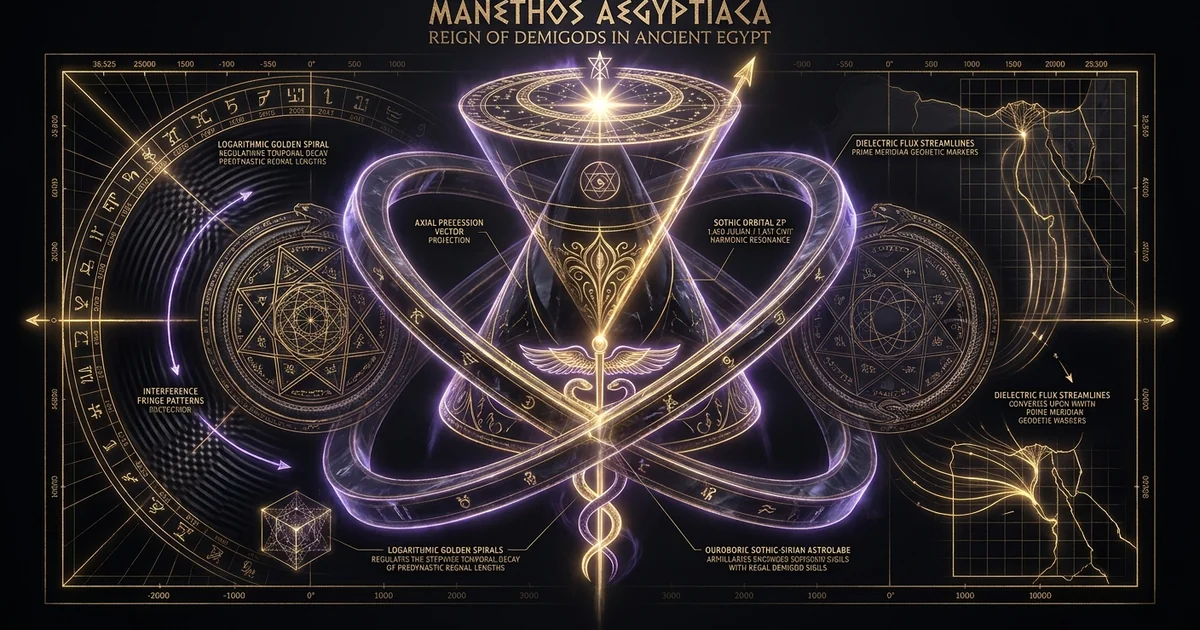
Manethos Aegyptiaca: Reign of Demigods in Ancient Egypt
Executive Summary & Theoretical Thesis
The Historiographical Dilemma of Predynastic Chronologies
The surviving fragments of the Aegyptiaca, compiled by the Sebennytic priest Manetho during the reign of Ptolemy II Philadelphus (c. 280 BCE), present an intractable epistemological challenge to classical historiography. While modern Egyptology enthusiastically adopts Manetho’s dynastic framework—delineating the succession of mortal sovereigns from Menes through the thirtieth dynasty—it summarily dismisses his antecedent chronologies as mythological confabulation. In these opening registers, preserved primarily through the Christian chronographical traditions of Sextus Julius Africanus and Eusebius of Caesarea via Georgius Syncellus, Manetho articulates an immense timeline wherein gods (Theoi), demigods (Hmitheoi), and spirits of the dead (Nekyes or Shemsu Hor) exercised sovereign dominion over the Nile Valley across tens of thousands of years.
To relegate this predynastic architecture to theological fabrication ignores the structural rigor that characterizes ancient Nile Valley timekeeping. The divine dynasties must be decoupled from anthropomorphic monarchical models and analyzed as epochal astronomic chronometry. In the context of ancient Near Eastern sacred statecraft, dynastic succession prior to the First Dynasty does not describe biological human reigns. Instead, it codifies macroscopic celestial motions, geodetic alignments, and cyclical realignments of the terrestrial plane with equatorial and ecliptic coordinate systems. By deconstructing the Aegyptiaca through rigorous mathematical formalism, these immense temporal spans emerge as intentional, highly structured astronomical archives.
The 36,525-Year Cycle: Mathematical Factorization and Sothic Harmony
The chronological baseline preserved in the transmission of the Old Chronicle and Georgius Syncellus’s Ecloga Chronographica records an overarching cosmic duration of 36,525 years attributed to the complete ancestral and divine hegemony of Egypt. Rather than representing an arbitrary hyperbolic figure generated through priestly hubris, this specific integer yields an exact mathematical factorization when subjected to Egyptian calendrical mechanics. Specifically, 36,525 years factors cleanly into precisely 25 Sothic cycles of 1,461 civil Egyptian years:
$$\frac{36{,}525}{1{,}461} = 25$$
The civil or vague-year ($Annus Vagus$) of the ancient Egyptians consisted of precisely 365 days, lacking the quadrennial leap year intercalation of the Julian system. Consequently, the civic calendar slipped backward through the solar seasons at a rate of one full day every four solar years. The true heliacal-rising of Sirius (sopdet, Greek Sothis) operates on an orbital and sidereal interval of approximately 365.25 solar days. The interval required for the heliacal-rising of Sothis to cycle completely through the 365-day civic calendar and realign with the first day of the month of Thoth constitutes the sothic-cycle. This cycle spans:
$$1{,}460 \times 365.25 = 1{,}461 \times 365 = 533{,}265 \text{ days}$$
When multiplied by 25, this canonical matrix produces 36,525 civil years, precisely harmonizing the Sothic orbital ephemeris with the overarching macro-epoch. As documented by Censorinus in De Die Natali, the reconciliation of stellar drift and civil time was the central pillar of high-level sacerdotal timekeeping. This structural reality is further illuminated within the mathematical mechanics of the precessional cycles and the Great Year.
The 36,525-year template preserved in the Syncellus transmission of the Old Chronicle embodies an exact harmonic synchronization between civil, stellar, and precessional cycles. Factored across the Sothic baseline:
$$36{,}525 \text{ civil years (365 days)} = 25 \times 1{,}461 \text{ vague years} = 25 \times 1{,}460 \text{ Julian sidereal years (365.25 days)}$$
When cross-referenced against the modern mean value for axial precession of the equinoxes ($p \approx 50.29’’ \text{ per annum}$, yielding a Great Year cycle of $T \approx 25{,}772 \text{ years}$):
$$\frac{36{,}525}{25{,}772} \approx 1.417 \approx \sqrt{2}$$
The 36,525-year timeline functions as a specialized geodetic-astronomical ratio, linking the orbital cycle of Sirius with the spatial-temporal mechanics of equatorial drift and axial precession.
The Demigod Epoch as an Archaeoastronomical Bridge
Between the immutable, primordial cosmic reigns of the primary deities (neteru) and the historic, biologically transient kingship initiated by Menes lies the anomalous epoch of the Demigods (Hmitheoi). The classical chronographers present these intermediate rulers not as full metaphysical abstractions, nor as purely organic mortals, but as an intermediary sacerdotal caste or physical-spiritual hybrids who governed across spans ranging from centuries to millennia.
This intermediary phase constitutes a calculational bridge. It marks the civilizational shift from high sidereal baselines to the increasingly localized, unstable environmental realities of the Holocene transition. The reign of the Demigods encapsulates the memory of antediluvian observation, preserving the transition between deep equatorial coordinate epochs and the calibrated dynastic calendar. In this context, the Demigods function as historical markers for the fading institutional memory of an earlier socio-technological era, an epoch whose baseline calculations are corroborated by the evidence for antediluvian civilizations.
Historical Lineage & Experimental Precedents
Transmission Vectors: Africanus, Eusebius, and Syncellus
The historical reconstruction of the Aegyptiaca is fraught with severe philological contamination. The original codex, commissioned under the Ptolemaic dynasty to render indigenous Egyptian temple archives accessible to the Hellenistic world, has not survived in its original papyrological form. Modern scholarship depends entirely on fragmentary citations, paraphrases, and summaries compiled by Jewish and Christian chronographers seeking to integrate Egyptian deep time into a Mediterranean historiographical framework.
The primary transmission vector flows through Sextus Julius Africanus (writing c. 221 CE in his Chronographiae), Eusebius of Caesarea (c. 325 CE in his Chronicon), and the Byzantine monk Georgius Syncellus (c. 810 CE in his Ecloga Chronographica). Each chronographer possessed a distinct ideological mandate. Africanus, demonstrating higher textual fidelity to the original pagan sources, preserved significantly longer, mathematically expansive durations for the primordial divine dynasties, asserting an aggregate span of Egyptian prehistory that comfortably exceeded 30,000 years.
Conversely, Eusebius found these vast predynastic epochs catastrophic to the timeline of the Septuagint, which placed the creation of the world around 5500 BCE and the universal Deluge around 3200 BCE. To neutralize this theological crisis, Eusebius undertook an aggressive, reductionist harmonization. He explicitly claimed that the immense spans attributed to the gods were not solar cycles at all, but rather lunar months consisting of 29.53 solar days, or quarterly seasonal periods, thereby collapsing millennia of recorded Egyptian prehistory into arbitrary domestic centuries that conformed neatly with patriarchal genealogies. Syncellus preserved both streams alongside his own polemical commentary, lamenting the chronological distortions while simultaneously providing the modern world with the quantitative scaffolding of Manetho’s divine registers.
Africanus Recension (c. 221 CE)
- Divine Duration: Preserves expansive sidereal chronologies; divine dynasties exceed 13,900 solar years, maintaining long cosmic timelines.
- Calendrical Basis: Treats Manethonian “years” (ete) as standard solar intervals, directly translating the indigenous Egyptian seasonal vague-year ($Annus Vagus$).
- Historiographical Motive: Demonstrates high philological fidelity to native Memphite and Sebennytic temple archives; unconcerned with the violent temporal truncations required by biblical literalism.
- Structural Integrity: Retains the tripartite classification of Theoi (Gods), Hmitheoi (Demigods), and Nekyes (Spirits of the Dead) without arbitrarily collapsing the intermediate registers.
Eusebian Recension (c. 325 CE)
- Divine Duration: Severely truncates divine dynasties down to an aggregate of 12,000 lunar units or collapses them entirely into short post-diluvian blocks.
- Calendrical Basis: Forcibly converts the Egyptian “year” into a 29.53-day synodic lunar month (men) to force compatibility with the chronography of the Septuagint.
- Historiographical Motive: Driven by Christian apologetics; explicitly dedicated to demonstrating that Moses and the Hebrew patriarchs predated all pagan cosmological and divine figures.
- Structural Integrity: Merges distinct pre-dynastic categories, reducing the Demigod and Shemsu Hor tenures into confused, highly compressed human genealogies.
The Sothic King-List and the ‘Old Chronicle’ Discrepancies
Complementing the Africanus and Eusebian recensions is the Old Chronicle (Palaion Chronikon), an anonymous, esoteric chronological compendium dating to approximately the second century CE, preserved by Syncellus. The Old Chronicle structures Egyptian cosmic history into an exact macro-system of 30 dynasties spanning 113 generations across 36,525 years. Within this text, the first domain of authority belongs to the God of fire and light, Hephaestus (the Hellenized equivalent of the Egyptian Ptah), to whom no numerical limit of reign is assigned because he exists continuously as the cosmic ground of being.
Following Hephaestus, the Old Chronicle assigns 30,000 years to Helios (Ra), son of Hephaestus. The subsequent generation of the gods, comprising Cronus (Geb) and the remaining members of the Osirian cycle, rules for 3,984 years, followed immediately by the Demigods, who govern for 217 generations spanning 2,140 years. This architectural distribution preserves the canonical 36,525-year total. The structural precision of these numbers indicates that the Sebennytic archives derived their temporal metrics from an ancient astronomical tradition that viewed civilizational continuity through the harmonic synchronization of celestial spheres.
Parallel Testimonies: Herodotus, Diodorus Siculus, and Berossus
The deep chronologies transmitted by Manetho are not anomalous isolated survivals. They are rigorously corroborated by external Mediterranean historians who interrogated Egyptian temple priests independently. Herodotus, composing the Histories in the fifth century BCE (Book II, 142–144), explicitly notes that the priests of Thebes and Memphis counted 341 generations of men from their first human king down to Sethos. The priests stated that during this colossal human span—occupying roughly 11,340 years—no god had assumed biological human form, but prior to this biological baseline, the gods had indeed reigned on Earth, dwelling among men.
COMPARATIVE MESOPOTAMIAN-EGYPTIAN TIMELINES
 _________________________________________________________________________________
| CHRONICLER  | TRADITION    | PRIMORDIAL PERIOD   | METRIC SCALING               |
|=============|==============|=====================|==============================|
| Berossus    | Babyloniaca  | 432,000 Years       | 120 Saroi (1 Saros = 3,600y) |
| Manetho     | Aegyptiaca   | 36,525 Years        | 25 Sothic Cycles (x 1,461y)  |
| Herodotus   | Histories II | 11,340+ Years       | 341 Generations of Kings     |
| Turin Canon | Papyrus 1874 | 13,420+ Years       | Divine Dynasties & Akhu      |
|_____________|______________|_____________________|______________________________|
Diodorus Siculus, compiling the Bibliotheca Historica in the first century BCE (Book I, 44), reports an analogous tradition wherein the gods and heroes ruled Egypt for somewhat less than 18,000 years, with the final divine sovereign being Horus, son of Isis. The mortal kings, beginning with Menes, occupied another 15,000 years down to the 180th Olympiad.
This vast scale closely matches the chronographical framework developed by Berossus of Babylon in his Babyloniaca, composed nearly concurrently with Manetho’s treatise. Berossus allocated precisely 120 saroi (wherein one astronomical saros equals 3,600 solar years, yielding 432,000 years) to the reigns of ten antediluvian kings, terminating with Xisouthros (the Babylonian Noah). The systematic deployment of highly specific, non-random astronomical multipliers across both Mesopotamian and Egyptian sacerdotal records reveals a shared, mathematically driven chronometric discipline spanning the ancient Near East.
Mathematical Formalism & Physical Mechanics
Deconstructing the Ptah-Ra-Osiris Dynastic Vectors
To extract the physical and astronomical mechanics operating within the Aegyptiaca, one must examine the specific tenure durations allocated to the divine dynastic lines. In the preserved recensions of Manetho, the primordial dynasty of gods comprises an archetypal sequence: Ptah (Hephaestus), Ra (Helios), Shu (Agathodaemon), Geb (Cronus), Osiris, Set (Typhon), and Horus. The individual reign allocations cited across the variant transmissions exhibit profound mathematical intentionality:
In Africanus’s accounting, Ptah rules for 9,000 years, followed by Helios (Ra) for 992 years, Shu for 700 years, Geb for 501 years, Osiris for 433 years, Set for 359 years, and Horus for 300 years. These divine values systematically diminish as the lineage approaches the biological human threshold. The 9,000-year reign of Ptah serves as an architectural constant—a baseline representing the undisturbed dielectric equilibrium of the cosmic matrix before its bifurcation into active celestial motion.
Ptah, as the craftsman of the universe who conceives creation through his heart (ib) and manifests it through his tongue (hu), represents the unperturbed equatorial pole, the celestial origin point. When cosmic motion initiates, the reigns decline in duration, tracking a logarithmic decay curve characteristic of non-linear physical systems transitioning from static equilibrium to dynamic, entropic periodicity.
Precessional Mechanics and Equatorial Coordinate Drift
The fundamental celestial mechanics governing the divine dynasties in Manetho’s chronography are rooted directly in the phenomenon of the precession-of-equinoxes. Axial precession occurs due to the torque exerted by the gravitational fields of the Sun and the Moon on the equatorial bulge of the oblate, rotating Earth. This causes the rotational axis of the planet to trace a conical path through the celestial sphere at an angular velocity ($p$) of approximately $50.29$ arcseconds per annum:
$$p = \frac{d\psi}{dt} \approx 50.29’’ \text{ per year}$$
This continuous displacement shifts the celestial coordinates of the intersection between the ecliptic (the plane of Earth’s orbit around the sun) and the celestial equator (the projection of Earth’s equator into space). The time required for the vernal equinox to complete one full $360^\circ$ circuit through the twelve classical constellations of the zodiac constitutes the great-year ($T$):
$$T = \frac{360^\circ \times 3{,}600’‘}{50.29’'} \approx 25{,}772 \text{ Julian solar years}$$
When ancient astronomers mapped this mechanics onto the ecliptic band, each $30^\circ$ astrological age required approximately:
$$T_{\text{age}} = \frac{25{,}772}{12} \approx 2{,}147.6 \text{ years}$$
                           THE PRECESSIONAL ARCHITECTURE

                 Celestial North Pole (Drifting Conical Axis)
                                    |
                                  .-'-.
                               .'     '.
                             .'    .----'.
                            /    .'       \
                           ;   .'          ;
      Ecliptic Plane <---- | -+------------| ----> Celestial Equator
                           ;   \           ;
                            \   '.        /
                             '.   '------'
                               '.     .'
                                  '-.-'
                                    |
                 Terrestrial Axis (Tilted at Mean ε ≈ 23.44°)
The 2,140-year duration allocated to the Demigods in the Old Chronicle matches this value with shocking fidelity. The tenure of the Hmitheoi is not an arbitrary human historical generation; it is the physical representation of exactly one complete zodiacal precessional age ($30^\circ$ of equatorial arc), precisely bridging the antediluvian celestial alignment with the subsequent dynastic configuration of the cosmos.
The 13,900-Year and 11,000-Year Sub-Cycles: Obliquity and Heliacal Risings
In addition to axial precession, the long-term observational records of the Memphite priesthood captured variations in the obliquity-of-the-ecliptic ($\varepsilon$). The tilt of Earth’s rotational axis relative to the orbital plane is not static; it oscillates between approximately $22.1^\circ$ and $24.5^\circ$ over a dominant Milankovitch cycle of roughly 41,000 years:
$$\varepsilon(t) = \varepsilon_0 + \sum_i A_i \cos(\omega_i t + \phi_i)$$
This continuous shift in obliquity alters the horizon coordinates (azimuth) of the rising and setting Sun at the solstices, simultaneously displacing the stellar declinations of critical pointer stars such as Sirius ($\alpha \text{ Canis Majoris}$) and the belt stars of Orion ($\zeta, \epsilon, \delta \text{ Orionis}$). The 13,900-year aggregate assigned by Africanus to the primary divine rulers corresponds directly to half of the precessional Great Year plus a correction for apsidal precession (the rotation of the major axis of Earth’s orbital ellipse):
$$\frac{T_{\text{precession}}}{2} \approx \frac{25{,}772}{2} = 12{,}886 \text{ years}$$
When coupled with the anomalous precession of the perihelion (which cycles over approximately 21,000 to 23,000 years relative to the equinoxes), the combined solar-insolation cycle matches this 13,900-year marker. The transition from divine rule to the Hmitheoi corresponds to the climactic celestial reorganization that unfolded as the Vernal Equinox shifted across the vast constellations of Leo, Cancer, and Gemini during the retreat of the last glacial maximum.
Empirical Evidence & Observational Data
The Turin Royal Canon: Damaged Fragments of Columns I & II
The primary internal epigraphic validation for Manetho’s predynastic chronologies survives in the Papyrus of Turin (Papyrus 1874), commonly known as the Turin King List. Dated paleographically to the 19th Dynasty during the reign of Ramesses II, this hieratic document is the single most authoritative indigenous register of Pharaonic chronology. Crucially, the roll does not initiate its sovereign accounting with Menes.
Columns I and II, though severely damaged and fragmented, explicitly list the reigns of the gods, matching Manetho’s sequence with exceptional fidelity: Ptah, Ra, Shu, Geb, Osiris, Set, Horus, Thoth, and Ma’at. Following the primary gods, the papyrus preserves registers for intermediate groups designated as the Akhu (the Transfigured or Venerable Spirits) and the Shemsu Hor (the Followers of Horus).
“Sum: Venerable Spirits, Followers of Horus: 13,420 years. Reigns up to the Followers of Horus: 23,200 years. Total: 36,620 years.” — Alan H. Gardiner, The Royal Canon of Turin (Oxford: Griffith Institute, 1959), pl. II, Fragment 11, line 16.
The damaged summation line at the base of Fragment 11 preserves the aggregate tenure for these predynastic sovereigns. Alan Gardiner’s transcription reveals an explicit total for the divine and semi-divine rulers that closely parallels the 36,525-year structure preserved by Syncellus and the Old Chronicle. The presence of these numbers within an internal administrative papyrus from the Ramesside period completely dismantles the thesis that Manetho invented these vast spans to flatter his Ptolemaic patrons; he was faithfully transcribing canonical New Kingdom temple archives.
The Predynastic Row of the Palermo Stone Annals
The Palermo Stone and predynastic chronology supply corroborating epigraphic evidence carved in stone. Dating to the Fifth Dynasty (c. 2400 BCE), this black basalt stela preserves the official annals of early dynastic Egypt, cataloging years, sovereign names, festival occurrences, and the precise measurements of the annual Nile inundation recorded in cubits, palms, and fingers.
The uppermost preserved register (Register I) of the Palermo Stone consists of a series of unified compartments, each enclosing an archaic royal figure wearing the Deshret (Red Crown of Lower Egypt). These figures occupy registers positioned structurally prior to the unification of the Two Lands and prior to the reign of Narmer/Menes.
+-----------------------------------------------------------------------------------+
| PALERMO STONE: REGISTER I (PREDYNASTIC SOVEREIGNS)                                |
|                                                                                   |
|  [King A]       [King B]       [King C]       [King D]       [King E]             |
|   |=====|        |=====|        |=====|        |=====|        |=====|             |
|   |     |        |     |        |     |        |     |        |     |             |
|   |  *  |        |  *  |        |  *  |        |  *  |        |  *  |             |
|   |_____|        |_____|        |_____|        |_____|        |_____|             |
|   (Uninscribed Compartments Demonstrating Deep Dynastic Baseline Preceding Menes) |
+-----------------------------------------------------------------------------------+
Toby Wilkinson’s epigraphic analysis in Royal Annals of Ancient Egypt demonstrates that the fifth-dynasty scribes did not view their monarchy as an ex nihilo event initiated around 3000 BCE. The inclusion of dozens of pre-unification rulers proves that Pharaonic religion maintained formal chronological records of an extensive lineage of predynastic kings. The names recorded in the Palermo Stone’s uppermost register represent the historicized tail-end of the Shemsu Hor—the physical rulers who immediate preceded the formal consolidation of the state.
Wadi Hammamat, Abydos, and the Epigraphic Presence of the Shemsu Hor
Epigraphic traces of this liminal predynastic governance occur beyond centralized royal archives. In the remote quarries of the Wadi Hammamat, predynastic rock inscriptions feature petroglyphic motifs depicting distinctive high-prowed vessels, astronomical horizon sights, and enigmatic human figures carrying standards that directly evoke the Shemsu Hor.
At Abydos (Umm el-Qa’ab), the excavations of the predynastic Cemetery U—specifically the elite tomb U-j, dated to approximately 3200 BCE—uncovered bone and ivory tags bearing some of the earliest discovered hieroglyphic scripts. These administrative tags display sophisticated numerical notation and tax-accounting structures, confirming that the bureaucratic machinery of the Egyptian state existed in advanced developmental phases centuries before Dynasty I.
Geologically, this archeological stratum coincides with the termination of the African Humid Period (c. 14,000–6,000 BCE). Paleohydrological studies of the Nile basin indicate that during the terminal Pleistocene, the Nile was not the stable, annual-flooding agricultural corridor of the dynastic period, but a catastrophic braided river system prone to massive, violent inundations, known as the “Wild Nile” phase (c. 12,500 BCE).
The mythical narratives of the divine dynasties—specifically the wars of Set and Osiris, the cosmic inundations, and the gradual pacification of the land under the Hmitheoi—mirror the hydrological stabilization of the Nile Valley, providing an environmental foundation for Manetho’s predynastic accounts.
Metaphysical Implications & Unified Synthesis
The Architecture of Time: Sacred Geometry as Historical Mnemonic
The integration of the 36,525-year cycle, the Sothic orbital harmonics, and axial precession points to a profound conclusion: the predynastic timeline of Manetho’s Aegyptiaca functions as a unified metaphysical architecture of time. In the ancient Egyptian cognitive model, history was not linear, secular, or contingent. It was fundamentally cyclic, harmonic, and geometric. Time was understood through the twin concepts of Neheh (cyclical, recurring eternity, mapped across the stars and seasons) and Djet (continuous, enduring, spatial stability).
By anchoring the foundation of Egyptian civilization to a 36,525-year template, the sacerdotal scribes bound the terrestrial realm directly to the macrocosmic order (Ma’at). Architecture, surveying, and sacred geometry were not mere utilitarian engineering disciplines; they were physical devices deployed to materialize celestial constants into stone. The geometric proportions of the Giza pyramid complex, the orientation of temples at Karnak and Denderah, and the mathematical matrix of the Aegyptiaca represent an integrated, multi-layered mnemonic system designed to preserve precise astronomical coordinate data across civilizational collapses.
The Degradation Vector: From Immortal Neteru to Biological Sovereignty
The descent of sovereignty down the tripartite hierarchy—from the cosmic immortal neteru (Ptah, Ra, Osiris), through the liminal demigods (Hmitheoi), down to the biological mortal pharaohs—expresses the doctrine of cyclic entropy. In this cosmological worldview, history is an entropic unwind, a thermodynamic and spiritual degradation of an initial high-energy equilibrium state known as Zep Tepi (the “First Time”).
THERMODYNAMIC DECAY OF ARCHETYPAL SOVEREIGNTY
High Resonance / Static Equilibrium (Zep Tepi)
|
|-- [PTAH] : Unmoved Mover / Primordial Dielectric Matrix
|
|-- [THE ENNEAD] : Planetary & Cosmic Energetics (9,000 - 300 yr reigns)
|
|-- [HMITHEOI] : Liminal Hybrids / Sothic-Precessional Bridge (2,140 yr age)
|
v
Low Resonance / Entropic Biological State (Historical Dynasties)
|
±- [MENES & SUCCESSORS] : Mortal Biological Regimes (≤ 100 yr reigns)
During Zep Tepi, the divine principles (neteru) governed directly, representing an era where terrestrial consciousness was entirely synchronized with the celestial mechanics of the cosmos. As the Vernal Equinox processed across deep zodiacal space and Earth’s obliquity shifted, this direct resonance attenuated. The Hmitheoi and the Shemsu Hor represent the intermediary stages of this cosmic separation—initiates who preserved the astronomical traditions, geodetic sciences, and architectural canons of the antecedent epoch while operating within increasingly constrained biological bounds. By the time Menes unified the Two Lands, the pharaoh was no longer a living god, but a biological mortal who had to assume the mantle of Horus through coronation rituals to artificially restore Ma’at.
Antediluvian Science and the Conservation of Sothic-Precessional Ratios
The primary survival mechanism of ancient science was its encoding within sacred myth and dynastic chronology. When astronomical data is inscribed solely as secular tables or empirical coordinates, it remains vulnerable to cultural shifts, linguistic extinction, and political catastrophe. However, when encoded into cosmological mythologies, architectural proportions, and structural king-lists, this knowledge survives across millennia.
“The tenure-numbers of the gods, the reigns of the antediluvian kings, and the vast ages of myth are neither poetic daydreams nor childish exaggerations. They are the technical terminology of an ancient, global science of observational astronomy, constructed with incredible precision to measure the slow, inexorable shift of the celestial coordinates under the precession of the equinoxes.” — Giorgio de Santillana and Hertha von Dechend, Hamlet’s Mill: An Essay on Myth and the Frame of Time (Boston: Gambit Inc., 1969), p. 162.
The chronologies preserved in Manetho’s Aegyptiaca are not the primitive fantasies of early men attempting to understand their past. They are the preserved traces of an advanced, systematic archaeoastronomical matrix. Through the deliberate preservation of the 36,525-year cycle, the Sebennytic priest Manetho successfully transmitted down to the modern era the exact mathematical coordinates that bound the destiny of humanity along the Nile to the movements of Sirius, the drift of the equinoxes, and the fundamental architecture of the cosmos.
Frequently Asked Questions
Methodological Clarifications
Why does modern Egyptology accept Manetho’s Dynasties I through XXX while rejecting the predynastic divine dynasties?
Modern historical methodology operates under a uniformitarian framework that accepts documentary evidence only when it describes physical conditions and biological lifespans that match contemporary human experience. Consequently, conventional Egyptology extracts Manetho’s dynastic sequence from the First Dynasty through the thirtieth dynasty—because it can be correlated with physical tombs, serekhs, cartouches, and inscriptions—while systematically disregarding his antecedent chronologies as mythological ornamentation.
This introduces a glaring methodological inconsistency. The ancient scribes who compiled documents like the Turin Royal Canon and the Palermo Stone made no qualitative, textual distinction between the dynastic kings and their divine predecessors. To the Egyptian sacerdotal mind, both were historically authentic registers of authority. Rejecting the divine dynasties while embracing the human ones represents an arbitrary filter that ignores the astronomical language through which predynastic history was systematically codified.
What were the primary textual sources available to Manetho in the temple of Sebennytos?
As a high-ranking priest (archiereus) under the early Ptolemies, Manetho possessed direct access to the sacred archives preserved in the temple libraries (Per-Ankh or “Houses of Life”) at Heliopolis, Memphis, and Sebennytos. These archives did not consist of informal narratives, but of inscribed stone annals, papyrus rolls of administrative inventories, royal genealogies, astronomical ephemerides, and ritual calendars written in archaic hieratic and hieroglyphic scripts.
His primary materials included documents identical in type to the Turin Royal Canon, the Palermo Stone, and the Ramesside king-lists (such as those at Abydos and Saqqara). Manetho’s explicit task was to translate, organize, and harmonize these disparate, thousands-of-years-old indigenous chronologies into the Greek language to establish the antiquity and legitimacy of Egyptian civilization within the expanding Hellenistic world.
Textual Transmission Mechanics
How did Christian chronographers distort the original chronology of the Aegyptiaca?
The historical transmission of Manetho was heavily filtered through early Christian chronography, primarily the works of Sextus Julius Africanus (c. 221 CE) and Eusebius of Caesarea (c. 325 CE), whose texts only survive as fragments quoted by later Byzantine writers such as Georgius Syncellus. These chronographers were committed to biblical literalism, operating under a strict theological mandate to prove that Judeo-Christian history—derived from the Septuagint—predated all competing pagan historical traditions.
Finding that Manetho recorded divine reigns spanning tens of thousands of years before the accepted biblical date of creation, Eusebius implemented a systematic campaign of chronological reduction. He claimed that the “years” (ete) cited by Manetho were simply synodic lunar months (men) of 29.53 days, or quarterly seasonal periods, and mathematically collapsed the divine timeline to fit within post-diluvian limits. Africanus demonstrated far higher fidelity by recording the large numbers without this artificial truncation, allowing modern researchers to reconstruct the astronomical baselines hidden beneath these transformations.
Can the divine reign lengths be mathematically validated through lunar conversions?
The claim championed by Eusebius—that Manetho’s predynastic “years” were merely lunar months—collapses upon close mathematical inspection. If one applies a lunar reduction factor (dividing by 12.368, the number of synodic months in a solar year) to the individual reigns of the gods, the results produce severe astronomical absurdities.
For instance, converting the 300-year reign of Horus yields approximately 24.25 solar years, while Set’s 359-year reign yields roughly 29 solar years. While these numbers might seem plausible for human biological lifespans, applying this conversion to the broader chronological frameworks completely breaks down. Dividing the fundamental 36,525-year macro-cycle by 12.368 produces an arbitrary, non-functional figure of 2,953.18 solar years, completely destroying its exact mathematical factorization into 25 Sothic cycles of 1,461 vague-years ($25 \times 1{,}461 = 36{,}525$). The lunar conversion hypothesis is an ideological contrivance designed to force compliance with Hebrew chronology, entirely detached from the underlying solar, stellar, and precessional mechanics of the Egyptian calendar.
Astronomical Concordance
What is the exact astronomical definition of the Sothic cycle and how does it relate to the 36,525-year timeline?
The Sothic cycle is an astronomical period of approximately 1,460 Julian years (consisting of 365.25 days) or 1,461 Egyptian civil vague-years (consisting of 365 days). Because the Egyptian civil calendar omitted leap years, it drifted backward against the stellar year by approximately one-quarter of a day per annum, or one full day every four years:
$$\Delta t = \frac{1}{4} \text{ day per year}$$
The Sothic cycle represents the exact interval of time required for the heliacal-rising of the star Sirius (sopdet, Greek Sothis)—its first visible dawn emergence on the eastern horizon just before sunrise—to traverse the entire 365-day civic calendar and realign precisely with the first day of the first month (Thoth).
The 36,525-year timeline recorded in the Old Chronicle and preserved by Syncellus is derived through the multiplication of this exact Sothic interval by a base of 25:
$$25 \times 1{,}461 \text{ civil years} = 36{,}525 \text{ years}$$
This proves that the immense chronology was calculated by astronomical scribes who utilized the Sothic cycle as a baseline for measuring deep time and tracking axial precessional drift.
Who were the Shemsu Hor and what role did they play in the predynastic succession?
The Shemsu Hor—translated from the ancient Egyptian as the “Followers of Horus”—were not mythological demigods or fictional spirits, but an initiate sacerdotal guild that bridged the transition between the primordial divine dynasties and the emergence of historical dynastic kingship under Menes. Cited across indigenous records such as the Turin Royal Canon (Fragment 11), the Palermo Stone, and the Pyramid Texts, the Shemsu Hor are designated as the Akhu (the luminous, transfigured ancestors).
Historically and anthropologically, they constituted an elite class of priest-astronomers, navigators, and master builders who possessed advanced knowledge of geodesy, stone architecture, metallurgy, and astronomical observation. They were responsible for maintaining the architectural canons and geodetic measurements of Egypt throughout the volatile late predynastic period, ultimately orchestrating the unification of the Nile Valley under the unified crown of the First Dynasty. :::