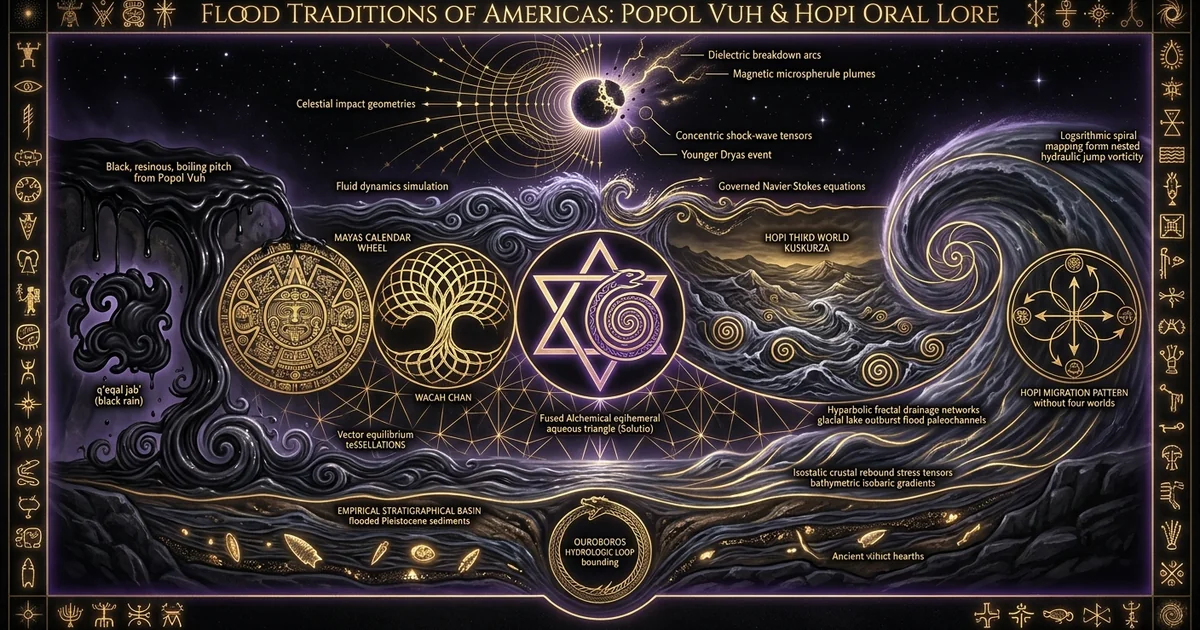
Flood Traditions of Americas: Popol Vuh & Hopi Oral Lore
Executive Summary & Theoretical Thesis: Paleoclimatic Realism in New World Deluge Cosmogonies
The cosmogonies of the indigenous Americas preserve an intricate, empirically grounded record of late-Pleistocene and early-Holocene environmental collapses. Rather than dismissing these accounts as psychologized archetypes, moralizing parables, or downstream derivatives of Eurasian mythic complexes, rigorous geomythological analysis demonstrates that traditions such as the K’iche’ Maya Popol Vuh and the Hopi world-epoch oral histories operate as distributed, multi-generational observational data matrices. These narratives capture specific thermodynamic, hydrogeological, and atmospheric signatures associated with abrupt global warming episodes, proglacial lake discharges, and catastrophic extraterrestrial impact events between approximately 12,800 and 8,200 years calibrated before present (cal BP).
Across both cultural spheres, universal global deluge myths indigenous to the Western Hemisphere diverge sharply from uniformist, gradualist hydrologic models. Instead, they document non-linear transitions: sudden atmospheric opacity, the precipitation of hyper-concentrated, petrochemical-rich slurries, crustal seismicity, and sustained marine and pluvial inundations that completely reworked regional geomorphology. By decoding these oral architectures through the dual lenses of paleohydrology and non-linear geodynamics, researchers recover an accurate phenomenological chronicle of the terminal Pleistocene transition.
The K’iche’ Account of the Submersion of the Wooden Men
In the Popol Vuh, the third primordial cosmological epoch chronicles the creation and absolute eradication of the tz’am or wooden effigies—the “wooden men” (popol vuh wooden men). This race of proto-humans possessed functional morphology and mechanical speech but lacked internal vitality, circulatory vitality, and psycho-spiritual alignment with the divine creative matrix. Consequently, their systemic breakdown triggered an ecological and geomechanical collapse. The narrative explicitly distinguishes this cataclysm from simple pluvial inundation. The K’iche’ text preserved in early colonial manuscripts describes the destruction of previous worlds through an onslaught termed k’ik’, an extraordinarily dense, black, resinous or pitch-like downpour falling from an occluded sky, accompanied by total solar obscuration.
"U wäch ulew x-u ban; k'ä t'e x-pe nima k'ik' ch-u wäch kaj... X-e k'isik, x-e sachik; x-e muluxik x-e mayik."
(They were struck down; a vast flood of black resin fell from the face of the sky... They were finished, they were wiped out; their forms were overturned and shattered.)
This phenomenon was accompanied by an inversion of the local biosphere and material technosphere: domestic utensils, grinding stones (metates), domestic hearth dogs, and masonry dwellings rebelled against their human manipulators, while the ground bucked with tectonic violence. The survivors who sought sanctuary in arboreal canopies or subterranean caverns found their shelters collapsing dynamically beneath them, leaving only the arboreal spider monkey (Ateles geoffroyi) as a vestigial biological relic of this evolutionary culling.
The Hopi Third World (Kuskurza) and Subterranean Refuge Dynamics
Parallel to the Mesoamerican sequence, the oral chronologies of the Hopi clans—transcribed through the sacred lineages of the Bear, Spider, and Bow clans—delineate four distinct world ages, termed Tuuwaqatsi. Each world culminates in an elemental purge driven by biological and spiritual entropy. The Third World, Kuskurza, is remembered as a technologically complex civilization characterized by urban aggregation, inter-polity aerial conflict conducted via aerodynamic craft (pátuwvota), and deep moral deviation. The Hopi third world water cataclysm operated as a rapid, trans-continental liquefaction event.
Sotuknang, the cosmic executive deity acting on behalf of the creator Taiowa, instructed the righteous remnant under the guidance of Spider Grandmother (Kókyangwúti) to seek refuge within the subterranean redoubts of the Anu Sinom, or the Ant People. Here, the ancestral survivors underwent a multi-generational subterranean shelter survival sequence while the subaerial surface was subjected to total oceanic transshipment and torrential cyclonic storms. The oral lore emphasizes an airtight, subterranean survival protocol where the Ant People shared their deep geological knowledge, rations, and thermodynamic shielding until the surface hydrologic regime achieved structural equilibrium, permitting emergence into the Fourth World (Tuuwaqatsi) via the Sipapu—a geo-mythic aperture historically localized near the Little Colorado River canyon.
Thermodynamic Catastrophism vs. Cultural Diffusionism
For over a century, standard historical models reduced these shared narrative structures to post-contact Christian syncretism or diffuse, ungrounded psychological projections. Such reductions are invalidated by the specific physical mechanisms documented in the native lexicons. Diffusionist paradigms cannot account for the regional coherence of these narratives across distinct linguistic phyla (Mayan vs. Uto-Aztecan), nor their precise convergence on the non-linear physics of terminal Pleistocene catastrophes.
The catastrophic dissolution of these ancestral worlds documents the physical mechanics of Younger Dryas impact mechanics and macro-scale paleo-hydrology megafloods. In both traditions, water acts not as an isolated atmospheric anomaly, but as the final hydrogeomorphic phase of a coupled atmospheric-impact-tectonic cycle.
K'iche' Maya: Destruction of the Wooden Men
- Primary Source: Popol Vuh (Part I, Chapter 3).
- Physical Agent: K’ik’ (viscous, hyper-thermal black atmospheric resin) followed by hyper-concentrated sediment slurries.
- Atmospheric Conditions: Severe global dimming, total solar eclipse, thermal radiation shockwaves.
- Biomechanical Vector: Eradication of rigid, soulless biological effigies (tz’ite wood; ts’ima reeds).
- Survival Archetype: Failed arboreal and speleological evasion; speciation degradation into primates.
- Geomorphological Trace: Marine transgressive sediment deposits, charcoal-rich soot layers across Central American lacustrine cores.
Hopi: Inundation of the Third World (Kuskurza)
- Primary Source: Clan oral mnemonics; Bear and Bow Society Kiva traditions.
- Physical Agent: Ocean transgression, pluvial saturation, subaerial crustal liquefaction.
- Atmospheric Conditions: Cyclonic storm tracks, high-altitude barometric collapse, dynamic electrical discharges.
- Biomechanical Vector: Elimination of technologically deviant urban populations and their pátuwvota weapons systems.
- Survival Archetype: Organized descent into deep subterranean karst/lava systems (Anu Sinom chambers).
- Geomorphological Trace: Pluvial lake highstands (Lake Bonneville, Lahontan), mega-ripple marks, channeled scablands of the Colorado Plateau.
Historical Lineage & Archival Precedents: The Preservation of Indigenous Geomythology
The transmission vectors governing indigenous American deluge chronologies represent an unbroken chain of esoteric preservation executed under conditions of extreme cultural attrition. These accounts were neither casual folktales nor secular history; they formed the fundamental operational blueprints for human survival within an unstable planetary environment.
Transmission Vector of the Father Francisco Ximénez K’iche’ Manuscripts
The primary surviving textual recension of the Popol Vuh owes its survival to a clandestine transcriptive event occurring between 1701 and 1703 in the parish of Santo Tomás Chichicastenango (historically Chuwi La), Guatemala. The Dominican friar Francisco Ximénez was granted access to an anonymous, highly secret K’iche’ document written in the Latin alphabet around 1550–1555 by indigenous nobles educated by the Franciscans.
Dennis Tedlock’s paleographic analysis (1985) establishes that the authors were directly transliterating a pre-Columbian, hieroglyphic, logographic-phonetic screenfold codex. The hieroglyphic original had functioned as a mnemonic springboard for deep oral chant recitations, astronomical computations, and cyclical calendar correlations.
Ximénez recognized the unprecedented nature of the text and transcribed the K’iche’ prose in parallel with his own Spanish translation. Crucially, the sections dealing with the destruction of the wooden men (Popol Vuh: The Mayan Book of the Dawn of Life) retain specific archaic lexical items (k’ik’, kamalotz, kottowach) that resisted Christian theological appropriation. The native scribes encoded explicit paleoclimatic dynamics: the atmospheric darkening was framed as the direct wrath of Huracán (Heart of Sky), accompanied by Chipi Caculha (Lightning Flash) and Raxa Caculha (Lightning Strike), preserving an unambiguous association between violent energetic-electrical discharges and atmospheric deluges.
Primary textual recension: Empiezan las historias del origen de los indios de esta provincia de Guatemala, Father Francisco Ximénez, O.P. (1701–1703). Preserved in the Ayer Collection of the Newberry Library, Chicago (MS 1515). The document preserves the phonetic K’iche’ script alongside a colonial Spanish translation, affirming the text as a phonetic transcription of an ancestral pictographic/hieroglyphic codex detailing the three failed creations, the catastrophic purge of the wooden effigies via petrochemical rain, and the solar realignment of the Fourth Epoch.
Esoteric Clan Transmission Within the Hopi Katsina Society Ceremonials
Unlike the Mesoamerican scribal transition to Latinate phonetics, the Hopi preserved their epochal records through strictly guarded, non-textual, socio-religious mnemonic architecture. Documented extensively by Frank Waters and Oswald White Bear Fredericks (1963) through exhaustive consultations with elders of the Bear, Spider, Parrot, and Bow clans, the Hopi transmission is bound to physical performance inside subterranean ceremonial chambers (kivas). The cycles of world destructions are ritually reactivated during the Wuwuchim (tribal initiation) and Soyalangw (winter solstice) ceremonials.
Within the kiva, the spatial geometry of the chamber serves as a multi-dimensional mnemonic map. The floor of the kiva features the Sipapu, a small, plugged cavity symbolizing the portal of emergence from the subterranean domains of the Ant People into the present world. Hopi oral historians utilized strictly regulated mnemonic cadences, song-poetry cycles, and physical prayer-sticks (pahos) to maintain zero-drift transmission over hundreds of generations.
The geographical specificity embedded within the Book of the Hopi is remarkable: the Third World was described as a vast, interconnected landmass spanning oceanic waters to the south and west, which underwent systematic break-up, subsidence, and hydraulic burial, compelling migratory fleets of reed-catamarans to hop across island archipelagos that represent the summits of drowned mountain chains—a topography consistent with the post-glacial inundation of the Pacific and Caribbean basins.
Epistemic Erasure: The Reduction of Structural Catastrophism to Solar Myths
During the nineteenth and twentieth centuries, Eurocentric anthropological scholarship subjected these indigenous chronicles to severe epistemic reductionism. Influenced by the comparative mythologists of the Max Müller school, structural functionalists like Bronislaw Malinowski, and psychoanalytic theorists, academic institutions systematically stripped native cosmogonies of their empirical geophysical content. Deluge narratives were categorized as “solar myths,” subjective anxieties regarding psychic disintegration, or universalizations of localized seasonal river floods.
This bias was reinforced by Charles Lyell’s strict geological uniformitarianism, which ideologically banned catastrophic mechanisms—such as extraterrestrial impacts, subglacial lake burst floods, and tectonic collapses—from accepted Earth-history models until the late twentieth century. Consequently, when native narratives described skies raining black oil or oceans marching over continental interiors, ethnologists labeled them infantile exaggerations. Only with the emergence of empirical paleoflood hydrology (Baker, 2009) and the verification of the Younger Dryas Boundary impact proxies (Firestone et al., 2007) did modern academia develop the physical frameworks required to read these texts as records of macro-regional environmental collapse.
Mathematical Formalism & Physical Mechanics: Hydro-Isostasy, Impact Ablation, and Megaflood Dynamics
To assess the fidelity of the Popol Vuh and Hopi accounts, their narrative elements must be translated into the mathematical frameworks of thermodynamic phase changes, fluid mechanics, and elastodynamic earth-crust responses occurring at the terminal Pleistocene boundary.
Thermodynamics of Glacial Lake Outbursts and Atmospheric Moisture Saturation
The transition out of the Last Glacial Maximum (LGM) was characterized by the accumulation of massive proglacial and subglacial lakes impounded behind unstable ice dams along the Laurentide and Cordilleran ice sheets. The physics of catastrophic glacial lake drainage events (e.g., Glacial Lake Missoula, Glacial Lake Agassiz) is governed by non-linear Navier-Stokes equations for highly turbulent, sediment-saturated fluid regimes:
$$\frac{\partial (\rho \mathbf{u})}{\partial t} + \nabla \cdot (\rho \mathbf{u} \otimes \mathbf{u}) = -\nabla p + \nabla \cdot \boldsymbol{\tau} + \rho \mathbf{g}$$
Where $\rho$ represents the fluid-sediment mixture density, $\mathbf{u}$ is the flow velocity vector, $p$ is thermodynamic pressure, $\boldsymbol{\tau}$ is the viscous stress tensor, and $\mathbf{g}$ is the gravitational acceleration vector. Under conditions of rapid hydrodynamic dam failure, discharge rates exceeded $Q_{max} \approx 2.7 \times 10^6 \text{ m}^3/\text{s}$, with Reynolds numbers ($Re$) surpassing $10^7$, shifting the flow regime into fully developed hyper-turbulent cavitation.
       [ Thermobaric Impact Event / Ice-Dam Rupture ]
                              │
                              ▼
        [ Hyper-Turbulent Outburst: Re > 10⁷, Q > 10⁶ m³/s ]
                              │
                              ▼
  [ Atmospheric Injection of Soot & Volatilized H₂O (k'ik') ]
                              │
                              ▼
   [ Ground Liquefaction & Hydro-Isostatic Flexure (Δw_b) ]
When hyper-velocity impactors interact with thick glacial masses, as formalized in the Younger Dryas Boundary (YDB) hypothesis, the kinetic energy ($E_k = \frac{1}{2} m v^2$) of the extraterrestrial body undergoes near-instantaneous conversion into thermal energy:
$$Q_{thermal} = \eta E_k = \eta \left( \frac{1}{2} m v^2 \right)$$
Where $\eta \approx 0.85 - 0.95$ represents the conversion efficiency into the shock-front and thermal radiation. The direct consequence is the explosive ablation of mega-volumes of ice into the upper troposphere and stratosphere.
This thermal pulse injects billions of metric tons of water vapor combined with pulverized, soot-rich, and hydrocarbon-dense particulates from target biomass combustion. As this stratospheric aerosol plume cools, it condenses into a viscous, soot-choked precipitation: precisely the hyper-concentrated, bituminous, blinding black downpour recorded as k’ik’ in the Popol Vuh.
Hydro-Isostatic Adjustment Equations during the Pleistocene-Holocene Boundary
The catastrophic draining of massive inland proglacial lakes and the synchronous melting of continental ice caps induced drastic perturbations in lithospheric mass balances. The regional flexural response of the Earth’s lithosphere to rapid unloading (deglaciation) and rapid loading (transgressive marine inundation of continental margins) is quantified through the classic thin-plate hydro-isostatic adjustment equation:
$$D \nabla^4 w + \rho_m g w = q(x, y, t)$$
Where:
- $D = \frac{E h^3}{12(1 - \nu^2)}$ represents the flexural rigidity of the lithosphere (with Young’s modulus $E$, lithospheric thickness $h$, and Poisson’s ratio $\nu$).
- $w(x, y, t)$ is the vertical crustal deflection.
- $\rho_m$ is the density of the underlying asthenospheric mantle.
- $q(x, y, t)$ is the spatial-temporal surface load, defined as the differential hydraulic-glacial column:
$$q(x, y, t) = \rho_w g \Delta h_w(x, y, t) - \rho_i g \Delta h_i(x, y, t)$$
The speed of this crustal unloading caused deep fault reactivation and continental-scale seismicity. As the Hopi oral histories document for the dissolution of the Third World, the stable surface of the Earth buckled, tilted, and sank beneath rapidly rising regional water lines. The fluid migration of asthenospheric mantle material generated flexural forebulge collapses, translating to localized apparent sea-level rises that advanced at rates far exceeding normal eustatic curves, submerging low-lying ancestral settlements across thousands of square kilometers.
In paleoflood channels, boundary shear stress at the bed interface is governed by the relation: $$\tau_b = \gamma R_h S_f$$ Where $\gamma$ is the unit weight of the sediment-water slurry, $R_h$ is the hydraulic radius, and $S_f$ is the energy slope. When $\tau_b$ exceeds critical entrainment thresholds ($\tau_c \approx 10^3 \text{ N/m}^2$), unweathered bedrock undergoes rapid plucking, hydraulic quarrying, and macro-fluting, eradicating human surface architecture.
Conversely, deep subterranean karst structures and basaltic lava tubes act as low-frequency mechanical-acoustic dampers. As longitudinal shock waves ($P$-waves) propagate through the crust: $$v_p = \sqrt{\frac{K + \frac{4}{3}\mu}{\rho}}$$ The subterranean void networks disrupt wave continuity, generating structural acoustic attenuation nodes and pressure dissipation zones that allow biological occupants within cave networks to survive subaerial thermobaric airbursts and surface shear flows.
Subterranean Cavity Resonance and Structural Survival During Hydraulic Shocks
Subterranean survival during hyper-energetic macro-catastrophes is fundamentally governed by non-linear acoustics and elastodynamics. When megafloods wash over continental surfaces, their mechanical coupling with the bedrock produces violent, low-frequency infrasonic vibrations (0.1–10 Hz). Surface dwellings undergo resonance amplification, where the natural frequency of timber, brick, or masonry structures aligns with the driving frequency of the hydraulic shock, inducing catastrophic structural failure.
Subterranean void networks—such as the deep karst configurations of the Grand Canyon region or the lava tube complexes of the San Francisco volcanic field—act as Helmholtz resonators and low-frequency mechanical wave filters. The acoustic impedance ($Z$) mismatch between solid rock, cavity airspace, and dense external fluid flow is quantified as:
$$Z_i = \rho_i v_i$$
$$R = \left( \frac{Z_2 - Z_1}{Z_2 + Z_1} \right)^2$$
Because the acoustic impedance of open air within deep caverns ($Z_1 \approx 415 \text{ N}\cdot\text{s/m}^3$) is several orders of magnitude lower than that of dense limestone, sandstone, or basalt ($Z_2 \approx 10^7 \text{ N}\cdot\text{s/m}^3$), the reflection coefficient $R \approx 1$. Consequently, shock waves driven by atmospheric overpressures or high-velocity sediment slurries are almost entirely reflected at the rock-atmosphere boundary.
Cavern geometries also establish acoustic levitation subterranean resonance conditions, generating stable cymatic modal nodes where atmospheric air columns remain structurally decoupled from subaerial barometric shearing. The Ant People refuge sanctuaries functioned as physics-compliant protective envelopes capable of sustaining life during surface thermal pulses and hydraulic scour.
Empirical Evidence & Observational Data: Geological Strata and Archaeoastronomical Markers
The material reality of these Mesoamerican and Ancestral Puebloan deluge traditions is verified by the geological record of North America and Mesoamerica. Stratigraphic analyses have exposed anomalous chemical, mineralogical, and geomorphological horizon markers dating precisely to the terminal Pleistocene boundary.
Stratigraphic Profile: Younger Dryas Boundary (12.8 ka cal BP)
═════════════════════════════════════════════════════════════════
[ Holocene Soil / Fluvial Silt Deposits ]
─────────────────────────────────────────────────────────────────
[ YDB "Black Mat" Layer ]
  ├── Platinum Peak (Pt/Pd > 50)
  ├── Hexagonal Nanodiamonds (Lonsdaleite)
  ├── Magnetic Microspherules (Fe-rich, quenched rapidly)
  └── Amorphous Soot / Polycyclic Aromatic Hydrocarbons (PAHs)
─────────────────────────────────────────────────────────────────
[ Allerød Alluvial Silt / Terminal Megafauna Strata ]
═════════════════════════════════════════════════════════════════
The Younger Dryas Boundary (YDB) Platinum and Nanodiamond Anomalies across Mesoamerica
In 2007, a interdisciplinary team led by Richard Firestone published anomalous proxy markers across North American sites that documented a catastrophic extraterrestrial cosmic airburst/impact event at approximately 12,800 cal BP. Subsequent refinement across global sequences (Kennett et al., 2015) pinpointed these signatures across Central Mexico and the American Southwest—the geographic heartlands of the Popol Vuh and Hopi traditions.
The primary stratigraphic marker of this horizon is the “black mat”: an organically enriched, carbonaceous layer rich in impact proxies:
- Nanodiamonds: Allotropes including cubic nanodiamonds and lonsdaleite (hexagonal diamond), which form exclusively under shock pressures exceeding 15–30 GPa and temperatures above 2000 K, conditions generated by cosmic impactors.
- Magnetic Spherules: High-temperature melted aluminosilicate and iron-rich microspherules showing rapid dendritic quenching textures, indicative of atmospheric fireball vaporization.
- Iridium and Platinum Spikes: High-precision inductively coupled plasma mass spectrometry (ICP-MS) reveals anomalous platinum-to-palladium ratios consistent with chondritic or iron meteoritic ablation across late-Pleistocene strata.
This stratigraphy demonstrates that the Popol Vuh’s description of k’ik’—black, burning atmospheric pitch that destroyed the wooden men—correlates directly with the widespread atmospheric deposition of soot, micro-diamonds, and melted mineral matrices generated by catastrophic atmospheric airbursts.
“A distinct, carbon-rich marker layer dated by high-precision Bayesian analysis to ~12.8 ka cal BP is observed across North and Central American lacustrine sequences. Sediments at Lake Cuitzeo (Michoacán, Mexico) exhibit an anomalous zone containing high concentrations of magnetic microspherules, carbon spherules, lonsdaleite nanodiamonds, and an unambiguous platinum peak. This assemblage requires extreme atmospheric shock and temperature regimes consistent with an extraterrestrial impact/airburst event triggering continent-wide biomass combustion and subsequent pluvial destabilization.” — Kennett, J. P., et al. (2015); Firestone, R. B., et al. (2007).
Paleohydrological Profiles: Lake Cuitzeo Sedimentary Records and the American Megafloods
Empirical confirmation of these processes in Mesoamerica comes from the lacustrine core extracted from Lake Cuitzeo in Michoacán, Central Mexico. An interdisciplinary team identified a 10-centimeter thick black layer at a depth corresponding precisely to the Allerød-Younger Dryas boundary. This stratum contains billions of nanodiamonds per gram, soot composites, and signs of extreme regional biomass burning, followed immediately by severe sedimentological shifts reflecting intense, hyper-concentrated lake highstands and turbulent storm runoffs.
Concurrently, paleohydrological surveys in the American Southwest and the Great Basin document rapid fluctuations in pluvial megalakes. Paleolake Bonneville and Lake Lahontan underwent catastrophic highstands, while the catastrophic discharge through the Snake River plain and the channeled scablands (Baker, 2009) carved macroscopic features visible from orbit: giant current ripples with wavelengths exceeding 100 meters, hanging valleys, and immense cataracts.
The ancestral populations inhabiting the Colorado Plateau and northern Mesoamerica were not observing localized seasonal floods. They witnessed the collapse of macro-scale pluvial regimes, where atmospheric river corridors funneled immense volumes of oceanic water into the continental interior, drowning entire regions and triggering widespread regional abandonment.
Subterranean Habitation Networks in the American Southwest and Mesoamerican Caves
The Hopi tradition of seeking sanctuary with the Ant People within subterranean chambers is supported by the archaeo-speleological record of the Four Corners region and the Yucatan Peninsula. Throughout the American Southwest, massive natural karstic systems, sandstone caves, and volcanic lava tubes show physical evidence of intensive, organized human shelter during periods of environmental degradation.
Sites throughout the Grand Canyon system, the Tsegi Canyon, and the Mesa Verde province preserve deep-interior human habitation sequences characterized by defensive masonry closures, water catchment cisterns, and food caches located far beneath subaerial surface exposures.
In the Maya area, deep karst cave complexes (chob’) were universally classified as portals to Xibalba (the underworld) and as places of primordial human refuge during cosmic destructions. The architectural configuration of the ancestral Ancestral Puebloan semi-subterranean pithouse and its ritual successor, the sunken circular kiva, directly models subterranean survival, serving as a functional architectural mnemonic of life beneath the earth during the catastrophic liquefaction of the surface world.
Metaphysical Implications & Unified Synthesis: Cyclical Chronology, Evolutionary Resets, and the Fourth World
The synthesis of Mesoamerican and Ancestral Puebloan deluge accounts extends beyond physical and paleoclimatic dynamics; it establishes an overarching cosmological philosophy of biological evolution, spiritual resonance, and cyclic temporal mechanics.
The Precession of the Equinoxes and Mesoamerican Great Cycles
Both the K’iche’ Maya and Hopi temporal cosmologies reject linear history, organizing time into recurring macro-cycles governed by cosmic and astronomical mechanics. In the Mesoamerican context, this cyclical architecture culminated in the Long Count calendar, a base-20 vigesimal computing system configured to track epochs of 13 Bak’tuns (approximately 5,125 solar years). The synthesis of five such epochs mirrors the macro-scale astronomical phenomenon known as the precession of the equinoxes, an axial wobble lasting approximately 25,772 years.
The destruction of the wooden men marks the terminal collapse of a major sub-cycle within this precessional architecture. The Popol Vuh details that this destruction was immediately succeeded by the elimination of Seven Macaw (Vucub Caquix), a celestial figure associated with the Ursa Major asterism whose vanity and artificial luminosity characterized an era of deep astronomical distortion.
The Hopi cyclical framework mirrors this architecture: the passage from the First World (Tokpela, destroyed by cosmic fire/volcanism), to the Second (Tokpa, destroyed by rotational freeze/axial tilt displacement), to the Third (Kuskurza, destroyed by water), and finally to the present Fourth World (Tuuwaqatsi) operates on a macro-temporal wheel calibrated to planetary rotational adjustments and galactic alignment markers.
The Biological Transition: From Mechanical Effigies to Conscious Receptacles
From a metaphysical and bio-systems perspective, the destruction of the wooden effigies (tz’am) in the Popol Vuh reflects a profound evolutionary purge. The K’iche’ text states that the wooden men failed because:
"Ma-ba k'o k-u k'ux, ma-ba k'o k-u na'oj; ma-ja bi k-e na'on u k'ux ki-Tzakol, ki-B'itol."
(They had no heart, they had no mind; they had no remembrance of the Heart of Earth, the Heart of Sky.)
The wooden men were purely mechanical entities: physically functional, capable of construction and vocal mimicry, but devoid of an integrated spiritual core and bio-resonant coherence. Within theoretical biophysics, this state models a biological substrate lacking high-order dielectric and electromagnetic field integration with the ambient Schumann resonance of the planetary cavity.
They consumed resources and transformed terrestrial material into domestic tools, but acted as entropic sinks rather than energetic transducers of conscious vitality.
Their destruction via k’ik’ was not arbitrary moralistic punishment; it was a systemic thermodynamic purge. In dynamic non-equilibrium thermodynamics, open systems that build up internal entropy without shedding it into the environment collapse under high-energy boundary shifts.
The wooden men could not sustain the rapid increase in atmospheric, electromagnetic, and vibrational frequencies that accompanied the terminal Pleistocene transitions. Consequently, they were ground down by their own material technosphere and swept away.
Only in the subsequent creation—the fourth world creation of modern humanity from sacred maize dough (Ixim) mixed with the blood of the cosmic gods—did biological morphology achieve dynamic psycho-spiritual resonance with the cosmic creator matrix: conscious entities capable of sustained mental, electromagnetic, and ritual exchange with their environment.
Subterranean Emergence: The Ant People (Anu Sinom) as Custodians of Evolutionary Lineages
The Hopi narrative of the Anu Sinom introduces an profound ecological-metaphysical symbiosis. During the collapse of the Third World, the surface human population, deeply fractured by technological hubris and weaponized conflict, was completely unsuited to survive the violent hydro-isostatic and atmospheric reset. The Ant People represent a specialized subterranean hominid lineage—or an esoteric custodial intelligence—optimized for troglodytic survival.
The linguistic and metaphysical morphology of the Ant People is illuminating:
- In Hopi, the ant is anu, and sinom means people or community.
- Esoterically, the ant exhibits supreme collective organization, absolute zero-waste thermodynamic efficiency, and advanced subterranean engineering: structural tunneling, humidity-controlled agricultural cultivation of fungi, and seismic sensing through deep subterranean sensitivity to low-frequency longitudinal acoustic waves.
By leading the human remnant beneath the crust, the Ant People protected the human genome through the multi-generational environmental bottleneck of the Younger Dryas. They taught the survivors the mechanics of seasonal subterranean habitation, seed storage, and vibrational attunement. The emergence through the Sipapu into the Fourth World was an evolutionary rebirth: humanity emerged stripped of its hyper-technological arrogance, dedicated to the humble, agricultural-spiritual stewardship of the arid Colorado Plateau through the cultivation of maize. The transition from the aquatic dissolution of Kuskurza to the arid, sunlit terrain of Tuuwaqatsi marked the crystallization of a new cultural consciousness, forged within the crucible of catastrophic earth changes and grounded in subterranean survival wisdom.
Frequently Asked Questions: Technical and Archaeoastronomical Inquiries
Physical Mechanisms of the Popol Vuh’s ‘Black Rain of Resin’
The Popol Vuh specifically records that the deluge destroying the wooden men consisted of k’ik’—a dense, dark resin or pitch falling continuously from the heavens. Mechanistically, this phenomenon reflects the atmospheric consequences of an extraterrestrial cosmic airburst or impact hitting an organic-rich continental ice sheet and boreal forest zones, precisely as documented in the Younger Dryas Boundary impact framework.
When hyper-velocity impactors penetrate the atmosphere and detonate above or on the Earth’s surface, the resulting thermobaric firestorms consume millions of square kilometers of terrestrial biomass. The intense heat volatilizes organic resins, pitch-rich pine and conifer oils, and subterranean fossil carbon deposits, launching these vaporized hydrocarbons into the stratosphere along with pulverized soot.
As this atmospheric mass encounters volatilized glacial moisture in the cooling stratospheric canopy, the water molecules bind to soot particles and suspended aromatic hydrocarbons. The resulting precipitation is a dense, black, viscous slurry: literally an oily, hyper-concentrated petrochemical rain.
This material was simultaneously corrosive, flammable, and blindingly opaque. As it fell, it blanketed the landscape in toxic hydrocarbon residue, suffocating respiratory life and fueling secondary wildfires across regions not yet submerged by proglacial waters. The K’iche’ scribes’ selection of the word k’ik’ (blood/resin/pitch) accurately preserves the chemical viscosity and destructive toxicity of this impact-generated atmospheric precipitation.
Linguistic and Archaeo-topographic Reality of the Hopi Ant People
The Anu Sinom of Hopi tradition are frequently romanticized in pop-cultural discourse, yet their linguistic and archaeo-topographical footprint reveals a pragmatic, grounded reality. Philologically, within the Uto-Aztecan language family, the term Anu directly denotes the insect order Formicidae (ants), while Sinom designates the living people, tribe, or extended clan.
Archaeo-topographically, the American Southwest contains extensive complexes of ancestral subterranean pithouses, cliff dwellings accessed through narrow, vertical crevices, and vast karst cavern systems throughout the Grand Canyon, Kaibab limestone formations, and northern New Mexico volcanic fields.
During the paleoclimatic volatility of the terminal Pleistocene and mid-Holocene droughts, surface populations systematically adapted their lifestyle to match the ecological behaviors of subterranean organisms. By tunneling into alluvial benches and volcanic tuffs, ancient populations constructed multi-chambered, temperature-regulated troglodytic communities.
These subterranean environments naturally retained constant, stable temperatures (10–14°C) year-round, shielded occupants from subaerial dust storms, thermal pulses, and extreme barometric swings, and provided direct access to subterranean water tables and perched aquifers.
The “Ant People” narrative preserves the historical reality of surviving alongside, or learning directly from, established subterranean communities who had mastered deep-earth habitation during surface macro-catastrophes. The contemporary Hopi kiva remains an intentional architectural replica of these ancestral subterranean safety networks.
Multi-Millennial Oral Fidelity Across Paleolithic-to-Historic Transitions
The preservation of high-fidelity environmental data across 10,000 to 12,000 years of oral transmission without alphabetic scripts has long challenged Western textual scholarship. However, cognitive anthropology and linguistic archaeology demonstrate that primary oral cultures use structured mnemonic techniques specifically designed to eliminate informational entropy and transmission drift.
- Rhythmic and Cadential Metrication: Sacred narratives are encoded as metered chants, songs, and choreographic dances. The mathematical constraints of meter, rhyme, and bodily rhythm create an error-correcting code: if a performer omits or alters a word, the rhythmic meter stumbles, alerting the assembled initiates to the deviation.
- Multi-Institutional Redundancy: Oral preservation was never entrusted to isolated individuals. Within the Hopi clan system, different components of the migration and emergence traditions are guarded by specific societies—the Bear, Bow, Antelope, and Snake clans. Every major winter ceremony (Soyalangw) serves as a peer-reviewed cross-comparison where clans assemble to cross-check their respective narrative segments against those of neighboring lineages.
- Topographic Anchoring (Geomythology): Oral histories are physically mapped onto immutable geological landforms. Every mountain peak, canyon, cave, and river bend acts as a geographic mnemonic node. As long as the landscape endures, the spatial layout prompts the exact preservation of the catastrophic narrative tied to that feature.
By combining rigid oral-cadence mechanics with strict sociopolitical auditing and geographical anchoring, indigenous American traditions maintained stable, high-resolution empirical memories of terminal Pleistocene catastrophes across hundreds of generations, preserving an essential scientific and metaphysical heritage for understanding the recurring cycles of our planet.